A Monthly Double-Blind Peer Reviewed (Refereed/Juried) Open Access International e-Journal - Included in the International Serial Directories
Indexed & Listed at:
VOLUME NO.3(2013),ISSUE NO.02(FEBRUARY) ISSN2231-5756
INTERNATIONAL JOURNAL OF RESEARCH IN COMMERCE, IT & MANAGEMENT
CONTENTS
CONTENTS
CONTENTS
CONTENTS
Sr.No.
TITLE & NAME OF THE AUTHOR (S)
Page No. 1. IDENTIFICATION OF KEY MOTIVATIONAL FACTORS; AN IMPLEMENTATION OF MASLOW'S HIERARCHY OF NEEDS IN PAKISTANI ORGANIZATIONS
MUHAMMAD TAHIR AKBAR & DR. MUHAMMAD RAMZAN
1 2. PROFITABILITY OF POTATO BASED CROPPING PATTERNS COMPARED TO RICE BASED CROPPING PATTERNS IN MYMENSINGH REGION
ROMAZA KHANUM, MD.SHARIFUL ISLAM & D. AFROZA
5 3. THE IMPACT OF ACCOUNTING INFORMATION SYSTEMS IN THE QUALITY OF FINANCIAL INFORMATION IN THE PRIVATE JORDANIAN UNIVERSITIES:
AN EMPIRICAL STUDY
DR. ATEF A. S. AL-BAWAB
11
4. THE ROLE OF SNNPRS MARKETING AND COOPERATIVE BUREAU IN THE EXPANSION AND DEVELOPMENT OF COOPERATIVES IN SNNPR REGION, ETHIOPIA, AFRICA
DR. S. BALAMURUGAN
18
5. STUDY ON THE HEALTH LIFESTYLE OF SENIOR LEARNERS IN TAIWAN
JUI-YING HUNG & CHIEN-HUI YANG
27 6. EFFECT OF INFORMATION TECHNOLOGY ON CORPORATE FINANCIAL REPORTING IN NIGERIA
AKINYOMI OLADELE JOHN &DR. ENAHORO JOHN A.
31 7. DIAGNOSTIC STUDY ON INTERACTIVE ADS AND ITS RESPONSE TOWARDS THE FM RADIO
EMON KALYAN CHOWDHURY & TAHMINA REZA
36 8. ACCOMMODATION OF ETHNIC QUEST FOR SELF-GOVERNANCE UNDER ETHNIC FEDERAL SYSTEM IN ETHIOPIA: THE EXPERIENCE OF SOUTHERN
REGIONAL STATE
TEMESGEN THOMAS HALABO
42
9. UNIVERSITY PERFORMANCE MEASUREMENT USING THE BALANCED SCORECARD METHOD – SPECIAL FOCUS TO THE LEARNING AND GROWTH PERSPECTIVE
W.M.R.B.WEERASOORIYA
46
10. INDEPENDENT DIRECTORS IN LISTED INDIAN PUBLIC SECTOR ENTERPRISES: AN ANALYTICAL STUDY
MOHINDER SINGH TONK
51 11. RELATIONSHIP BETWEEN EMOTIONAL & SOCIAL COMPETENCES AND TRANSFORMATIONAL LEADERSHIP STYLE
BADRI BAJAJ & DR. Y. MEDURY
56 12. ICT DEVELOPMENTS IN HIGHER EDUCATION IN INDIA: THE ROAD MAP AHEAD
DR. M. K. SINGH & DR. SONAL SHARMA
60 13. CONSUMER SENSITIVITY TOWARDS PRICING OF COSMETIC PRODUCTS: AN EMPIRICAL STUDY
DR. D. S. CHAUBEY, LOKENDRA YADAV & HARISH CHANDRA BHATT
67 14. CONVENIENCE YIELD: EMPIRICAL EVIDENCES FROM INDIAN CHILLI MARKET
IRFAN UL HAQ & DR. K CHANDERASEKHARA RAO
74 15. CELLULAR PHONES: THE HUB OF MODERN COMMUNICATION - AN ANALYTICAL STUDY
DR. A. RAMA & S. MATHUMITHA
78 16. WOMAN LEADERSHIP IN AXIS BANK: A COMPARISON OF WOMAN AND MAN LEADER USING CAMEL MODEL
ARTI CHANDANI & DR. MITA MEHTA
83 17. A STUDY OF ANTS TEAMBUILDING TECHNIQUES AND ITS APPLICATION IN ORGANIZATIONAL WORK TEAMS
AMAR DATT & DR. D. GOPALAKRISHNA
90 18. BASEL II AND INDIAN CREDIT RATING AGENCIES – IMPACT & IMPLICATIONS
RAVI KANT & DR. S. C. JAIN
95 19. A STUDY ON THE CONSUMPTION PATTERN OF BAKERY PRODUCTS IN SOUTHERN REGION OF TAMIL NADU
DR. A. MARTIN DAVID, R. KALYAN KUMAR & G.DHARAKESWARI
101 20. e-COMMERCE: AN INVISIBLE GIANT COMPETITOR IN RETAILING IN EMERGING COUNTRIES
NISHU AYEDEE.
107 21. THE GREAT MATHEMATICIAN SRINIVASA RAMANUJAN
G. VIJAYALAKSHMI
111 22. ISSUES RELATING TRANSITION IPv4 TO IPv6 IN INDIA
ANANDAKUMAR.H
117 23. QUALITY OF WORK-LIFE: A TOOL TO ENHANCE CONFIDENCE AMONG EMPLOYEES
JYOTI BAHL
124 24. GLOBAL RECESSION: IMPACT, CHALLENGES AND OPPORTUNITIES
SHAIKH FARHAT FATMA
128 25. IMPACT OF CELL PHONE ON LIFESTYLE OF YOUTH: A SURVEY REPORT
MALIK GHUFRAN RUMI, PALLAVI TOTLANI & VINSHI GUPTA
133 26. EFFECTIVENESS OF TRAINING IN AUTO COMPONENT INDUSTRY – AN EMPIRICAL STUDY
R.SETHUMADHAVAN
143 27. THE IMPACT ON MARKETING BY THE ADVENT OF WEB 2.0 INTERNET TOOLS
JAYAKUMAR MAHADEVAN
146 28. MARKET INFLUENCE ON THE TECHNOLOGY IN THE ENERGY SECTOR - A STUDY OF INDIAN SCENARIO
MANOHAR SALIMATH C
150 29. SPOT ELECTRICITY PRICE MODELLING AND FORECASTING
G P GIRISH
154 30. AN ANALYTICAL STUDY OF RURAL MARKETING IN INDIA - OPPORTUNITIES AND POSSIBILITY
BASAVARAJAPPA M T
158
CHIEF PATRON
CHIEF PATRON
CHIEF PATRON
CHIEF PATRON
PROF. K. K. AGGARWAL
Chancellor, Lingaya’s University, Delhi
Founder Vice-Chancellor, Guru Gobind Singh Indraprastha University, Delhi
Ex. Pro Vice-Chancellor, Guru Jambheshwar University, Hisar
FOUNDER
FOUNDER
FOUNDER
FOUNDER PATRON
PATRON
PATRON
PATRON
LATE SH. RAM BHAJAN AGGARWAL
Former State Minister for Home & Tourism, Government of Haryana
Former Vice-President, Dadri Education Society, Charkhi Dadri
Former President, Chinar Syntex Ltd. (Textile Mills), Bhiwani
CO
CO
CO
CO----ORDINATOR
ORDINATOR
ORDINATOR
ORDINATOR
AMITA
Faculty, Government M. S., Mohali
ADVISORS
ADVISORS
ADVISORS
ADVISORS
DR. PRIYA RANJAN TRIVEDI
Chancellor, The Global Open University, Nagaland
PROF. M. S. SENAM RAJU
Director A. C. D., School of Management Studies, I.G.N.O.U., New Delhi
PROF. M. N. SHARMA
Chairman, M.B.A., Haryana College of Technology & Management, Kaithal
PROF. S. L. MAHANDRU
Principal (Retd.), Maharaja Agrasen College, Jagadhri
EDITOR
EDITOR
EDITOR
EDITOR
PROF. R. K. SHARMA
Professor, Bharti Vidyapeeth University Institute of Management & Research, New Delhi
CO
CO
CO
CO----EDITOR
EDITOR
EDITOR
EDITOR
DR. BHAVET
Faculty, M. M. Institute of Management, Maharishi Markandeshwar University, Mullana, Ambala, Haryana
EDITORIAL
EDITORIAL
EDITORIAL
EDITORIAL ADVISORY BOARD
ADVISORY BOARD
ADVISORY BOARD
ADVISORY BOARD
DR. RAJESH MODI
Faculty, Yanbu Industrial College, Kingdom of Saudi Arabia
PROF. SANJIV MITTAL
University School of Management Studies, Guru Gobind Singh I. P. University, Delhi
PROF. ANIL K. SAINI
Chairperson (CRC), Guru Gobind Singh I. P. University, Delhi
DR. SAMBHAVNA
VOLUME NO.3(2013),ISSUE NO.02(FEBRUARY) ISSN2231-5756
INTERNATIONAL JOURNAL OF RESEARCH IN COMMERCE, IT & MANAGEMENT
DR. MOHENDER KUMAR GUPTA
Associate Professor, P. J. L. N. Government College, Faridabad
DR. SHIVAKUMAR DEENE
Asst. Professor, Dept. of Commerce, School of Business Studies, Central University of Karnataka, Gulbarga
ASSOCIATE EDITORS
ASSOCIATE EDITORS
ASSOCIATE EDITORS
ASSOCIATE EDITORS
PROF. NAWAB ALI KHAN
Department of Commerce, Aligarh Muslim University, Aligarh, U.P.
PROF. ABHAY BANSAL
Head, Department of Information Technology, Amity School of Engineering & Technology, Amity
University, Noida
PROF. A. SURYANARAYANA
Department of Business Management, Osmania University, Hyderabad
DR. SAMBHAV GARG
Faculty, M. M. Institute of Management, Maharishi Markandeshwar University, Mullana, Ambala, Haryana
PROF. V. SELVAM
SSL, VIT University, Vellore
DR. PARDEEP AHLAWAT
Associate Professor, Institute of Management Studies & Research, Maharshi Dayanand University, Rohtak
DR. S. TABASSUM SULTANA
Associate Professor, Department of Business Management, Matrusri Institute of P.G. Studies, Hyderabad
SURJEET SINGH
Asst. Professor, Department of Computer Science, G. M. N. (P.G.) College, Ambala Cantt.
TECHNICAL ADVISOR
TECHNICAL ADVISOR
TECHNICAL ADVISOR
TECHNICAL ADVISOR
AMITA
Faculty, Government M. S., Mohali
FINANCIAL ADVISORS
FINANCIAL ADVISORS
FINANCIAL ADVISORS
FINANCIAL ADVISORS
DICKIN GOYAL
Advocate & Tax Adviser, Panchkula
NEENA
Investment Consultant, Chambaghat, Solan, Himachal Pradesh
LEGAL ADVISORS
LEGAL ADVISORS
LEGAL ADVISORS
LEGAL ADVISORS
JITENDER S. CHAHAL
Advocate, Punjab & Haryana High Court, Chandigarh U.T.
CHANDER BHUSHAN SHARMA
Advocate & Consultant, District Courts, Yamunanagar at Jagadhri
SUPERINTENDENT
SUPERINTENDENT
SUPERINTENDENT
SUPERINTENDENT
SURENDER KUMAR POONIA
CALL FOR MANUSCRIPTS
CALL FOR MANUSCRIPTS
CALL FOR MANUSCRIPTS
CALL FOR MANUSCRIPTS
We invite unpublished novel, original, empirical and high quality research work pertaining to recent developments & practices in the area of Computer, Business, Finance, Marketing, Human Resource Management, General Management, Banking, Insurance, Corporate Governance and emerging paradigms in allied subjects like Accounting Education; Accounting Information Systems; Accounting Theory & Practice; Auditing; Behavioral Accounting; Behavioral Economics; Corporate Finance; Cost Accounting; Econometrics; Economic Development; Economic History; Financial Institutions & Markets; Financial Services; Fiscal Policy; Government & Non Profit Accounting; Industrial Organization; International Economics & Trade; International Finance; Macro Economics; Micro Economics; Monetary Policy; Portfolio & Security Analysis; Public Policy Economics; Real Estate; Regional Economics; Tax Accounting; Advertising & Promotion Management; Business Education; Management Information Systems (MIS); Business Law, Public Responsibility & Ethics; Communication; Direct Marketing; E-Commerce; Global Business; Health Care Administration; Labor Relations & Human Resource Management; Marketing Research; Marketing Theory & Applications; Non-Profit Organizations; Office Administration/Management; Operations Research/Statistics; Organizational Behavior & Theory; Organizational Development; Production/Operations; Public Administration; Purchasing/Materials Management; Retailing; Sales/Selling; Services; Small Business Entrepreneurship; Strategic Management Policy; Technology/Innovation; Tourism, Hospitality & Leisure; Transportation/Physical Distribution; Algorithms; Artificial Intelligence; Compilers & Translation; Computer Aided Design (CAD); Computer Aided Manufacturing; Computer Graphics; Computer Organization & Architecture; Database Structures & Systems; Digital Logic; Discrete Structures; Internet; Management Information Systems; Modeling & Simulation; Multimedia; Neural Systems/Neural Networks; Numerical Analysis/Scientific Computing; Object Oriented Programming; Operating Systems; Programming Languages; Robotics; Symbolic & Formal Logic and Web Design. The above mentioned tracks are only indicative, and not exhaustive.
Anybody can submit the soft copy of his/her manuscript anytime in M.S. Word format after preparing the same as per our submission guidelines duly available on our website under the heading guidelines for submission, at the email address: [email protected].
GUIDELINES FOR
GUIDELINES FOR
GUIDELINES FOR
GUIDELINES FOR SUBMISSION OF MANUSCRIPT
SUBMISSION OF MANUSCRIPT
SUBMISSION OF MANUSCRIPT
SUBMISSION OF MANUSCRIPT
1. COVERING LETTER FOR SUBMISSION:
DATED: _____________ THE EDITOR
IJRCM
Subject: SUBMISSION OF MANUSCRIPT IN THE AREA OF .
(e.g. Finance/Marketing/HRM/General Management/Economics/Psychology/Law/Computer/IT/Engineering/Mathematics/other, please specify)
DEAR SIR/MADAM
Please find my submission of manuscript entitled ‘___________________________________________’ for possible publication in your journals.
I hereby affirm that the contents of this manuscript are original. Furthermore, it has neither been published elsewhere in any language fully or partly, nor is it under review for publication elsewhere.
I affirm that all the author (s) have seen and agreed to the submitted version of the manuscript and their inclusion of name (s) as co-author (s).
Also, if my/our manuscript is accepted, I/We agree to comply with the formalities as given on the website of the journal & you are free to publish our contribution in any of your journals.
NAME OF CORRESPONDING AUTHOR: Designation:
Affiliation with full address, contact numbers & Pin Code: Residential address with Pin Code:
Mobile Number (s): Landline Number (s): E-mail Address: Alternate E-mail Address:
NOTES:
a) The whole manuscript is required to be in ONE MS WORD FILE only (pdf. version is liable to be rejected without any consideration), which will start from
the covering letter, inside the manuscript.
b) The sender is required to mention the following in the SUBJECT COLUMN of the mail:
New Manuscript for Review in the area of (Finance/Marketing/HRM/General Management/Economics/Psychology/Law/Computer/IT/ Engineering/Mathematics/other, please specify)
c) There is no need to give any text in the body of mail, except the cases where the author wishes to give any specific message w.r.t. to the manuscript. d) The total size of the file containing the manuscript is required to be below 500 KB.
e) Abstract alone will not be considered for review, and the author is required to submit the complete manuscript in the first instance.
f) The journal gives acknowledgement w.r.t. the receipt of every email and in case of non-receipt of acknowledgment from the journal, w.r.t. the submission
of manuscript, within two days of submission, the corresponding author is required to demand for the same by sending separate mail to the journal.
2. MANUSCRIPT TITLE: The title of the paper should be in a 12 point Calibri Font. It should be bold typed, centered and fully capitalised.
3. AUTHOR NAME (S) & AFFILIATIONS: The author (s) full name, designation, affiliation (s), address, mobile/landline numbers, and email/alternate email address should be in italic & 11-point Calibri Font. It must be centered underneath the title.
VOLUME NO.3(2013),ISSUE NO.02(FEBRUARY) ISSN2231-5756
INTERNATIONAL JOURNAL OF RESEARCH IN COMMERCE, IT & MANAGEMENT
5. KEYWORDS: Abstract must be followed by a list of keywords, subject to the maximum of five. These should be arranged in alphabetic order separated bycommas and full stops at the end.
6. MANUSCRIPT: Manuscript must be in BRITISH ENGLISH prepared on a standard A4 size PORTRAIT SETTING PAPER. It must be prepared on a single space and single column with 1” margin set for top, bottom, left and right. It should be typed in 8 point Calibri Font with page numbers at the bottom and centre of every page. It should be free from grammatical, spelling and punctuation errors and must be thoroughly edited.
7. HEADINGS: All the headings should be in a 10 point Calibri Font. These must be bold-faced, aligned left and fully capitalised. Leave a blank line before each heading.
8. SUB-HEADINGS: All the sub-headings should be in a 8 point Calibri Font. These must be bold-faced, aligned left and fully capitalised.
9. MAIN TEXT: The main text should follow the following sequence:
INTRODUCTION
REVIEW OF LITERATURE
NEED/IMPORTANCE OF THE STUDY
STATEMENT OF THE PROBLEM
OBJECTIVES
HYPOTHESES
RESEARCH METHODOLOGY
RESULTS & DISCUSSION
FINDINGS
RECOMMENDATIONS/SUGGESTIONS
CONCLUSIONS
SCOPE FOR FURTHER RESEARCH
ACKNOWLEDGMENTS
REFERENCES
APPENDIX/ANNEXURE
It should be in a 8 point Calibri Font, single spaced and justified. The manuscript should preferably not exceed 5000 WORDS.
10. FIGURES & TABLES: These should be simple, crystal clear, centered, separately numbered & self explained, and titles must be above the table/figure. Sources of data should be mentioned below the table/figure. It should be ensured that the tables/figures are referred to from the main text.
11. EQUATIONS: These should be consecutively numbered in parentheses, horizontally centered with equation number placed at the right.
12. REFERENCES: The list of all references should be alphabetically arranged. The author (s) should mention only the actually utilised references in the preparation of manuscript and they are supposed to follow Harvard Style of Referencing. The author (s) are supposed to follow the references as per the following:
•
All works cited in the text (including sources for tables and figures) should be listed alphabetically.•
Use (ed.) for one editor, and (ed.s) for multiple editors.•
When listing two or more works by one author, use --- (20xx), such as after Kohl (1997), use --- (2001), etc, in chronologically ascending order.•
Indicate (opening and closing) page numbers for articles in journals and for chapters in books.•
The title of books and journals should be in italics. Double quotation marks are used for titles of journal articles, book chapters, dissertations, reports, workingpapers, unpublished material, etc.
•
For titles in a language other than English, provide an English translation in parentheses.•
The location of endnotes within the text should be indicated by superscript numbers.PLEASE USE THE FOLLOWING FOR STYLE AND PUNCTUATION IN REFERENCES: BOOKS
•
Bowersox, Donald J., Closs, David J., (1996), "Logistical Management." Tata McGraw, Hill, New Delhi.•
Hunker, H.L. and A.J. Wright (1963), "Factors of Industrial Location in Ohio" Ohio State University, Nigeria.CONTRIBUTIONS TO BOOKS
•
Sharma T., Kwatra, G. (2008) Effectiveness of Social Advertising: A Study of Selected Campaigns, Corporate Social Responsibility, Edited by David Crowther &Nicholas Capaldi, Ashgate Research Companion to Corporate Social Responsibility, Chapter 15, pp 287-303.
JOURNAL AND OTHER ARTICLES
•
Schemenner, R.W., Huber, J.C. and Cook, R.L. (1987), "Geographic Differences and the Location of New Manufacturing Facilities," Journal of Urban Economics,Vol. 21, No. 1, pp. 83-104.
CONFERENCE PAPERS
•
Garg, Sambhav (2011): "Business Ethics" Paper presented at the Annual International Conference for the All India Management Association, New Delhi, India,19–22 June.
UNPUBLISHED DISSERTATIONS AND THESES
•
Kumar S. (2011): "Customer Value: A Comparative Study of Rural and Urban Customers," Thesis, Kurukshetra University, Kurukshetra.ONLINE RESOURCES
•
Always indicate the date that the source was accessed, as online resources are frequently updated or removed.WEBSITES
DIAGNOSTIC STUDY ON INTERACTIVE ADS AND ITS RESPONSE TOWARDS THE FM RADIO
EMON KALYAN CHOWDHURY
LECTURER
DEPARTMENT OF ACCOUNTING
FACULTY OF BUSINESS STUDIES
PREMIER UNIVERSITY
CHITTAGONG
TAHMINA REZA
LECTURER
DEPARTMENT OF MARKETING
FACULTY OF BUSINESS STUDIES
PREMIER UNIVERSITY
CHITTAGONG
ABSTRACT
Interactive Ads is the commercial part for the radio stations. It is a value added services for the radio station. Radio is a learning bridge. Radio has been found to be an effective medium, which can cover large population packets within low cost and in short span of time (Li, Hairong; Leckenby, John D. 2004) Its use in educational settings has been reported by many researchers. It can act as a community telephone, fostering information exchange at community level, and as an effective catalyst towards formal and non-formal education. Owing to the usefulness of radio in education, entertainment and other sectors of life, it has shown good signs of growth in developing countries as well, if compared to access to telecom or internet (Cross, R., & Smith, J. (1997). Radio reaches a wider audience than any other medium. For example there are an estimated 94 radios per thousand people in the least developed countries, ten times the number of televisions. Off late, the FM radio has been gaining momentum in the developing countries. Many developed countries such as the USA and India have set up specialized FM Radio Stations exclusively for Education. The research objectives include: To know about the listening habits of FM radio in Chittagong, to know about profile of respondents for interactive ads in leisure activities with the demography of listeners in Chittagong and also the language in which the respondents prefer the interactive ads.
KEYWORDS
Ads, FM Radio.
INTRODUCTION
M Radio is a broadcast technology invented by Edwin Howard Armstrong that uses frequency modulation to provide high-fidelity sound over broadcast radio. FM radio is distributed primarily through broadcast reception of FM radio signals; although it is also possible to distribute FM signals via cable FM, either by using an adapter to plug analogue cable wires directly into an FM receiver, or through the use of television channel allocations on a digital cable service. FM channels play important role in promoting the interactive ads. The goals of interactive advertising are usually akin to the traditional objectives of advertising, i.e. to sell a product. This in turn means that many of the traditional elements of advertising impact and effectiveness remain relevant, even
within the scope of interactive media. However, according to the Journal of Interactive Advertising 2001, interactive advertising also has some properties that
expand the range of potential objectives and that improve advertising effectiveness. Interactive advertising also has the potential to decrease the losses associated with poorly coordinated advertising, to reduce the difficulties commonly encountered in clearly communicating an advertising message and to help
overcome new product hurdles, such as a consumer rejection (Rodgers, S. 2001. The Interactive Advertising Model)
At present there are six FM radio stations in Bangladesh viz., ratio today, radio foorti, radio amar, ABC radio, BBC bangle and radio2fun.In Chittagong only two stations are aired viz., radio today and radio foorti (http://en.wikipedia.org/wiki/List_of_Bangladeshi_television_and_radio_channels) Bangladesh has total 26 radio stations and the number of radio receivers is 6150000. Radio receivers per 1000 is 46.9% (Source: Press reference, Bangladesh)
RADIO ADVERTISING
Commercial radio stations make most of their revenue selling “airtime” to advertisers. Of total media expenditures, radio accounts for 6.9%. Radio advertisements or “spots” are available when a business or service provides valuable consideration, usually cash, in exchange for the station airing their spot or mentioning them on air. Radio accounts for a small share of total advertising expenditure (just under 4%) following consistent increases in radio’s share of total display advertising expenditure in the late 1990s. Statistics show that between 1995 and 2005, radio advertising revenues more than doubled, growing from 296 million to 579 million.
(Brandingstrategysinsider.com)
TYPES OF RADIO ADVERTISING
There are two principal routes to market for advertisers seeking to purchase radio Advertising airtime.
Direct Advertising: where an advertiser approaches the sales team at each individual station, separately station by station. The industry typically refers to this type of purchase as “local advertising” as it is the approach generally used by local advertisers who wish to advertise on one or a small number of specific local stations.
Indirect Advertising: where an advertiser employs the services of a media buying agency to manage its purchases of advertising on individual stations or clusters of stations, purchasing this airtime through a single point of sale (the radio group’s advertising sales house). This is called “national advertising” by the industry.
FM radios in Chittagong:
1. Radio Today 89.60
2. Radio Foorti 88.00
LITERATURE REVIEW
VOLUME NO.3(2013),ISSUE NO.02(FEBRUARY) ISSN2231-5756
INTERNATIONAL JOURNAL OF RESEARCH IN COMMERCE, IT & MANAGEMENT
Lang et al. 1999; Lang et al. 2000; Thorson and Lang 1992), and is applied here as a potential theoretical framework for investigating the effects of interactivity on the information processing of interactive advertising Web sites.RESEARCH DESIGN
PROBLEM STATEMENT
There are no studies done to understand about interactive ads in FM and its responses in Chittagong city. The habit of listening to FM Radio differs from one age group to another age group. It also varies with education, nature of job, habits, hobbies etc. It is important that the radio stations know their clients listening habits to interface.
RESEARCH OBJECTIVES
1. To know about profile of respondents for interactive ads in leisure activities with the demography of listeners in Chittagong.
2. To know about the listening habits of FM radio in Chittagong.
3. To know in which language the respondents prefer the interactive ads.
4. To measure the extent of popularity of interactive ads.
SCOPE OF THE STUDY
The study covers the effectiveness of the interactive ads of the FM radio and response towards the FM radio in Chittagong. It covers the study of the listening habits of the listeners, their attitudes towards the programs of the FM radios in Chittagong.
PLAN OF ANALYSIS
1. By using Tally bar method separate tables are formulated
2. Each table is analyzed properly and separate title is given for each classified table by using percentile technique the classified tables have been depicted
using bar diagrams, and pie charts.
3. Mean is found for the collected data.
4. SPSS package is used to conduct chi square test for the variables.
RESEARCH METHODOLOGY
The populations have been categorized according to different age groups, the nature of the jobs and their qualifications. The sample size (respondents) is 300
from total population in Chittagong. In the research study the topic calls for a Descriptive and Casual type of research. The data have collected from both
primary and secondary sources. The primary data has been collected through questionnaires and secondary data have been collected from the data achieve of the radio stations, newspapers and different print media.
SCALING TECHNIQUES
The Questions comprising of following types:
a. Dichotomous Questions i.e. YES/NO (5 Questions)
b. Multiple Choice Questions i.e. with choices (12 Questions)
c. Open ended questions i.e. where 2 or 3 lines are provided (3 Questions)
d. Likert Scale i.e. 1 to 5 scales question, where 1=Strongly Disagree and 5=Strongly Agree (3 Questions)
e. Ranking Scale i.e. Ranks 1, 2, 3, 4, 5, 6.(1 Question) The study required a market research, which involved a field work during research feedback was
gathered through Questionnaires from 300 respondents who were selected randomly from all the different areas of the Chittagong.
RESEARCH LIMITATIONS
a. The sample size of only 300 was selected and the study was based only on these samples
b. Finding the respondents was difficult since many of them did not have sufficient time
c. This project required analysis of different areas but due to time constraint it was difficult to carry out the study in depth.
DATA ANALYSIS AND INFERENCE
TABLE 1: AGE IN YEARS
Age Total respondent Percentage
Below 10 5.00 1.67
10 -18 65.00 21.67
18 -30 135.00 45.00
30 -50 60.00 20.00
50 -75 25.00 8.33
75 & above 10.00 3.33
Total 300.00 100.00
INFERENCE: In the survey conducted 2% respondents are less than 10 years age, 22% belong to age group of 10-18 years, 45% belong to age group of 18-30 years, 20% belong to age group of 30-50 years, 8% belong to age group of 50-75 years and 3% belong to age group 75 years and above. Majority of the respondents belong to the age group of 18-30 years.
TABLE 2: SEX
Sex Total respondent Percentage
Male 195 65
Female 105 35
Total 300 100
INFERENCE: In the survey conducted 65% are male and 35% are female. Majority of the respondents surveyed are male.
TABLE 3: EDUCATIONS QUALIFICATIONS Qualifications Total respondent Percentage
Below SSC 65.00 21.67
HSC 30.00 10.00
UG 90.00 30.00
PG 65.00 21.67
Diploma 35.00 11.67
If others specify 15.00 5.00
INFERENCE: In the survey conducted 22% respondent’s qualification is below SSC, 10% respondents studied up to HSC, 12% are diploma holders, 30% are under graduates, 22% are Post Graduates, 5% have done other courses. Majority of the respondents are under Graduates.
TABLE 4: NATURE OF JOB
Nature of job Total respondent Percentage
Private service 50.00 16.67
Business 85.00 28.33
Consultants 8.00 2.67
Students 152.00 50.67
Others 5.00 1.67
Total 300.00 100.00
INFERENCE: In the survey conducted 17% respondents belong to private service 28% of respondents are business people, 3% of respondents are Consultants, 50% of respondents are Students and remaining 2% respondents belong to other professions like Bank sector, Teachers, Labor etc. Here, majority of the respondents are Students (152).
TABLE 5: HOBBIES
Particulars Total respondent Percentage
Watching movies 35.00 11.67
Listening to music 140.00 46.67
Reading newspaper 50.00 16.67
Shopping 10.00 3.33
Others 65.00 21.67
Total 300.00 100.00
INFERENCE: In the survey conducted 12% of respondents watch movie in their leisure time, 47% of respondents listen to music, 17% likes to read newspaper, 3% go for Shopping, and rest have different hobbies like, going to park, driving, dancing, knitting, spending time with family, taking rest etc. In the study conducted majority of the respondents’ hobbies listening to music in their leisure time activities
TABLE 6: HABIT OF LISTENING TO MUSIC Particulars Total respondent Percentage
Yes 225 75
No 75 25
Total 300 100
INFERENCE: In the survey conducted 75% of the respondents have the habit of listening to radio and 25% of respondents don’t have the habit of listening to radio. In the survey conducted majority of the respondents have the habit of listening to radio.
TABLE 7: RADIO STATION THAT I LISTEN MOST Channel Total respondent Percentage
Radio Today 297 49.5
Radio Foorti 303 50.50
Total 600 100
INFERENCE: The popularity of both the channel is almost same. Each respondent liked both the channels.
TABLE 8: KNOWLEDGE ABOUT INTERACTIVE ADS Particulars Total respondent Percentage
Yes 160.00 53.33
No 140.00 46.67
Total 300.00 100.00
INFERENCE: In the survey conducted 53% respondents know about Interactive Ads and 47% don’t know about it. Majority of the respondents know about Interactive Ads.
TABLE 9: I LIKE INTERACTIVE ADS Total respondent Percentage
Yes 211.00 70.33
No 89.00 29.67
Total 300.00 100.00
INFERENCE: In the survey conducted 70% respondents likes interactive ads and 30% doesn’t like it. Majority of the respondents likes interactive ads.
TABLE 10: I PARTICIPATED IN INTERACTIVE ADS Total respondent Percentage
Yes 204.00 68.00
No 96.00 32.00
Total 300.00 100.00
INFERENCE: In the survey conducted 68% respondents participates in interactive ads and 32% does not. Majority of the respondents participate in the interactive ads.
TABLE 11: IF “NO” THE REASON IS
Particulars Total respondent Percentage
No time 29.00 30.20
Not interested 18.00 18.75
Timing not suitable 5.00 5.21
No proper response 44.00 45.83
Total 96.00 100.00
INFERENCE: In the research conducted the reason for nonparticipation in Interactive Ads is: 30% don’t have time, 19% are Not Interested, 5% felt Timing is not
VOLUME NO.3(2013),ISSUE NO.02(FEBRUARY) ISSN2231-5756
INTERNATIONAL JOURNAL OF RESEARCH IN COMMERCE, IT & MANAGEMENT
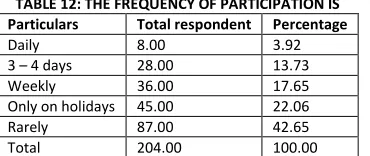
TABLE 12: THE FREQUENCY OF PARTICIPATION IS Particulars Total respondent Percentage
Daily 8.00 3.92
3 – 4 days 28.00 13.73
Weekly 36.00 17.65
Only on holidays 45.00 22.06
Rarely 87.00 42.65
Total 204.00 100.00
INFERENCE: In the research the study describes that the frequency of participation of respondents is: 4% Daily, 14% three to four days, 17% for the Weekly, 22% for only on holidays, and 43% rarely. The Major participation in the interactive ads are rarely i.e. 43%.
TABLE 13: I PARTICIPATED THROUGH
Particulars Total respondent Percentage
Call 38.00 18.63
SMS 142.00 69.61
Email 20.00 9.80
Post mail 4.00 1.96
Total 204.00 100.00
INFERENCE: In the research the respondents are participating in interactive ads as follows: 19% through phone calls, 69% through SMS, 10% through emails and 2% through post mail. Marjory the respondents participated throw SMS.
TABLE 14: I GOT RESPONSE FROM INTERACTIVE ADS Particular Total respondent Percentage
Yes 67.00 32.84
No 137.00 67.16
Total 204.00 100.00
INFERENCE: In the research it is seen that significant number of respondents do not get response from interactive ads (68%).
TABLE 15: ALONG WITH THE MESSAGE, I WOULD LIKE TO DISCLOSE Particulars Total respondent Percentage
Name 67.00 32.84
Place 27.00 13.24
Contact no. 61.00 29.90
Address 2.00 0.98
Email 26.00 12.75
All of them 21.00 10.29
Total 204.00 100.00
INFERENCE: In the table clearly describes that 33% of respondents would like to disclose their Name, 13% Place, 30% Contact numbers, 1% Address, 13% Email, 10% of all forms. From the survey conducted most of the respondents would like to disclose their name along with the message they send.
TABLE 16: THE MESSAGE THAT I OFTEN SEND ARE (a)
Birthday message Love message Opinion on famous personality
Frequenc y Percentage Frequency Percentage Frequency Percentage
Never 98 32.67 121 40.33 86 28.67
Rarely 30 10 63 21 79 26.33
Sometimes 97 32.33 78 26 98 32.67
Frequently 70 23.33 35 11.67 30 10
Very frequently 5 1.67 3 1 7 2.33
Total 300 100 300 100 300 100
INFERENCE: The survey reveals that maximum people do not send birthday message and love message and sometimes like to send message on famous personality.
TABLE 16: THE MESSAGE THAT I OFTEN SEND ARE (b)
Patriotic message Real Happiness Heartfelt feelings
Frequency Percentage Frequency Percentage Frequency Percentage
Never 105 35 101 33.67 108 36
Rarely 92 30.67 57 19 83 27.67
Sometimes 74 24.67 82 27.33 79 26.33
Frequently 23 7.67 59 19.67 23 7.67
Very frequently 6 2 1 0.33 7 2.33
Total 300 100 300 100 300 100
INFERENCE: The survey indicates very insignificant portion of listeners are very regular in sending patriotic message and seriously reluctant to share personal happiness and rarely share heartfelt feelings with others on radio.
TABLE 16: THE MESSAGE THAT I OFTEN SEND ARE (c)
Helping message Jokes Puzzles Few words about dear one
Frequency Percentage Frequency Percentage Frequency Percentage Frequency Percentage
Never 41 13.67 142 47.33 97 32.33 143 47.67
Rarely 12 4 61 20.33 100 33.33 81 27
Sometimes 189 63 56 18.67 74 24.67 32 10.67
Frequently 48 16 32 10.67 23 7.67 39 13
Very frequently 10 3.33 9 3 6 2 5 1.67
INFERENCE: Here we see, maximum people sometimes send helping message and never shared jokes and rarely participate in puzzle game and tremendously reluctant to wish on dear one’s occasions.
TABLE: 17: I PREFER INTERACTIVE ADS IN LANGUAGES
Bengali English Chittagonian (local)
Frequency Percentage Frequency Percentage Frequency Percentage
Not at all 12 4.00 18 6.00 198 66.00
Sometimes 79 26.33 236 78.67 79 26.33
Always 209 69.67 46 15.33 23 7.67
Total 300 100.00 300 100.00 300 100.00
INFERENCE: In the survey, it is very clear that Bengali should be the main mode of communication. Sometimes English is okay but surprisingly Chittagonian has been disliked by those people who are all time Chittagonian speakers.
TABLE 18: THROUGH INTERACTIVE ADS I WOULD LIKE TO TALK TO Particulars Total respondent Percentage
Actors 64.00 21.33
Doctors 57.00 19.00
Singers 93.00 31.00
Politicians 54.00 18.00
Corporate personality 5.00 1.67
Others 27.00 9.00
Total 300.00 100.00
INFERENCE: The survey report depicts that maximum people like to talk to singers followed by actors and doctors.
TABLE 19: I USUALLY PREFER TO LISTEN TO RADIO IN/AT…… Particulars Total respondent Percentage
Morning 28.00 9.33
Afternoon 22.00 7.33
Evening 24.00 8.00
Night 99.00 33.00
Anytime 127.00 42.33
Total 300.00 100.00
INFERENCE: Most of the people like to listen to radio as and when they get time and large number of them likes to listen at night.
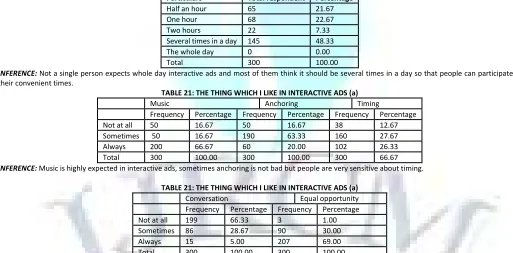
TABLE 20: IN MY OPINION THE IDEAL DURATION FOR INTERACTIVE ADS Particulars Total respondent Percentage
Half an hour 65 21.67
One hour 68 22.67
Two hours 22 7.33
Several times in a day 145 48.33
The whole day 0 0.00
Total 300 100.00
INFERENCE: Not a single person expects whole day interactive ads and most of them think it should be several times in a day so that people can participate in their convenient times.
TABLE 21: THE THING WHICH I LIKE IN INTERACTIVE ADS (a)
Music Anchoring Timing
Frequency Percentage Frequency Percentage Frequency Percentage
Not at all 50 16.67 50 16.67 38 12.67
Sometimes 50 16.67 190 63.33 160 27.67
Always 200 66.67 60 20.00 102 26.33
Total 300 100.00 300 100.00 300 66.67
INFERENCE: Music is highly expected in interactive ads, sometimes anchoring is not bad but people are very sensitive about timing.
TABLE 21: THE THING WHICH I LIKE IN INTERACTIVE ADS (a)
Conversation Equal opportunity
Frequency Percentage Frequency Percentage
Not at all 199 66.33 3 1.00
Sometimes 86 28.67 90 30.00
Always 15 5.00 207 69.00
Total 300 100.00 300 100.00
INFERENCE: Majority listeners hate conversation during interactive ads and expressed strong support for equal opportunity as far as participation is concern.
TEST OF HYPOTHESIS
Hₒ: Preference of interactive ads is not dependent on language H₁: Preference of interactive ads is dependent on language
TABLE 22
Observed (O) Expected (E) (O-E)²/E
Bengali 12 79 209 403 583.3333* 55.74876
English 18 236 46 572 583.3333 0.22019
Chittagonian 198 79 23 775 583.3333 62.97619
Total 1750 X² Cal= 118.9451
∗ =
3 =
1750
3 = 583.3333
VOLUME NO.3(2013),ISSUE NO.02(FEBRUARY) ISSN2231-5756
INTERNATIONAL JOURNAL OF RESEARCH IN COMMERCE, IT & MANAGEMENT
Hₒ is rejected.So, we can say that preference of interactive ads is dependent on language.
MAJOR RESEARCH FINDINGS
1. In the survey conducted 2% respondents are less than 10 years age, 22% belong to age group of 10-18 years, 45% belong to age group of 18-30 years, 20%
belong to age group of 30-50 years, 8% belong to age group of 50-75 years and 3% belong to age group 75 years and above. Majority of the respondents belong to the age group of 18-30 years.
2. In the survey conducted 65% are male and 35% are female. Majority of the respondents surveyed are male.
3. In the survey conducted 22% respondent’s qualification is below SSC, 10% respondents studied up to HSC, 12% are diploma holders, 30% are under
graduates, 22% are Post Graduates, 5% have done other courses. Majority of the respondents are under Graduates.
4. In the survey conducted 17% respondents belong to private service 28% of respondents are business people, 3% of respondents are Consultants, 50% of
respondents are Students and remaining 2% respondents belong to other professions like Bank sector, Teachers, Labor etc. Here, majority of the respondents are Students (152).
5. The popularity of both the channel is same. Each respondent liked both the channels.
6. In the survey conducted 53% respondents know about Interactive Ads and 47% don’t know about it. Majority of the respondents know about Interactive
Ads.
7. In the survey conducted 70% respondents likes interactive ads and 30% doesn’t like it. Majority of the respondents likes interactive ads
8. In the survey conducted 68% respondents participates in interactive ads and 32% does not. Majority of the respondents participate in the interactive ads.
9. In the research the study describes that the frequency of participation of respondents is: 4% Daily, 14% three to four days, 17% for the Weekly, 22% for
only on holidays, and 43% rarely. The Major participation in the interactive ads are rarely i.e. 43%.
10. In the research the respondents are participating in interactive ads as follows: 19% through phone calls, 69% through SMS, 10% through emails and 5%
through post mail. Marjory the respondents participated throw SMS.
11. The survey indicates very insignificant portion of listeners are very regular in sending patriotic message and seriously reluctant to share personal happiness
and rarely share heartfelt feelings with others on radio.
12. In the survey, it is very clear that Bengali should be the main mode of communication. Sometimes English is okay but surprisingly Chittagonian has been
disliked by those people who are all time Chittagonian speakers.
RECOMMENDATIONS
1. In the survey conducted significant portion of respondents are not aware of Interactive Ads so it should adopt promotional campaigns like public
advertisements in TV, Magazines news papers to create awareness among public about these ads.
2. From the survey it is found that majority of the respondents are not participating in Interactive Ads as they did not get proper response for their messages
in the past. So the programmer should respond to the listeners specially the ones who are participating by sending messages and requesting songs, so that public gets motivated to participate in the future.
3. In the survey conducted 32% of respondents did not participate in Interactive Ads as the program timing is not suitable for them. So the radio station
should arrange these Participative programs based on the conveniences of the listeners.
4. Many of the respondents prefer to listen to radio in the night. So such programs should be arranged during night at 10pm to 12am.
5. In this program ‘music is very popular. The other ways like Sending Flowers, Gifts, and Wishing etc should also be organized and popularized.
6. 93% of respondents want to talk to singers. So in such programs singers should be invited often during some special occasions like festivals, national
holidays etc, so that audience get chance to talk to them. This is one way of making Interactive Ads popular.
7. In the survey conducted, respondents prefer Interactive Ads in Bengali Language rather than English and Chittagonian.
8. Few of the respondents don’t like the way of anchoring in Interactive Ads. So the programmers should improve the anchoring style and make it attractive.
9. In Chittagong, the FM Radio Stations should give more importance on outdoor advertising to attract new listeners.
CONCLUSION
Bangladesh has huge untapped radio market and has the potential to grow as the most viable medium of advertisement over the next few years, UK media and Bangladesh media have their own respective target audience but radio is more effective as it is portable. The potential to advertise through radio is exponential. At the rate at which Bangladesh is growing, radio should command an advertising market share of 10-12 percent. Britain has more than 300 radio stations, of which almost all are going digital. We have online radio listening, listening through television and radio device. And we believe Bangladesh should learn from UK how effectively the medium can be used and also understand from the mistakes we committed. Stressing on the lessons for Bangladesh, sometimes ago Britain relied heavily on national advertising. This is something Bangladesh can follow. Stating the benefits of radio as a useful tool of advertising, Radio is a national medium with flexibilities of a local medium. Radio is unique and Bangladesh needs to understand the way people use it.
SCOPE FOR FURTHER RESEARCH
We considered FM channels based in Chittagong city only. Researchers can do the similar type of research on other important metro cities in Bangladesh to know the taste, choice and the reactions of listeners, and their interactive attitudes towards FM based ads.
REFERENCES
1. Chi, H. Hsien, “Interactive Digital Advertising vs. Virtual Brand Community: Exploratory Study of User Motivation and Social Media Marketing Responses in
Taiwan”
2. Cross, R., & Smith, J. (1997). Customer-focused strategies and tactics. In R. Brady, E. Forrest, & R. Mizerski (Eds.), Cybermarketing: Your Interactive
Marketing Consultant (pp. 55-78). Lincolnwood, IL: NTC Business Books.
3. Li, Hairong; Leckenby, John D. 2004. Internet Advertising Formats and Effectiveness. Center for Interactive Advertising.
REQUEST FOR FEEDBACK
Dear Readers
At the very outset, International Journal of Research in Commerce, IT and Management (IJRCM)
acknowledges & appreciates your efforts in showing interest in our present issue under your kind perusal.
I would like to request you to supply your critical comments and suggestions about the material published
in this issue as well as on the journal as a whole, on our E-mail i.e.
for further
improvements in the interest of research.
If you have any queries please feel free to contact us on our E-mail
.
I am sure that your feedback and deliberations would make future issues better – a result of our joint
effort.
Looking forward an appropriate consideration.
With sincere regards
Thanking you profoundly
Academically yours
Sd/-
VOLUME NO.3(2013),ISSUE NO.02(FEBRUARY) ISSN2231-5756