A Monthly Double-Blind Peer Reviewed (Refereed/Juried) Open Access International e-Journal - Included in the International Serial Directories
Indexed & Listed at:
Ulrich's Periodicals Directory ©, ProQuest, U.S.A., EBSCO Publishing, U.S.A., Cabell’s Directories of Publishing Opportunities, U.S.A., Open J-Gage, India [link of the same is duly available at Inflibnet of University Grants Commission (U.G.C.)],
VOLUME NO. 2 (2012), ISSUE NO. 12 (DECEMBER) ISSN2231-5756
INTERNATIONAL JOURNAL OF RESEARCH IN COMMERCE, IT & MANAGEMENT
CONTENTS
CONTENTS
CONTENTS
CONTENTS
Sr.No.
TITLE & NAME OF THE AUTHOR (S)
Page No.
1. EFFECTIVENESS OF PAY-FOR-PERFORMANCE AND FIXED-PAY PRACTICES: AN ASSESSMENT OF PAY SATISFACTION, COMMITMENT AND TURNOVER INTENTION
PRINCY THOMAS & DR. G. NAGALINGAPPA
1
2. ROLE OF CORPORATE GOVERNANCE ON PERFORMANCE OF PRIVATE COMMERCIAL BANKS IN BANGLADESH: AN ECONOMETRIC ANALYSIS
DR. MD NAZRUL ISLAM, MOHAMMAD MASUD ALAM & MOHAMMAD ASHRAFUL FERDOUS CHOWDHURY
6
3. IDENTIFYING OPPORTUNITIES, CHALLENGES AND INFRASTRUCTURE REQUIREMENTS FOR ESTABLISHING SECONDARY MARKETS IN ETHIOPIA
KANNAN SIMHAKUTTY ASURI & LETENAH EJIGU
12
4. A NOVEL BANKRUPTCY PREDICTION MODEL BASED ON SUPPORT VECTOR DATA DESCRIPTION METHOD
ALIREZA DEHVARI, FEZEH ZAHEDI FARD & MAHDI SALEHI
17
5. ANALYSIS OF FACTORS INFLUENCING EXPORT VOLUME: THE NIGERIAN EXPERIENCE
KAREEM, R.O, OKI A.S, RAHEEM, K.A & BASHEER, N.O
24
6. A MODEL FOR ORGANIZING, MEASURING, ANALYZING STUDENTS’ KNOWLEDGE AND PERFORMANCE
ROY MATHEW
32
7. DETERMINANTS OF CUSTOMER LOYALTY AND SUBSCRIBER CHURN OF MOBILE PHONE SERVICES IN GHANA
JACOB NUNOO & CHRISTIAN KYEREMEH
38
8. FACTORS AFFECTING CUSTOMERS’ ATTITUDE TOWARDS INFORMATION TECHNOLOGY ADOPTION IN COMMERCIAL BANKS OF ETHIOPIA: A CASE STUDY OF SELECTED BANKS IN MEKELLE CITY
ZEMENU AYNADIS
42
9. EFFECTIVE USE OF TRAINING FEEDBACK FOR REINFORCEMENT OF LEARNING AND EMPLOYEE DEVELOPMENT
AJAY KR VERMA, SUDHIR WARIER & LRK KRISHNAN
53
10. IMPACT OF DEMOGRAPHIC VARIABLES ON FACTORS OF JOB SATISFACTION OF EMPLOYEES IN PUBLIC SECTOR: AN EMPIRICAL STUDY
DR. RIZWANA ANSARI, DR. T. N. MURTY, NILOUFER QURAISHY & S A SAMEERA
62
11. SUBSCRIBERS’ ATTITUDE TOWARDS DTH SERVICES
M. J. SENTHIL KUMAR & DR. N. R. NAGARAJAN
69
12. ISSUES AND CHALLENGES INDIAN BUSINESS: VISION 2020 WITH THE REFERENCE OF MICRO, SMALL AND MEDIUM ENTERPRISES (MSMEs) IN INDIA
DR. M. L. GUPTA, DR. SHWETABH MITTAL & PRIYANKA GUPTA
73
13. ENHANCING JOB SATISFACTION OF SOFTWARE PROFESSIONALS: THE RELEVANCE OF EMOTIONAL QUOTIENT
V. ANOOPKUMAR & DR. R. GANESAN
82
14. A SURVEY ON CONSUMER ATTITUDE TO CHOOSE AND USE VARIOUS TELECOM SERVICES
V. BALAKUMAR & DR. C. SWARNALATHA
88
15. COUNTERPRODUCTIVE WORK BEHAVIOUR (CWB) AND LOCUS OF CONTROL (LOC) AMONG MANAGERS
DR. RISHIPAL & PAWAN KUMAR CHAND
94
16. CORPORATE GOVERNANCE FAILURES IN INDIA - A REVIEW
KAISETTY. BALAJI & DR. Y. VENU GOPALA RAO
98
17. SIGNIFICANCE OF INCLUSIVE GROWTH IN INDIAN ECONOMIC DEVELOPMENT – A STUDY
DR. T. C. CHANDRASHEKAR
103
18. A STUDY ON EMPLOYEE JOB PERFORMANCE (A COMPARATIVE STUDY OF SELECT PUBLIC AND PRIVATE ORGANIZATIONS)
S.FAKRUDDIN ALI AHMED & DR. G. MALYADRI
110
19. ORGANISATIONAL AND ENVIRONMENTAL DETERMINANTS OF PERFORMANCE APPRAISAL SYSTEM: A REVIEW AND FRAMEWORK FROM CONTEXTUAL PERSPECTIVE
SAPNA TANEJA, DR. RAVIKESH SRIVASTAVA & DR. N. RAVICHANDRAN
117
20. E-LEARNING INITIATIVES TO AUGMENT BUSINESS PERFORMANCE: AN EMPIRICAL STUDY OF SELECT AUTO COMPONENT FIRMS
DR. AISHA M. SHERIFF & GEETHA R
127
21. INTERPRETIVE STRUCTURAL MODELING BASED APPROACH FOR ADOPTING CPFR IN INDIAN INDUSTRIES
RAJESH A. KUBDE & DR. SATISH V. BANSOD
136
22. TECHNOLOGY TRENDS AND IMPACT OF ROBOTICS IN THE CORPORATE WORLD AT DIFFERENT LEVELS OF MANAGEMENT
P. POONGUZHALI & DR. A. CHANDRA MOHAN
141
23. PERFORMANCE APPRAISAL ACT AS A MAJOR MOTIVATIONAL SOURCE
NAILA IQBAL
147
24. FOREIGN DIRECT INVESTMENT FLOWS INTO INDIA AND THEIR CAUSAL RELATIONSHIP WITH ECONOMIC GROWTH SINCE LIBERALISATION
S. GRAHALSKSHMI & DR. M. JAYALAKSHMI
150
25. INCLUSIVE GROWTH AND REGIONAL DISPARITIES IN ANDHRA PRADESH
V. VANEENDRA NATHA SASTRY
159
26. STRATEGIES TO COPE UP WORK - PLACE STRESSORS: AN EMPIRICAL STUDY IN EDUCATIONAL INSTITUTIONS
B. LAVANYA
162
27. DETERMINANTS OF JOB SATISFACTION AMONG EMPLOYEES IN INFORMATION TECHNOLOGY INDUSTRY IN DELHI
BRAJESH KUMAR & DR. AWADHESH KUMAR
166
28. MODERN CHALLENGES TO WOMEN ENTREPRENEURSHIP DEVELOPMENT: A STUDY OF DISTRICT RAJOURI IN JAMMU AND KASHMIR STATE
AASIM MIR
169
29. INTERNATIONAL HRM CHALLENGES FOR MNC’s
B. G. VENKATESH PRASAD & N. CHETAN KUMAR
173
30. INSIDER TRADING: GOVERNANCE, ETHICAL AND REGULATORY PERSPECTIVE
NIDHI SAHORE
177
INTERNATIONAL JOURNAL OF RESEARCH IN COMMERCE, IT & MANAGEMENT
CHIEF PATRON
CHIEF PATRON
CHIEF PATRON
CHIEF PATRON
PROF. K. K. AGGARWAL
Chancellor, Lingaya’s University, Delhi
Founder Vice-Chancellor, Guru Gobind Singh Indraprastha University, Delhi
Ex. Pro Vice-Chancellor, Guru Jambheshwar University, Hisar
FOUNDER
FOUNDER
FOUNDER
FOUNDER PATRON
PATRON
PATRON
PATRON
LATE SH. RAM BHAJAN AGGARWAL
Former State Minister for Home & Tourism, Government of Haryana
Former Vice-President, Dadri Education Society, Charkhi Dadri
Former President, Chinar Syntex Ltd. (Textile Mills), Bhiwani
CO
CO
CO
CO----ORDINATOR
ORDINATOR
ORDINATOR
ORDINATOR
AMITA
Faculty, Government M. S., Mohali
ADVISORS
ADVISORS
ADVISORS
ADVISORS
DR. PRIYA RANJAN TRIVEDI
Chancellor, The Global Open University, Nagaland
PROF. M. S. SENAM RAJU
Director A. C. D., School of Management Studies, I.G.N.O.U., New Delhi
PROF. M. N. SHARMA
Chairman, M.B.A., Haryana College of Technology & Management, Kaithal
PROF. S. L. MAHANDRU
Principal (Retd.), Maharaja Agrasen College, Jagadhri
EDITOR
EDITOR
EDITOR
EDITOR
PROF. R. K. SHARMA
Professor, Bharti Vidyapeeth University Institute of Management & Research, New Delhi
CO
CO
CO
CO----EDITOR
EDITOR
EDITOR
EDITOR
DR. BHAVET
Faculty, M. M. Institute of Management, Maharishi Markandeshwar University, Mullana, Ambala, Haryana
EDITORIAL ADVISORY BOARD
EDITORIAL ADVISORY BOARD
EDITORIAL ADVISORY BOARD
EDITORIAL ADVISORY BOARD
DR. RAJESH MODI
Faculty, Yanbu Industrial College, Kingdom of Saudi Arabia
PROF. SANJIV MITTAL
University School of Management Studies, Guru Gobind Singh I. P. University, Delhi
PROF. ANIL K. SAINI
Chairperson (CRC), Guru Gobind Singh I. P. University, Delhi
DR. SAMBHAVNA
VOLUME NO. 2 (2012), ISSUE NO. 12 (DECEMBER) ISSN2231-5756
INTERNATIONAL JOURNAL OF RESEARCH IN COMMERCE, IT & MANAGEMENT
DR. MOHENDER KUMAR GUPTA
Associate Professor, P. J. L. N. Government College, Faridabad
DR. SHIVAKUMAR DEENE
Asst. Professor, Dept. of Commerce, School of Business Studies, Central University of Karnataka, Gulbarga
ASSOCIATE EDITORS
ASSOCIATE EDITORS
ASSOCIATE EDITORS
ASSOCIATE EDITORS
PROF. NAWAB ALI KHAN
Department of Commerce, Aligarh Muslim University, Aligarh, U.P.
PROF. ABHAY BANSAL
Head, Department of Information Technology, Amity School of Engineering & Technology, Amity
University, Noida
PROF. A. SURYANARAYANA
Department of Business Management, Osmania University, Hyderabad
DR. SAMBHAV GARG
Faculty, M. M. Institute of Management, Maharishi Markandeshwar University, Mullana, Ambala, Haryana
PROF. V. SELVAM
SSL, VIT University, Vellore
DR. PARDEEP AHLAWAT
Associate Professor, Institute of Management Studies & Research, Maharshi Dayanand University, Rohtak
DR. S. TABASSUM SULTANA
Associate Professor, Department of Business Management, Matrusri Institute of P.G. Studies, Hyderabad
SURJEET SINGH
Asst. Professor, Department of Computer Science, G. M. N. (P.G.) College, Ambala Cantt.
TECHNICAL ADVISOR
TECHNICAL ADVISOR
TECHNICAL ADVISOR
TECHNICAL ADVISOR
AMITA
Faculty, Government M. S., Mohali
FINANCIAL ADVISORS
FINANCIAL ADVISORS
FINANCIAL ADVISORS
FINANCIAL ADVISORS
DICKIN GOYAL
Advocate & Tax Adviser, Panchkula
NEENA
Investment Consultant, Chambaghat, Solan, Himachal Pradesh
LEGAL ADVISORS
LEGAL ADVISORS
LEGAL ADVISORS
LEGAL ADVISORS
JITENDER S. CHAHAL
Advocate, Punjab & Haryana High Court, Chandigarh U.T.
CHANDER BHUSHAN SHARMA
Advocate & Consultant, District Courts, Yamunanagar at Jagadhri
SUPERINTENDENT
SUPERINTENDENT
SUPERINTENDENT
SUPERINTENDENT
SURENDER KUMAR POONIA
INTERNATIONAL JOURNAL OF RESEARCH IN COMMERCE, IT & MANAGEMENT
CALL FOR MANUSCRIPTS
CALL FOR MANUSCRIPTS
CALL FOR MANUSCRIPTS
CALL FOR MANUSCRIPTS
Weinvite unpublished novel, original, empirical and high quality research work pertaining to recent developments & practices in the area of Computer, Business, Finance, Marketing, Human Resource Management, General Management, Banking, Insurance, Corporate Governance and emerging paradigms in allied subjects like Accounting Education; Accounting Information Systems; Accounting Theory & Practice; Auditing; Behavioral Accounting; Behavioral Economics; Corporate Finance; Cost Accounting; Econometrics; Economic Development; Economic History; Financial Institutions & Markets; Financial Services; Fiscal Policy; Government & Non Profit Accounting; Industrial Organization; International Economics & Trade; International Finance; Macro Economics; Micro Economics; Monetary Policy; Portfolio & Security Analysis; Public Policy Economics; Real Estate; Regional Economics; Tax Accounting; Advertising & Promotion Management; Business Education; Management Information Systems (MIS); Business Law, Public Responsibility & Ethics; Communication; Direct Marketing; E-Commerce; Global Business; Health Care Administration; Labor Relations & Human Resource Management; Marketing Research; Marketing Theory & Applications; Non-Profit Organizations; Office Administration/Management; Operations Research/Statistics; Organizational Behavior & Theory; Organizational Development; Production/Operations; Public Administration; Purchasing/Materials Management; Retailing; Sales/Selling; Services; Small Business Entrepreneurship; Strategic Management Policy; Technology/Innovation; Tourism, Hospitality & Leisure; Transportation/Physical Distribution; Algorithms; Artificial Intelligence; Compilers & Translation; Computer Aided Design (CAD); Computer Aided Manufacturing; Computer Graphics; Computer Organization & Architecture; Database Structures & Systems; Digital Logic; Discrete Structures; Internet; Management Information Systems; Modeling & Simulation; Multimedia; Neural Systems/Neural Networks; Numerical Analysis/Scientific Computing; Object Oriented Programming; Operating Systems; Programming Languages; Robotics; Symbolic & Formal Logic and Web Design. The above mentioned tracks are only indicative, and not exhaustive.
Anybody can submit the soft copy of his/her manuscript anytime in M.S. Word format after preparing the same as per our submission guidelines duly available on our website under the heading guidelines for submission, at the email address: [email protected].
GUIDELINES FOR SUBM
GUIDELINES FOR SUBM
GUIDELINES FOR SUBM
GUIDELINES FOR SUBMISSION OF MANUSCRIPT
ISSION OF MANUSCRIPT
ISSION OF MANUSCRIPT
ISSION OF MANUSCRIPT
1. COVERING LETTER FOR SUBMISSION:
DATED: _____________
THE EDITOR
IJRCM
Subject: SUBMISSION OF MANUSCRIPT IN THE AREA OF .
(e.g. Finance/Marketing/HRM/General Management/Economics/Psychology/Law/Computer/IT/Engineering/Mathematics/other, please specify)
DEAR SIR/MADAM
Please find my submission of manuscript entitled ‘___________________________________________’ for possible publication in your journals.
I hereby affirm that the contents of this manuscript are original. Furthermore, it has neither been published elsewhere in any language fully or partly, nor is it under review for publication elsewhere.
I affirm that all the author (s) have seen and agreed to the submitted version of the manuscript and their inclusion of name (s) as co-author (s).
Also, if my/our manuscript is accepted, I/We agree to comply with the formalities as given on the website of the journal & you are free to publish our contribution in any of your journals.
NAME OF CORRESPONDING AUTHOR: Designation:
Affiliation with full address, contact numbers & Pin Code: Residential address with Pin Code:
Mobile Number (s): Landline Number (s): E-mail Address: Alternate E-mail Address:
NOTES:
a) The whole manuscript is required to be in ONE MS WORD FILE only (pdf. version is liable to be rejected without any consideration), which will start from the covering letter, inside the manuscript.
b) The sender is required to mention the following in the SUBJECT COLUMN of the mail:
New Manuscript for Review in the area of (Finance/Marketing/HRM/General Management/Economics/Psychology/Law/Computer/IT/ Engineering/Mathematics/other, please specify)
c) There is no need to give any text in the body of mail, except the cases where the author wishes to give any specific message w.r.t. to the manuscript. d) The total size of the file containing the manuscript is required to be below 500 KB.
e) Abstract alone will not be considered for review, and the author is required to submit the complete manuscript in the first instance.
f) The journal gives acknowledgement w.r.t. the receipt of every email and in case of non-receipt of acknowledgment from the journal, w.r.t. the submission of manuscript, within two days of submission, the corresponding author is required to demand for the same by sending separate mail to the journal.
2. MANUSCRIPT TITLE: The title of the paper should be in a 12 point Calibri Font. It should be bold typed, centered and fully capitalised.
3. AUTHOR NAME (S) & AFFILIATIONS: The author (s) full name, designation, affiliation (s), address, mobile/landline numbers, and email/alternate email address should be in italic & 11-point Calibri Font. It must be centered underneath the title.
4. ABSTRACT: Abstract should be in fully italicized text, not exceeding 250 words. The abstract must be informative and explain the background, aims, methods,
VOLUME NO. 2 (2012), ISSUE NO. 12 (DECEMBER) ISSN2231-5756
INTERNATIONAL JOURNAL OF RESEARCH IN COMMERCE, IT & MANAGEMENT
5. KEYWORDS: Abstract must be followed by a list of keywords, subject to the maximum of five. These should be arranged in alphabetic order separated by commas and full stops at the end.
6. MANUSCRIPT: Manuscript must be in BRITISH ENGLISH prepared on a standard A4 size PORTRAIT SETTING PAPER. It must be prepared on a single space and
single column with 1” margin set for top, bottom, left and right. It should be typed in 8 point Calibri Font with page numbers at the bottom and centre of every page. It should be free from grammatical, spelling and punctuation errors and must be thoroughly edited.
7. HEADINGS: All the headings should be in a 10 point Calibri Font. These must be bold-faced, aligned left and fully capitalised. Leave a blank line before each
heading.
8. SUB-HEADINGS: All the sub-headings should be in a 8 point Calibri Font. These must be bold-faced, aligned left and fully capitalised.
9. MAIN TEXT: The main text should follow the following sequence:
INTRODUCTION
REVIEW OF LITERATURE
NEED/IMPORTANCE OF THE STUDY
STATEMENT OF THE PROBLEM
OBJECTIVES
HYPOTHESES
RESEARCH METHODOLOGY
RESULTS & DISCUSSION
FINDINGS
RECOMMENDATIONS/SUGGESTIONS
CONCLUSIONS
SCOPE FOR FURTHER RESEARCH
ACKNOWLEDGMENTS
REFERENCES
APPENDIX/ANNEXURE
It should be in a 8 point Calibri Font, single spaced and justified. The manuscript should preferably not exceed 5000 WORDS.
10. FIGURES & TABLES: These should be simple, crystal clear, centered, separately numbered & self explained, and titles must be above the table/figure. Sources
of data should be mentioned below the table/figure. It should be ensured that the tables/figures are referred to from the main text.
11. EQUATIONS: These should be consecutively numbered in parentheses, horizontally centered with equation number placed at the right.
12. REFERENCES: The list of all references should be alphabetically arranged. The author (s) should mention only the actually utilised references in the preparation
of manuscript and they are supposed to follow Harvard Style of Referencing. The author (s) are supposed to follow the references as per the following:
•
All works cited in the text (including sources for tables and figures) should be listed alphabetically.•
Use (ed.) for one editor, and (ed.s) for multiple editors.•
When listing two or more works by one author, use --- (20xx), such as after Kohl (1997), use --- (2001), etc, in chronologically ascending order.•
Indicate (opening and closing) page numbers for articles in journals and for chapters in books.•
The title of books and journals should be in italics. Double quotation marks are used for titles of journal articles, book chapters, dissertations, reports, working papers, unpublished material, etc.•
For titles in a language other than English, provide an English translation in parentheses.•
The location of endnotes within the text should be indicated by superscript numbers.PLEASE USE THE FOLLOWING FOR STYLE AND PUNCTUATION IN REFERENCES: BOOKS
•
Bowersox, Donald J., Closs, David J., (1996), "Logistical Management." Tata McGraw, Hill, New Delhi.•
Hunker, H.L. and A.J. Wright (1963), "Factors of Industrial Location in Ohio" Ohio State University, Nigeria. CONTRIBUTIONS TO BOOKS•
Sharma T., Kwatra, G. (2008) Effectiveness of Social Advertising: A Study of Selected Campaigns, Corporate Social Responsibility, Edited by David Crowther & Nicholas Capaldi, Ashgate Research Companion to Corporate Social Responsibility, Chapter 15, pp 287-303.JOURNAL AND OTHER ARTICLES
•
Schemenner, R.W., Huber, J.C. and Cook, R.L. (1987), "Geographic Differences and the Location of New Manufacturing Facilities," Journal of Urban Economics, Vol. 21, No. 1, pp. 83-104.CONFERENCE PAPERS
•
Garg, Sambhav (2011): "Business Ethics" Paper presented at the Annual International Conference for the All India Management Association, New Delhi, India, 19–22 June.UNPUBLISHED DISSERTATIONS AND THESES
•
Kumar S. (2011): "Customer Value: A Comparative Study of Rural and Urban Customers," Thesis, Kurukshetra University, Kurukshetra. ONLINE RESOURCES•
Always indicate the date that the source was accessed, as online resources are frequently updated or removed. WEBSITESINTERNATIONAL JOURNAL OF RESEARCH IN COMMERCE, IT & MANAGEMENT
A STUDY ON EMPLOYEE JOB PERFORMANCE
(A COMPARATIVE STUDY OF SELECT PUBLIC AND PRIVATE ORGANIZATIONS)
S.FAKRUDDIN ALI AHMED
ASSOCIATE PROFESSOR
DEPARTMENT OF MBA
NARAYANA ENGINEERING COLLEGE
GUDUR
DR. G. MALYADRI
PROFESSOR
DEPARTMENT OF MBA
SRINIVASA INSTITUTE OF TECHNOLOGY & MANAGEMENT STUDIES
CHITTOOR
ABSTRACT
Managing human resources in today’s dynamic environment is becoming more and more complex as well as important. Recognition of people is a valuable resource in the organization has led to increases trends in employee performance and job security. Performance Appraisal is the important aspect in the organization to evaluate the employee’s performance. It helps in understanding the employees work culture, involvement, and satisfaction. It helps the organization in deciding employee’s promotion, transfer, incentives, and pay revision. A performance appraisal is an evaluation about Organizational actions and provides feed back to Employees with an eye on improving future performance. Effective performance appraisal system contains two basic systems operating in conjunction i.e Evaluation system and Feedback system. Then reason for having a system of performance appraisal to establish and uphold the principle of accountability. The chief causes or organization failures are “non-alignment of responsibility and accountability”. In the severely non-aligned system no one is accountable for anything. In this event the principle of accountability breaks down completely. Hence organizational failure is the only possible outcome. In the above context the researcher has selected one public sector organization and one private sector organization, The main objective of the study to evaluate the performance Appraisal System practices in select Public and Private sector organizations. To collect the data for the purpose of the study, a sample of 150 (one hundred fifty) respondents from each company has been chosen totaling to 300 respondents. Questionnaires were administered to those respondents. Respondents were chosen using Stratified Random sampling technique. However, only 206 questionnaires were found to be with complete information and valid for the study. The overall response rate was 67%. This sample is deemed reasonable because often studies in conflict are based on small samples.
KEYWORDS
performance appraisal, employee commitment, retention, , career development, Team work, Employee engagement.
1. INTRODUCTION
uman Resources Development (HRD) means enhancing the capabilities of human beings by allowing them to undergo learning experiences. Thus, human resource development programs are learning situations that result in enhanced capabilities for people who undergo them.
Human resource development in the organizational context is a process by which the employees of an organization are helped in a continuous planned way to acquire or sharpen capabilities required to perform various functions associated with their present or expected future roles; develop their general capabilities as individuals and discover and exploit their own inner potentials for their own organizational development purposes; and develop an organizational culture in which supervisor – subordinate relationships, team work, employee commitment, employee engagement and collaboration among sub units are strong contribute to the professional well being, motivation, and pride of employees Rao (1985)1 The emphasis of this definition is, first, on the organizational role of employees, but is not limited to it. The individual’s inner urges, genius and potential are emphasized as worth developing not just for organizational culture. So is the emphasis of team work, which is particularly relevant in the context of the Indian experience, where the absence of team spirit is far too often the bane of our organizations.
Abraham (1988)2 has defined HRD as activities and processes undertaking to promote the intellectual, moral, psychological, social and economic development of
the individual so as to help him achieve his highest human potential as a resource for the community. In other words, it means an all-round development of the person so that he can contribute his best to the community and the nation. HRD can be defined as a set of systematic and planned activities designed by an organization to provide its members with opportunities to learn necessary skills to meet current and future job demands Randy, Jon & David,( 2002)3.
According to Lex Dilworth (2003)4 HRD is the creative design and co – mingling of strategies, structures, systems technologies and human beings in a ways that promote both individual as well as organizational learning and builds as well as sustains organizational effectiveness.
2. REVIEW OF LITERATURE
Performance appraisal is an essential and inescapable managerial activity. Appraisal is necessary for all important decisions relating to people, such as placement and promotion, remuneration and reward, training and development as well as long term manpower planning and organizational development Basu(1985)5 Performance appraisal is probably one o the oldest yet most imperfect managerial activity it has been the subject of an abundance of research and literature over the past few decades and has been described by (Fletcher and Williams-(1985)6 as one of the great growth industries of the sixties and the seventies. Yet as banks and Murphy(1985)7 observe, despite advances in appraisal technology, effective performance appraisal in organizations continues to be a compelling but unrealized goal. Once a talented individual is brought into an organization, another function of HRM comes into play –creating an environment that will motive and reward exemplary performance. One way to assess performance is through a formal review on a periodic basis, generally, known as performance appraisal or performance evaluation. Because line managers are in daily contact with the employees and can beat measure performance, they are usually the ones who conduct the appraisals. Other evaluators of the employee’s performance can include subordinates, peers, group and self or a combination of one or more (Mondy and Noe, 1996)8
Just as there can be different performance evaluators, depending on the Job, several appraisal systems can be used. some of the popular appraisal methods including 1)Ranking of all employees in a group; 2) using rating scales to define above average, and below average performance,3) recording favorable and unfavorable performance, Known as critical incidents; and 4) managing by objectives, or MBO.
Martha et.al (2002)9 studies that the impact of various types of training and their impact on performance appraisal satisfaction. In This study a sample instrument was used to estimate the significance of training methods on performance appraisal satisfaction and it was conducted for 635 business professionals. In order to analyze the relationship between the dependent variable and normal curve a profit analysis and descriptive statistics were used. The results of the study states that a negative coefficient implies that including this independent variable reduces the probability that an employee is unsatisfied. And the largest
VOLUME NO. 2 (2012), ISSUE NO. 12 (DECEMBER) ISSN2231-5756
INTERNATIONAL JOURNAL OF RESEARCH IN COMMERCE, IT & MANAGEMENT
impact on employee satisfaction from a training variable is found for the support for continuing education. And the authors suggest that the training programs do influence the employee satisfaction.Compton.R (2005)10 studied whether Performance management process have to provide more effective strategic tool in HRD repertoire. The study was undertaken from 3 universities with 992 respondents, for this study performance management technique like rating scales, behaviorally anchored rating scales were used. The result of the study confirms with that substantial changes have been made with respect to use, nature of performance management system. And also suggest that the use of performance management systems remain problematic although there are some positive indications.
Stein(2006)11 indicated that there should be a central control over performance appraisal System in the fire service relates to the fact that supervisors must not
deliver negative information which has an impact on the working relationship between the company officers and the employees.
Monaharn T.R. et al. (2009)12Study tried to set a target values, identifying week factors and determine the bench factors of underperforming employees. This study also aimed to rank employee based on the performance data envelopment analysis. This attempt to frame the recommendations and suggestions to the management. For the purpose of the study manufacturing unit has chosen as sample the employee respondents were 23. For this study a serious of statistical tools were used they are like quantitative data analytical tools along with series of regression analysis are used. The results of the study are rank the employees in terms of their performance, set targets for inefficient employees to become efficient, and find the short falls and surpluses in inputs for employees. And the authors suggested opined that periodic appraisals and support continuous improvement in status of the employees.
Vasset (2010)13 et.al to examine the fairness in organizations in more detail, the authors undertook a study of municipal health service employees perceptions of justice in relation to Pas. In this research two types of measures are associated with procedural justice. One concerns the PA process, the other concerns Feedback, which is more likely to be accepted when the requirements of procedural justices have been fulfilled. The data were collected through survey forms were sent to a representative sample of nurses and auxiliary nurses from 25 of the 430 municipalities in Norway. Participants' responses were measured using validated scales, and reliability was measured using Cronbach's (1951) formula. The study found that the most important element In employees' perceptions of procedural justice in PAs is their own ability to contribute. The study indicates that some respondents perceive the PA process as unfair. They noted, for example, that the same PA processes were used for different employees, that there were different degrees of PA training and experience, and follow-up conversations rarely took place. Respondents indicated that it is normal practice to have constructive discussions during PAs.
Performance appraisal is an essential and inescapable managerial activity. Appraisal is necessary for all important decisions relating to people, such as placement and promotion, remuneration and reward, training and development, as well as long- term manpower planning and organizational development. Performance appraisal is probably one of the oldest yet most imperfect managerial activities. It has been the subject of an abundance of research and literature over the past few decades and has been described by Flecher as one of the great growth industries of the sixties and seventies. In Indian organizations, concern with managerial appraisal has been quite high. In recent years, several experiments and innovations have been attempted and more and more organizations have found it necessary to confront these issues in their formal appraisal system.
3. NEED FOR THE STUDY
Performance appraisal is a method of evaluating the behaviors of employees in the works pot, normally including both the quantitative and qualitative aspects of job performance. Performance appraisal is the systematic description of an employee’s job-relevant strengths and weakness. The basic purpose is to find out how well the employee is performing the job and establish a plan to improvement. Provide information about the performance ranks. Decisions regarding salary fixation, confirmation, promotion, transfer are taken based on performance
4. OBJECTIVES OF THE STUDY
1. To evaluate the performance Appraisal System practices in select Public and Private sector organizations. 2. To review the performance appraisal of employees
3. To provide feedback of employees regarding their performance
5. HYPOTHESES
The following hypotheses are set to be tested in this study
Public and private sector enterprises do not differ in their Performance Appraisal practices as reported by their employees.
6. RESEARCH METHODOLOGY
To collect the data for the purpose of the study, a sample of 150 (one hundred fifty) respondents from each company has been chosen totaling to 300 respondents. Questionnaires were administered to those respondents. Respondents were chosen using Stratified Random sampling technique. Of the total 300 respondents 236 respondents returned filled questionnaires in the initial stage. Later on a reminder had been sent to those respondents who did not return their questionnaires. In second stage, 35 respondents replied. Finally, a final reminder had been sent to non respondents. But, all the efforts gone in vain. In all, 271 respondents submitted their filled in questionnaires. However, only 206 questionnaires were found to be with complete information and valid for the study. The overall response rate was 67%. This sample is deemed reasonable because often studies in conflict are based on small samples.
6.1 MEASURES (STANDARDIZED SCALES) &TOOLS FOR ANALYSIS OF DATA
Questionnaire consist eight major sections relating to the measurement of HRD practices like, performance appraisal. There are various instruments existing for the measurement of HRD practices, however, almost all of them were exclusively developed for the industrial employees. Instead of relying on existing questionnaires, for this study a unique structured questionnaire was designed. The scale items were measured using Five point Scale (5 = Strongly Agree and 1 = Strongly Disagree). The collected data was analyzed with appropriate statistical tools and techniques such as percentage method, Mean and Standard Deviation, Inter Item correlation and Regression analysis, Chi-square analysis was used for the analysis of the study.
6.2 PROFILE OF THE RESPONDENTS OF BOTH PUBLIC AND PRIVATE COMPANIES
In this chapter, an attempt has been made to present the profile of the respondents of two companies selected in this study i.e. Public Sector and Private Sector Enterprises. Various personal characteristics of the respondents across these two companies have been presented in the following tables such as Age, Qualification, Department wise Employees, Total years of working, years of work experience in the present organization, present no of years of work experience in the present job.
6.2.1 DEMOGRAPHIC PROFILE OF GENDER RESPONDENTS
INTERNATIONAL JOURNAL OF RESEARCH IN COMMERCE, IT & MANAGEMENT
6.2.2 ENTERPRISE WISE GENDER CLASSIFICATIONTABLE 6.2.2: COMPANY WISE GENDER CLASSIFICATION OF RESPONDENTS Gender Vs. Company Company Total
Public sector undertaking Private sector undertaking
Gender Male 90 80 170
43.7% 38.8% 82.5%
Female 15 21 36
7.3% 10.2% 17.5%
Total 105 101 206
51.0% 49.0% 100.0%
From the above table 3.2 presents the summary of the total respondents with Gender wise categorization in the public and private sector undertakings i.e. consist of BHEL and VIJAI Electricals. The data shows that in case of BHEL male respondents consist of 43.7 percent are male and 7.3 percent of female respondents. While in case of VIJAI Electricals 38.8(percent) male respondents and 10.2(percent) of female respondents respectively. In other words majority of the male respondents from both the companies comprise male amounting to 2/3 of respondents while one third female respondents.
6.3 DATA ANALYSIS AND INTERPRETATION
In the present context, an attempt is been made to what extent the existing performance appraisal system is effectively and how it can be appraises. The various variables cross tabulated and presented are advanced succession planning, effective utilization of performance appraisal, report assessment, performance standards, promotion, wage increase, key skills increase, employee efficiency, identification of training needs, Further it was hypothesized that “public and private sector enterprises do not differ in their performance appraisal system practices as reported by their employees.” For this chi square test was conducted on them. Results pertaining to the testing of these hypotheses are presented at the end of section.
TABLE 6.3.1: PERFORMANCE APPRAISAL IS EFFECTIVELY CONDUCTED BY OUR ORGANIZATION S No Type of company Performance Appraisal is effectively conducted
by our organization
Total%
Strongly disagree Somewhat disagree Neutral Somewhat agree Strongly agree
1 Public sector 20 16 27 35 7 105
19.0% 15.2% 25.7% 33.3% 6.7% 100.0%
2 Private sector 0 1 38 26 36 101
0% 1.0% 37.6% 25.7% 35.6% 100.0%
Total 20 17 65 61 43 206
9.7% 8.3% 31.6% 29.6% 20.9% 100.0% Source: Compiled from primary data records
Pearson Chi-Square 55.926, df=2, P< 0.05, Mean =3.44, Std Deviation =1.191.
From the present table it is clear that majority of the respondents i.e. (35.6 percent) from the private sector company strongly agree that the performance appraisal is effectively conducted.The calculated chi –square test value presented is more than the table value which indicates that the association between the attributes is statistically significant. Hence the null hypotheses is not accepted, further it indicates that the private sector undertaking has better implementation of performance appraisal system as compared with public sector undertaking.
6.3.2 PERFORMANCE APPRAISAL ASSESSMENT
Most companies have a formal Performance appraisal system in which employee job performance is rated on a regular basis, usually once a year. A good Performance appraisal system can greatly benefit an organization. It helps direct employee behavior toward organizational goals by letting employees know what is expected of them, and it yields information for making employment decisions, such as those regarding pay raises, promotions, and discharges. Performance Standards indicate the level of performance an employee is expected to achieve. Such standards should be clearly defined so that employees know exactly what the company expects them.
TABLE 6.3.2 PERFORMANCE APPRAISAL REPORTS IN OUR ORGANIZATION ARE BASED ON OBJECTIVE ASSESSMENT AND ADEQUATE INFORMATION S No Type of company Performance Appraisal reports in our Organization are based on objective assessment and adequate information Total
Strongly disagree Somewhat disagree Neutral Somewhat agree Strongly agree
1 Public sector 15 18 28 38 6 105
14.3% 17.1% 26.7% 36.2% 5.7% 100.0%
2 Private sector 0 6 13 42 40 101
.0% 5.9% 12.9% 41.6% 39.6% 100.0%
Total 15 24 41 80 46 206
7.3% 11.7% 19.9% 38.8% 22.3% 100.0%
Source: Compiled from primary data records. Pearson Chi-Square=51.760 df =3 P <0.05, Mean 3.57: Std Deviation 1.170
From the present table it is evident that majority of the respondents i.e. (39.6 percent) from private sector company are strongly agree with performance appraisal reports in our origination are based on objective assessment and adequate information and some more major part of the respondents are somewhat agree with the performance appraisal reports in our organization are based on objective assessment and adequate information it represents that the private sector r company respondents are strongly agree with the statement.
Interestingly, the calculated Chi –square value presented is mores the table value therefore the association between the two attributes is statistically significant. Hence the null hypothesis is not accepted.
6.3.3 PERFORMANCE STANDARDS
VOLUME NO. 2 (2012), ISSUE NO. 12 (DECEMBER) ISSN2231-5756
INTERNATIONAL JOURNAL OF RESEARCH IN COMMERCE, IT & MANAGEMENT
TABLE 6.3.3: PERFORMANCE STANDARDS ARE SET AT THE BEGINNING OF THE REVIEW PERIOD AND KNOWN TO THE EMPLOYEES No Type of company Performance Standards are set at the beginning of the review period and known to the employee Total Strongly disagree Somewhat disagree Neutral Somewhat agree Strongly agree
1 Public sector 6 9 26 51 13 105
5.7% 8.6% 24.8% 48.6% 12.4% 100.0%
2 Private sector 13 0 0 32 56 101
12.9% .0% .0% 31.7% 55.4% 100.0%
Total 19 9 26 83 69 206
9.2% 4.4% 12.6% 40.3% 33.5% 100.0% Source: Compiled from primary data records
Pearson Chi-Square: 68.674 df=2, P< 0.05, Mean= 3.84, Std deviation=1.204
In the present table, it is clear that the large majority 56 percent of the respondents from the private sector company agree that performance standards are set at the beginning of the review period and known to the employee.Hence the calculated Chi -square test value presented is greater than the table value which indicates that the association between the two variable is statistically significant. Hence the null hypothesis is not accepted. In other words, the respondents form both companies agree with the statement.
6.3.4 APPRAISAL RATING AND THE CORRESPONDING MONETARY REWARD
Performance evaluation is one of the most central human resources practices in organizations due to is critical linkages with selection, compensation, training g and other employment practices. Efforts to understand performance ratings have tended to focus n either instrumentation issues, and the corresponding monetary rewards, the improvement of rating scales, which embedded the evaluation process with in the interactions that occur between superiors and subordinates.
In this contest the mangers been asked whether the extent of closeness between formal appraisal rating and the corresponding monetary reward is very good. Therefore it was decided to know whether there is need to improve the closeness between the appraisal rating and corresponding monetary reward in the companies selected for the study. Thus, the data collected in this regard are cross tabulated and the results are presented in the table.
TABLE 6.3.4: IN MY OPINION THAT THE EXTENT OF CLOSENESS BETWEEN FORMAL APPRAISAL RATING AND THE CORRESPONDING MONETARY REWARD IS VERY GOOD
S No
Type of company
In my opinion that the extent of closeness between formal Appraisal rating and the corresponding Monetary reward is very good
Total
Strongly disagree Somewhat disagree Neutral Somewhat agree Strongly agree
1 Public sector 14 15 24 40 12 105
13.3% 14.3% 22.9% 38.1% 11.4% 100.0%
2 Private sector 0 20 12 38 31 101
.0% 19.8% 11.9% 37.6% 30.7% 100.0%
Total 14 35 36 78 43 206
6.8% 17.0% 17.5% 37.9% 20.9% 100.0%
Source: Compiled from primary data records Pearson Chi-Square=27.093, df =1 P<0.05, Mean= 3.49, Std Deviation=1.192
The calculated chi square test value presented is greater than the table value which indicates that the association between the two variables is statistically significant, in other words the null hypothesis is not accepted. In other words, the responses from both the companies supports that the closeness between formal appraisal rating and the corresponding monetary reward is very good.
6.3.5 PERFORMANCE APPRAISAL SYSTEM HELPS IN GENERATING DATA FOR KEY SKILLS
In every company, the performance appraisal system is adopted to suit the purpose and need of the employee growth and development through training, self and management development programs, to guide to job changes with the help of continuous ranking. It is also used in the areas related to key skills like compensation, human resource planning, and internal employee administration. Competent appraisal of individual performance in an organization or company serves to improve the overall effectiveness of the entity. The informative function is fulfilled when the appraisal system supplies data to managers and appraises about individual strengths and weaknesses. Therefore it was decided to know whether the present appraisal system helps in generating data for key skills is the best in the companies selected for this study. Thus the data collected in this regard are cross tabulated and the results are presented in the table.
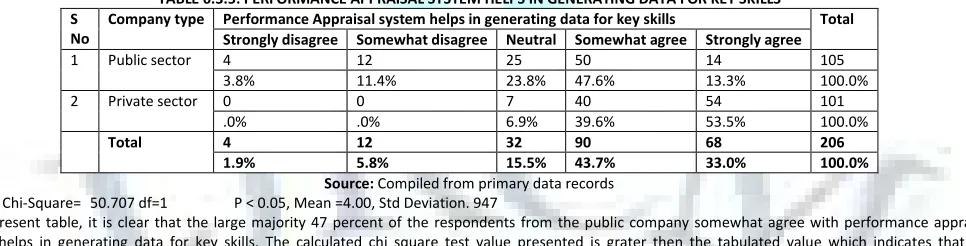
TABLE 6.3.5: PERFORMANCE APPRAISAL SYSTEM HELPS IN GENERATING DATA FOR KEY SKILLS S
No
Company type Performance Appraisal system helps in generating data for key skills Total Strongly disagree Somewhat disagree Neutral Somewhat agree Strongly agree
1 Public sector 4 12 25 50 14 105
3.8% 11.4% 23.8% 47.6% 13.3% 100.0%
2 Private sector 0 0 7 40 54 101
.0% .0% 6.9% 39.6% 53.5% 100.0%
Total 4 12 32 90 68 206
1.9% 5.8% 15.5% 43.7% 33.0% 100.0% Source: Compiled from primary data records
Pearson Chi-Square= 50.707 df=1 P < 0.05, Mean =4.00, Std Deviation. 947
In the present table, it is clear that the large majority 47 percent of the respondents from the public company somewhat agree with performance appraisal system helps in generating data for key skills. The calculated chi square test value presented is grater then the tabulated value which indicates that the association between the two variables is statistically significant. On the other words the null hypothesis is not accepted.
6.3.6 PERFORMANCE APPRAISAL SYSTEM HELPS IN IDENTIFYING EMPLOYEE EFFICIENCY
INTERNATIONAL JOURNAL OF RESEARCH IN COMMERCE, IT & MANAGEMENT
TABLE 6.3.6: PERFORMANCE APPRAISAL SYSTEM HELPS IN IDENTIFYING EMPLOYEE EFFICIENCYS No Type of company Performance Appraisal system helps in identifying employee efficiency Total Strongly disagree Somewhat disagree Neutral Some what agree Strongly agree
1 Public sector 6 10 30 37 22 105
5.7% 9.5% 28.6% 35.2% 21.0% 100.0%
2 Private sector 0 0 14 21 66 101
.0% .0% 13.9% 20.8% 65.3% 100.0%
Total 6 10 44 58 88 206
2.9% 4.9% 21.4% 28.2% 42.7% 100.0% Source: Compiled from primary data records
Pearson Chi-Square= 48.172,df=2 P<0.05,Mean 4.03,Std Deviation1.050.
The calculated chi-square value presented is greater than the table value and also supports that the association between both the variables is statistically significant. Hence the null hypothesis is not accepted. In other words, the effectiveness of appraisal system depends on the standardized techniques or methods adopted by the type of company.
6.3.7 ASSESSMENT OF TRAINING NEEDS THROUGH PERFORMANCE APPRAISAL
Performance appraisal can significantly help in identifying the training needs of the employees. Performance appraisal helps to revel the differences and discrepancies in the desired and the actual performance of the employees. The causes of the discrepancies are also found whether they are due to lack of adequate training or not. The employee can also tell about his training requirement in his self appraisal. A performance appraisal after the training program can also help in judging the effectiveness of the program. Training needs analysis is the systematic method of determining if a training need exists and if it does, what training is required to fill the gap between standard and the actual performance of the employee. This evaluation suggests and results in improvement identifying the training needs. Therefore, it is decided to know whether there is appraisal contains the information for career planning of executives in the selected companies for this study. Thus the data collected in this regard are cross tabulated and the results presented in the table.
TABLE 6.3.7: PERFORMANCE APPRAISAL SYSTEMS HELP IN IDENTIFYING THE TRAINING NEEDS
S No. Company Type Performance Appraisal system help in identifying the Training needs Total Strongly disagree Somewhat disagree Neutral Somewhat agree Strongly agree
1 Public sector 7 2 31 40 25 105
6.7% 1.9% 29.5% 38.1% 23.8% 100.0%
2 Private sector 0 0 1 39 61 101
.0% .0% 1.0% 38.6% 60.4% 100.0%
Total 7 2 32 79 86 206
3.4% 1.0% 15.5% 38.3% 41.7% 100.0% Source: Compiled from primary data records
Pearson Chi-Square= 52.149 df =1 P<0.05
From the present table it is evident that the majority of the respondents 60 percent from the private sector undertaking are strongly agree, with the performance appraisal system help in identifying the training needs.
The calculated Chi-square test value presented is grater then the power value which indicates that the association between both the variables is statistically significant. In other words, it is evident that null hypothesis is not accepted.
6.3.8 HYPOTHESIS RESULTS
The results pertaining to the testing of hypothesis, “public and private sector enterprises do not differ in Performance Appraisal practices as reported by their employees” have been presented in the tables. It could be observed from the above results and their consequential explanation, out of seven cross tabulations, the Chi square tests Yielded seven statistically significant associations between the two variables. Therefore, it could be said that, since all the tables could yield significant association, the null hypothesis is not accepted. This is rejected. In other words, it indicates there is a no significant difference between the performance appraisal practices conducted in public and private sector undertakings are differ.
Further, it is clear from the above results in relating to advanced succession planning is not seen in public company. Whereas, in case of private company it exists. In both the companies public and private it is observed that performance appraisal leads to promotion and employee training needs are identified but the same time there is no simultaneous increase in wages. in public company the appraisal system helps the subordinate only to limited extent for self development and communication are appraisal results. Whereas, in case of private company to great extent. The present appraisal system adopted in both public and private companies are the best and good enough, but at the same time needs improvement in appraising the performance appraises.
HYPOTHESES RESULTS
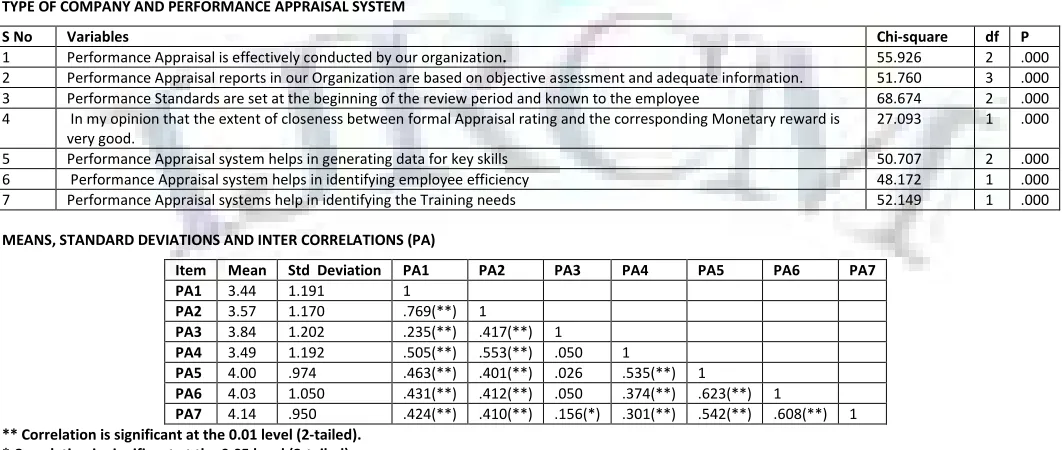
TYPE OF COMPANY AND PERFORMANCE APPRAISAL SYSTEM
S No Variables Chi-square df P
1 Performance Appraisal is effectively conducted by our organization. 55.926 2 .000
2 Performance Appraisal reports in our Organization are based on objective assessment and adequate information. 51.760 3 .000
3 Performance Standards are set at the beginning of the review period and known to the employee 68.674 2 .000
4 In my opinion that the extent of closeness between formal Appraisal rating and the corresponding Monetary reward is very good.
27.093 1 .000
5 Performance Appraisal system helps in generating data for key skills 50.707 2 .000
6 Performance Appraisal system helps in identifying employee efficiency 48.172 1 .000
7 Performance Appraisal systems help in identifying the Training needs 52.149 1 .000
MEANS, STANDARD DEVIATIONS AND INTER CORRELATIONS (PA)
Item Mean Std Deviation PA1 PA2 PA3 PA4 PA5 PA6 PA7
PA1 3.44 1.191 1
PA2 3.57 1.170 .769(**) 1
PA3 3.84 1.202 .235(**) .417(**) 1
PA4 3.49 1.192 .505(**) .553(**) .050 1
PA5 4.00 .974 .463(**) .401(**) .026 .535(**) 1
PA6 4.03 1.050 .431(**) .412(**) .050 .374(**) .623(**) 1
PA7 4.14 .950 .424(**) .410(**) .156(*) .301(**) .542(**) .608(**) 1
VOLUME NO. 2 (2012), ISSUE NO. 12 (DECEMBER) ISSN2231-5756
INTERNATIONAL JOURNAL OF RESEARCH IN COMMERCE, IT & MANAGEMENT
7. RESULTS AND DISCUSSIONS
The performance appraisal system in the both public and private companies Performance appraisal system and for improvement of managerial appraisal system. The majority of the respondents agreed that performance appraisal system is effectively done private company. Whereas, in case of public company it is different, in both the companies public and private it is observed that performance appraisal leads to promotion and employee training needs are identified but at the same time there is no simultaneous increase in wages.The public sector in India is going through profound restructuring in the face of environmental constraints that force the sector to become more efficient and effective. In this respect, one of the most popular tools used in the contemporary reform program is the application of performance appraisal systems. However, since appraising is considered to be a particularly controversial management practice anywhere it is being practiced, the successful institutionalization of such a system faces numerous challenges and obstacles.
The performance appraisal report based assessment is differ in public and private sector companies. Performance could be more difficult to assess in the public sector than in the private sector due to complex goals which are harder to measure, and a lack of financial indicators in the public sector (Burgess2003). The biggest problem with the move to a meritocracy is that it is susceptible to subjective measurement where doubt undermines the system. During performance appraisal meetings with employees, supervisors should discuss goals for future performance and employee career plans more seriously and clearly. When performance deficiencies are evident, supervisors and employees should work together to identify possible causes to develop an action plan to remedy these deficiencies. Job analysis is vital to organizations that wish to establish internally consistent compensation systems.
8. FINDINGS, SUGGESTIONS AND CONCLUSIONS
In This section, various aspects of Performance Appraisal practices in the companies under study have been presented while each of the practice pertaining to Performance appraisal has been dealt with. The data collected in this regard have been cross tabulated and the results been presented.
7.12.1 EFFECTIVENESS OF PERFORMANCE APPRAISAL SYSTEM
From the present table, it is clear that majority of the respondents i.e. from the private sector company strongly agree that the performance appraisal is effectively conducted in our organization.
This indicates that the association between the attributes is statistically significant. Hence the null hypotheses is not accepted, there is a significant difference between effectiveness of performance appraisal is differ in both public and private companies. Further it representst the private sector undertaking has better implementation of performance appraisal system as compared with public sector undertaking.
7.12.2 PERFORMANCE APPRAISAL REPORTS TOWARDS OBJECTIVE ASSESSMENT
It is evident that majority of the from private sector company are strongly agree with performance appraisal reports in our origination are based on objective assessment and adequate information and some more major part of the respondents are somewhat agree with the performance appraisal reports in our organization are based on objective assessment and adequate information it represents that the private sector r company respondents are strongly agree with the statement.
Interestingly, the association between the two attributes is statistically significant. Hence the null hypothesis is not accepted. Further there is a significant difference performance appraisal reports to words objective assessment is differ in both public and private companies. Hence null hypothesis is rejected. 7.12.3 PERFORMANCE REVIEW
It is clear that the large majority 56 percent of the respondents from the private sector company agree that performance standards are set at the beginning of the review period and known to the employee. On the other hand, in case of public sector company.
This indicates that the association between the two variables are statistically significant. Hence the null hypothesis is not accepted. In other words, further there is a significant difference in performance standards in both public and private companies. Hence null hypothesis is rejected.
7.12.4 CLOSENESS BETWEEN FORMAL APPRAISAL RATING AND THE CORRESPONDING MONETARY REWARD
It is clear that the large majority of the respondents 37.6 percent form and private company somewhat agree with appraisal rating and the corresponding monetary reward was very good. This indicates that the association between the two variables is statistically significant, in other words the null hypothesis is not accepted. In other words, the responses from both the companies supports that the closeness between formal appraisal rating and the corresponding monetary reward is very good. Further there is a significant difference in closeness between formal appraisal rating and the corresponding monetary reward in both public and private companies.
7.12.5 PERFORMANCE APPRAISAL SYSTEM HELPS IN GENERATING DATA FOR KEY SKILLS
In the present table, it is clear that the large majority 47 percent of the respondents from the public company somewhat agree with performance appraisal system helps in generating data for key skills. This indicates that the association between the two variables is statistically significant. In other words the null hypothesis is not accepted. Further there is a significant difference in between performance appraisal system helps in generating key skills in both public and private companies.
7.12.6 PERFORMANCE APPRAISAL SYSTEM HELPS IN IDENTIFYING EMPLOYEE EFFICIENCY
From the present table, it is evident that large majority 65 percent of the respondents from the private company are strongly agree with performance appraisal system helps in identifying employee efficiency. The association between both the variables is statistically significant. Hence the null hypothesis is not accepted. In other words, the effectiveness of appraisal system depends on the standardized techniques or methods adopted by the type of company. Further it indicates that there is a significant difference in between identifying employee efficiency through performance appraisal practices in both public and private companies.
7.12.7 PERFORMANCE APPRAISAL SYSTEMS HELP IN IDENTIFYING THE TRAINING NEEDS
From the present table it is evident that the majority of the respondents 60 percent from the private sector undertaking are strongly agree, with the performance appraisal system help in identifying the training needs.This indicates that the association between both the variables is statistically significant. In other words, it is evident that null hypothesis is not accepted. Further there is a significant difference in identifying the training needs through performance appraisal is differ in both the public and private companies.
CONCLUSION
It was Hypothesized that “ public and private sector enterprise differ in their Performance Appraisal practices as reported by their employees” it was found from the study that out of seven cross tabulations i.e effectiveness of performance appraisal, employee efficiency Identifying the training needs and employee efficiency. while total seven yield statistically significant associations between the independent and dependent variables and none of them yielded insignificant association between the two variables. This means a null hypothesis was rejected. Hence, from the above calculations it is true that there is a difference in adopting or applying performance appraisal practices are differ from public company to private company.
SUGGESTIONS FOR FUTURE RESEARCH
PERFORMANCE APPRAISAL SYSTEM
It is widely accepted that unless people working in the organization are emotionally inspired with the job satisfaction and job involvement, environmental relations cannot be improved for effective performance in the long run. The following are few suggestions
1. Management must be strong, firm, unbiased, kind, considerate, while setting new values, attitudes and beliefs leading to openness, mutual trust and participative management based on philosophy of fair, firm, and friendly.
2. Honest decisions and conduct of higher officials would certainly set an example to the subordinated.
INTERNATIONAL JOURNAL OF RESEARCH IN COMMERCE, IT & MANAGEMENT
4. People with self motivation can drive themselves to incredible levels of excellence.The paradigm shift from management to governance, from managers to complete facilitators rather than leaders, from traditional worker to “Duckers knowledge worker”, from life time employment to quit labour turnover, from bureaucratic organizations to net worked organizations’ necessities the need of relock at the organizational policies and practices. The available skills and possible potentials from within can be identified and brought out by suitably modifying the policies and upgrading the potential appraisal system, develop career paths, change in promotion policy, empowerment, flexibility decentralized decision making, timely recognition of good performance project need specialization and reorient training system.
REFERENCES
1. Abraham E.S.J. (1988). “HRD climate in banks In Khandelwal”, A.K.(eds).Infra.pp.50-51.
2. Basu, Mihir K. Performance Appraisal in India, Centre for organization Development, Hyderabad (Mimeographed), February, 1985.
3. Compton, R. (2005). “Performance Management: Panacea or Corporate Outcast?” Research and Practice in Human Resource Management, Vol 13, No 1, pp 46-54.
4. Fletcher, Clive and Richard Williams. “Performance Appraisal and career Development London, Hutchinson, 1985 .for Specific Objectives: Preferences of Managers in Private Clubs, International Journal of Contemporary Hospitality Management 14(13): 114-119.
5. Lex Dilworth (2003). “Searching for the Future of HRD. American in developing Human Resources”, Vol. 5 No 3, pp 241-244.
6. Manoharan, T. R., Muralidharan, C. & Deshmukh, S. G. (2009). Employee Performance Appraisal Using Data Envelopment Analysis: A Case Study, Research and Practice in Human Resource Management, vol 17, No 1, pp 92-111.
7. Martha C. Spears and Darrell F. Parker (2002), “A Probit Analysis of the Impact of Training on Performance Appraisal Satisfaction”, American Business Review, Vol. 20 Issue 2, pp 5-12.
8. Mondy and noe (1996) Human resource management, Upper Saddle River, NJ: Practice hill. In the Conventional Approach, Journal of European Industrial Training 21(4): 142- 153.
9. Murphy CristinaG. and Kevin N. “Towards narrowing the research Practice Gap in Performance Appraisal.” Personal Psychology, Vol 38, No 2; pp 335-345, summer 1985.
10. RandyL.Desimone, JonM.Werner and DavidM.Harris (2002). “Human Resource Development”, Harcourt College Publishers, Orlando, Florida, P.3
11. Rao, T.V. (1985), “Integrated Human Resource Development System”, in Goodstein D. Leonard & Pfeiffer J. William, The 1985 Annual: Developing Human Resources, San Diego CA: University Associates: p227.
VOLUME NO. 2 (2012), ISSUE NO. 12 (DECEMBER) ISSN2231-5756
INTERNATIONAL JOURNAL OF RESEARCH IN COMMERCE, IT & MANAGEMENT
REQUEST FOR FEEDBACK
Dear Readers
At the very outset, International Journal of Research in Commerce, IT and Management (IJRCM)
acknowledges & appreciates your efforts in showing interest in our present issue under your kind perusal.
I would like to request you to supply your critical comments and suggestions about the material published
in this issue as well as on the journal as a whole, on our E-mail i.e.
for further
improvements in the interest of research.
If you have any queries please feel free to contact us on our E-mail
.
I am sure that your feedback and deliberations would make future issues better – a result of our joint
effort.
Looking forward an appropriate consideration.
With sincere regards
Thanking you profoundly
Academically yours
Sd/-