Active Filter Design Techniques
Literature Number SLOA088
Excerpted from
Active Filter Design Techniques
Thomas Kugelstadt
16.1 Introduction
What is a filter?
A filter is a device that passes electric signals at certain frequencies or frequency ranges while preventing the passage of others. — Webster.
Filter circuits are used in a wide variety of applications. In the field of telecommunication, band-pass filters are used in the audio frequency range (0 kHz to 20 kHz) for modems and speech processing. High-frequency band-pass filters (several hundred MHz) are used for channel selection in telephone central offices. Data acquisition systems usually require anti-aliasing low-pass filters as well as low-pass noise filters in their preceding sig-nal conditioning stages. System power supplies often use band-rejection filters to sup-press the 60-Hz line frequency and high frequency transients.
In addition, there are filters that do not filter any frequencies of a complex input signal, but just add a linear phase shift to each frequency component, thus contributing to a constant time delay. These are called all-pass filters.
At high frequencies (> 1 MHz), all of these filters usually consist of passive components such as inductors (L), resistors (R), and capacitors (C). They are then called LRC filters.
In the lower frequency range (1 Hz to 1 MHz), however, the inductor value becomes very large and the inductor itself gets quite bulky, making economical production difficult.
In these cases, active filters become important. Active filters are circuits that use an op-erational amplifier (op amp) as the active device in combination with some resistors and capacitors to provide an LRC-like filter performance at low frequencies (Figure 16–1).
L R
C
VIN VOUT VIN
VOUT R1
C1
C2
R2
This chapter covers active filters. It introduces the three main filter optimizations (Butter-worth, Tschebyscheff, and Bessel), followed by five sections describing the most common active filter applications: low-pass, high-pass, band-pass, band-rejection, and all-pass fil-ters. Rather than resembling just another filter book, the individual filter sections are writ-ten in a cookbook style, thus avoiding tedious mathematical derivations. Each section starts with the general transfer function of a filter, followed by the design equations to cal-culate the individual circuit components. The chapter closes with a section on practical design hints for single-supply filter designs.
16.2 Fundamentals of Low-Pass Filters
The most simple low-pass filter is the passive RC low-pass network shown in Figure 16–2.
R
C
VIN VOUT
Figure 16–2. First-Order Passive RC Low-Pass
Its transfer function is:
A(s)+
1 RC
s)RC1 +
1
1)sRC
where the complex frequency variable, s = jω+σ , allows for any time variable signals. For pure sine waves, the damping constant, σ, becomes zero and s = jω .
For a normalized presentation of the transfer function, s is referred to the filter’s corner frequency, or –3 dB frequency, ωC, and has these relationships:
s+ws
C+
jw
wC+j f
fC+jW
With the corner frequency of the low-pass in Figure 16–2 being fC = 1/2πRC, s becomes s = sRC and the transfer function A(s) results in:
A(s)+ 1
1)s
The magnitude of the gain response is:
|A|+ 1
1)W2
Ǹ
R
C
R
C
R
C
R
C VIN
VOUT
Figure 16–3. Fourth-Order Passive RC Low-Pass with Decoupling Amplifiers
The resulting transfer function is:
A(s)+ 1
ǒ
1)a1sǓǒ
1)a2sǓ
AAA(1)ans)In the case that all filters have the same cut-off frequency, fC, the coefficients become a1+a2+ AAAan+a+ 2
nǸ *
1
Ǹ
, and fC of each partial filter is 1/α times higher than fC of the overall filter.Figure 16–4 shows the results of a fourth-order RC low-pass filter. The rolloff of each par-tial filter (Curve 1) is –20 dB/decade, increasing the roll-off of the overall filter (Curve 2) to 80 dB/decade.
Note:
Filter response graphs plot gain versus the normalized frequency axis
–40
–50
–60
–80
0.01 0.1 1 10
–20 –10 0
100 –30
–70
Frequency — Ω Ideal 4th Order Lowpass
4th Order Lowpass 1st Order Lowpass
|A| — Gain — dB
–180
–270
–360
0.01 0.1 1 10
–90 0
100 Frequency — Ω
Ideal 4th Order Lowpass
4th Order Lowpass
1st Order Lowpass
φ
— Phase — degrees
Note: Curve 1: 1st-order partial low-pass filter, Curve 2: 4th-order overall low-pass filter, Curve 3: Ideal 4th-order low-pass filter
Figure 16–4. Frequency and Phase Responses of a Fourth-Order Passive RC Low-Pass Filter
In addition, Figure 16–4 shows the transfer function of an ideal fourth-order low-pass func-tion (Curve 3).
In comparison to the ideal low-pass, the RC low-pass lacks in the following characteris-tics:
D The passband gain varies long before the corner frequency, fC, thus amplifying the upper passband frequencies less than the lower passband.
D The transition from the passband into the stopband is not sharp, but happens gradually, moving the actual 80-dB roll off by 1.5 octaves above fC.
D The phase response is not linear, thus increasing the amount of signal distortion significantly.
The gain and phase response of a low-pass filter can be optimized to satisfy one of the following three criteria:
1) A maximum passband flatness,
2) An immediate passband-to-stopband transition,
3) A linear phase response.
For that purpose, the transfer function must allow for complex poles and needs to be of the following type:
A(s)+ A0
ǒ
1)a1s)b1s2Ǔǒ
1)a2s)b2s2
Ǔ
AAAǒ1
)ans)bns2Ǔ
+ A0
P
i
ǒ
1)ais)bis2Ǔ
where A0 is the passband gain at dc, and ai and bi are the filter coefficients.
Since the denominator is a product of quadratic terms, the transfer function represents a series of cascaded second-order low-pass stages, with ai and bi being positive real coef-ficients. These coefficients define the complex pole locations for each second-order filter stage, thus determining the behavior of its transfer function.
The following three types of predetermined filter coefficients are available listed in table format in Section 16.9:
D The Butterworth coefficients, optimizing the passband for maximum flatness
D The Tschebyscheff coefficients, sharpening the transition from passband into the stopband
D The Bessel coefficients, linearizing the phase response up to fC
pas-sive components is the application of LRC filters. However, these filters are mainly used at high frequencies. In the lower frequency range (< 10 MHz) the inductor values become very large and the filter becomes uneconomical to manufacture. In these cases active fil-ters are used.
Active filters are RC networks that include an active device, such as an operational ampli-fier (op amp).
Section 16.3 shows that the products of the RC values and the corner frequency must yield the predetermined filter coefficients ai and bi, to generate the desired transfer func-tion.
The following paragraphs introduce the most commonly used filter optimizations.
16.2.1 Butterworth Low-Pass FIlters
The Butterworth low-pass filter provides maximum passband flatness. Therefore, a But-terworth low-pass is often used as anti-aliasing filter in data converter applications where precise signal levels are required across the entire passband.
Figure 16–5 plots the gain response of different orders of Butterworth low-pass filters ver-sus the normalized frequency axis, Ω (Ω = f / fC); the higher the filter order, the longer the passband flatness.
–20
–30
–40
–60
0.01 0.1 1 10
0 10
100 –10
–50
Frequency — Ω 1st Order
2nd Order
4th Order
10th Order
|A|
—
Gain
—
dB
16.2.2 Tschebyscheff Low-Pass Filters
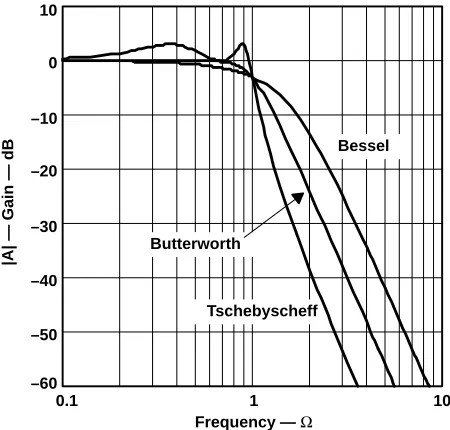
The Tschebyscheff low-pass filters provide an even higher gain rolloff above fC. However, as Figure 16–6 shows, the passband gain is not monotone, but contains ripples of constant magnitude instead. For a given filter order, the higher the passband ripples, the higher the filter’s rolloff.
–20
–30
–40
–60
0.01 0.1 1 10
0 10
100 –10
–50
Frequency — Ω 2nd Order
4th Order
9th Order
|A|
—
Gain
—
dB
Figure 16–6. Gain Responses of Tschebyscheff Low-Pass Filters
With increasing filter order, the influence of the ripple magnitude on the filter rolloff dimin-ishes.
Each ripple accounts for one second-order filter stage. Filters with even order numbers generate ripples above the 0-dB line, while filters with odd order numbers create ripples below 0 dB.
Tschebyscheff filters are often used in filter banks, where the frequency content of a signal is of more importance than a constant amplification.
16.2.3 Bessel Low-Pass Filters
–180
–270
–360
0.01 0.1 1 10
–90 0
100 Frequency — Ω
Butterworth Bessel
Tschebyscheff
φ
—
Phase
—
degrees
Figure 16–7. Comparison of Phase Responses of Fourth-Order Low-Pass Filters
0.8
0.6
0.4
0
0.01 0.1 1 10
1.2 1.4
100 1
0.2
Frequency — Ω
Butterworth
Bessel Tschebyscheff
Tgr
—
Normalized Group Delay
—
s/s
–20
–30
–40
–60
0.1 1 10
0 10
–10
–50
Frequency — Ω Butterworth
Bessel
Tschebyscheff
|A|
—
Gain
—
[image:10.612.234.459.124.339.2]dB
Figure 16–9. Comparison of Gain Responses of Fourth-Order Low-Pass Filters
16.2.4 Quality Factor Q
The quality factor Q is an equivalent design parameter to the filter order n. Instead of de-signing an nth order Tschebyscheff low-pass, the problem can be expressed as designing a Tschebyscheff low-pass filter with a certain Q.
For band-pass filters, Q is defined as the ratio of the mid frequency, fm, to the bandwidth at the two –3 dB points:
Q+ fm
(f2*f1)
For low-pass and high-pass filters, Q represents the pole quality and is defined as:
Q+
Ǹ
abii
10
0
–10
–30
0.01 0.1 1 10
30
20
–20
Frequency — Ω 1st Stage
2nd Stage
3rd Stage
4th Stage
5th Stage
Overall Filter Q5
40
|A|
—
Gain
—
[image:11.612.212.438.125.340.2]dB
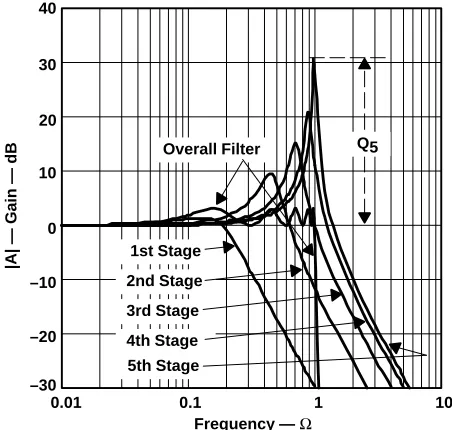
Figure 16–10. Graphical Presentation of Quality Factor Q on a Tenth-Order Tschebyscheff Low-Pass Filter with 3-dB Passband Ripple
The gain response of the fifth filter stage peaks at 31 dB, which is the logarithmic value of Q5:
Q5[dB]+20·logQ5
Solving for the numerical value of Q5 yields:
Q5+103120+35.48
which is within 1% of the theoretical value of Q = 35.85 given in Section 16.9, Table 16–9, last row.
The graphical approximation is good for Q > 3. For lower Qs, the graphical values differ from the theoretical value significantly. However, only higher Qs are of concern, since the higher the Q is, the more a filter inclines to instability.
16.2.5 Summary
The general transfer function of a low-pass filter is :
(16–1)
A(s)+ A0
P
i
ǒ
1)ais)bis2Ǔ
The multiplication of the denominator terms with each other yields an nth order polynomial of S, with n being the filter order.
While n determines the gain rolloff above fC with *n·20 dBńdecade, ai and bi determine the gain behavior in the passband.
In addition, the ratio b
Ǹ
iai +Q is defined as the pole quality. The higher the Q value, the
more a filter inclines to instability.
16.3 Low-Pass Filter Design
Equation 16–1 represents a cascade of second-order low-pass filters. The transfer func-tion of a single stage is:
(16–2)
Ai(s)+ A0
ǒ
1)ais)bis2Ǔ
For a first-order filter, the coefficient b is always zero (b1=0), thus yielding:
(16–3)
A(s)+ A0
1)a1s
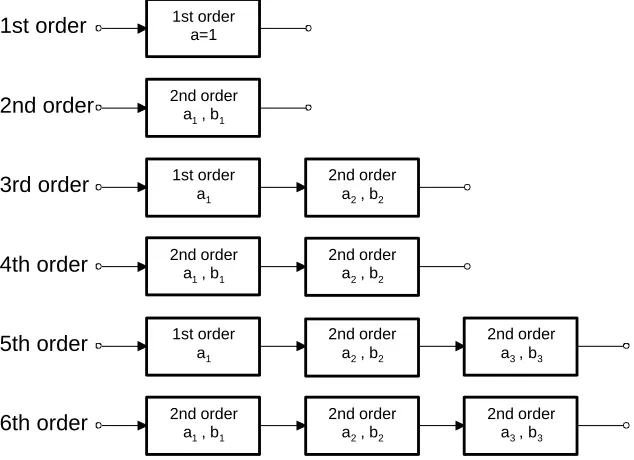
The first-order and second-order filter stages are the building blocks for higher-order fil-ters.
Often the filters operate at unity gain (A0=1) to lessen the stringent demands on the op amp’s open-loop gain.
2nd order a2 , b2
2nd order a2 , b2
2nd order a2 , b2
2nd order a2 , b2
2nd order a3 , b3
2nd order a3 , b3 1st order
a=1
2nd order a1 , b1
1st order a1
2nd order a1 , b1
2nd order a1 , b1
1st order
2nd order
3rd order
4th order
5th order
6th order
[image:13.612.119.436.127.357.2]1st order a1
Figure 16–11. Cascading Filter Stages for Higher-Order Filters
Figure 16–10 demonstrated that the higher the corner frequency of a partial filter, the high-er its Q. Thhigh-erefore, to avoid the saturation of the individual stages, the filthigh-ers need to be placed in the order of rising Q values. The Q values for each filter order are listed (in rising order) in Section 16–9, Tables 16–4 through 16–10.
16.3.1 First-Order Low-Pass Filter
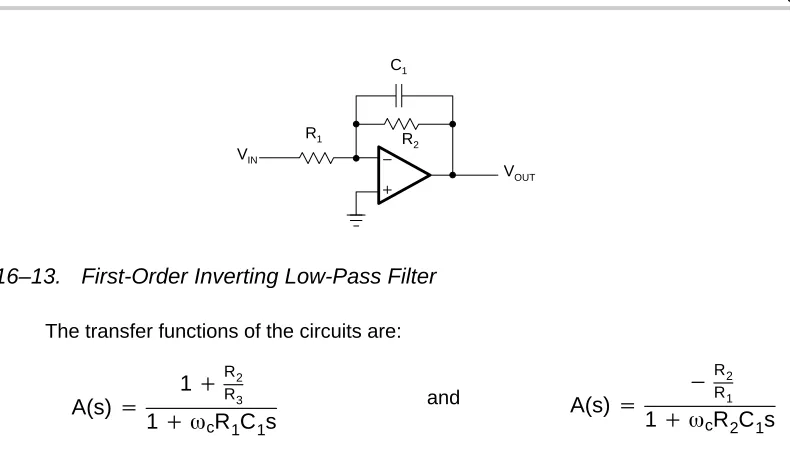
Figures 16–12 and 16–13 show a first-order low-pass filter in the inverting and in the non-inverting configuration.
R1
R2
R3
C1 VIN
VOUT
R1 R2 C1
VIN
[image:14.612.133.528.96.325.2]VOUT
Figure 16–13. First-Order Inverting Low-Pass Filter
The transfer functions of the circuits are:
A(s)+
1)R2
R3
1)wcR1C1s
A(s)+ *
R2 R1
1)wcR2C1s
and
The negative sign indicates that the inverting amplifier generates a 180° phase shift from the filter input to the output.
The coefficient comparison between the two transfer functions and Equation 16–3 yields:
A0+1)R2
R3 A0+ *
R2
R1
and
a1+wcR1C1 and a1+wcR2C1
To dimension the circuit, specify the corner frequency (fC), the dc gain (A0), and capacitor C1, and then solve for resistors R1 and R2:
R1+ a1
2pfcC1
R2+ a1
2pfcC1
and
R2+R3
ǒ
A0*1Ǔ
R1+ *R2A0
and
The coefficient a1 is taken from one of the coefficient tables, Tables 16–4 through 16–10 in Section 16.9.
Example 16–1. First-Order Unity-Gain Low-Pass Filter
For a first-order unity-gain low-pass filter with fC = 1 kHz and C1 = 47 nF, R1 calculates to:
R1+ a1
2pfcC1
+ 1
2p·103Hz·47·10*9F+3.38 kW
However, to design the first stage of a third-order unity-gain Bessel low-pass filter, assum-ing the same values for fC and C1, requires a different value for R1. In this case, obtain a1 for a third-order Bessel filter from Table 16–4 in Section 16.9 (Bessel coefficients) to calculate R1:
R1+ a1
2pfcC1
+ 0.756
2p·103Hz·47·10*9F+2.56 kW
When operating at unity gain, the noninverting amplifier reduces to a voltage follower (Fig-ure 16–14), thus inherently providing a superior gain accuracy. In the case of the inverting amplifier, the accuracy of the unity gain depends on the tolerance of the two resistors, R1 and R2.
R1
C1
VIN
VOUT
Figure 16–14. First-Order Noninverting Low-Pass Filter with Unity Gain
16.3.2 Second-Order Low-Pass Filter
There are two topologies for a second-order low-pass filter, the Sallen-Key and the Multi-ple Feedback (MFB) topology.
16.3.2.1 Sallen-Key Topology
VIN
VOUT
R1 R2
C1 C2
R3
[image:16.612.219.417.126.232.2]R4
Figure 16–15. General Sallen-Key Low-Pass Filter
VIN
VOUT
R1 R2
C1 C2
Figure 16–16. Unity-Gain Sallen-Key Low-Pass Filter
The transfer function of the circuit in Figure 16–15 is:
A(s)+ A0
1)wc
ƪ
C1ǒ
R1)R2Ǔ
)ǒ
1*A0Ǔ
R1C2ƫ
s)wc2R1R2C1C2s2
For the unity-gain circuit in Figure 16–16 (A0=1), the transfer function simplifies to:
A(s)+ 1
1)wcC1
ǒ
R1)R2Ǔ
s)wc2R1R2C1C2s2The coefficient comparison between this transfer function and Equation 16–2 yields:
A0+1
a1+wcC1
ǒ
R1)R2Ǔ
b1+wc2R1R2C1C2
Given C1 and C2, the resistor values for R1 and R2 are calculated through:
R1 , 2+a1C2# a1 2C
2 2
*4b1C1C2
Ǹ
In order to obtain real values under the square root, C2 must satisfy the following condi-tion:
C2wC14b1
a12
Example 16–2. Second-Order Unity-Gain Tschebyscheff Low-Pass Filter
The task is to design a second-order unity-gain Tschebyscheff low-pass filter with a corner frequency of fC = 3 kHz and a 3-dB passband ripple.
From Table 16–9 (the Tschebyscheff coefficients for 3-dB ripple), obtain the coefficients a1 and b1 for a second-order filter with a1 = 1.0650 and b1 = 1.9305.
Specifying C1 as 22 nF yields in a C2 of:
C2wC14b1
a12 +22·10*
9nF ·4 ·1.9305
1.0652 ^150 nF
Inserting a1 and b1 into the resistor equation for R1,2 results in:
R1+
1.065·150·10*9* ǒ
Ǹ
1.065·150·10*9Ǔ2*4·1.9305·22·10*9·150·10*94p·3·103·22·10*9·150·10*9 +1.26 kW
and
R2+
1.065·150·10*9) ǒ
Ǹ
1.065·150·10*9Ǔ2*4·1.9305·22·10*9·150·10*94p·3·103·22·10*9·150·10*9 +1.30 kW
with the final circuit shown in Figure 16–17.
VIN
VOUT 1.26k 1.30k
22n 150n
Figure 16–17. Second-Order Unity-Gain Tschebyscheff Low-Pass with 3-dB Ripple
The general transfer function changes to:
A(s)+ A0
1)wcRC
ǒ
3*A0Ǔ
s)(wcRC)2s2A0+1)R4
R3
with
The coefficient comparison with Equation 16–2 yields:
a1+wcRC
ǒ
3*A0Ǔ
b1+ ǒwcRCǓ
2
Given C and solving for R and A0 results in:
R+
Ǹ
b12pfcC
A0+3* a1
b1
Ǹ
+3*Q1and
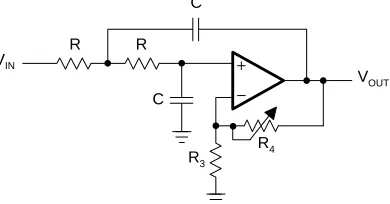
Thus, A0 depends solely on the pole quality Q and vice versa; Q, and with it the filter type, is determined by the gain setting of A0:
Q+ 1
3*A0
The circuit in Figure 16–18 allows the filter type to be changed through the various resistor ratios R4/R3.
VIN
VOUT
R R
C C
R3
R4
[image:18.612.212.407.409.511.2]Figure 16–18. Adjustable Second-Order Low-Pass Filter
Table 16–1 lists the coefficients of a second-order filter for each filter type and gives the resistor ratios that adjust the Q.
Table 16–1. Second-Order FIlter Coefficients
SECOND-ORDER BESSEL BUTTERWORTH 3-dB TSCHEBYSCHEFF
a1 1.3617 1.4142 1.065
b1 0.618 1 1.9305
Q 0.58 0.71 1.3
16.3.2.2 Multiple Feedback Topology
The MFB topology is commonly used in filters that have high Qs and require a high gain.
VIN
VOUT
R1
R2
R3
C2
C1
Figure 16–19. Second-Order MFB Low-Pass Filter
The transfer function of the circuit in Figure 16–19 is:
A(s)+ *
R2 R1
1)wcC1
ǒ
R2)R3)R2R3
R1
Ǔ
s)wc 2C1C2R2R3s2
Through coefficient comparison with Equation 16–2 one obtains the relation:
A0+ *R2
R1
a1+wcC1
ǒ
R2)R3)R2R3
R1
Ǔ
b1+wc2C1C2R2R3
Given C1 and C2, and solving for the resistors R1–R3:
R2+
a1C2*
Ǹ
a12C22*4b1C1C2ǒ
1*A0Ǔ
4pfcC1C2
R1+ R2
*A0
R3+ b1
4p2f
c 2
In order to obtain real values for R2, C2 must satisfy the following condition:
C2wC14b1
ǒ
1*A0Ǔ
a12
16.3.3 Higher-Order Low-Pass Filters
Higher-order low-pass filters are required to sharpen a desired filter characteristic. For that purpose, first-order and second-order filter stages are connected in series, so that the product of the individual frequency responses results in the optimized frequency re-sponse of the overall filter.
In order to simplify the design of the partial filters, the coefficients ai and bi for each filter type are listed in the coefficient tables (Tables 16–4 through 16–10 in Section 16.9), with each table providing sets of coefficients for the first 10 filter orders.
Example 16–3. Fifth-Order Filter
The task is to design a fifth-order unity-gain Butterworth low-pass filter with the corner fre-quency fC = 50 kHz.
First the coefficients for a fifth-order Butterworth filter are obtained from Table 16–5, Sec-tion 16.9:
ai bi
Filter 1 a1 = 1 b1 = 0
Filter 2 a2 = 1.6180 b2 = 1
Filter 3 a3 = 0.6180 b3 = 1
Then dimension each partial filter by specifying the capacitor values and calculating the required resistor values.
First Filter
R1
C1 VIN
VOUT
Figure 16–20. First-Order Unity-Gain Low-Pass
With C1 = 1nF,
R1+ a1
2pfcC1
+ 1
2p·50·103Hz·1·10*9F+3.18 kW
Second Filter
VIN
VOUT
R1 R2
C1 C2
Figure 16–21. Second-Order Unity-Gain Sallen-Key Low-Pass Filter
With C1 = 820 pF,
C2wC14b2
a22 +820·10
*12F· 4·1
1.6182+1.26 nF
The closest 5% value is 1.5 nF.
With C1 = 820 pF and C2 = 1.5 nF, calculate the values for R1 and R2 through:
R1+a2C2* a2
2C 2
2
*4b2C1C2
Ǹ
4pfcC1C2
R1+a2C2) a2
2C 2
2
*4b2C1C2
Ǹ
4pfcC1C2
and
and obtain
R1+
1.618·1.5·10*9* ǒ
Ǹ
1.618·1.5·10*9Ǔ2*4·1·820·10*12·1.5·10*94p·50·103·820·10*12·1.5·10*9 +1.87 kW
R2+
1.618·1.5·10*9) ǒ
Ǹ
1.618·1.5·10*9Ǔ2*4·1·820·10*12·1.5·10*94p·50·103·820·10*12·1.5·10*9 +4.42 kW
R1 and R2 are available 1% resistors. Third Filter
The calculation of the third filter is identical to the calculation of the second filter, except that a2 and b2 are replaced by a3 and b3, thus resulting in different capacitor and resistor values.
Specify C1 as 330 pF, and obtain C2 with:
C2wC14b3
a32 +330·10
*12F· 4·1
0.6182+3.46 nF
With C1 = 330 pF and C2 = 4.7 nF, the values for R1 and R2 are:
D R1 = 1.45 kΩ, with the closest 1% value being 1.47 kΩ
D R2 = 4.51 kΩ, with the closest 1% value being 4.53 kΩ Figure 16–22 shows the final filter circuit with its partial filter stages.
VIN 1.87k 4.42k
820p 1.5n
1.47k 4.53k
330p 4.7n
VOUT 1n
3.16k
Figure 16–22. Fifth-Order Unity-Gain Butterworth Low-Pass Filter
16.4 High-Pass Filter Design
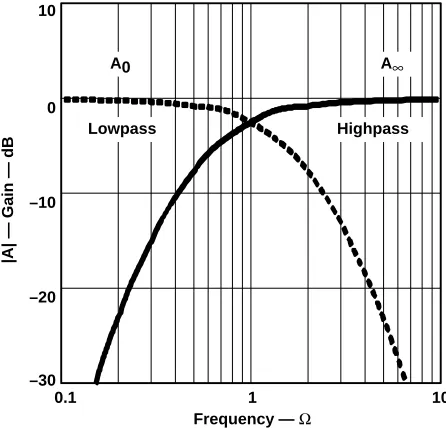
By replacing the resistors of a low-pass filter with capacitors, and its capacitors with resis-tors, a high-pass filter is created.
VIN
VOUT
R1 R2
C1 C2
VIN
VOUT
R1 R2
C1 C2
Figure 16–23. Low-Pass to High-Pass Transition Through Components Exchange
10
0
–10
–30
0.1 1 10
–20
Frequency — Ω
A0 A∞
Lowpass Highpass
|A|
—
Gain
—
[image:23.612.213.436.124.338.2]dB
Figure 16–24. Developing The Gain Response of a High-Pass Filter
The general transfer function of a high-pass filter is then:
(16–4)
A(s)+ AR
P
i
ǒ
1)ai
s)
bi s2
Ǔ
with A∞ being the passband gain.
Since Equation 16–4 represents a cascade of second-order high-pass filters, the transfer function of a single stage is:
(16–5)
Ai(s)+ AR
ǒ
1)ais)
bi s2
Ǔ
With b=0 for all first-order filters, the transfer function of a first-order filter simplifies to:
(16–6)
A(s)+ A0
1)ai
16.4.1 First-Order High-Pass Filter
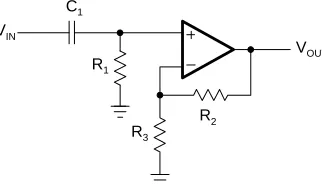
Figure 16–25 and 16–26 show a first-order high-pass filter in the noninverting and the in-verting configuration.
R1
R2
R3
C1
VIN
VOUT
Figure 16–25. First-Order Noninverting High-Pass Filter
R1
R2
C1 VIN
VOUT
Figure 16–26. First-Order Inverting High-Pass Filter
The transfer functions of the circuits are:
A(s)+
1)R2
R3
1)wcR1
1C1
·1s A(s)+ *
R2 R1
1)wcR1
1C1
·1s
and
The negative sign indicates that the inverting amplifier generates a 180° phase shift from the filter input to the output.
The coefficient comparison between the two transfer functions and Equation 16–6 pro-vides two different passband gain factors:
AR+1)R2
R3 AR+ *
R2
R1
and
while the term for the coefficient a1 is the same for both circuits:
a1+ 1
To dimension the circuit, specify the corner frequency (fC), the dc gain (A∞), and capacitor (C1), and then solve for R1 and R2:
R1+ 1
2pfca1C1
R2+R3(AR*1) and R2+ *R1AR
16.4.2 Second-Order High-Pass Filter
High-pass filters use the same two topologies as the low-pass filters: Sallen-Key and Mul-tiple Feedback. The only difference is that the positions of the resistors and the capacitors have changed.
16.4.2.1 Sallen-Key Topology
The general Sallen-Key topology in Figure 16–27 allows for separate gain setting via A0 = 1+R4/R3.
R3 R4
VIN
VOUT R1
R2
[image:25.612.215.413.582.652.2]C1 C2
Figure 16–27. General Sallen-Key High-Pass Filter
The transfer function of the circuit in Figure 16–27 is:
A(s)+ a
1)R2ǒC1)C2Ǔ)R1C2(1*a)
wcR1R2C1C2 · 1
s)w 1
c2R1R2C1C2
·1
s2
a+1)R4
R3
with
The unity-gain topology in Figure 16–28 is usually applied in low-Q filters with high gain accuracy.
VIN
VOUT
R1 R2
C C
To simplify the circuit design, it is common to choose unity-gain (α = 1), and C1 = C2 = C. The transfer function of the circuit in Figure 16–28 then simplifies to:
A(s)+ 1
1)w 2
cR1C
·1s) 1
wc2R1R2C2
·1
s2
The coefficient comparison between this transfer function and Equation 16–5 yields:
AR+1
a1+ 2
wcR1C
b1+ 1
wc2R1R2C2
Given C, the resistor values for R1 and R2 are calculated through:
R1+ 1
pfcCa1
R2+ a1
4pfcCb1
16.4.2.2 Multiple Feedback Topology
The MFB topology is commonly used in filters that have high Qs and require a high gain.
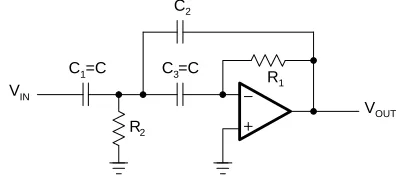
To simplify the computation of the circuit, capacitors C1 and C3 assume the same value (C1 = C3 = C) as shown in Figure 16–29.
VIN
VOUT
C1=C
C2
C3=C
R2
[image:26.612.231.430.483.574.2]R1
Figure 16–29. Second-Order MFB High-Pass Filter
The transfer function of the circuit in Figure 16–29 is:
A(s)+ *
C C2
1) 2C)C2
wcR1CC2· 1
s)
2C)C2
Through coefficient comparison with Equation 16–5, obtain the following relations:
AR+ C
C2
a1+ 2C)C2
wcR1CC2
b1+ 2C)C2
wcR1CC2
Given capacitors C and C2, and solving for resistors R1 and R2:
R1+1*2AR
2pfc·C·a1
R2+ a1
2pfc·b1C2(1*2AR)
The passband gain (A∞) of a MFB high-pass filter can vary significantly due to the wide tolerances of the two capacitors C and C2. To keep the gain variation at a minimum, it is necessary to use capacitors with tight tolerance values.
16.4.3 Higher-Order High-Pass Filter
Likewise, as with the low-pass filters, higher-order high-pass filters are designed by cas-cading first-order and second-order filter stages. The filter coefficients are the same ones used for the low-pass filter design, and are listed in the coefficient tables (Tables 16–4 through 16–10 in Section 16.9).
Example 16–4. Third-Order High-Pass Filter with fC = 1 kHz
The task is to design a third-order unity-gain Bessel high-pass filter with the corner fre-quency fC = 1 kHz. Obtain the coefficients for a third-order Bessel filter from Table 16–4, Section 16.9:
ai bi
Filter 1 a1 = 0.756 b1 = 0
Filter 2 a2 = 0.9996 b2 = 0.4772
and compute each partial filter by specifying the capacitor values and calculating the re-quired resistor values.
First Filter
R1+ 1
2pfca1C1
+ 1
2p·103Hz·0.756·100·10*9F+2.105 kW
Closest 1% value is 2.1 kΩ.
Second Filter
With C = 100nF,
R1+ 1
pfcCa1
+ 1
p·103·100·10*9·0.756+3.18 kW
Closest 1% value is 3.16 kΩ.
R2+ a1
4pfcCb1
+ 0.9996
4p·103·100·10*9·0.4772+1.67 kW
Closest 1% value is 1.65 kΩ.
Figure 16–30 shows the final filter circuit.
2.10k 100n VIN
VOUT 3.16k
1.65k
100n 100n
Figure 16–30. Third-Order Unity-Gain Bessel High-Pass
16.5 Band-Pass Filter Design
In Section 16.4, a high-pass response was generated by replacing the term S in the low-pass transfer function with the transformation 1/S. Likewise, a band-low-pass characteristic is generated by replacing the S term with the transformation:
(16–7)
1
DW
ǒ
s)1sǓ
|A| [dB] |A| [dB]
0 –3
0 –3
Ω
1
Ω1 Ω2
Ω
1
0 0
∆Ω
Figure 16–31. Low-Pass to Band-Pass Transition
The corner frequency of the low-pass filter transforms to the lower and upper –3 dB fre-quencies of the band-pass, Ω1 and Ω2. The difference between both frequencies is de-fined as the normalized bandwidth ∆Ω:
DW+W2*W1
The normalized mid frequency, where Q = 1, is:
Wm+1+W2·W1
In analogy to the resonant circuits, the quality factor Q is defined as the ratio of the mid frequency (fm) to the bandwidth (B):
(16–8)
Q+fm
B +
fm
f2*f1+
1
W2*W1
+DW1
The simplest design of a band-pass filter is the connection of a high-pass filter and a low-pass filter in series, which is commonly done in wide-band filter applications. Thus, a first-order high-pass and a first-first-order low-pass provide a second-first-order band-pass, while a second-order high-pass and a second-order low-pass result in a fourth-order band-pass response.
16.5.1 Second-Order Band-Pass Filter
To develop the frequency response of a second-order band-pass filter, apply the trans-formation in Equation 16–7 to a first-order low-pass transfer function:
A(s)+ A0
1)s
1
DW
ǒ
s)1sǓ
Replacing s with
yields the general transfer function for a second-order band-pass filter:
(16–9)
A(s)+ A0·DW·s
1)DW·s)s2
When designing band-pass filters, the parameters of interest are the gain at the mid fre-quency (Am) and the quality factor (Q), which represents the selectivity of a band-pass filter.
Therefore, replace A0 with Am and ∆Ω with 1/Q (Equation 16–7) and obtain:
(16–10)
A(s)+
Am Q ·s
[image:30.612.230.460.432.649.2]1)Q1·s)s2
Figure 16–32 shows the normalized gain response of a second-order band-pass filter for different Qs.
–20
–25
–30
–45
0.1 1 10
–35
Frequency — Ω 0
–5
–10
–15
Q = 10 Q = 1
|A|
—
Gain
—
dB
The graph shows that the frequency response of second-order band-pass filters gets steeper with rising Q, thus making the filter more selective.
16.5.1.1 Sallen-Key Topology
R1
R2
VIN
VOUT
2R R
[image:31.612.211.407.183.281.2]C C R
Figure 16–33. Sallen-Key Band-Pass
The Sallen-Key band-pass circuit in Figure 16–33 has the following transfer function:
A(s)+ G·RCwm·s
1)RCwm(3*G)·s)R2C2wm2·s2
Through coefficient comparison with Equation 16–10, obtain the following equations:
fm+ 1
2pRC
mid-frequency:
G+1)R2
R1
inner gain:
Am+ G
3*G
gain at fm :
Q+ 1
3*G
filter quality:
The Sallen-Key circuit has the advantage that the quality factor (Q) can be varied via the inner gain (G) without modifying the mid frequency (fm). A drawback is, however, that Q and Am cannot be adjusted independently.
Care must be taken when G approaches the value of 3, because then Am becomes infinite and causes the circuit to oscillate.
To set the mid frequency of the band-pass, specify fm and C and then solve for R:
R+ 1
Because of the dependency between Q and Am, there are two options to solve for R2: ei-ther to set the gain at mid frequency:
R2+2Am*1
1)Am
or to design for a specified Q:
R2+2Q*1
Q
16.5.1.2 Multiple Feedback Topology
VIN
VOUT R1
C
C
R3
[image:32.612.215.398.510.644.2]R2
Figure 16–34. MFB Band-Pass
The MFB band-pass circuit in Figure 16–34 has the following transfer function:
A(s)+
* R2R3
R1)R3Cwm·s
1) 2R1R3
R1)R3Cwm·s) R1R2R3
R1)R3C2·wm2·s2
The coefficient comparison with Equation 16–9, yields the following equations:
fm+ 1
2pC
R1)R3
R1R2R3
Ǹ
mid-frequency:
*Am+
R2
2R1
gain at fm:
Q+pfmR2C
filter quality:
B+ 1
pR2C bandwidth:
with-out affecting bandwidth, B, or gain, Am. For low values of Q, the filter can work without R3, however, Q then depends on Am via:
*Am+2Q2
Example 16–5. Second-Order MFB Band-Pass Filter with fm = 1 kHz
To design a second-order MFB band-pass filter with a mid frequency of fm = 1 kHz, a quali-ty factor of Q = 10, and a gain of Am = –2, assume a capacitor value of C = 100 nF, and solve the previous equations for R1 through R3 in the following sequence:
R2+ Q
pfmC+
10
p·1 kHz·100 nF+31.8 kW
R1+ R2
*2Am+
31.8 kW
4 +7.96 kW
R3+ *AmR1
2Q2)A
m
+2·7.96 kW
200*2 +80.4W
16.5.2 Fourth-Order Band-Pass Filter (Staggered Tuning)
Figure 16–32 shows that the frequency response of second-order band-pass filters gets steeper with rising Q. However, there are band-pass applications that require a flat gain response close to the mid frequency as well as a sharp passband-to-stopband transition. These tasks can be accomplished by higher-order band-pass filters.
Of particular interest is the application of the low-pass to band-pass transformation onto a second-order low-pass filter, since it leads to a fourth-order band-pass filter.
Replacing the S term in Equation 16–2 with Equation 16–7 gives the general transfer func-tion of a fourth-order band-pass:
(16–11)
A(s)+
s2·A 0(DW)
2
b1
1)a1
b1DW·s)
ƪ
2) (DW)2b1
ƫ
·s2) a1b1DW·s3)s4
Similar to the low-pass filters, the fourth-order transfer function is split into two second-or-der band-pass terms. Further mathematical modifications yield:
(16–12)
A(s)+
Ami Qi ·as
ƪ
1)Qas 1)(as)2
ƫ
·
Ami Qi ·
s
a
ƪ
1)Q1 iǒ
s
a
Ǔ
)ǒ
asǓ
2
ƫ
D Ami is the gain at the mid frequency, fmi, of each partial filter
D Qi is the pole quality of each filter
D α and 1/α are the factors by which the mid frequencies of the individual filters, fm1 and fm2, derive from the mid frequency, fm, of the overall bandpass.
In a fourth-order band-pass filter with high Q, the mid frequencies of the two partial filters differ only slightly from the overall mid frequency. This method is called staggered tuning.
Factor α needs to be determined through successive approximation, using equation 16–13:
(16–13) a2)
ƪ
a·DW·a1b1
ǒ1
)a2Ǔƫ
2
) 1
a2*2*
(DW)2
b1 +0
with a1 and b1 being the second-order low-pass coefficients of the desired filter type. To simplify the filter design, Table 16–2 lists those coefficients, and provides the α values for three different quality factors, Q = 1, Q = 10, and Q = 100.
Table 16–2. Values of α For Different Filter Types and Different Qs
Bessel Butterworth Tschebyscheff
a1 1.3617 a1 1.4142 a1 1.0650
b1 0.6180 b1 1.0000 b1 1.9305
Q 100 10 1 Q 100 10 1 Q 100 10 1
∆Ω 0.01 0.1 1 ∆Ω 0.01 0.1 1 ∆Ω 0.01 0.1 1
After α has been determined, all quantities of the partial filters can be calculated using the following equations:
The mid frequency of filter 1 is:
(16–14)
fm1+fam
the mid frequency of filter 2 is:
(16–15)
fm2+fm·a
with fm being the mid frequency of the overall forth-order band-pass filter. The individual pole quality, Qi, is the same for both filters:
(16–16)
Qi+Q·ǒ1)a
2Ǔb 1
a·a1
with Q being the quality factor of the overall filter.
The individual gain (Ami) at the partial mid frequencies, fm1 and fm2, is the same for both filters:
(16–17)
Ami+Qi
Q·
Am
B1
Ǹ
with Am being the gain at mid frequency, fm, of the overall filter.
Example 16–6. Fourth-Order Butterworth Band-Pass Filter
The task is to design a fourth-order Butterworth band-pass with the following parameters:
D mid frequency, fm = 10 kHz
D bandwidth, B = 1000 Hz
D and gain, Am = 1
From Table 16–2 the following values are obtained:
D a1 = 1.4142
D b1 = 1
In accordance with Equations 16–14 and 16–15, the mid frequencies for the partial filters are:
fmi+10 kHz
1.036 +9.653 kHz and fm2+10 kHz·1.036+10.36 kHz
The overall Q is defined as Q+fmńB , and for this example results in Q = 10.
Using Equation 16–16, the Qi of both filters is:
Qi+10·ǒ1)1.036
2Ǔ·1
1.036·1.4142 +14.15
With Equation 16–17, the passband gain of the partial filters at fm1 and fm2 calculates to:
Ami+14.15
10 ·
1 1
Ǹ
+1.415The Equations 16–16 and 16–17 show that Qi and Ami of the partial filters need to be inde-pendently adjusted. The only circuit that accomplishes this task is the MFB band-pass fil-ter in Paragraph 16.5.1.2.
To design the individual second-order band-pass filters, specify C = 10 nF, and insert the previously determined quantities for the partial filters into the resistor equations of the MFB band-pass filter. The resistor values for both partial filters are calculated below.
R21+
Qi
pfm1C
+p·9.653 kHz·10 nF14.15 +46.7 kW R22+
Qi
pfm2C
+p·10.36 kHz·10 nF14.15 +43.5 kW
Filter 1: Filter 2:
R11+
R21 *2Ami
+*46.7 k2·*1.415W +16.5 kW R12+
R22 *2Ami
+*43.5 k2·*1.415W +15.4 kW
R31+
*AmiR11
2Qi 2
)Ami
+2·14.151.415·16.5 k2)1.415W +58.1W R32+
*AmiR12
2Qi 2
)Ami
+2·14.151.415·15.4 k2)1.415W +54.2W
–15
–20
–25
–35
100 1 k 10 k 100 k
–5 0 5
1 M –10
–30
f — Frequency — Hz A1
Q = 10 A2
Q = 1
|A|
—
Gain
—
[image:37.612.210.438.124.340.2]dB
Figure 16–35. Gain Responses of a Fourth-Order Butterworth Band-Pass and its Partial Filters
16.6 Band-Rejection Filter Design
A band-rejection filter is used to suppress a certain frequency rather than a range of fre-quencies.
Two of the most popular band-rejection filters are the active twin-T and the active Wien-Robinson circuit, both of which are second-order filters.
To generate the transfer function of a second-order band-rejection filter, replace the S term of a first-order low-pass response with the transformation in 16–18:
(16–18) DW
s)1s
which gives:
(16–19)
A(s)+ A0ǒ1)s
2Ǔ
1)DW·s)s2
|A| [dB] |A| [dB]
0 –3
0 –3
Ω
1
Ω
1
0 0
∆Ω
Ω1 Ω2
Figure 16–36. Low-Pass to Band-Rejection Transition
The corner frequency of the low-pass transforms to the lower and upper –3-dB frequen-cies of the band-rejection filter Ω1 and Ω2. The difference between both frequencies is the normalized bandwidth ∆Ω:
DW+Wmax*Wmin
Identical to the selectivity of a band-pass filter, the quality of the filter rejection is defined as:
Q+fm
B +
1
DW
Therefore, replacing ∆Ω in Equation 16–19 with 1/Q yields:
(16–20)
A(s)+ A0ǒ1)s
2Ǔ
1)Q1·s)s2
16.6.1 Active Twin-T Filter
The original twin-T filter, shown in Figure 16–37, is a passive RC-network with a quality factor of Q = 0.25. To increase Q, the passive filter is implemented into the feedback loop of an amplifier, thus turning into an active band-rejection filter, shown in Figure 16–38.
VIN VOUT
C C
2C R/2
R R
R1 R2 2C
R
C C
R R/2 VIN
[image:39.612.218.424.121.268.2]VOUT
Figure 16–38. Active Twin-T Filter
The transfer function of the active twin-T filter is:
(16–21)
A(s)+ kǒ1)s
2Ǔ
1)2(2*k)·s)s2
Comparing the variables of Equation 16–21 with Equation 16–20 provides the equations that determine the filter parameters:
fm+ 1
2pRC
mid-frequency:
G+1)R2
R1
inner gain:
A0+G
passband gain:
Q+ 1
2(2*G)
rejection quality:
The twin-T circuit has the advantage that the quality factor (Q) can be varied via the inner gain (G) without modifying the mid frequency (fm). However, Q and Am cannot be adjusted independently.
To set the mid frequency of the band-pass, specify fm and C, and then solve for R:
R+ 1
2pfmC
Because of the dependency between Q and Am, there are two options to solve for R2: ei-ther to set the gain at mid frequency:
or to design for a specific Q:
R2+R1
ǒ
1* 12Q
Ǔ
16.6.2 Active Wien-Robinson Filter
The Wien-Robinson bridge in Figure 16–39 is a passive band-rejection filter with differen-tial output. The output voltage is the difference between the potendifferen-tial of a constant voltage divider and the output of a band-pass filter. Its Q-factor is close to that of the twin-T circuit. To achieve higher values of Q, the filter is connected into the feedback loop of an amplifier.
VIN
VOUT
R
R C
C R1
2R1
Figure 16–39. Passive Wien-Robinson Bridge
VOUT
VIN R
R C
C
R1 2R1
R2 R3
[image:40.612.178.439.267.521.2]R4
Figure 16–40. Active Wien-Robinson Filter
The active Wien-Robinson filter in Figure 16–40 has the transfer function:
(16–22)
A(s)+ *
b
1)aǒ1)s2Ǔ
1)1)3a·s)s2
a+R2
R3 b+
R2
R4
and with
fm+ 1
2pRC
mid-frequency:
A0+ * b
1)a
passband gain:
Q+1)a
3 rejection quality:
To calculate the individual component values, establish the following design procedure:
1) Define fm and C and calculate R with:
R+ 1
2pfmC
2) Specify Q and determine α via:
a+3Q*1
3) Specify A0 and determine β via: b+ *A0·3Q
4) Define R2 and calculate R3 and R4 with:
R3+Ra2
and
R4+R2
b
In comparison to the twin-T circuit, the Wien-Robinson filter allows modification of the passband gain, A0, without affecting the quality factor, Q.
If fm is not completely suppressed due to component tolerances of R and C, a fine-tuning of the resistor 2R2 is required.
0
–5
–10
–20
1 10 100 1 k 10 k
–15
Frequency — Ω
Q = 10
Q = 1
Q = 0.25
|A|
—
Gain
—
[image:42.612.233.461.123.339.2]dB
Figure 16–41. Comparison of Q Between Passive and Active Band-Rejection Filters
16.7 All-Pass Filter Design
In comparison to the previously discussed filters, an all-pass filter has a constant gain across the entire frequency range, and a phase response that changes linearly with fre-quency.
Because of these properties, all-pass filters are used in phase compensation and signal delay circuits.
Similar to the low-pass filters, all-pass circuits of higher order consist of cascaded first-or-der and second-orfirst-or-der all-pass stages. To develop the all-pass transfer function from a low-pass response, replace A0 with the conjugate complex denominator.
The general transfer function of an allpass is then:
(16–23)
A(s)+
P
i
ǒ
1*ais)bis2Ǔ
P
i
ǒ
1)ais)bis2Ǔ
with ai and bi being the coefficients of a partial filter. The all-pass coefficients are listed in Table 16–10 of Section 16.9.
(16–24)
A(s)+
P
i
ǒ
1*biW2Ǔ
2
)ai2W2
Ǹ
·e*jaP
i
ǒ
1*biW2Ǔ
2
)ai2W2
Ǹ
·e)jaThis gives a constant gain of 1, and a phase shift,φ, of:
(16–25) f+ *2a+ *2
ȍ
i
arctan aiW
1*biW2
To transmit a signal with minimum phase distortion, the all-pass filter must have a constant group delay across the specified frequency band. The group delay is the time by which the all-pass filter delays each frequency within that band.
The frequency at which the group delay drops to 1ńǸ2–times its initial value is the corner frequency, fC.
The group delay is defined through:
(16–26)
tgr+ *
df
dw
To present the group delay in normalized form, refer tgr to the period of the corner frequen-cy, TC, of the all-pass circuit:
(16–27)
Tgr+
tgr
Tc+
tgr·fc+tgr·wc
2p
Substituting tgr through Equation 16–26 gives:
(16–28)
Tgr+ * 1
2p·
df
Inserting the ϕ term in Equation 16–25 into Equation 16–28 and completing the derivation, results in:
(16–29)
Tgr+1p
ȍ
i
ai
ǒ
1)biW2Ǔ
1)
ǒ
a12*2b1Ǔ
·W2)b1 2
W4
Setting Ω = 0 in Equation 16–29 gives the group delay for the low frequencies, 0 < Ω < 1, which is:
(16–30)
Tgr0+1p
ȍ
i
ai
The values for Tgr0 are listed in Table 16–10, Section 16.9, from the first to the tenth order. In addition, Figure 16–42 shows the group delay response versus the frequency for the first ten orders of all-pass filters.
2
1.5
1
0
0.01 0.1 1 10
3 3.5
100 2.5
0.5
Frequency — Ω
Tgr
—
Normalized Group Delay
—
s/s
[image:44.612.230.461.369.585.2]1st Order 2nd Order 3rd Order 4th Order 5th Order 6th Order 7th Order 8th Order 9th Order 10th Order
16.7.1 First-Order All-Pass Filter
Figure 16–43 shows a first-order all-pass filter with a gain of +1 at low frequencies and a gain of –1 at high frequencies. Therefore, the magnitude of the gain is 1, while the phase changes from 0° to –180°.
R1 R1
R C
VIN VOUT
Figure 16–43. First-Order All-Pass
The transfer function of the circuit above is:
A(s)+1*RCwc·s
1)RCwc·s
The coefficient comparison with Equation 16–23 (b1=1), results in:
(16–31)
ai+RC·2pfc
To design a first-order all-pass, specify fC and C and then solve for R:
(16–32)
R+ ai
2pfc·C
Inserting Equation 16–31 into 16–30 and substituting ωC with Equation 16–27 provides the maximum group delay of a first-order all-pass filter:
(16–33)
tgr0+2RC
16.7.2 Second-Order All-Pass Filter
Figure 16–44 shows that one possible design for a second-order all-pass filter is to sub-tract the output voltage of a second-order band-pass filter from its input voltage.
VIN
VOUT
R1
C
C R
2
R3
R
R
The transfer function of the circuit in Figure 16–44 is:
A(s)+1)
ǒ
2R1*aR2Ǔ
Cwc·s)R1R2C2w c2·s2
1)2R1Cwc·s)R1R2C2wc2·s2
The coefficient comparison with Equation 16–23 yields:
(16–34)
a1+4pfcR1C
(16–35)
b1+a1pfcR2C
(16–36) a+a12
b1 +
R
R3
To design the circuit, specify fC, C, and R, and then solve for the resistor values: (16–37)
R1+ a1
4pfcC
(16–38)
R2+ b1
a1pfcC
(16–39)
R3+Ra
Inserting Equation 16–34 into Equation16–30 and substituting ωC with Equation 16–27 gives the maximum group delay of a second-order all-pass filter:
(16–40)
tgr0+4R1C
16.7.3 Higher-Order All-Pass Filter
Higher-order all-pass filters consist of cascaded first-order and second-order filter stages.
Example 16–7. 2-ms Delay All-Pass Filter
A signal with the frequency spectrum, 0 < f < 1 kHz, needs to be delayed by 2 ms. To keep the phase distortions at a minimum, the corner frequency of the all-pass filter must be fC ≥ 1 kHz.
Equation 16–27 determines the normalized group delay for frequencies below 1 kHz:
Tgro+
tgr0
TC +2 ms·1 kHz+2.0
fC+Tgr0
tgr0 +1.087 kHz
To complete the design, look up the filter coefficients for a seventh-order all-pass filter, specify C, and calculate the resistor values for each partial filter.
Cascading the first-order all-pass with the three second-order stages results in the de-sired seventh-order all-pass filter.
VOUT
VIN
R12
C2
C2 R
22
R32
R2
R2
R13
C3
C3 R
23
R33
R3
R3
R14
C4
C4 R
24
R34
R4
R4 R11 R11
[image:47.612.110.494.250.582.2]R1 C1
16.8 Practical Design Hints
This section introduces dc-biasing techniques for filter designs in single-supply applica-tions, which are usually not required when operating with dual supplies. It also provides recommendations on selecting the type and value range of capacitors and resistors as well as the decision criteria for choosing the correct op amp.
16.8.1 Filter Circuit Biasing
The filter diagrams in this chapter are drawn for dual supply applications. The op amp op-erates from a positive and a negative supply, while the input and the output voltage are referenced to ground (Figure 16–46).
R1
R2
C1
VIN V
OUT
+VCC
[image:48.612.220.414.276.381.2]– VCC
Figure 16–46. Dual-Supply Filter Circuit
For the single supply circuit in Figure 16–47, the lowest supply voltage is ground. For a symmetrical output signal, the potential of the noninverting input is level-shifted to midrail.
R1
R2
CIN
VIN
VOUT +VCC
RB
RB VMID
Figure 16–47. Single-Supply Filter Circuit
[image:48.612.240.431.448.574.2]low-pass filter, the RC network can affect the filter characteristic. Then it is necessary to either include the biasing network into the filter calculations, or to insert an input buffer between biasing network and the actual filter circuit, as shown in Figure 16–48.
VIN
VOUT R1 R2
C1
C2
+VCC
+VCC
RB
RB
CIN V
MID V
MID VMID
[image:49.612.160.477.173.291.2]VMID
Figure 16–48. Biasing a Sallen-Key Low-Pass
CIN ac-couples the filter, blocking any dc level in the signal source. VMID is derived from VCC via the voltage divider. The op amp operates as a voltage follower and as an imped-ance converter. VMID is applied via the dc path, R1 and R2, to the noninverting input of the filter amplifier.
Note that the parallel circuit of the resistors, RB , together with CIN create a high-pass filter. To avoid any effect on the low-pass characteristic, the corner frequency of the input high-pass must be low versus the corner frequency of the actual low-high-pass.
The use of an input buffer causes no loading effects on the low-pass filter, thus keeping the filter calculation simple.
In the case of a higher-order filter, all following filter stages receive their bias level from the preceding filter amplifier.
VIN
+VCC
RB
RB
CIN V
MID
VMID
VOUT
R1
R2
R3
C2
C1
+VCC
+VCC VMID
RB
RB
CB to further filter stages
VMID
Figure 16–49. Biasing a Second-Order MFB Low-Pass Filter
The input buffer decouples the filter from the signal source. The filter itself is biased via the noninverting amplifier input. For that purpose, the bias voltage is taken from the output of a VMID generator with low output impedance. The op amp operates as a difference am-plifier and subtracts the bias voltage of the input buffer from the bias voltage of the VMID generator, thus yielding a dc potential of VMID at zero input signal.
A low-cost alternative is to remove the op amp and to use a passive biasing network instead. However, to keep loading effects at a minimum, the values for RB must be signifi-cantly higher than without the op amp.
The biasing of a Sallen-Key and an MFB high-pass filter is shown in Figure 16–50.
+VCC VIN VOUT R1 R2 C C VIN VOUT C1=C
C2
C3=C
[image:51.612.82.513.126.346.2]R2 R1 VMID +VCC VMID +VCC VMID RB RB CB
Figure 16–50. Biasing a Sallen-Key and an MFB High-Pass Filter
16.8.2 Capacitor Selection
The tolerance of the selected capacitors and resistors depends on the filter sensitivity and on the filter performance.
Sensitivity is the measure of the vulnerability of a filter’s performance to changes in com-ponent values. The important filter parameters to consider are the corner frequency, fC, and Q.
For example, when Q changes by ± 2% due to a ± 5% change in the capacitance value, then the sensitivity of Q to capacity changes is expressed as: s Q
C+ 2% 5%+0.4
% %. The following sensitivity approximations apply to second-order Sallen-Key and MFB filters:
sQ
C[s
Q
R[s
fc
C[s
fc
R["0.5 % %
Although 0.5 %/% is a small difference from the ideal parameter, in the case of higher-or-der filters, the combination of small Q and fC differences in each partial filter can signifi-cantly modify the overall filter response from its intended characteristic.
Figures 16.51 and 16.52 show how an intended eighth-order Butterworth low-pass can turn into a low-pass with Tschebyscheff characteristic mainly due to capacitance changes from the partial filters.
The difference between ideal and real response peaks with 0.35 dB at approximately 30 kHz, which is equivalent to an enormous 4.1% gain error can be seen.
3
1.5
0
–3 10 k 6 7.5
100 k 4.5
–1.5 9
f — Frequency — Hz A1
A1R A2
A3 A4
A2R A3R
A4R
|A|
—
Gain
—
[image:52.612.237.461.155.369.2]dB
Figure 16–51. Differences in Q and fC in the Partial Filters of an Eighth-Order Butterworth
Low-Pass Filter
–1.2
–1.6
–2
–2.8
1 k 10 k 100 k
–2.4
f — Frequency — Hz 0.4
0
–0.4
–0.8
A – Real
A – Ideal
|A|
—
Gain
—
dB
[image:52.612.224.463.423.638.2]If this filter is intended for a data acquisition application, it could be used at best in a 4-bit system. In comparison, if the maximum full-scale error of a 12-bit system is given with ½ LSB, then maximum pass-band deviation would be – 0.001 dB, or 0.012%.
To minimize the variations of fC and Q, NPO (COG) ceramic capacitors are recommended for high-performance filters. These capacitors hold their nominal value over a wide tem-perature and voltage range. The various temtem-perature characteristics of ceramic capaci-tors are identified by a three-symbol code such as: COG, X7R, Z5U, and Y5V.
COG-type ceramic capacitors are the most precise. Their nominal values range from 0.5 pF to approximately 47 nF with initial tolerances from ± 0.25 pF for smaller values and up to ±1% for higher values. Their capacitance drift over temperature is typically 30ppm/°C.
X7R-type ceramic capacitors range from 100 pF to 2.2 µF with an initial tolerance of +1% and a capacitance drift over temperature of ±15%.
For higher values, tantalum electrolytic capacitors should be used.
Other precision capacitors are silver mica, metallized polycarbonate, and for high temper-atures, polypropylene or polystyrene.
Since capacitor values are not as finely subdivided as resistor values, the capacitor val-ues should be defined prior to selecting resistors. If precision capacitors are not available to provide an accurate filter response, then it is necessary to measure the individual ca-pacitor values, and to calculate the resistors accordingly.
For high performance filters, 0.1% resistors are recommended.
16.8.3 Component Values
Resistor values should stay within the range of 1 kΩ to 100 kΩ. The lower limit avoids ex-cessive current draw from the op amp output, which is particularly important for single-supply op amps in power-sensitive applications. Those amplifiers have typical output cur-rents of between 1 mA and 5 mA. At a supply voltage of 5 V, this current translates to a minimum of 1 kΩ.
The upper limit of 100 kΩ is to avoid excessive resistor noise.
16.8.4 Op Amp Selection
The most important op amp parameter for proper filter functionality is the unity-gain band-width. In general, the open-loop gain (AOL) should be 100 times (40 dB above) the peak gain (Q) of a filter section to allow a maximum gain error of 1%.
0
f / Hz 40 dB‘
AOL
APEAK
A
fP fT
A0 |A| [dB]
Figure 16–53. Open-Loop Gain (AOL) and Filter Response (A)
The following equations are good rules of thumb to determine the necessary unity-gain bandwidth of an op amp for an individual filter section.
1) First-order filter:
fT+100·Gain·fc
2) Second-order filter (Q < 1):
fT+100·Gain·fc·ki ki+
fci
fc
with
3) Second-order filter (Q > 1):
fT+100·Gain·fac
i
Qi2*0.5
Qi2*0.25
Ǹ
For example, a fifth-order, 10-kHz, Tschebyscheff low-pass filter with 3-dB passband rip-ple and a dc gain of A0 = 2 has its worst case Q in the third filter section. With Q3 = 8.82 and a3 = 0.1172, the op amp needs to have a unity-gain bandwidth of:
fT+100·2·10 kHz
0.1172
8.822*0.5
8.822*0.25