Please cite this article as: R. Jamshidi, Bi-level Model for Reliability based Maintenance and Job Scheduling,International Journal of Engineering (IJE),IJE TRANSACTIONS C: Aspects Vol. 31, No. 3, (March 2018) 432-439
International Journal of Engineering
J o u r n a l H o m e p a g e : w w w . i j e . i rBi-level Model for Reliability based Maintenance and Job Scheduling
R. Jamshidi*
School of Engineering, Damghan University, Damghan, Iran
P A P E R I N F O
Paper history:
Received 21July2017
Received in revised form 15September2017 Accepted 12October2017
Keywords: Scheduling Human Error Bi-level Optimization
A B S T R A C T
Many defects in manufacturing system are caused by human resources that show the significance of the human resources in manufacturing systems. Most manufacturers attempt to investigate the human resources in order to improve the work conditions and reduce the human error by providing a proper work-rest schedule. On the other hand, manufacturer deal with machine scheduling based on demand and work type. The mentioned scheduling would be effective if both are simultaneously implemented; then, we confront integrated human- machine systems which work with minimum cost, machine failure and human errors. Considering this fact, we propose a bi-level mixed integer nonlinear model to minimize the machine scheduling costs such as earliness-tardiness cost and interruption cost in the upper level and human error in lower level according to performance shaping factors (PSFs). Several numerical instances are implemented by the proposed model to show the model effectiveness to obtain the best work schedule for human resources and machines in manufacturing systems.
doi: 10.5829/ije.2018.31.03c.05
1. INTRODUCTION1
There are extensive literature investigated on models of machine scheduling, but most of them considered an unreal assumption that leads to non-applicable results. They often assume that machines are available all the time, during the planning period, while machines cannot operate nonstop because of maintenance actions, human resources rest [1-3].
Regarding this fact, two factors influence the machine scheduling, the first is machine maintenance and the second is human resources rest.
The first factor, machine maintenance has been investigated under unavailability assumption in machine scheduling models. Wang and Cheng [4] studied a two identical parallel-machine scheduling in which one machine is available in a predetermined interval and the other machine is available all the time in the planning horizon. The objective is to maximize the number of on-time jobs. Costa et al. [5] investigated a scheduling problem with periodic tool changes that cause machine availability restrictions. Gedik et al. [6] proposed a model to schedule non-identical jobs with availability intervals and sequence dependent setup times on
*Corresponding Author’s Email:[email protected] (R.Jamshidi)
unrelated parallel machines in a fixed planning horizon. Sheen et al. [7] studied a scheduling n non-preemptive problem with machine availability and eligibility constraints. Lee and Kim [8] proposed a model to schedule identical parallel machines. Each machine requires a preventive maintenance and are unavailable for a specific period. Mishra and Jain [9] investigated a model that considers an accumulated deterioration based on increasing intensity for the random failures that make machines unavailable. Mokhtari et al.[10] studied a realistic variant of flow shop scheduling which integrates flow shop batch processing machines (FBPM) and preventive maintenance with unavailability constraints.
Other reported literature [11-14] also investigated the maintenance of the machine under availability constraints and proposed several models for machine scheduling. In all mentioned models the human effect was not considered. That is to say, human was considered as a common factor that does not have any effect on scheduling.
mixed-integer nonlinear model to find the best working schedule based on product quality cost and workers reliability. They assumed that the workers have a specific fatigue limit and the workers can rest to elevate their fatigue. Qiong et al. [16] presented a meta-heuristic model to tackle the limitation on human resources in parallel machine scheduling problem with precedence constraints. Bouzidi-Hassini et al. [17] discussed a new approach to schedule the production and simultaneously maintenance operations. This approach takes into account human resources parameters such as availability and skills. Zhu et al. [18] studied a single machine scheduling problem that the process time of each job is dependent on resource allocation function, job position in the sequence and rate-modifying activity. Although, there are other research papers that investigate the human resource in scheduling, most of them considered human as a common resource like other resources such as equipment and raw material.
Another category of papers tries to schedule human resources according to error, fatigue and reliability and considered human as important as machines in scheduling. They tried to schedule human resources to implement the jobs in a proper interval of fatigue and error rate. Pacaux-Lemoine et al. [19] showed the less attention paid to the integration of human and machines in manufacturing systems and proposed a framework to overcome this defect. Böllhoff et al. [20] presented an empirical study of the human error probability (HEP) and its effects on cellular manufacturing. Li et al. [21] provided a framework to evaluate the muscle force and fatigue development caused by lifting tasks. The output of this type of frameworks utilized in mathematical models that optimize machine schedule and human rest schedule for example, Jamshidiand and Maadi [22] proposed a model to optimize the human resources rest time and machine schedule based on the fatigue-recovery model. Jaber et al.[23] presented the
“learning–forgetting–fatigue–recovery model”
(LFFRM) that addresses probable problems related to human resources in manufacturing environments.
2. BI-LEVEL PROGRAMMING
Bi-level programming (BLP) is categorized in hierarchical programming area. In this type of programming an agent as a “leader”, integrates through its optimization process the response of a “follower” to his decisions. The followers is assumed to be rational and try to make optimal decisions. That is to say, in the BLP problems, each agent (decision maker) optimizes his objective function(s) separately. While, the agents' decisions in each level affect the decision space of another level [24].
BLP model is discussed in many papers and applications are presented in literature [25-28]. The general formulation of a BLP problem is as follows [24]:
x
( U ) min
s .t .
0 ,
F(x, y)
G(x, y)
wherey = y(x) is define implicitly by lower level as follows:
y ( L ) min
s .t .
0 ,
f(x, y)
g(x, y)
As could be seen the BLP consists of two sub models the upper level (U) and the lower level (L). F(x, y) is the objective function of the upper level and the X is the vector of decision variable of upper level decision maker.G(x, y)is also the set of constraint for upper level. On the other hand, thef(x, y)is the objective function of lower level. Y is the decision vector of the lower level decision-maker and g(x, y) is the constraint set of the lower level. To solve a BLP the important factor is the response function. The value of Y calculated in the lower level and replaced in upper level through response function. In fact, the response function connects the upper and lower-level variables and creates a link between the two models. There are some advantages for BLP in comparison with traditional one level models. (1) BLP can be used to optimize different or contradictory objective function (2) BLP can obtain the optimal results for leaders and followers problems and (3) facilitate the modeling by splitting large models to small models [26].
Since the machine scheduling and human rest scheduling are two conflict decisions. BLP can be used to model this type of problems and provide the optimal solution for machine scheduling and human work-rest schedule.
3. HUMAN RELIABILITY ANALYSIS AND PSFS
Human reliability analysis (HRA) is a set of methods includes error classification, error detection, and human error probability (HEP) determination. HRA methods have been proposed to reduce or eliminate the HEP and related costs such as injuries, human resource idleness, and poor quality.
HRA has been categorized in three classes [29]:
Depend HRA methods are less subjective and recently proposed.
HRA based on the cognitive control theory Many efforts have been done to make the HRA closer to reality. One of these efforts is proposing PSF to consider the effect of some internal and external factors on human reliability. On the other hand PSFs represent
some effective aspects such as individual
characteristics, the environment, the environment and the task that decreases or improves human resources performance, thereby increasing or decreasing the human error probability [30].
PSF was proposed by Swain [31] for first time and usually treated as ‘‘the regulation item for the introduction of the error rate’’ or ‘‘the providing items for the prediction of human error’’. In fact, PSFs are the aspects of human behavior and the context that can impact on human resource performance, these factors were viewed in terms of the effects, they might exert on human performance such as work efficiency and system reliability. Many PSFs and categories have been proposed by researchers for different systems such as nuclear or power plant [32],[33],[34].
In practice, the number of PSFs that are included in HRA methods lies between these 1 to 60 PSFs. For example, the SPAR-H method [35], which is widely used in the US nuclear industry, includes eight PSFs. The internationally widely used cognitive reliability and error analysis method (CREAM) [36] use nine PSFs. Boring studied the important PSFs and proposed 8 PSFs that are considered in common HRA methods [37]. These PSFs are "Available Time", "Stress", "Complexity", "Experience and Training", "Procedures", "Ergonomics", "Fitness for Duty", "Work Process".
In prior researches, some coefficients have been proposed for each PSF that show the effect of PSF on the HEP. For example, SPAR-H method proposed a table for PSF value in the different situation and the system [38]. Table 1 shows the weight for the different manner of available time as a PSF.
TABLE 1. The PSF weight for available time
PSF level (Available Time) Multipliers Action Multipliers Diagnosis
Inadequate Time P (failure) =1 P (failure) =1
Time available = time
required/Barely adequate time 10 10
Nominal time 1 1
Time available > 5 x time
required Extra time 0.1 0.1
Time available > 50 x time
required Expansive time 0.01 0.01
Insufficient information Nominal time Nominal time
PSFs can have a positive or negative effect on HEP. When the PSF has a positive effect, it corresponds to a value less than one; that is used to decrement the HEP. When the PSF influence in a negative way, it corresponds to a value greater than one and causes a reduction in HEP. The total effect of PSFs can be obtained using Equation (1)
𝑇𝑃𝐼 = 𝐼𝑃𝑆𝐹1∗ 𝐼𝑃𝑆𝐹2∗ … ∗ 𝐼𝑃𝑆𝐹8 (1)
The total impact of PSFs (TPI) is the multiplication of each PSF impact (IPSF). According to the amount TPI, the HEP value can be provided by Equation (2)
𝐻𝐸𝑃𝑐𝑜𝑚𝑝𝑜𝑠𝑖𝑡𝑒=𝐻𝐸𝑃𝐻𝐸𝑃𝑛𝑜𝑚𝑖𝑛𝑎𝑙.𝑇𝑃𝐼
𝑛𝑜𝑚𝑖𝑛𝑎𝑙.(𝑇𝑃𝐼−1)+1 (2)
HEPnominal is the nominal error rate for a specific human
resource. As could be seen the HEPcomposite value is the
human error rate in presence of PSFs. We uses these Equations in the lower level to optimize the rest time of workers according to HEP.
4. PROBLEM STATEMENT
In This section, the BLP model has been proposed. First, the upper-level model is developed. After while, the lower-level model is proposed. Before introducing the mathematical model all indices, parameters and variables used to model the problem are presented as follows:
Nomenclature Indices
I Number of job
J Number of time position
M Number of machine and worker
i Index for job (i=1,2,…N)
j Index for time position (j=1, 2,…J)
m Index for machine and its related worker (m=1, 2,…M)
Parameters
Pi Processing time of job i
Dic The ideal completion time (or due-date) of job i
Dis The ideal start time for job I (Dis= Dic- Pi+1)
i
The unitary earliness penalty of job i
i
The unitary interrupt penalty of job i
i
The unitary tardiness penalty of job i
coim The complexity of job i for worker m
prim The worker m procedure to implement job i
exim The worker m experience to implement job i
fim The worker m fitness to implement job i
NOHEPm The nominal error probability for worker m
Decision variables
Ci The completion time of job i
Mmj 1 if the work of machine m rests in position j; = 0 otherwise
Ymj 1 if the worker of machine m is idle in position j; =0 otherwise
Ximj
1 if job i is done on machine m in position j; = 0 otherwise
Ei The earliness of job i
Ti The tardiness of job i
Si The start time of job i
CoPSFmj
The PSF value related to complexity for worker m in position j
PrPSFmj
The PSF value related to procedure for worker m in position j
ExPSFmj
The PSF value related to experience for worker m in position j
FiPSFmj The PSF value related to fitness for worker m in position j
TPImj Total impact of PSFs in position j for worker m
HEPmj The worker m error probability in position j
In this paper we model a production system that includes parallel machines and their related human resources. The model aim to optimize the production schedule in upper level and work-rest schedule of human resources in lower level. Some assumptions have been made to model the proposed problem.
Each machine has a worker (human resource) The processing time for all jobs is known and
deterministic.
No job can be processed on more than one machine simultaneously.
Any machine can process any job.
No machine can process more than one job at a time.
Preemption is allowed.
Number of jobs and machines are fixed.
Transportation time between machines is negligible.
Machine setup time is negligible.
Four PSFs have been considered. (Complexity, procedure, experience and fitness for duty) since they are dependent on the jobs.
The HEP of a worker cannot be more than critical HEP
If worker HEP is more than critical HEP, he should rest to reduce the error rate.
The process time of jobs is known and deterministic.
With respect to above notation and assumptions, the bi-level model can be proposed as below:
1
1
1 1
1 1 1
( )
1
2 2
I
upper i i i i i
I M J
i imj imj im imJ
i m j
Min Z E T
X X X X
(1)
∑𝑀𝑚=1∑𝐽𝑗=1𝑋𝑖𝑚𝑗= 𝑃𝑖
∀𝑖; (2)
∑𝑀𝑚=1𝑋𝑖𝑚𝑗≤ 1
∀𝑖, 𝑗; (3)
𝑇𝑖≥ 𝐶𝑖− 𝐷𝑖𝑐 ∀𝑖; (4)
𝐸𝑖≥ 𝐷𝑖𝑠− 𝑆𝑖 ∀𝑖; (5)
𝐶𝑖= 𝑚𝑎𝑥
𝑚 [𝑚𝑎𝑥𝑗 (𝑗 ∗ 𝑋𝑖𝑚𝑗)] ∀𝑖; (6)
𝑆𝑖= 𝑚𝑖𝑛𝑚 [𝑚𝑖𝑛𝑗 [𝑗 + 𝐴(1 − 𝑋𝑖𝑚𝑗)]] ∀𝑖; (7)
∑𝐼𝑖=1𝑋𝑖𝑚𝑗≤ 1 − 𝑀𝑚,𝑗 ∀𝑚, 𝑗; (8)
𝑋𝑖𝑚𝑗∈ {0,1} ∀𝑖, 𝑚, 𝑗; (9)
𝑀𝑚𝑗∈ {0,1} ∀𝑖, 𝑚; (10)
𝑇𝑖, 𝐸𝑖≥ 0 ∀𝑖; (11)
1 1
1 1 *
M J
mj M J
m J
lower mj
m j HEP
Min Z Y
M J
(12)𝑌𝑚𝑗= (1 − ∑𝐼𝑖=1𝑋𝑖𝑚𝑗)∗ (1 − 𝑀𝑚𝑗) ∀𝑚, 𝑗; (13)
𝐻𝐸𝑃𝑚𝑗−𝐻𝐸𝑃𝑐𝑟𝑖𝑡𝑖𝑐𝑎𝑙≤ 𝑀𝑚𝑗 ∀𝑚, 𝑗; (14)
𝑀𝑚𝑗≤ 1 + (𝐻𝐸𝑃𝑚𝑗−𝐻𝐸𝑃𝑐𝑟𝑖𝑡𝑖𝑐𝑎𝑙) ∀𝑚, 𝑗; (15)
𝐶𝑜𝑃𝑆𝐹𝑚𝑗= ∑𝐼𝑖=1𝑐𝑜𝑖𝑚. 𝑋𝑖𝑚𝑗 ∀𝑚, 𝑗; (16)
𝑃𝑟𝑃𝑆𝐹𝑚𝑗= ∑𝐼𝑖=1𝑝𝑟𝑖𝑚. 𝑋𝑖𝑚𝑗 ∀𝑚, 𝑗; (17)
𝐸𝑥𝑃𝑆𝐹𝑚𝑗= ∑𝐼𝑖=1𝑒𝑥𝑖𝑚. 𝑋𝑖𝑚𝑗
∀𝑚, 𝑗; (18)
𝐹𝑖𝑃𝑆𝐹𝑚𝑗= ∑𝐼𝑖=1𝑓𝑖𝑚. 𝑋𝑖𝑚𝑗
∀𝑚, 𝑗; (19)
𝑇𝑃𝐼𝑚𝑗= 𝐶𝑜𝑃𝑆𝐹𝑚𝑗∗ 𝑃𝑟𝑃𝑆𝐹𝑚𝑗∗
𝐸𝑥𝑃𝑆𝐹𝑚𝑗∗ 𝐹𝑖𝑃𝑆𝐹𝑚𝑗 ∀𝑚, 𝑗; (20)
𝐻𝐸𝑃𝑚𝑗=
∑ 𝑁𝑂𝐻𝐸𝑃𝑚.𝑇𝑃𝐼𝑚𝑗
𝑁𝑂𝐻𝐸𝑃𝑚.(𝑇𝑃𝐼𝑚𝑗−1)+1 𝑗
𝑗=𝑗−1
2
∀𝑚, 𝑗 ≥ 2 (21)
𝐻𝐸𝑃𝑚𝑗= 𝑁𝑂𝐻𝐸𝑃𝑚 ∀𝑚, 𝑗 = 0 (22)
Relation (1) shows the objective function of upper level. The first component calculates the total weighted earliness and tardiness cost. The second component computes the interruption cost. Equality (2) guarantees that the number of time positions in which job i is processed on all machines, is equal to the processing time of job i. Inequality (3) makes sure that each job can be processed by one machine in each position time. Constraints (4) and (5) calculate the tardiness and earliness of each job respectively. Equations (6) and (7) calculate the completion time and start time for each job. Constraint (8) guarantees that if the worker of machine m rests in a time position no job can be implemented by the machine in the time position. Sets (9-10) define the binary variables and set (11) identifies non-negativity constraints. Relation (12) proposes the objective function of the lower level model. This function tries to minimize the average of HEP for all machine in all position times in first component and idle time of worker in the second component. Equation (13) shows that if the machine does not work and its worker does not rest, the worker is idle. Constraint (14) makes sure that if the HEP of the worker is less than the critical HEP the worker should rest to reduce the error probability. On the other hand constraint (15) guarantees that worker cannot rest if his error rate is less than critical HEP. Constraints (16-19) calculate the PSFs related to complexity, procedure, experience, and fitness for duty according to multiplayers like what mentioned in TABLE 1. These multipliers are given according to work type and worker skills to do job i.
Equation (20) compute the total PSF impact on HEP according to Equation (I) also it should be noted that if the worker does not work his error probability is equal to zero. Finally Equation (21) calculates the average of HEP for each time position, this equation proposes an implicit fact. If the worker does not work in the prior time position, its HEP in current positions reduces in comparison to working in prior position. Constraint (22) indicates that in error rate of the worker in the first position is equal to nominal HEP. Constraint (23) sets a non-negative limit on HEP for each machine and each time position.
If we assume that the critical HEP is equal to 1 then the mentioned problem turns into a common parallel machine scheduling. [39] proposed that common parallel machine scheduling problems are NP-hard and no exact polynomial algorithms have been found to solve these problems. To overcome this difficulty we use some linearization technique to convert the model into a linear one and solve the mathematical model in a reasonable amount time.
5. NUMERICAL EXAMPLE
In this section, we investigate some instances using the proposed bi-level mathematical model. We consider 5 instances in a lathing work shop with 2-5 parallel machines and several jobs as proposed in Table 2.
TABLE 2. Instance parameters
Instance No. Job No. Machine No. Critical HEP Nominal HEP
Worker1 Worker 2 Worker 3 Worker 4 Worker 5
1 3 2 0.1 0.15 0.15
2 5 2 0.17 0.13 0.12
3 10 3 0.16 0.15 0.13 0.15
4 15 4 0.2 0.16 0.14 0.17 0.18
5 20 5 0.24 0.15 0.17 0.17 0.16 0.21
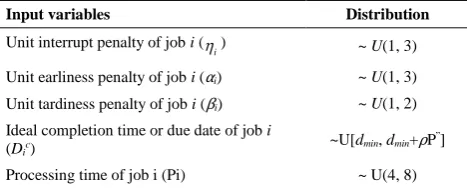
Other parameters such as earliness cost, tardiness cost and interrupt penalty have been extracted from uniform number with appropriate intervals shown in TABLE .
TABLE 3.Cost and time parameters for proposed instances
Input variables Distribution
Unit interrupt penalty of job i ( i
) ~ U(1, 3)
Unit earliness penalty of job i (αi) ~ U(1, 3) Unit tardiness penalty of job i (βi) ~ U(1, 2) Ideal completion time or due date of job i
(Dic) ~U[dmin, dmin+ρP
”]
Processing time of job i (Pi) ~ U(4, 8)
𝑑𝑚𝑖𝑛= max (0, 𝑃,,(𝜐 − 𝜌
2)) and𝑃
,,= 1/𝑀 ∑ 𝑃 𝑖 𝑁
𝑖=1 . The
expression of 𝑃,, tries to satisfy the scale invariance
criteria and regularity described in literature [40] for generating experimental scheduling instances. The two parameters and ρ are the tardiness and range parameters, respectively. υ and ρ varies between (0.5, 0.8).
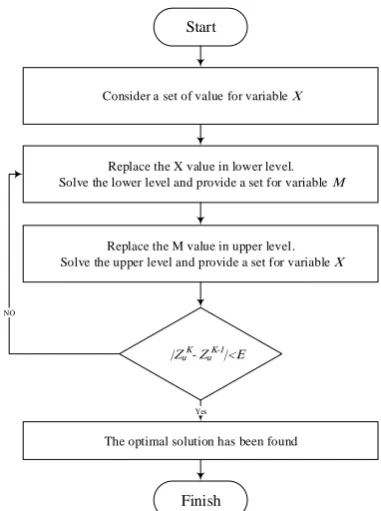
To provide the optimal results using the proposed bi-level model, a repetitive procedure is implemented. The schema of this procedure is shown in Figure . The value of E is considered to be equal to 1.
Start
Consider a set of value for variable X
Replace the X value in lower level.
Solve the lower level and provide a set for variable M
Replace the M value in upper level.
Solve the upper level and provide a set for variable X
|ZuK- ZuK-1| < E
The optimal solution has been found
NO
Yes
Finish
Figure 1. The schema of repetitive procedure for bi-level
model
For further investigation, we proposed the detail results of instance No.1.
TABLE 2. The results of proposed method for instances
Instance No. Z upper Z lower
1 7.99 26.078
2 12.33 32.45
3 16.24 49.65
4 21.36 78.95
5 29.65 94.23
Tables 5 and 6 show the value of variables Ximj and Mmj
that present the work time of machines and workers rest time, respectively.
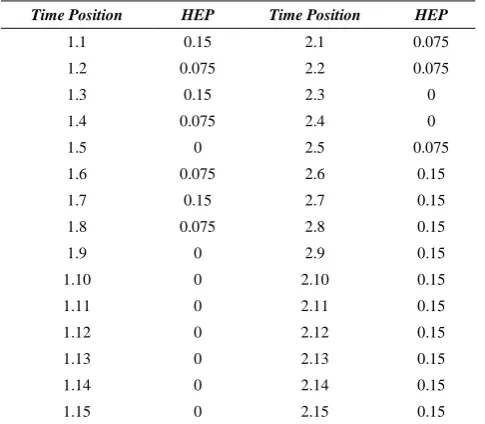
As could be seen the worker of machine 1, rests in positions 1 and 7. He also implements job 1 in positions 10-15 and job 2 in positions 5-6 and 8-9. The model tries to maintain the HEP of workers in a proper interval. The HEP value for each worker in each position is shown in TABLE 3.
The proposed results showed that the human reliability was maintained in a proper and safe interval, but the total completion time was extended because of lower level constraints, compared to when human reliability was not considered in classic job scheduling models. Using the proposed human work- rest schedule, the human error decreases and many excess costs such as rework, human injuries and poor quality were reduced.
TABLE 5. The X value for instance 1
X(i,m,j) value X(i,m,j) value X(i,m,j) value X(i,m,j) value X(i,m,j) value X(i,m,j) value
1.1.1 1.2.1 2.1.1 2.2.1 3.1.1 3.2.1 1
1.1.2 1.2.2 2.1.2 2.2.2 3.1.2 3.2.2 1
1.1.3 1.2.3 2.1.3 2.2.3 3.1.3 3.2.3 1
1.1.4 1.2.4 2.1.4 2.2.4 1 3.1.4 1 3.2.4
1.1.5 1.2.5 2.1.5 1 2.2.5 3.1.5 3.2.5 1
1.1.6 1.2.6 2.1.6 1 2.2.6 3.1.6 3.2.6
1.1.7 1.2.7 2.1.7 2.2.7 3.1.7 3.2.7
1.1.8 1.2.8 2.1.8 1 2.2.8 3.1.8 3.2.8
1.1.9 1.2.9 2.1.9 1 2.2.9 3.1.9 3.2.9
1.1.10 1 1.2.10 2.1.10 2.2.10 3.1.10 3.2.10
1.1.11 1 1.2.11 2.1.11 2.2.11 3.1.11 3.2.11
1.1.12 1 1.2.12 2.1.12 2.2.12 3.1.12 3.2.12
1.1.13 1 1.2.13 2.1.13 2.2.13 3.1.13 3.2.13
1.1.14 1 1.2.14 2.1.14 2.2.14 3.1.14 3.2.14
1.1.15 1 1.2.15 2.1.15 2.2.15 3.1.15 3.2.15
TABLE 6. The M value for instance 1
M(m,j) value M(m,j) value M(m,j) value M(m,j) value M(m,j) value M(m,j) value
1.1 1.6 1.11 2.1 2.6 1 2.11 1
1.2 1.7 1 1.12 2.2 2.7 1 2.12 1
1.3 1 1.8 1.13 2.3 2.8 1 2.13 1
1.4 1.9 1.14 2.4 2.9 1 2.14 1
TABLE 3. The HEP value for workers in Instance 1.
Time Position HEP Time Position HEP
1.1 0.15 2.1 0.075
1.2 0.075 2.2 0.075
1.3 0.15 2.3 0
1.4 0.075 2.4 0
1.5 0 2.5 0.075
1.6 0.075 2.6 0.15
1.7 0.15 2.7 0.15
1.8 0.075 2.8 0.15
1.9 0 2.9 0.15
1.10 0 2.10 0.15
1.11 0 2.11 0.15
1.12 0 2.12 0.15
1.13 0 2.13 0.15
1.14 0 2.14 0.15
1.15 0 2.15 0.15
6. CONCLUSION
In this paper, we proposed a bi-level mathematical model for production systems that deal with machine and human resources. The proposed model aim is to provide an optimal machine work scheduling considering the human resources rest time. The machine scheduling is optimized in the upper level and the human resources rest time is optimized in lower level. We considered HEP as the main factor in lower level. Performance shaping factors (PSFs) were considered to make the HEP value closer to reality. Several instances proposed to examine the model efficiency and effectiveness. The obtained results verify that the proposed model can obtain optimal work- rest schedule for machines and human resources.
7. REFERENCES
1. Alsyouf, I., "The role of maintenance in improving companies’ productivity and profitability", International Journal of Production Economics, Vol. 105, No. 1, (2007), 70-78. 2. Alsyouf, I., "Maintenance practices in swedish industries:
Survey results", International Journal of Production Economics, Vol. 121, No. 1, (2009), 212-223.
3. Pinjala, S.K., Pintelon, L. and Vereecke, A., "An empirical investigation on the relationship between business and maintenance strategies", International Journal of Production Economics, Vol. 104, No. 1, (2006), 214-229.
4. Wang, X. and Cheng, T.C.E., "A heuristic for scheduling jobs on two identical parallel machines with a machine availability constraint", International Journal of Production Economics, Vol. 161, (2015), 74-82.
5. Costa, A., Cappadonna, F.A. and Fichera, S., "Minimizing the total completion time on a parallel machine system with tool
changes", Computers & Industrial Engineering, Vol. 91, (2016), 290-301.
6. Gedik, R., Rainwater, C., Nachtmann, H. and Pohl, E.A., "Analysis of a parallel machine scheduling problem with sequence dependent setup times and job availability intervals",
European Journal of Operational Research, Vol. 251, No. 2, (2016), 640-650.
7. Sheen, G.-J., Liao, L.-W. and Lin, C.-F., "Optimal parallel machines scheduling with machine availability and eligibility constraints", The International Journal of Advanced Manufacturing Technology, Vol. 36, No. 1, (2008), 132-139. 8. Lee, J.-Y. and Kim, Y.-D., "A branch and bound algorithm to
minimize total tardiness of jobs in a two identical-parallel-machine scheduling problem with a identical-parallel-machine availability constraint", Journal of the Operational Research Society, Vol. 66, No. 9, (2015), 1542-1554.
9. Mishra, A. and Jain, M., " Maintainability policy for deteriorating system with inspection and common cause failure (technical note) ", International Journal of EngineeringTransactions C: Aspects, Vol. 26, No. 6, (2013), 631-640
10. Mokhtari, H., Noroozi , A. and Molla-Alizadeh-Zavardehi, S., " A reliability based modelling and optimization of an integrated production and preventive maintenance activities in flowshop scheduling problem ", International Journal of EngineeringTransactions C: Aspects, Vol. 28, No. 12, (2015), 1774-1781
11. Feng, Q., Li, S.-s. and Shang, W.-p., "Two-agent single machine scheduling with forbidden intervals", Applied Mathematics-A Journal of Chinese Universities, Vol. 30, No. 1, (2015), 93-101.
12. Li, W.-X. and Zhao, C.-L., "Deteriorating jobs scheduling on a single machine with release dates, rejection and a fixed non-availability interval", Journal of Applied Mathematics and Computing, Vol. 48, No. 1, (2015), 585-605.
13. Shen, L. and Gupta, J.N.D., "Family scheduling with batch availability in flow shops to minimize makespan", Journal of Scheduling, (2017). https://doi.org/10.1007/s10951-017-0529-x
14. Afzalirad, M. and Shafipour, M., "Design of an efficient genetic algorithm for resource-constrained unrelated parallel machine scheduling problem with machine eligibility restrictions",
Journal of Intelligent Manufacturing, (2015), 1-15.
15. Jamshidi, R. and Seyyed Esfahani, M.M., "Human resources scheduling to improve the product quality according to exhaustion limit", TOP, Vol. 22, No. 3, (2014), 1028-1041. 16. Qiong, Z., Yichao, G., Gong, Z., Jie, Z. and Xuefang, C., An ant
colony optimization model for parallel machine scheduling with human resource constraints, in Proceedings of the 6th cirp-sponsored international conference on digital enterprise technology, G.Q. Huang, K.L. Mak, and P.G. Maropoulos, Editors. 2010, Springer Berlin Heidelberg: Berlin, Heidelberg.917-926.
17. Bouzidi-Hassini, S., Benbouzid-Si Tayeb, F., Marmier, F. and Rabahi, M., "Considering human resource constraints for real joint production and maintenance schedules", Computers & Industrial Engineering, Vol. 90, (2015), 197-211.
18. Zhu, Z., Chu, F., Sun, L. and Liu, M., "Single machine scheduling with resource allocation and learning effect considering the rate-modifying activity", Applied Mathematical Modelling, Vol. 37, No. 7, (2013), 5371-5380.
20. Böllhoff, J., Metternich, J., Frick, N. and Kruczek, M., "Evaluation of the human error probability in cellular manufacturing", Procedia CIRP, Vol. 55, (2016), 218-223. 21. Li, X., Komeili, A., Gül, M. and El-Rich, M., "A framework for
evaluating muscle activity during repetitive manual material handling in construction manufacturing", Automation in Construction, Vol. 79, (2017), 39-48.
22. Jamshidi, R. and Maadi, M., "Maintenance and work-rest scheduling in human-machine system according to fatigue and reliability",International Journal of EngineeringTransactions A: Basics, Vol. 30, No. 1, (2017), 85-92.
23. Jaber, M.Y., Givi, Z.S. and Neumann, W.P., "Incorporating human fatigue and recovery into the learning–forgetting process", Applied Mathematical Modelling, Vol. 37, No. 12, (2013), 7287-7299.
24. Kim, T.J. and Suh, S., "Toward developing a national transportation planning model: A bilevel programming approach for korea", The Annals of Regional Science, Vol. 22, No. 1, (1988), 65-80.
25. Colson, B., Marcotte, P. and Savard, G., "Bilevel programming: A survey", 4OR, Vol. 3, No. 2, (2005), 87-107.
26. Sun, H., Gao, Z. and Wu, J., "A bi-level programming model and solution algorithm for the location of logistics distribution centers", Applied Mathematical Modelling, Vol. 32, No. 4, (2008), 610-616.
27. Yaakob, S.B. and Watada, J., Solving bilevel quadratic programming problems and its application, in Knowledge-based and intelligent information and engineering systems: 15th international conference, kes 2011, kaiserslautern, germany, september 12-14, 2011, proceedings, part iii, A. König, et al., Editors. 2011, Springer Berlin Heidelberg: Berlin, Heidelberg.187-196.
28. Wu, D.D. and Olson, D.L., Bilevel programming merger analysis in banking, in Enterprise risk management in finance. 2015, Palgrave Macmillan UK: London.145-162.
29. Cuschieri, A. and Tang, B., "Human reliability analysis (hra) techniques and observational clinical hra", Minim Invasive Ther Allied Technol, Vol. 19, No. 1, (2010), 12-17.
30. Boring R.L. and Blackman, H.S., "The origins of the spar-h method’s performance shaping factor multipliers", in Human Factors and Power Plants and HPRCT, 13th Annual Meeting, Sage Publications., (2007 of Conference), 177-184.
31. Swain, A.D., "Field calibrated simulation, proceeding of the symposium on human performance quantification in system effectiveness", National Academy Command and the National Academy of Engineering, (1967), IV-1–IV-A-21.
32. Embrey, D.E., " Slim-maud: The assessment of human error probabilities using an interactive computer-based approach.", (1984). Technical Press, Aldershot, UK
33. Miller, D.P. and Swain, A.D., "Human error & human reliability. ", In: G. Solvandy (Ed.), Handbook of Human Factor, Prude University, Wiley-Interscience, New York., (1987). 34. Williams, J.C., " Heart-a proposed method for assessing and
reducing human error, " in Procedure of the 9th Advances in Reliability Technology Symposium, , University of Bradford. (1986).
35. Cacciabue, P.C., "Modelling and simulation of human behaviour for safety analysis and control of complex systems", Safety Science, Vol. 28, No. 2, (1998), 97-110.
36. Leva, M.C., De Ambroggi, M., Grippa, D., Garis, R.D., Trucco, P. and Sträter, O., "Quantitative analysis of atm safety issues using retrospective accident data: The dynamic risk modelling project", Safety Science, Vol. 47, No. 2, (2009), 250-264. 37. Boring, R.L., "How many performance shaping factors are
necessary for human reliability analysis", in the 10th International Probabilistic Safety Assessment & Management Conference (PSAM10), Seattle, US. (2010).
38. Gertman, D., Blackman, H., Marble, J., Byers, J. and Smith, C.,
The spar-h human reliability analysis method, NUREG/CR-6883, Editor. 2005, US Nuclear Regulatory Commission: Washington.
39. Lenstra, J.K., "Interfaces between operations research and computer science", Designing decision support systems notes, Vol. 8701, (1987).
40. Hall, N.G. and Posner, M.E., "Generating experimental data for computational testing with machine scheduling applications",
Operations Research, Vol. 49, No. 6, (2001), 854-865.
Bi-level Model for Reliability based Maintenance and Job Scheduling
R.Jamshidi
School of Engineering, Damghan University, Damghan, Iran
P A P E R I N F O
Paper history:
Received 21July 2017
Received in revised form 15September 2017 Accepted 12October 2017
Keywords: Scheduling Human Error Bi-level Optimization
ديكچ ه
نا یورین شقن تیمها رما نیا هک تسا یناسنا لماع درکلمع زا یشان تاجناخراک رد اه صقن زا یرایسب یناس
د نیا ر
و یناسنا لماع هب رتشیب هجوت روظنم هب دنراد یعس ناگدننکدیلوت رتشیب .دهد یم ناشن ار اه طیحم شهاک
نا یاهاطخ یناس
کی م زین اه نیشام اب ناگدننکدیلوت لباقم یوس زا .دنیامن هئارا ار هنیهب تحارتسا و راک همانرب ا هجاو
دیاب و دن ب یراک همانر
نا هک تسا رثوم ینامز ییاه همانرب نینچ .دنیامن میظنت راک عون و اضاقت نازیم ساسا رب ار اه نآ و ناس
رد نیشام ا ای طابتر
سیس کی و دنوش یسررب رگیدکی ناسنا مت
دروم نیشام ت
نیدب یحطس ود لدم کی هلاقم نیا رد .دریگ رارق هجو روظنم
ز لیبق زا اه نیشام یزیر همانرب یاه هنیزه ات دراد یعس یطخ ریغ یضایر لدم نیا ..تسا هدش هئارا درکدو
،درکرید و
رب ار یناسنا یاطخ دوخ نییاپ حطس رد و دیامن هنیهب دوخ ییلااب حطس رد ار فقوت یاهروتکاف ساسا
ش هد لک درکلمع ی
دمآ تسدب جیاتن هک تسا هتفرگ رارق یسررب دروم لدم نیا زا هدافتسا اب لاثم یدادعت .دیامن هنیمک کاح ه
یقفوم زا ی لدم ت
![table for PSF value in the different situation and the system [38]. Table 1 shows the weight for the different manner of available time as a PSF](https://thumb-us.123doks.com/thumbv2/123dok_us/201201.2014343/3.595.307.544.444.742/table-different-situation-table-weight-different-manner-available.webp)