A b s t r a c t. The results of the experiments showed that the P treatment considerably enhanced the Zn-binding capability of acid soil. The contribution of ortho- and pyro-P to Zn binding was that they changed the structure of humus ligands in the sorbing metal-humus complexes. This was clearly demonstrated with the Fe-HA complex as a simulator of soil sorbent. New double carbon-carbon and phosphorus-oxygen bonds were discovered in the P-modified humic ligand of the Fe-HA complex. Their accumu-lation provided an explanation for the enhancement of Zn binding by P-treated soil. In addition to P=O bonds, the C=C bonds should also be considered as functional groups capable of metal ion bin-ding. Because of the greater number of electron-donor groups in the pyro-P-modified humus ligand, the pyro-P-treated soil bound Zn more firmly than the ortho-P-treated one. The dissimilar struc-ture of the control and ortho-, pyro-P-modified humus ligands had a direct relationship with the capability of microflora to adapt to the rising Zn pollution of soil. As compared with control, toxic action of Zn compounds was even enhanced by ortho-P although its addition to soil promoted the Zn binding. On the contrary, pyro-P addition to soil reduced the toxic action of Zn compounds. Con-sequently, the capability of soil to bind external Zn into inert and nontoxic compounds depends on the structural features of humus ligands in surface metal-humus complexes which are of a great importance as sorption barriers.
K e y w o r d s: humus ligand structure, phosphate fertilizers, zinc binding
INTRODUCTION
The capability of soil to bind external chemical com-pounds is mainly determined by reactions that occur at the solid-liquid interface. These reactions are controlled by the sorbent properties. Earlier studies (Borgaardet al., 1990; Gunjigake and Wada, 1981; Gerke, 1993) showed that soil metal-containing compounds, especially those of iron, are
important in the binding of anions, such as phosphate (P), and cations, such as Zn. Barrow (1986), Kudeyarova and Semenyuk (1999), Xie and MacKenzie (1990) showed that soil treatment with both ortho- and pyro-P may contribute to the enhancement of the Zn binding. It follows that pre-ceding P binding modifies the structure of sorbing surfaces and thereby influences the subsequent binding of Zn. How-ever, the relationship between P-induced surface changes and the capability of soil to bind external metals remains largely unexplored. Soil solids as sorbents for P are extensively covered with humus molecules and thus exhibit the properties of the metal-humus complexes.
There is consequently a need to examine structural features of metal-containing humus compounds under treat-ment with ortho- and pyro-P. Much attention should be gi-ven to high P additions because the use of them is the pri-mary means of overcoming soil microzonality and simula-ting soil conditions for acceleration of chemical reactions at the soil particles – phosphate solution interface. As it is known, soil P is usually distributed heterogeneously and is rather frequently in high quantities. Especially, the high total P sites are representative in heavily P-fertilized soils.
Properties of soil humus substances (HS) are of crucial importance to influence the bioavailability of metals (Men-donça and Rowell, 1996; Narwal and Singh, 1999). Compo-sition of soil microflora is primarily a function of substrate. Polysaccharides rank among the most essential constituents of soil humus (Lobartini and Tan, 1988). Because of this the preference was given to the amylolytic community to make sure that the toxicity of the Zn compounds in polluted soil can vary significantly with the humus properties.
Structural and Zn-binding features of ortho- and pyrophosphate modified soil
metal-humus sorbents (Features of P-modified humus sorbents)
A.Yu. Kudeyarova
Institute of Physicochemical and Biological Problems in Soil Science, Russian Academy of Sciences, 142290 Pushchino Moscow Region, Russia,
Received March 4, 2002; accepted April 22, 2002
© 2002 Institute of Agrophysics, Polish Academy of Sciences
*Corresponding author’s e-mail: [email protected]
A A
Agggrrroooppphhyhyysssiiicccsss
w w
The aims of the research were: (1) to reveal the changes induced by ortho- and pyro-P in the structure of Fe-contai-ning humus sorbents, and (2) to show their effect on extrac-tability and toxicity of the resulting Zn compounds in a range of Zn additions to soil.
MATERIALS AND METHODS
A soil sample was taken from the humus horizon of a grey forest soil (humic luvisols). The chemical parameters of the initial soil were the following: pHKCl– 4.57, base
saturation degree – 50 %, total carbon content – 1.3 %, content of total and organic P in the 0.1N NaOH extract – 34.7 and 31.4 mg/100 g, respectively. After sampling, the soil was air-dried and crushed to pass through a 1-mm sieve. The levels of Zn additions to soil were 0, 1, 2, 5, 10, 20, 50, 100, 200, 500 mg Zn/100 g. Zinc was added to original soil and soil treated with KH2PO4or K4P2O7at the rates of 0,
5.5, 21.8, 65.5 and 174.5 mg P/100 g. High additions of both Zn and P were used to simulate the microzonal accumulation of chemicals in soil. After 1 day of incubation at 25° C and moisture content adjusted to 55% WHC, all the soil samples were divided into two parts.
One part of the soil samples was dried in air and sub-sequently used for chemical analyses. Zinc was extracted with 0.1 N NH4Cl (1:80, soil to solution ratio) and its
concentration in the extract was measured using the atomic absorption method with a Perkin-Elmer instrument. The 0.1 N NaOH soil extracts (1:20, soil to solution ratio) were used: (1) to measure the concentrations of soluble Fe and P, (2) to determine optical density (spectrophotometrically at 400 nm), (3) to record electronic spectra of alkali-soluble HS in the region from 200 to 800 nm using the UV-VIS Specord spectrophotometer, (4) to compare control and P-modified alkali-soluble HS for the amount of C=C bonds using the test with permanganate solution (the volumes of 0.1 N NaOH extracts expended to decolourize 10 ml of 0.001 N KMnO4 were noted).
To determine the total contents of Fe and P in 0.1 N NaOH extracts, the extract aliquots were amalgamated with a mixture (3:1) of H2SO4and HClO4. The concentration of
Fe was measured using the atomic absorption method. The concentration of P was determined in accordance with Mur-phy and Riley (1962). To precipitate HA, the 0.1 N NaOH extract from the original soil was acidified with dilute HCl to pH 1.3–1.5. The HA separated was treated with FeCl3to
prepare Fe-HA complex. The FeCl3treatment provided C:
Fe ratio of 1:6. The complex prepared was treated for five weeks with KH2PO4and K4P2O7. The P solution was added to the Fe-HA complex to have a C:P ratio of 1:12. The value of pH for each system was 4.1. Control complex and P- mo-dified organic solids were used for the infrared examination (KBr – technique) using the Specord M-80 spectropho-tometer.
The second part of the soil samples after 1 day of incu-bation was used for microbiological testing in accordance with the technique of Guzevet al.(1980). Each sample was subdivided into six equal portions to be placed in six Petri dishes. Soil surfaces in Petri dishes were coated with starch to stimulate soil amylolytic microflora. Three weeks after the soil incubation at a constant temperature and moisture, the identification of amylolytic species was carried out together with visual estimation of the area occupied by each species.
RESULTS AND DISCUSSION
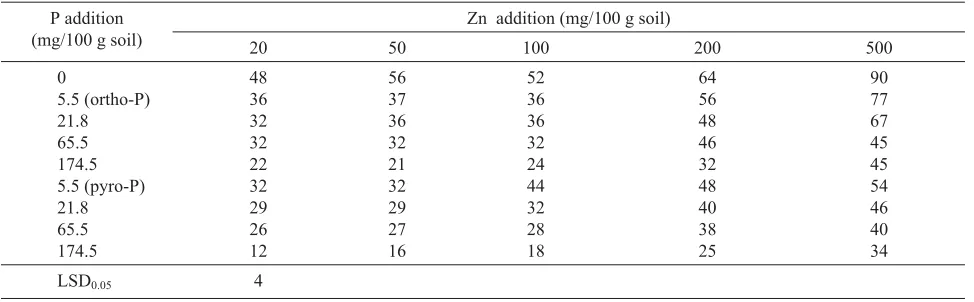
Table 1 shows that P treatment of soil considerably decreased the extractability of Zn by 0.1 N NH4Cl. That is,
the capability of soil to bind external zinc increased under the influence of P. The degree of Zn binding was directly dependent on the P content in soil and was higher when pyro-P was added.
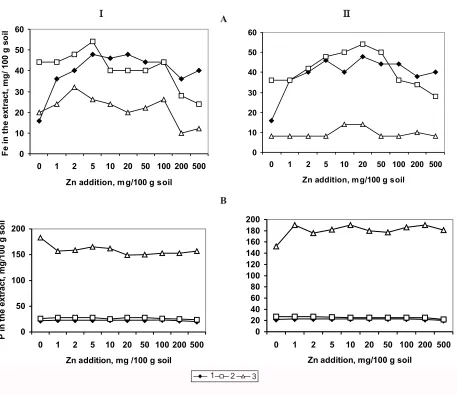
As shown in Fig. 1, the P treatment level had a different effect on the reactivity of soil Fe-containing humus surfaces. Thus, P added at a rate of 5.5 mg/100 g to Zn-control and
P addition (mg/100 g soil)
Zn addition (mg/100 g soil)
20 50 100 200 500
0
5.5 (ortho-P) 21.8 65.5 174.5 5.5 (pyro-P) 21.8 65.5 174.5
48 36 32 32 22 32 29 26 12
56 37 36 32 21 32 29 27 16
52 36 36 32 24 44 32 28 18
64 56 48 46 32 48 40 38 25
90 77 67 45 45 54 46 40 34
LSD0.05 4
slightly Zn-polluted soil promoted theincrease in the extrac-tability of Fe by 0.1 N NaOH (Fig. 1A). On the contrary, P (especially pyro-P) added to soil at a rate of 174.5 mg/100 g decreased extractability of Fe independently of Zn pollution level. Iron atoms in highly P-saturated HS were more strongly held by chemical bonds to pass into alkali solution, indicating that some structural changes were induced by P in sorbing compounds. It is apparent that the degree of Fe ex-tractability was governed by the amount of P incorporated into humus macroligand (Fig. 1B).
The colour of 0.1 N NaOH extract became more and more dark as the soil’s total P increased (Table 2). So, it is apparent that chromophore groups accumulate in humus molecules, mainly in the HA fraction. Test results for the C=C bonds showed (Table 3) that the volume of 0.1 N NaOH extract required to decolourize KMnO4solution was
smaller if humus molecules were P-modified. This test demonstrates the increase in the number of double carbon-carbon bonds in P-modified HS. Since aromatic cores are
not able to decolourize permanganate solution, it is evident that additional C=C bonds fell within the ring side chains.
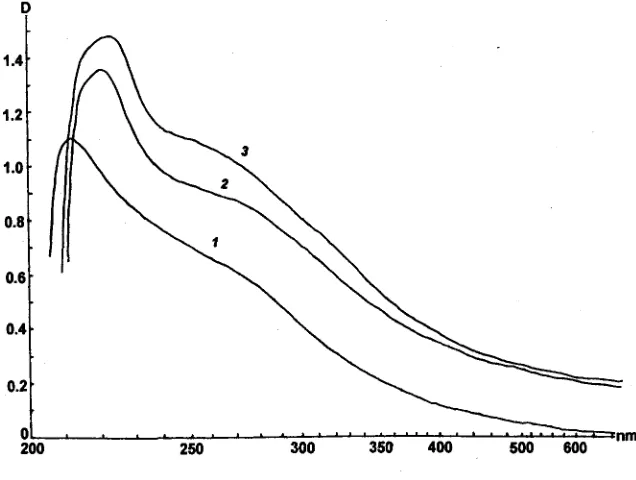
The electronic spectra (Fig. 2) showed the pronounced effect of P on the electron energy state in the extractable HS. Judging from the increased excitability of the molecular
0 10 20 30 40 50 60
0 1 2 5 10 20 50 100 200 500
Zn addition, m g/100 g soil
F
e
in
th
e
ext
ract
,
m
g
/
100
g
s
o
il
0 10 20 30 40 50 60
0 1 2 5 10 20 50 100 200 500
Zn addition, m g/100 g soil
0 50 100 150 200
0 1 2 5 10 20 50 100 200 500
Zn addition, mg /100 g soil
P
in
the
extract,
m
g/100
g
soil
1 2 3
0 20 40 60 80 100 120 140 160 180 200
0 1 2 5 10 20 50 100 200 500
Zn addition, mg/100 g soil
1 2 3
Fig. 1.Soluble Fe and P in 0.1 N NaOH extract depending on Zn and P addition to soil: A) Fe, B) P; I) ortho-P, II) pyro-P; 1) P – control
soil, 2) 5.5 mg P/100 g, and 3) 174.5 mg P/100 g.
P addition ( mg /100 g
soil)
Before precipitation of HA (a cell layer 2 mm)
After precipitation of HA (a cell layer 20 mm)
0 5.5 21.8 65.5 174.5
0.19 0.28 0.35 0.48 0.59
0.23 0.23 0.24 0.30 0.37
LSD0.05 0.04 0.03
T a b l e 2. Optical density of 0.1 N NaOH extracts (at 400 nm) depending on ortho-P addition
A
electronic system by UV radiation, P (pyro-P to a greater degree) increased the mobility of electrons in the humus molecules. This fact suggests the P-induced structural mo-dification of the molecules. The P-induced spectral changes are most pronounced in the short-wavelength region of UV spectrum (210–230 nm). The absorption band in this region is attributed to thep®p * – transition ofp -electrons of the C=C bonds. Bathochromic band shift observed in the spectra of P-treated HS can be indicative of the occurrence of additional C=C bonds in the side chains. This is consistent with the results of chemical test (Table 3).
Another P-induced spectral change was observed in more long-wavelength UV region (250–350 nm) (Fig. 2). The second (slight) absorption band in the UV region of spectrum can be attributed to the n®p * – transition of n-electrons possessed by the nucleophilic atoms (oxygen, for one, in the C=O group and heteroanalogs). Hypso-chromic shift of this absorption band in the spectra of
P-modified HS could probably be due to the occurrence of the P=O groups which are more polar than the C=O groups.
The experimental results clearly demonstrate the P-induced changes in the structure of humus molecules. The changes observed suggest that there is an accumulation of both additional C=C groups and new O-containing (pro-bably P=O) groups. To confirm this suggestion, the Fe-HA complex was tested as the metal-humus sorbent for P anions. Figure 3 shows that control and P-modified complex solids differed structurally. There are the absorption bands at 1610 and 1402 cm–1in the control IR spectrum (Fig. 3B) which correspond to the coordinated C=O group (Bellamy, 1975). The P treatment of complex resulted in the disappearance of these frequencies. At the same time, some new absorption bands arose in the spectra of the Fe-HA complex treated with ortho- and pyro-P (Fig. 3C and D). Among them are the bands in the range from 1340 to 1170 cm–1which can be attributed to the vibration frequencies of the P=O groups having the dissimilar surroundings. Besides, there is the absorption band at 1664 or 1646 cm–1which can be attribu-ted to the vibration frequency of the C=C groups.
The data obtained proves the possibility of formation of new double carbon-carbon and phosphorus-oxygen bonds in the P-modified HA ligand of the Fe-containing complex through the substitution of prior carbonyl groups. New C=C and P=O bonds, as having a free pair ofp - and n-electrons respectively, should be considered as electron-donor (fun-ctional) groups. Their formation could be responsible for the enhancement of the Zn binding by the P-treated soil.
P treatment of soil Volume (ml)
P – control soil
Ortho-P, 65.5 mg P /100 g soil Pyro-P, 65.5 mg P /100 g soil
3.3 2.8 1.5
LSD0.05 0.3
T a b l e 3.Volume of 0.1 N NaOH extract required to decolourize 0.001 N KMnO4
Fig. 2.Electronic spectra of alkali-soluble HS (0.1 N NaOH as a reference): 1) P- control soil, 2) ortho-P-modified, 3) pyro-P- modified (P
The possible contribution of the C=C groups to Zn bin-ding is supported by experimental data on the Fe binbin-ding (Fig. 3A and B). Thus, the absorption band at 1660 cm–1 corresponding to the C=C vibration is only observed in the IR spectrum of initial HA. In the spectrum of the FeCl3
-treated HA this band is absent but there is the absorption band at 432 cm–1which can be attributed to Fe-C vibration (Bellamy, 1975). Spectral features testify to the fact that the C=C groups are capable of metal binding.
As for the P=O groups, it is known that phosphoryl compounds are more capable of metal complexation than carbonyl ones. This fact is in agreement with the data on Zn binding by P-treated soil (Table 1). As is evident from the Table 1, the pyro-P-treated soil bound Zn more firmly than the ortho-P-treated soil. Figures 3C and D show that the ortho- and pyro-P-modified humic ligands exhibited dissi-milar infrared features, mainly in the region of 1340–1170 cm–1which can be assigned to P=O vibrations. There were two absorption bands in this region of each discrete spec-trum. This fact is probably indicative of two P isomers. Besides, the different P=O vibration frequencies in the IR
spectra of the ortho- and pyro-P-modified humic ligands suggest the dissimilarity of substitutes at P atoms.
The dissimilar arrangement of ortho- and pyro-P- modi-fied humic acid ligand in Fe complex would be expected to influence the toxicity of the Zn compounds resulting from the Zn additions to P-treated soil. The toxicity of heavy metal compounds may be shown by the changes in species composition of native active communities of microorga-nisms. The approach developed by Guzev et al. (1980) allows the study of the species succession resulting from the appearance of harmful products in polluted soil.
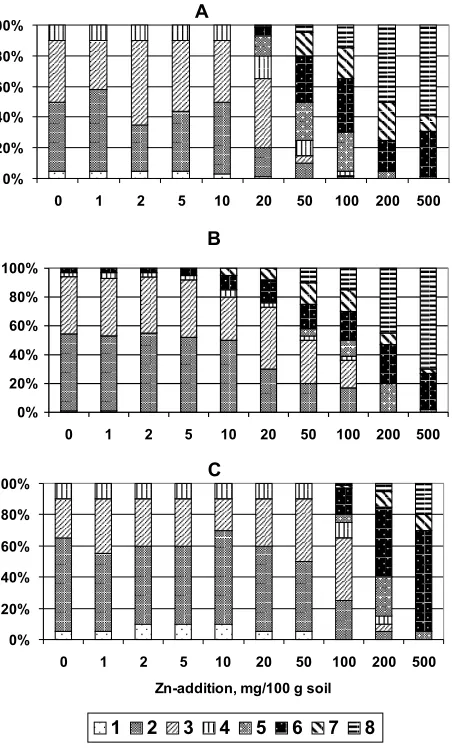
Figure 4 shows that the treatment of soil with ortho- or pyro-P produced a strong but dissimilar effect on the capability of amylolytic microflora to adapt to a rising Zn
A
0% 20% 40% 60% 80% 100%
0 1 2 5 10 20 50 100 200 500
B
0% 20% 40% 60% 80% 100%
0 1 2 5 10 20 50 100 200 500
C
0% 20% 40% 60% 80% 100%
0 1 2 5 10 20 50 100 200 500
Zn-addition, mg/100 g soil
1 2 3 4 5 6 7 8
Fig. 4. The composition of amylolytic community depending on
Zn and P addition to soil (%): A) P – control soil; B) ortho-P, 174.5 mg P/100 g soil; C) pyro-P, 174.5 mg P/100 g soil; 1) Strepto-myces;2)Humicola;3)Oidiodendron; 4)Actinomucor;5) Verti-cillium;6)Penicilliumsp.; 7)Pen. vermiculatum;8)Pen. funi-culosum.
Fig. 3. IR – spectra: A) HA, B) Fe-HA complex, C) ortho-P
pollution level. So, ortho-P in no way reduced the stress caused by Zn pollution of soil even though it contributed greatly to the Zn binding (Table 1). On the contrary, the ortho-P treatment enhanced the toxic effect of Zn. Some colonies ofPen. vermiculatumemerged in the P-treated soil at a rate of 10 mg Zn/100 g. At the same time, in P-control soil such species emerged at a rate of 50 mg Zn/100 g soil. It should be also noted that certain colonies of Penicillium species (Pen. sp.) appeared in soil at a zero level of Zn pollution but with 174.5 mg P/100 g. This fact suggests that the ortho-P-modified HS alone might account for the appearance ofPenicilliummicroflora.
The effect of pyro-P differed from that of ortho-P on the toxicity of Zn compounds to amylolytic microflora (Fig. 4). In comparison with ortho-P, pyro-P at a rate of 174.5 mg P/100 g contributed to the considerable widening of the homeostasis zone of the native soil amylolytic community (to Zn level of 100–200 mg/100 g). Referring to Figs 2 and 3, the humic ligand transformations induced by ortho-P and pyro-P resulted in the formation of structurally dissimilar products. The results, thus, prove that the toxicity of Zn compounds in the Zn-polluted soil greatly depended on structural features of humus ligands in sorbing HS, namely, on the number and specificity of the functional groups as well as their surroundings.
CONCLUSIONS
The degree of Zn binding by acid soil considerably enhanced under the treatment with ortho-P and especially pyro-P. The contribution of P to Zn binding was that they changed the structure of humus ligands in the sorbing metal-humus complexes. This was clearly demonstrated with Fe-HA complex as a simulator of soil sorbent. New double carbon-carbon and phosphorus-oxygen bonds were discovered in the P-modified humic ligand of Fe-HA complex. Their accumulation provided an explanation for the enhancement of Zn binding by P-treated soil. In addition to P=O bonds, the C=C bonds should be also considered as functional groups capable of metal ion binding. Because of the greater number of electron-donor groups in the pyro-P-modified humus ligand, the pyro-P-treated soil bound Zn more firmly than the ortho-P-treated one. Dissimilar struc-ture of the control and ortho-P-, pyro-P-modified humus ligands had a direct relationship to the capability of
micro-flora to adapt to a rising Zn pollution of soil. As compared with control, the toxic action of Zn compounds was even enhanced by ortho-P although its addition to soil promoted the Zn binding. On the contrary, pyro-P addition to soil re-duced the toxic action of Zn compounds. Consequently, the capability of soil to bind external Zn into inert and nontoxic compounds depends on the structural features of humus ligands in surface metal-humus complexes which are of a great importance as sorption barriers.
REFERENCES
Barrow N.J., 1986.Testing a mechanistic model. VI. Molecular
modelling of the effects of pH on phosphate and on Zinc retention by soils. J. Soil Sci., 37, 311–318.
Bellamy L.J., 1975.The Infrared Spectra of Complex Molecules.
Chapman and Hall, London.
Borggaard O.K., Jorgensen S.S., Moberg J.P., and
Raben-Lange B., 1990.Influence of organic matter on phosphate
adsorption by aluminium and iron oxides in sandy soils. J. Soil Sci., 41, 443–449.
Gerke J., 1993.Phosphate adsorption by humic/Fe-oxide mixtures
aged at pH 4 and 7 and by poorly ordered Fe-oxide. Geo-derma, 59, 279–288.
Gunjigake N. and Wada K., 1981.Effect of phosphorus
concen-tration and pH on phosphate retention by active aluminum and iron of ando soils. Soil Sci., 132, 347–352.
Guzev V.S., Bondarenko N.G., Byzov B.A., Mirchink T.G., and
Zviagintsev D.G., 1980.The structure of initiated microbial
cenosis as an integral method for evaluating the micro-biological state of soil (in Russian). Microbiology, 49, 134– 140.
Kudeyarova A.Yu. and Semenyuk N.N., 1999.Chemical and
microbiological aspects of the buffering capacity of gray forest soil under zinc contamination. Eurasian Soil Sci., 32, 199–208.
Lobartini J.C. and Tan K.H., 1988.Differences in humic acid
characteristics as determined by carbon-13 nuclear magnetic resonance, scanning electron microscopy, and infrared analysis. Soil Sci. Soc. Am. J., 52, 125–130.
Mendonça E.S. and Rowell D.L., 1996.Mineral and organic
frac-tions of two oxisols and their influence on effective cation-exchange capacity. Soil Sci. Soc. Am. J., 60, 1888–1892.
Murphy J. and Riley J.P., 1962.A modified single solution
me-thod for determination of phosphate in natural waters. Anal. Chim. Acta, 27, 31–36.
Xie R.J. and MacKenzie A.F., 1990.Zinc sorption, desorption,