A polio intervention in East African refugees
to NSW
Abstract: This paper summarises a public health intervention in Sydney, NSW in late 2006 that resulted from the potential exposure of a number of refugees to polio virus while in transit in Nairobi, Kenya. The intervention involved the attempted follow-up of 113 persons at risk, assessment for symptoms and immunisation where indicated. No symptomatic cases were found. Seventy-five people were immunised with inactivated polio myelitis vaccine. The intervention highlighted the impor-tance of close collaboration between health services, the Department of Immigration and Citizenship and settlement service agencies, and provided several lessons to consider when assessing newly arrived refugees.
Mitchell M. Smith
A,Cand Sanjyot Vagholkar
BANSW Refugee Health Service
BGeneral Practice Unit, Fairfield Hospital and School of Public Health and Community Medicine, University of NSW CCorresponding author. Email: [email protected]
NSW PUBLIC HEALTH BULLETIN
Vol. 20(5–6) • May–June 2009State Health Publication ISSN 1034 7674
w w w. p u b l i s h . c s i r o. a u / j o u r n a l s / p h b CONTENTS – See back page
New South Wales (NSW) receives between 3000 and 4000 permanent refugee settlers each year.1In the past 5 years,
nearly 43% of these have come from African countries, in particular the Sudan but also Sierra Leone, Liberia, Burundi and others.1
In October 2006, the then Department of Immigration and Multicultural Affairs (DIMA), now known as the Department of Immigration and Citizenship, was notified of a confirmed case of polio in a girl in Dadaab refugee camp
in northern Kenya.2A small number of refugees from the
Dadaab camp had come to Australia in the period of concern. Additionally, a number of refugees from other camps (mainly in Kenya and Tanzania) had passed through the International Organization for Migration (IOM) Transit Centre in Kilmani, Nairobi, and had potentially been in contact with refugees from the Dadaab region.
A subcommittee of the Communicable Diseases Network of Australia (CDNA) met and, in consultation with DIMA, recommended that refugees who may have come into contact with polio be assessed for signs and symptoms of the disease and be vaccinated if appropriate. A similar inter-vention was underway in the United States.3
In the latter part of 2006, NSW had not received any refugee settlers from Dadaab camp, but received 113 people who had transited through Nairobi in the period in question. It was recognised that not everyone who passed through Nairobi en route to Australia had actually been in the transit camp, so not all were deemed at risk.
Planning
Advice concerning the intervention was received from CDNA. Refugees who had passed through the transit centre in Nairobi before arrival in Australia would:
78 | Vol. 20(5–6) 2009 NSW Public Health Bulletin
• be clinically assessed for signs or symptoms of polio and, if indicated, have a stool specimen collected for polio testing;
• have polio vaccination(s) as per age; and
• be given hand washing advice (including a fact sheet from CDNA).
People living in the same household (other than refugee family members) were to be assessed and treated in a similar manner.
DIMA provided advice about the settlement locations of those refugees requiring follow-up. The refugees were dispersed across three area health services as follows:
• Sydney West Area Health Service, 70 refugees; • Sydney South West Area Health Service, 20 refugees;
and
• Wollongong region, South Eastern Sydney Illawarra Area Health Service, 23 refugees.
Ten family units (ranging in size from one to nine people) had arrived under refugee visas (subclass 200) and were therefore in direct contact with the DIMA-funded settle-ment service, the Australian Centre for Languages (ACL).4,5 Eighteen family units had arrived on Special
Humanitarian Program visas, having been sponsored: their initial settlement needs were met by family members or other sponsors.4 Arrivals in the latter
category are historically more difficult to contact and engage.
A teleconference was held on 31 October 2006 between the NSW Department of Health, relevant public health unit directors and the NSW Refugee Health Service with the following outcomes:
• a protocol was drafted outlining roles and
responsibilities for public health units, the Refugee Health Service and ACL;
• the Refugee Health Service was tasked with co-ordinating the intervention;
• the Refugee Health Service and each of the three relevant public health units were to consider the most suitable arrangements for local service provision and data collection; and
• no proactive media involvement was planned, for fear of stigmatisation.
The State Vaccine Centre was contacted and it advised that 170 doses of inactivated poliomyelitis vaccine (IPV) were in stock.
Intervention
A mix of arrangements for service provision was made depending on numbers to be seen and the existing services in each area health service:
Sydney West Area Health Service
• Clinics (staffed by the public health unit and Refugee Health Service) held at community health centres; • Existing outpatient clinic for refugee children at the
Children’s Hospital, Westmead;
• Routine Refugee Health Service clinics; and • Home visits by public health unit staff. Sydney South West Area Health Service
• General Practice Unit, Fairfield Hospital, assisted by public health unit staff;
• General practitioners; and
• Routine Refugee Health Service clinic.
South Eastern Sydney Illawarra Area Health Service • General practitioners.
Close liaison was required with ACL to identify current addresses of the refugee settlers, inform them of the need to be assessed and assist with transporting people to the various locations. Immunisation status was assessed through documentation (rarely present) or history.
Outcomes
Other logistic challenges included:
• some new arrivals frequently moving house; • large families (up to nine people);
• the short timeframe for implementation of the intervention prevented translation of the fact sheets, so information about polio and personal hygiene was given verbally through interpreters or settlement workers who spoke the appropriate language; • insufficient availability of suitably qualified
interpreters;
• transport needs, including the need for staff or volunteers to accompany the refugees to clinics; • limited capacity of ACL staff to assist due to an ongoing need to assist other new arrivals during the period;
• IPV not being held by general practitioners, requiring transport of the vaccine to general practice
clinics; and
• difficulties ascertaining past history of vaccination among the refugees, including a lack of
documentation.
The episode did not attract any media attention. This was seen as a positive outcome for the refugee settlers, given that in the past there has been unwarranted concern about refugee settlers and imported infectious diseases.6
Discussion
This was the first time, to our knowledge, that a targeted follow-up of refugee entrants had occurred in NSW in response to a specific disease concern. Despite the logis-tic challenges outlined, the majority of those needing to be assessed were seen and immunised where appropriate. The willingness of general practitioners and various hos-pital, community health and public health unit staff to be involved was vital during this intervention. The NSW Refugee Health Service acted as a central co-ordination point and this was seen as useful, particularly because the Service had existing links with local DIMA staff, settle-ment service providers, public health units, the General Practice Unit at Fairfield Hospital and other relevant service providers.
A number of lessons were learnt from this public health intervention. In a similar situation in the future, we would recommend:
• direct contact between health service staff and
patients in preference to contact via settlement service (e.g. ACL) staff, to help ensure that health
information being communicated is appropriate, and to facilitate logistic arrangements;
• that specific additional resources be made available to settlement services for such an intervention, as these services play an important liaison role;
• access to an adequate number of volunteers with suitable transport to get newly arrived refugees to health services efficiently;
• timely efforts at the national level to enhance
interpreter availability for certain minority languages; • increased information for mainstream health staff in
this setting to help sensitise them to working with traumatised, newly arrived refugee families;
• more communication in the early stages involving all relevant agencies, which would help to identify logistic barriers and to share potential solutions; and
A polio intervention in East African refugees to NSW
Table 1. Characteristics of refugees arriving in NSW from the International Organization for Migration Transit Centre in Kilmani, Nairobi assessed for polio (nⴝ85) in 2006
N %
Gender Males 47 55
Age group (as per vaccine needs) ⬍8 years 19 22
8–14 years 21 25
15⫹years 45 53
Citizenship Sudan 46 54
Burundi 33 39
Stateless 6 7
Residence (area health service) Sydney West 43 51
South Eastern Sydney Illawarra 23 27
Sydney South West 19 22
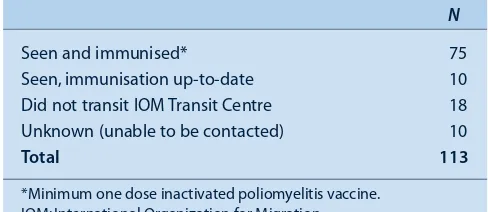
Table 2. Follow-up of refugees to NSW potentially exposed to polio in Nairobi, late 2006
N
Seen and immunised* 75
Seen, immunisation up-to-date 10
Did not transit IOM Transit Centre 18
Unknown (unable to be contacted) 10
Total 113
80 | Vol. 20(5–6) 2009 NSW Public Health Bulletin
• that a detailed protocol covering roles and
responsibilities for health and non-health agencies be prepared to assist implementation of the intervention. The intervention highlighted the fact that even with resource-intensive pursuit of individuals and families, not all newly arrived refugees can necessarily be tracked down. This has implications for other disease outbreaks requiring rigorous follow-up, and for routine screening of certain conditions among new arrivals to NSW.
Conclusion
This intervention relating to poliomyelitis assessment and immunisation was ultimately successful, yet it presented a number of logistical and other challenges for those involved. It is likely that there will be further interventions of this type in the future, requiring interaction between clinical and public health staff and agencies involved with newly arrived refugees. Lessons from this event may inform the response to similar episodes.
Acknowledgments
The authors would like to thank medical, nursing and administrative staff from all health services that contributed to this intervention. The support and liaison provided by Dr Kathy King and other staff from the Department of Immigration and Citizenship is appreciated. The vital assistance from ACL settlement service staff is also warmly acknowledged.
References
1. Australian Government Department of Immigration and Citizenship. New South Wales: settlement trends and needs of new arrivals 2007. Belconnen: Commonwealth of Australia;
2007. Available from: http://www.immi.gov.au/living-in-australia/delivering-assistance/government-programs/ settlement-planning/_pdf/trends_needs_nsw.pdf (Cited 23 November 2008.)
2. World Health Organization. Wild poliovirus confirmed in Kenya after 22 years. Kenya Weekly Bulletin. Nairobi: World Health Organisation; 2006. Available from: https://www.who. int/hac/crises/ken/sitreps/Kenya_Weekly_Bulletin_15Oct2006. pdf (Cited 23 November 2008.)
3. Centers for Disease Control and Prevention. Recommendations for remaining U.S. bound refugees in Dadaab, Kenya refugee camps following the reported case of poliomyelitis in the camp. Atlanta: Centers for Disease Control and Prevention; 2006. Available from: http://www.cdc.gov/ncidod/dq/refugee/ response/pdf/polio_recs_11_24_06.pdf (Cited 23 November 2008.)
4. Australian Government Department of Immigration and Citizenship. Fact Sheet 60: Australia’s Refugee and
Humanitarian Program. Canberra: Department of Immigration and Citizenship; 2008. Available from: http://www.immi. gov.au/media/fact-sheets/60refugee.htm (Cited 23 November 2008.)
5. Australian Government Department of Immigration and Citizenship. Fact Sheet 66: Integrated Humanitarian Settlement Strategy. Canberra: Department of Immigration and
Citizenship; 2008. Available from: http://www.immi.gov.au/ media/fact-sheets/66ihss.htm (Cited 23 November 2008.)
6. AAP. ‘Hanson turns on “diseased” Africans’, Sydney Morning
Herald, 6 December 2006. Available from: http://www.smh.
After a virtual absence of endemic measles transmission in Australia for 3 years, a large outbreak began in Sydney in March 2006. Measles vaccination rates in Australia have gradually increased since 1968, when single dose
The effectiveness of prophylaxis for measles
contacts in NSW
Abstract: Objectives: As international estimates of the effectiveness of post-exposure prophylaxis of measles vary, we sought to determine the effec-tiveness of post-exposure prophylaxis with either vaccine or immunoglobulin in susceptible persons with known measles contact. Methods: Data were obtained on all cases of measles notified in NSW between 1 March and 31 May 2006 and their contacts. The effectiveness of prophylaxis was cal-culated using the cohort method. Results: During March to May 2006, 57 cases of measles were notified and 1760 measles contacts were identified, of which 553 were classified as susceptible. The calculated effectiveness of post-exposure prophylaxis with vaccine or immunoglobulin in preventing measles was 83.3% (95% CI: 27–96%). Conclusion: Post-exposure immunisation remains an effective tool for preventing secondary cases of measles.
Vicky Sheppeard
A,B,F, Bradley Forssman
C,
Mark J. Ferson
D, Conrad Moreira
B,
Sue Campbell-Lloyd
A, Dominic E. Dwyer
Eand Jeremy M. McAnulty
AACentre for Health Protection, NSW Department of Health BCentre for Population Health, Sydney West Area Health Service CSchool of Public Health, University of Sydney
DPublic Health Unit, South Eastern Sydney Illawarra Area Health Service and School of Public Health and Community Medicine, University of NSW
ECentre for Infectious Diseases and Microbiology Laboratory Services, Institute of Clinical Pathology and Medical Research, Westmead Hospital
FCorresponding author. Email: vicky.sheppeard@ swahs.health.nsw.gov.au
measles vaccine was first made available for infants.1A
second dose was introduced in New South Wales (NSW) for adolescent girls in 1992 and for boys in 1994. Since 1999, the vaccine has been recommended for children at 12 months and 4 or 5 years of age combined with mumps and rubella vaccine (MMR). In 1998, a school-based catch-up program provided a second MMR dose to primary school children.2By 2005, measles notifications
in Australia had declined to the lowest ever recorded, and the NSW vaccination coverage rate was stable at around 94% for first dose and 89% for two doses.3
Measles is a notifiable condition in NSW, and public health follow-up involves interviews with the affected person or carer, advice about minimising spread to others, identification of exposed contacts, and provision of pro-phylactic immunisation, using either measles-containing vaccine (within 72 hours of exposure) or normal human immunoglobulin (NHIG) within 7 days of exposure.4
Measles may be infectious for many days before the diag-nosis is made therefore many people may be exposed. Public health follow-up can be resource intensive but there are few data to indicate its effectiveness, and practice varies from country to country.
Recent analyses published by the United States (US) Centers for Disease Control and Prevention have confirmed the effectiveness of NHIG when given as post-exposure prophylaxis (PEP) at a dose of 0.25 mL/kg up to 6 days after contact; however, one case occurred from those given MMR as prophylaxis.5,6A review in Japan raised some
concerns regarding the efficacy of NHIG in children when used at a dose of 0.33 mL/kg up to 5 days after exposure.7
We used the opportunity of measles outbreaks during March, April and May 2006 to assess the effectiveness of PEP.8
Methods
We obtained data on all notified cases of measles onset between 1 March and 31 May 2006 in NSW residents. We also included data on two residents of other states who acquired measles in NSW and required public health control activities by NSW public health units.
82 | Vol. 20(5–6) 2009 NSW Public Health Bulletin
the presence of a compatible clinical illness, or detection of measles virus by immunofluorescence (IF) or reverse transcriptase-polymerase chain reaction (RT-PCR) or measles virus culture); or clinical (fever and/or cough and/or coryza and/or conjunctivitis and maculopapular rash) with an epidemiological link to a laboratory-confirmed case.4
All measles-specific IgM antibody tests were either per-formed initially or confirmed at a reference laboratory. Measles virus IF was performed on acetone-fixed smear swabs stained with measles-specific monoclonal antibod-ies and RT-PCR using primers to the measles nucleoprotein region on nasal or pharyngeal specimens, as previously described.9
Surveillance officers collected data on symptoms and signs of cases through interview of cases (or their parents) and their health-care providers, and recorded on a standard reporting form. Case interviews were also used to identify possible contacts.
A contact, as defined in the NSW Health protocol, was anyone who was in the same room as the case, or the same room for up to 2 hours after, during the infectious period.4
All contacts included in this study were Australian resi-dents. Susceptible contacts, i.e. people who were considered to have inadequate immunity to measles, were defined according to Australian guidelines as:
• infants from 6–12 months of age;
• children aged 1–4 years who had not received any doses of MMR; and
• children aged over 4 years, and adults born during or after 1966, who had not received two doses of MMR.10
Contacts identified as susceptible were offered post-exposure prophylactic immunisation with either MMR within 3 days of exposure, or NHIG within 7 days of exposure.
Other public health actions included:
• advising contacts about the symptoms of measles and how to avoid infecting other people;
• utilising mass media messages;
• enhanced surveillance using direct communication via faxes to general practitioners, hospitals, child-care centres and laboratories to raise awareness of the outbreak; and
• extension of eligibility for free MMR vaccine from general practitioners to all susceptible persons in NSW from 18 May 2006.
Data on cases, contacts and prophylaxis were collated using Microsoft Excel 2000 (Microsoft Corporation).
Prophylaxis effectiveness (PE) was calculated using the cohort method:
PE⫽((ARU⫺ARP)/ARU)⫻100)
where ARU represents the attack rate in susceptible con-tacts not receiving prophylaxis and ARP is the attack rate in susceptible contacts who received prophylaxis.11Taylor
series 95% confidence intervals were calculated around the relative risk, and then converted to PE confidence intervals.12
Rates of secondary cases in contact groups were compared using Fisher’s exact test in EpiInfo 3.5.1 (Centers for Disease Control and Prevention).
Results
Description of the outbreak
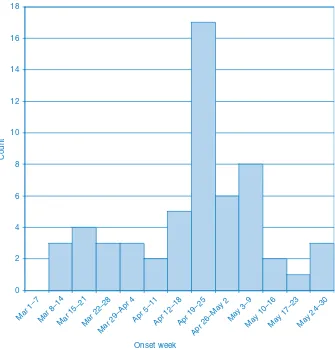
Fifty-seven cases of measles were reported during the 3-month period (Figure 1). A description of the first 2 months of the outbreak has been reported elsewhere.8,13
Of the 57 cases, four (7%) were aged under 1 year, 19 (33%) 1–4 years, 14 (25%) 5–14 years, 18 (32%) 15–40 years and 2 (4%) over 40 years. Thirteen (23%) required hospitalisation. Hospital admission was more common in infants and adults (38%) than in children aged 1–14 years (12%).
Public health interventions
In total, 1760 contacts were identified, an average of 31 contacts per case. Five hundred and fifty-three contacts (31%) were defined as susceptible to measles. Twelve patients spent time in busy hospital emergency depart-ments while infectious and prior to being diagnosed, resulting in 1139 of these identified contacts.
Early in the outbreak, delays in clinical and laboratory confirmation of measles and case notification as well as delays in identification of potential contacts, meant that prophylactic immunisation for contacts within the recom-mended 7 days of exposure was often not possible.4 For
example, an early case visited the hospital emergency department four times prior to diagnosis, and 120 families who were exposed were not identified within 7 days. Table 1 summarises prophylactic administration for sus-ceptible contacts and numbers of secondary cases accord-ing to prophylaxis type. Other contacts managed by their general practitioner or hospital are not included.
measles. Applying this percentage to the 265 contacts known to have received prophylaxis, 12 (rather than two) may have otherwise developed measles.
The effectiveness of receiving either MMR or NHIG as prophylaxis compared to no prophylaxis in susceptible contacts was 83.3% (95% CI: 27–96). The effectiveness of prophylaxis with NHIG alone was 75.8% (CI: 0–94) and for MMR was 100%.
The rate of secondary measles was significantly higher among social contacts (eight cases from 117 identified contacts) and household contacts (five from 128) com-pared to either of the two cases that arose from 1139 iden-tified hospital contacts, and none from 400 school or child-care contacts (P⬍0.0002).
Discussion
In the largest outbreak of measles in NSW since the National Measles Control Campaign, public health inter-ventions including post-exposure prophylaxis were effec-tive in preventing the further spread of measles. Although perhaps only 10 secondary cases were directly averted, those additional 10 cases could have generated further generations of cases and their contacts.
This study had a number of limitations. First, contacts’ susceptibility was estimated based on Australian guide-lines and were not serologically confirmed. Classification on the basis of age could lead to either an over- or under-estimation of the number of susceptible contacts. Our data on the rate of measles in contacts who did not receive pro-phylaxis suggest that perhaps as few as 4.5% of contacts
The effectiveness of prophylaxis for measles contacts in NSW
0 2 4 6 8 10 12 14 16 18
Mar 1–7 Mar 8–14Mar 15–21Mar 22–28
Mar 29–Apr 4Apr 5–11Apr 12–18Apr 19–25Apr 26–May 2 May 3–9
May 10–16May 17–23May 24–30
Onset week
Count
Figure 1. Notified cases by week of onset, NSW, March–May 2006.
Table 1. Prophylaxis and outcomes for susceptible contacts of measles cases, NSW, March–May 2006
Contacts Secondary cases Rate identified identified (per 1000)
MMR 82 0 0
NHIG 183 2 10.9
Refused 93 3 32.3
Too late 195 10 51.3
Total 553 15 27.1
84 | Vol. 20(5–6) 2009 NSW Public Health Bulletin
who we defined as susceptible were in fact susceptible, and so the number of contacts categorised as susceptible was likely an overestimate. Any misclassification was, however, non-differential between those who did and did not receive prophylaxis, which would result in an underes-timate of effectiveness. Second, the estimation of effec-tiveness may be affected by under enumeration of secondary cases. It is possible that secondary cases of measles were not detected if they did not seek health care or were mis-diagnosed. However, we believe this is unlikely due to the assertive public health actions. Finally, we did not record data on all contacts as some contact tracing efforts were managed outside of public health units.
Despite these limitations, this study has demonstrated that PEP was effective in reducing this measles outbreak, and is likely to be so in the future. Such outbreaks have been predicted because a proportion of the population remains susceptible to measles.14,15 Each year, 5–10% of eligible
Australian children are not vaccinated, there is an expected vaccine failure rate and a known susceptibility in young adults born after 1965.16 The success of Australia’s
measles vaccination programs has largely resulted in the elimination of local transmission of measles in the past decade.3Thus, health-care providers and the community
are less familiar with its presentation, severity and poten-tial for complications. This presents a challenge in main-taining a high index of suspicion for measles diagnosis (including appropriate laboratory confirmation) and ensuring an appropriate outbreak response from both health-care providers and the community. Therefore, a timely response by public health agencies to every measles notification is critical to effective measles control. We estimated that the effectiveness of prophylaxis with either NHIG or MMR was 83%, and that both types of prophylaxis were effective. When MMR was given within 3 days of exposure, no cases of measles occurred. Measles did arise in two recipients of NHIG but both of these contacts received prophylaxis on the seventh day after exposure. This suggests that the effectiveness of NHIG prophylaxis decreases with time since a contact is exposed to measles, and may not be useful more than 6 days after exposure.
There are only a small number of recent reports on the value of prophylaxis during measles outbreaks. In an out-break in Iowa, United States, no cases of measles arose in 20 contacts given NHIG prophylaxis within 6 days of contact with measles; however, one case arose among 175 persons receiving post-exposure MMR.5In an outbreak in
Japan, NHIG appeared to be less effective as 57% of con-tacts given NHIG developed measles.7
The apparently greater effectiveness of prophylaxis in the Iowa and NSW outbreaks may be due to the dose of NHIG
used for measles prevention: the recommended NHIG dose for measles prophylaxis in Australia is 0.2 mL/kg and 0.25 mL/kg in the US, whereas in Japan 0.33 mL/kg of NHIG is used.4,7,17However, the reported titre of
measles-specific IgG in the Japanese NHIG was equal to or less than 16 IU/mL, while the titre of measles-specific IgG in the Australian NHIG preparation is currently estimated to be 32 IU/mL (personal communication, Trish Kleeman, CSL Limited, 19 April 2007). This suggests that if a high level of immunity is maintained in the community then adequate measles antibody titres will be present in NHIG preparations derived from blood donations.
Conclusion
Measles outbreaks create a substantial burden on the public health system. In the recent outbreak in Iowa, the economic impact of containing one case of measles was estimated at $US142 452, largely in time spent by public health staff on contact tracing and giving prophylaxis.6
In our study, 176 contacts were traced and 26 people given post-exposure prophylaxis for each case of measles averted. Although only 10 secondary cases of measles may have been averted, many subsequent generations of disease and the follow-up of scores of associated contacts were also likely to have been prevented.
Post-exposure immunisation remains an effective tool for preventing secondary cases of measles.
Acknowledgments
The NSW Public Health Network, particularly communicable disease surveillance officers, the Virology Section of the Institute for Clinical Pathology and Medical Research and NSW Department of Health Communicable Diseases Branch and Immunisation Unit all contributed extensively. Alex Rosewell assisted with the review of emergency department records to identify the index patient.
References
1. Gidding HF, Burgess MA, Kempe AE. A short history of vaccination in Australia. Med J Aust 2001; 174: 37–40.
2. Turnbull FM, Burgess MA, McIntyre PB, Lambert SB, Gilbert GL, Gidding HF et al. The Australian Measles Control Campaign, 1998. Bull World Health Organ 2001; 79: 882–8.
3. Brotherton J, Wang H, Schaffer A, Quinn H, Menzies R, Hull B et al. Vaccine preventable diseases and vaccination coverage in Australia 2003 to 2005. Commun Dis Intell 2007; 31(Suppl): S31–6.
4. NSW Department of Health. Measles response protocol for public health units. Sydney: NSW Department of Health; 2004. Available from http://www.health.nsw.gov.au/infect/ pdf/measles.pdf (Cited 20 March 2006.)
5. Centers for Disease Control and Prevention. Postexposure prophylaxis, isolation, and quarantine to control an import-associated measles outbreak – Iowa, 2004. MMWR Morb
Mortal Wkly Rep 2004; 53: 969–71.
Impact on the Public Health Infrastructure – Iowa, 2004.
Pediatrics 2005; 116: e1–4. doi:10.1542/peds.2004-2512
7. Endo A, Izumi H, Miyashita M, Taniguchi K, Okubo O, Harada K. Current efficacy of postexposure prophylaxis against measles with immunoglobulin. J Pediatr 2001; 138: 926–8. doi:10.1067/mpd.2001.113710
8. Department of Health and Aging. Communicable Diseases Surveillance – Highlights for 2nd quarter, 2006. CDI 2006; 30(3): 385–7. Available from: http://www.health.gov.au/ internet/main/publishing.nsf/Content/cda-cdi3003n.htm (Cited November 2008.)
9. Weston KM, Dwyer DE, Ratnamohan M, McPhie K, Chan SW, Branley JM et al. Nosocomial and community transmission of measles virus genotype D8 by a returning traveller from Nepal.
Commun Dis Intell 2006; 30: 58–65.
10. Communicable Diseases Network Australia and New Zealand. Guidelines for the control of measles outbreaks in Australia. Technical Report Series No. 5. Canberra: Commonwealth Department of Health and Aged Care; 2000.
11. Torvaldsen S, McIntyre PB. Observational methods in epidemiologic assessment of vaccine effectiveness.
Commun Dis Intell 2002; 26: 451–7.
12. Hightower AW, Orenstein WA, Martin SM. Recommendations for the use of Taylor series confidence intervals for estimates of vaccine efficacy. Bull World Health Organ 1988;
66: 99–105.
13. Communicable Diseases Report. New South Wales, for March and April 2006. NSW Public Health Bull 2006; 17: 88–94. doi:10.1071/NB06022
14. MacIntyre CR, Hull B, Burgess M. Measles control in NSW Divisions of General Practice. NSW Public Health Bull 2003; 14: 13–6. doi:10.1071/NB03004
15. Parker AA, Staggs W, Dayan GH, Ortega-Sánchez IR, Rota PA, Lowe L et al. Implications of a 2005 measles outbreak in Indiana for sustained elimination of measles in the United States. N Engl J Med 2006; 355: 447–55. doi:10.1056/NEJMoa060775
16. Gidding HF, Gilbert GL. Measles immunity in young Australian adults. Commun Dis Intell 2001; 25: 133–6.
17. Heyman DL, editor. Control of communicable diseases manual. 18th ed. Washington: American Public Health Association; 2004.
86 | Vol. 20(5–6) 2009 NSW Public Health Bulletin
Lyssavirus is a zoonotic viral disease that generally infects
domestic and wild mammals. The genus Lyssavirus falls within the family Rhabdoviridae. There are seven geno-types recognised within the genus (although a number of other viruses await classification). These are rabies virus; Lagos bat virus; Mokola virus; Duvenhage virus; the European bat lyssaviruses 1 and 2; and Australian bat lyssavirus (ABLV).1–3
Audit of post-exposure treatment to prevent
lyssavirus infection in Sydney South West Area
Health Service, 2005–2007
Abstract: Objectives: To describe the profile of people who received post-exposure treatment to prevent lyssavirus infection in Sydney South West Area Health Service between 2005 and 2007 and to assess treatment compliance with the current NSW Health protocol. Methods: Thirty-eight public health files and a subset of 11 medical records were reviewed to collect demographic, exposure and treatment information for the period. Results: Twenty-nine (76%) potential Lyssavirus exposures occurred overseas. Nine potential expo-sures occurred within Australia; eight of these resulted from a bat bite or scratch. Thirteen (34%) of all potential exposures resulted from handling an animal. Conclusion: Many potential exposures were the result of a bite or scratch from a domesti-cated animal; the animal’s survival or health status was not routinely recorded. While all people who commenced post-exposure treatment completed the prescribed course, this was often not within the stipulated timeframe.
Adam T. Craig
A,C, Trish F. Mannes
Band Leena Gupta
BANSW Public Health Officer Training Program, NSW Department of Health
BPublic Health Unit, Sydney South West Area Health Service CCorresponding author. Email:
Lyssavirus is typically transmitted to humans in the
virus-laden saliva of an infected animal through a bite, scratch or lick on broken skin or mucous membranes.1–3
Symptoms of lyssavirus infection include: headache; fever; malaise; sensory change around the site of the bite or scratch; weakness; excitability; aversion to air and water; delirium; convulsions; and coma. Once symptoms of lyssavirus infection develop, death usually follows within 2 to 6 days.3An estimated 55 000 deaths per year
are caused by lyssavirus genotype 1 (rabies) worldwide, mostly in rural areas of Asia and Africa. Asia carries the largest public health burden, with an estimated 24 000 deaths per year.4
While lyssavirus genotype 1 (rabies) has never been reported in Australia, ABLV has emerged as an important reservoir for the disease. ABLV rarely infects humans and only two cases of human infection have been recorded in Australia. Both cases occurred in the mid 1990s and were fatal.5–7People who handle Australian fruit bats (Pteropus
sp.) are at risk of contracting ABLV, whereas those who come into contact with unvaccinated domestic or wild animals in countries where lyssavirus 1 is endemic are at risk of contracting rabies.3In more than 99% of all human
lyssavirus 1 cases worldwide, the virus has been transmit-ted from a dog.8
The most effective mechanism to aid in the protection against Lyssavirus is to wash the wound site immediately for a minimum of 15 minutes with soap or detergent and water, followed by the application of an antiviral antisep-tic such as ethanol (70%), iodine or providone iodine.3,9–11
For people not previously vaccinated against Lyssavirus, post-exposure treatment consists of five intramuscular injections of 1 mL rabies vaccine at days 0, 3, 7, 14 and 28–30, and one dose of human rabies immunoglobulin (HRIG) at the time of the first post-exposure vaccine. It is recommended that as much of the HRIG as possible be infiltrated into the wound site. For people who have had previous vaccination against Lyssavirus, post-exposure treatment consists of two doses of vaccine at day 0 and day 3.3,8,9,12
In New South Wales (NSW), public health units are responsible for authorising all post-exposure treatment, in accordance with the Rabies and Other Lyssavirus
Infections Response Protocol for NSW Public Health
Audit of post-exposure treatment to prevent lyssavirus infection
Units.3 This paper describes the profile of people who
received post-exposure treatment in Sydney South West Area Health Service (SSWAHS) between 2005 and 2007, and assesses if treatment was delivered in accordance with the current NSW Health protocol.
Methods
We extracted the public health records for notifications of potential exposure to Lyssavirus received by the SSWAHS Public Health Unit between 1 January 2005 and 31 May 2007, and collected de-identified patient demographic information and exposure data. One-third of the extracted files were randomly selected and the patients’ medical records were accessed from either their general practition-ers or the hospitals that provided the post-exposure treat-ment. We collected information from the medical records about the nature of the exposure and adherence to treat-ment. We verified the information collected from the public health records. We were unable to obtain medical records for two cases. Data was extracted by AC (author) and collated and analysed using Microsoft Excel.
The audit was approved by the human research ethics committee of Royal Prince Alfred Hospital.
Results
From 1 January 2005 to 31 May 2007, the SSWAHS Public Health Unit received notifications and recommended post-exposure treatment for 38 people (18 males and 20 females), potentially exposed to Lyssavirus. Seventeen of these were for people potentially exposed in 2005, 17 in 2006 and four in the first 5 months of 2007. Fifty-three percent were aged between 21 and 40 years.
Of the 38 people who sought post-exposure treatment, 29 (76%) were potential exposures while overseas and nine (24%) while in Australia. Of the 29 potential overseas exposures, 12 were exposed in Thailand; three in China and two each in India, Vietnam, Malaysia and the Philippines. Five of the remaining six people were poten-tially exposed in South-East Asian countries.
Dog bites (n⫽15, 54%) and dog scratches (n⫽5, 15%) were the most common form of potential overseas expo-sure. Other potential overseas exposures were associated with bites or scratches from monkeys (n⫽6, 21%), cats (n⫽2, 7%) and one mouse (3%). The World Health Organization does not recommend post-exposure treat-ment of potential exposure to rabies associated with mouse bite or scratch.13Bites or scratches from
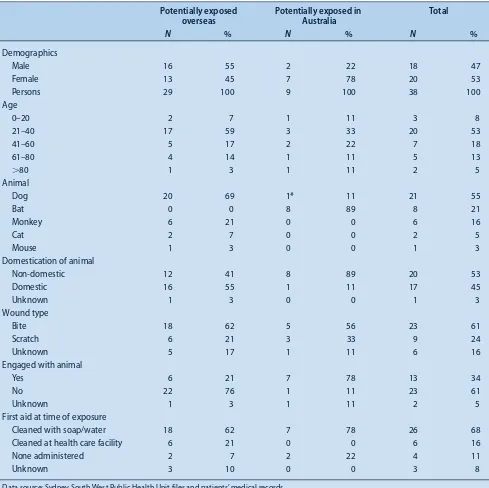
domesti-cated animals accounted for 16 (55%) potential overseas exposures; 13 of these were from domesticated dogs. Non-domestic animals accounted for 12 (41%) potential over-seas exposures; six from wild dogs and four from wild monkeys (Table 1). Of those potentially exposed while
overseas, six (21%) people reported that they had handled the animal that bit or scratched them.
Of the nine potential exposures occurring in Australia, eight were the result of a wild bat bite or scratch and one bite was from a vaccinated dog imported from Italy. Seven (78%) of the people potentially exposed in Australia reported that they handled the animal that caused the injury. The injuries occurred when handling, releasing, detangling or assisting a bat (Table 1). No records were available about the health of the animal in the days fol-lowing the potential exposure and no records indicated that any of the animals were tested for Lyssavirus. Of the 11 randomly selected medical records reviewed to assess compliance with post-exposure treatment, three people commenced post-exposure treatment on the day of exposure, three within 7 days of exposure, one on the eighth day and one 33 days after potential exposure. The three other records reported commencement of treatment while overseas and within a week of potential exposure. All 11 people completed the full five-dose course of post-exposure treatment; five within the 30-day period stipu-lated in the Response Protocol for NSW Public Health
Units, three within 40 days of exposure and three
com-pleted the course more than 50 days after exposure.3Three
people received HRIG within a week of exposure, three did not receive HRIG at all and no record was available to determine if HRIG was provided to the other five patients.
Discussion
This audit provides a useful description of people receiv-ing post-exposure treatment to prevent lyssavirus infection in SSWAHS and supports the findings of similar work undertaken by Young et al. in Queensland.14The audit was
able to identify risk behaviours that contribute to potential exposure to Lyssavirus, both in Australia and overseas. Of note is the number of people (n⫽13, 34%) who were exposed when handling the animal that bit or scratched them, in particular people exposed to bat bites or scratches in Australia (n⫽5, 56%). Simple strategies to mitigate this exposure, such as not engaging with animals or use of personal protective equipment in occupational settings, may reduce the incidence of potential exposure.
88 | Vol. 20(5–6) 2009 NSW Public Health Bulletin
rabies.9 For potential exposures from bats in Australia,
national guidelines state that where possible the bat should be kept and tested for Lyssavirus at an appropriate refer-ence laboratory.10
People who sought post-exposure treatment for Lyssavirus generally did so soon after being exposed and completed the course of treatment, but not always within the time-frame stipulated in the NSW Health protocol. Emphasis on adherence to treatment and mechanisms to follow up patients and health-care providers to facilitate timely delivery of treatment may be required to improve compli-ance with the protocol in the future.
The value of this audit is limited by the small number of cases available to review and the quality of information in medical and public health records about the treatment rationale, follow-up, previous treatment (if post-exposure treatment commenced elsewhere) or the factors contribut-ing to the potential exposure. Due to these limitations, we note that the findings of the audit should be interpreted with caution and recommend its replication in other area health services or on a statewide basis to gain a better understanding of the issue. In addition, our study only reflects circumstances where post-exposure treatment was requested and does not include potentially exposed people who did not seek treatment.
Table 1. Demographic and exposure details of people potentially exposed overseas and in Australia to rabies/lyssavirus in Sydney South West Area Health Service, Jan 2005 to May 2007
Potentially exposed Potentially exposed in Total
overseas Australia
N % N % N %
Demographics
Male 16 55 2 22 18 47
Female 13 45 7 78 20 53
Persons 29 100 9 100 38 100
Age
0–20 2 7 1 11 3 8
21–40 17 59 3 33 20 53
41–60 5 17 2 22 7 18
61–80 4 14 1 11 5 13
⬎80 1 3 1 11 2 5
Animal
Dog 20 69 1* 11 21 55
Bat 0 0 8 89 8 21
Monkey 6 21 0 0 6 16
Cat 2 7 0 0 2 5
Mouse 1 3 0 0 1 3
Domestication of animal
Non-domestic 12 41 8 89 20 53
Domestic 16 55 1 11 17 45
Unknown 1 3 0 0 1 3
Wound type
Bite 18 62 5 56 23 61
Scratch 6 21 3 33 9 24
Unknown 5 17 1 11 6 16
Engaged with animal
Yes 6 21 7 78 13 34
No 22 76 1 11 23 61
Unknown 1 3 1 11 2 5
First aid at time of exposure
Cleaned with soap/water 18 62 7 78 26 68
Cleaned at health care facility 6 21 0 0 6 16
None administered 2 7 2 22 4 11
Unknown 3 10 0 0 3 8
Audit of post-exposure treatment to prevent lyssavirus infection
Conclusion
This study used routinely collected data to review poten-tial exposures to Lyssavirus and compliance with the NSW Health treatment protocol for people seeking post-exposure treatment in SSWAHS. The audit identified that: many potential exposures to Lyssavirus were the result of a bite or scratch from a domesticated animal; an animal’s sur-vival or health status at the time of the potential exposure or afterwards is not routinely recorded; and all people who commenced post-exposure treatment completed the pre-scribed course, although not always within the timeframe stipulated in the protocol.
References
1. NSW Health. Rabies and bat lyssavirus infection. N S W Public
Health Bull 2002; 13(1–2): 27.
2. World Health Organization Media Centre. Fact Sheet – Rabies. Geneva: World Health Organization; 2008. Available from: http://www.who.int/mediacentre/factsheets/fs099/en/ (Cited 14 November 2008.)
3. NSW Health. Rabies and other lyssavirus infections: response protocol for NSW Public Health Units, Notifiable Diseases Manual. Sydney: NSW Health; July 2007. Available from: http://www.health.nsw.gov.au/factsheets/guideline/rabies.html (Cited 14 November 2008.)
4. WHO Expert. Consultation on Rabies: First Report. WHO Technical Report Series 931. Geneva: World Health
Organization; 2005. Available from: http://www.who.int/rabies/ trs931_%2006_05.pdf (Cited 14 November 2008.)
5. Hanna J, Carney I, Smith G, Tannenberg A, Deverill J, Botha J et al. Australian Bat Lyssavius infection: a second human case with long incubation period. Med J Aust 2000; 172(12): 573–4.
6. Allworth A, Murray K, Morgan J. A human case of encephali-tis due to a lyssavirus recently identified in fruit bats. CDI 1996; 20(24): 504.
7. NSW Health. Infectious Disease Factsheet. Rabies and Bat Lyssavirus Infection. Sydney: NSW Health; 2008. Available from: http://www.health.nsw.gov.au/factsheets/infectious/ rabiesbatinfection.html (Cited 14 November 2008.)
8. National Health and Medical Research Council. The Australian Immunisation Handbook. 9th edition. Canberra: NHMRC and Australian Government Department of Health and Ageing; 2008. pp. 110–7.
9. World Health Organization. WHO Recommendations on Rabies Post-Exposure Treatment and the Correct Technique of Intradermal Immunization Against Rabies. Geneva: WHO; 1996. Available from: http://whqlibdoc.who.int/hq/1996/ WHO_EMC_ZOO_96.6.pdf (Cited 14 November 2008.)
10. Commonwealth Department of Health and Ageing. Australian Bat Lyssavirus Information for Medical Practitioners. Canberra: Commonwealth Department of Health and Ageing; 2001.
11. Rabies vaccine-update. Wkly Epidemiol Rec 2007; 82(8): 62–8.
12. Wilde H. Failure of post exposure rabies prophylaxis. Vaccine 2007; 25(44): 7605–9. doi:10.1016/j.vaccine.2007.08.054
13. World Organization for Animal Health. Health Standards. Manual of Diagnostic Tests and Vaccines for Terrestrial Animals. Chapter 2.2.5. Rabies. Paris: World Organization for Animal Health; 2007. Available from: http://www.oie.int/Eng/ Normes/Mmanual/A_00044.htm (Cited 14 November 2008.)
14. Young M, McCall B. Trends in potential exposure to Australian bat lyssavirus in South East Queensland, 1996 to 2003.
90 | Vol. 20(5–6) 2009 NSW Public Health Bulletin
As part of its routine program, BreastScreen New South Wales (NSW) assesses women for breast cancer risk factors. Alcohol use is not currently assessed in any BreastScreen NSW service, despite substantial evidence supporting the association between alcohol consumption and the risk of breast cancer.1–4 Consumption of 30 g of
alcohol each day (three standard drinks) is associated with a similar level of risk to other recognised risk factors for breast cancer, such as young age at menarche and family
Another opportunity for prevention: assessing
alcohol use by women attending breast
screening services in Lismore, NSW
Substantial epidemiological evidence supports the association between alcohol consumption and the risk of breast cancer; however, information on alcohol consumption is not routinely collected by breast screening services in NSW. This study was conducted to investigate the level of self-reported alcohol use among women accessing North Coast BreastScreen in Lismore, NSW. Two hundred and sixty-four consecutive women were screened using the Alcohol Use Disorders Identification Test. Their drinking status was categorised as low risk, risky or high risk. Two-thirds of the screened women (69.7%) were classified as low-risk drinkers; 9.8% as risky and 0.4% as high-risk drinkers. Although the risk of breast cancer increases with the amount of alcohol consumed, evidence suggests that even low-risk drinking is associated with increased risk of breast cancer. Implications for prevention activities by breast screening services are discussed.
Michelle D. Daly
A,C, Megan E. Passey
Band Amanda J. Harvey
AANorth Coast Area Health Service
BDepartment of Rural Health (Northern Rivers), School of Public Health, University of Sydney C Corresponding author. Email:
history; however, alcohol consumption is one of the few risks that is modifiable.2
The current National Health and Medical Research Council (NHMRC) guidelines note that alcohol increases women’s risk of breast cancer and the risk increases with the level of alcohol used. Compared with women who drink little or no alcohol, the risk of breast cancer is 35% higher in women who drink three to four standard drinks a day and 67% with more than four drinks a day. Even low level drinking is associated with some increase in risk.4
The 2004 National Drug Strategy Household Survey found that just over half (58.1%) of women aged 60 years or more approved of regular (i.e. daily or nearly every day) alcohol use. Approval for regular drinking in younger age groups was higher, with 74.7% of 40–49-year-old women and 69% of 50–59-year-old women approving of regular drinking. The survey also showed that in the Australian adult female population, 9.6% used alcohol at a level con-sidered to be risky or high risk for long-term harm from a range of chronic physical and psychological illnesses.5
BreastScreen services are free to eligible women and the uptake is high, with 63.5% of women aged 45–54 years, 80.9% of women aged 55–64; and 84.2% of 65–74-year-old women reporting having received a screening mammogram in the previous 2 years.6For the North Coast
region of NSW, the corresponding figures are 73.1%, 81.9% and 80.5% respectively.6We conducted a study to
assess the level of self-reported alcohol use among women accessing North Coast BreastScreen.
Methods
The receptionist or a women’s health nurse invited consec-utive women attending North Coast BreastScreen in Lismore NSW to participate in a study. They were informed that the purpose of the study was a survey on alcohol use. Those providing written informed consent were asked to complete a brief anonymous questionnaire that included the Alcohol Use Disorders Identification Test (AUDIT) assessment tool and basic demographic information.
The AUDIT is a brief 10-item screening instrument devel-oped by the World Health Organization for detecting risky and high-risk levels of drinking.7It has been used widely
10.1071/NB07121
Another opportunity for prevention
and validated as a screening tool in more than 16 studies, including Australian studies.7–11 It uses three domains:
alcohol intake; dependence; and problems associated with drinking. Based on the scores, it classifies respondents’ alcohol use into three drinking risk levels: low risk (includes non-drinkers), risky and high risk. For women, low-risk drinking is classified as scoring 0–5 on the AUDIT; risky drinking is a score of 6–12; and high-risk drinking is a score of 13 or more.7
Data were collected one day per week over three consecu-tive months in 2006. Women were given information on the study and, if willing to participate, were asked to provide consent. Participants were given written instruc-tions on how to complete and self-score the survey. They were also given written feedback on their AUDIT score, options for interventions and other relevant information. All women were able to complete the AUDIT while waiting to have their mammogram, without assistance from the researchers. No women asked to speak with a cli-nician to discuss their drinking risk level. Women were instructed to separate their consent form and AUDIT and place them in two separate envelopes to ensure anonymity. Data were entered onto a specifically designed database. Based on the AUDIT score, women were categorised as non-drinkers, low-risk non-drinkers, risky or high-risk drinkers. Ethical approval for the study was obtained from the North Coast Area Health Service Human Research Ethics Committee.
Results
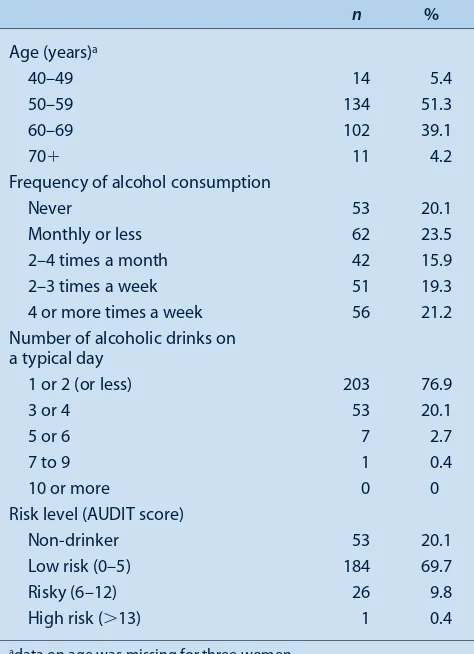
Two hundred and sixty-four women completed the AUDIT questionnaire. No women declined to participate. Fifty-three women (20.1%) were classified as non-drinkers, 184 (69.7%) as low-risk drinkers, 26 (9.8%) as risky drinkers and one (0.4%) as a high-risk drinker (Table 1). All but four of the women classified as risky or high-risk drinkers drank alcohol at least two to three times per week, with 12 reporting drinking four or more times per week. Nearly a quarter of the women reported drinking at least three or four drinks on a typical day when they were drinking. Discussion
In this study, we found that 10.2% of women attending North Coast BreastScreen reported risky or high-risk drinking, when screened using the AUDIT. This is lower than the rates reported for the NSW Population Health Survey (2006).6However, the definitions of risky drinking
used in the two studies are different. We used the AUDIT, which has been widely validated for use as a screening tool in clinical settings, with the intention of providing inter-ventions for those identified as drinking at risky levels. By contrast, the NSW Population Health Survey uses a definition appropriate for population surveys and defines
risky drinking for women as one of the following: drinking alcohol on a daily basis; drinking on average more than two standard drinks per day; or drinking more than four stan-dard drinks on any one day. High-risk drinking was deter-mined as drinking seven or more standard drinks on any one day as per NHMRC Australian Alcohol Guidelines.4
With the AUDIT, women drinking every day but at low levels would not be classified as risky drinkers. Thus use of the drinking levels defined in AUDIT results in a more conservative estimate of the prevalence of risky drinking. The prevalence of risky drinking is consistent with the level of acceptability of alcohol use reported in the 2004 National Drug Strategy Household Survey.5 This result
may reflect a lack of awareness of the association between alcohol use and breast cancer. The Breast Health Survey found that 31.1% of women considered there was no increased risk of breast cancer associated with alcohol consumption.12
Given the prevalence of risky drinking among women in the breast screening age group, and that alcohol consump-tion is a modifiable risk factor for breast cancer, it would be beneficial for primary health-care services such as
Table 1. Age and alcohol consumption for 264 consecutive women attending North Coast BreastScreen, Lismore, NSW, over 3 months in 2006
n %
Age (years)a
40–49 14 5.4
50–59 134 51.3
60–69 102 39.1
70⫹ 11 4.2
Frequency of alcohol consumption
Never 53 20.1
Monthly or less 62 23.5
2–4 times a month 42 15.9
2–3 times a week 51 19.3
4 or more times a week 56 21.2
Number of alcoholic drinks on a typical day
1 or 2 (or less) 203 76.9
3 or 4 53 20.1
5 or 6 7 2.7
7 to 9 1 0.4
10 or more 0 0
Risk level (AUDIT score)
Non-drinker 53 20.1
Low risk (0–5) 184 69.7
Risky (6–12) 26 9.8
High risk (⬎13) 1 0.4
adata on age was missing for three women.
92 | Vol. 20(5–6) 2009 NSW Public Health Bulletin
BreastScreen to implement routine screening and early intervention. Completion of the AUDIT screening tool without any clinician feedback has itself been shown to be an effective brief intervention and is therefore more bene-ficial than merely providing women with information on the risks associated with alcohol use and breast cancer.13
Completion of the AUDIT encourages women to reflect on their drinking level. The NSW Health clinical guidelines for nursing and midwifery practice in NSW support a self-help model of intervention when staff lack time to provide a more intensive intervention.14The guidelines add that
self-help approaches are effective with women who drink at mild and moderate levels. However, it would be benefi-cial to conduct further research on the effectiveness of this approach in the BreastScreen setting.
In our study, we were able to incorporate the use of the AUDIT into the daily screening procedures of North Coast BreastScreen, with no women refusing to participate. Women were given information on how to complete and self-score the survey, feedback on their score and options for interventions, including contact details for drug and alcohol services. As BreastScreen has the mandate to screen all women aged 50–70 years for breast cancer, the service routinely sees the majority of women in this age group. Screening and provision of feedback in a manner similar to that used in this study by all NSW BreastScreen services would be an inexpensive mechanism for identify-ing women at risk and alertidentify-ing women to the risks associated with alcohol consumption. Delivering this intervention would also support the role of general practitioners who provide early interventions in primary care.
The NHMRC recently released new draft guidelines for safe alcohol consumption, which suggested reducing the level of alcohol consumption that is considered safe. These new guidelines reinforce the argument for incorporating screening for alcohol use, with provision of suitable inter-ventions, into the routine procedures of BreastScreen services.
Acknowledgments
We would like to thank the staff of Lismore BreastScreen Services and the women who participated in the study.
References
1. Singletary K, Gapstur S. Alcohol and breast cancer: review of epidemiologic and experimental evidence and potential mechanisms. JAMA 2001; 286(17): 2143–51.
doi:10.1001/jama.286.17.2143
2. Smith Warner SA, Hunter D, Yaun S-S, Walter C, Potter J, Holmberg L et al. Alcohol and breast cancer in women. JAMA 1998; 279(7): 535–40. doi:10.1001/jama.279.7.535
3. National Health and Medical Research Council. Australian alcohol guidelines for low risk drinking: Draft for public consultation. Canberra: NHMRC; 2007. Available from: http://www.nhmrc.gov.au/guidelines/_files/draft_australian_ alcohol_guidelines.pdf (Cited 20 March 2009.)
4. National Health and Medical Research Council. Australian Alcohol Guidelines: Health Risks and Benefits. Endorsed October 2001. Canberra: Commonwealth of Australia; 2003. Available from: http://www.nhmrc.gov.au/publications/ synopses/_files/ds9.pdf (Cited 20 March 2009.)
5. Australian Institute of Health and Welfare. 2004 National Drug Strategy Household Survey: Detailed Findings. AIHW cat. no. PHE66. Canberra: AIHW (Drug Statistics Series No. 16); 2005.
6. Population Health Division. The health of the people of New South Wales: Report of the Chief Health Officer, 2006. Sydney: NSW Department of Health; 2006.
7. Saunders JB, Aasland OG, Babor TF, De La Fuente JR, Grant M. Development of the alcohol use disorders identification test (AUDIT): WHO collaborative project on early detection of persons with harmful alcohol consumption. Addiction 1993; 88: 791–804. doi:10.1111/j.1360-0443.1993.tb02093.x
8. Saunders JB, Aasland OG, Amundsen A, Grant M. Alcohol consumption and related problems among primary health care patients. WHO collaborative project on early detection of persons with harmful alcohol consumption. Addiction 1993; 88: 349–62. doi:10.1111/j.1360-0443.1993.tb00822.x
9. WHO Brief Interventions Study Group. A cross-national trial of brief interventions with heavy drinkers. Am J Public Health 1996; 86: 949–55.
10. Conigrave KM, Hall W, Saunders JB. The AUDIT question-naire: choosing a cut-off score. Addiction 1995; 90: 1349–56. doi:10.1111/j.1360-0443.1995.tb03552.x
11. Conigrave KM, Saunders JB, Reznik RB. Predictive capacity of the AUDIT questionnaire for alcohol-related harm.
Addiction 1995; 90: 1479–85.
doi:10.1111/j.1360-0443.1995.tb02810.x
12. National Breast Cancer Centre. National Breast Cancer Centre Breast Health Survey Technical Report. 2005. Camperdown: NBCC; 2005.
13. Babor TF, Grant M. A randomized clinical trial of brief interventions in primary health care: summary of WHO project. Addiction 1994; 89: 657–60. doi:10.1111/j.1360-0443.1994.tb00944.x
Pertussis outbreaks in aged-care facilities
The Editor
NSW Public Health Bulletin
Dear Editor
We concur with Al-Murieb and colleagues that pertussis outbreaks are a potential and probably under-recognised problem in aged-care facilities.1 In February 1999, we
investigated an outbreak of acute respiratory infection, which had affected over 50% of the residents of a Sydney nursing home. Serological and virological testing pointed to influenza A as the major cause of illness in 19 of 35 coughing residents.2However, 10 residents also had
evi-dence of recent pertussis infection based on the presence in serum of IgA antibodies to Bordetella pertussis detected using an in-house, whole-cell antigen assay, which has been shown not to cross-react with sera con-taining elevated antibody titres to influenza A virus.3Of
these 10 residents, one demonstrated seroconversion to
Bordetella IgA on parallel testing of serum samples
col-lected during the outbreak and 7 months earlier.2
Single-sample serological assays have been the mainstay of laboratory diagnosis of pertussis in adults, but recently concerns about poor specificity of some of these assays have been reported.3,4The rapid advance of nucleic acid
detection technology has meant that polymerase chain reaction (PCR) assays of high specificity have become widely available in public and private sector pathology laboratories for the diagnosis of pertussis. Early in the infection, the sensitivity of PCR is superior to that of culture; however, this sensitivity, like that of culture, rapidly decreases as the paroxysmal phase progresses.5In
Australia in the period 2000–2005, PCR seems to have almost replaced culture in the diagnosis of pertussis in infants and young children, while serology was the means of diagnosis in 80–90% of cases in adults.6Single-sample Bordetella serology has a definite place in the evaluation
of a coughing illness that has lasted a number of weeks, especially in adults; however, in the setting of an outbreak investigation where cough symptoms have been present for less than 3–4 weeks, PCR should be considered the first line in laboratory diagnosis, if it is available.
Mark J. Ferson
Public Health Unit, South Eastern Sydney Illawarra Area Health Service and School of Public Health and Community Medicine, University of NSW
Peter W. Robertson
SEALS Area Serology Laboratory, Prince of Wales Hospital and School of Medical Sciences, University of NSW
References
1. Al-Murieb A, Brown AM, Raulli A, George C, Gander C, Forrester P et al. Evidence of pertussis clusters in three aged-care facilities in the former Macquarie Area Health Service, NSW. N S W Public Health Bull 2008; 19: 157–60. doi:10.1071/NB07054
2. Ferson MJ, Morgan K, Robertson PW, Hampson AW, Carter I, Rawlinson WD. Concurrent summer influenza and pertussis outbreaks in a nursing home in Sydney, Australia. Infect
Control Hosp Epidemiol 2004; 25: 962–6. doi:10.1086/502327
3. Robertson PW, Goldberg H, Jarvie BH, Smith DD, Whybin LR.
Bordetella pertussis infection: a cause of persistent cough in
adults. Med J Aust 1987; 146: 522–5.
4. Public Health Laboratory Network. Pertussis case definition. Canberra: Commonwealth of Australia, 2007. Available from: www.health.gov.au/internet/main/publishing.nsf/Content/cda-phlncd-pertussis.htm (Cited 30 December 2008.)
5. de Melker HE, Versteegh FG, Conyn-Van Spaendonck MA, Elvers LH, Berbers GA, van Der Zee A et al. Specificity and sensitivity of high levels of immunoglobulin G antibodies against pertussis toxin in a single serum sample for diagnosis of infection with Bordetella pertussis. Clin Infect Dis 1999; 29: 1239–42.
6. Quinn HE, McIntyre PB. Pertussis epidemiology in Australia over the decade 1995-2005 – trends by region and age group.
Commun Dis Intell 2007; 31: 205–15.
The Editor
NSW Public Health Bulletin
Dear Editor
Ferson and Robertson have pointed out that polymerase chain reaction (PCR) has become, if not the gold standard, at least a silver standard for the diagnosis of pertussis. They recommend that in an outbreak situation of a cough-ing illness where symptoms have been present for less than 3–4 weeks, PCR should be considered in first-line laboratory diagnosis if it is available. We entirely concur.
94 | Vol. 20(5–6) 2009 NSW Public Health Bulletin
which could be performed locally (or at least regionally), rather than PCR, which was not readily available.
In our investigation, we were concerned about the use of single-point specific IgA because interpretation can be difficult. We used a case definition of positive single-point IgA and a clinically compatible illness. This definition proved to be a robust epidemiological diagnosis.
Around the same time, cases of pertussis were identified in other workplaces. A few of these workplaces responded by asking staff to have a blood test (against our advice). A number of completely asymptomatic people had posi-tive single-point specific IgA, which was not considered evidence of current pertussis infection.
It is interesting to note that pathological testing in the current pertussis epidemic is almost entirely PCR. In the face of large numbers of cases, many general practitioners seem content to make a clinical diagnosis of pertussis, particularly if there is some epidemiological link, and to treat appropriately.
Outbreaks of pertussis continue to occur in institutions and workplaces supporting the need for booster vaccina-tion of adults.
Anthony M. Brown and Ala’a Al-Murieb
Equine influenza
Equine influenza (EI) is an acute viral respiratory disease of horses and other equine species such as donkeys and mules. Symptoms generally include elevated temperature, a deep dry cough and nasal discharge.1,2EI is highly
infec-tious and serious outbreaks associated with the importa-tion of horses with subclinical infecimporta-tion from endemic areas have occurred in South Africa, Asia and Europe in recent years.3,4The virus is usually transmitted by respiratory
secretion droplets through the cough of an infected horse and can survive on skin, fabrics and surfaces of contami-nated equipment for up to 24 hours.5 Further spread by
direct transmission from humans and fomites can subse-quently be significant.5
Prior to 2007, there were no reported cases of EI in Australia and vaccination against the disease was not prac-tised other than to meet export requirements. Following reports of suspected infection at the Eastern Creek Quarantine Station in New South Wales (NSW), the first reports of EI disease in Australia were made to the NSW Department of Primary Industries by a veterinarian who observed sick horses in Sydney on 24 August 2007. Laboratory testing confirmed that these horses were infected with EI. A statewide lockdown of the movement of horses was declared on 25 August by the NSW Chief Veterinary Officer and the Australian Veterinary Emergency Plan (AUSVETPLAN) equine influenza strategy for disease control was activated.5At the peak of this outbreak, 47 000
infected horses on 5943 properties were reported in NSW and, as a result, horse owners across Australia experienced significant economic and social impacts.
Measures taken to control and eradicate the disease included: quarantine and controlled movement of horses; establishment of disease control zones; implementation of decontamination procedures for properties; introduction of surveillance systems to determine the extent of infec-tion, vaccination and awareness; and information campaigns for industry and the wider community. The response to EI involved over 2000 people deployed across NSW as part of a whole-of-government approach.6 The response was
ultimately successful with Australia declaring freedom from EI on 30 June 2008.
NSW Health involvement
Epidemiologists, public health nurses, surveillance offi-cers and trainee public health offioffi-cers from the NSW Department of Health and area health services provided technical advice and assistance to the Department of Primary Industries from September to December 2007. During this time, a number of disease cluster investiga-tions were initiated to determine the mode of transmission for cases of EI that had no apparent epidemiological links, and to study the role of fomite and other modes of virus transmission. One such study, conducted in October 2007, concluded that direct transmission of EI virus via bird plumage or other animals was possible.7Further research
would be necessary to confirm the possibility of this trans-mission mechanism.
Influenza: horses and humans
While there are similarities between horse and human influenza outbreak management strategies, there are also significant differences in strategies used to control the spread of the diseases.
The Biopreparedness Unit, NSW Department of Health, is responsible for developing procedures for the manage-ment of large scale human disease outbreaks in NSW, focussing on pandemic influenza planning. The response for pandemic influenza in NSW aims to contain the spread of infection until a vaccine becomes available. The stock standstill strategy, effective in the containment of EI, would be extremely difficult to replicate for the control of a human influenza outbreak. The objective of such a strategy is to eliminate the transmission outside of the restricted zone, thereby allowing the infection to ‘burn itself out’. Similar, but less severe, strategies for humans in an influenza pandemic include isolation, quarantine, social distancing and movement restrictions. More severe restrictions such as isolation of communities or regions would have unacceptably high social and financial costs. NSW Health involvement in the response to the EI emer-gency was invaluable in providing insight into the poten-tial challenges of a large-scale human disease outbreak such as pandemic influenza.
This example of a large-scale disease outbreak response highlights the importance of planning for the success of disease control strategies. Important considerations for future pandemic planning include an understanding of the mechanisms for disease transmission and the resource
BUG BREAKFAST IN THE BULLETIN
Paula J. Spokes
A, Ian Roth
Band Paul K. Armstrong
CANSW Public Health Officer Training Program, NSW Department of Health
BNSW Department of Primary Industries
96 | Vol. 20(5–6) 2009 NSW Public Health Bulletin
and personnel capacity required to respond to a statewide outbreak.
References
1. Huntingdon PJ. Equine influenza: the disease and its control. Technical report series No. 184. Melbourne: Department of Agriculture and Rural Affairs, Victoria; 1990.
2. Miller WC. Equine influenza: further observations on the “coughing” outbreak, 1965. Vet Rec 1965; 77(16): 455–6.
3. Dalglish AR. The International Movement of Horses: The current infectious disease situation. Proceedings of the 9th International Conference of Racing Analysts and Veterinarians. New Orleans, USA, 1992.
4. Guthrie AJ, Stevens KB, Bosman PP. The circumstances surrounding the outbreak and spread of equine influenza in South Africa. Rev Sci Tech 1999; 18(1): 179–85.
5. Animal Health Australia. Disease strategy: Equine influenza (Version 3.0). Australian Veterinary Emergency Plan (AUSVETPLAN), Edition 3. Canberra: Primary Industries Ministerial Council; 2007.
6. NSW Department of Primary Industries. Summary of the 2007/08 Equine Influenza Outbreak. Sydney: NSW Department of Primary Industries; 2008. Available from: http://www.dpi.nsw.gov.au/agriculture/livestock/horses/health/ general/influenza/summary-of-the-200708-ei-outbreak (Cited 20 March 2009.)