HAS THE SEPARATION OF FUNCTIONS BETWEEN ROADS FUND ADMINISTRATION AND ROADS AUTHORITY IMPROVED THE PERFORMANCE DELIVERY OF ROADS IN TERMS OF EFFICIENCY AND
EFFECTIVENESS IN MALAWI?
Hastings Floliano Kadzanja
Submitted in partial fulfilment of the requirements for the degree of
MASTER OF PUBLIC ADMINISTRATION
DECLARATION
I Hastings Kadzanja do declare that this is my own research work. Other sources or materials used in the dissertation have been acknowledged accordingly.
ACKNOWLEDGEMENT
I wish to acknowledge my project supervisors, Ron Smith and Bessie Nyirenda for their untiring support during the period of this research project. Let me also extend my heartfelt gratitude to my wife and children for their moral support. It was indeed a very difficult time for them because I denied them time to chart with me and to a certain extent resources for their daily leaving.
ACRONYMS
ANRP ANNUAL NATIONAL ROADS PROGRAMME
IPC INTERIM PAYMENT CERTIFICATE
MBE MALAWI BOARD OF ENGINEERS
MCCI INDUSTRY MALAWI CONFEDERATION OF CHAMBERS OF COMMERCE AND
MERA MALAWI ENERGY REGULATORY AUTHORITY
MGDS MALAWI GROWTH DEVELOPMENT STRATEGY
MIM MALAWI INSTITUTUE OF MANAGEMENT
MoTP MINISTRY OF TRANSPORT AND PUBLIC WORKS MoWS MINISTRY OF WORKS AND SUPPLIES
NCB NATIONAL COMPETITIVE BIDDING
NCIC NATIONAL CONSTRUCTION INDUSTRY COUNCIL
NRA NATIONAL ROADS AUTHORITY
OECD ORGANISATION OF ECONOMIC AND COMMUNITY DEVELOPMENT
PA PROCEDURES AGREEMENT
PCC PETROLEUM CONTROL COMMISSION
RA ROADS AUTHORITY
RF ROADS FUND
RFA ROADS FUND ADMINISTRATION
RMI ROAD MAINTENANCE INITIATIVE
ROMARP ROAD MAINTENANCE AND REHABILITATION PROGRAM
ABSTRACT
In 2006, the Malawi Government implemented some reforms in the Road Sector which resulted into repealing the National Roads Authority Act and enacting two new pieces of legislations namely; Roads Authority Act and the Roads Fund Administration Act. The objective was to separate the implementation function from the financing function of the then National Roads Authority’s combined structure.
The study was carried to investigate whether this reforms had brought about some benefits in terms of improvements in the service delivery focusing on efficiency and effective delivery of roads in Malawi. In carrying out this research, the researcher employed interpretivism approach because it made the researcher to easily interpret the social roles of others in accordance with the researcher’s own set of meanings. The research approach that was employed was deductive. The strategy employed was case study strategy because the research involved exploring views of different people from organisations involved in the roads management and other road users on their feelings towards general road management in relation to the new reforms.
The results show that many of the Malawian citizens in the first place are not aware that there are two separate institutions managing the roads. Further research revealed that practically though the majority citizen lacks information on the existence of the two institutions but the reform has brought about positive benefits while some challenges were also encountered.
TABLE OF CONTENTS
1 CHAPTER ONE – INTRODUCTION...1
1.1 The Creation of the National Roads Authority...2
1.2 Challenges Encountered with the National Roads Authority...2
1.3 The Establishment of Roads Authority and the Roads Fund Administration...3
1.4 Problem Statement...4
1.5 Research Aim, Objectives and Questions...5
1.6 The Author...6
1.7 The Research Structure...7
2 CHAPTER TWO - LITERATURE REVIEW...9
2.1 Introduction...9
2.2 Road Management in Other Countries...11
2.3 Roads Fund Administration Brief Profile...12
2.4 Benefits Arising from the Reforms...14
2.5 Governance Issues in the Road Sector...16
2.6 Critical Review of the Roads Fund Administration and Roads Authority...28
2.7 Critical analysis of benefits of the separation of roles of RFA and RA in the road construction industry...39
3 CHAPTER THREE – RESEARCH DESIGN...45
3.1 Research Philosophy...46
3.2 Research Approach...46
3.3 Research Strategy...47
3.4 Research Choice...47
3.5 Pilot Study...47
4 CHAPTER FOUR – ANALYSIS OF RESEARCH FINDINGS...52
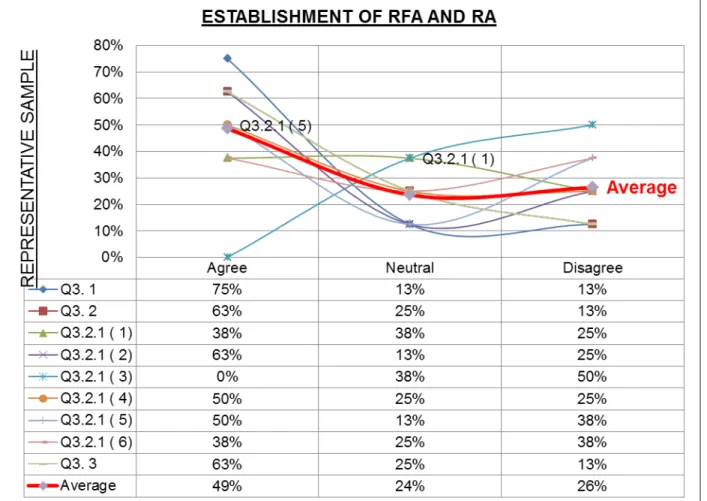
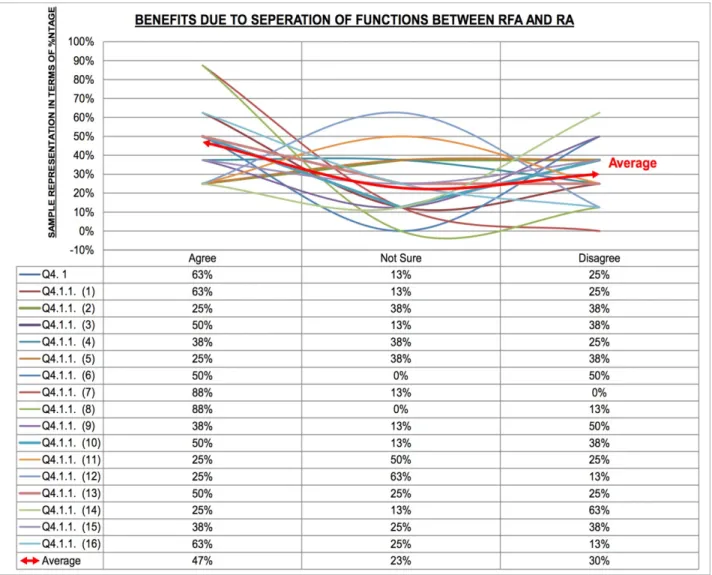
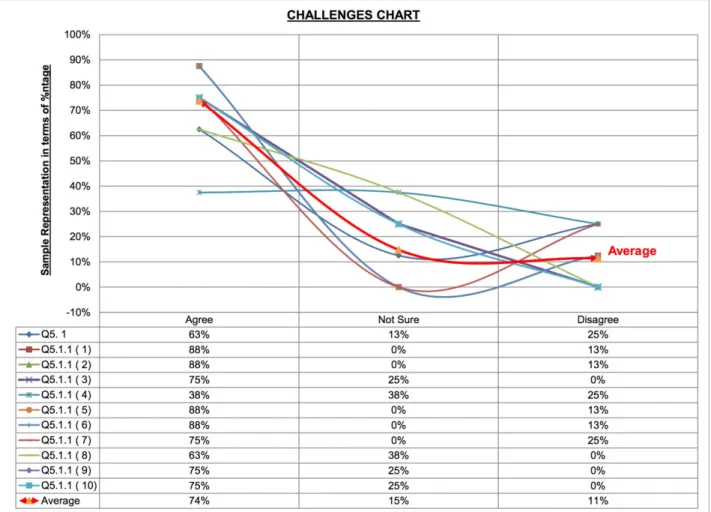
FIGURE 1 - RFA ORGANISATION CHART...17 FIGURE 2 - IMPLEMENTING AGENCIES IN THE ROAD SUB-SECTOR...21 FIGURE 3 - NRA ORGANISATIONAL CHART...38 FIGURE 4 - LINE GRAPH HIGHLIGHTING ISSUES TO DO WITH ESTABLISHMENT OF RFA AND
RA...53 FIGURE 5 - LINE GRAPH HIGHLIGHTING ISSUES TO DO WITH BENEFITS ACCRUING FROM
SEPARATION OF FUNCTIONS BETWEEN RA AND RFA...54 FIGURE 6 - LINE GRAPH HIGHLIGHTING ASPECTS OF CHALLENGES DUE TO THE
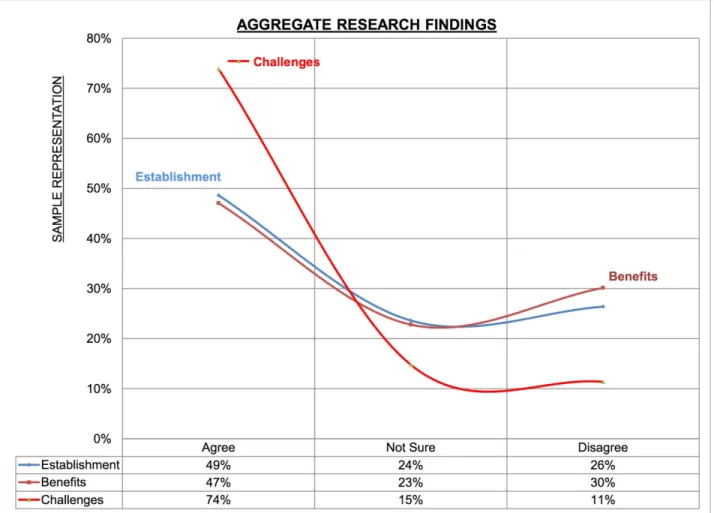
SEPARATION OF FUNCTIONS BETWEEN THE RFA AND RA...55 FIGURE 7 - AGGREGATE REPRESENTATION OF ASPECTS OF ESTABLISHMENT, CHALLENGES AND BENEFITS IN THE ROAD SUB-SECTOR IN MALAWI...56
1 List of Tables
TABLE 1 - ROADS FUND AUDITED ACCOUNTS...34 TABLE 2 - STRATIFIED RANDOM SAMPLING...49
2 Appendices
1 CHAPTER ONE – INTRODUCTION
In the early 1980’s up to the late 1990’s the responsibility for all road works covering construction and maintenance works was vested in the Ministry of Transport. Within the Ministry there was a department for roads which was responsible for all road works. All funding for maintenance was from the national budget. With the passing of time and from experience, there were more demands on the national budget leading to less funding allocations towards roads maintenance. This was happening while public roads continued to deteriorate and large backlog of road rehabilitation continued to increase due to insufficient maintenance.
Responding to the deteriorating conditions of the road network and its adverse impact on economic growth, the Government of Malawi established a Road Maintenance Initiative (RMI) country Programme in 1995 (Kumar, 2000). The Roads Maintenance Initiative Programme had set the broad outline of new policy framework for the sector. The Road Maintenance Initiative had recommended that the policy and institutional reforms needed to overcome the noted problems in the sub-sector and hence recommended total focus in the following areas:
a) Creating ownership and commitment of key stakeholders by involving them in decision making of the management of public roads.
b) Establishing stable source of finance for road maintenance by introducing road user fees so that road users pay for the use of the road network
c) Clarifying who is responsible for managing different parts of the road network; financing and implementation of the road network in Malawi.
1.1 The Creation of the National Roads Authority
In response to the RMI report, the National Roads Authority (NRA) was established through an Act of Parliament in 1997. The objective of its establishment was to improve the management and financing of the road sector. Of importance to note is that during the same time of its establishment a Road Fund was also established. This fund was established within the National Roads Authority in order to develop a dedicated and sustainable funding source for the road maintenance. The main source of fund for the Road Fund was the Fuel Levy and the International Transit Fees.
The establishment of the National Roads Authority was in away a response to enhancing the concept of good governance principles of ensuring total accountability and transparency in the management of public roads. Observance of good governance in such areas as accountability, transparency, citizen participation, observance of constitution and rule of law, effectiveness and efficiency are the key focus areas promoted by the world Bank and remain the basis upon which the bank supports institution’s various developmental programmes (World Bank Report, 1998)
1.2 Challenges Encountered with the National Roads Authority
operating under a closed system and no one would know what was happening behind curtains in terms of Road Fund management.
Generally this structure was found to be inadequate in the sense that it did not provide good governance system to restrict conflict of interest. Further to that, it did not provide a good system of checks and balances to preclude political discretionary powers of the Ministry of Transport and hence no separation of duties. Further to note is that the system did not provide enough control system to prevent the arbitrary use of the roads funds incomes.
1.3 The Establishment of Roads Authority and the Roads Fund Administration
The challenge of the combined structure of the National Roads Authority led the Government to undertake further institutional reforms by structuring the National Roads Authority. The National Roads Authority Act was replaced. Two pieces of legislation were enacted namely; the Roads Authority Act and the Roads Fund Administration Act (Act of Parliament No. 3 & 4, 2006). The objective was to separate the implementation function from the financing of the then National Roads Authority’s combined structure.
Two institutions namely; the Roads Authority and the Roads Fund Administration were created to perform the following roles;
a) The Roads Authority – Performing all contractual matters pertaining to contract management. This includes matters pertaining to the construction, maintenance and rehabilitation of public roads (Roads Authority Act, 2006). b) The Roads Fund Administration – Responsible for raising, administering
meant reducing powers vested in one Board and one ministry. They were made to report under different ministries and Boards. The Roads Authority Board is responsible and accountable to the Minister of Transport and Public Works while the Roads Fund Administration Board reports and is accountable to the Ministry of Finance, Economic Planning and Development.
1.4 Problem Statement
Reforming the road sector through the dissolution of the National Roads Authority and the establishment of the Roads Fund Administration and the Roads Authority was deemed the right thing to do for the road construction industry in Malawi. As already alluded to, the reforms were aimed at promoting governance issues that included the transparency, accountability, efficiency and effectiveness for the purpose of ensuring that there are always quality roads which will help to fasten the economic growth of the country’s economy.
However, we note that there continue to be an outcry of dissatisfaction among the general public regarding the general slow pace at which new roads are commissioned and the poor state of some roads in the country. The Nation Newspaper reported in one of its editions that during the Parliamentary Sessions, a lot of Members of Parliament had taken Government to task for failure to rehabilitate or maintain roads in their Constituencies despite Parliament allocating funds for the course (Nation Newspaper, 2014). The continued questioning of the quality of some roads and the public’s persistent requests to have their roads regularly maintained and rehabilitated probably is a wake-up call that there is a problem in the system. This justified the need to investigate the impact of such reforms and the cause for such disatisfaction.
general maintenance, rehabilitation and the quality of the roads being commissioned. Of importance also is to show the levels of commitment employed by the two study institutions on how they get accountable to the general public.
Malawi’s economy is agro-based requiring systematic and trustworthy road network in transporting various farm products from mostly rural areas to the cities and towns. The importance of an effective road infrastructure development cannot therefore be overemphasized as it has been marked the engine of any economy (Morriset, 2001). Roads connecting cities and towns have assisted in transporting goods between them.
1.5 Research Aim, Objectives and Questions
1.5.1 Research Aim
The study was commissioned to investigate whether the separation of functions between Roads Fund Administration and Roads Authority has improved the performance delivery of roads in terms of efficiency and effectiveness in Malawi.
1.5.2 Research Objective
The following objectives were deemed relevant to achieve the research aim:
a) To establish the rationale for the establishment of the Roads Fund Administration and the Roads Authority.
The researcher has attempted to review the below research questions in the study:
a) What is the rationale behind reforming the Road Sector?
b) What governance issues were put in place to embrace performance of the road sector and how have they impacted on delivery of road networks?
c) Has the separation of roles of the Roads Fund Administration and Roads Authority brought any challenges in the road construction instruction industry?
1.6 The Author
The author of this report is one of the members of staff of the Roads Fund Administration and a student of the Masters of the Public Administration. Throughout his academic experience, the author has acquired knowledge in the field of public policy formulation, corporate governance, risk management and strategic leadership skill. The author would be best placed to use knowledge gained to improve the performance of the two institutions particularly the Roads Fund Administration. During the period of research, the author has learnt that ignoring issues surround governance in the implementation of various road projects has adversely affected the quality of work.
Governance has been defined as the formal and informal arrangements that determine how public decisions are made and how public actions are carried out (OECD, 2005).
combining roles posed a big risk of resource mismanagement. No one in such an arrangement was able to know what was going into the operational aspect of the National Roads authority. The political leadership in the name of Minister was too powerful to be challenged. For example who could have the powers to sanction audit of the organizations? Experience has taught us lessons how those with political powers have often abused public resources. There is a great need to exercise accountability and total control in the management of public resources if the road sector is to overcome this problem. OECD defined accountability as the obligation to present an account of and answer for the execution of responsibilities through the political and constitutional structure. Control on the other hand defined as a process designed to provide reasonable assurance regarding the effectiveness and efficiency of operations, reliability of reporting and compliance with applicable laws and regulations (OECD, 2005). The question to be asked is what is it that is to be accounted for and what is that we will be controlling? It should be accountability and control over various resources such as finances and other assets. It should be political control over various resources.
It is against this background and through the research that the author being an administrator is so passionate to take this study and to contribute to the effective performance of both the Roads Fund Administration and the Roads Authority
1.7 The Research Structure
The author has presented this dissertation in five chapters which are:
a) Chapter One – Introduction
The author has set out the purpose of the study and outlined issues that have been researched
explained the research approach that has been used in the study d) Chapter Four – Research Findings
e) Chapter Five – Conclusions and recommendations
2 CHAPTER TWO - LITERATURE REVIEW
2.1 Introduction
Malawi is a land locked country with a population estimated to be sixteen million as at July 2013. It shares its borders with Tanzania, Zambia and Mozambique. Malawi economy is predominantly agricultural with about 90% of the population living in the rural areas (Ministry of Trade and Industry, 2014). The Malawi Government developed a policy ensuring that all sectors of the economy are equally developed. One strategy used was the development of the Malawi Growth and Development Strategy with the overall objective to reduce poverty through sustained economic growth and infrastructure development (MGDS). The Malawi Growth and Development Strategy paper had set Government’s priority areas as a means of achieving total growth of the Malawi economy. According to the Ministry of Industry and Trade (2014), infrastructure development is one of the Government’s priority areas of which road construction works constitutes a significant share
The importance of road infrastructure development cannot be overemphasized as it has been marked the engine of the Malawi economy (Morriset, 2012). Good roads have assisted in connecting cities and towns hence allowing goods to be transported between the cities and towns. Morriset (2012) further asserts that though virtual connectivity has become the order of the day due to modern communication avenues, the importance of a good transport network remains undoubted.
view of the need to link the rural farming population with the urban market centres, schools, hospitals as well as other service centres. The Government’s ambitious economy transformation was hampered by several challenges including the poor road network arising from the deteriorating conditions of the existing roads.
To improve management and financing of the road sector, an Act of Parliament was passed in 1997 allowing the creation of the National Roads Authority (NRA), mandated to manage the road sector on behalf of the Malawi Government (Kumar, 2000). The National Roads Authority was also responsible for financing and maintenance of road projects. The National Roads Authority (NRA) combined the functions of both funding road construction and execution or operations of road construction, maintenance and rehabilitation. A 1998 Road Maintenance Initiative (RMI) follow up report indicated that there were risks associated with the structure in the National Roads Authority in that National Roads Authority was both the buyer and seller of road maintenance services (Likongwe, 2014). The combination of functions did not follow good governance principles. Good Governance entails following of separation of functions and to ensure that transparency and accountability is achieved. Transparency entails doing this in the open and in the case of road management, it means open hiring of contractors (bids to be through open tender) and that there should be a will to publish financial reports. Accountability on the other hand is the obligation to present an account of and answer for the execution of responsibilities through the political and constitutional structure (OECD, 2005).
2.2 Roads Management in Other Countries
Reforming road sector has not been the Malawi Government’s priority area only. Other countries have gone through the same reforms. It is therefore important to know why other nations also undertook reforms. Could it be that they too were experiencing similar challenges as to those experienced by the Malawi Government?
The Road Development Agency in Zambia was created through the Public Roads Act No. 12 of 2002 to provide for care, maintenance and construction of public roads in Zambia (online source, www.rda.org.zm).
Namibia has also a Road Fund Administration which is responsible for managing the Road Fund. The Roads Fund Administration in Namibia was also established by an Act of Parliament (Act 18 of 1999) specifically to:
i. Determine the amount of funding for road projects and programmes ii. Determination of the manner in which such amount of funding shall be
allocated
iii. Determination and the imposition of the types and rates of road user charges
The Namibia Road user charges consists of the following; fuel levy, vehicle registration and annual licencing fees, cross border charges, abnormal load fees and mass distance charges (www.rfanam.com.na, 2015).
comprises of five Board of Directors consisting of individuals from diverse racial, gender, business, professionals, and cultural backgrounds.
Kenya on the other had has a Kenya Road Board whose mandate is to oversee the road network in Kenya and thereby coordinate its development, rehabilitation and maintenance and to be the principle and adviser to the government on all related matters (Intergrated Transport Policy, 2009). It has a Board of Directors comprising of four membership. The Board is made of stakeholders representatives representing various interest groups such as, the Ministry of Transport and Information, the Chairman and Executive Director, Members and the Private Sector and Members from the Public Sector.
In Tanzania, there is a Tanzania National Roads Agency whose objective is to develop, maintain and manage the truck and regional roads in an efficient manner for sustainable and safe network, consistent with poverty reduction strategy and government policies. One common feature is that all these were formed in reaction to the general transport sector challenges. The Intergrated National Transport Policy( 2009), mentioned the following as their major challenges:
i. Poor quality of transport services ii. Inappropriate modal split
iii. Globalisation
iv. Strategic national consideration v. Lack of inter-modal intergration vi. Lack of urban transport policy
vii. Lack of funds for development and maintenance
2.3 Structure of the reformed organisations
and Secretariat personnel. The purpose for establishing a lean structure is to reduce operational cost and ensuring that more resources are used in the actual road works. These are referred to as construction costs – costs associated with construction materials. One of the reasons why organisations fail to accomplish their set objectives is the high costs incurred in running them. Organisations spend most of their resources on non-core value issues other than investing in areas relating to their business plans. Reducing cost on non-essential areas is very important for the growth of any business. Kishore (2009), urges that identifying cost saving strategies is one of the ways for the efficient utilization of available funds.
It should be noted that road construction involves use of significant large sums of money as there are so many costs that goes into projects. Therefore reducing costs through proper management of personnel is of vital importance. Akimovs (2006), noted that in the time period of 2006 – 2012, level of road construction prices had shown significant fluctuations and that difference of year – to – year level of costs was more than a half.
It is said that construction costs have gone high because of such factors as:
i. Direct cost - cost of materials, operation of machinery and equipment, transportation costs, workforce
ii. Indirect cost - costs related from banks, as well a warranties issued by banks on fulfillment of contract, acquisition of which requires freezing of funds
Lyatuu, argues that “The road sector reform in Tanzania originated from ideas conceived at a technical unit in the World Bank called the Road Maintenance Initiative (RMI) that began work in 1989”. The report identified four building blocks for road sector reforms which were:
i. Stakeholder involvement ii. Adequate and stable funding iii. Clearly defined responsibilities iv. Sound business policies
2.4 Benefits Arising from the Reforms
Literature has revealed that in almost all the countries that went through the reform processes, several benefits were realized. For example in Tanzania, the reforms attracted a major, multi-donor funded programme called Intergrated Roads Project (IRP). The reforms achieved a substantial physical improvements in most of paved road networks in restoring the bad section to good conditions (Lyatuu). Further ,it is said that there have been a significant level of operational efficiency.
Kumar (2002), observes that one of the declared objectives of the Road Sector reforms in Tanzania of the road funds is that they would result in efficiency on implementation. The efficiency of implementation is achieved through:
a) Supervision and reporting arrangements
- Records of site activities are kept by all regional offices
- The contractors are required to submit payment certificates checked by the Engineer
- On reporting – the annual business plans are prepared by each regional office containing information on the road network, description of works to be carried out and funding requirements.
- Regional quarterly report are prepared by the regional office to provide the head office with details of the works carried out in the past. The reports are used to monitor expenditure of funds and the physical progress of works
b) Trunk and Regional Roads
2.5 Governance Issues in the Road Sector
Almost all Governments in Africa, Malawi inclusive are donor dependent in as far as financing major projects such as commissioning of new roads is concerned. As opposed to the previous arrangements where the donor community would release finances or aid upon presentation of project proposals; today the scenario is different. The donor community will only release funding upon fulfillment of certain conditions. Most donors are now advocating for fulfillment governance issues. Governments are encouraged to practice good governance now set as a major condition for accessing donor aid. Understanding the term governance at this point is very critical. Bovaird and Lofffier (2009), defined governance as how an organisation works with its partners stakeholders and networks to influence the outcomes of public policies. The following encompasses good governance principles in general.
a) stakeholder engagement b) transparency
c) accountability d) sustainability
e) effective and efficient f) responsive
g) follow the rule of law
conditions on aid are not only Malawian problem as most countries are experiencing the same.
2.5.1 Governance in the Roads Fund Administration Secretariat
2.5.1.1
Secretariat
The operations of the roads fund administration are directed by a Board of Directors appointed by the minister responsible for finance (RFA strategic plan, 2015-2019). The board comprises of seven members. The board appoints a chairman and vice chairman from among themselves. The Roads Fund Administration has a secretariat headed by the Chief Executive. Under the Chief Executive are three Heads of the departments namely; Head of Finances, Head of Audit and Company Secretary & Head of Administration. Below the heads of there exist sectional supervisors and the rest are the support staff.
Organisation Chart for RFA
Minister of Finance
Board of Directors
the board's mandate is to provide an oversight role while the secretariat is mandate is to manage the institution's day to day activities.
Other functions of the board as mandated by the Roads Fund Administration Act are:
a) to administer and manage the Roads Fund
b) to prepare and publish audited accounts of the RFA
c) to recommend to the minister fuel levy and other road user charges and tariffs as required
d) to allocate financial resources for the construction, maintenance and rehabilitation of roads based on a percentage of the approved annual work programme of the Roads Authority and for traffic and road safety management
e) to arrange for the collection of monies assigned to the roads fund f) to identify other sources of funding
g) to coordinate and ensure total and timely accountability of the roads fund
h) to arrange for the collection of roads users charges by agents assigned for the purpose
i) to prepare and publish procedures for the disbursements for the roads fund
j) to specify the requirements for the certification of direct payments of works
l) to monitor through financial and technical audits the use of funds disbursed to the Roads Authority for maintenance and rehabilitation of roads
2.5.1.2
RFA's Core Values
In order to effectively and efficiently manage the Roads Fund and other resources, the Roads Fund Administration developed the following six core values namely; integrity; transparency, zero tolerance to corruption, efficiency, staff focus and team work. These were developed mainly in response to achieve good governance within its framework.
2.5.1.3
Accountability and Transparency
Accountability is defined as the obligation to present an account of and answer for the execution of responsibilities through the political and constitutional structure. OECD (2005), further defined accountability as the general duty on the governments to disclose and take responsibility for their decisions. The questions to be asked here is,’ to who do they account funds and what is being accounted for?
2.5.1.4
Accountability to the Public and Other Stakeholders
performance of functions
The procedure agreement also sets out the following:
a) The management of financial systems used by the Roads Authority and measures introduced by it to ensure the efficient utilisation of funds allocated to it in respect of projects and programmes included in its business plan
b) The principles to be applied in budgeting for administration expenditure including the cost of acquiring immovable property for administration purpose.
c) The procedures to be followed by the Roads Authority in calling for and the evaluation and awarding of tenders and in the negotiation of agreement with any person.
d) Any other matter relating to the performance of the Roads Authority's functions under Roads Authority Act which the Roads Fund Administration may require.
In addition to the procedures Agreement, the Roads Fund Administration and the Roads Authority sign or yearly basis the Annual Financing Agreement based on an Annual National Roads Programme (ANRP) which is a consolidation of all annual roads programmes across the nation.
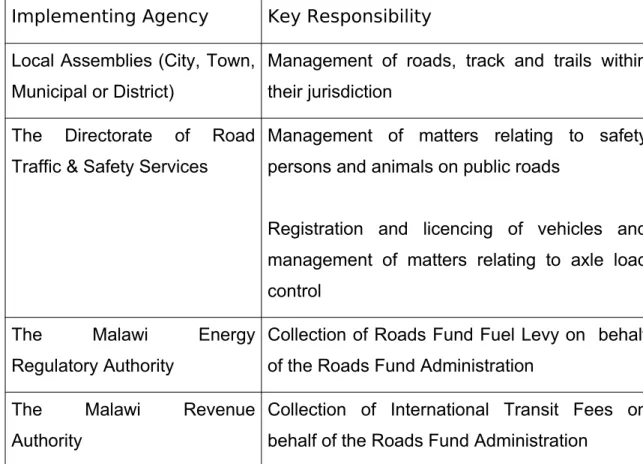
Implementing Agency Key Responsibility
Local Assemblies (City, Town, Municipal or District)
Management of roads, track and trails within their jurisdiction
The Directorate of Road Traffic & Safety Services
Management of matters relating to safety persons and animals on public roads
Registration and licencing of vehicles and management of matters relating to axle load control
The Malawi Energy
Regulatory Authority
Collection of Roads Fund Fuel Levy on behalf of the Roads Fund Administration
The Malawi Revenue Authority
Collection of International Transit Fees on behalf of the Roads Fund Administration
Figure 2 - Implementing Agencies in the Road Sub-Sector
In addition and complementary to this the Roads Fund Administration do often publicize in the National media their audited accounts. Further the public is made aware of what has actually gone into the year's programme by publicizing through several media houses such as radios, televisions and newspapers, funds disbursed and the projects that have been financed.
2.5.1.5
Zero Tolerance to Corruption
their corruption involvement among them includes the following: a) Director of Public Procurement
b) Malawi Housing Corporation c) Immigration Department d) The Traffic Police
e) Malawi Revenue Authority (Custom) f) Directorate of Road Traffic
g) The Regular Police
Going through the list one would note that corruption is deep rooted and widespread in government offices and department. the Roads Fund Administration being a government agency and operating in the same environment other organisations are operating could not therefore be totally spared though not mentioned in the report.
The Roads Fund Administration has put up control measures that ensures that corruption is controlled or minimized and these are:
a) developement of the anti-corruption policy
b) the periodic auditing of its operations as well as those of the implementing agencies particularly the Roads Authority
c) conducting sensetization meetings with the general public and all stakeholders involved in the roads management
Supporting the idea that corruption is everywhere the Ethiopian Roads Authority's commission report argues that 'corruption in the road sector is common mainly in the following and processes:
a) tendering procedures particularly the way road projects are awarded to companies without considering their track record causing time and cost overruns and also compromising the quality of each road constructed by a single contractor
b) costly road design problems
c) Weakness in the supervision of each and every project in the monitoring progress.
2.5.1.6
Participation
rural areas. The clubs are provided with simple tools to be used in the upgrading and rehabilitation of feeder roads. they are also given the allowance which acts as a motivator. The program has been welcomed by many of them through they are constantly requesting for upward adjustment of the allowance rate. In one the interaction meetings the researcher had with some of them, they claimed to be receiving K500 per person per day which is an equivalent of less than one dollar per person per day. This indeed appears to be on a lower side considering the economic trends where prices of essential commodities are drastically increasing in response to the international monetary trends as the Malawi kwacha continues to depreciate against major currencies such as the American Dollar, the British Pounds and other internationally competitive currencies
2.5.2 Governance in the Roads Authority
2.5.2.1
Secretariat
As is the case with the Roads Fund administration, the operations of the Roads Authority are directed by a board of directors appointed by the Minister of Transport and Public Works (roads authority act 2006). The secretariat is headed by the Chief Executive and is assisted by other heads of departments. The board has several functions including the following: a) To advice the minister on the construction and maintenance and
rehabilitation of public roads and the prohibition of any act that may lead to damage the public roads
c) To advice the minister on research and studies necessary for promoting the construction, maintenance and rehabilitation of public roads
d) To ensure that all tenders for the construction, maintenance and rehabilitation of public roads are conducted through open and competition bidding in a transparent and fair manner
e) To advise the minister on the development and training of human resources required for the construction, maintenance and rehabilitation of public roads.
f) To advise the minister on specifications, designs standards and classification of public roads
g) To advise the roads agencies on the construction, maintenance and rehabilitation of the different classes of public roads under their responsibility
h) To liaise with the roads traffic and roads safety authorities on matters relating to the safety of persons and animals on public roads
i) To advise the minister on appropriate road signs
j) To recommend to the minister and the minister responsible for land matters the reservation of land for public roads under construction, maintenance and rehabilitation
k) To prescribe measures for preventing damage however caused by any person to public roads or any part there of the damage from such person or his insurers
l) To publish periodic reports of the activities and achievements of the authority and make the reports available to general public
2.5.2.2
Accountability and Transparency Issues in the Roads Authority
Recognizing that accountability and transparency is crucial if the organization is to achieve its objectives efficiently and effectively, the Roads Authority, has put up the following measures:
a) Procurement of Services and Contractors
The Malawi government has a procurement department which was formed mainly to provide for the principles and procedures to be applied in and to regulate the public procurement of goods, works and services and to ensure the monitoring and oversights of public procurement activities (Public Procurement Act, 2003). The Roads Authority therefore ensures that their procurement activities are in line with the Public Procurement Act. Hiring and procurement of essential services and contracts are done through open and competitive bidding process. Before the actual bidding, the procurement entity must ensure that technical specifications are drawn and the following elements must be addressed:
i. General description of the scope and purpose of the works ii. Precise description of the scope of works to be carried out
including elements such as design, construction, erection, any manufacturing, installation of equipment
iii. Physical nature and conditions of construction site
iv. Detailed listing of any equipment and component to be supplied
v. Detailed design and drawing of works to be performed, to the extent that those are to be supplied by the procuring entity under the contracting management in question
descriptions and standards as to items such as plumbing and electrical installations
vii. Environmental impact safety standards to be met
viii. Description of performance and quality guarantees required ix. Inspection and testing to be conducted at various stages of
construction x. Completion tests
xi. Technical documentation, drawings, operating manuals to be provided by suppliers
xii. Type and quality of training supervision to be provided by suppliers
xiii. Inspection and performance test to be passed for acceptance
Bidding is done through tendering process where an invitation to tender is published in the local press and in the Gazette and in case of international tendering, bidding is published in the internationally recognized papers. All qualified national and international bidders are requested to compete. This is done to achieve accountability and transparency and to ensure that all qualified suppliers and contractors are participating.
b) Control Measures
has put up the following controls:
i. Periodic audits of both the internal and external works ii. Internal audits activities of its operations
iii. Scrutinizing validity of contractors by constant checking with the office of the Director of Public Procurement and the National Construction Industry of Malawi
2.6 Critical Review of the Roads Fund Administration and Roads Authority
The general question that has to be asked by the public is “Have the reforms yielded any positive impact? And why should there be problems when the idea of reformation was borrowed from elsewhere?
The management, administration and accounting for the Roads Fund by the Roads Fund Administration as a separate institution and reporting to a separate Board and Ministry has dealt with problems experienced during the National Roads Authority era and created high levels of efficiency and positive effects in the management and financing of maintenance and rehabilitation of public roads in Malawi. Random interviews that the researcher conducted revealed that most people agree that the reforms have brought about positive impact. In support of this ascertain, one tourist from the Africa Guide Forum (2001), commented, “I have just returned from a round trip starting in Malawi travelling through Zambia, Namibia, South Africa, Swaziland, Zimbabwe and back to Malawi. The roads conditions were good in all the countries and although we have 4 wheeled drive, we did not use it. All the main roads in Malawi have been resurfaced and are excellent”.
a) Provision of Checks and Balances to the Roads Authority and the Road Sector in General
The Roads Fund Administration’s monitoring of the use of funds disbursed from the Roads Fund for maintenance and rehabilitation of public roads through financial procurement and technical audits has brought project management discipline and efficiencies in the road sector. Typical examples are provided below:
i. There have been progressive improvements in the way the Roads Authority manages and monitor road works and services for the maintenance and rehabilitation over the years (Mazengera, 2011). ii. Punitive measures which were non-existent in practice before are now
applied on contractors and consultants working on road maintenance and rehabilitation for their non-compliance with conditions of contracts iii. There have been visible improvements in the quality of contractors’
road works and consultants’ supervision services and contracts have been completed within specified time.
iv. The Roads Fund Administration’s review of contractors and consultants’ certificates and invoices received from the Roads Authority before they are paid has resulted in the certificates and invoices now being submitted with correct claims and works done.
b) Enhanced Transparency and Accountability in the Use of Roads Fund Revenues
c) Better Annual Road Works Plans and Management of Political Pressures
Roads Fund financed projects are now better planned than before since only those programmes included in the Annual Financing Agreements signed between the Roads Authority and the Roads Fund Administration are funded. Since the programmes to be funded from the Roads Fund are only included in the signed Annual Financing Agreement, the Roads Authority is now able to decline political demands or request for projects outside the approved annual road maintenance and rehabilitation programme on the basis of lack of funds. This is so because Roads Fund resources are now managed by a different institution other than the implementing institution in the name of the Roads Authority.
d) Good Financial Management
As was previously the case during the then National Roads Authority where the Roads Fund was perpetually in deficit, today’s story is different. They are now no over-expenditures on the Roads Fund budgets since cost overruns on contracts beyond the annual funding agreed with the Roads authority are only approved after consultations with the Roads Fund Administration on availability of excess funds.
e) Increased and Visible Road Maintenance Activities
2.6.1 Challenges Encountered with the Reforms
Reforming the road sector has in general terms brought positive news if various reports and sayings are to go by. However there are some challenges that have to be improved upon. Some notable challenges include the following:
2.6.2 Policy Making
Policy making process has to follow similar steps upon which accountability and transparency are achieved. A good policy is the one which is made in a transparent manner and that it allows stakeholders and interested groups to participate. The Practical Guide to Policy Making (Page 2), defined policy making as the process by which governments translates their political vision into programmes and actions to deliver outcomes - desired change in the real world. It is argued that a good policy making must contain the following ten features; Forward Looking, Outward Looking, Innovative, Flexible and Creative, Evidence Based, Inclusive, Joined Up, Learns Lessons, Communication, Evaluation and Review.
Mark Ledburg etal (2006), identified the main policy instruments available to government and these are:
a) Information, education and advise b) Direct intervention
c) Economic Instrument
d) Regulation and other legislation e) Market based solution
the public could have acquired the knowledge leading to their understanding of the issues affecting them. The provision of information could have been provided through public education campaigns delivered through various media houses.
However and currently, it is a known fact that the media are struggling to get information from the government agencies and departments because of the existing laws. Relying on information given by personnel working within the two institutions is not adequate as they too are interested parties. They choose what information to give out and what information to keep under carpet.
A solution to the problem is to push on to the government to see that the access to Information Bill is passed in parliament and has become a law. The Roads Fund Administration and the Roads Authority must join hands with organization and the majority Malawian to lobby with the government for the passing of this very important bill. Once the Access to Information Bill is made into law, it will help create positive image for both the Roads Fund Administration and the Roads authority since the general public and stakeholders will be able to ask for information of their interest.
2.6.3 Failure to Fully Comply with Governance Issues
Defining the two terms, Decentralisation is the transfer or delegation of authority (administrative, legal and public authority) to plan, make decisions and manage public functions from central government and its agencies to field organization of those agencies.
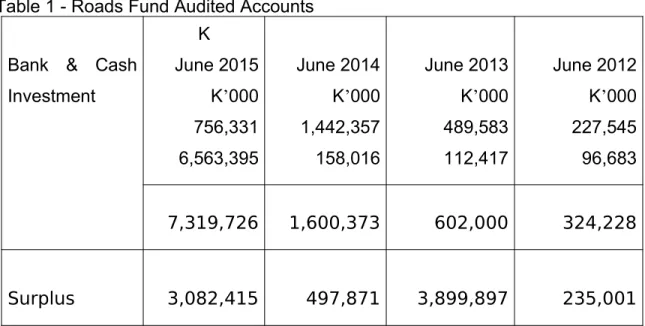
Devolution involves the transfer of real decision making powers and authority (through legislation and or constitutional provisions to local government authorities that have legal status, specific functions, an elected leadership and local sources of revenue (UNDP Assessment Report, 2000). Relating this to the Roads Fund Administration and the Roads Authority, it is clear that they both operate from the Centralized System and operating upon a Head Office. The Roads Authority operates with regional offices of the Centre, South and Northern Zones. This arrangement has proved that it has slowed down the efficient and effective delivery of services. There is lack of coordination between District Assembly personnel and those in the rural areas. The present scenario is that there are so many roads requiring maintenance or rehabilitation. The resources are there but no-one seem to take responsibility. In one of the meetings addressed by the Chief Executive Officer of the Roads Fund Administration, he acknowledged to be keeping idle funds amounting to over MK7,319,726 and called upon the Chief Executive Officer of the Roads Authority to speed up the process of procuring contractors for the road projects. He lamented that keeping such huge sums of money was unfair when so many roads are not in good condition.
This may be the right time for the institutions to push for decentralization of the road works so that all roads must be managed within their cities, assemblies, districts and towns.
Table 1 - Roads Fund Audited Accounts
Bank & Cash Investment
K June 2015
K’000 756,331 6,563,395
June 2014 K’000 1,442,357 158,016
June 2013 K’000 489,583 112,417
June 2012 K’000 227,545 96,683
7,319,726 1,600,373 602,000 324,228
Surplus 3,082,415 497,871 3,899,897 235,001
Source: Roads Fund Audited Financial Statements (2012 – 2015)
2.6.4 Human Resource Challenges
Both the Roads Fund Administration and the Roads Authority have employed staff within their different departments and sections. There are no records to substantiate any measure of performance of their jobs. The danger of the institution not conducting staff performance management is that they may be keeping too many staff doing less work or that they may have employed less staff and doing more work which may negatively impact on their overall performance and hence a source of inefficiency.
a) People know what is expected of them – they are clear about their goals and accountabilities.
b) They have the skills and competencies to achieve their goals c) High performance is recognized and rewarded accordingly
d) People feel their jobs is worth doing and that there is a strong fit between the job and their capabilities
e) Managers act as supportive leaders and coaches providing regular feedback, performance reviews and development.
The common feature is that the organization and the employee agree and sign for specific targets to be achieved which are persistently reviewed.
The achievements of individual targets directly contribute to the overall success of the entire organization.
Another Human Resources challenges is the organisations failure to provide clearly defined training guidelines. Employees are yearly sent for various external and internal training and workshops. One could hardly assess and equate the value of such training. The fear is such haphazardly set trainings may just be another way upon which the resources are not put into good use. The Roads Fund Administration and the Roads Authority are encourage to put across a proper training policy guided by training programmes that are aligned to their organisations’ strategic plans.
2.6.4.1
Discussion of the Key Questions and Primary Focus of Research
Administration and Roads Authority.
Four primary key questions have been identified as paramount for the achievement of the objective as set out in the objective above. The four primary key questions are as set out below but a general prose will follow which will give a clear overview of these four questions.
a) What were the roles of the then National Roads Authority?
b) What were the reasons for dissolution of National Roads Authority? c) Who initiated the whole process of separation of roles of RFA and
RA?
d) Have all the players in the Road Construction Industry fully adopted changes brought about by the separation of roles of RFA and RA? According to Kumar (2000), before 1997 the government of Malawi had instituted several initiatives to curb the problem of deteriorating conditions of the road network which was having adverse effects on the economic growth of the country. Under the guidance of the Ministry of Transport, the various key stakeholders established initiatives such as:
i. Road Maintenance Initiative (RMI) and
ii. Road Maintenance and Rehabilitation Program (ROMARP)
However, the initiatives did not prove comprehensive enough and as such an act of parliament was passed in 1997 for the creation of the National Roads Authority (NRA). The mandate of the National Roads Authority was to manage the road sector on behalf of Government with resources generated from a Road Fund (RF) whose full responsibility rested with the Board of the NRA. This was in the hope that improvements would be realized in the management and financing of the road sector. The National Roads Authority’s Board was tasked with the following specific functions:
ii. Monitor the maintenance and development of public road network of Malawi
iii. Raise the required funds for adequate maintenance and rehabilitation of public roads
iv. Prioritize annual roads program submitted to NRA by the various central and local road agencies
v. Advice the ministers of Works and Supplies, Local Government and Transport on:
- preparation of efficient and effective implementation of the annual roads program as specified and
- Control of overloading of vehicles on public roads.
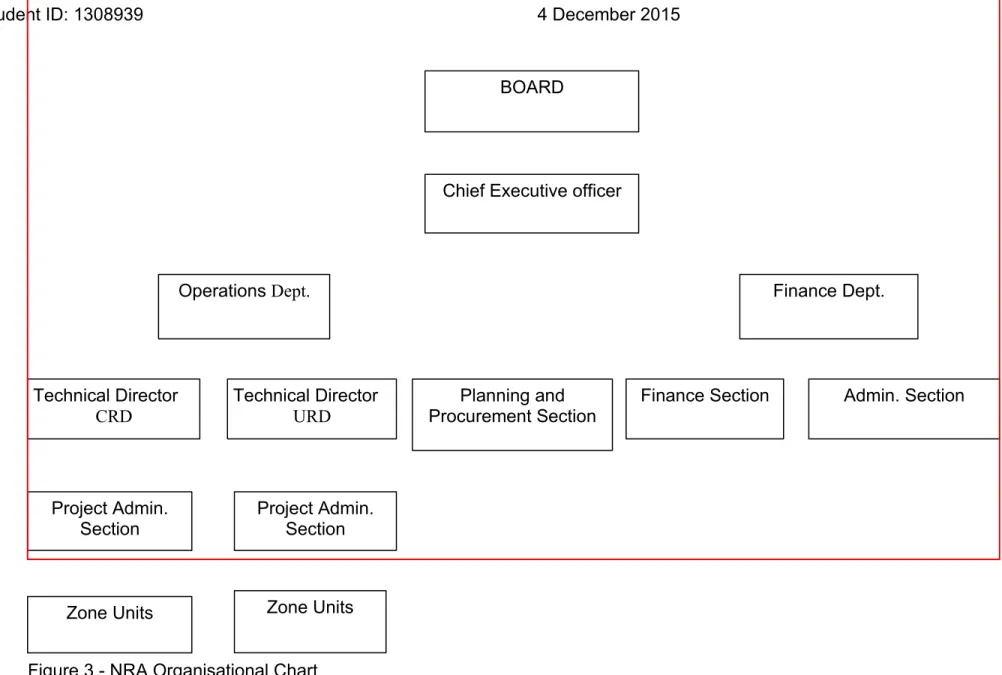
Figure 3 on page 49 depicts the organization chart that the then National Roads Authority adopted for its operations.
Figure 3 - NRA Organisational Chart
Planning and Procurement Section
Zone Units Zone Units
Project Admin. Section Project Admin.
Section
Admin. Section Finance Section
Technical Director URD Technical Director
CRD
Finance Dept. Operations Dept.
2.7 Critical analysis of benefits of the separation of roles of RFA and RA in the road construction industry
The questions that should help to achieve this objective are three in number but one general prose will suffice to cover all of them. The following are the specific questions and what follows thereafter is the aforesaid prose:
a) What were the envisioned benefits for the establishment of Roads Authority and Roads Fund Administration?
b) Have the envisioned benefits for the separation of roles of RFA and RA been achieved?
c) Is there room for improvement in roles of the two institutions that would increase the benefits in the road construction industry?
• Assurance of economic growth and national well-being iii. Road user costs
• General reductions in vehicle operating costs and savings in travel time iv. Accident levels and costs
• This would ensure reduced numbers of accidents, savings in death and injury, and reduction in consequential costs.
v. Environmental degradation
• Assurance of a healthier, less damaged, and more pleasant environment for those using and living adjacent to the road
vi. Road Administration costs
• Better value for money and lower costs for activities undertaken on the road network
These benefits should be enjoyed by beneficiaries such as: i. Owners and operators of commercial vehicles and buses
ii. Representatives of industry of commerce and agriculture, who have vested interest in an efficient road network to support their business operations. iii. The travelling public using the road network
iv. The road administration and the road engineering industry
These assertions are also echoed by the World Bank in its report, Road financing and Road funds, World Bank, (2012).
2.7.1 Identify challenges being faced in the road construction industry due to the separation of roles of RFA and RA.
The researcher has identified three specific areas to address in order to achieve the objective as set out in this sub-paragraph. A generic perspective will be given with regard to literature from elsewhere where the road management has been assigned to two institutions as is the case in Malawi. The specific research questions are as follows:
a) Has the separation of roles of RFA and RA brought any challenges in the road construction industry?
b) What challenges have been brought by the separation of roles of RFA and RA in the road construction industry?
c) Are there any measures that have been put in place to mitigate the challenges brought about by the separation of roles of RFA and RA?
World Bank, (2012) reveals that the oldest Roads Fund is the one in South Africa which was established in 1935 but had its fuel levy suspended in 1988 only to be reinstated in 1998. Already, it can be construed that there are several challenges associated with the change brought about by the break-away of a Roads Fund from the main road agency; in the case of Malawi, the road agency is the Roads Authority. In Malawi, the Roads Fund reports directly to the ministry of Finance and gets it parliamentary appropration through the ministry. However, Robinson et al, (1998) has identified several pitfalls with this kind of arrangement as follows:
i. The Ministry may decide to stop paying money into the Road Fund ii. Release of funds into the Road Fund may be withheld
iii. Decisions may be made to take money out of the Road Fund and use it for other purposes other than within the mandate of the Road Fund,
iii. Dissolution of the Roads Fund Board and the Roads Fund Administration operating without a board for three years; from 2009 to 2011.
The chairman further indicated that at the time of that annual report, the outstanding balance of collected fuel levies but unremitted to the Roads Fund Administration was at a staggering eight billion Malawi kwacha. Another major challenge as cited by Mazengera, (2009) is non-compliance of some petroleum companies that are not part of the Petroleum Importers Limited Consortium of Malawi.
The preceding paragraphs have indicated what challenges there may be in the road sub-sector from literature alone. Subsequent chapters will now narrow down to the results of the research project to establish if at all the information from this literature review is relevant to the case institutions as well as the surveyed contractors and civil engineering Consultants.
2.7.2 Conceptual Framework
When the Road Sector reforms were being implemented, expectations were very high amongst the public and general road users that they were to see total efficiency in the management of roads. However, due to various competing interests amongst leaders and politicians, there seem to be continued challenges in the road sector. This is supported by the Principle Agent Problem (Theory) which state the following:
a) Policy makers/agenda settlers will promote their own pet projects and self interest
b) Interest groups (including Civil Society) will promote their own pet projects and self interest
c) Agenda are set through bargain processes rather than rational choice It is for this reason that we see that despite having the two institutions with good guiding principles, the majority Malawians public still question the performance of the Roads Fund Administration and the Roads authority. The problem may not be with the two organisations as per say but the various interest groups managing the road works for example:
a) Contractors deliberately neglect close supervision of works resulting in poor service delivery
b) Within their office set up, some officers would bypass crucial procurement procedures with the aim of getting kickbacks (corruption) and award contract to unqualified contractors which becomes a cost in the end.
from one to another for their political interest. In other cases they have pronounced commissioning of new roads during public meetings without consulting the administration of RFA and RA as these creates unnecessary pressures. The Roads Authority and the Roads Fund Administration are then forced to abandon the planned projects for the haphazard and unplanned projects for their survival and to deal with the political problem. This study was conducted to deal with the gap in knowledge between the theoretical belief and what is believed to be actual.
2.7.3 Summary
The chapter has brought to light some key findings of this literature review as follows:
a) The Roads Authority faces some challenges within its mandate of implementing and executing the construction, maintenance and rehabilitation of public roads in Malawi.
b) The Roads Fund Administration faces some challenges within its mandate of raising, administering and accounting for funds for construction, maintenance and rehabilitation of public roads
c) The Roads Authority is failing to upgrade, construct and rehabilitate all commissioned road project as per agreed annual work plan.
3 CHAPTER THREE – RESEARCH DESIGN
Literature has revealed that before the reforms in the road sector were introduced, a lot of inefficiencies were noticed in the management of the road networks. The inefficiencies had resulted in having poor state of roads as most roads had a lot of potholes making them impassable most of the time. During that time very few new roads were being commissioned. Whenever a new road was commissioned, the quality of the roads were very poor raising such questions as what was the problem considering that considerable amounts of resources were being spent. To date, eight years down the line, several challenges continue to be experienced. These include the slow pace at which roads are maintained, rehabilitated and commissioned.
Literature has further revealed that the ineffective and inefficient delivery of service is to a larger extent as a result of the centralized set up of administration existing in both the Roads Fund Administration and the Roads Authority. It was observed that both organisations may in certain cases lack capacity in terms of human resources to manage all roads across the country. Where they may have enough numbers of its human resources, the challenge remained on the institutions’ capacity to efficiently and effectively utilize them. Employees were recruited on the basis of fulfilling establishment of various post as no efforts were made to evaluate employee performances.
The Roads Fund Administration and the Roads Authority has neglected an important issue and that is the regular provision of information to the general public. Information provision is essential for both knowledge and also for the public to own the roads.
road sector and how they have impacted on the delivery of road works c) Has the separation of roles between the Roads Fund Administration and
the Roads Authority brought any challenges in the road construction industry?
3.1 Research Philosophy
The philosophy that was used in carrying out this research was the Interpretivism. According to Saunders et al (2007), Interpretivism makes the researcher to understand differences between humans in their roles as social actors. Interpretivism makes researchers to interpret the social roles of others in accordance with his own set of meanings. In this research, “Has the separation of functions between RFA and RA improved the performance delivery of roads in terms of efficiency and effectiveness in Malawi?”, the researcher applied this philosophy because it allowed him to interpret data obtained from other people as well as giving it the meaning using the knowledge that he has regarding the operations of the two organisations. The research was tackled with an inclination towards “Public Policy and Corporate Governance” issues. This is so because the reforms that were made were aimed at improving the efficiency and effectiveness in the management of public roads. For our better understanding, these had to start from the effect of policy formulation. Allowing good governance to start from the initial policy formulation where stakeholder participation was considered, could have made the outcomes of the reforms bear fruits
3.2 Research Approach
3.3 Research Strategy
Case study was the strategy employed. According to Collins & Hussey (2003) a case study is a methodology which focuses on understanding the dynamics present within single setting and often used in exploratory stages of research. It is a holistic, detailed and in depth exploration of an individual, group as an entity, an organization or an event in context, conducted in natural, real life situations (Hoskins et al, 2004). Further to that case study strategy is best suited for the “why” and “how” questions which could ably explain situations leading to the unsatisfactory performance by the Roads Authority and Roads fund Administration.
Case study has been chosen because this research will involve exploring views of different people from organisations involved in the roads management and other road users on their feelings towards general management of roads in relation to the separation of functions between the Roads Authority and the Roads Fund Administration.
Another Strategy that was employed was the survey and more detail will be given in chapter 4 of this report.
3.4 Research Choice
Mixed method was the choice for the research where both numeric and no-numeric data was obtained from the questionnaires and interviews that were administered and conducted respectively. This choice auger well with the quantitative and qualitative data analyses methods that will be used for the research.
Executive Officer of the Roads Fund Administration and the Roads authority. The purpose was to explain to them the purpose of this study which helped in clearing their conscious and avoid organizational politics.
3.5.1 Time Horizon
Time is one of the major constraints in this research because the research results were tied to a specific and shorter time frame. In view of these time boundaries, the time horizon for the research was the cross-sectional.
3.5.2 Techniques and Procedures
Specific Data Collection Techniques that were employed are: i. Interviews
ii. Questionnaires iii. Reports
These have the advantage in the sense that they target people that are directly involved. In this research, specific people whom the researcher interviewed or send questionnaires included, the Chief Executive Officer of the Roads Authority, the Chief Executive Officer of the Roads Fund Administration, Engineers and the Chief Executive Officer of the National Construction Industry, the general public or the road user and selected contractors and consultants.
3.5.3 Sampling Techniques
kept to a minimum. This sampling technique had thus been chosen because of its equal representation from the categories that make the total population.
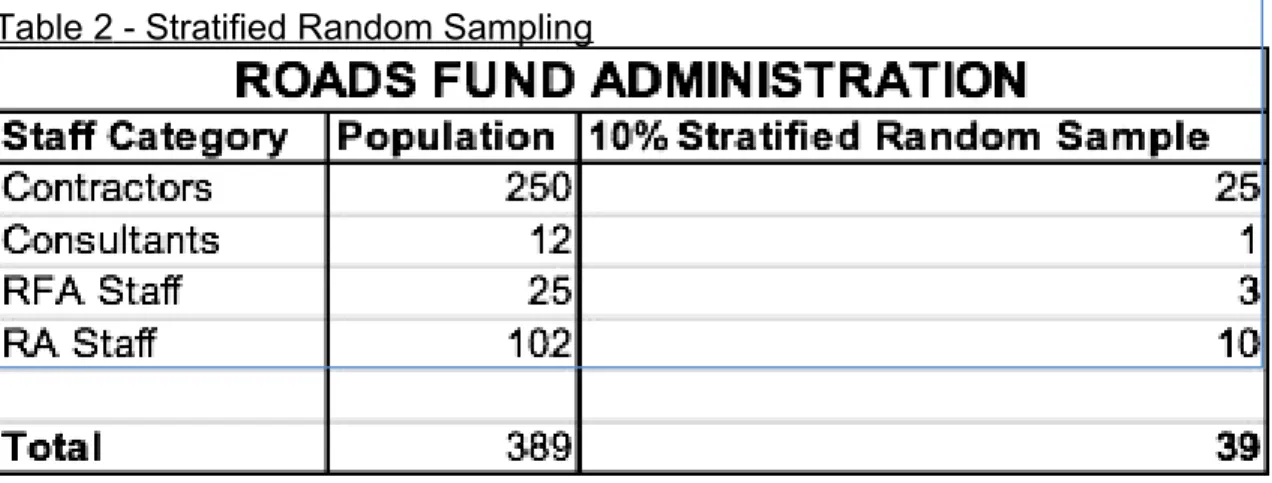
The table below is a summary of respondents as regards to Stratified Random Sampling.
Table 2 - Stratified Random Sampling
In this sampling technique a total population of 389 were categorized as contractors (250), consultants (12), RFA staff (25) and RA staff (102). A ten percent (10%) random sample from each category yields the figures in the right column of the table giving a total rounded off stratified random sample of 39. At least two consultants were sampled. This is in view of the fact that a sample size of one was likely to bias the findings within that category.
3.5.3.1 Data Analysis
research questions
iii. Equipment such as motor vehicles, computers and internet services
3.5.3.3 Research Limitations
Understanding the fact that the chosen area of study involved several players, the scope of this research was limited to investigate one area and this is to investigate the effects of separation of functions between the Roads Authority and the Roads Fund Administration and their overall effect in the management of public roads.
The researcher acknowledged the need to conduct further research to explore other aspect of this subject like “the political influence in the management of public roads”.
3.5.3.4
Ethical issues
Data used in achieving objectives of this research was obtained from a wide cross section of players in the road construction sector in Malawi. As such, it was necessary to observe some basic ethical values in as far as respondents are concerned. The basic ethical values that will be observed during and after the research paper are:
i. Confidentiality and ii. Informed consent
In this regard the researcher will treat all data collected with the highest level of confidentiality and that no information will be released without the consent of the owner.
3.5.3.5
Dissemination
The research report will be submitted as per prescription by the University of Bolton (UoB) and Malawi Institute of Management (MIM) visa viz:
ii. Bound as well as Soft copy to MIM