V N .1(2011),I N .7(D ) ISSN 2231-5756
I
I
I
N
N
N
T
T
T
E
E
E
R
R
R
N
N
N
A
A
A
T
T
T
I
I
I
O
O
O
N
N
N
A
A
A
L
L
L
J
J
J
O
O
O
U
U
U
R
R
R
N
N
N
A
A
A
L
L
L
O
O
O
F
F
F
R
R
R
E
E
E
S
S
S
E
E
E
A
A
A
R
R
R
C
C
C
H
H
H
I
I
I
N
N
N
C
C
C
O
O
O
M
M
M
M
M
M
E
E
E
R
R
R
C
C
C
E
E
E
,
,
,
I
I
I
T
T
T
A
A
A
N
N
N
D
D
D
M
M
M
A
A
A
N
N
N
A
A
A
G
G
G
E
E
E
M
M
M
E
E
E
N
N
N
T
T
T
A Monthly Double-Blind Peer Reviewed Refereed Open Access International e-Journal - Included in the International Serial Directories
Indexed & Listed at: Ulrich's Periodicals Directory ©, ProQuest, U.S.A., Index Copernicus Publishers Panel, Poland, Open J-Gage, India
C
C
C
CONTENTS
ONTENTS
ONTENTS
ONTENTS
Sr.
No.
TITLE & NAME OF THE AUTHOR (S)
Page No.
1
.
CONFLICT MANAGEMENT AND LEADERSHIP STYLE AS PREDICTORS OF ORGANISATIONAL LEARNINGARUNA B. BHAT, DR. SANTOSH RANGNEKAR & DR. MUKESH BARUA
1
2
.
A STUDY ON TRAINING FACTORS AND ITS IMPACT ON TRAINING EFFECTIVENESS IN KEDAH STATE DEVELOPMENT CORPORATION, KEDAH, MALAYSIADR. VIMALA SANJEEVKUMAR & HU YANAN
8
3
.
EDUCATIONAL HYPERMEDIA - IMPACTS ON TEACHING AND LEARNING PROCESSESDR. SALAH ALKHAFAJI. & B.SRIRAM.
16
4
.
TECHNOLOGICAL ‘CATCHING UP’ IN BANGLADESH-EPZS: A PERFORMANCE APPRAISALDR. TAIMUR SHARIF & DR. JAMAL UDDIN AHMED
21
5
.
APPRAISING ICT RELEVANCE IN POLITICAL ADVERTISINGDR. CHINENYE NWABUEZE, RITA OKEKE & FESTINUS OKOYE
32
6
.
EFFECTIVE MAINTENANCE MANAGEMENT IN PETROCHEMICAL INDUSTRIESN. K. K. PRASANNA & TUSHAR N. DESAI
36
7
.
IMPACT OF BUSINESS TYPES ON THE PROBLEMS FACED BY SHG WOMEN ENTREPRENEURSDR. M. R. VANITHAMANI & DR. S. SANDHYA MENON
41
8
.
MORALE AND MOTIVATION OF PUBLIC SECTOR BANK EMPLOYEES (A CASE STUDY OF KURNOOL CITY IN A.P.)DR. G. RAMA KRISHNA, P. BASAIAH, DR. A. HARI HARA NATH REDDY & K. VENU GOPAL RAO
45
9
.
HIDDEN MOTIVATORS OF TELECOM EMPLOYEESDR. PRATIMA VERMA
50
10
.
MICROFINANCE IN INDIAR. RAJENDRAKUMAR & DR. S. ASOKKUMAR
55
11
.
IDENTIFICATION OF IT GOVERNANCE PRACTICES & HUMAN RESOURCES IMPACTING BUSINESS - IT ALIGNMENT IN THE INDIAN IT CONTEXT LAKSHMI VISHNU MURTHY TUNUGUNTLA & DR. MU.SUBRAHMANIAN57
12
.
CONSUMER’S PERCEPTION AND PURCHASE INTENTIONS TOWARDS GREEN PRODUCTSDASARI.PANDURANGARAO, SHAIK.CHAND BASHA & K.V.R.SATYAKUMAR
63
13
.
ROUGH SET THEORY IN ANALYSING THE CONSUMER AWARENESS ABOUT FACE WASH PRODUCTS IN CHENNAI CITYC.R.SENTHILNATHAN
67
14
.
A STUDY ON BRAND PREFERENCE OF MOBILE PHONE CUSTOMERS WITH REFERENCE TO ERODE CITYDR. P. KARTHIKEYAN
72
15
.
RELATIONSHIP BETWEEN WORKING CAPITAL AND PROFITABILITY: AN EMPIRICAL ANALYSISM. SUMAN KUMAR, S. MD. AZASH & N. VENKATA RAMANA
77
16
.
FEMALE WORKFORCE - A MISSING PILLAR OF HUMAN RESOURCE DEVELOPMENT IN THE GLOBALIZATION ERAFIONA JEELANI, ZEENAZ ELIZABETH & DR. PARVEZ A. MIR
81
17
.
AN ANALYSIS ON IMPACT OF MOBILE PHONES ON INDIAN CONSUMER - A COMPARATIVE STUDYSHEETAL SINGLA & DR. SANJIV BANSAL
86
18
.
‘SOFT SKILLS’- AN ESSENTIALITY IN TODAY’S BUSINESS ENGLISHJAYATEE CHAKRABORTY
96
19
.
ROLE OF RFID TECHNOLOGY IN HOSPITALSDR. L. KALYAN VISWANATH REDDY & RAMAIAH ITUMALLA
100
20
.
A COMPARATIVE STUDY OF CORPORATE GOVERNANCE DISCLOSURE PRACTICE OF ELECON AND GMMJAIMIN H. TRIVEDI & DIVYANG V. BHRAMBHATT
106
21
.
A STUDY ON WORKING CAPITAL MANAGEMENT IN TAMILNADU SUGAR CORPORATION LIMITED (TASCO)DR. P. KANAGARAJU
109
22
.
PERFORMANCE EVALUATION AND BARRIERS OF CRM PRACTICES IN HIGHER EDUCATIONDR. NARINDER TANWAR
113
23
.
SERVICE QUALITY GAP IN PRIVATE HOSPITALSVANISHREE
119
24
.
MEASURING IMPACT OF TRAINING ON DEVELOPMENT: A STATISTICAL APPROACHS. AMOLAK SINGH
122
25
.
IMPACT OF STRESS ON WORK-LIFE-BALANCE OF WOMEN EMPLOYEES WITH REFERENCE TO BPO AND EDUCATION SECTORS IN BANGALOREK. THRIVENI KUMARI
129
V N .1(2011),I N .7(D ) ISSN 2231-5756
CHIEF PATRON
CHIEF PATRON
CHIEF PATRON
CHIEF PATRON
PROF. K. K. AGGARWAL
Chancellor, Lingaya’s University, Delhi
Founder Vice-Chancellor, Guru Gobind Singh Indraprastha University, Delhi
Ex. Pro Vice-Chancellor, Guru Jambheshwar University, Hisar
PATRON
PATRON
PATRON
PATRON
SH. RAM BHAJAN AGGARWAL
Ex. State Minister for Home & Tourism, Government of Haryana
Vice-President, Dadri Education Society, Charkhi Dadri
President, Chinar Syntex Ltd. (Textile Mills), Bhiwani
CO
CO
CO
CO----ORDINATOR
ORDINATOR
ORDINATOR
ORDINATOR
AMITA
Faculty, Government M. S., Mohali
ADVISORS
ADVISORS
ADVISORS
ADVISORS
DR. PRIYA RANJAN TRIVEDI
Chancellor, The Global Open University, Nagaland
PROF. M. S. SENAM RAJU
Director A. C. D., School of Management Studies, I.G.N.O.U., New Delhi
PROF. M. N. SHARMA
Chairman, M.B.A., Haryana College of Technology & Management, Kaithal
PROF. S. L. MAHANDRU
Principal (Retd.), Maharaja Agrasen College, Jagadhri
EDITOR
EDITOR
EDITOR
EDITOR
PROF. R. K. SHARMA
Professor, Bharti Vidyapeeth University Institute of Management & Research, New Delhi
CO
CO
CO
CO----EDITOR
EDITOR
EDITOR
EDITOR
DR. BHAVET
Faculty, M. M. Institute of Management, Maharishi Markandeshwar University, Mullana, Ambala, Haryana
EDITORIAL ADVISORY BOARD
EDITORIAL ADVISORY BOARD
EDITORIAL ADVISORY BOARD
EDITORIAL ADVISORY BOARD
DR. RAJESH MODI
Faculty, Yanbu Industrial College, Kingdom of Saudi Arabia
PROF. SANJIV MITTAL
University School of Management Studies, Guru Gobind Singh I. P. University, Delhi
PROF. ANIL K. SAINI
Chairperson (CRC), Guru Gobind Singh I. P. University, Delhi
DR. SAMBHAVNA
Faculty, I.I.T.M., Delhi
DR. MOHENDER KUMAR GUPTA
V N .1(2011),I N .7(D ) ISSN 2231-5756
DR. SHIVAKUMAR DEENE
Asst. Professor, Government F. G. College Chitguppa, Bidar, Karnataka
MOHITA
Faculty, Yamuna Institute of Engineering & Technology, Village Gadholi, P. O. Gadhola, Yamunanagar
ASSOCIATE EDITORS
ASSOCIATE EDITORS
ASSOCIATE EDITORS
ASSOCIATE EDITORS
PROF. NAWAB ALI KHAN
Department of Commerce, Aligarh Muslim University, Aligarh, U.P.
PROF. ABHAY BANSAL
Head, Department of Information Technology, Amity School of Engineering & Technology, Amity University, Noida
PROF. A. SURYANARAYANA
Department of Business Management, Osmania University, Hyderabad
DR. ASHOK KUMAR
Head, Department of Electronics, D. A. V. College (Lahore), Ambala City
DR. SAMBHAV GARG
Faculty, M. M. Institute of Management, Maharishi Markandeshwar University, Mullana, Ambala, Haryana
DR. V. SELVAM
Divisional Leader – Commerce SSL, VIT University, Vellore
DR. PARDEEP AHLAWAT
Reader, Institute of Management Studies & Research, Maharshi Dayanand University, Rohtak
S. TABASSUM SULTANA
Asst. Professor, Department of Business Management, Matrusri Institute of P.G. Studies, Hyderabad
SURJEET SINGH
Asst. Professor, Department of Computer Science, G. M. N. (P.G.) College, Ambala Cantt.
TECHNICAL ADVISOR
TECHNICAL ADVISOR
TECHNICAL ADVISOR
TECHNICAL ADVISOR
AMITA
Faculty, Government H. S., Mohali
MOHITA
Faculty, Yamuna Institute of Engineering & Technology, Village Gadholi, P. O. Gadhola, Yamunanagar
FINANCIAL ADVISORS
FINANCIAL ADVISORS
FINANCIAL ADVISORS
FINANCIAL ADVISORS
DICKIN GOYAL
Advocate & Tax Adviser, Panchkula
NEENA
Investment Consultant, Chambaghat, Solan, Himachal Pradesh
LEGAL ADVISORS
LEGAL ADVISORS
LEGAL ADVISORS
LEGAL ADVISORS
JITENDER S. CHAHAL
Advocate, Punjab & Haryana High Court, Chandigarh U.T.
CHANDER BHUSHAN SHARMA
Advocate & Consultant, District Courts, Yamunanagar at Jagadhri
SUPERINTENDENT
SUPERINTENDENT
SUPERINTENDENT
SUPERINTENDENT
V N .1(2011),I N .7(D ) ISSN 2231-5756
CALL FOR MANUSCRIPTS
CALL FOR MANUSCRIPTS
CALL FOR MANUSCRIPTS
CALL FOR MANUSCRIPTS
Weinvite unpublished novel, original, empirical and high quality research work pertaining to recent developments & practices in the area of Computer, Business, Finance, Marketing, Human Resource Management, General Management, Banking, Insurance, Corporate Governance and emerging paradigms in allied subjects like Accounting Education; Accounting Information Systems; Accounting Theory & Practice; Auditing; Behavioral Accounting; Behavioral Economics; Corporate Finance; Cost Accounting; Econometrics; Economic Development; Economic History; Financial Institutions & Markets; Financial Services; Fiscal Policy; Government & Non Profit Accounting; Industrial Organization; International Economics & Trade; International Finance; Macro Economics; Micro Economics; Monetary Policy; Portfolio & Security Analysis; Public Policy Economics; Real Estate; Regional Economics; Tax Accounting; Advertising & Promotion Management; Business Education; Business Information Systems (MIS); Business Law, Public Responsibility & Ethics; Communication; Direct Marketing; E-Commerce; Global Business; Health Care Administration; Labor Relations & Human Resource Management; Marketing Research; Marketing Theory & Applications; Non-Profit Organizations; Office Administration/Management; Operations Research/Statistics; Organizational Behavior & Theory; Organizational Development; Production/Operations; Public Administration; Purchasing/Materials Management; Retailing; Sales/Selling; Services; Small Business Entrepreneurship; Strategic Management Policy; Technology/Innovation; Tourism, Hospitality & Leisure; Transportation/Physical Distribution; Algorithms; Artificial Intelligence; Compilers & Translation; Computer Aided Design (CAD); Computer Aided Manufacturing; Computer Graphics; Computer Organization & Architecture; Database Structures & Systems; Digital Logic; Discrete Structures; Internet; Management Information Systems; Modeling & Simulation; Multimedia; Neural Systems/Neural Networks; Numerical Analysis/Scientific Computing; Object Oriented Programming; Operating Systems; Programming Languages; Robotics; Symbolic & Formal Logic and Web Design. The above mentioned tracks are only indicative, and not exhaustive.
Anybody can submit the soft copy of his/her manuscript anytime in M.S. Word format after preparing the same as per our submission guidelines duly available on our website under the heading guidelines for submission, at the email addresses: [email protected]or
GUIDELINES FOR SUBMISSION OF MANUSCRIPT
GUIDELINES FOR SUBMISSION OF MANUSCRIPT
GUIDELINES FOR SUBMISSION OF MANUSCRIPT
GUIDELINES FOR SUBMISSION OF MANUSCRIPT
1. COVERING LETTER FOR SUBMISSION:
DATED: _____________
THE EDITOR
IJRCM
Subject:SUBMISSION OF MANUSCRIPT IN THE AREA OF .
(e.g. Computer/IT/Engineering/Finance/Marketing/HRM/General Management/other, please specify).
DEAR SIR/MADAM
Please find my submission of manuscript titled ‘___________________________________________’ for possible publication in your journals.
I hereby affirm that the contents of this manuscript are original. Furthermore, it has neither been published elsewhere in any language fully or partly, nor is it under review for publication anywhere.
I affirm that all author (s) have seen and agreed to the submitted version of the manuscript and their inclusion of name (s) as co-author (s).
Also, if my/our manuscript is accepted, I/We agree to comply with the formalities as given on the website of journal & you are free to publish our contribution in any of your journals.
NAME OF CORRESPONDING AUTHOR:
Designation:
Affiliation with full address, contact numbers & Pin Code:
Residential address with Pin Code:
Mobile Number (s):
Landline Number (s):
E-mail Address:
Alternate E-mail Address:
2. MANUSCRIPT TITLE: The title of the paper should be in a 12 point Calibri Font. It should be bold typed, centered and fully capitalised.
3. AUTHOR NAME (S) & AFFILIATIONS: The author (s) full name, designation, affiliation (s), address, mobile/landline numbers, and email/alternate email address should be in italic & 11-point Calibri Font. It must be centered underneath the title.
4. ABSTRACT: Abstract should be in fully italicized text, not exceeding 250 words. The abstract must be informative and explain the background, aims, methods,
V N .1(2011),I N .7(D ) ISSN 2231-5756
5. KEYWORDS: Abstract must be followed by list of keywords, subject to the maximum of five. These should be arranged in alphabetic order separated by commas and full stops at the end.
6. MANUSCRIPT: Manuscript must be in BRITISH ENGLISH prepared on a standard A4 size PORTRAIT SETTING PAPER. It must be prepared on a single space and
single column with 1” margin set for top, bottom, left and right. It should be typed in 8 point Calibri Font with page numbers at the bottom and centre of the every page. It should be free from grammatical, spelling and punctuation errors and must be thoroughly edited.
7. HEADINGS: All the headings should be in a 10 point Calibri Font. These must be bold-faced, aligned left and fully capitalised. Leave a blank line before each
heading.
8. SUB-HEADINGS: All the sub-headings should be in a 8 point Calibri Font. These must be bold-faced, aligned left and fully capitalised.
9. MAIN TEXT: The main text should follow the following sequence:
INTRODUCTION
REVIEW OF LITERATURE
NEED/IMPORTANCE OF THE STUDY
STATEMENT OF THE PROBLEM
OBJECTIVES
HYPOTHESES
RESEARCH METHODOLOGY
RESULTS & DISCUSSION
FINDINGS
RECOMMENDATIONS/SUGGESTIONS
CONCLUSIONS
SCOPE FOR FURTHER RESEARCH
ACKNOWLEDGMENTS
REFERENCES
APPENDIX/ANNEXURE
It should be in a 8 point Calibri Font, single spaced and justified. The manuscript should preferably not exceed 5000 words.
10. FIGURES &TABLES: These should be simple, centered, separately numbered & self explained, and titles must be above the table/figure. Sources of data should be mentioned below the table/figure. It should be ensured that the tables/figures are referred to from the main text.
11. EQUATIONS: These should be consecutively numbered in parentheses, horizontally centered with equation number placed at the right.
12. REFERENCES: The list of all references should be alphabetically arranged. The author (s) should mention only the actually utilised references in the preparation
of manuscript and they are supposed to follow Harvard Style of Referencing. The author (s) are supposed to follow the references as per following:
•
All works cited in the text (including sources for tables and figures) should be listed alphabetically.•
Use (ed.) for one editor, and (ed.s) for multiple editors.•
When listing two or more works by one author, use --- (20xx), such as after Kohl (1997), use --- (2001), etc, in chronologically ascending order.•
Indicate (opening and closing) page numbers for articles in journals and for chapters in books.•
The title of books and journals should be in italics. Double quotation marks are used for titles of journal articles, book chapters, dissertations, reports, working papers, unpublished material, etc.•
For titles in a language other than English, provide an English translation in parentheses.•
The location of endnotes within the text should be indicated by superscript numbers.PLEASE USE THE FOLLOWING FOR STYLE AND PUNCTUATION IN REFERENCES: BOOKS
•
Bowersox, Donald J., Closs, David J., (1996), "Logistical Management." Tata McGraw, Hill, New Delhi.•
Hunker, H.L. and A.J. Wright (1963), "Factors of Industrial Location in Ohio," Ohio State University.CONTRIBUTIONS TO BOOKS
•
Sharma T., Kwatra, G. (2008) Effectiveness of Social Advertising: A Study of Selected Campaigns, Corporate Social Responsibility, Edited by David Crowther & Nicholas Capaldi, Ashgate Research Companion to Corporate Social Responsibility, Chapter 15, pp 287-303.JOURNAL AND OTHER ARTICLES
•
Schemenner, R.W., Huber, J.C. and Cook, R.L. (1987), "Geographic Differences and the Location of New Manufacturing Facilities," Journal of Urban Economics, Vol. 21, No. 1, pp. 83-104.CONFERENCE PAPERS
•
Garg Sambhav (2011): "Business Ethics" Paper presented at the Annual International Conference for the All India Management Association, New Delhi, India, 19–22 June.UNPUBLISHED DISSERTATIONS AND THESES
•
Kumar S. (2011): "Customer Value: A Comparative Study of Rural and Urban Customers," Thesis, Kurukshetra University, Kurukshetra.ONLINE RESOURCES
•
Always indicate the date that the source was accessed, as online resources are frequently updated or removed.WEBSITE
V N .1(2011),I N .7(D ) ISSN 2231-5756
PERFORMANCE EVALUATION AND BARRIERS OF CRM PRACTICES IN HIGHER EDUCATION
DR. NARINDER TANWAR
ASST. PROFESSOR
B S ANANGPURIA INSTITUTE OF TECHNOLOGY AND MANAGEMENT
FARIDABAD
ABSTRACT
In today’s scenario, most of the higher educational institutions want to compete with others. To compete with other institutions, some institutions are getting autonomous status, some of them are trying to get ISO certification, others are looking for accreditation status, deemed university status, and some others are tied-up with multinational companies and so on. The institutions, which are not ready to compete, will surely become as “Void and Vanish”. It is essential that academic institutions have to concentrate about some strategies, techniques, or methods by which they can become “Brand”. One such strategy which the higher educational institutes can follow is customer relationship management (CRM). At present academic institutions are eager to maintain a long-term relationship with the students rather than a relation which is related only to their course duration. Customer relationship management is all about satisfying and retaining the customer by providing the perquisites he/she desires for. Academic institutions are themselves not different from any other organizations. Whether they are government owned or self-financed private institutions; almost all educational institutions focus on not only to impart state-of-the-art education to their students, but also have to maintain relations with their working staff, administrators, companies, vendors and with their primary customers - students. CRM plays an increasingly important role in maintaining such relationships in these organizations. In the light of various benefits which CRM offers, the author has made an effort to evaluate the performance of CRM programme along with the barriers faced in the implementation process.
KEYWORDS
Benefits, Barriers, Customer, Higher education, Relationship.
INTRODUCTION – CRM
ustomer Relationship Management is a comprehensive strategy and process of acquiring, retaining, and partnering with selective customers to create superior value for the company and the customer. It involves the integration of marketing, sales, customer service, and the supply-chain functions of the organization to achieve greater efficiencies and effectiveness in delivering customer value. Dwyer, Schurr, and Oh (1987) have characterized such cooperative relationships as being interdependent and long-term orientated rather than being concerned with short-term discrete transactions. The long-term orientation is often emphasized because it is believed that marketing actors will not engage in opportunistic behavior if they have a long-term orientation and that such relationships will be anchored in mutual gains and cooperation (Ganesan, 1994). Another important facet of CRM is “customer selectivity.” As several research studies have shown, not all customers are equally profitable for an individual company (Storbacka, 2000). The company therefore must be selective in tailoring its program and marketing efforts by segmenting and selecting appropriate customers for individual marketing programs. In some cases, the “outsourcing of some customers” could be called for so that a company allocates its resources to those customers it can serve the best in order to create mutual value. However, the objective of a company is not really to prune its customer base but to identify the programs and methods that would be the most profitable as it creates value for the firm and the customer.
As is implicit in the above definition, the purpose of CRM is to improve marketing productivity. Marketing productivity is achieved by increasing marketing efficiency and by enhancing marketing effectiveness (Sheth & Sisodia, 1995). In CRM, marketing efficiency is achieved because cooperative and collaborative processes help in reducing transaction costs and overall development costs for the company. Two important processes of CRM include proactive customer business development and building partnering relationships with the most important customers. These lead to superior mutual value creation. The core theme of all CRM and relationship marketing perspectives is its focus on a cooperative and collaborative relationship between the firm and its customers, and/or other marketing actors.
CRM AND HIGHER EDUCATION
In today's competitive academic environment where students have many options available to them, factors that enable educational institutions to attract and retain students should be seriously studied. Higher education institutions, which what to gain competitive edge in the future, may need to begin searching for effective and creative ways to attract, retain and foster stronger relationships with students. As a private organization, it has to depend on the interaction and mechanism of the market. As a result, competition to woo as many students as possible or so-called "potential customer" may become more and more intense. To make the matter harder, as a private institution, it does not have the "privilege" to receive any subsidies or financial assistances form the government (Teo, 2001). An expectation that cannot be fulfilled on the institutions is the key factors for student's withdrawal (Alridge & Rowley, 2001). According to the study by Kanji, Abdul Malek and Wallace (1999) do give some insights on the real situation of the Higher Education Institutions. Most institutions do give a great deal of importance to meet customers' expectations which is similar to business organizations, but thy still lack customer awareness among the staff and it has become a common drawback for many institutions.
Higher education is far enough behind the commercial sector to gain from the CRM and assume customer-centric approaches (Teo, 2001). Teaching departments and offices work as separate entities in many colleges and universities today. Faced with divisional boundaries, it is often very difficult for these different institutional functions to focus on their customers in a coordinated fashion. By providing a common platform for customer communication and interaction, customer relationship management practices are designed to increase the effectiveness of staff members who interact with customers or prospects. CRM approaches are going to drive the growth of new types of resources and services. Within the higher education enterprises, much of this is focused in the students’ area and having an impact on students as well as on the administrative staff and management, companies, the faculty, media, and the institution as a whole. A look at each of these areas (Kotler, Fox, 1995):
STUDENTS –Today’s system has little to offer students, particularly the new breed of technology-savvy students who want more of their involvement in the learning environment. Today’s students demand a higher level of access to information about their options, their performance, and their future. They also demand the technology resources be an integral part of their learning experience. The standard for access to faculty and student services will change as students come to expect virtual access to faculty and student services resources. The old ways of interacting with students will become untenable – like expecting them to line up for hours when instead they can choose an institution that can meet their needs on their own terms, on their schedule, with virtual support system. COMPANIES –Companies come to educational institutions for recruiting their students in campus selection procedures. They are so amongst the most important clients of such education organizations. Keeping continuous and direct contacts with these companies will enable institutes to maintain good and healthy relationships and improve contacts and service to them.
ADMINISTRATORS –A customer relationship management business strategy for a college or university administrative system would also introduce a true self-service system that empowers the administrative team to rethink the investment to administrative resources in institutional self-services.
V N .1(2011),I N .7(D ) ISSN 2231-5756
FACULTY MEMBERS – Today’s system provides little value for faculty members. In the new learning environment, faculty and student services are closely linked, dynamically sharing resources and strategies to enable student learning. Imagine a process whereby a faculty member can make immediate student referrals to key support programs on campus-even when working at home.
INSTITUTION –Customer relationship management delivers a new conceptual and structural framework for directing institutional activities to attract and retain its various customers. Most import is the ability of a truly robust set of institutional processes and tools to bring the entire institution together around its people. MEDIA – Academic institutions are many times interested in advertising, publicizing, promoting, and marketing for them. In doing this they are required to maintain and be in contact with various media based service providers who help them for this purpose. CRM plays an important role in maintaining and making new such productive, profitable, rewarding, and fruitful relationships which benefit these organizations on short and long runs both.
OBJECTIVES OF THE STUDY
The objectives of the study are to evaluate the performance of various customer relationship management strategies currently being practiced by different higher educational institutes and to find out the various obstacles in the way of implementing CRM strategies successfully in the field of higher education.
RESEARCH METHODOLOGY
The research design of the study is exploratory cum descriptive. The research is exploratory due to the fact that the field of higher education has not been deeply touched by the earlier researcher. Therefore, in this case, extensive preliminary work needs to be done to gain familiarity with the phenomena in the situation to understand what is occurring, before developing a model and setting up a rigorous design for comprehensive investigation. The study is descriptive because the area of research that has been chosen by the researcher explains the attributes, which are associated with customer relationship management implication in the management education sector in India. The research is a two-tier study and seeks to explore the responses from director/administrator, who manages the various resources and activities within the institute and students, who avail education service form the management institutes. To fulfill the objective of the study two sets of questionnaires were prepared one for students and another one for directors/administrators. The questionnaires related to students (N=400) and director/administrators (N=40) were put forwarded to respondents of different higher educational institutes and observations are presented in the form of tables. The research has been carried out in the NCR region comprising the state of Haryana, UP, & Delhi as NCR has emerged as a prominent center higher education. Further, to solve the purpose of the study both descriptive as well as inferential statistical techniques were applied. In the descriptive, Means and Standard Deviation were calculated and to test the significance level of the difference between Means of the criterion variables Mann-Whitney Test and Karl Pearson’s Coefficient of Correlation (r) were applied.
RESULTS OF SURVEY
The benefits of customer relationship management strategies are abounding. CRM practices allow institutes not only to retain students, but enables more effective marketing, creates intelligent opportunities and opens up possibility of rapid introduction of new courses. To be able to deliver these benefits, institutes must be able to customize their offerings, deliver the service as promised and demanded by customer (students) base. Keeping the students satisfied is obviously one way of ensuring that they will stay with the institute. However, by maintaining an overall relationship with students, institutes are able to unlock potential of their customer base and maximize contribution to their business. Integration of customer relationship management practices in higher education offer many benefits. In the questionnaire respondents were asked to indicate their opinions about various benefits sought after the successful implementation of customer relationship management practices and the results are presented in the form of Tables.
DIRECTOR’S/ADMINISTRATOR’S PERCEPTION ABOUT VARIOUS CRM BENEFITS
From the Table 1.1, it is evident that CRM practices make students more familiar to technological tools used in management institutes (Mean = 4.42, Std. Dev. = 0.5), helps in improving business intelligence to identify and target the students in a better way (Mean = 4.33, Std. Dev. = 0.806), up gradation of skills among students (Mean = 4.31, Std. Dev. = 0.648), increase the loyalty level among students (Mean = 4.27, Std. Dev. = 0.75), it helps in developing skills level of faculty members in an institute and students are benefited by the same faculty members (Mean = 4.26, Std. Dev. = 0.757), improve services and support level for students in the institute (Mean = 4.25, Std. Dev. = 0.776), it helps in increasing the response rate among students about faculty members and institute (Mean = 4.25, Std. Dev. = 0.98), customer relationship management practices make institute environment such that there is a focus on students on one-to-one basis (Mean = 4.22, Std. Dev. = 1.29), it can help in improving relationships with alumni (Mean = 4.22, Std. Dev. = 0.846), integrates the management of people and processes for the better functioning within the institute (Mean = 4.13, Std. Dev. = 0.607), helps in maximizing the life time value of the students (Mean = 4.12, Std. Dev. = 1.343), helps in making the performance appraisal system better and more transparent (Mean = 4.09, Std. Dev. = 0.987), helps in evaluating the profitability of a students in terms of his/her stay with the institute as a students and then as a alumni (Mean = 4.05, Std. Dev. = 1.131), improve service without having any increase in the administrative costs as customer retention is cheaper than customer acquisition (Mean = 4.00, Std. Dev. = 0.751), greater efficiency at work place (Mean = 3.95, Std. Dev. = 0.845), enhances students’ total experience and retention with the institute (Mean = 3.95, Std. Dev. = 0.932), relationship management practices helps in identifying different customer/student segments (Mean = 3.95, Std. Dev. = 1.218), and CRM practices always ensure a better students satisfaction in the campus (Mean = 3.77, Std. Dev. = 1.349).
TABLE 1.1: DIRECTOR’S/ADMINISTRATOR’S PERCEPTION ABOUT VARIOUS CRM BENEFITS (Number of Respondents = 40) S. No. Variables Mean Scores Standard Deviation
1 Improve business intelligence 4.33 0.806
2 Helps in differentiating customer segments 3.95 1.218
3 Evaluate customer profitability 4.05 1.131
4 Maximize life time value of students 4.12 1.343
5 Focus on one to one marketing 4.22 1.29
6 Ensure better students' satisfaction 3.77 1.349
7 Integrates the mgt. of people and processes 4.13 0.607
8 Improve customer (students’) service and support 4.25 0.776
9 Greater efficiency at work place 3.95 0.845
10 Improve service without increasing cost 4 0.751
11 Increased response rate among students 4.25 0.98
12 Up gradation of students' skills 4.31 0.648
13 Skills development of faculty to benefit students 4.26 0.757
14 Makes students familiar with technological tools 4.42 0.5
15 Helpful in improving relationships with alumni 4.21 0.846
16 Improves the loyalty level among students 4.27 0.75
17 Enhances students' experience & retention 3.95 0.932
18 Effective performance appraisal system 4.09 0.987
V N .1(2011),I N .7(D ) ISSN 2231-5756
Results of the survey also indicated that the in cases of some of the variables standard deviation values are very consistent such as, make the students familiar with the technological tools (0.5), integrates the management of people and processes (0.607), up gradation of students skills (0.648), improvement the loyalty level among the students (0.75), improved service quality without increasing cost (0.751), skills development of faculty to benefit students (0.757), improve students’ service and support (0.776), helps in improving business intelligence to identify and target students (0.806), greater efficiency at work place (0.845), improves relationships with the alumni (0.846), enhances students’ total experience and retention (0.932), making the performance appraisal system more effective (0.987). It shows that the respondents are very much positive about the various benefits of relationship management practices in an institute. Where as in case of ensure better students’ satisfaction (1.349), helps in maximizing the life time value of the students (1.343), focus on one-to-one marketing (1.29), helps in differentiating the various customer/student segment (1.218), helps in evaluating customer/students’ profitability (1.131), the respondents have high divergence of opinions regarding these benefits of customer relationship management practices in an institute
Among respondents (N=40) majority are in an agreement that it improves business intelligence and marketing decision making capabilities along with differentiating students segments on the basis of their requirements. Now institutes are more able to identify ways to attract students such as, infrastructure, skills level of faculty, courses offered, facilities offered, technological resources, etc. Nearly 3/4 respondents stated that relationship management practices have helped management institutes in evaluating life-time value and profitability of students. CRM technology allows in assessing students lifetime value based on past transactional data. Marketing campaigns are designed accordingly to attract students with similar needs and characteristics. The value proposition enables an institute to calculate net present value of profits, the business will realize on a customer over a given period of time. It has helped in assessing the profitability
of relationships with students. About 4/5th of the respondents are in agreement that now management institutes are focusing on interacting with students on
one-to-one basis so that they feel more satisfied and thus helping institutes in marinating and developing relationships with them. Institutes understand the requirements of its present and future students and engage in a carefully tailored one to one dialog with students and then customize communications and make offers according to student’s preferences. Majority of respondents are in agreement that resources within management institutes are working to achieve common objectives. Therefore, relationship management strategies integrate the management of resources and thus improve students’ services within management institutes. Nearly 85% of the respondents are in agreement that relationship management practices have increased efficiency at work place. This is due to the reason that now everybody is having assigned responsibilities and clear about what he/she is expected to do. Moreover required resources are provided to staff member to perform the job in prescribed way. Majority of the respondents stated that CRM practices have helped in improving customer (students) services without increasing cost. Institutes are aware that acquiring new students is a costly effort than retaining existing ones and if an institute is able to maintain its relationships with exiting students then, acquiring new students proved to be an easy and less costly effort. About 4/5 respondents have stated that CRM helped in increasing response rate among students and knowing their requirements. The services offered to students are now based on selected criteria. This results into up-gradation of students’ conceptual, practical and behavioral skills. Furthermore, communications are tailored to individual’s preferences and therefore, response rate is much higher than conventional campaigns. Introduction of relationship management practices within the institute helped in the career development of faculty members also. Management institutes are very well known to the fact that qualified and skilled faculty is the most valuable sources in establishing and developing relationships with students. As discussed earlier in the implementation of relationship management practices technological tools play an important role which makes the staff and students more familiar to these resources. 3/4 respondents have accepted the importance of strategic alliance with alumni. But during survey it has been observed that students are not satisfied with the management institutes about placement activities which prove that there is an immense need to focus on such activities which can help in developing relationships with the alumni and thus helping in better satisfaction among the students. During the survey it was noticed that majority of respondents are in agreement that relationship management practices improved loyalty level among students and staff and as a result established as a leading edge competitor. Respondents have said that such practices enhance employees’ total experience and retention statistics. Employees’ retention is one of the critical factors in the success of any organization as a retained employee understands the objectives of organization as well as the requirement of its customers and thus, helps in better implementation of such practices which satisfy customers, make them loyal to organization. About 3/4th respondents have mentioned that implementation of CRM practices have helped in enhancing the
effectiveness of performance appraisal system in management institutes. This is due to the reason that students are involved in performance appraisal in concerned with activities such as, review of faculty performance, introduction of new courses, and overall institute’s performance. Feedback and suggestions given by students are incorporated in the developing the further performance appraisal strategies. From the survey, it is evident that customer relationship management practices are very much beneficial for higher education.
STUDENT’S PERCEPTION ABOUT VARIOUS CRM BENEFITS
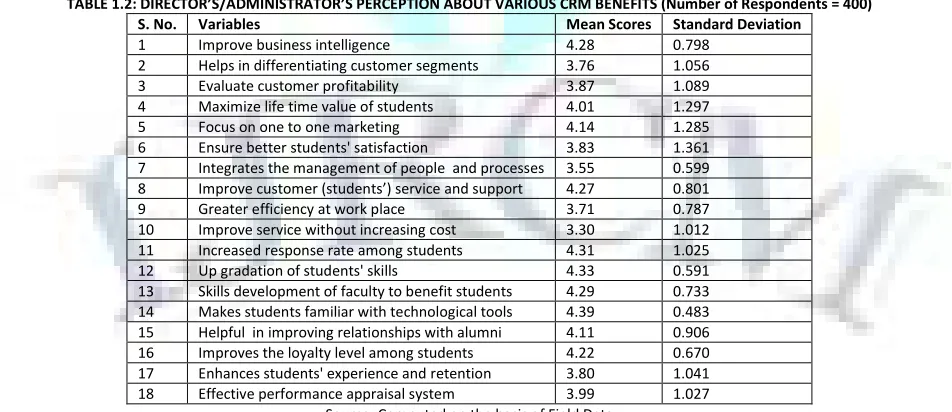
The responses of students about the various benefits of customer relationship management practices were also collected by the researcher so that differences and similarities between the responses of two respondents (director/administrator and students) can be identified. The students were asked to indicate their opinion about the various benefits on the same parameters on which the responses of directors/administrators have been collected and result of the survey are presented in Table 1.2.
TABLE 1.2: DIRECTOR’S/ADMINISTRATOR’S PERCEPTION ABOUT VARIOUS CRM BENEFITS (Number of Respondents = 400) S. No. Variables Mean Scores Standard Deviation
1 Improve business intelligence 4.28 0.798
2 Helps in differentiating customer segments 3.76 1.056
3 Evaluate customer profitability 3.87 1.089
4 Maximize life time value of students 4.01 1.297
5 Focus on one to one marketing 4.14 1.285
6 Ensure better students' satisfaction 3.83 1.361
7 Integrates the management of people and processes 3.55 0.599
8 Improve customer (students’) service and support 4.27 0.801
9 Greater efficiency at work place 3.71 0.787
10 Improve service without increasing cost 3.30 1.012
11 Increased response rate among students 4.31 1.025
12 Up gradation of students' skills 4.33 0.591
13 Skills development of faculty to benefit students 4.29 0.733
14 Makes students familiar with technological tools 4.39 0.483
15 Helpful in improving relationships with alumni 4.11 0.906
16 Improves the loyalty level among students 4.22 0.670
17 Enhances students' experience and retention 3.80 1.041
18 Effective performance appraisal system 3.99 1.027
Source: Computed on the basis of Field Data
V N .1(2011),I N .7(D ) ISSN 2231-5756
level among students (Mean = 4.22, Std. Dev. = 0.670), customer relationship management practices make institute environment such that there is a focus on students on one-to-one basis (Mean = 4.14, Std. Dev. = 1.285), it can help in improving relationships with alumni (Mean = 4.11, Std. Dev. = 0.906), helps in making the performance appraisal system better and more transparent (Mean = 4.09, Std. Dev. = 0.987), helps in maximizing the life time value of the students (Mean = 4.01, Std. Dev. = 1.297), helps in evaluating the profitability of a students in terms of his/her stay with the institute as a students and then as a alumni (Mean = 3.99, Std. Dev. = 1.027), customer relationship management practices always ensure a better students satisfaction in the campus (Mean = 3.83, Std. Dev. = 1.361), enhances students’ total experience and retention with the institute (Mean = 3.80, Std. Dev. = 1.041), CRM practices helps in identifying different customer/student segments (Mean = 3.76, Std. Dev. = 1.056), greater efficiency at work place (Mean = 3.71, Std. Dev. = 0.787), integrates the management of people and processes for the better functioning within the institute (Mean = 3.55, Std. Dev. = 0.599), and improve service without having any increase in the administrative costs as customer retention is cheaper than customer acquisition (Mean = 3.30, Std. Dev. = 1.012).
Results of the survey also indicated that the in cases of some of the variables standard deviation values are very consistent such as, make the students familiar with the technological tools (0.483), up gradation of students skills (0.591), integrates the management of people and processes (0.599), improvement the loyalty level among the students (0.670), skills development of faculty to benefit students (0.733), greater efficiency at work place (0.787), helps in improving business intelligence to identify and target students (0.798), improve students’ service and support (0.801), improves relationships with the alumni (0.906). It shows that the respondents are very much positive about the various benefits of relationship management practices in an institute. Where as in case of ensure better students’ satisfaction (1.361), helps in maximizing the life time value of the students (1.297), focus on one-to-one marketing (1.285), helps in evaluating customer/students’ profitability (1.089), helps in differentiating the various customer/student segment (1.056), enhances students’ total experience and retention (1.041), making the performance appraisal system more effective (1.027), and improved service quality without increasing cost (1.012), the respondents have high divergence of opinions regarding these benefits of customer relationship management practices in an institute
To ascertain level of difference among the responses of respondents (Director/Administrator and Students) Mann-Whitney Test was conducted. High value (Mann-Whitney Test Value closer to 1.000) indicates that there is not any significant difference between the opinions of both of the respondents (Students and Directors/Administrators) while less value indicates (Mann-Whitney Test Value closer to 0.000) that there is a significant difference between the opinions of respondents (Table 1.3).
TABLE 1.3: RELATIONSHIP AMONG THE RESPONSES OF RESPONDENTS ABOUT VARIOUS CRM BENEFITS
S. No. Variables Mean Scores (N=400) Mean Scores (N=40) Mann Whitney Test Value
1 Improve business intelligence 4.28 4.33 0.471**
2 Helps in differentiating customer segments 3.76 3.95 0.082*
3 Evaluate customer profitability 3.87 4.05 0.412**
4 Maximize life time value of students 4.01 4.12 0.524**
5 Focus on one to one marketing 4.14 4.22 0.507**
6 Ensure better students' satisfaction 3.83 3.77 0.331**
7 Integrates the management of people and processes 3.55 4.13 0.075*
8 Improve customer (students’) service and support 4.27 4.25 0.629**
9 Greater efficiency at work place 3.71 3.95 0.396**
10 Improve service without increasing cost 3.30 4 0.088*
11 Increased response rate among students 4.31 4.25 0.541**
12 Up gradation of students' skills 4.33 4.31 0.760**
13 Skills development of faculty to benefit students 4.29 4.26 0.684**
14 Makes students familiar with technological tools 4.39 4.42 0.749**
15 Helpful in improving relationships with alumni 4.11 4.21 0.405**
16 Improves the loyalty level among students 4.22 4.27 0.568**
17 Enhances students' experience and retention 3.80 3.95 0.347**
18 Effective performance appraisal system 3.99 4.09 0.391**
Source: Computed on the basis of Field Data
Note: *, ** indicate Mann-Whitney Test value is significant at 5% and 1% levels respectively.
The student’s response (Mean 3.30) in case of improve service without increasing cost is less than the mean value (Mean 4) of directors which indicates that there is a significant difference in the opinion and the same is supported by Mann-Whitney Test Value (0.088). In response to help in differentiating customer segments (0.082), and integrate the management of people and processes within the management institutes (0.075), the responses of both of the respondents is different in case of these mentioned variables and it is well justified by Mann-Whitney Test Value. Responses of respondents in regard to other benefits of customer relationships management are very similar such as, up-gradation of students skill (0.760), make students more familiar with technological tools (0.749), skills development of faculty to benefit students (0.684), improve student service and support (0.629), improve loyalty level among students (0.568), increase response rate among students (0.541), etc., the responses of both of the respondents are similar.
BARRIERS OF CUSTOMER RELATIONSHIP MANAGEMENT IN HIGHER EDUCATION
Successful implementation of relationship management practices in management institutes entails certain barriers and an effective management of barriers would result in successful adoption and implementation of relationship management practices. The researcher has found that as the relationship management practices has benefited management institutes in many way but there are certain barriers also. Such barriers have been identified by researcher and presented before respondents (N=40) to know their opinions. The survey results of key barriers in the implementation of relationship management practices are presented in the Table 1.4.
TABLE 1.4: BARRIERS IN THE WAY OF SUCCCESSFUL IMPLEMENTATION OF CRM PRACTICES IN HIGHER EDUCATION (Number of Respondents = 40) S. No. Variables Mean Scores Standard Deviation
1 Lack of commitment from top level management 3.15 1.685
2 Non-cooperation from the staff 2.77 1.522
3 Insufficient budget 2.63 1.643
4 Lack of infrastructural requirements 2.95 1.601
5 Lack of skills level 2.91 1.542
6 Resistance to change by staff and students 3.25 1.372
7 Inadequate strategic planning 3.08 1.362
8 Lack of integrated communication system 2.87 1.417
9 Lack of proper training & support 3.42 1.465
10 Inadequate knowledge of students' requirements 3.01 1.502
Source: Computed on the basis of Field Data
V N .1(2011),I N .7(D ) ISSN 2231-5756
management (Mean = 3.15, Std. Dev. = 1.685), inadequate strategic planning (Mean = 3.08, Std. Dev. = 1.362), and inadequate knowledge of students’ requirements (Mean = 3.01, Std. Dev. = 1.502), have emerged as the major barriers. Further, lack of infrastructural requirements (Mean = 2.95, Std. Dev. = 1.601), lack of skills at different levels (Mean = 2.91, Std. Dev. = 1.542), lack of integrated communication system within the institute (Mean = 2.87, Std. Dev. = 1.417), non-cooperation from the staff (Mean = 2.77, Std. Dev. = 1.522), and insufficient budget (Mean = 2.63, Std. Dev. = 1.643), are also the barriers worth taking note of. Standard deviation values of some of some of barriers such as, lack of commitment from the top management (1.685), insufficient budget (1.643), lack of infrastructural requirements (1.601), lack of skills at different levels (1.542), non-cooperation from the staff (1.522), inadequate knowledge of students’ requirements (1.502), and lack of proper training and support from the top level management (1.467), indicate that there is divergence of opinion among the respondents.
As far as lack of commitment from top management is concerned 47% respondents stated that it is a barrier in the way of implementing relationship management practices successfully while the rest of respondents were not having same opinion or a different one. Researcher has observed that in some management institutes in-spite of knowing the benefits of relationship management practices top management does not provide proper support which is needed for successful implementation. Nearly 3/4 respondents are in disagreement that there is non-cooperation from the staff in the way of implementation process. As the staff members are very well known that these practices also helping them in their career development as well. In case of lack of financial
resources only 1/3rd of the respondents are in agreement that management lacks financial resources while the rest of the respondents were having a different
opinion. In survey, researcher has noticed that majority of respondents agreed that management is having sufficient financial resources but lacked motivation to invest in required areas. Nearly 42% respondents are in agreement that institutes lack infrastructural requirements such as, building, labs, workshops, library, etc., which are priorities for students while seeking admission in an institute while other respondents were in the opinion that management institutes are having sufficient infrastructural facilitates. During research, it has been noticed that in many institutes have made sufficient investments as far as infrastructural requirements are concerned as the institutes know that the way education is expanding infrastructure is one the basic requirements which is strongly considered by students and their parents during the admission time. Among respondents 3/5 are in disagreement that there is a lack of skills level in management institutes as far as faculty/staff is considered. During the survey, it was found that institutes know the importance of having qualified and experienced faculty/staff as this is most important factor which contributes in the way of maintaining relationships with students. In case of incorporating technological tools in education programs 55% of the respondents stated that there is a resistance from staff and students. Researcher has observed that initially, faculty members resist delivering lectures though LCD projector and interacting with students through e-mail. In the same way students also have shown some resistance such as, lack of initiative in case of presentations, submission of assignment through mail or visiting industries to make interaction with alumni. Nearly half of the respondents have mentioned that management institutes are having resources but there an inadequate strategic planning to use these resources. In some institutes, researcher has observed that there are sufficient books in library as far as the numbers are concerned but there is lack of sufficient title. In some cases, it has been identified that management institutes are having sufficient classrooms but there is no planning to arrange a space for group discussion or conducting seminars for students. About 65% respondents are in agreement that there is lack of proper training and support for the staff. There are some areas such as, interacting with students during admission time, solving problems of students, using technological tools, etc., where training should be provided for successful outcome. Nearly 1/2 respondents have stated that student’s requirements have not been identified properly by management institutes and rest of the respondents were not having same opinion. For the success of any organization identifying the customer’s requirements is the most important steps. And during research, researcher has noticed that while in some institutes this job has been done properly but in some others there is an immense need to do it properly.
In the study, at attempt has also been made to gain insight into the major obstacles in the way of successful implementation of customer relationship management practices in management institutes. To identify the relationship among the means values of the key barriers and average of barriers in the way of successful implementation of customer relationship management practices coefficient of correlation has been calculated. High value of ‘r’ (Towards +1.0) indicates barriers with high significant level and less value of ‘r’ (Towards 0.0) indicates barriers with less significant level in the way of successful implementation of customer relationship management strategies and the results are presented in Table 1.5.
TABLE 1.5: RELATIONSHIP BETWEEN KEY BARRIERS AND AVERAGE OF BARRIERS IN SUCCESSFUL IMPLEMENTATION OF CRM PRACTICES IN HIGHER EDUCTION (Number of Respondents = 40)
S. No. Variables Mean Scores Standard Deviation r value
1 Lack of commitment from top level management 3.15 1.685 0.942**
2 Non-cooperation from the staff 2.77 1.522 0.817*
3 Insufficient budget 2.63 1.643 0.823*
4 Resistance to change by staff and students 3.25 1.372 0.971**
5 Lack of proper training and support 3.42 1.465 0.937**
6 Inadequate knowledge of student’s requirement 3.01 1.502 0.982**
Notes: r-value indicates value of Karl Pearson’s Coefficient of Correlation. *, ** indicate Correlation is significant at 5% and 1% levels respectively.
Source: Computed on the basis of Field Data
The test results in the table indicate that among the different barriers which come in the way of successful implementation of customer relationship management strategies, lack of proper training for the staff (r = 0.937), resistance to change by staff and students (r = 0.971), lack of commitment from the top level management (r = 0.942), Inadequate knowledge of students’ requirements (r = 0.982), non-cooperation from the staff (r = 817), and insufficient budget as a barrier (r = 0.823), have been identified as key barriers and the same is support by the correlation results also as the values indicate significant and positive correlations.
CONCLUSION
V N .1(2011),I N .7(D ) ISSN 2231-5756
REFERENCES
1. Alridge, S., and J. Rowely. (2001), “Conducting a Withdrawal Survey,” Quality in Higher Education, 7(1), pp. 55-63.
2. Dwyer, Robert F., Paul H. Schurr, and Sejo Oh. (1987), “Developing Buyer-Seller Relationships,” Journal of Marketing, 51 (April), pp. 1-13.
3. Ganesan, Shankar (1994), “Determination of Long-Term Orientation in Buyer Seller Relationship,” Journal of Marketing, 58 (April), pp. 1-19.
4. Kanji, G. K., Abdul Malik, A. B. Tambi and W. Wallace (1999), “A Comparative Study of Quality Practices in Higher Education Institutions in the US and Malaysia,” Total Quality Management, 10(3), pp. 357-371.
5. Kotler, Philip and F.A. Fox (1995), “Strategic Marketing for Educational Institutions,” Second Edition, Prentice-Hall, Inc., Englewood Cliffs, New Jersey.
6. Storbacka, Kaj (2000), “Customer Profitability: Analysis and Design Issues,” In Handbook of Relationship Marketing, Jagdish N. Sheth and Atul Parvatiyar,
Eds., Thousand Oaks, CA: Sage Publications, pp. 565-586.
7. Sheth, Jagdish N. and Atul Pravatiyar (1995), “Relationship Marketing in Consumer Markets: Antecedents and Consequences,” Journal of the Academy of
Marketing Science, (Fall), pp. 255-271.
V N .1(2011),I N .7(D ) ISSN 2231-5756
REQUEST FOR FEEDBACK
Dear Readers
At the very outset, International Journal of Research in Commerce, IT and Management (IJRCM)
acknowledges & appreciates your efforts in showing interest in our present issue under your kind perusal.
I would like to request you to supply your critical comments and suggestions about the material published
in this issue as well as on the journal as a whole, on our E-mails i.e.
or
for further improvements in the interest of research.
If you have any queries please feel free to contact us on our E-mail
.
I am sure that your feedback and deliberations would make future issues better – a result of our joint
effort.
Looking forward an appropriate consideration.
With sincere regards
Thanking you profoundly
Academically yours
Sd/-