VOLUME NO.6(2016),ISSUE NO.12(
DECEMBER
) ISSN 2231-5756A Monthly Double-Blind Peer Reviewed (Refereed/Juried) Open Access International e-Journal - Included in the International Serial Directories
Indexed & Listed at:
Ulrich's Periodicals Directory ©, ProQuest, U.S.A., EBSCO Publishing, U.S.A., Cabell’s Directories of Publishing Opportunities, U.S.A., Google Scholar, Open J-Gage, India [link of the same is duly available at Inflibnet of University Grants Commission (U.G.C.)],
Index Copernicus Publishers Panel, Poland with IC Value of 5.09 & number of libraries all around the world.
VOLUME NO.6(2016),ISSUE NO.12(
DECEMBER
) ISSN 2231-5756CONTENTS
Sr.
No.
TITLE & NAME OF THE AUTHOR (S)
Page
No.
1
.
PERFORMANCE MANAGEMENT SYSTEM IN TELECOM INDUSTRY: COMPARISON OF INDIAN PUBLIC
AND PRIVATE SECTOR UNDERTAKINGS
ADITYA GAUTAM & SAMEEKSHA JAIN
1
2
.
SUPREME COURT OF INDIA ON GROUNDS OF SETTING ASIDE ARBITRAL AWARD
SUDHIR S. KOTWAL & DR. ASMITA A. VAIDYA
6
3
.
PERFORMANCE EVALUATION OF THE CYBERAGE SCHEME IN GOA: STUDENTS’ PERSPECTIVE
DR. GAJANAN MADIWAL
10
4
.
INFORMATION MANAGEMENT SYSTEM IN THE LIVELIHOOD PROJECT
DR. VIJAY KUMAR & AJAY PUROHIT
13
5
.
TESTING WEAK FORM OF EFFICIENT MARKET HYPOTHESIS IN INDIA: WITH SPECIAL REFERENCE TO
NIFTY MIDCAP 50 INDEX BASED COMPANIES
DR. N. N. PANDEY
18
6
.
THE RETAIL AVALANCHE: A STUDY ON CUSTOMER PERCEPTION
ZOHEB ALI K & DR. RASHMI KODIKAL
22
7
.
INVESTORS ATTITUDE TOWARDS SAFETY AS AN IMPORTANT CRITERION FOR MUTUAL FUND
INVESTMENT – WITH SPECIAL REFERENCE TO CHENNAI CITY
S. PRASANNA KUMAR & DR. T. JOSEPH
27
8
.
FDI IN INDIAN RETAIL SECTOR: BOON OR BANE?
YASMIN BEGUM R. NADAF & SHAMSHUDDIN M. NADAF
32
9
.
UNDERSTANDING THE RELATIONSHIP BETWEEN ETHICAL LEADERSHIP BEHAVIOR AND ETHICAL
CLIMATE IN PRIVATE SECTOR BANKS IN ERNAKULAM DISTRICT
ROHINI. S. NAIR & SMITHA RAJAPPAN
36
10
.
A STUDY ON LECTURERS’ PERCEPTION OF STUDENTS’ FEEDBACK ON COURSES AND TEACHING WITH
REFERENCE TO PRIVATE INSTITUTIONS IN BANGALORE CITY
ASHA RANI.K
39
11
.
THE CHANGING DYNAMICS OF TALENT ACQUISITION IN RECRUITMENT SERVICE CENTERS: A
CONCEPTUAL STUDY
NAMITHA.S
45
12
.
THE AMALGAMATION OF SBI AND ITS SUBSIDIARIES: OPPORTUNITIES AND CHALLENGES
ANAND DHANANJAY WALSANGKAR
49
13
.
ORGANIZATIONAL RESOURCES AND CAPABILITIES FOR KNOWLEDGE STRATEGY IN HIGH VELOCITY
ENVIRONMENTS: THE PERSPECTIVE OF BUSINESS STRATEGY ALIGNMENT
K.UMA LAKSHMI & DR. SUMITHA K
53
14
.
FINANCIAL DISTRESS AND ITS IMPACT ON STOCK PRICES OF MINING SECTOR FIRMS IN INDONESIA
STOCK EXCHANGE
FITRI WAHYUNI, LUKYTAWATI ANGGRAENI & TONY IRAWAN
59
15
.
DISTRICT WISE SITUATION OF THE CHILD LABOUR (AGE 5-14) IN ANDHRA PRADESH
DR. PARUPALLY ANJANEYULU & SRIPARNA BANERJEE
65
16
.
INVESTIGATION OF UNEMPLOYMENT REGISTRATION SYSTEM IN ADDIS ABABA: THE CASE OF BOLE,
ARADA AND YEKA SUB-CITIES
WUBALEM SERAW GEZIE
71
17
.
POVERTY: A COLOSSAL PEST IN INDIA
KHEM RAJ
77
18
.
EXTRADITION AND LAW
SHREEMANSHU KUMAR DASH
83
19
.
COMPARATIVE ANALYSIS OF FARMERS’ SUICIDE IN ODISHA WITH INDIA
IPSITA PRIYADARSINI PATTANAIK
86
20
.
NEED FOR CHANGE IN THE HISTORICAL LEGACY OF CURRENT FINANCIAL YEAR
GUNEEV BRAR
91
VOLUME NO.6(2016),ISSUE NO.12(
DECEMBER
) ISSN 2231-5756INTERNATIONAL JOURNAL OF RESEARCH IN COMMERCE, IT & MANAGEMENT
CHIEF PATRON
PROF. K. K. AGGARWAL
Chairman, Malaviya National Institute of Technology, Jaipur
(An institute of National Importance & fully funded by Ministry of Human Resource Development, Government of India)
Chancellor, K. R. Mangalam University, Gurgaon
Chancellor, Lingaya’s University, Faridabad
Founder Vice-Chancellor (1998-2008), Guru Gobind Singh Indraprastha University, Delhi
Ex. Pro Vice-Chancellor, Guru Jambheshwar University, Hisar
FOUNDER PATRON
LATE SH. RAM BHAJAN AGGARWAL
Former State Minister for Home & Tourism, Government of Haryana
Former Vice-President, Dadri Education Society, Charkhi Dadri
Former President, Chinar Syntex Ltd. (Textile Mills), Bhiwani
FORMER CO-ORDINATOR
DR. S. GARG
Faculty, Shree Ram Institute of Business & Management, Urjani
ADVISORS
PROF. M. S. SENAM RAJU
Director A. C. D., School of Management Studies, I.G.N.O.U., New Delhi
PROF. M. N. SHARMA
Chairman, M.B.A., Haryana College of Technology & Management, Kaithal
PROF. S. L. MAHANDRU
Principal (Retd.), Maharaja Agrasen College, Jagadhri
EDITOR
PROF. R. K. SHARMA
Professor, Bharti Vidyapeeth University Institute of Management & Research, New Delhi
CO-EDITOR
DR. BHAVET
Faculty, Shree Ram Institute of Engineering & Technology, Urjani
EDITORIAL ADVISORY BOARD
DR. RAJESH MODI
Faculty, Yanbu Industrial College, Kingdom of Saudi Arabia
PROF. SANJIV MITTAL
University School of Management Studies, Guru Gobind Singh I. P. University, Delhi
PROF. ANIL K. SAINI
Chairperson (CRC), Guru Gobind Singh I. P. University, Delhi
DR. SAMBHAVNA
VOLUME NO.6(2016),ISSUE NO.12(
DECEMBER
) ISSN 2231-5756DR. MOHENDER KUMAR GUPTA
Associate Professor, P. J. L. N. Government College, Faridabad
DR. SHIVAKUMAR DEENE
Asst. Professor, Dept. of Commerce, School of Business Studies, Central University of Karnataka, Gulbarga
ASSOCIATE EDITORS
PROF. NAWAB ALI KHAN
Department of Commerce, Aligarh Muslim University, Aligarh, U.P.
PROF. ABHAY BANSAL
Head, Department of I.T., Amity School of Engineering & Technology, Amity University, Noida
PROF. A. SURYANARAYANA
Department of Business Management, Osmania University, Hyderabad
PROF. V. SELVAM
SSL, VIT University, Vellore
DR. PARDEEP AHLAWAT
Associate Professor, Institute of Management Studies & Research, Maharshi Dayanand University, Rohtak
DR. S. TABASSUM SULTANA
Associate Professor, Department of Business Management, Matrusri Institute of P.G. Studies, Hyderabad
SURJEET SINGH
Asst. Professor, Department of Computer Science, G. M. N. (P.G.) College, Ambala Cantt.
FORMER TECHNICAL ADVISOR
AMITA
Faculty, Government M. S., Mohali
FINANCIAL ADVISORS
DICKIN GOYAL
Advocate & Tax Adviser, Panchkula
NEENA
Investment Consultant, Chambaghat, Solan, Himachal Pradesh
LEGAL ADVISORS
JITENDER S. CHAHAL
Advocate, Punjab & Haryana High Court, Chandigarh U.T.
CHANDER BHUSHAN SHARMA
Advocate & Consultant, District Courts, Yamunanagar at Jagadhri
SUPERINTENDENT
VOLUME NO.6(2016),ISSUE NO.12(
DECEMBER
) ISSN 2231-5756INTERNATIONAL JOURNAL OF RESEARCH IN COMMERCE, IT & MANAGEMENT
CALL FOR MANUSCRIPTS
We invite unpublished novel, original, empirical and high quality research work pertaining to the recent developments & practices in the areas of Com-puter Science & Applications; Commerce; Business; Finance; Marketing; Human Resource Management; General Management; Banking; Economics; Tourism Administration & Management; Education; Law; Library & Information Science; Defence & Strategic Studies; Electronic Science; Corporate Gov-ernance; Industrial Relations; and emerging paradigms in allied subjects like Accounting; Accounting Information Systems; Accounting Theory & Practice; Auditing; Behavioral Accounting; Behavioral Economics; Corporate Finance; Cost Accounting; Econometrics; Economic Development; Economic History; Financial Institutions & Markets; Financial Services; Fiscal Policy; Government & Non Profit Accounting; Industrial Organization; International Economics & Trade; International Finance; Macro Economics; Micro Economics; Rural Economics; Co-operation; Demography: Development Planning; Development Studies; Applied Economics; Development Economics; Business Economics; Monetary Policy; Public Policy Economics; Real Estate; Regional Economics; Political Science; Continuing Education; Labour Welfare; Philosophy; Psychology; Sociology; Tax Accounting; Advertising & Promotion Management; Management Information Systems (MIS); Business Law; Public Responsibility & Ethics; Communication; Direct Marketing; E-Commerce; Global Business; Health Care Administration; Labour Relations & Human Resource Management; Marketing Research; Marketing Theory & Applications; Non-Profit Or-ganizations; Office Administration/Management; Operations Research/Statistics; Organizational Behavior & Theory; Organizational Development; Pro-duction/Operations; International Relations; Human Rights & Duties; Public Administration; Population Studies; Purchasing/Materials Management; Re-tailing; Sales/Selling; Services; Small Business Entrepreneurship; Strategic Management Policy; Technology/Innovation; Tourism & Hospitality; Transpor-tation Distribution; Algorithms; Artificial Intelligence; Compilers & Translation; Computer Aided Design (CAD); Computer Aided Manufacturing; Computer Graphics; Computer Organization & Architecture; Database Structures & Systems; Discrete Structures; Internet; Management Information Systems; Mod-eling & Simulation; Neural Systems/Neural Networks; Numerical Analysis/Scientific Computing; Object Oriented Programming; Operating Systems; Pro-gramming Languages; Robotics; Symbolic & Formal Logic; Web Design and emerging paradigms in allied subjects.
Anybody can submit the soft copy of unpublished novel; original; empirical and high quality research work/manuscriptanytime in M.S. Word format
after preparing the same as per our GUIDELINES FOR SUBMISSION; at our email address i.e. [email protected] or online by clicking the link online submission as given on our website (FOR ONLINE SUBMISSION, CLICK HERE).
GUIDELINES FOR SUBMISSION OF MANUSCRIPT
1. COVERING LETTER FOR SUBMISSION:
DATED: _____________
THE EDITOR
IJRCM
Subject: SUBMISSION OF MANUSCRIPT IN THE AREA OF .
(e.g. Finance/Mkt./HRM/General Mgt./Engineering/Economics/Computer/IT/ Education/Psychology/Law/Math/other, please specify)
DEAR SIR/MADAM
Please find my submission of manuscript titled ‘___________________________________________’ for likely publication in one of your journals.
I hereby affirm that the contents of this manuscript are original. Furthermore, it has neither been published anywhere in any language fully or partly, nor it is under review for publication elsewhere.
I affirm that all the co-authors of this manuscript have seen the submitted version of the manuscript and have agreed to inclusion of their names as co-authors.
Also, if my/our manuscript is accepted, I agree to comply with the formalities as given on the website of the journal. The Journal has discretion to publish our contribution in any of its journals.
NAME OF CORRESPONDING AUTHOR :
Designation/Post* :
Institution/College/University with full address & Pin Code : Residential address with Pin Code : Mobile Number (s) with country ISD code : Is WhatsApp or Viber active on your above noted Mobile Number (Yes/No) : Landline Number (s) with country ISD code :
E-mail Address :
Alternate E-mail Address :
Nationality :
* i.e. Alumnus (Male Alumni), Alumna (Female Alumni), Student, Research Scholar (M. Phil), Research Scholar (Ph. D.), JRF, Research Assistant, Assistant Lecturer, Lecturer, Senior Lecturer, Junior Assistant Professor, Assistant Professor, Senior Assistant Professor, Co-ordinator, Reader, Associate Profes-sor, ProfesProfes-sor, Head, Vice-Principal, Dy. Director, Principal, Director, Dean, President, Vice Chancellor, Industry Designation etc. The qualification of
VOLUME NO.6(2016),ISSUE NO.12(
DECEMBER
) ISSN 2231-5756NOTES:
a) The whole manuscript has to be in ONE MS WORD FILE only, which will start from the covering letter, inside the manuscript. pdf.
version is liable to be rejected without any consideration.
b) The sender is required to mention the following in the SUBJECT COLUMNof the mail:
New Manuscript for Review in the area of (e.g. Finance/Marketing/HRM/General Mgt./Engineering/Economics/Computer/IT/ Education/Psychology/Law/Math/other, please specify)
c) There is no need to give any text in the body of the mail, except the cases where the author wishes to give any specific message w.r.t. to the manuscript.
d) The total size of the file containing the manuscript is expected to be below 1000 KB.
e) Only the Abstract will not be considered for review and the author is required to submit the complete manuscript in the first instance.
f) The journal gives acknowledgement w.r.t. the receipt of every email within twenty-four hours and in case of non-receipt of
acknowledgment from the journal, w.r.t. the submission of the manuscript, within two days of its submission, the corresponding author is required to demand for the same by sending a separate mail to the journal.
g) The author (s) name or details should not appear anywhere on the body of the manuscript, except on the covering letter and the cover page of the manuscript, in the manner as mentioned in the guidelines.
2. MANUSCRIPT TITLE: The title of the paper should be typed in bold letters, centeredand fully capitalised.
3. AUTHOR NAME (S) & AFFILIATIONS: Author (s) name, designation, affiliation (s), address, mobile/landline number (s), and email/al-ternate email address should be given underneath the title.
4. ACKNOWLEDGMENTS: Acknowledgements can be given to reviewers, guides, funding institutions, etc., if any.
5. ABSTRACT: Abstract should be in fully Italic printing, ranging between 150 to 300 words. The abstract must be informative and eluci-dating the background, aims, methods, results & conclusion in a SINGLE PARA. Abbreviations must be mentioned in full.
6. KEYWORDS: Abstract must be followed by a list of keywords, subject to the maximum of five. These should be arranged in alphabetic order separated by commas and full stop at the end. All words of the keywords, including the first one should be in small letters, except special words e.g. name of the Countries, abbreviations etc.
7. JEL CODE: Provide the appropriate Journal of Economic Literature Classification System code (s). JEL codes are available at www.aea-web.org/econlit/jelCodes.php. However, mentioning of JEL Code is not mandatory.
8. MANUSCRIPT: Manuscript must be in BRITISH ENGLISH prepared on a standard A4 size PORTRAIT SETTING PAPER. It should be free from any errors i.e. grammatical, spelling or punctuation. It must be thoroughly edited at your end.
9. HEADINGS: All the headings must be bold-faced, aligned left and fully capitalised. Leave a blank line before each heading.
10. SUB-HEADINGS: All the sub-headings must be bold-faced, aligned left and fully capitalised.
11. MAIN TEXT:
THE MAIN TEXT SHOULD FOLLOW THE FOLLOWING SEQUENCE:
INTRODUCTION
REVIEW OF LITERATURE
NEED/IMPORTANCE OF THE STUDY
STATEMENT OF THE PROBLEM
OBJECTIVES
HYPOTHESIS (ES)
RESEARCH METHODOLOGY
RESULTS & DISCUSSION
FINDINGS
RECOMMENDATIONS/SUGGESTIONS
CONCLUSIONS
LIMITATIONS
SCOPE FOR FURTHER RESEARCH
REFERENCES
APPENDIX/ANNEXURE
VOLUME NO.6(2016),ISSUE NO.12(
DECEMBER
) ISSN 2231-5756INTERNATIONAL JOURNAL OF RESEARCH IN COMMERCE, IT & MANAGEMENT
12. FIGURES & TABLES: These should be simple, crystal CLEAR, centered, separately numbered & self-explained, and the titles must be above the table/figure. Sources of data should be mentioned below the table/figure. It should be ensured that the tables/figures are referred to from the main text.
13. EQUATIONS/FORMULAE: These should be consecutively numbered in parenthesis, left aligned with equation/formulae number placed at the right. The equation editor provided with standard versions of Microsoft Word may be utilised. If any other equation editor is utilised, author must confirm that these equations may be viewed and edited in versions of Microsoft Office that does not have the editor.
14. ACRONYMS: These should not be used in the abstract. The use of acronyms is elsewhere is acceptable. Acronyms should be defined on its first use in each section e.g. Reserve Bank of India (RBI). Acronyms should be redefined on first use in subsequent sections.
15. REFERENCES: The list of all references should be alphabetically arranged. The author (s) should mention only the actually utilised
references in the preparation of manuscript and they may follow Harvard Style of Referencing. Also check to ensure that everything
that you are including in the reference section is duly cited in the paper. The author (s) are supposed to follow the references as per the following:
•
All works cited in the text (including sources for tables and figures) should be listed alphabetically.•
Use (ed.) for one editor, and (ed.s) for multiple editors.•
When listing two or more works by one author, use --- (20xx), such as after Kohl (1997), use --- (2001), etc., in chronologically ascending order.•
Indicate (opening and closing) page numbers for articles in journals and for chapters in books.•
The title of books and journals should be in italic printing. Double quotation marks are used for titles of journal articles, book chapters, dissertations, reports, working papers, unpublished material, etc.•
For titles in a language other than English, provide an English translation in parenthesis.•
Headers, footers, endnotes and footnotes should not be used in the document. However, you can mention short notes to elucidatesome specific point, which may be placed in number orders before the references.
PLEASE USE THE FOLLOWING FOR STYLE AND PUNCTUATION IN REFERENCES:
BOOKS
•
Bowersox, Donald J., Closs, David J., (1996), "Logistical Management." Tata McGraw, Hill, New Delhi.•
Hunker, H.L. and A.J. Wright (1963), "Factors of Industrial Location in Ohio" Ohio State University, Nigeria. CONTRIBUTIONS TO BOOKS•
Sharma T., Kwatra, G. (2008) Effectiveness of Social Advertising: A Study of Selected Campaigns, Corporate Social Responsibility, Edited by David Crowther & Nicholas Capaldi, Ashgate Research Companion to Corporate Social Responsibility, Chapter 15, pp 287-303.JOURNAL AND OTHER ARTICLES
•
Schemenner, R.W., Huber, J.C. and Cook, R.L. (1987), "Geographic Differences and the Location of New Manufacturing Facilities," Jour-nal of Urban Economics, Vol. 21, No. 1, pp. 83-104.CONFERENCE PAPERS
•
Garg, Sambhav (2011): "Business Ethics" Paper presented at the Annual International Conference for the All India Management Asso-ciation, New Delhi, India, 19–23UNPUBLISHED DISSERTATIONS
•
Kumar S. (2011): "Customer Value: A Comparative Study of Rural and Urban Customers," Thesis, Kurukshetra University, Kurukshetra. ONLINE RESOURCES•
Always indicate the date that the source was accessed, as online resources are frequently updated or removed. WEBSITESVOLUME NO.6(2016),ISSUE NO.12(
DECEMBER
) ISSN 2231-5756DISTRICT WISE SITUATION OF THE CHILD LABOUR (AGE 5-14) IN ANDHRA PRADESH
DR. PARUPALLY ANJANEYULU
RESEARCH ASSOCIATE
CENTRE FOR ECONOMIC AND SOCIAL STUDIES
BEGUMPET
SRIPARNA BANERJEE
SR.PROGRAMME MANAGER
CENTRE FOR ECONOMIC AND SOCIAL STUDIES
BEGUMPET
ABSTRACT
ILO defined the term “child labour” is as work that deprives children of their childhood, their potential and their dignity, and that is harmful to physical and mental development. ILO estimated approximately 114 million (53%) child labour are in Asia and the Pacific; 14 million (7%) live in Latin America; and 65 million (30%) live in sub-Saharan Africa. As per the recent Census 2011 in India, 42% of India’s total population is children and sadly India is the home to the largest number of child labourers in the world. According to estimate there are over 60 million child labour is India constituting nearly twenty-five per cent of the working children of the world (Reported in Mishra, 2004, pp.1-3). Notably, Constitution of India prohibits child labour in hazardous industries (but not in non-hazardous industries) as a Fundamental Right under Article 24 and the law in Indian (called The Child and Adolescent Labour (Prohibition and Regulation) Act, 1986, Amendment Act, 2016) says that any no child below age of 14 shall be employed or permitted to work in any occupation or process. Andhra Pradesh has 13 districts with 5 crores population. As per 2011 Census above 52 (0-6 years) lakh children are living in the state. The state had the dubious distinction of having the largest number of child labour compared to other States in the country till 2001. In order to reduce the number of child labour in the State, the government of Andhra Pradesh adopted a proactive approach on child labour and as a result of all these measures, there has been a substantial decline in child labour in the State between the periods 2001 and 2011, the percentage of child labour being 24.96 in 2001 compared to 14.10 in 2011. With this background this paper analysed child labour situation in all the districts of Andhra Pradesh. The main objectives of the paper to highlight the districts specific number of child labour in the state and find out the trends of the state in decreasing/ increasing the number of child labour.
KEYWORDS
child labour, hazardous, child and adolescent labour (prohibition and regulation) act, 1986, amendment act, 2016.
INTRODUCTION
hild labour is a visible manifestation of violations of a range of rights of children and is recognized as a serious and enormously complex social problem not only in India but in entire world. Working children are denied their right to survival and development, education, leisure and play, and adequate standard of living, opportunity for developing personality, talents, mental and physical abilities, and protection from abuse and neglect. Under extreme economic distress, children are forced to forego educational opportunities and take up jobs which are mostly exploitative as they are usually underpaid and engaged in hazardous conditions.
ILO defined the term “child labour” is as work that deprives children of their childhood, their potential and their dignity, and that is harmful to physical and mental development. ILO estimated approximately 114 million (53%) child labour are in Asia and the Pacific; 14 million (7%) live in Latin America; and 65 million (30%) live in sub-Saharan Africa. The UNICEF estimates that India with its larger population has the highest number of labourers in the world less than 14 years of age. As per the recent Census 2011, 42% of India’s total population is children and sadly India is the home to the largest number of child labourers in the world. Child labour is the practice of having children engages in economic activity, on part- or full-time basis. The practice deprives children of their childhood, and is harmful to their physical and mental development. Poverty, lack of good schools and growth of informal economy are considered as the important causes of child labour in India.
Before the development of the industrial sector, child labour was vastly engaged in agriculture and informal sectors. Agriculture and small industrial sector con-sisting of match industry, diamond industry, brass ware industry, carpet industry, lock making industry, slate industry, handloom and power loom industry, zari work, hosiery, pottery industry, beedi industry are some of the units which absorb large number of child labour in India. The 1998 national Census of India esti-mated the total number of child labour, aged 4–15, to be at 12.6 million, out of a total child population of 253 million in 5–14 age group. A 2009–10 nationwide survey found child labour prevalence had reduced to 4.98 million children (or less than 2% of children in 5–14 age groups). According to Census, 2011 found the total number of child labour, aged 5–14, to be at 4.35 million, and the total child population to be 259.64 million in that age group.
According to (2004-05) NSSO estimates 68.14 percentage of Child Labour is working in agriculture followed by manufacturing trade and hotels in India. The per-centage of Child Labour engaged in agriculture is still high in the States like Madhya Pradesh, Maharashtra, Karnataka, Uttaranchal, Himachal Pradesh, Gujarat, Chhattisgarh, Rajasthan and Orissa. It is found very low in Kerala and Tamil Nadu. This can be attributed to the social development activities initiated in early 1980’s in the southern states.The population of Child Labour engaged in manufacturing sector is high in Kerala, Uttar Pradesh and West Bengal as compared to other states in India. According to 1991 Census the number of working children in A.P was 16.61 lakh which reduced to 13.63 lakh in 2001, which was second largest number after Uttar Pradesh.
OBJECTIVES OF THE STUDY
1. To highlight the districts specific number of child labours in the state and find out the trends of the state in decreasing/ increasing the number of child labour.
2. To give recommendations to the policy makers to tackle the issue in the changing socio-economic and political context.
OVERVIEW OF ANDHRA PRADESH STATE
Andhra Pradesh state has 162000 sq. km area (Approx.) and it has 13 districts; these districts have 670 revenue Mandals with 4 crores 95 lakhs population. 248 lakhs male and 247 lakhs female population are living across the state.
VOLUME NO.6(2016),ISSUE NO.12(
DECEMBER
) ISSN 2231-5756INTERNATIONAL JOURNAL OF RESEARCH IN COMMERCE, IT & MANAGEMENT
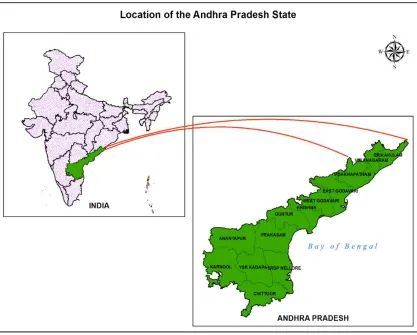
FIGURE 1: LOCATION OF THE STUDY AREA
Rural Population is 70.4% and urban population 29.6%. It has 1crore 26 lakhs households. In those 90 lakhs and above are located in rural areas rest of the households (36 lakhs) in urban areas. State has two regions, one is Coastal Andhra and other one is Rayalaseema. These regions are having 9 and 4 districts respectively (See Figure 1). Godavari and Krishna and its tributaries are flowing through the state. It has a coast line of 974 Kms. Running from Ichapuram in the North to Sullurpet in the south. Visakhapatnam, Vijayawada, Kurnool cities are major in the state. After bifurcation of the two states (Telangana state and Andhra Pradesh) central government declared Hyderabad as a joint capital city for the 10 years period. Recently Andhra Pradesh government declared Amaravati as the capital city of the state.
CHILD POPULATION
As per the 2011 Census figures, the total population of Andhra Pradesh is 4.93 crores, in that the child population (5-14 years) share is 17.8% (88 lakhs) and male child population is 45.2 lakhs and female children are 42.8 lakhs. 0 - 6 years age share is only 10.5% to the total population on of the state. Among all the 13 districts, YSR Kadapa (21%) has highest child population followed by Prakasam (18.7%). Only YSR Kadapa district has above 20% child population. Four districts like Chittoor, Anantapur, Srikakulam and Vizianagaram districts are having above the state (17.8%) average. Visakhapatnam, SPSR Nellore, Guntur, East Godavari and Kurnool districts are having between 17 to 17.8% of the child population.
TABLE 1: DISTRICT WISE TOTAL POPULATION AND CHILD POPULATION IN ANDHRA PRADESH (AGE 5-14)-2011 District Name Total Population Child Population (5-14) % of Child Population Boys Girls
YSR Kadapa 4053463 851218 21 438592 412626
Prakasam 3397448 635312 18.7 328557 306755
Chittoor 2882469 536371 18.6 277683 258688
Anantapur 4081148 746174 18.3 385245 360929
Srikakulam 2703114 492358 18.2 254381 237977
Vizianagaram 2344474 418819 17.9 215010 203809
Andhra Pradesh 49386799 8808502 17.8 452751 4280987
Visakhapatnam 4290589 760993 17.7 389461 371532
SPSR Nellore 2963557 514870 17.4 266793 248077
Guntur 4887813 843988 17.3 435554 408434
East Godavari 5154296 885491 17.2 448660 436831
Kurnool 4174064 719789 17.2 371042 348747
West Godavari 3936966 664222 16.9 336907 327315
Krishna 4517398 738897 16.4 379630 359267
Source: Census 2011
VOLUME NO.6(2016),ISSUE NO.12(
DECEMBER
) ISSN 2231-5756CONSTITUTIONAL SAFEGUARDS
Indian constitute has given articles and it is protecting to the children from various situation. They are explained in the below box.
TABLE 2
Articles Contents
Article 21A The State shall provide free and compulsory education to all children of the age of six to fourteen years.
Article 23 Traffic in human beings and beggar and other similar forms of forced labour are prohibited and any contravention of this prohibition shall be an offence punishable in accordance with law.
Article 24 No child below the age of 14 years shall be employed to work in any factory or mine or engaged in any other hazardous employment.
Article 39 (e) The State shall, in particular, direct its policy towards securing the health and strength of the tender age of children are not abused and that citizens are not forced by economic necessity to enter avocations unsuited to their age or strength.
STATUTORY PROVISIONS TO ELIMINATE CHILD LABOUR:
In relation with the above mentioned Constitutional provisions, the country has enacted various laws time to time to address the issue of child labour in the line with ILO Conventions and various international standards including Convention on the Rights of Child (CRC). The legal provisions prohibiting child labour are as follows
TABLE 3
Name of the Act Prohibition of child labour Penalties
The Children (Pledging of Labour) Act, 1933
An agreement to pledge the labour of a child shall be void. [section 3] Parent or guardian, contractor, and employer of
a child shall be punished with fine up to Rs. 200. [sections 4, 5 & 6]
The Factories Act,
1948
No child who has not completed his fourteenth year shall be required or allowed to work in any factory. [section 67]
The occupier and manager of the factory shall each be guilty of an offence and punishable with imprisonment up to two years or with fine up to one lakh rupees or with both. [section 92]
The Mines Act, 1952 No person below 18 years of age shall be allowed to work in any mine or part
thereof. [section 40]
The owner, agent or manager of such mine shall be punishable with fine up to Rs. 500. [section 68] The Apprentices Act,
1961
A person shall not be qualified for being engaged as an apprentice to undergo apprenticeship training in any designated trade, unless he is not less than 14 years of age. [section 3]
He shall be punished with imprisonment up to six months or with fine or with both. [section 30 (1)]
The Beedi and Cigar Workers (Conditions of Employment) Act, 1966
No child shall be required or allowed to work in any industrial premises. [section 24]
He shall be punished with fine up to Rs. 250. [sec-tion 33]
The Bonded Labour
System (Abolition)
Act, 1976
According to the definition given in section 2(g) of the Act, bonded labour rep-resents the relationship between a creditor and a debtor wherein the debtor undertakes to mortgage his services or the services of any of his family members to the creditor for a specified or unspecified period with or without wages ac-companied by denial of choice of alternative avenues of employment, or to deny him freedom of movements.
Every offence under the Act is cognizable and boilable. Offences for contravention of provisions of the Act are punishable with imprisonment for a term, which may extend to three years and also with fine, which may extend to two thousand ru-pees.
Child and Adolescent
Labour (Prohibition
and Regulation) Act,
1986, Amendment
Act, 2015
The Act prohibits employment of children (a person who has not completed 14 years of age) in any occupation and Process and also prohibits employment of adolescents (a person who has completed his fourteenth year of age but has not completed his eighteenth year) in certain hazardous occupations and processes.
He shall be punished with imprisonment for three months to one year or with fine Rs. 10,000 to Rs. 20,000 or with both. [section 14 (1)]
The Juvenile Justice (Care & Protection of Children) Act, 2015
The Act prohibits punishment for exploitation of a child employee. For exploitation of a child employee, a person
shall be punishable with imprisonment for a term which may extend to 5 years or with fine of one lakh rupees
PERCENTAGE OF CHILD LABOUR TO CHILD POPULATION
VOLUME NO.6(2016),ISSUE NO.12(
DECEMBER
) ISSN 2231-5756INTERNATIONAL JOURNAL OF RESEARCH IN COMMERCE, IT & MANAGEMENT
FIGURE 2: PERCENTAGE OF CHILD LABOUR TO CHILD POPULATION (5-14 YEARS)
Figure 2 indicates the %age of child labour to child population. The red color values are indicate districts having child labour above the state average, blue color indicate these districts are having medium average child labour like Guntur, Prakasam, Krishna, Vizianagaram, YSR Kadapa and Chittoor districts fall under this category (4% - 5.1%). Rest of the four districts (Srikakulam, SRSP Nellore, West Godavari and East Godavari) are having very low (below 4%) child labour population. East Godavari (3.15%) district is having lowest child labour population in entire Andhra Pradesh state.
Government of Andhra Pradesh with ILO support made effort to reduce the child labour in Kurnool district. It sponsored Elimination of Child Labour Project but starting it not functioning well and not achieving the hundred percentage. Asper the Complied from 2001 Census data, 138326 no. of Child Labour were found in the Kurnool district. The NCLP Schools have been sanctioned to the selected districts on priority basis in 1995-96. But, at present the number of the schools has declined in Kurnool district since 2010-11. NCLP schools 93 in 1995 but 2010 -11 only 9 schools are functioning (Office records of NCLPs).
PERCENTAGE OF CHILD LABOUR TO TOTAL WORKER POPULATION
Andhra Pradesh state having total 2.46 crores total worker population in 2011. Guntur (24.9 lakhs) districts having highest total worker population followed by East Godavari (22.5 lakhs). Anantapur, Krishna and Kurnool having 21 lakhs and above total worker population. Visakhapatnam, Chittoor, West Godavari and Prakasam districts are having 18 to 20 lakhs workers population. And other four districts like Srikakulam (15 lakhs), YSR Kadapa and SRSP Nellore districts are having 14 lakhs workers population and Vizianagaram (12.6 lakhs) having the lowest workers population in entire Andhra Pradesh state.
FIGURE 3: PERCENTAGE OF CHILD LABOUR TO TOTAL WORKER POPULATION (5-14 YEARS)
VOLUME NO.6(2016),ISSUE NO.12(
DECEMBER
) ISSN 2231-5756West Godavari districts are having below 2% of the child labour to the total worker population. West Godavari (1.16%) has least child labour percentage to the total worker population. Rest of the 6 districts are having 1.5% to 1.8% of child labour to the total worker population.
Declining Percentage of Child Labour
The recent figures shows the Child labour percentage in Andhra pradesh is declining stage. Asper the Census data from 1991 to 2011, 5.04% of the child labour declined. In 1991 it was 10.14% but while the 2011 Census data showing 5.1% only. The figure 4 showing the % of the declining rate in all the districts of the Andhra Pradesh state. Past two decades Vizianagaram has registered highest declining rate with 8.09% followed by the Srikakulam district with 7.01%. Out of 13 districts, 7 districts are recorded above the state declining (5.04%) rate. Guntur, West Godavari, Anantapur, Prakasam and SPSR Nellore districts are showed 5 to 7% declining rate. Kurnool (4.58), Krishna (4.51) and Chittoor (4.1) districts are also in positive way in the context of the declining rate. Other three districts such as East Godavari (3.7), YSR Kadapa (3.2) and Visakhapatnam (2.49) districts are recorded lowest declining rate. Among the all districts Visakhapatnam noted least declining rate.
FIGURE 4: DECLINING PERCENTAGE OF CHILD LABOUR FROM 1991 TO 2011 (5-14 YEARS)
The figure 5 showing declining percentage of child labour from 2001 to 2011. State average of the child labour declining rate from 2001 to 2011 is 4.75% and it is less compare to 1991 to 2011 average of the state (5.04%). In last decade, the child labour population in Andhra Pradesh has declined at the rate of 4.75%. Vizianagaram district displayed highest declining rate at 10% and districts of Kurnool, Guntur, Srikakulam, Prakasam and West Godavari displayed more than 5% decline rate. SPSR Nellore, Krishna, East Godavari and Chittoor districts are registered 3 to 4% declining rate. Visakhapatnam district reported lowest decline at 1.73% followed by YSR Kadapa district at 2.37%. From 2001 to 2011, Country wise declining percentage of child labour increased from 5 to 6.03% but the Andhra Pradesh state has in declining stage (4.75%) in the same period.
VOLUME NO.6(2016),ISSUE NO.12(
DECEMBER
) ISSN 2231-5756INTERNATIONAL JOURNAL OF RESEARCH IN COMMERCE, IT & MANAGEMENT
RECOMMENDATIONS
• Innovative ways of ensuring retention among children in schools and in this context the need for provision of child friendly bridge courses and remedial
teaching methodologies
• Set up and strengthen Block level and Village level child protection committees (BLCPC and VLCPC) as mandated under Integrated Child Protection Scheme
(ICPS) to track child labour in household/village/block level
• Appropriate budgetary allocations for children in need of care and protection and to ensure overall development of children
• Mapping of ‘hot spots’ and vulnerable pockets/ communities of the district through the District Needs Assessment (DNA) under ICPS and through surveys.
Link the needy children with sponsorship support to eliminate and prevent child labour
• Notify guidelines and strengthen sponsorship support under ICPS to the vulnerable families to prevent children from being engaged in work and also to
ensure that the child continues his/her education within their own families
• Putting adequate monitoring mechanisms in place for ensuring that children are not made to work in occupations/processes hazardous for their health in
family based occupations or in the informal/unorganised sectors.
• Ensuring inter departmental coordination to prevent and eliminate child labour in Andhra Pradesh
• Creating mass awareness among various stakeholders including parents and teachers on the need for sending children to school and ensuring that children
do not drop out of school.
• Reviving the NCLP schools culture as a transitory mechanism for mainstreaming working children into regular schools
• Monitoring the implementation of the MGNREGS scheme and plugging in loopholes in the implementation of this scheme.
• Working in close collaboration with civil society organisations and corporate houses as part of the Public Private Partnership (PPP) model
CONCLUSION
As per the Census-2011, the Kurnool district has highest child labour in the state followed by Visakhapatnam and Ananthapur. These three districts are having more than 5% of child labour to total child population. Overall Child labour percentage declined from 1991 to 2011 in the state. Vizianagaram district recorded highest declined rate were as Visakhapatnam has the lowest declined rate.
In order to reduce the number of child labour in the State, the government of Andhra Pradesh adopted a proactive approach on child labour, resulting in a number of welfare programmes and regulatory measures. The ILO AP State based project (Phase II) implemented during 2007 -2009 has facilitated drafting of State Action Plan for Elimination of Child Labour 2009. The implementation of SAP 2009 witnessed sea changes in the legislation with the emergence of RTE Act, 2009 that translated the constitutional right to education into a statute mandating the state to provide free and compulsory education to all children in the age of 6-14 years which required amendment of Child Labour (P&R) Act, to provide for total prohibition of employment of children up to the age of 14 years, which is in active process. In the changing socio-economic condition, the state government again revised the SAP and came up with an updated “State action plan for elimination of child labour 2013”. The new State Action Plan (SAP) for prevention and elimination of child labour 2013 aims at total prohibition of employment of children up to the age of 14 years by December 2015. The SAP, 2013 approaches child labour with a wide definition that all children out of school are either child labour or potential child labour and the employers engaging the child labour as well as the public consuming the goods and services produced by the child labour abetting the offence, are employers. These measures included stricter punitive action against employers of children, stricter enforcement of child labour legislation etc. As a result of all these measures, there has been a substantial decline in child labour in the State past two decades.
REFERENCES
1. Child labour legislation in India, A Study in Retrospect and Prospect by Helen R. Sekar, V.V. Giri National Labour Institute, Noida, and Utter Pradesh
2. Combating child labour in India an empirical study in Andhra Pradesh by prof. K. Venkat Narayana, department of economics, KU, Warangal.
3. State action plan for elimination of child labour 2013 by labour training and factories department labour, employment, Govt. of Andhra Pradesh
4. UNICEF; the Disadvantaged Urban Child in India.
VOLUME NO.6(2016),ISSUE NO.12(
DECEMBER
) ISSN 2231-5756REQUEST FOR FEEDBACK
Dear Readers
At the very outset, International Journal of Research in Commerce, IT & Management (IJRCM) acknowledges
& appreciates your efforts in showing interest in our present issue under your kind perusal.
I would like to request you to supply your critical comments and suggestions about the material published
in this issue, as well as on the journal as a whole, on our e-mail
for further
improve-ments in the interest of research.
If you have any queries, please feel free to contact us on our e-mail
.
I am sure that your feedback and deliberations would make future issues better – a result of our joint effort.
Looking forward to an appropriate consideration.
With sincere regards
Thanking you profoundly
Academically yours
Sd/-
Co-ordinator
DISCLAIMER
VOLUME NO.6(2016),ISSUE NO.12(
DECEMBER
) ISSN 2231-5756