V
OLUMEN
O.
7
(2017),
I
SSUEN
O.
03
(M
ARCH)
ISSN
2231-5756
A Monthly Double-Blind Peer Reviewed (Refereed/Juried) Open Access International e-Journal - Included in the International Serial Directories
Indexed & Listed at:
Ulrich's Periodicals Directory ©, ProQuest, U.S.A., EBSCO Publishing, U.S.A., Cabell’s Directories of Publishing Opportunities, U.S.A., Google Scholar, Open J-Gage, India [link of the same is duly available at Inflibnet of University Grants Commission (U.G.C.)],
Index Copernicus Publishers Panel, Poland with IC Value of 5.09 & number of libraries all around the world.
V
OLUMEN
O.
7
(2017),
I
SSUEN
O.
03
(M
ARCH)
ISSN
2231-5756
INTERNATIONAL JOURNAL OF RESEARCH IN COMMERCE, IT & MANAGEMENT
CONTENTS
Sr.
No.
TITLE & NAME OF THE AUTHOR (S)
Page
No.
1
.
AN EXTENDED TECHNOLOGY ACCEPTANCE MODEL AND THE IMPACT OF EXTERNAL VARIABLES IN
ASSESSING CUSTOMER ADOPTION OF INTERNET BANKING SERVICES
LALITHA.B.S. & DR. C. S. RAMANARAYANAN
1
2
.
IMPACT OF INFORMATION AND COMMUNICATION TECHNOLOGY (ICT) ON THE PERFORMANCE OF SMALL
AND MEDIUMS SIZE ORGANISATIONS (SMEs)
PRAMOD KUMAR MISHRA, DR. DEVENDRA KUMAR PANDEY & DR. ANIL VASHISHT
8
3
.
A STUDY ON INVESTING BEHAVIOUR AND PATTERN OF COLLEGE EMPLOYED WOMEN IN BANGALORE
B RAMMYA & DR. BATANI RAGHAVENDRA RAO
11
4
.
DOES EMOTIONAL INTELLIGENCE AFFECT EMPLOYEE ENGAGEMENT? A STUDY IN THE PRIVATE HEALTH
CARE INDUSTRY OF KOLKATA
JHILAM RUDRA DE & JAYDEEP H GOSWAMI
14
5
.
LITERATURE REVIEW ON JOB SATISFACTION OF ACADEMICIANS OF HIGHER EDUCATIONAL INSTITUTIONS
OUTSIDE INDIA
MEGHA RASTOGI, DR. MANISH SRIVASTAVA & DR. CHANCHAL CHAWALA
18
6
.
EDUCATIONAL WELFARE SCHEMES ON SCHEDULED CASTE AND SCHEDULED TRIBES IN RURAL AREA IN THE
STATE OF TAMIL NADU
DR. S. GANAPATHY & THANGAM ALAGARSAMY
27
7
.
DOES WOMEN EMPOWER THROUGH SELF HELP GROUPS? A STUDY IN RANGA REDDY DISTRICT,
TELANGANA, INDIA
DR. Y. KRISHNA MOHAN NAIDU & M.KONDALA RAO
30
8
.
ASSESSING CONSUMER SATISFACTION IN E-BANKING OF BANKS IN BANGALORE CITY OF KARNATAKA
STATE
DR. VEENA ANGADI, GATTAMRAJU SREELATHA & DR. GOPALA KRISHANA
35
9
.
DETERMINANTS OF GROWTH IN MICRO AND SMALL ENTERPRISES (MSEs): A CASE OF JIMMA TOWN
SAMSON EMIRU, KENENISA LEMIE & HAYELOM NEGA
38
10
.
OPTIMAL PORTFOLIO CONSTRUCTION IN SELECTED MANUFACTURING SECTORS WITH REFERENCE TO
NATIONAL STOCK EXCHANGE (NSE)
RAMA KRISHNA MISHRA
44
11
.
EFFECTIVE COMMUNICATION: A NEED OF BUSINESS
BABALPREET KAUR
49
12
.
WOMEN ENTREPRENEURS IN INDIA: OPPORTUNITIES & CHALLENGES
PUSHPA L
51
13
.
A STUDY ON FINANCIAL INCLUSION IN RURAL INDIA BY REGIONAL RURAL BANKS
DR. BRAJABALLAV PAL
54
14
.
CONSUMER PERCEPTION TOWARDS AAVIN MILK AND MILK PRODUCTS IN COIMBATORE TOWN
DR. S. SIVARAMAN & S. MOHANRAJ
59
15
.
A REVIEW OF LITERATURE ON STRESS MANAGEMENT: WORK RELATED STRESS OF EMPLOYEES
JIKKU SUSAN KURIAN & SAI PRANATHI BHAMIDIPATI
63
16
.
THE IMPORTANCE OF THE USE OF INFORMATION AND COMMUNICATION TECHNOLOGY (ICT) IN
ACCOUNTING EDUCATION: A CASE STUDY IN BOTHO UNIVERSITY
MINI SEBASTIAN
65
17
.
A STUDY ON INDIVIDUAL TAX PAYERS’ PERCEPTION TOWARDS e-FILING SYSTEM IN INDIA WITH SPECIAL
REFERENCE TO BALLARI CITY
JALIHAL SHARANAPPA
75
18
.
CREDIT CRUNCH AND FINANCIAL CRISIS EFFECT ON CONSUMER BUYING BEHAVIOUR
DR. LALITA MISHRA
80
19
.
CONSUMER ATTITUDE TOWARDS INTERNET SERVICE PROVIDER
KARTHIKEYAN.B
86
20
.
GREEN MARKETING: CHALLENGES AND OPPORTUNITIES
M.SELVAMUTHU, S. PRAVEENKUMAR & A.DHIVYA
89
V
OLUMEN
O.
7
(2017),
I
SSUEN
O.
03
(M
ARCH)
ISSN
2231-5756
INTERNATIONAL JOURNAL OF RESEARCH IN COMMERCE, IT & MANAGEMENT
CHIEF PATRON
PROF. K. K. AGGARWAL
Chairman, Malaviya National Institute of Technology, Jaipur
(An institute of National Importance & fully funded by Ministry of Human Resource Development, Government of India)
Chancellor, K. R. Mangalam University, Gurgaon
Chancellor, Lingaya’s University, Faridabad
Founder Vice-Chancellor (1998-2008), Guru Gobind Singh Indraprastha University, Delhi
Ex. Pro Vice-Chancellor, Guru Jambheshwar University, Hisar
FOUNDER PATRON
LATE SH. RAM BHAJAN AGGARWAL
Former State Minister for Home & Tourism, Government of Haryana
Former Vice-President, Dadri Education Society, Charkhi Dadri
Former President, Chinar Syntex Ltd. (Textile Mills), Bhiwani
FORMER CO-ORDINATOR
DR. S. GARG
Faculty, Shree Ram Institute of Business & Management, Urjani
ADVISOR
PROF. S. L. MAHANDRU
Principal (Retd.), Maharaja Agrasen College, Jagadhri
EDITOR
PROF. R. K. SHARMA
Professor & Dean, Bharti Vidyapeeth University Institute of Management & Research, New Delhi
CO-EDITOR
DR. BHAVET
Faculty, Shree Ram Institute of Engineering & Technology, Urjani
EDITORIAL ADVISORY BOARD
PROF. S. P. TIWARI
Head, Department of Economics & Rural Development, Dr. Ram Manohar Lohia Avadh University, Faizabad
DR. CHRISTIAN EHIOBUCHE
Professor of Global Business/Management, Larry L Luing School of Business, Berkeley College, Woodland
Park NJ 07424, USA
PROF. SIKANDER KUMAR
Chairman, Department of Economics, Himachal Pradesh University, Shimla, Himachal Pradesh
DR. JOSÉ G. VARGAS-HERNÁNDEZ
Research Professor, University Center for Economic & Managerial Sciences, University of Guadalajara,
Gua-dalajara, Mexico
PROF. M. N. SHARMA
Chairman, M.B.A., Haryana College of Technology & Management, Kaithal
DR. TEGUH WIDODO
Dean, Faculty of Applied Science, Telkom University, Bandung Technoplex, Jl. Telekomunikasi, Terusan
Buah Batu, Kabupaten Bandung, Indonesia
PROF. M. S. SENAM RAJU
V
OLUMEN
O.
7
(2017),
I
SSUEN
O.
03
(M
ARCH)
ISSN
2231-5756
INTERNATIONAL JOURNAL OF RESEARCH IN COMMERCE, IT & MANAGEMENT
DR. CLIFFORD OBIYO OFURUM
Director, Department of Accounting, University of Port Harcourt, Rivers State, Nigeria
DR. KAUP MOHAMED
Dean & Managing Director, London American City College/ICBEST, United Arab Emirates
SUNIL KUMAR KARWASRA
Principal, Aakash College of Education, ChanderKalan, Tohana, Fatehabad
DR. MIKE AMUHAYA IRAVO
Principal, Jomo Kenyatta University of Agriculture and Technology, Westlands Campus, Nairobi-Kenya
DR. S. TABASSUM SULTANA
Principal, Matrusri Institute of P.G. Studies, Hyderabad
DR. NEPOMUCENO TIU
Chief Librarian & Professor, Lyceum of the Philippines University, Laguna, Philippines
PROF. SANJIV MITTAL
Professor, University School of Management Studies, Guru Gobind Singh I. P. University, Delhi
DR. ANA ŠTAMBUK
Head of Department in Statistics, Faculty of Economics, University of Rijeka, Rijeka, Croatia
PROF. RAJENDER GUPTA
Convener, Board of Studies in Economics, University of Jammu, Jammu
DR. SHIB SHANKAR ROY
Professor, Department of Marketing, University of Rajshahi, Rajshahi, Bangladesh
PROF. ANIL K. SAINI
Chairperson (CRC), Guru Gobind Singh I. P. University, Delhi
DR. SRINIVAS MADISHETTI
Professor, School of Business, Mzumbe University, Tanzania
PROF. NAWAB ALI KHAN
Professor, Department of Commerce, Aligarh Muslim University, Aligarh, U.P.
MUDENDA COLLINS
Head of the Department of Operations & Supply Chain, The Copperbelt University, Zambia
DR. EGWAKHE A. JOHNSON
Professor, Babcock University, Ilishan-Remo, Ogun State, Nigeria
Dr. A. SURYANARAYANA
Professor, Department of Business Management, Osmania University, Hyderabad
Dr. MURAT DARÇIN
Associate Dean, Gendarmerie and Coast Guard Academy, Ankara, Turkey
PROF. ABHAY BANSAL
Head, Department of I.T., Amity School of Engineering & Technology, Amity University, Noida
DR. YOUNOS VAKIL ALROAIA
Head of International Center, DOS in Management, Semnan Branch, Islamic Azad University, Semnan, Iran
WILLIAM NKOMO
Asst. Head of the Department, Faculty of Computing, Botho University, Francistown, Botswana
SHASHI KHURANA
Associate Professor, S. M. S. Khalsa Lubana Girls College, Barara, Ambala
DR. SEOW TA WEEA
Associate Professor, Universiti Tun Hussein Onn Malaysia, Parit Raja, Malaysia
DR. OKAN VELI ŞAFAKLI
Associate Professor, European University of Lefke, Lefke, Cyprus
DR. MOHENDER KUMAR GUPTA
Associate Professor, Government College, Hodal
DR. BORIS MILOVIC
V
OLUMEN
O.
7
(2017),
I
SSUEN
O.
03
(M
ARCH)
ISSN
2231-5756
INTERNATIONAL JOURNAL OF RESEARCH IN COMMERCE, IT & MANAGEMENT
DR. MOHAMMAD TALHA
Associate Professor, Department of Accounting & MIS, College of Industrial Management, King Fahd
Uni-versity of Petroleum & Minerals, Dhahran, Saudi Arabia
DR. V. SELVAM
Associate Professor, SSL, VIT University, Vellore
DR. IQBAL THONSE HAWALDAR
Associate Professor, College of Business Administration, Kingdom University, Bahrain
DR. PARDEEP AHLAWAT
Associate Professor, Institute of Management Studies & Research, Maharshi Dayanand University, Rohtak
DR. ALEXANDER MOSESOV
Associate Professor, Kazakh-British Technical University (KBTU), Almaty, Kazakhstan
DR. ASHOK KUMAR CHAUHAN
Reader, Department of Economics, Kurukshetra University, Kurukshetra
YU-BING WANG
Faculty, department of Marketing, Feng Chia University, Taichung, Taiwan
SURJEET SINGH
Faculty, Department of Computer Science, G. M. N. (P.G.) College, Ambala Cantt.
DR. MELAKE TEWOLDE TECLEGHIORGIS
Faculty, College of Business & Economics, Department of Economics, Asmara, Eritrea
DR. RAJESH MODI
Faculty, Yanbu Industrial College, Kingdom of Saudi Arabia
DR. SAMBHAVNA
Faculty, I.I.T.M., Delhi
DR. THAMPOE MANAGALESWARAN
Faculty, Vavuniya Campus, University of Jaffna, Sri Lanka
DR. SHIVAKUMAR DEENE
Faculty, Dept. of Commerce, School of Business Studies, Central University of Karnataka, Gulbarga
SURAJ GAUDEL
BBA Program Coordinator, LA GRANDEE International College, Simalchaur - 8, Pokhara, Nepal
FORMER TECHNICAL ADVISOR
AMITA
Faculty, Government M. S., Mohali
FINANCIAL ADVISORS
DICKIN GOYAL
Advocate & Tax Adviser, Panchkula
NEENA
Investment Consultant, Chambaghat, Solan, Himachal Pradesh
LEGAL ADVISORS
JITENDER S. CHAHAL
Advocate, Punjab & Haryana High Court, Chandigarh U.T.
CHANDER BHUSHAN SHARMA
Advocate & Consultant, District Courts, Yamunanagar at Jagadhri
V
OLUMEN
O.
7
(2017),
I
SSUEN
O.
03
(M
ARCH)
ISSN
2231-5756
INTERNATIONAL JOURNAL OF RESEARCH IN COMMERCE, IT & MANAGEMENT
CALL FOR MANUSCRIPTS
We invite unpublished novel, original, empirical and high quality research work pertaining to the recent developments & practices in the areas of Com-puter Science & Applications; Commerce; Business; Finance; Marketing; Human Resource Management; General Management; Banking; Economics; Tourism Administration & Management; Education; Law; Library & Information Science; Defence & Strategic Studies; Electronic Science; Corporate Gov-ernance; Industrial Relations; and emerging paradigms in allied subjects like Accounting; Accounting Information Systems; Accounting Theory & Practice; Auditing; Behavioral Accounting; Behavioral Economics; Corporate Finance; Cost Accounting; Econometrics; Economic Development; Economic History; Financial Institutions & Markets; Financial Services; Fiscal Policy; Government & Non Profit Accounting; Industrial Organization; International Economics & Trade; International Finance; Macro Economics; Micro Economics; Rural Economics; Co-operation; Demography: Development Planning; Development Studies; Applied Economics; Development Economics; Business Economics; Monetary Policy; Public Policy Economics; Real Estate; Regional Economics; Political Science; Continuing Education; Labour Welfare; Philosophy; Psychology; Sociology; Tax Accounting; Advertising & Promotion Management; Management Information Systems (MIS); Business Law; Public Responsibility & Ethics; Communication; Direct Marketing; E-Commerce; Global Business; Health Care Administration; Labour Relations & Human Resource Management; Marketing Research; Marketing Theory & Applications; Non-Profit Or-ganizations; Office Administration/Management; Operations Research/Statistics; Organizational Behavior & Theory; Organizational Development; Pro-duction/Operations; International Relations; Human Rights & Duties; Public Administration; Population Studies; Purchasing/Materials Management; Re-tailing; Sales/Selling; Services; Small Business Entrepreneurship; Strategic Management Policy; Technology/Innovation; Tourism & Hospitality; Transpor-tation Distribution; Algorithms; Artificial Intelligence; Compilers & Translation; Computer Aided Design (CAD); Computer Aided Manufacturing; Computer Graphics; Computer Organization & Architecture; Database Structures & Systems; Discrete Structures; Internet; Management Information Systems; Mod-eling & Simulation; Neural Systems/Neural Networks; Numerical Analysis/Scientific Computing; Object Oriented Programming; Operating Systems; Pro-gramming Languages; Robotics; Symbolic & Formal Logic; Web Design and emerging paradigms in allied subjects.
Anybody can submit the soft copy of unpublished novel; original; empirical and high quality research work/manuscriptanytime in M.S. Word format
after preparing the same as per our GUIDELINES FOR SUBMISSION; at our email address i.e. [email protected] or online by clicking the link online submission as given on our website (FOR ONLINE SUBMISSION, CLICK HERE).
GUIDELINES FOR SUBMISSION OF MANUSCRIPT
1. COVERING LETTER FOR SUBMISSION:
DATED: _____________
THE EDITOR
IJRCM
Subject: SUBMISSION OF MANUSCRIPT IN THE AREA OF______________________________________________________________.
(e.g. Finance/Mkt./HRM/General Mgt./Engineering/Economics/Computer/IT/ Education/Psychology/Law/Math/other, please specify)
DEAR SIR/MADAM
Please find my submission of manuscript titled ‘___________________________________________’ for likely publication in one of your journals.
I hereby affirm that the contents of this manuscript are original. Furthermore, it has neither been published anywhere in any language fully or partly, nor it is under review for publication elsewhere.
I affirm that all the co-authors of this manuscript have seen the submitted version of the manuscript and have agreed to inclusion of their names as co-authors.
Also, if my/our manuscript is accepted, I agree to comply with the formalities as given on the website of the journal. The Journal has discretion to publish our contribution in any of its journals.
NAME OF CORRESPONDING AUTHOR :
Designation/Post* :
Institution/College/University with full address & Pin Code :
Residential address with Pin Code :
Mobile Number (s) with country ISD code :
Is WhatsApp or Viber active on your above noted Mobile Number (Yes/No) :
Landline Number (s) with country ISD code :
E-mail Address :
Alternate E-mail Address :
Nationality :
V
OLUMEN
O.
7
(2017),
I
SSUEN
O.
03
(M
ARCH)
ISSN
2231-5756
INTERNATIONAL JOURNAL OF RESEARCH IN COMMERCE, IT & MANAGEMENT
NOTES:
a) The whole manuscript has to be in ONE MS WORD FILE only, which will start from the covering letter, inside the manuscript. pdf.
version is liable to be rejected without any consideration.
b) The sender is required to mention the following in the SUBJECT COLUMNof the mail:
New Manuscript for Review in the area of (e.g. Finance/Marketing/HRM/General Mgt./Engineering/Economics/Computer/IT/ Education/Psychology/Law/Math/other, please specify)
c) There is no need to give any text in the body of the mail, except the cases where the author wishes to give any specific message
w.r.t. to the manuscript.
d) The total size of the file containing the manuscript is expected to be below 1000 KB.
e) Only the Abstract will not be considered for review and the author is required to submit the complete manuscript in the first instance.
f) The journal gives acknowledgement w.r.t. the receipt of every email within twenty-four hours and in case of non-receipt of acknowledgment from the journal, w.r.t. the submission of the manuscript, within two days of its submission, the corresponding author is required to demand for the same by sending a separate mail to the journal.
g) The author (s) name or details should not appear anywhere on the body of the manuscript, except on the covering letter and the cover page of the manuscript, in the manner as mentioned in the guidelines.
2. MANUSCRIPT TITLE: The title of the paper should be typed in bold letters, centeredand fully capitalised.
3. AUTHOR NAME (S) & AFFILIATIONS: Author (s) name, designation, affiliation (s), address, mobile/landline number (s), and email/al-ternate email address should be given underneath the title.
4. ACKNOWLEDGMENTS: Acknowledgements can be given to reviewers, guides, funding institutions, etc., if any.
5. ABSTRACT: Abstract should be in fully Italic printing, ranging between 150 to 300 words. The abstract must be informative and eluci-dating the background, aims, methods, results & conclusion in a SINGLE PARA. Abbreviations must be mentioned in full.
6. KEYWORDS: Abstract must be followed by a list of keywords, subject to the maximum of five. These should be arranged in alphabetic order separated by commas and full stop at the end. All words of the keywords, including the first one should be in small letters, except special words e.g. name of the Countries, abbreviations etc.
7. JEL CODE: Provide the appropriate Journal of Economic Literature Classification System code (s). JEL codes are available at www.aea-web.org/econlit/jelCodes.php. However, mentioning of JEL Code is not mandatory.
8. MANUSCRIPT: Manuscript must be in BRITISH ENGLISH prepared on a standard A4 size PORTRAIT SETTING PAPER. It should be free
from any errors i.e. grammatical, spelling or punctuation. It must be thoroughly edited at your end.
9. HEADINGS: All the headings must be bold-faced, aligned left and fully capitalised. Leave a blank line before each heading. 10. SUB-HEADINGS: All the sub-headings must be bold-faced, aligned left and fully capitalised.
11. MAIN TEXT:
THE MAIN TEXT SHOULD FOLLOW THE FOLLOWING SEQUENCE:
INTRODUCTION REVIEW OF LITERATURE
NEED/IMPORTANCE OF THE STUDY STATEMENT OF THE PROBLEM OBJECTIVES
HYPOTHESIS (ES)
RESEARCH METHODOLOGY RESULTS & DISCUSSION FINDINGS
RECOMMENDATIONS/SUGGESTIONS CONCLUSIONS
LIMITATIONS
SCOPE FOR FURTHER RESEARCH REFERENCES
APPENDIX/ANNEXURE
V
OLUMEN
O.
7
(2017),
I
SSUEN
O.
03
(M
ARCH)
ISSN
2231-5756
INTERNATIONAL JOURNAL OF RESEARCH IN COMMERCE, IT & MANAGEMENT
12. FIGURES & TABLES: These should be simple, crystal CLEAR, centered, separately numbered & self-explained, and the titles must be above the table/figure. Sources of data should be mentioned below the table/figure. It should be ensured that the tables/figures are
referred to from the main text.
13. EQUATIONS/FORMULAE: These should be consecutively numbered in parenthesis, left aligned with equation/formulae number placed at the right. The equation editor provided with standard versions of Microsoft Word may be utilised. If any other equation editor is utilised, author must confirm that these equations may be viewed and edited in versions of Microsoft Office that does not have the editor.
14. ACRONYMS: These should not be used in the abstract. The use of acronyms is elsewhere is acceptable. Acronyms should be defined on its first use in each section e.g. Reserve Bank of India (RBI). Acronyms should be redefined on first use in subsequent sections.
15. REFERENCES: The list of all references should be alphabetically arranged. The author (s) should mention only the actually utilised references in the preparation of manuscript and they may follow Harvard Style of Referencing. Also check to ensure that everything that you are including in the reference section is duly cited in the paper. The author (s) are supposed to follow the references as per the following:
•
All works cited in the text (including sources for tables and figures) should be listed alphabetically.•
Use (ed.) for one editor, and (ed.s) for multiple editors.•
When listing two or more works by one author, use --- (20xx), such as after Kohl (1997), use --- (2001), etc., in chronologically ascending order.•
Indicate (opening and closing) page numbers for articles in journals and for chapters in books.•
The title of books and journals should be in italic printing. Double quotation marks are used for titles of journal articles, book chapters, dissertations, reports, working papers, unpublished material, etc.•
For titles in a language other than English, provide an English translation in parenthesis.•
Headers, footers, endnotes and footnotes should not be used in the document. However, you can mention short notes to elucidate some specific point, which may be placed in number orders before the references.PLEASE USE THE FOLLOWING FOR STYLE AND PUNCTUATION IN REFERENCES: BOOKS
•
Bowersox, Donald J., Closs, David J., (1996), "Logistical Management." Tata McGraw, Hill, New Delhi.•
Hunker, H.L. and A.J. Wright (1963), "Factors of Industrial Location in Ohio" Ohio State University, Nigeria.CONTRIBUTIONS TO BOOKS
•
Sharma T., Kwatra, G. (2008) Effectiveness of Social Advertising: A Study of Selected Campaigns, Corporate Social Responsibility, Edited by David Crowther & Nicholas Capaldi, Ashgate Research Companion to Corporate Social Responsibility, Chapter 15, pp 287-303.JOURNAL AND OTHER ARTICLES
•
Schemenner, R.W., Huber, J.C. and Cook, R.L. (1987), "Geographic Differences and the Location of New Manufacturing Facilities," Jour-nal of Urban Economics, Vol. 21, No. 1, pp. 83-104.CONFERENCE PAPERS
•
Garg, Sambhav (2011): "Business Ethics" Paper presented at the Annual International Conference for the All India Management Asso-ciation, New Delhi, India, 19–23UNPUBLISHED DISSERTATIONS
•
Kumar S. (2011): "Customer Value: A Comparative Study of Rural and Urban Customers," Thesis, Kurukshetra University, Kurukshetra.ONLINE RESOURCES
•
Always indicate the date that the source was accessed, as online resources are frequently updated or removed.WEBSITES
V
OLUMEN
O.
7
(2017),
I
SSUEN
O.
03
(M
ARCH)
ISSN
2231-5756
INTERNATIONAL JOURNAL OF RESEARCH IN COMMERCE, IT & MANAGEMENT
IMPACT OF INFORMATION AND COMMUNICATION TECHNOLOGY (ICT) ON THE PERFORMANCE OF
SMALL AND MEDIUMS SIZE ORGANISATIONS (SMEs)
PRAMOD KUMAR MISHRA
Ph. D. RESEARCH SCHOLAR
AMITY UNIVERSITY
GWALIOR
DR. DEVENDRA KUMAR PANDEY
ASSOCIATE PROFESSOR
AMITY UNIVERSITY
GWALIOR
DR. ANIL VASHISHT
DIRECTOR
AMITY BUSINESS SCHOOL
AMITY UNIVERSITY
GWALIOR
ABSTRACT
Resent decade information and communication technology creating a big impact in social, economic and personal development. It becomes an important object of scientific researches in this decade. By Implementing of information and communication technology in various organisations they gain and exploit the positive outcomes (growth in production, efficiency, effectiveness and organisation expansion etc.). This article is totally based on logical, systematic and comparative analysis of scientific literature. Result of this scientific research work indicate that information and communication has impact of Improvement of internal and external organisational performance, organizational process and their communication capabilities.
KEYWORDS
information and communication technology (ICT), Small and Medium size Enterprise (SMEs).
1.
INTRODUCTION
nformation and communication technology (ICT) has changed the way of doing business and way of communication. It is important to adopt and use ICT for economic growth of company’s organisation and countries that are able to exploit theme. Globalisation of business in worldwide, knowledge of society and economic effectiveness of countries and individual organisation.
ICT and its impact in social, personal and economic development had become an important object of scientific research in resent decade. (Ollo-Lopez and Ara-mendia –Mineta, 2012) some of the studies have focused to analysing how to adopt ICT by companies.
Companies have done two types of studies.
• Productivities related studies.
• Environment related.
In devolved countries more than 30 percent of R&D budgets allocates to information and communication technology department. Small and medium size organi-sation is heart and soul of any developing countries economy (Wolf, 2001; Matthews, 2007).
According to Alam and Noor (2009) Small and medium size organisation are providing more than 50 percent employment and sharing more than fifty percent of economy of Developing and developed countries. Therefore, the huge amount on the research of ICT is investing by these countries.
Alam and Noor (2009) also noted that big industries are doing research on large scale to identify the benefit of the ICT in their industries. Remaining countries does not understand the benefits of ICT.
Authors also agree on some research opinion that the use of ICT, SME can also compete with large companies. In this research, methods are Systematic, logical and comparative analysis.
2.
ICT IMPACT ON ORGANIZATIONS
Those companies and countries that adopt new and innovative technology are growing rapidly. There are different studies analyzing ICT and their factors that create impact of ICT adoption and their significant effect on the firm environment and their performance. To compete on global label and improve efficiency, communication, it is necessary to adopt ICT. Manochehri, Al-Esmail and Ashrafi, (2012) states that to get benefit from ICT adoption or deliver better services of business, and explore new business opportunities, there should be three conditions.
• Certain Infrastructure
• Skilled ICT person.
• Adequate Budget to invest on ICT.
3.
IMPACT OF ICT IN SMEs SECTOR
All of these conditions should be satisfied to achieve the best result.
The SME sector is playing an important role in development of economy, employment generation and poverty reduction in developing country. SME sector increase economic growth of nation and contribute significantly of employment creation.
United Kingdom (UK) identified three distinct stages in IT use in small business.
• Basic – use of IT is minimal.
• Substantial – Several application and machine in use.
Sophisticated – Integrated various system and increase developed use technology.
V
OLUMEN
O.
7
(2017),
I
SSUEN
O.
03
(M
ARCH)
ISSN
2231-5756
INTERNATIONAL JOURNAL OF RESEARCH IN COMMERCE, IT & MANAGEMENT
Matthews (2007) identified that harnessing technology (including ICT) has observed a similar stage progress with company’s progress from simple to enabling technology. As companies expand a specific department then companies have required new technology, certain infrastructure, skill full IT person, adequate budget, and only then positive impact of ICT we can see in companies.
According to Manochehri, Al-Esmail, (2012) Internet, Mobile, Computer have main contributing in development of any organisation.
• It allows companies to overcome traditional trade barriers.
• It provides financial transitions facilities.
• Also provide more information for SMEs.
ICT also influence organisation performance, sell easily their product and service in the market. Armendia –muneta (2012) said that adoption of ICT creates positive effect on production directly and indirectly, depending on different sector and to have great potential to support a sustainable development. With the use of email, e-commerce, and social networking sites cut down on the physical transportation. Companies should have invested on ICT on long term bases because the positive impact of ICT occurred only a period of time.
Consoil (2012) analysed scientific literature of ICT impact on companies and identified and categorized main effect in 4 Groups Performance, growth, expansion and new product.
Performance, growth, expansion and new products.
FIG 1: IMPACT OF ICT IN THE PRIVATE SECTOR (Consoli, 2012)
ICT makes services and manufacturing trade for both of the organisation very easily. A growing no of studies has confirmed a positive and significant effect on productivity and manufacturing in private and public industries.
Matei and Sayulescu (2012) find out that contribution of ICT investment on economic growth in the USA for 1960 to 1990. Half of the economic growth was due to implementation of ICT. The World Bank studies in 50 developing countries which implemented ICT in their industries. There sales growth faster, increase productivity and employee’s growth faster. The small industries that accept ICT in their organisation these are better position.
4.
DIRECT AND INDIRECT EFFECT OF ICT ON SMEs PERFORMANCE
The increasing interest creates an impact of ICT performance on SMEs companies. Consoil (2012) suggested that effect of ICT performance has summarised and analysed by following indicator as effectiveness, efficiency, competitiveness and innovation and benefits.
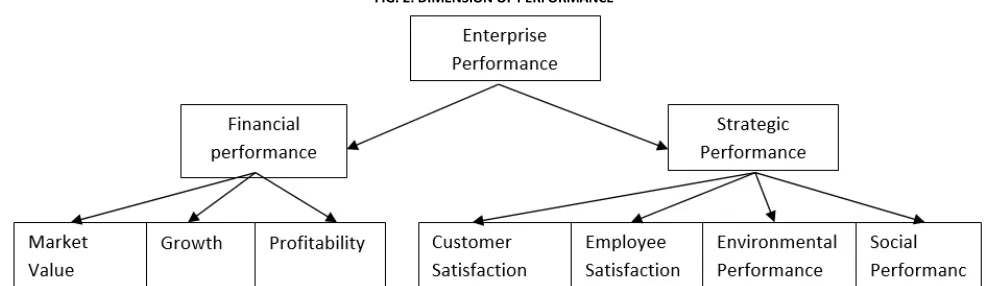
Undoubtedly information and communication technology has powerful impact on economic performance, technology and productivity. It has also social impact. Performance of enterprise has two types.
• Financial performance
• Strategic performance
These types could be represented by competitive aspect: market value, growth profitability, customer satisfaction, employee satisfaction, social performance and social performance.
FIG. 2: DIMENSION OF PERFORMANCE
V
OLUMEN
O.
7
(2017),
I
SSUEN
O.
03
(M
ARCH)
ISSN
2231-5756
INTERNATIONAL JOURNAL OF RESEARCH IN COMMERCE, IT & MANAGEMENT
Indicator of Performance Dimension (Santos and Brito, 2012)______________________________________________________________________________
Dimension Indicator
____________________________________________________________________________ Market Value Net revenue, Market Share growth, Net Income Growth, Employee Growth Stock price improvement, Dividend Yield, Stock Price volatility Profitability Return on Assets, Return on Investment, Net income revenue
Customer Satisfaction Mix Product and Services, Number of complaints, Purchase rate, new customer retentions, General Customer satisfaction Employee satisfaction Wage and rewards policies, Career plans, Turnover, investment in employee training and development, employ satisfaction Environmental Performance Level of pollution emission, Number of project to improve, use of recyclable material
Social Performance Number of social and cultural projects, employment of minorities
Empirical studies have confirmed the positive affect of ICT on firm performance in term of productivity, profitability, market value and market share. Some studies also revealed that ICT has some effects in terms intermediate performance measure: service quality, cost saving, flexibility and also customer satisfaction. All dimension of strategic performance could be qualified as affected indirectly.
World Economic forum comprises on the basis on Global Competitiveness Reports has 12 key elements of competitiveness (Matei & Sayulescu, 2012) that are related to ICT impact on both strategic and financial dimension of performance.
Institution Infrastructure
Macroeconomic environment High education and training Good market efficiency Labour market efficacy Financial Market development Technological readiness Market size
Business sophistication Innovation
All 12 elements are powerful and interrelated, Matei and Sayilesci (2012) states that there could be 1 percent increment of total estimate in GDP and 4 percent in competitiveness by implementing of ICT.
CONCLUSION
This paper provides theoretical result on direct and indirect effects of ICT on SMEs performance. ICT can improve overall financial and operation performance of SMEs by using the opportunity.
The measure area of ICT impact is networking and communication, resource planning and marketing. Some empirical studies confirmed the positive effect of ICT on performance of SMEs, in term of profitability, productivity, market share and market value. To make the best performance by the implementing of ICT it is important to align with organisation process and internal capabilities of the organisation.
Results of these works confirm that ICT has impact on the improvement of internal and external communicator. ICT has also play a great role in innovative perfor-mance by SMEs.
Some limitation on this research also mentioned. ICT adoption possible effect on SMEs or cluster of enterprise.
REFERENCES
1. Alam, S. S., & Noor, M. K. M. (2009). ICT adoption in small and medium enterprises: an empirical evidence of service sectors in Malaysia. International Journal of Business and Management, 4(2), 112–125.
2. Bayo-Moriones, A., Billon, M., & Lera-Lopez, F. (2013). Perceived performance effects of ICT in manufacturing SMEs. Industrial Management & Data Systems, 113(1), 117–135. http://dx.doi.org/10.1108/02635571311289700
3. Consoli, D. (2012). Literature analysis on determinant factors and the impact of ICT in SMEs.
4. Esselaar, S., Stork, C., Ndiwalana, A., & Deen-Swarray, M. (2007). ICT usage and its impact on profitability of SMEs in 13 African Countries.Information Tech-nologies and International Development, 4(1), 87–100. http://dx.doi.org/10.1162/itid.2007.4.1.87
5. Higon, D. A. (2011). The impact of ICT on innovation activities: evidence for UK SMEs. International
6. Lopez-Nicolas, C., & Soto-Acosta, P. (2010). Analyzing ICT adoption and use effects on knowledge creation: An empirical investigation in SMEs. International Journal of Information Management, 30, 521–528. http://dx.doi.org/10.1016/j.ijinfomgt.2010.03.004
7. Manochehri, N. N., Al-Esmail, R., & Ashrafi, R. (2012). Examining the impact of information an communication technologies (ICT) on enterprise practices: a preliminary perspective from Qatar. The Electronic Journal on Information Systems in Developing Countries (EJISDC), 51(3), 1–16.
8. Matei, A., & Savulescu, C. (2012). Empirical analysis of ICT, economic growth and competitiveness in the EU, The International Conference on ICT Management (ICTM 2012), Wroclow, Poland.
9. Matthews, P. (2007). ICT assimilation and SME expansion. Journal of International Development, 19, 817–827. http://dx.doi.org/10.1002/jid.1401 10. Procedia – Social and Behavioral Sciences, 62, 93–97. http://dx.doi.org/10.1016/j.sbspro.2012.09.016
11. Santos, J. B. & Brito, L. A. L. (2012). Toward a subjective measurement model for firm performance. Brazilian Administration Review (BAR), 9(6), 95–117. http://dx.doi.org/10.1590/S1807-76922012000500007
V
OLUMEN
O.
7
(2017),
I
SSUEN
O.
03
(M
ARCH)
ISSN
2231-5756
INTERNATIONAL JOURNAL OF RESEARCH IN COMMERCE, IT & MANAGEMENT
REQUEST FOR FEEDBACK
Dear Readers
At the very outset, International Journal of Research in Commerce, IT & Management (IJRCM) acknowledges
& appreciates your efforts in showing interest in our present issue under your kind perusal.
I would like to request you to supply your critical comments and suggestions about the material published
in this issue, as well as on the journal as a whole, on our e-mail
for further
improve-ments in the interest of research.
If you have any queries, please feel free to contact us on our e-mail
.
I am sure that your feedback and deliberations would make future issues better – a result of our joint effort.
Looking forward to an appropriate consideration.
With sincere regards
Thanking you profoundly
Academically yours
Sd/-
Co-ordinator
DISCLAIMER
V
OLUMEN
O.
7
(2017),
I
SSUEN
O.
03
(M
ARCH)
ISSN
2231-5756