UBIR: University of Bolton Institutional Repository
Educational Cybernetics: Reports Institute for Educational Cybernetics
2006
UNFOLD Deliverable 8.3. Final evaluation report.
David GriffithsUniversity of Bolton, [email protected]
Josep Blat
Universitat Pompeu Fabra
Nidia Berbegal
Ayman Moghnieh
Fabien Girardin
See next page for additional authors
This Report is brought to you for free and open access by the Institute for Educational Cybernetics at UBIR: University of Bolton Institutional Repository. It has been accepted for inclusion in Educational Cybernetics: Reports by an authorized administrator of UBIR: University of Bolton Institutional Repository. For more information, please [email protected].
Digital Commons Citation
Griffiths, David; Blat, Josep; Berbegal, Nidia; Moghnieh, Ayman; Girardin, Fabien; Santos, José Luis; Sayago, Sergio; Burgos, Daniel; Tattersall, Colin; Kew, Christopher; and Dias, Ana. "UNFOLD Deliverable 8.3. Final evaluation report.." (2006).Educational Cybernetics: Reports.Paper 18.
INFORMATION SOCIETY TECHNOLOGIES PROGRAMME
TECHNOLOGY ENHANCED LEARNING
D8.3
Final Evaluation Report
Project Acronym : UNFOLD
Contract No : IST-2003-507835
Delivery Date : 22nd February 2006
Project Partners
Partner
Org. Contact Person Tel Fax Email Address
UPF Dai Griffiths + 34 93 542 2173 +34 93 5422517 [email protected]
University of Bolton
Oleg Liber + 44 1204 903660 +44 1204 399074 [email protected]
OUNL Rob Koper + 31-455762317 + 31 455762802 [email protected]
EUCEN Carme Royo + 34 93 5421825 + 34 93 5422975 [email protected]
Table of Contents
Table of Contents
... 2
Deliverable Identification Sheet
... 3
1. Executive summary
... 4
1.1 Overview of UNFOLD evaluation work
... 4
1.2 Summary of conclusions
... 4
2. Index to UNFOLD evaluation actions
... 8
3. Brief reports on the UNFOLD evaluation scenarios
... 10
Scenario 1: Effectiveness of awareness raising material and Web
... 10
Scenario 2: Resources for CoPs
... 13
Scenario 3: Infrastructure provided for interactions
... 15
Scenario 4: Level of information flows in CoP
... 19
Scenario 5: User group satisfaction with f2f meetings/workshops and
... 26
Scenario 6: The usefulness of the CoPs to their participants and organizations
... 26
Scenario 7: CoP members level of involvement with LD over lifetime of project
... 32
Scenario 8: Level of adoption of LD achieved during the project
... 34
Scenario 9: Effectiveness of UNFOLD with respect to the adoption of LD
... 37
4. Published Papers on UNFOLD evaluation work
... 39
4.1 Influence of face-to-face meetings on virtual community activity: the case of Learning Network for Learning Design
... 40
4.2 Encouraging contributions in Learning Networks using Incentive Mechanisms
... 51
Results
... 57
4.3 Spanish Language paper: Virtual communities, research groups and projects on IMS Learning Design. State of the art, key factors and forthcoming challenges
Deliverable Identification Sheet
Project ref. no. IST-2003-507835
Project acronym UNFOLD
Project full title Understanding New Frameworks of Learning Design
Distribution level PU
Contractual date of delivery
14th February 2006
Actual date of delivery 22nd February 2006
Deliverable number D8.3
Deliverable name Final Evaluation Report
Type Report
Status & version Final
Number of pages 80
WP / Task responsible UPF
Other contributors OUNL, Bolton University, EUCEN
Author(s) Dai Griffiths, Josep Blat, Nidia Berbegal, Ayman Moghnieh, Fabien Girardin, Jose Luis Santos, Sergio Sayago, Daniel Burgos, Colin Tattersall, Chris Kew, Ana Dias
EC Project Officer Marco Marsella
Abstract This report provides an overview of evaluation work
carried out in the context of the UNFOLD project. It relates this to the UNFOLD evaluation plan, and shows how the work carried out has fulfilled that plan. The results of the evaluation are largely positive, with particularly strong performance in addressing the user group and providing an effective programme of events and activities. Details of the evaluation actions carried out are provided in D8.1, D8.2 and the annex to this report /submitted as a separate document.
Keywords UNFOLD, Learning Design, IMS LD, evaluation,
specification
Circulated to partners 21st February 2006
1. Executive summary
1.1 Overview of UNFOLD evaluation work
This report provides an overview of the evaluation work carried out in the UNFOLD project. The actions taken are related to the scenarios and questions defined in the evaluation plan, and conclusions given.
The first action taken was the development of the project evaluation plan, delivered in month six, and available in an appendix to D8.1. In the eighteen months following the definition of the evaluation plan evaluation work was carried out intensively to ensure that the project was performing well in its coordination activity. This continuous process was seen to be essential to ensure that the coordination function of the project was being fulfilled, as it is otherwise hard to assess.
Evaluation work was carried out in three periods, each of six months, and reported in the deliverables D8.1, D8.2 and D8.3. For each period an action plan was developed, and these are included in the deliverables. The details of the evaluation actions are available in the three periodic evaluation reports, D8.1, D8.2, and the annex to this report, which is delivered in a separate file. An index to the actions is provided in the first section of this report, indicating where the details can be found.
In this period all the scenarios identified in the Evaluation Plan were addressed.
The support of Communities of Practice is a new field, and research is important in this emerging area. Thus, although it was not a specific UNFOLD activity, research into this aspect was considered to be important for the project, to inform our activities and support the attainment of UNFOLD goals.
We now proceed to provide a summary of the conclusions drawn from the evaluation actions carried out. These are grouped according to the scenarios from the UNFOLD plan. More detailed (but still brief) reports are provided in section 3 of this report, but for further detail readers are referred to the full reports in the periodic evaluation reports, and the Annex to this document.
1.2 Summary of conclusions
Scenario 1, Effectiveness of awareness raising material and web.
The evaluation actions carried out show that the resources were of good quality and easy to read.
Navigation was addressed in scenarios 3 and 4. As is explained there, some problems were identified with navigation, and were addressed as the project progressed.
A widespread need for more introductory materials and activities was identified.
Scenario 2: Resources for CoPs
Evaluation actions and direct feedback from members has shown that the resources which are most valuable to members are
a) those which support the face to face and synchronous online activities of the project b) those which provide introductory materials and activities.
These materials were created by UNFOLD. In particular members were able to access activity nodes on the LN4LD server which provided an introduction to LD, and runnable Units of Learning. The log file analyses of the servers confirm that these were the most frequently consulted resources.
The questionnaires administered to meeting participants did not distinguish between general and CoP resources, and the positive results are considered to be applicable to this scenario as well.
The paper Influence of face-to-face meetings on virtual community activity: the case of learning network for learning design included in this report provides a detailed picture of the interaction between face to face meetings and resources.
Scenario 3: Infrastructure provided for interactions and
A number of usability issues were identified in evaluation actions, principally the accessibility of the forums, and the complexity of the menu structures. Remedial action was taken by the project. Evidence from log file analysis and structured questionnaires at project meetings indicates that the changes were appropriate, and that the effectiveness of the system improved.
Experiments were carried out in order to identify ways of encouraging participation on LN4LD, which met with some success, as demonstrated by the dramatic increase in use of the server in early 2005. Details of this work are available in the paper Infrastructure provided for interactions included in this report.
Scenario 4: Level of information flows in CoP
Number of people reached
The project reached a large number of people, with 1210 users being registered on the project sites, 621 of whom received the project mail distribution list.
Geographic spread
The geographic spread of participation was very wide. The highest rates of participation at face to face events came from Netherlands and the UK. There were strong indications that project work in Spain and France resulted in increased membership in those countries. There is also smaller but significant participation from Canada and Australia. A similar pattern is shown in the online events, where geographic location was not an issue. Here France has a substantial participation.
Sectors which participants come from
IMS LD has its origins in the academic sector and this is where it is still strongest.
What proportion of the participants are active, and to what extent?
Most UNFOLD members were passive, receiving the mailing list, and accessing information. 333 different people attended project in person events (some of whom attended multiple events). Thus the total number of people who attended project meetings is 27·5% of the total membership. A very positive result for the project is that twice as many sessions at UNFOLD meetings were run by members than were run by project personnel. This is a strong indication of the commitment to the project of the core membership, and the reality of UNFOLD as a coordination action.
Synchronous online discussions attracted 187 participants over the 11 events held. As described in scenario 3, participation in the project forums was relatively low, compared with face to face participation.
Scenario 5: User group satisfaction with f2f meetings/workshops
Scenario 6: The usefulness of the CoPs to their participants and organizations
These two scenarios are considered together, because the data is highly related.
Value of the events: Analysis of structured questionnaires administered at face to face events shows that the events were highly relevant to the participants. The CoP meetings were more highly rated than the outreach workshops. This is to be expected as the outreach workshops were intended to involve people who were not members of UNFOLD, had little previous understanding of the specification.
Quality of inputs: The quality of the formal inputs was also very high, with the outreach workshops also achieving a very high score on this measure.
Strong points and improvements: feedback and suggestions were gathered from participants at all meetings, and reviewed by project personnel. They are detailed in the evaluation reports for the individual meetings.
New opportunities: 79% of participants felt that their participation had opened up new opportunities for them, and 80% expressed their intention to maintain their participation in the CoPs.
Outcomes: The outcomes of the project are described in report D10 UNFOLD outcomes.
Effort put in and benefit received: There is a very strong indication that participants found it worth their while to attend project events. Not only was attendance high, and at the participants own expense, but the participants were also willing to put in substantial effort to preparing sessions and papers for the events. As a result more than twice as many sessions at UNFOLD meetings were run by members than were run by project personnel.
Scenario 7: CoP members level of involvement with LD over lifetime of project
As described for the previous scenario, a large number of practical sessions were organised by at project meetings. This was in response to requests from members, who consistently said that they found them useful. The popularity of the Runnable Units of Learning activity on LN4LD, which provided an easy way to get to grips with running Learning Design applications also shows that members engaged with the specification.
The results for the project as a whole, however, indicate that a majority of participants were actively involved in working with the specification on at least a weekly basis, with 32% being working with the specification on most working days.
Scenario 8: Level of adoption of LD achieved during the project
The speed of implementation of IMS LD tooling was much slower than anticipated when the workplan was written.
Studies were made of progress made in implementation, which are reported in D8.2 action 4, and in D8.3 Annex, action 3, as well as in the UNFOLD final publication. These show that while progress is strong, if slow, on tooling, adoption with learners is still in the very initial stages. The feedback from users at UNFOLD events frequently specified the lack of easy to use tooling as the principal barrier to the adoption of IMS LD.
The project has gathered together exemplar UoLs, with 37 UoLs being available on the LN4LD Runnable Units of Learning activity. These are not the total of the Units of Learning existing “in the wild”. Calculation of the total number of existing UoLs is problematic, because it is not clear at what point a variation on a UoL becomes a new design.
The questionnaires administered at face to face meetings show that adoption with learners is low, and that development of tooling is more advanced, although still not high.
Scenario 9: Effectiveness of UNFOLD with respect to the adoption of LD
As discussed in relation to scenario 8, the level of implementation achieved in IMS LD is well below that which was anticipated when the workplan was written and the project commenced. As a result it is hard to evaluate the effectiveness of UNFOLD with respect to the adoption of LD when there are as yet almost no examples of the specification being used with learners.
Analysis of project activities, however, revealed some particular development initiatives which owe a debt to UNFOLD meetings. These are discussed in report D10 UNFOLD Outcomes, which are summarised in the section on Scenario 9 below.
Studies of adoption indicate that all the known IMS LD development projects have been involved in UNFOLD. While it is not possible to know what would have happened if UNFOLD had not existed, it seems clear that this is a positive contribution to the adoption of LD.
In the light of slower than expected progress in tooling, which has in turn slowed adoption, we also point to the positive results obtained by the project in Scenario 4, Level of
2. Index to UNFOLD evaluation actions
The evaluation actions were reported in the following documents and pages:
D8.1 Periodic Evaluation Report 1
Evaluation actions in meetings
Action 1. Evaluation at UNFOLD-Barcelona meeting 7 Action 2. Evaluation at UNFOLD-Online EDUCA workshop 8 Action 3. Evaluation at UNFOLD workshop at EUCEN conference 9 Action 4. Usability inspection of the UNFOLD web site 10 Action 5. Log analysis of use of UNFOLD servers 11
D8.2 Periodic Evaluation Report 2
Action 1: Evaluation actions in meetings 8 Findings of the UNFOLD CoP workshop in Valkenburg 9 Findings of the Paris CoP event 10 Findings of the Second UNFOLD CoP meeting in Barcelona 11 Findings of the UNFOLD CoP workshop in Madrid 12 Action 2: Usability testing of the UNFOLD website 15 Action 3: Evaluation of participation 16
Statistical analysis 16
Interviews with CoPs members 20 Action 4: Benchmarking studies 22
D8.3 Periodic Evaluation Report (Annex)
Action 1: Log file analysis 7 Action 2: Evaluating the context of UNFOLD results 18 Action 3: Evaluation reports on UNFOLD events 29 Braga - UNFOLD Communities of Practice meeting 29 Valkenburg UNFOLD – Prolearn Conference 48 Berlin - UNFOLD CoP meeting 67 Rome – Eucen Workshop 85 Madrid - Complutense 94 Action 4: Usability test for UNFOLD site http://www.unfold-project.net 107
Test plan 108
Conclusions 132
These evaluation activities of have been organised according to the project Evaluation plan, which analysed the evaluation needs of the project and identified nine scenarios to be addressed. For each scenarios actors, questions to be answered, indicators, benchmarks and timing were indicated. The detailed scenarios are available in the project evaluation plan, submitted , as an Annex to D8.1 Periodic Evaluation Report 1.
Scenario Scenario name Actions taken Results in
evaluation report
1 Effectiveness of awareness raising material and Web
Structured questionnaires at all Communities of Practice meetings and project workshops
D8.1, actions 1,2,3 D8.2, action 1 D8.3 Annex, action 3 Analysis of search results 8.2, action 3
2 Resources for CoPs Log file analysis D8.1 action 5 D8.2 action 3 D8.3 action 1 Interviews with users D8.2, Action 3 3 Infrastructure
provided for interactions
Experiments in LN4LD D8.3 Papers Website usability inspection D8.1 action 4 Website usability trials D8.2 action 15
D8.3 action 4 4 Level of
information flows in CoP
Log file analysis D8.1 action 5 D8.2 action 3 D8.3 action 1 5 User group
satisfaction with f2f meetings/workshops
Structured questionnaires D8.1, actions 1,2,3 D8.2, action 1 D8.3 Annex, action 3 Interviews with CoP members D.8.2 action 3
6 The usefulness of the CoPs to their participants and organizations
Structured questionnaires D8.1, actions 1,2,3 D8.2, action 1 D8.3 Annex, action 3 Interviews with CoP members D.8.2 action 3
7 CoP members level of involvement with LD over lifetime of project
Analysis of participation statistics for face to face events and online activities
D8.3 body of this report
8 Level of adoption of LD achieved during the project
Structured questionnaires D8.1, actions 1,2,3 D8.2, action 1 D8.3 Annex, action 3 Study of progress made in
implementation
D8.2 action 4
D8.3 Annex, action 3 9 Effectiveness of
UNFOLD with respect to the adoption of LD
Analysis of patterns of participation
D8.2 action 4
3. Brief reports on the UNFOLD evaluation
scenarios
The evaluation actions taken by the project have addressed all of these areas, as we now describe.
Scenario 1: Effectiveness of awareness raising material
and Web
Questions addressed and conclusions
The questions addressed in this scenario were:
• Are the resources and Web of good quality?
• Do they meet the needs of the user group?
• Are the resources and Web well designed and easy to navigate?
• What additional materials or functionality would be valuable?
The evaluation actions carried out show that the resources were of good quality and easy to read.
Navigation was addressed in scenarios 3 and 4 below. As is explained there, some problems were identified with navigation, and were addressed as the project progressed. In common with the needs of CoP members, a general need for more introductory materials and activities was identified.
Actions carried out
D8.1, action 4, Usability Inspection of website. The results of this usability inspection suggest that the main positive aspects of the UNFOLD web site are the consistency and good readability of materials.
Regarding consistency, both the distribution of the elements in each page and the
navigational scheme are rather consistent. Furthermore, both the downloaded documents and the content of the web pages are very well structured and easy to read; even though there are some minor errors, mainly related to the duplication and visualization of links in the home page.
D8.2, Action 2, Usability testing of the UNFOLD website found that readability is one of the most well-rated aspects of the site, followed by the information about the events and the clearness, sufficiency and quality of the information offered.
D8.1, actions 1,2,3; D8.2, action 1; D8.3 Annex, action 3. Structured questionnaires at project meetings
Quality of information provided in organisation of meeting: 1 = BEST
Information provided in meeting organisation was sufficient. 1 = BEST
Two of the workshops (Kaunas and Madrid Online Educa) were not completely
satisfactory in this respect. It may be that the attendees had very little prior knowledge of Learning Design, and would have benefited from additional information prior to the event.
The information provided in meeting organisation was easy to read. 1 = BEST
Again the scores for some workshops are lower for the same reason as that given for the previous graph.
Information-Easy to read
Scenario 2: Resources for CoPs
Questions addressed and conclusions
The questions addressed in this scenario are:
• Are the resources appropriate to the needs of members of the CoP?
• Are the resources of good quality and clearly presented?
• What additional resources would be valuable?
• How should they be created?
Evaluation actions and direct feedback from members has shown that the resources which are most valuable to members are
a) those which support the face to face and synchronous online activities of the project b) those which provide introductory materials and activities.
These materials were created, in particular members were able to access activity nodes on the LN4LD server which provided an introduction to LD, and runnable Units of Learning. The log file analyses of the servers confirm that these were the most frequently consulted resources.
The questionnaires administered to meeting participants did not distinguish between general and CoP resources, and the positive results are considered to be applicable to this scenarios as well.
The paper Influence of face-to-face meetings on virtual community activity: the case of learning network for learning design included in this report provides a detailed picture of the interaction between face to face meetings and resources.
Actions carried out
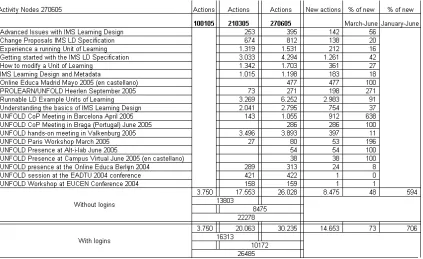
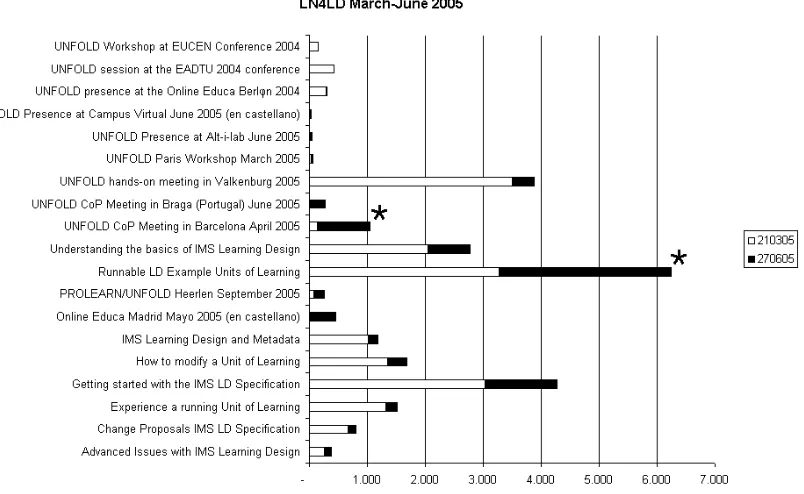
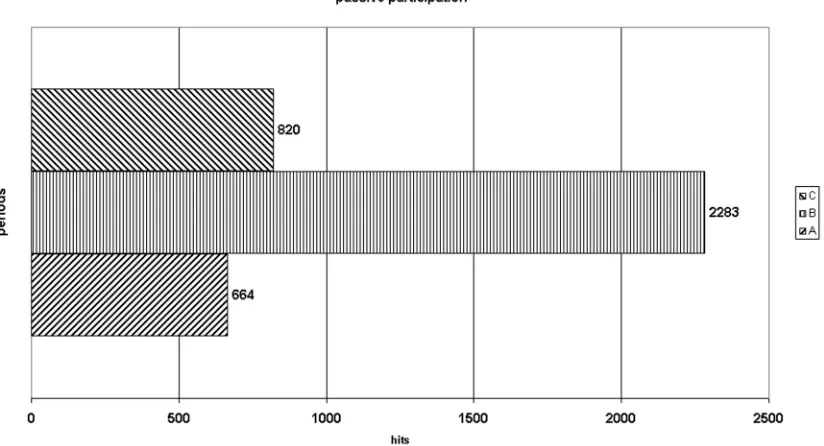
D8.2 Action 3, Evaluation of Participation notes that there is significant activity around the most popular AN Example Units of Learning, while it is remarkable the progress of
Getting started and Understanding the basics showing the support provided for IMS LD. It also notes that there was a strong increase in activities online in areas of the server related to the Barcelona event in April. The relationship between face to face events and the demand for resources is detailed in a published paper available in the appendix to this document:Influence of face-to-face meetings on virtual community activity: the case of learning network for learning design
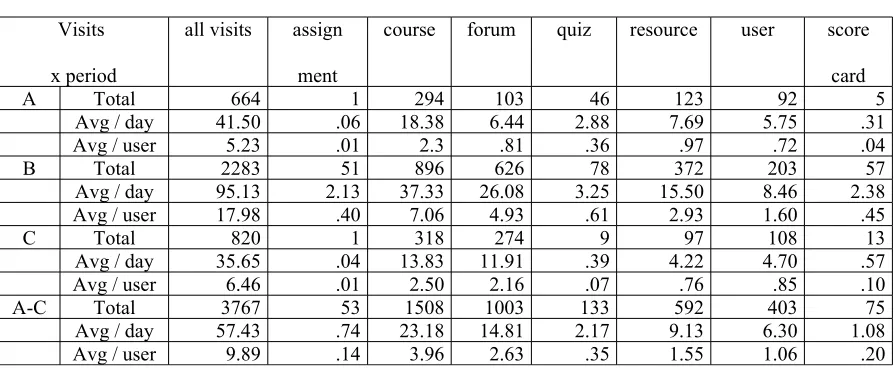
These two trends (a need for support in the basics of LD, and a online support for face to face events) were observed throughout the project, and reappear in the analysis for LN4LD in the final period. Thus in D8.3 Action 1, Log file analysis we see that for LN4LD analysis was carried out of the activity on the Activity Nodes of the LN4LD server, as shown in the table on the following page. There were 25 activity nodes on the site in this period. Some of these experienced a drop in activity, and those were the activity nodes relating to in person events which were some months in the past. Similarly those nodes related to events in this period increased in activity.
We note the following.
• There is one activity node for an in person event in the past which increased
activity. This is Activity Node 16, UNFOLD hands on meeting in Valkenburg 2005. The explanation for this increase is that resources are available here for Reload and Coppercore, which have been the most widely used applications for creating and running Units of Learning.
• There is an increase in Activity Node 25 Getting started with the IMS LD
Specification. This shows that these introductory materials met a need for users who wanted help to get to grips with the specification.
D8.3, Action 1, Log file analysis also notes that the most frequently accessed documents in this period on the main project website were the MOTplus guide and the Collage documentation. These both contain practical information about graphical Learning Design editors. This again shows that users had a need for basic information about the
specification and available tools, and also confirms feedback from members that the need for easy to use editors is the most urgent challenge facing IMS LD, and also the findings for the LN4LD site.
D8.2, Action 3, Interviews with 16 key users shows that both Plone and Moodle sites are considered to offer valuable information, as they have been used by people who are very busy otherwise. Both seem to contain quite complex information, and the main criticisms are that they are not sufficiently friendly for first time users, for newcomers to the
Scenario 3: Infrastructure provided for interactions
Questions addressed and conclusions
The questions addressed in this scenario were:
• Do the online facilities provided to the CoPs meet the needs of the CoP participants in their online activities?
• Is the system easy to use?
• Is the system hard to learn?
• Is the system consistent?
• What improvements could be made to the system?
• How effective and usable is the technology used to support the CoPs A number of usability issues were identified in evaluation actions, principally the accessibility of the forums, and the complexity of the menu structures. Remedial action was taken by the project. Evidence from log file analysis and structured questionnaires at project meetings indicates that the changes were appropriate, and that the effectiveness of the system improved.
A detailed analysis of some of the changes made on LN4LD is available in the paper
Infrastructure provided for interactions included in this report.
Actions carried out
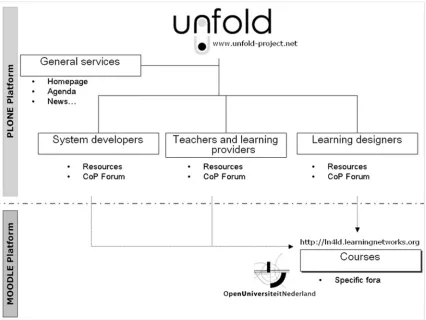
The initial structure of the UNFOLD web provision is described in D5 Establishment of CoPs. In this structure the interactive support for the Teachers and Learning Providers, and for the Systems Developers, was on the www.unfold-project.net server, the main project website, while the support for the Learning Designers CoP was on the Learning Networks for Learning Design server.
A number of problems were identified with this structure
D8.1, action 4, Usability inspection of project website showed that the user interfaces of the UNFOLD forums are quite clear, despite the fact that there might be some minor problems regarding concrete options such as “subscribe”. On they did not seem to be as conspicuous as they should have been. Although there was an option to join to the
UNFOLD project on the home page, there was not a visual and clear option to “participate in UNFOLD”; although the web site provides three forums.
Direct feedback from users at meetings and through mail, and their practice in posting, showed that there was a degree of confusion about what activities should be carried out where.
It was noted that the practical introductory activities to the IMS LD specification on the LN4LD server were proving popular, as many members were still at the initial stage with the specification. At the same time the LN4LD server was used to experiment with ways of stimulating participation, in December 2004 and January 2005. These results proved promising, and are documented in D8.2 Action 3: Evaluation of Participation, and at greater length in the papers in the appendix to this present document: Encouraging contributions in Learning Networks using Incentive Mechanisms
0 50 100 150 200 250 300
15 Oct 04 - 21 Mar 05 21 Mar 05 - 27 Jun 05 27 Jun 05 - 20 Dec 05
Average daily number of actions on LN4LD server, per period
The more detailed analysis which is available in the UNFOLD Evaluation Report 2 shows that this dates from initiatives taken to boost participation in December 2004. Thus the overall picture of the use of LN4LD is of a steep increase in early 2005, and a maintained level of activity in the from March to December 2005. The slight decrease in activity in the final period is no doubt due to a marked slowdown in activity in the holiday period in August.
Forums
The increase in activity described above was primarily due to the Activity Nodes rather than the forums.
Throughout the 18 months of the project online forums were maintained, and all queries posted were answered. It is clear, however, that this did not prove to be as useful a tool for project work as had been anticipated. In response to evaluation which revealed low levels of use, the project made a number of innovations, such as
• adding ‘mail push’ so that subscribers received mail in their personal mail client (month 9)
• providing a system of rewards so that more frequent posters were given privileged access to resources (month 12)
• a radical redesign of the project forums which were concentrated on the revised Learning Networks for Learning Design site (month 16)
The results did not vary significantly, although there were some bursts of activity. To give an example, in the final six months of the project facilitators initiated 29 threads (either directly or through close collaborators among the membership). The response was relatively low key, with only 84 responses.
mainly in Level A and B, but also with a first tryout in Level C. The variety of topics is high although all of them are mainly focused on Adaptive learning, learning flow,
collaborative learning and personalization. These outcomes are categorized in ´use cases´ and ´show cases´ meaning the first ones those cases with actual content showing actual lesson plans, and the second ones those UoLs created to show specific features of the specification or some pedagogical aspect modelled with it. The authors come from any of the UNFOLD CoPs and they are usually attending the face to face events, raising
pedagogical and technical questions in the forums and getting and providing practical support in the creation of these UoLs. UNFOLD websites play then an important role both, helping members of the CoPs to create their own UoLs and facilitating the dissemination of these outcomes
The success of this initiative only seems to demonstrate more clearly that members were principally interested in engaging in UNFOLD to obtain information and resources, to present and disseminate their work, to publish results, and to find unique opportunities for synchronous discussion. Interestingly activity on the forums is picking up gradually since the end of the project, which suggests that now that UNFOLD face to face events are not available members are seeking other possibilities.
There was an increase recorded in the Discussion forums on IMS LD in the last period, and while this was satisfactory, it remained at a relatively low level, and was less active than the Runnable LD Example Units of Learning.
Analysis of the questionnaires administered at UNFOLD events throughout the project show that participants clearly preferred face to face over online activity. This result is perhaps unsurprising (the respondents were self selected as wanting to come to face to face events). Nevertheless demonstrates that UNFOLD participants were not driven to
participate in face to face events because the information was not available from UNFOLD online activities, but rather because they preferred this modality.
There were also online synchronous discussions and seminars on the UNFOLD server, and these proved very productive and popular. 187 members participated in 11 synchronous sessions, an average of 20,7 participants per event. The participants in these discussions were very keen to exchange ideas and to pick up on news of research which was relevant to their work. This may be why the synchronous online exchanges were more effective than the forums, as they enabled participants to get feedback from a large number of participants almost instantly, in a brainstorm-like environment, whereas the same interactions in a forum would have taken weeks, and might never have reached critical mass.
Online events participation
71% 29%
As shown by the graphic above, 29% of respondents to questionnaires administered at face to face events throughout the project said that they had participated in UNFOLD online events.
The log file analyses of the www.unfold-project.net site showed that a certain number of “document not found” messages were persistently returned by the server. Specifically, in the final 6 months of the project, nearly a million requests were returned correctly, but 42.589 returned “document not found”. This was due to the caching by web search engines of pages which had been moved in redesigning the site.
D8.1 Action 3, Log file analysis, and D8.3 Action 1, Log file analysis show that the heaviest use of the server was in the week. While activity was low on Saturday, as might be expected, there was significant activity on Sundays at the end of the project, more than on Wednesdays. In the second of the two reports the figures for hourly analysis show two periods of intense activity, 2 - 4 am, and 9am to 1 pm. This anomalous high activity in the night is suspected to be due to web crawlers which take advantage of periods of low Web activity to catalogue the site (although visitors from other parts of the world no doubt also accessed the site). The mid day spike indicates that most users were accessing the site during their work hours. There was also, however, substantial activity on Sunday. This suggests that some users were investigating IMS LD because they wished to use it in the future, but that their current work did not support this. ·
Online events vs F2F
24%
50% 25%
1%
Scenario 4: Level of information flows in CoP
Questions addressed and conclusions
This scenario relates closely to feedback from the first project review indicated that the project needed to be clearer about its achievements and the make up of the Communities of Practice.
With a view to this end the project intensified analysis of information about the patterns of participation in UNFOLD, which would in turn provide perspective on the effectiveness of the project in supporting adoption of the specification.
• How many people is the project reaching?
• What is the geographic spread of participants?
• What sectors do the participants come from?
• What proportion of the participants are active, and to what extent?
Number of people reached
The project reached a large number of people, with 1210 users being registered on the project sites, 621 of whom received the project mail distribution list.
Geographic spread
The geographic spread of participation was very wide. Thus the highest rates of
participation at face to face events came from Netherlands and the UK, the two countries where this might be expected, given their track record in developing the IMS LD
specification and in implementing systems. To put these results in perspective, however, it should be remembered that the location of meetings had a strong influence on the
attendance, with a natural tendency for a greater attendance from the host country. Thus the Portuguese attendance was largely at a single meeting in Portugal. On the other hand, there was only one UK event, compared with two in Netherlands, so the UK participation was clearly substantially more intense than that of the Netherlands. A surprising result is that the attendance from Spain and Netherlands was almost identical, despite the much less well established tradition of work with IMS LD in Spain. This is an indication that project work in the Spanish speaking community bore fruit. The results for France and Canada also reflect the efforts of the project to draw these communities into UNFOLD activities. There is also smaller but significant participation from Canada and Australia. A similar pattern is shown in the online events, where geographic location was not an issue. Here France has a substantial participation, but the figure for Canada is very high, considering that participants had to get up early in the morning in order to participate.
Sectors which participants come from
IMS LD has its origins in the academic sector and this is where it is still strongest. The project took steps to involve the industrial sector. Developers of commercial applications have been invited to attend events wherever possible, resulting in the participation of Chronotech, elive, Cosmos and GTK Press. Contact has also been established with BlackBoard. The majority of development efforts in the LD area are Open Source, and many of these are funded by educational institutions or grants from education authorities. There are, however, a large number of independent Open Source organisations who are major players in the education market. UNFOLD has been in contact with a number of these, including LAMS, Moodle, Boddington and .LRN. Analysis of attendance at face to face meetings shows that representatives of 50 industrial organisations attended, that is to say 12% of the total participation.
What proportion of the participants are active, and to what extent?
is 27·5% of the total membership, a high figure given that most members of online coordination actions and forums are typically passive.
Once they had come to an event, participation by members was very high. A very positive result for the project is that twice as many sessions at UNFOLD meetings were run by members than were run by project personnel. This is a strong indication of the commitment to the project of the core membership, and the reality of UNFOLD as a coordination
action, rather than simply a dissemination process. Graphs for this data are provided in the discussion of scenarios 5 and 6 below.
Synchronous online discussions attracted 187 participants over the 11 events held. As described in scenario 3, participation in the project forums was relatively low, compared with face to face participation.
Evaluation actions carried out
In the final phase of the project the results of the structured questionnaires reported in
D8.1, actions 1,2,3; D8.2, action 1; and D8.3 Annex, action 3 were collated and analysed.
The results were in turn collated with the information available from server logfiles and membership records.
The resulting picture of members involvement provides the following picture:
Number of registered users
Membership of the UNFOLD Plone site carried with it membership of the UNFOLD mailing list, and registration requested users to indicate which CoP they were most closely involved in.
The Moodle LN4LD platform also required users to register.
This provided flexibility for users, as they could choose to register with for the mailing list, for the activities on the LN4LD site, or for both.
By the end of the project the numbers of users registered on the sites was as follows LN4LD members 892 (registered for actives and forums on LN4LD) UNFOLD members 621 (registered to receive the UNFOLD mailing list) Total of individuals 1210
While there is no benchmark to assess these figures, the project believe that these are very satisfactory results.
Country of origin
0
20
40
60
80
100
120
A
us
tr
al
ia
A
us
tr
ia
B
el
gi
um
B
ul
ga
ria
C
an
ad
a
E
st
on
ia
F
ra
nc
e
G
er
m
an
y
G
re
ec
e
In
di
a
Ir
el
an
d
It
al
y
Li
th
ua
ni
a
M
ar
ro
co
s
N
et
he
rla
nd
s
N
ig
er
ia
N
or
w
ay
P
ol
an
d
P
or
tu
ga
l
R
us
si
a
S
pa
in
S
w
ed
en
S
w
itz
er
la
nd
T
ur
ke
y
U
K
U
S
A
.Attendance at in person events (total 437 at eight events)
Thus the highest rates of participation at face to face events came from the two countries where this might be expected, given their track record in developing the IMS LD
specification and in implementing systems. To put these results in perspective, however, it should be remembered that the location of meetings had a strong influence on the
0 5 10 15 20 25 30 A us tr ia B el gi um C an ad a F ra nc e G er m an y It al y N et he rla nd s N or w ay P or tu ga l S pa in S w ed
en UK
Participation in online events ((total 187 at nine events)
A similar pattern is shown in the online events, where geographic location was not an issue. Here France has a substantial participation, but the figure for Canada is very high, considering that participants had to get up early in the morning in order to participate.
The following graphic shows the statistics for the combined face to face and online events, and it provides a good overview of the areas with the strongest participation. In general terms this pattern reflects the distribution of interest in the IMS LD specification, which is, for example perceived to be much higher in Canada than in the US.
0 20 40 60 80 100 120 140 160 A u st ra lia A u st ri a B e lg iu m B u lg a ri a C a n a d a E st o n ia F ra n ce G e rm a n y G re e ce H u n g a ry Ic e la n d In d ia Ir e la n d Ita ly L ith u a n ia M a rr o co s N e th e rl a n N ig e ri a N o rw a y P o la n d P o rt u g a l R o m a n ia R u ss ia S a u d i S p a in S w e d e n S w itz e rl a T a iw a n T u rk e y U K U S A
Participation by Community of Practice
The declaration of community affiliation on the UNFOLD main site provided a division as follows:
0 50 100 150 200 250 300 350
providers developers designers french phd
Declared membership of CoP
(total people = 621, some members of more than one CoP).
0 5 10 15 20 25 30 35 40 45 50
im
p
le
me
n
ta
tio
n
a
u
th
o
ri
n
g
te
a
ch
e
rs ld
u
n
fo
ld
Topics of presentations, papers and discussions at CoP meetings
All the three CoPs were substantially represented in the topics of presentations, papers and discussions at CoP meetings. This indicates that the three areas identified by the project were all adequately addressed. The fact that implementation issues were more frequently addressed than authoring, which were in turn more frequent than teachers issues, reflects the state of tooling for IMS LD, where a number of tools were appearing, but where authoring facilities for learning designers were still not ideal, and few opportunities for working with learners were available.
Industrial participation
industrial user group at the eLig (eLearning Industry Group) conference held jointly with EADTU (European Association of Distance Teaching Universities).
Developers of commercial applications have been invited to attend events wherever possible, resulting in the participation of Chronotech, elive, Cosmos and GTK Press. Contact has also been established with BlackBoard. The majority of development efforts in the LD area are Open Source, and many of these are funded by educational institutions or grants from education authorities. There are, however, a large number of independent Open Source organisations who are major players in the education market. UNFOLD has been in contact with a number of these, including LAMS, Moodle, Boddington and .LRN. The collaboration established with the PROLEARN network of excellence has been significant, as it has enabled the project to obtain access to the PROLEARN network, which is explicitly designed to link academic and industrial expertise in education and training, and a joint event was organised with PROLEARN.
As a result of these and other awareness raising efforts there has been a significant industrial participation in UNFOLD events. The table on the following page lists 50 participants in UNFOLD events who have been identified as being from either commercial companies, or from independent Open Source foundations, that is to say 12% of the total participation.
Company Country
Fachhochschule Vorarlberg Gmbh Austria
GTK Press Canada
AFIDE France
AIRBUS France
Aska France
CESI On Line France
Ferand Beghin, eLearning Consultant France
InWent GmbH / Internationale Weiterbildung und Entwicklung GmbH Germany
ANOVA Multimedia Studios GmbH Germany
Capacity Building International Germany
Fraunhofer FIT Germany
TheCoDe Germany
InWent GmbH / Internationale Weiterbildung und Entwicklung GmbH Germany
MOU SA Greece
Bifröst School of Business Iceland
Didagroup Italy
Euform.it Italy
Garamond srl Italy
Giunti Interactive Labs Italy
Berg Interactive Media and Communication Netherlands
CED-Groep Rotterdam Netherlands
Chronotech Netherlands
Deskjob Netherlands
Edugolive Netherlands
ETINE IT & Education Services Netherlands
Kennisnet Netherlands
LogicaCMG Netherlands
MemoTrainer BV Netherlands
Sofos Consultancy Amsterdam Netherlands
The Mediator Group Netherlands
Threeships enterprises bv Netherlands
Turpin Vision bv Netherlands
WeistraConsult Netherlands
wynneconsult Netherlands
Fronter AS Norway
it:solutions Norway
SIVECO Romania Romania
Evintia Spain
Master-D Spain
Pedagogia Interactiva eLearning Consultancy Spain
Sadiel Spain
SEGI-Consulting Spain
www.a3net.net Spain
Institute for Information Industry Taiwan
Siemens Business Services Turkey
Nelson Thornes Publishers UK
Cordys Worldwide
Scenario 5: User group satisfaction with f2f
meetings/workshops and
Scenario 6: The usefulness of the CoPs to their
participants and organizations
Questions addressed and conclusions
These two scenarios are considered together, because the data is highly related. The questions addressed were:
- Do the regular UNFOLD F2F events produce valuable outcomes for the participants? - Are the events well organized? How could they be improved?
- Are the facilities satisfactory? How could they be improved? - Were the formal inputs (if any) valuable and interesting?
- Have the CoPs opened up new possibilities for the participants? - What outcomes can be identified from participation in UNFOLD? - What has the balance been between effort put in and benefit received?
Value of the events: Analysis of structured questionnaires administered at face to face events shows that the events were highly relevant to the participants. The CoP meetings were more highly rated than the outreach workshops. This is to be expected as the outreach workshops were intended to involve people who were not members of UNFOLD, had little previous understanding of the specification.
Quality of inputs: The quality of the formal inputs was also very high, with the outreach workshops also achieving a very high score on this measure.
Strong points and improvements: feedback and suggestions were gathered from participants at all meetings, and reviewed by project personnel. They are detailed in the evaluation reports for the individual meetings.
New opportunities: 79% of participants felt that their participation had opened up new opportunities for them, and 80% expressed their intention to maintain their participation in the CoPs.
Outcomes: The outcomes of the project are described in report D10 UNFOLD outcomes.
Effort put in and benefit received: No formal cost benefit analysis was carried out, but there is a very strong indication that participants found it worth their while to attend project events. Not only was attendance high, and at the participants own expense, but the
participants were also willing to put in substantial effort to preparing sessions and papers for the events. As a result more than twice as many sessions at UNFOLD meetings were run by members than were run by project personnel. This is a strong indication of the commitment to the project of the core membership, and the reality of UNFOLD as a coordination action, rather than simply a dissemination process.
The events were seen by the participants as being highly relevant.
Relevancy of the event to the participants 1 = BEST
The quality of the information provided to participants in the course of activities at UNFOLD events was also seen to be very high:
Quality of the information provided in UNFOLD event activities 1 = BEST
79% of respondents felt that UNFOLD had opened up new opportunities for them:
Relevancy of the event to the participants
1 1,5 2 2,5 3 3,5 4 4,5 5 B cn 0 4 K au na s B er lin H ee rle n R om e B er lin M ea n Information provided 1 1,5 2 2,5 3 3,5 4 4,5 5 B cn 0 4 K au n as B er lin V al k P ar is B cn 0 5 M ad O E B ra ga R om e M ad C M ea n
Unfold > New opportunities
A similar proportion stated that they intended to be active in the UNFOLD CoPs in future.
D.8.2 action 3, interviews with users showed that UNFOLD is considered to be
developing very valuable work, supporting networking, encouraging the adoption of the specification and the debates tied to that, and stimulating pedagogical debates overall related to Learning Technologies. This result was consistent with the results of the questionnaires at the face to face meetings.
The best evidence for the usefulness of the events to the user group, and their organisations is that they were willing to fund their attendance at UNFOLD face to face meetings, which attracted participation from 400 people who paid their own expenses.
Another strong indicator is the willingness of participants to present their work and run workshops at UNFOLD events
Future participation in CoPs
14%
80% 6%
Types of activity at UNFOLD CoP meetings
0 10 20 30 40 50 60 70 80
presentation practical discussion
Number of presentation, practical and discussion sessions
The UNFOLD communities of practice focused on practical activities and discussion sessions as well as on input on new developments and research in the area of IMS LD. This policy was adopted as there was a need to develop a sense of joint activity, and to develop the basic skills required by participants. In terms of numbers of sessions, there were substantially more presentation sessions than any other category, however it should be remembered that each presentation session was substantially shorter than the other sessions. In the following graphic a rough adjustment is made for the length of the sessions, and it seems clear that sessions with active participation took up at least half of the time of UNFOLD meetings.
0 10 20 30 40 50 60 70 80
presentation practical discussion
Approximate adjustment for length of session (Practical x3, discussion x2)
Input into UNFOLD meetings
0 10 20 30 40 50 60 70 80 90 100
Sessions run by UNFOLD members
Sessions run by UNFOLD project personnel
Proportion of sessions at CoP meetings run by project personnel and by UNFOLD members
A very positive result for the project is that twice as many sessions at UNFOLD meetings were run by members than were run by project personnel. This is a strong indication of the commitment to the project of the core membership, and the reality of UNFOLD as a coordination action, rather than simply a dissemination process.
0 5 10 15 20 25 30 35 40 45 50
un
fo
ld
pr
oj
ec
t
re
se
ar
ch
in
du
st
ry
Presenters and discussion leaders in CoP meetings by sector
Scenario 7: CoP members level of involvement with LD
over lifetime of project
Questions addressed and conclusions
The questions addressed by this action are:
• Have members made use of the opportunity to deepen their understanding of Learning Design, and to use it?
• How has their level of involvement with LD varied over the lifetime of the project As described for the previous scenario, a large number of practical sessions were organised by at project meetings. This was in response to requests from members, who consistently said that they found them useful. The popularity of the Runnable Units of Learning activity on LN4LD, which provided an easy way to get to grips with running Learning Design applications also shows that members engaged with the specification.
At a more theoretical level, the large number of publications which have emerged from project activities indicates that the level of discourse was high.
These results indicate that the members made use of the opportunity to deepen their understanding of Learning Design.
The levels of engagement with the specification over the lifetime of the project has been followed in questionnaires, but no clear pattern has emerged over time. This seems to be due to a high degree of variation in the profiles of the participants at the different meetings. For example, in UK and Netherlands the population of users with a high degree of
engagement with the specification is much higher than in Portugal, simply because the specification is much less well established in that country.
The results for the project as a whole, however, indicate that a majority of participants were actively involved in working with the specification on at least a weekly basis, with 32% being working with the specification on most working days.
Actions carried out
Use of the specification
Questionnaires administered at ten UNFOLD face to face events showed that the majority of participants regularly used the IMS LD specification in one way or another.
59% of respondents worked with the specification at least once every week, while 41% had much more sporadic contact with the specification, either never or monthly.
Work w ith LD standards
13%
19%
27% 24%
17%
In questionnaires at eight face to face events participants were asked to state if they had used IMS LD with learners. The results show clearly that there the specification has so far not been used extensively with learners.
This is borne out by the fact that the project team are only aware of one current initiative to use IMS LD in an authentic classroom environment, which is being carried out at
Liverpool Hope University.
Percentage of participants at events who had used IMS LD with learners IMS LD w ith learners
94% 6%
Scenario 8: Level of adoption of LD achieved during the
project
Questions addressed and conclusions
• To what extent has the UNFOLD project accelerated the adoption of LD in industries, universities,…?
• Which are the main problems which UNFOLD have found in carrying out these tasks?
• How many tools (designs, unit of learning,…) have been created since UNFOLD was launched?
• How many plugfests have been held, and how satisfactory were the results
• How many UoLs have been created, and often have they been used with learners
• What kinds of pedagogical approaches have been undertaken?
• Is there a relationship between cultural diversity and range of learning approaches? How great is it? Has it increased over the life of the project?
The speed of implementation of IMS LD tooling was much slower than anticipated when the workplan was written. Consequently many of these detailed questions were not relevant. Thus UNFOLD as not accelerated the adoption of LD at Universities, because it is only in the final stage of the project that beta software is sufficiently reliable to run pilot courses with authentic users. Similarly plugfests have not been held, because the systems developers had not reached this stage. Nevertheless, informal interoperability trials were held at all project workshops in which practical sessions were held, opening UoLs in different editors and running them in CopperCore and Reload. In view of this it is clear that no pattern can be established for pedagogical approaches, or for learning approaches and cultural diversity.
Studies were made of progress made in implementation, which are reported in D8.2 action 4, and in D8.3 Annex, action 3, as well as in the UNFOLD final publication. These show that while progress is strong, if slow, on tooling, adoption with learners is still in the very initial stages.
The project has gathered together exemplar UoLs, with 37 UoLs being available on the LN4LD Runnable Units of Learning activity. These are not the total of the Units of Learning existing “in the wild”. It is estimated that these are currently number in the hundreds, but the boundary for what constitutes a separate UoL is not clear. For example, the Collage editor makes it easy to produce endless variations on a number of templates, but it would not be useful to count these all as separate UoLs. As work on templates gathers pace in the coming years it will be possible to gather more useful information on this aspect.
The feedback from users at UNFOLD events frequently specified the lack of easy to use tooling as the principal barrier to the adoption of IMS LD.
Actions carried out
Studies of adoption: Studies were made of progress made in implementation, which are reported in D8.2 action 4, and in D8.3 Annex, action 3, as well as in the UNFOLD final publication. These conclude that over the last two years the IMS Learning Design
specification has courted the attention of a host of interested parties from developers to teachers, Industry to standards and specifications watchdogs. It has spawned the development of many specialised tools and has been adopted by leading Open Source eLearning initiatives.
The evidence gathered in this report shows clearly that there has been substantial activity in the development of tooling in 2005, but development of Units of Learning is only now starting to gather pace, and it has not been possible to find evidence of use with learners apart from funded trials. This matches the experience of the UNFOLD project, and the patterns of participation which have been identified in project meetings.
The need for high level authoring tools with support for templates, as well as more flexible players, is identified as one of the main barriers to adoption.
Summary of responses to questionnaires
The questionnaires filled out by participants at meetings included a free text section related to adoption. Members frequently identified the lack of easy to use tools as the principal problem faced in increasing adoption. The transcripts of online discussions also show this concern, especially among the Teachers and Learning Providers community.
Estimates of adoption
In questionnaires administered at project meetings participants were also asked to provide their estimates of the degree of adoption of the IMS LD specification. The results here are somewhat erratic. This inconsistency is probably due to the fact that a substantial number of respondents were relatively or completely new to the specification, and so their
responses may be considered to be essentially random, and a noise factor in the results.
Participants estimate of the degree of adoption of IMS LD with learners 1 = BEST Blue = country of origin Purple = home institution
Despite this, the results are clear, with adoption with learners being very low, and adoption of tools being significantly stronger.
Adoption with learners
1 1,5 2 2,5 3 3,5 4 4,5 5
Participants estimate of the degree of adoption of IMS LD Tools: 1 = BEST Blue = country of origin Purple = home institution
Adoption regarding tools
1 1,5 2 2,5 3 3,5 4 4,5 5
Scenario 9: Effectiveness of UNFOLD with respect to the
adoption of LD
As discussed in relation to scenario 8, the level of implementation achieved in IMS LD is well below that which was anticipated when the workplan was written and the project commenced. As a result it is hard to evaluate the effectiveness of UNFOLD with respect to the adoption of LD when there are as yet almost no examples of the specification being used with learners.
Analysis of project activities, however, revealed some particular development initiatives which owe a debt to UNFOLD meetings. These are discussed in report D10 UNFOLD Outcomes
Firstly it is noted in studies of adoption that all the known IMS LD development projects have been involved in UNFOLD. This coming together of the entire development
community is a significant result, and has greatly enhanced both the knowledge which developers have of each others work, and the knowledge which Learning Designers have of the tools which are available. While it is not possible to know what would have
happened if UNFOLD had not existed, it seems clear that this is a positive contribution to the adoption of LD.
Secondly, analysis of project meetings and interactions makes it possible to identify individual outcomes, as discussed in report D10 UNFOLD Outcomes. These include
• The adoption of IMS LD in the Moodle development road (outcome of Braga CoP meeting and engagement with the Moodle community)
• Establishment of a workgroup on the ‘Layer of services between IMS LD, LAMS and Moodle’
• Establishment of a workgroup on ‘Integration between IMS LD and Moodle’.
• The .LRN beta IMS LD compliant module was also facilitated by project activity.
• The Collage tool was built on the Reload LD editor, following contacts at UNFOLD meetings.
• The COSMOS tool was developed in direct response to participation at UNFOLD meetings.
• UNFOLD took on a formal role as the user group for the SLED project which is developing a service based Learning Design player.
• The links between the 8LEM and DialogPlus project, and the LearningMapR and NetUniversité projects were also the source of valuable exchanges which would not have occurred without the project.
• Collaboration between teachers and learning designers has substantially clarified the task faced in creating templates for IMS LD. See Griffiths, D. and J. Blat (2005). "The Role of Teachers in Editing and Authoring Units of Learning using IMS Learning Design." International Journal on Advanced Technology for Learning 2(3).
• The IMS LD architecture has been taken forward by the project, and a revised architecture published at the close. This has been taken up by the TENCompetence project as the basis for its own development of an activity based eLearning system.
• Exemplar Units of Learning have been gathered by the project, and activities provided which provide an introduction to working with the specification which is not available anywhere else.
• Development of training materials and workshops which would otherwise not have been available.
4. Published Papers on UNFOLD evaluation work
Three papers have been published which are based on the work reported in this deliverable, and they are reproduced below.
Scenario 2. Resources for CoPs:
Burgos, Daniel; Hummel, Hans; Tattersall, Colin; Brouns, Francis; Kurvers, Hub; Koper, Rob: Influence of face-to-face meetings on virtual community activity: the case of learning network for learning design
Submitted to the Web Based Communities 2006 conference. San Sebastian, Spain. February 26th-28th, 2006. [www.iadis.org/wbc200]
This paper by the UNFOLD team in project partner OUNL analyses the relationship between face to face and online activities in the UNFOLD Communities of Practice.
Scenario 3: Infrastructure provided for interactions
Hans G. K. Hummel, Daniel Burgos, Colin Tattersall, Francis Brouns, Hub Kurvers & Rob Koper: Encouraging contributions in Learning Networks using Incentive Mechanisms.
In learning networks using incentive mechanisms. Journal of Computer Assisted Learning,21, 355-365. Submitted (April 8,2005)
The authors describe the incentive mechanisms which were experimented with to encourage participation on the UNFOLD activities on the LN4LD server.
Scenario 8, Level of adoption of LD achieved during the project
Spanish Language paper
4.1 Influence of face-to-face meetings on virtual
community activity: the case of Learning Network for
Learning Design
Burgos, Daniel; Hummel, Hans; Tattersall, Colin; Brouns, Francis; Kurvers, Hub; Koper, Rob:
ABSTRACT
Virtual communities main feature is the interchange of ideas and points of view around a specific topic, frequently split into several sub-topics. This activity involves participation, both active and passive, and it feeds back the community, keeping it warm and dynamic. On the other hand, thematic face-to-face meetings build and feed existing links between their members and encourage discussions on the topic of the conference. Using the virtual community of Learning Network for Learning Design – LN4LD (OUNL, 2004) and the European project UNFOLD (UNFOLD, 2004) we monitored and analysed several data of actions taken by users, members of this learning network. Both, the virtual community LN4LD and the face-to-face meetings for UNFOLD, are fully focused on the
dissemination and adoption of the specification IMS Learning Design and keep a strong shared relationship chasing this common objective.Between January and June 2005
UNFOLD organized three face-to-face meetings. After the measuring and interpretation of all the data collected along this period, we are able to demonstrate that there is a direct cause and effect relationship between the organization of face-to-face meetings and the increase of registered users and the related actions taken by them inside the virtual
community. We hypothesize that virtual communities of non-structured learning get more internal activity when supplemented with to-face meetings. This means that the face-to-face relationships increase and make stronger virtual links and they encourage the activity in the learning network.
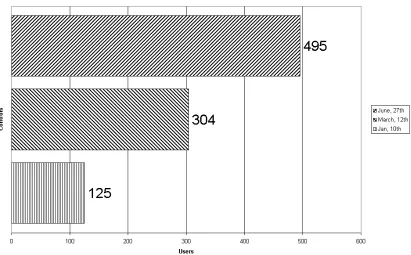
Along this case study we also show that it was multiplied by six the amount of actions taken by users and by four the amount of registered users. This paper provides a full detailed report on all the process and about the reading of the results that support the initial hypothesis. Supplementary, and in order to focus the topic of research and our approach, we also describe the theoretical background underneath the case study and a specific summary of the current panorama on virtual communities about IMS LD.
KEYWORDS
Virtual community, face-to-face meeting, IMS Learning Design, learning network
•INTRODUCTION. DEFINITION AND FEATURES OF A VIRTUAL COMMUNITY
Community, made an analysis and further description of the factors and features that describe a community of non-face-to-face users.
Although in 1993 the World Wide Web was not invented yet, it was born in 1996 by Tim Berners-Lee (Berners-Lee, 2001), there were so far some services and resources living in Internet, like emailing lists, online chats, peer-to-peer communications or postings. All these facilities were the core of Internet and they will be the base for later virtual communities.
We also could consider the term virtual community as a qualification or extension of another term, community of practice, first pointed out in 1991 by Jean Lave y Etienne Wenger (Lave and Wenger, 1991) with the meaning of a group of people met around a topic of common interest to share ideas and find solutions. Certainly, in the current virtual communities there is no urgent need for the second goal, find solutions, although people want to interchange their knowledge while discussing certain topics and using facilities and resources.
Additionally, the main features of a virtual community are: a) a member of it feels himself as a part of a wider social statement, b) there is a network of relationships between its users, c) there is a continuous interchange of ideas and contents full of meaning for their users, and d) the relationships between the members of the community keep along the time, building set of interlaced stories (Figallo, 1998; Kwoch and Schwier, 1997). Also, for Hagel and Armstrong (1997) there is a set of drives to create and feed the community, like a) a common objective or interest together with other people, b) the willing to share a personal experience or background or to establish social relationships, c) the willing of enjoying some rewarding new experiences or of living a fantasy, and d) the need of making any kind of transaction.
It’s true that Internet is not needed at all to build and create virtual communities. For instance, we can take the well-known case of the scientist Robert Boyle, in XVII century, who built something called the invisible colleges (Spratt, 2003). This group of people was formed by several prominent scientist around England and old Europe and share common goals to increase and spread the benefits of the Science, looking for answers to questions that Religion couldn’t provide. Later, in 1660, this group founded a legal association that would become the Royal British Society, usually considered as the oldest scientific society in the World. In these invisible colleges their members devoted to Science as a new
philosophy and established contacts and relationships, using mail and periodical face-to-face clandestine meetings. They used these meetings to discuss theoretical and practical hot topics on Science and to make the links between them