Garnet (Almandine-Spessartine) Growth Zoning and Its
Application to Constrain Metamorphic History
in Dehsalm Complex, Iran
F. Masoudi,
*B. Mehrabi, and Sh. Mahmoudi
Department of Geology, Tarbiat Moallem University, Tehran, Islamic Republic of Iran
Abstract
Dehsalm Metamorphic Complex located in east of Iran consists of regionally
metamorphosed rocks intruded by three phases of granitic masses. Synkinematic
porphyroblasts of garnet from staurolite-garnet schist present well preserved
growth zoning. Electron microprobe analysis of selected garnets was carried out
to interpret the origin and pattern of zoning in amphibolite facies garnets and its
implication on tectonic history of the Dehsalm Metamorphic Complex.
Qualitative and quantitative X-ray maps and rim-to-core profiles for Mn, Mg, and
Fe reveal concentric zoning with a well-preserved rim in garnet grains. Gradual
decrease in Mn and increase in Fe and Mg from the core to the rim of the garnet
porphyroblasts are indicative of continuous growth zoning and absence of
retrograde diffusion in garnet. Distributions of Mg, Fe and Mn are concentric in
garnet grains, while X-ray map for Ca shows non concentric zoning with spherical
and fan type distribution from core to rim. Concentration of Ca is not controlled
by cracks and it more likely associated with the regions of crystal weakness. Field
observation and absence of zoning in contemporaneous staurolite next to zoned
garnet suggest that prograde metamorphism occurred at a widely spaced isograds.
The presence of fine concentric growth zoning in garnet porphyroblasts indicates
that staurolite-garnet schist was formed under amphibolite facies condition and
prior to their homogenization in higher amphibolite facies. The well-preserved
garnet growth zoning is a sign that staurolite-garnet schists were rapidly cooled
and later metamorphic phases had no effect on regional metamorphic schists in
south west of the region.
Keywords: Garnet (almandine-spessartine); Growth zoning; Amphibolite facies; Dehsalm
Metamorphic Complex; Iran
*E-mail: masoudi@saba.tmu.ac.ir Introduction
Chemical zoning of garnet has been extensively studied to provide quantitative descriptions of igneous and metamorphic systems in both equilibrium and non equilibrium conditions. The study of zoning in
garnet crystals. For instance growth zoning in garnet especially in green schist and amphibolite facies is one of the controversial discussion issues in metamorphic petrology, since the distribution of the elements in solid solutions present among the garnet end members such as almandine, spessartine and grossular is a leading map which records P-T variations in prograde metamorphism
[26,27]. Another good example is the application of zoning to estimate cooling rates during retrograde diffusion [5]. Distribution of elements such as Mn, Fe, Mg and Ca in garnet porphyroblasts mainly depends on metamorphic grade, heating and cooling rates, the nature of metamorphic fluids and the chemistry of protolite.
The effect of each factor has been investigated, but still the unusual behavior of some elements like Ca in amphibolite facies or higher metamorphic grades is not well known. Most of the observed zoning in garnet grains formed during complex history, and consequently it is difficult to recognize the effects of the individual factors. For instance, growth zoning in garnet is usually disturbed by diffusion during cooling and retrograde metamorphism.
Multi phase metamorphism has been reported in Dehsalm Metamorphic Complex (DMC) in east of Iran [18]. However, synkinematic porphyroblasts of garnet from regional metamorphic schists present well preserved zoning, and garnet zoning in staurolite-garnet schists from DMC allows us to interpret origin and pattern of zoning in amphibolite facies garnets as well as examining tectonic history of DMC. In the present research electron microprobe analysis of selected staurolite and garnet porphyroblasts were carried out and distributions of elements in garnet from the rim to the core were examined. X-ray maps of selected elements were considered to characterize detailed compositional variation patterns in synkinematic porphyroblasts of garnet.
Geological Setting
In eastern rim of Lut Zone in Iran, close to Deh Salm village, polymetamorphic rocks, granitic intrusions and pegmatite veins of DMC with complicated tectonic history is outcropped. DMC is located between 31° 13′ and 31° 32′ latitudes and 59° 23′ to 59° 40′ eastern longitudes in the southeast of South Khorasan province and 60 km west of Nehbandan city. Metamorphic rocks consist of slate and phyllite, andalusite schist, andalusite-garnet schist, sillimanite schist, staurolite-garnet schist, amphibolites, marble, metasandstone and hornfelses. General trend of DMC is NW following tectonic trends of Eastern Iran. Staurolite-garnet schist
occurred in the southwest of Complex (Fig. 1). Mineralogical and chemical aspects of plutonic and metamorphic rocks had been described by Reyer & Mohaffez [22], Sahandi and Mohajel [24], Mahmoudi [18] and Masoudi et al. [19].
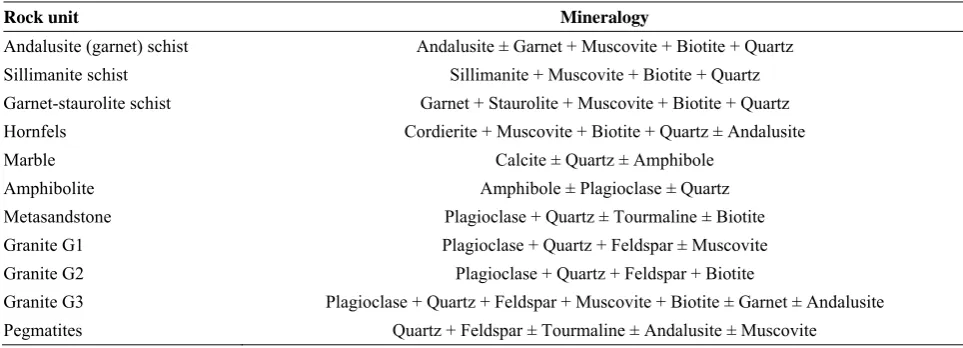
According to petrography and petrology, geographic distribution, topography and shape, granitic intrusions of DMC can be classified into three phase. G1 granite is located in the west of complex, and contains granites with low topography and strong degree of alteration. G2, Shah Kuh, granite outcropped in the north with a significant aureole of pyroxene hornfels facies at its peak. G3 is composed of small and stretched bodies of sheeted granites intruded parallel to metamorphic schistosity in andalusite and sillimanite schists of high temperature zones, followed by pegmatites in the form of veins and simple elongate bodies. Mineralogy of main units of DMC is summarized in Table 1.
Metamorphic Events
DMC experienced a complicated metamorphic and tectonic history. Field, microscopic and structural studies showed three suite of metamorphic rocks; regional metamorphic rocks, high temperature metamor-phic rocks and contact metamormetamor-phic rocks.
Regional Metamorphism
Regional metamorphism of flysch type sediments of Triassic and older age [22], with metapelitic nature, composed of phyllite, mica schist and staurolite-garnet schist intercalated with crystalline limestone and meta-sandstone. The regionally metamorphic rocks are mainly located in the western part of the complex with limited outcrops. Metamorphic grade increases from slate in the north to staurolite-garnet schist in the south, with following metamorphic zones.
Chlorite Zone
Slate and phyllite are representative rocks of this zone. Main minerals are chlorite + quartz + phengitic muscovite + albite + calcite and also carbon traces are perceived in this zone.
Biotite Zone
This zone isrecognized by biotite appearances in the metapelites. Biotite zone contains biotite + chlorite + muscovite + quartz + albite + calcite assemblage.
Garnet Zone
Figure 1. Geological map of the Dehsalm Metamorphic Complex. Circles showing location of samples (modified after Sahandi, [23]).
Its mineralogy is different from mica schists of biotite zones but strong schistosity is still observed. This zone is recognized by garnet + biotite + muscovite + quartz ± albite assemblage. Garnet euhedral crystals are uniform in size and distribution.
Staurolite Zone
This zone is characterized by staurolite isograd, exposed in the south-west of the DMC (Chah Abdollahi region) with low topography. Staurolite zone is recognized by staurolite schists and staurolite-garnet schists composed of staurolite + biotite + muscovite + quartz ± garnet assemblage and represents the highest metamorphic grade in the area.
Thermal Metamorphism
High temperature low pressure metamorphic rocks consist of metapelites and a set of rocks including marbles, metasandstones and amphibole schists (Fig. 1). Metapelites with average width of 2 km and at least 15 km length composed of andalusite (garnet) schists, andalusite-sillimanite schists and sillimanite schists. Metamorphic grade increases from west to east and it has gone up to the extent of secondary sillimanite zone. Pegmatites and G3 type granite are intruded parallel to schistosity of schists. The existence of pegmatites resulting from melting, expresses temperature increase,
up to granite melting curve in fluid presence condition [20]. From west to east, the following metamorphic zones are present in the metapelites.
Zone I (Andalusite)
Considering a west-east traverse, slates and phyllites of regional metamorphic rocks gives their way to andalusite schist. In outcrop, at the outer margin of Zone I, andalusite crystals are relatively small (up to 1 cm in length) and sub-hedral. However, in specimens from further within Zone I, andalusites occur more conspicuously in prismatic forms up to 6 cm in length with chiastolite texture. In the southern part of the area, the contact of regional grade schists and andalusite schists is covered by quaternary alluvium. This zone refers to assemblages containing andalusite + biotite + muscovite + quartz + plagioclase with minor garnet in some samples.
Zone II (Sillimanite)
Zone II is distinguished from andalusite zone by the appearance of fibrous sillimanite, with andalusite + sillimanite + biotite + muscovite + quartz ± plagioclase ± garnet assemblage. Sillimanite in the form of fibrous sprays formed directly from the reaction of matrix, though evidence for the direct replacement of andalusite to sillimanite is observed.
Zone III (Sillimanite + K-Feldspar)
Development of sillimanite crystals coincides with the appearance of K-feldspar in Zone III. Sillimanite becomes more abundant (up to 15%). Pelites have lost their primary muscovite, and andalusite is replaced with sillimanite, giving the quartz-bearing assemblage of biotite + quartz + sillimanite + K-feldspar.
Contact Metamorphism
Contact metamorphism occurred around G1 and G2 granites and produced skarn and hornfels, respectively.
G1 Granites Contact Metamorphism
In the east of DMC, G1 granite intruded in metasand-stones with intercalation of marble. Recrystallisation of quartz and tourmaline can be observed in metasand-stone. However, contact metamorphism of marbles resulted in skarn formation, with following assemblages:
diopside + grossularite + wollastonite + calcite diopside + anorthite + quartz + calcite
Table 1. Mineralogy of main rock units in Dehsalm Metamorphic Complex
Rock unit Mineralogy
Andalusite (garnet) schist Andalusite ± Garnet + Muscovite + Biotite + Quartz Sillimanite schist Sillimanite + Muscovite + Biotite + Quartz Garnet-staurolite schist Garnet + Staurolite + Muscovite + Biotite + Quartz Hornfels Cordierite + Muscovite + Biotite + Quartz ± Andalusite
Marble Calcite ± Quartz ± Amphibole
Amphibolite Amphibole ± Plagioclase ± Quartz
Metasandstone Plagioclase + Quartz ± Tourmaline ± Biotite
Granite G1 Plagioclase + Quartz + Feldspar ± Muscovite
Granite G2 Plagioclase + Quartz + Feldspar + Biotite
Granite G3 Plagioclase + Quartz + Feldspar + Muscovite + Biotite ± Garnet ± Andalusite Pegmatites Quartz + Feldspar ± Tourmaline ± Andalusite ± Muscovite
G2 Granites Contact Metamorphism
Shah Kuh granite (G2) intruded before Cretaceous in the north of the complex and creates a significant aureole in pelitic rocks. Contact metamorphism characterized by toughening of the schists and phyllites into true cordierite hornfels. In contact zone, cordierite + biotite + quartz + muscovite assemblage is identified. In general, mineral assemblage is rather uniform throughout the innermost aureole. However, in some specimens chlorite is present.
Sample Description
Zoned garnets in staurolite-garnet schists were examined in order to investigate the peak of regional metamorphism in the DMC. In hand specimen, samples mainly contain staurolite, garnet and mica in a fine-grained matrix. Garnet crystals are uniform in size and distribution. The zoned garnets have euhedral crystal face on some sides, with diameters between 1 and 3 mm. Desert type weathering and strong winds in the area resulted in small garnet placer deposits (with grade of up to 9% garnet). Garnet is red to brownish red, and crystals in staurolite-garnet schists have lighter colors than those in garnet schist. In thin section, staurolite-garnet schists show quartz (up to 5%), staurolite-garnet (up to 3%), staurolite (<4%), and biotite (<3%) in a very fine-grained matrix.
Pressure shadow is observed around garnet crystals, provided suitable space for growing mica. Garnet and staurolite porphyroblasts are synkinematic and mica rinds around them. Garnet grains are notably poor in inclusions; however, sometimes they contain cracks. In some cases, garnet crystals are observed along with staurolite (sample DMC1). Garnet schists without
staurolite contain chlorite with garnet + biotite + muscovite + quartz + chlorite assemblages but where staurolite is present; assemblage is staurolite + garnet + biotite + muscovite + quartz.
Analytical Method and Results
Two samples were chosen from staurolite-garnet schists (DMC1 & DMC2) and initially examined optically. Electron microprobe analysis of garnets was carried out at the Paris University, using a Cameca SX-2302 EPMA. For garnet porphyroblast in sample DMC1, major element profiles were acquired at operating conditions of 15 kV accelerating voltage and 10 nA beam current. Along a linear traverse from core to rim of the crystal, 11 analyses with the equal interval were obtained for Mn, Fe, Mg, Al, Ca, and Ti. The core to rim results are summarized in Table 2. All iron was assumed to be Fe2+ on recalculation.
X-ray qualitative and quantitative compositional maps for both garnet and staurolite porphyroblasts from sample DMC1 were produced for Ca, Fe, Mg, Mn, Ti, Si and Al. X-ray qualitative maps also were made for Mn, Fe, Mg and Al for garnet grain from sample DMC2. X-ray maps were made by analyzing small contiguous areas of garnet crystal and then assembling images into a mosaic image.
Results and Discussion
Pattern of Zoning
Table 2. Quantitative core to rim results of EMPA analyses along traverse marked by white line on Figure 4
Analysed point Distance from core (µm) Element (Wt%)
Mg Fe Al Ca Mn Ti
1 (core) 0 0.79 18.4 15 9.5 9.1 0.15
2 80 0.8 19 15 10 8.8 0.17
3 160 0.9 20 15 7.6 8.5 0.18
4 240 1.0 20 14 7.3 8.0 0.22
5 320 1.0 20 13 7.8 7.5 0.16
6 400 1.1 21 11 8.0 7.4 0.17
7 480 1.1 22 12 9.0 6.9 0.16
8 560 1.2 23 10 9.8 6.4 0.15
9 640 1.3 24 12 7.5 5.1 0.16
10 720 1.5 25 11 6.1 3.9 0.14
11 (rim) 800 1.9 25.5 12 5.0 2.6 0.13
Figure 2. Major element profiles of core to rim of 11 points
analysis along linear traverse with equal interval in garnet from DMC1 sample.
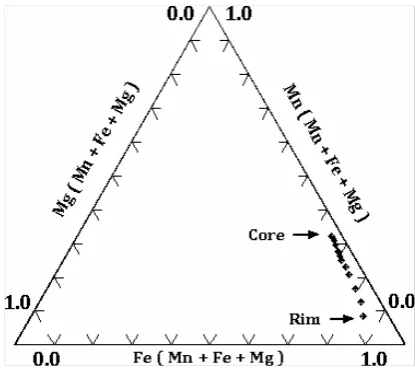
Figure 3. Linear trends in core to rim chemical composition
of garnet on Mn-Mg-Fe ternary diagram.
rim while Mn and Ca have been decreased. Ca shows unusual changes from the core towards the rim and Ti has little changes from the core to the rim (Fig. 2). The trend which lowers Mn from core to rim is accompanied by decrease in the ratio Fe/Mg from 23.29 in the core to 13.42 in the rim. Mn, Mg and Fe ternary diagram (Fig. 3) shows linear chemical changes from the core to the rim for analyzed garnet (Sample MDC1).
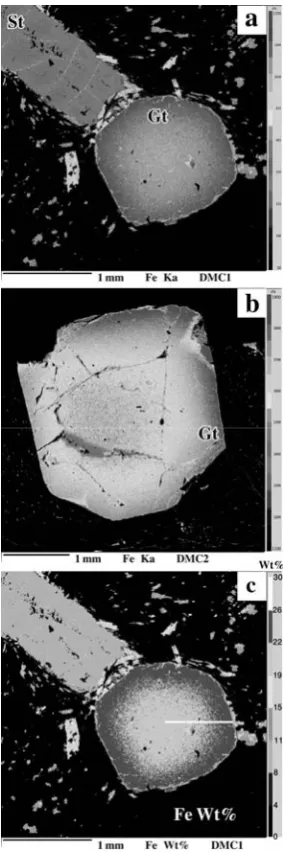
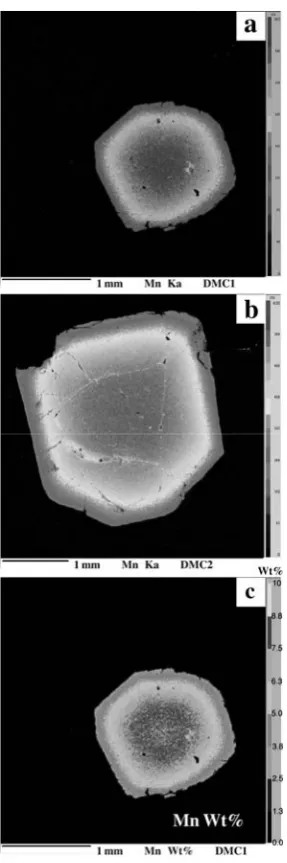
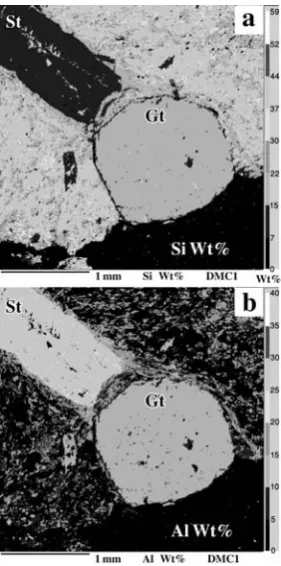
Qualitative and quantitative X-ray maps for Mg, Fe and Mn reveal well concentric patterns in both studied garnets (Figs. 4-6) with increase of Mg and Fe from core to rim, while Mn show the opposite trend (Fig. 6). Ca X-ray map shows decrease from core to rim with some fan-shaped distribution (Fig. 7). There is no detectable Ti, Si and Al zoning (Figs. 8 & 9).
X-ray composition maps of measured elements for both garnet crystals reveal the same pattern as concluded from measured profile for garnet in sample DMC1 (Fig. 2). Staurolite is not zoned based on Mg, Fe, Mn, Ca, Si and Al X-ray maps (Figs. 4-7 & 9) while Ti show sector zoning in sample DMC1 (Fig. 8). Quantitative analysis of Ti from different zones of 3 staurolite porphyroblasts in sample DMC1, indicate that Ti generally varies between 0.22 to 0.34 wt%.
Origin of Zoning in Garnet
Figure 4. EMPA Mg X-ray maps of garnet and staurolite porphyroblasts in samples DMC1 and DMC2. Qualitative X-ray maps (a & b) illustrate concentric distributions for Mg in both garnets (DMC1 and DMC2). Quantitative analyses of Mg (c) show gradual increase of Mg from core to rim. However, staurolite is not zoned for Mg. Location of selected microprobe traverse is marked by white line.
homogeneous or weakly zoned core of garnet gives way to pronounced zoning in Fe, Mg and Mn near the rim, and the sense of zoning of Mg and Mn is the reverse of that in growth zoning [9,10,28].
X-ray compositional maps and rim-to-core profiles for Mn, Mg, and Fe were determined by EPMA reveal nice concentric zoning with a well-preserved rim for studied garnet grains. Gradual decrease in Mn and
Figure 5. Qualitative (a & b) and quantitative (c) EMPA
X-ray compositional maps of Fe in garnet and staurolite porphyroblasts. Fe concentrations rise outward from the core and reach at a maximum at the rim in garnet.
Figure 6. EMPA Mn X-ray maps in garnet porphyroblasts. Qualitative (a & b) and quantitative (c) concentrations of Mn follow the same pattern observed in normal growth zoning of garnet crystals.
without the presence of significant retrograde diffusion. Carlson [4] reviewed evidences in metamorphic rocks for partial chemical disequilibrium and suggested that even though Fe and Mg might equilibrate at cm scale under lower-greenschist-facies conditions, Mn might not equilibrate at that scale until upper-greenschist-facies conditions were reached, Ca and some trivalent cations might not equilibrate until the middle amphibolite facies. Patterns of zoning in studied garnets are in line with such a suggestion. In DMC, Ca
Figure 7. Qualitative (a & b) and quantitative (c) EMPA Ca
X-ray maps of garnet crystal in sample DMC1. Ca distribution is not concentric and Ca-enrichment follows a radial pattern. Note, however, that quantitative Ca X-ray map (c) shows decrease from core to rim with some fan-shaped distribution.
in garnets from amphibolite facies staurolite-garnet schists, failed to equilibrate beyond mm-size length-scales as noted previously [4,21]. Distribution of Ca on Ca X-ray maps (Fig. 7) reveal that Ca distribution is not concentric, however, it is not accidental too, and it may be concluded that Ca-enrichment follows a radial pattern.
Hwang et al. [16], by study of almandine garnet from
Figure 8. Quantitative (a & c) and qualitative (b) EMPA Ti X-ray maps of garnet and staurolite crystals in sample DMC1. Garnet is not zoned for Ti. However, Ti concentrations illustrate sector zoning in staurolite. Zoning is more obvious in picture (a) and lower concentrations are brighter.
behavior, beyond the far end of microcracks, interface diffusion, rather than viscous flow in continuous fluid of considerable thickness, must play an important role in corrugating the interface. They proposed that Ca-enrichment is connected to fluid-infiltrated and/or chloritization of open crack within the garnet grains.
In the present case, Ca does not equilibrate at the millimeter-scale for garnet either. In fact, they have fixed values at the margin next to the garnet interface, irrespective of which mineral is in contact with garnet across the zone in amphibolite facies schists as noted previously by Hams & Menard [11] and Whitney et al.
[30]. Nevertheless, based on X-ray composition map for Ca, concentration of this element is not controlled by
cracks, and it is more likely coincident with the regions of crystal weakness.
Application and Implication of Zoning on Tectonic History of DMC
Garnet Zoning
Well-preserved growth zoning in the garnet is not very common in higher amphibolite facies rocks. In prograde metamorphism, garnets will begin to homogenize above 600°C, depending on the duration of high temperature conditions and the grain size [25]. Therefore, the presence of nice concentric growth zoning in studied garnet porphyroblasts indicates that staurolite-garnet schists are formed before higher amphibolite facies and under amphibolite facies condition. Absence of Al2SiO5 (sillimanite or andalusite) in the studied rocks add corroborative on this conclusion.
On the other hand, very slow cooling of a rock, after crystallization of final mineral assemblages, may allow significant diffusion to occur. In the literature, a cooling rate of 1-10°C/Ma is estimated for such a slow cooling and formation of retrograde diffusion in garnet grains [9,28]. Therefore, complete preservation of garnet growth zoning even in the rim in the studied samples reveals rapid cooling soon after peak metamorphism with the cooling rate of higher than introduced for slow cooling rate. Such a rapid cooling could be observed during rapid uplift and unroofing of the metamorphic terrains.
The presence of well and untouched garnet zoning and lack of subsequent diffusional modification implies that no later metamorphic events affected the staurolite-garnet schists.
Staurolite Zoning
Hollister [15] presented several models for the development of sector zoning and concluded that sector zoning in all elements is preserved in contact metamorphic staurolite, that only Ti is sector zoned in staurolite from regional metamorphic terrains with closely spaced isograds, and no sector zoning is observed in regional metamorphic terrains with widely spaced isograds. Furthermore, as discussed by Tracy [28], it is possible that many staurolites in regional terrains were originally zoned, but the slow cooling after peak of metamorphism allowed volume diffusion to operate and homogenize the crystals.
Figure 9. Quantitative EMPA Si (a) and Al (b) X-ray maps of garnet and staurolite crystals in sample DMC1. There is no detectable Al and Si zoning in garnet and staroulite.
DMC have formed during regional metamorphism with closely spaced isograds. Distribution of regional metamorphic rocks in the SW of the complex from slate to mica schists and staurolite-garnet schists in the short distance (Fig. 1) could be an evidence for the presence of such closely spaced isograds during prograde regional metamorphism in DMC. Furthermore, based on well developed growth zoning in garnets close to unzoned staurolite in sample DMC1 (Figs. 4-9), there is no evidence for retrograde diffusion and it could be concluded that staurolites were formed unzoned in the first place during regional metamorphism.
Concluding Remarks
The present study demonstrates that zoning in synkinematic porphyroblasts of garnet from staurolite-garnet schists in DMC has been formed by mineral growth during prograde regional metamorphism. Complete zoning in garnet provides information about zoning growth in amphibolite facies rocks and tectonic history of metamorphism. Distributions of Mg, Fe and Mn are concentric in garnet grains and Mg and Fe increase outwards, while Mn decreases from the core to
the rim. However, X-ray maps for Ca show non concentric zoning with spherical and fan type distribution from core to rim.
Field observation and presence of only Ti zoning in staurolite indicate that prograde metamorphism occurred at the closely spaced isograds condition. The well-preserved garnet growth zoning indicates that staurolite-garnet schists were rapidly cooled and later metamorphic phases were not influenced regional metamorphic schists in southwest of the region.
Acknowledgements
This work has been supported by research funds from Research Deputy at Tarbiat Moallem University.
References
1. Atherton M.P. and Edmunds W.M. An electron microprobe study of some zoned garnets from metamorphic rocks. Earth Planet. Sci. Lett., 1: 185-193 (1966).
2. Azomov P.A. and Shlukenberg A.G. Numerical modeling of the growth zoning in metamorphic garnets. Can. Mineral., 9: 132-145 (1995).
3. Banno S. Notes on rock forming minerals, zonal structure of pyralspite in Sanbagawa schists in the Bessi area, Shikoku. J. Geol. Soc. Japan, 71: 185-188 (1965). 4. Carlson W.D. Scales of disequilibrium and rates of
equilibrium during metamorphism. Am. Mineral., 87: 185-204 (2002).
5. Chen N.S., Sun M., You Z.D., and Malpas J. Well-preserved garnet growth zoning in granulite from the Dabie Mountains, central China. J. Metamorphic Geol., 16: 213-222 (1988).
6. Chernoff C.B. and Carloson W.D. Disequilibrium for Ca during growth of politic garnet. J. Metamorph. Geol., 15: 421-435 (1977).
7. Chinner G.A. Almandine in thermal aureoles. J. Petrol., 3: 316-340 (1962).
8. Debethune P., Goossens P., and Berger P. Emploi des grenats zonaires comme indicoteure du ourse de metamorphisme. C.R. Acad. Sci. Paris, 260: 6940-6949 (1965).
9. Fernando G.W.A.R., Hauzenberger C.A., Baumgartner L. P., and Hofmeister W. Modeling of retrograde diffusion zoning in garnet: evidence for slow cooling of granulites from the Highland Complex of Sir Lanka. Mineral. and Petrol., 78: 53-71 (2003).
10. Grant J.A. and Weiblen P.W. Retrograde zoning in garnet near the end sillimanite isograde. Am. J. Sci., 270: 281-296 (1971).
11. Hams W.E. and Menard T. Fluid-assisted modification of garnet composition along rims, cracks and mineral inclusion boundaries in sample of amphibolite facies schists. Am. Mineral., 78: 338-344 (1993).
rocks. Nature, 210: 689 (1966).
13. Hollister L.S. Garnet zoning; An interpretation based on the Rayleigh fractionation model. Science, 154: 1647-1651 (1966).
14. Hollister L.S. Contact metamorphism in the Kwoiek area of British Columbia; An end-member of the metamorphic process. Geol. Soc. Am. Bull., 80: 2464-2494 (1969). 15. Hollister L.S. Origin, mechanism, and consequences of
compositional sector zoning in staurolite. Am. Mineral 55: 742-766 (1970).
16. Hwang S.L., Shen P., Yui T.F., and Chu H.T. On the mechanism of resorption zoning in metamorphic garnet. J. Metamorph. Geol., 21: 761-769 (2003).
17. Inui M. and Toriumi M. A theoretical study on the formation of growth zoning in garnet consuming chlorite. J. Petrol., 45: 1369-1392 (2004).
18. Mahmoudi Sh. Investigation of economic minerals and petrology of Dehsalm complex W of Iran. M.Sc. Theses, Tarbieat Moalem University, Tehran, Iran (2003). 19. Masoudi F., Mehrabi B., and Mahmoudi Sh. Magmatic
andalusite and its application on granitic intrusion thermobaromery in Dehsalm Complex, W of Iran. 21st Annual Meeting of Earth Sciences, Geological Survey of Iran, Tehran, Iran (2003a).
20. Masoudi F., Mehrabi B., and Mahmoudi Sh. Geneses of pegmatites in DehSalm Complex, W of Iran. 6th Annual Meeting of Geological Society of Iran, Tehran, Iran (2003b).
21. Meth Ch.E. and Carlson W.D. Diffusion-Controlled synkinematic growth of garnet from a heterogenous precursor at Passo Del Sole, Switzerland. Can. Mineral., 43: 147-182 (2005).
22. Reyer D. and Mohaffez S. A first contribution of the
NIOC-ERAP agreements to the knowledge of Iranian geology. Edition Techni. Paris, 58 p. (1972).
23. Sahandi M. Geological map of Dehsalm, 1/250000 scale. Geological survey of Iran (1992).
24. Sahandi M. and Mohajel M. Study of metamorphic rocks in the region east of Dehsalm (central Lot) and investigation of time relation between metamorphic and magmatic events. Geological Survey of Iran, Internal report (1984).
25. Spear F.S. On the interpretation of peak metamorphic temperatures in light of garnet diffusion during cooling. J. Metamorph. Geol., 9: 379-388 (1991).
26. Spear F.S., Selverstone J., Hickmott D., Crowley P., and Hodges K.V. P-T paths from garnet zoning: a new technique for deciphering tectonic processes in crystalline terranes. Geology, 12: 87-90 (1984).
27. Spear F.S. and Peacocok S.M. Metamorphic Pressure-Temperature-Time Paths. Short Course in Geology 7. American Geophysical Union, Washington, D.C. (1989). 28. Tracy R.J. Compositional zoning and inclusions in
metamorphic minerals. Reviews in Mineralogy, Vol. 10, Chapter 9 (1986).
29. Tuccillo M.E., Essene E.J., and Van Der Pluijm B.A. Growth and retrograde zoning in garnets from high grade metapelites: implication for pressure-temperature paths. Geology, 18: 839-842 (1990).
30. Whitney D.L., Mechum T.A., Dilek Y., and Kuehner S.M. Modification of garnet by fluid infiltration during regional metamorphism in garnet through sillimanite-zone rocks, Dutchess County, New York. Am. Mineral., 81: 696-705 (1996).
![Figure 1. Geological map of the Dehsalm Metamorphic Complex. Circles showing location of samples (modified after Sahandi, [23])](https://thumb-us.123doks.com/thumbv2/123dok_us/193104.2013366/3.595.55.285.96.324/geological-dehsalm-metamorphic-complex-circles-location-modified-sahandi.webp)