belief model on psychological factors of AIDS
preventive behaviors in addicts
Fateme Bastami1, Naser Sharafkhani2, Katayoun Bakhteyar3,
Mohmmad Heydari4, Akbar Hassanzadeh5, Firoozeh Mostafavi1
Abstract
AIDS is a problem threatening public health throughout the world, especially developing countries. Injecting drug users are most at risk of HIV infection and account for 68.15% of all suffering cases in Iran. This study investigated the effect of health intervention on the AIDS preventive behaviors among addicts based on HBM. This was a quasi-experimental research with pretest-posttest design. The study sample comprised 88 randomly selected male addicts being kept at rehabilitation centers in Khorramabad, Iran. The participants were randomly assigned to intervention and control groups. Data were collected through questionnaire designed to assess health belief model structures as well as knowledge, and behavior domains. The educational content was designed, edited, and executed after the analysis of pretest results. The intervention group received 3 sessions each of 90 minutes. Two months after the intervention, the posttest was performed using the same questionnaire. The results showed that mean
scores of perceived benefits, self-efficacy, susceptibility, severity, knowledge, and preventive behaviors significantly increased in
the intervention group after the intervention while the mean score
of perceived barriers significantly decreased. Based on the results
of this study, of this survey, it can be concluded that an increase in the score of health belief model structures including perceived
susceptibility, perceived severity, and perceived benefits could
result in adopting preventive behaviors against AIDS. Therefore,
this survey confirms the efficacy of health belief model in
adopting AIDS preventive practices among addicts.
Keywords: Addicts, AIDS, Drug Users, health belief model Journal of Research & Health
Social Development & Health Promotion Research Center
Vol. 7, No. 6, Nov & Dec 2017 Pages: 1120- 1129 DOI: 10.18869/acadpub.jrh.7.6.1120
Original Article
1. Department of Health Education and Promotion, Faculty of Health, Isfahan University of Medical Sciences, Isfahan, Iran 2. Department of Health Education and Promotion, Faculty of Health, Arak University of Medical Sciences, Arak, Iran
3. Department of Public Health, Faculty of Health and Nutrition, Lorestan University of Medical Sciences, Khorramabad, Iran 4. Department of Health Education, Health Care Center, Lorestan University of Medical Sciences, Lorestan, Iran
5. Department of Biostatistics, Faculty of Health, Isfahan University of Medical Sciences, Isfahan, Iran
Correspondence to: Firoozeh Mostafavi, Department of Health Education and Promotion, Faculty of Health, Isfahan University of Medical Sciences, Isfahan, Iran
Email: [email protected]
Received: 25 Jan 2016 Accepted: 1 Jun 2016
How to cite this article: Bastami F, Sharafkhani N, Bakhteyar K, Heydari M, Hassanzadeh A, Mostafavi F. Effect of educational intervention based on health belief model on psychological factors of AIDS preventive behaviors in addicts. J Research & Health2017; 7(6): 1120- 1129.
Introduction
The HIV is one of the most lethal viruses discovered in the modern age. Due to high mortality rate and excessive costs, HIV/AIDS
(Human Immunodeficiency Virus/ Acquired Immune Deficiency Syndrome) is as a serious health and financial concern all across the
world. AIDS has turned into an epidemic
has reduced and drug abuse is rapidly on the rise. It is unfortunate that most addicts are not aware that they are infected with HIV [1,2]. According to the Ministry of Health and Medical Education by 2013 in sum 27,041 people were infected by HIV in Iran. According to the report, 89.3% of infected cases were men and 10.7% women. 45.9% of patients with AIDS were between 25 and 34 which comprised the highest proportion among the age groups. Among all cases of HIV positive, 68.15% were infected by sequencing intravenous drug abuse, 12.66% by sexual intercourse, 0.9% by blood and blood products, 1.22% by mother to child (1.22%), and 17.05% by unknown sources. Hence, the majority of HIV infected cases in Iran are drug users (or IDUs) [3].
HIV infection is more prevalent among drug users. Drug addicts are at risk for the infection because of addiction for them is combined with issues such as poverty, illiteracy, unemployment, and homelessness. According to a report by the World Health Organization (WHO), the number of countries that report HIV infection has been rising, especially for developing countries. Injection drug use-related HIV transmission accounts for 5–10% of HIV cases in the world, 36% in the USA and more than 60% in Iran [4,5].
Studies have shown that IDUs are able to change their behaviors in a manner to protect themselves and others from HIV infection, and this point is very important to researchers who are studying
in this field. According to the WHO, the only
effective way in dealing with the issue of AIDS is health education where vulnerable groups should be prioritized. The emerging HIV epidemic in Iran is serious and with no doubt it will have a huge negative impact on the economic, social, and political aspects of the country. Thus, efforts to confront this epidemic in Iran are a national priority and urgent intervention strategies for at
risk groups specifically injecting drug users are
key to solve this problem [6].
The only way to combat AIDS alongside treatment and effective vaccines is health education and behavior change. Informing the society can be very effective in reducing HIV
infections. Designing and implementing an effective HIV prevention and control program based on reducing high-risk behaviors has turned into a major challenge for health workers and researchers all over the world [7,8]. The value of educational health programs is assessed based on their effectiveness and the effectiveness is highly dependent on the correct utilization of theories and models in health education. In other words, appropriate support theories in accordance with the major health needs can increase the effectiveness of educational health programs [9].
The effectiveness of the Health Belief Model (HBM), which was used as a theoretical framework in this study, has been proven in predicting AIDS preventive behaviors by different researchers. The HBM constructs have also proven to be effective in HIV/AIDS education programs as they help understand behaviors that prevent AIDS and drug abuse. The HBM is one of the oldest health behavior theories on which numerous researchers have
worked in different behavioral fields in order to
design and evaluate behavioral interventions. Moreover, the effectiveness of this model has been proven in the area of AIDS education in different internal and foreign researches. The HBM proposes that in order for an individual to take action to avoid a disease, the individual needs to believe that a) he/she is susceptible to the disease (perceived susceptibility); b) the disease could have at least a moderate to severe impact on some components of his or her life (perceived severity); c) certain behaviors could
be beneficial in reducing his or her perceived
susceptibility or severity in the event of
affliction with the disease (perceived benefits);
and d) these behaviors would not be impeded by factors such as cost, pain, and embarrassment (perceived barriers) [10,11].
Self–efficacy is a person’s belief in how
research has demonstrated that manipulation
of self–efficacy is an effective strategy for
reducing health risk behaviors [12].
HBM constructs have been applied as a guide for predicting health behaviors. Theoretical based interventions in several researches [9,13] have shown the predictive nature of the HBM. This research was carried out due to there have been a few educational intervention programs to lower high-risk behaviors in drug addicts based on HBM . The current research investigates the Effect of educational program based on HBM on the AIDS preventive behaviors among drug users in Khorramabad.
Method
A quasi-experimental research with pretest-posttest design was used to assess the effect of an educational intervention program on HIV/ AIDS preventive behaviors. The participant included 88 male addicts that were being kept at the rehabilitation centers in Khorramabad, Iran. The participants were selected from four different centers; a group of 44 from two centers were regarded as the intervention group and a group of 44 from the other two centers as the control group. Due to limitations in the sample size, the participants were selected through the census method. Hence, all of the addicts at the rehabilitation centers were the participant of the research. The inclusion criteria were: 1) being a full-time residence at the rehabilitation centers, 2) being admitted at least for 6 months, and 3) not receiving any educational program in regard to HIV/AIDS prevention. The exclusion criteria were unwillingness to continue with the study, failure to attend training sessions, and lack of favorable physical and psychological well-being in the participant.
At the rehabilitation centers, HIV prevention and related educational programs are not offered. Patients are monitored twenty four hours a day, seven days a week, by trained staffs. Apart from the participants who were
under treatment by caregivers, no specific drugs
were given to other patients. The researcher presented permission with lower case letter from Isfahan University of Medical Sciences
to the drug rehabilitation centers. At the
beginning of the study, sufficient information
regarding the aim of the study was given to the participants, and they were reassured that
their information will remain confidential.
Data gathering was undertaken by a questionnaire designed in nine sections including: 1) personal information (age, marital status, occupation, and so on); 2) 10 questions measuring the knowledge level about HIV/AIDS which were scored on either 0 or 1; the 0 score for a wrong answer
or “I don’t know” choice and the 1 score for
a correct answer; 3) 10 questions measuring
the perceived self-efficacy which scored on
a 4-point Likert scale ranging from “strongly
agree” to “strongly disagree”; 4) 8 questions
measuring the perceived benefits which
scored on a 4-point Likert scale ranging from
“strongly agree” to “strongly disagree “; 5) 7 questions measuring the perceived barriers which scored on a 4-point Likert scale ranging
from “strongly agree” to “strongly disagree”;
6) 6 questions measuring the perceived susceptibility which scored on a 4-point
Likert scale ranging from “strongly agree” to “strongly disagree”; 7) 8 questions measuring the perceived severity which scored on a 4-point Likert scale ranging from “strongly
agree” to “strongly disagree”; 8) 4 questions regarding the cues to action related to the practice answered with yes/no choices and 9) 6 yes/no questions related to the practice, which were scored 0 or 1.
The content validity of questionnaire was assessed by a panel of experts through evaluating the clarity of the wording of the statements and rating of the responses. The
panel consisted of 3 experts in the field of
health education and promotion, 2 in social preventive medicine, 1 in psychology, 1 in sociology, and 3 in infectious diseases.
In order to evaluate the scientific validity,
the questionnaire was given to professionals experienced in health education working at Isfahan University of Medical Sciences. As the
scientific reliability of the questionnaire was
used and the Cronbach’s alpha was calculated (Cronbach’s alpha= 0.76). The questionnaire
used in this research was previously employed by Karimi in a study entitled “The effect of health education based on HBM on preventive
behaviors of AIDS in addict in Zarandieh” [14].
After gathering pretest data, the results were analyzed and then, an educational program was designed. The educational content was aimed at acquainting drug addicts with AIDS, transmission ways and prevention, improving perceived susceptibility and severity, perceived
self-efficacy, benefits of and barriers to
the disease prevention. The educational sessions were held for groups of 10–12 at the rehabilitation center by means of speeches, face to face, question and answer, group discussion,
and displaying educational films. Each group
participated in 3 sessions each of 90 minutes. To sustain the educational program, pamphlets,
booklets, and educational films were distributed
to the treatment group. The control group received no education as a treatment. Since the participants were retained at the centers averagely for one month period, to complete
the data gathering process, the researcher was in contact with the participants by phone call. Therefore, 2 months after the educational intervention, the participants were invited back to the center through phone or personal visits to complete posttest questionnaires. The information from the participants was gathered through interviews (from illiterate or less literate persons) or as written (from the rest of participants). The data were analyzed using SPSS 20 software in descriptive (means, standard deviations, and ranges) and inferential statistical methods (paired t-tests, independent t-test, Chi-square, and Mac Nemar). Also, the Kolmogorov- Smirnov test showed that distribution of quantitative
variables had no significant difference
with normal distribution; in other words, quantitative variables followed a normal distribution (p>0.05).
Results
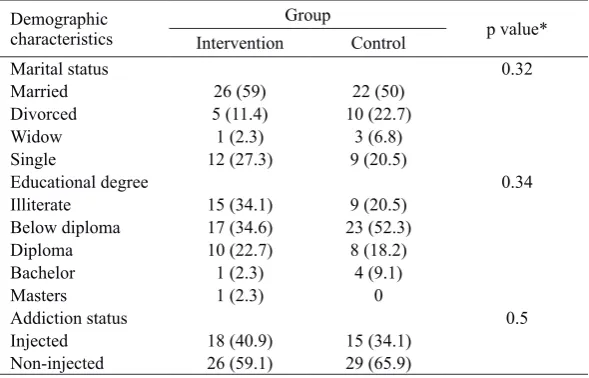
As can be seen in Table 1, the intervention and control groups did not differ with respect to demographic characteristics.
Table 1 Personal and basic information in the intervention and control groups Demographic
characteristics InterventionGroup Control p value*
Marital status 0.32
Married 26 (59) 22 (50)
Divorced 5 (11.4) 10 (22.7)
Widow 1 (2.3) 3 (6.8)
Single 12 (27.3) 9 (20.5)
Educational degree 0.34
Illiterate 15 (34.1) 9 (20.5)
Below diploma 17 (34.6) 23 (52.3)
Diploma 10 (22.7) 8 (18.2)
Bachelor 1 (2.3) 4 (9.1)
Masters 1 (2.3) 0
Addiction status 0.5
Injected 18 (40.9) 15 (34.1)
Non-injected 26 (59.1) 29 (65.9)
*Chi-square
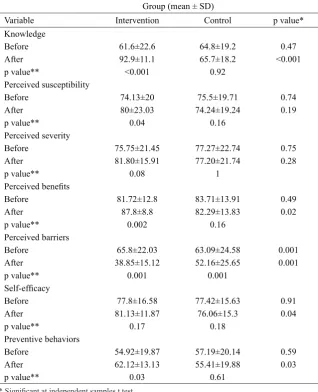
The results of Paired t-test showed that after the intervention, the mean scores of knowledge and performance regarding HIV/AIDS preventive behaviors, perceived susceptibility
and severity, perceived self-efficacy, perceived benefits and barriers significantly increased in the intervention group, while no significant
difference was observed in the control
group. The independent t-test showed that before the intervention, there was no
significant difference in the mean scores of
aforementioned variables between the groups, while after the intervention the mean scores of variables in the intervention group were
significantly higher than those of the control
Table 2 Mean scores of knowledge, health belief model constructs and performance before and after intervention in the two groups
Group (mean ± SD)
Variable Intervention Control p value*
Knowledge
Before 61.6±22.6 64.8±19.2 0.47
After 92.9±11.1 65.7±18.2 <0.001
p value** <0.001 0.92
Perceived susceptibility
Before 74.13±20 75.5±19.71 0.74
After 80±23.03 74.24±19.24 0.19
p value** 0.04 0.16
Perceived severity
Before 75.75±21.45 77.27±22.74 0.75
After 81.80±15.91 77.20±21.74 0.28
p value** 0.08 1
Perceived benefits
Before 81.72±12.8 83.71±13.91 0.49
After 87.8±8.8 82.29±13.83 0.02
p value** 0.002 0.16
Perceived barriers
Before 65.8±22.03 63.09±24.58 0.001
After 38.85±15.12 52.16±25.65 0.001
p value** 0.001 0.001
Self-efficacy
Before 77.8±16.58 77.42±15.63 0.91
After 81.13±11.87 76.06±15.3 0.04
p value** 0.17 0.18
Preventive behaviors
Before 54.92±19.87 57.19±20.14 0.59
After 62.12±13.13 55.41±19.88 0.03
p value** 0.03 0.61
* Significant at independent samples t test. ** Significant at paired samples t test.
Table 3 Cues to action about HIV/AIDS preventive behaviors before and after intervention in the two groups
Group
Cues to action Intervention Control p value*
Rehabilitation staff
Before 79.5 88.6 0.24
After 100 88.6 0.02
p Value** 0.004 1
Family members
Before 65.9 70.5 0.64
After 59.1 70.5 0.26
p Value** 0.62 1
Friends
Before 61.4 68.2 0.5
After 27.3 68.2 <0.001
p Value** 0.003 1
Mass media
Before 70.5 59.1 0.26
After 68.2 59.1 0.37
p value** 1 1
Table 3 shows cues to action about HIV/AIDS preventive behaviors before and after the intervention in the two groups.
Discussion
The results of this study demonstrated that after performing an intervention based on HBM on male drug addicts, –knowledge, perceived susceptibility and severity, and
perceived benefits increased in the addicts
while perceived barriers decreased, indicating an improvement in overall performance of drug addicts regarding HIV/AIDS. The knowledge levels of drug addicts in the intervention group before and after the intervention
showed a significant difference. This
change reveals the effects of the educational intervention by increasing the awareness of addicts. The results of this study showed that implementation of health education programs
had a significant effect on improving the
awareness and performance of participants under the subject of study regarding AIDS disease. These results are in agreement with the results of studies carried out by Melkote et al. [15], Siam on women [16], and Fogel et al. on incarcerated women [17]. These results inform the public about different modes of HIV transmission, preventive measures against it,
and how the transmission influences people
in order to make them to change dangerous and risky behaviors. Public awareness is effective in controlling the disease. In this study, the majority of drug users answered the questions on HIV/AIDS knowledge correctly. However, misinterpretation still exists in regard to transmission paths, which
is consistent with the findings of Eshrati study
that was conducted on prisoners. The study of Magnussen et al. [18] also showed only poor to moderate improvements in knowledge about HIV/AIDS, attitudes, negotiation and communication skills or behavior change. Hence, higher quality studies are required in this context.
The findings of this study indicate the need
for continuing educational programs on this high risk group. Also, it is effective to increase
awareness about HIV transmission and prevention methods which can encourage people to change risky behaviors in order
to reduce the spread of HIV. The findings
indicated that in the studied population, before the educational intervention, most individuals considered themselves to be at risk of AIDS. This was due to the fact that the study was conducted on drug users and the likelihood of risky behaviors such as sexual behavior and use of intravenous drugs was high in this group. Therefore, the perceived susceptibility construct both before and after the intervention in two groups was high. As a result, the mean score of perceived susceptibility went from 74.13% to 80% after the intervention which shows a
significant increase. However, in the control
group, perceived susceptibility mean score decreased from 75.5% to 74.24%. The results
of Ghaffari’s study showed a significant
increase in perceived susceptibility scores in the intervention group and a decrease in the control group [19].The results of studies by
Sharifirad and Aghamolaei indicated that
the mean score of perceived susceptibility increased solely in the intervention group
[20,21] that are consistent with the findings
of this research. This score in the Karimi study before the intervention was 4.43 that increased to 7.15 after the intervention [14].
Correct information can influence perceived
susceptibility. In fact, the increase in the mean score of the construct in the intervention group could be due to the intervention as the control group did not receive any intervention.
Carmel who reviewed 46 studies using HBM concluded that the perceived susceptibility is a powerful predictive for most behaviors [22]. Rahmati et al. found out that most students believed that AIDS is a serious, fatal disease [23]. According to the HBM, high perceived susceptibility is necessary to motivate the adoption of preventive behaviors and part of the curriculum on AIDS should be focused on this construct. One of the most important
health conditions is not believed that they are vulnerable to catch onto the particular situation. If a person is sensitive to health problems and believes that no symptoms of the disease can lead to illness, then this sensitivity results in the prevention of high risk behaviors [24]. In this study, the mean scores of perceived severity increased from 75.75% to 81.80% after the intervention, indicating an
insignificant difference. This indicates that the
studied population is well aware of the fact that AIDS is a risky, incurable disease. This score in the Karimi study increased from 7.15 to 9.01 [14] that is consistent with the results of
studies of Aghamolaei and Sharifirad in which perceived severity significantly increased after
the intervention [20,21]. Also, it was consistent
with the study findings of Rahmati et al. who
demonstrated that 82.5% of participants were aware that AIDS is lethal [23]. In the Milloy research in Bangkok, 95% believed that AIDS is a disease that does not have a cure and if a person became infected with HIV, death would be indispensible [25]. It is appropriate to use HBM for HIV/AIDS because of the fatal consequences of the disease. In view point of individuals, AIDS is a fatal disease. In this study, the frequency of rehabilitation staff as cues to action after the intervention
significantly increased. However, their
numbers remained unchanged in the control group. At these centers, educational programs were not provided by staffs. However, in this research by doing intervention, the staffs found an interest in the topic of education for this high risk group and acted as cues to action after the intervention. Frequency of friends as cues
to action after the intervention significantly
decreased in the intervention group while their numbers remained unchanged in the control group. In this study, the participants found that friends as cues to action are not suitable for AIDS preventive behaviors, because their information is not valid for AIDS preventive behaviors.
Frequency of mass media and family members as cues to action before and after the intervention was similar in both groups.
However, in this study, Mass media was the most important source of information in both groups about AIDS. The study on the high school students by Pirzadeh was consistent with this study [26]
The results of this study showed that the
mean score of perceived benefits after the intervention significantly increased in
the intervention group. The effectiveness of education in increasing the perceived
benefits related to the preventive behaviors
of AIDS in addicts was also observed in the studies conducted by Koopman and Volk [11], Lollis et al. [27], and Karimi et al. [14]. Various studies have shown a strong
relationship between perceived benefits and taking preventive measures; an individual’s understanding of the benefits of a specific
measure paves the way for him/her to take it [24].
The results of this study showed that the mean score of perceived barriers before education
was 65.8, which reduced significantly to
38.85. The effectiveness of education in decreasing the perceived barriers-related to AIDS prevention was observed in the studies by Karimi et al. on drug addicts and
Pirzadeh and Sharifiradon on students [26]. In other studies, it has also been confirmed
that educational programs have a positive
significant effect on reducing the perceived
barriers, which are in accordance with our
findings [14,28,29]. A study by Adih in
Ghana also demonstrated that people with low perceived barriers use condoms in their sexual intercourses almost 6 times more than other people [30].
The results of this study showed that before
the intervention, there was no significant
difference in the mean score of perceived
self-efficacy between both groups (p= 0.91),
while after the intervention, the mean score
of perceived self-efficacy in the intervention group was significantly higher than that of control group (p= 0.04). Studies examining
the relationship between perceived
health behaviors and some studies suggest that
self-efficacy explains >50% variance of health behaviors [31]. The role of self-efficacy as an
important basis for reducing risky behaviors
related to AIDS has been confirmed in the
studies conducted by Zamboni [32], Magura
[33], and Smith [34]. Improving self-efficacy
also is proposed as an intermediate factor in the reduction of HIV infection [35].
According to the social cognitive theory, a
person who has low self-efficacy is more
probable to engage in a dangerous-risky behavior compared to a person with high
self-efficacy [35]. In Adih’s study in Ghana, people with high self-efficacy had used condoms 3 times more than those with low self-efficacy [30]. Kasen’s study showed that students who had a low self-efficacy had engaged in sexual
activity twice more than students with high
self-efficacy and they had used condoms 5 time less [36]. Lin’s study in Taiwan also showed that self-efficacy is the most reliable predictor
of safe or unsafe sexual behavior [37]. Future studies should focus on strategies to increase
perceived self-efficacy and benefits, as well as
strategies to decrease perceived barrier to adopt preventive behaviors [14].
limitations of this study was a lack of
cooperation amongst officials at the
rehabilitation centers for addicts because they disliked the educational subject (AIDS). Also, the physical and psychological sickness
of addicts made it difficult for them to take
part in the educational sessions or complete the questionnaires. Moreover, it was time-consuming for the illiterate or less literate addicts to answer the questions. Summoning up addicts to complete posttest questionnaires and their lack of cooperation were other limitations. The results of this study showed that the health education program designed
based on the HBM had a significant effect on
improving the level of awareness of addicts as well as their perceived susceptibility, severity,
benefits, barriers, and self-efficacy towards
adopting HIV/AIDS preventive behaviors in Khorramabad, which is in accordance with the results of similar studies.
Conclusion
The results of this study showed that health education program designed based on the
HBM had a significant effect on improving the
level of awareness of addicts as well as their
perceived benefits, barriers, and self-efficacy
toward adopting HIV/AIDS preventive behaviors in Khorramabad; therefore, theory-based health educational strategies are suggested as an effective alternative to traditional educational interventions.
Acknowledgments
The authors would like to thank the Research Council of Isfahan University of Medical
Sciences because of financial support. All
moral ethics have been regarded in all steps of conducting the research and writing the manuscript according to declaration Helsinki in 1995 (as revised in Edinburgh 2000).
Contributions
Study design: FB, MF
Data collection and analysis: FB, MF AH, ShN
Manuscript preparation: MH, ShN, BK
Conflict of Interest
"The authors declare that they have no competing interests."
Funding
This article is adapted from the research project (grant No. 391474) which was approved by Research Council of Isfahan University of Medical Sciences.
References
1- Safdar S, Mehmood A, Abbas SQ. Prevalence of HIV/AIDS among jail inmates in Sindh. J Pak Med Assoc2009; 59(2): 111-2.
2- Sorensen JL, London J, Heitzmann C, et al. Psychoeducational group approach: HIV risk reduction in drug users. AIDS Educ Prev1994; 6(2): 95-112. 3- Center for Disease Control(CDC). Statistics of HIV/ AIDS in islamic republic of Iran. Tehran: Disease Management Center, Ministry of Health and Medical Education; 2013.
inject drugs in Iran: the 2010 National Surveillance Survey. Sex Transm Infect2013; 89(3): 29-32.
5- Heydari A, Dashtgard A, Moghadam ZE. The effect of Bandura's social cognitive theory implementation on addiction quitting of clients referred to addiction quitting clinics. Iran J Nurs Midwifery Res2014; 19(1): 19-23. 6- Kheirandish P, Seyedalinaghi SA, Hosseini M, et al. Prevalence and correlates of HIV infection among male injection drug users in detention in Tehran, Iran. J Acquir
Immune Defic Syndr2010; 53(2): 273-5.
7- Rhodes T, Platt L, Sarang A, Vlasov A, Mikhailova L, Monaghan G. Street policing, injecting drug use and harm reduction in a Russian city: a qualitative study of police perspectives. J Urban Health2006; 83(5): 911-25. 8- Quirk M, Godkin M, Schwenzfeie E. Evaluation of two AIDS prevention interventions for inner-city adolescent and young adult women. Am J Prev Med1993; 9(1): 21-6. 9- Workagegn F, Kiros G, Abebe L. Predictors of HIV-test utilization in PMTCT among antenatal care attendees in government health centers: institution-based cross-sectional study using health belief model in Addis Ababa, Ethiopia, 2013. HIV AIDS (Auckl)2015; 7: 215-22. 10- Kinsler J, Sneed CD, Morisky DE, Ang A. Evaluation of a school-based intervention for HIV/AIDS prevention among Belizean adolescents. Health Educ Res2004; 19(6): 730-8.
11- Volk JE, Koopman C. Factors associated with condom use in Kenya: a test of the health belief model. AIDS Educ Prev2001; 13(6): 495-508.
12- O'Leary A. Social-cognitive theory mediators of behavior change in the National Institute of Mental Health Multisite HIV Prevention Trial. J Health Psych2001; 20(5): 369-76.
13- Buldeo P, Gilbert L. Exploring the Health belief model
and first-year students' responses to HIV/AIDS and VCT
at a South African university. Afr J AIDS Res2015; 14(3): 209-18.
14- Karimy MHA, Ghofranipour GH. The effect of health education based on health belief model on preventive behaviors of AIDS in addict in Zarandieh. Journal of Guilan University of Medical Sciences2009;18:64-73. 15- Melkote SR, Muppidi SR. AIDS communication: role of knowledge factors on perceptions of risk. J Dev Comm1999; 10(1): 16-26.
16- Seyam Sh. Survey of women’s knowledge about aids
in Rasht 2006. Journal Guilan University of Medical Sciences2008; 17(65): 59-66.
17- Fogel CI, Crandell JL, Neevel AM, et al. Efficacy
of an adapted HIV and sexually transmitted infection prevention intervention for incarcerated women: a randomized controlled trial. Am J Public Health2015; 105(4): 802-9.
18- Magnussen L, Ehiri JE, Ejere HO, Jolly PE. Interventions to prevent HIV/AIDS among adolescents
in less developed countries: are they effective? Int J Adolesc Med Health2004; 16(4): 303-23.
19- Ghaffari M, Niknami S, Kazemnejad A, Mirzae E, Ghofranipour F. Designing and validating 10 conceptual scales to prevent HIV among adolescents. Journal of Kermanshah University of Medical Sciences2007; 11(1): 38-50.
20- Sharifi-Rad G, Hazavei MM, Hasan-Zadeh A,
Danesh-amouz A. The effect of health education based on health belief model on preventive actions of smoking in grade one, middle school students. Arak Medical University Journal2007;10(1): 79-86.
21- Agha Molaei T, Eftekhar H, Mohammad K. Application of health belief model to behavior change of diabetic patients. Payesh2005; 4(4): 263-69. 22- Carmel S. The health belief model in the research of AIDS-related preventive behavior. Public Health Rev1989; 18(1): 73-85.
23- Rahmati F, Niknami S, Aminshokravi F, editors. Evaluation HBM model on planning preventive of HIV/AIDS in the students. Tehran University. The 3nd National Congress on Health Education and Promotion Hamadan; 2008.
24- Li X, Lei Y, Wang H, He G, Williams AB. The health belief model: a qualitative study to understand high-risk sexual behavior in Chinese men who have sex with men.
J Assoc Nurses AIDS Care2016; 27(1): 66-76.
25- Milloy MJ, Fairbairn N, Hayashi K, et al. Research Overdose experiences among injection drug users in Bangkok, Thailand. Harm Reduction Journal2010; 7(1): 9.
26- Pirzadeh A, Sharifirad GhR. Effect of educational
program on knowledge and health belief model
structures about acquired immune deficiency
syndrome (AIDS) among high school female student in Isfahan, Iran. Journal Gorgan University of Medical Sciences2012 ;14(3): 66-71.
27- Lollis CM, Johnson EH, Antoni MH. The efficacy
of the health belief model for predicting condom usage and risky sexual practices in university students. AIDS Educ Prev1997; 9(6): 551-63.
28- Hounton SH, Carabin H, Henderson NJ. Towards an understanding of barriers to condom use in rural Benin using the Health Belief Model: A cross sectional survey. BMC Public Health2005; 5(1): 8.
29- Eshrati B, Taghizadeh Asl R, Anne Dell C, et al. Preventing HIV transmission among Iranian prisoners:
initial support for providing education on the benefits
of harm reduction practices. Harm Reduct J2008; 5(21): 1-7.
30- Adih WK, Alexander CS. Determinants of condom use to prevent HIV infection among youth in Ghana. J Adolesc Health1999; 24(1): 63-72.
Morowatisharifabad MA. The relationship of health
behavior with self-esteem and self-efficacy in students
of Yazd Shahid Sadooghi university of medical sciences (2005). Journal of Strides in Development of Medical Education2007; 3(2): 111-7.
32- Zamboni BD, Crawford I, Williams PG. Examining communication and assertiveness as predictors of condom use: Implications for HIV prevention. AIDS Educ Prev2000; 12(6): 492-504.
33- Magura S, Siddiqi Q, Shapiro J, et al. Outcomes of an AIDS prevention program for methadone patients. Int J Addict1991; 26(6): 629-55.
34- Smith KW, McGraw SA, Costa LA, McKinley JB. A
self-efficacy scale for HIV risk behaviors: development
and evaluation. AIDS Educ Prev1996; 8(2): 97-105. 35- Ebrahimipour H, Jalali Akerdi B, Solhi M, Esmaeli H.
Effect of educational intervention based on Self- Efficacy
Theory (SET) on behavior of prevention of HIV/ AIDS in high risk women. The Iranian Journal of Obstetrics, Gynecology and Infertility2015; 18(144): 19-27.
36- Kasen S, Vaughan RD, Walter HJ. Self-efficacy for
AIDS preventive behaviors among tenth grade students. Health Educ Q1992; 19(2): 187-202.