S O F T W A R E R E V I E W
Open Access
Sig2BioPAX: Java tool for converting flat files to
BioPAX Level 3 format
Ryan L Webb, Avi Ma
’
ayan
*Abstract
Background:The World Wide Web plays a critical role in enabling molecular, cell, systems and computational biologists to exchange, search, visualize, integrate, and analyze experimental data. Such efforts can be further enhanced through the development of semantic web concepts. The semantic web idea is to enable machines to understand data through the development of protocol free data exchange formats such as Resource Description Framework (RDF) and the Web Ontology Language (OWL). These standards provide formal descriptors of objects, object properties and their relationships within a specific knowledge domain. However, the overhead of converting datasets typically stored in data tables such as Excel, text or PDF into RDF or OWL formats is not trivial for non-specialists and as such produces a barrier to seamless data exchange between researchers, databases and analysis tools. This problem is particularly of importance in the field of network systems biology where biochemical interactions between genes and their protein products are abstracted to networks.
Results:For the purpose of converting biochemical interactions into the BioPAX format, which is the leading standard developed by the computational systems biology community, we developed an open-source command line tool that takes as input tabular data describing different types of molecular biochemical interactions. The tool converts such interactions into the BioPAX level 3 OWL format. We used the tool to convert several existing and new mammalian networks of protein interactions, signalling pathways, and transcriptional regulatory networks into BioPAX. Some of these networks were deposited into PathwayCommons, a repository for consolidating and organizing biochemical networks.
Conclusions:The software tool Sig2BioPAX is a resource that enables experimental and computational systems biologists to contribute their identified networks and pathways of molecular interactions for integration and reuse with the rest of the research community.
Background
BioPAX is a protocol for the specification and represen-tation of cell signaling pathways, gene-regulatory net-works, protein-protein interactions and other types of biomolecular interaction data [1]. There are several soft-ware tools that use the BioPAX format for pathway visualization and analysis for hypotheses generation. For example, the popular tool Cytoscape allows customiz-able visualization and easy navigation of different types of networks [2]. Cytoscape plug-ins, including the popu-lar BiNGO [3], and other plugins such as BiNoM [4], and cPath [5] further extend Cytoscape’s capabilities for
pathway analysis, data visualization, and data integration. BiNGO is a plugin that statistically analyzes a set of genes and their corresponding Gene Ontology func-tional annotations to determine which funcfunc-tional cate-gories are overrepresented in that gene set. BiNGO uses Cytoscape’s visualization capabilities to display the results. BiNoM is a plugin that performs structural ana-lysis of networks, identifying strongly connected compo-nents, paths and cycles. cPath is an interaction database that can be included in Cytoscape as a plugin. The cPath database is a central repository for pathway and interaction datasets from multiple sources including MINT [6], IntAct [7], Reactome [8], and BioGRID [9]. The plugin allows for data retrieval from the central cPath database via an XML Web Services API, using the Cytoscape visualization engine for viewing biochemical * Correspondence: [email protected]
Department of Pharmacology and Systems Therapeutics, Systems Biology Center New York (SBCNY), Mount Sinai School of Medicine, New York NY 10029, USA
networks. Interaction data stored in cPath are in Bio-PAX format.
BioPAX is one of several specification protocols that have been developed in an attempt to formally charac-terize biochemical regulatory molecular interactions. Some of these other specifications include the Proteo-mics Standard Initiative Molecular Interactions format (PSI-MI) [10] and the Systems Biology Markup Lan-guage (SBML) [11]. There are tools for conversion of some of these data formats into BioPAX. The previously mentioned Cytoscape plugin BiNoM also allows for con-version between BioPAX, SBML, and CellDesigner for-mats. However, most biochemical interaction data is not stored in one of these formats already, but rather stored in flat files, Excel spreadsheets, as network diagrams, or as tables in PDF format. While there are commercial products available to help researchers transform their flat text files into a general OWL format, to date, there are no tools available to transform flat files into BioPAX format. Such a tool would be useful because there are many pathway databases and networks that need to be converted for data sharing and reuse. Additionally, biol-ogists that identify new interactions or describe new pathways in publications and do not have the technical expertise to convert their interaction data into BioPAX format will be able to do so with the tool.
Implementation
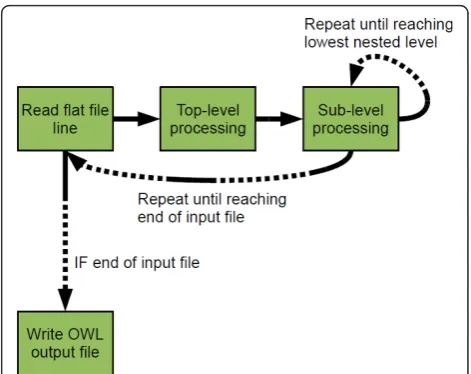
We created a Java-based tool, Sig2BioPAX, for the pur-pose of converting cell signaling pathways and interac-tion network datasets into BioPAX. The software package uses the Jena Library[12], which includes data structures for representation and modification of RDF and OWL files. In the implementation, BioPAX classes are represented as Java classes. The classes contain vari-ables which store the settings and details necessary for proper instantiation of those classes. Program control is passed through a tree of functions which adds new instances of classes as necessary to represent the data from the input file. Reading the input flat text file line-by-line, Sig2BioPAX adds nodes to the OWL model sequentially. Before adding a new node, the program traverses the model to make sure that no identical node (that is, a node having the same children) already exists. Finally, the newly created model is written to an OWL file using the Jena library functions. See Figure 1 for a flow-diagram of the internals of the Sig2BioPAX program.
There are a finite number of reaction types that can be processed and converted into the BioPAX format. These reactions are described in Table 1. Sig2BioPAX mainly supports cell signaling reaction types including protein-protein binding interactions, protein kinase phosphorylations and phosphatase dephosphoryations,
guanine nucleotide exchange reactions, and ubiquitina-tions. Since BioPAX level 3 has added support for tran-scriptional regulatory interactions, Sig2BioPAX can be used to convert protein/DNA interactions in the form of transcription-factors binding to regulatory regions of genes. Sig2BioPAX categorizes the input reaction lines based on user-supplied rules. These rules determine the logic used to convert the flat files to the BioPAX level 3 format. The rules must be specified in a rules file using a custom language which is fully described in the pro-gram’s instruction manual and also available within the GUI version of the program by clicking the question mark button. A default rules.txt is included with the program’s release. Users may modify the includedrules. txtor create their own rules file from scratch.
for each input template type. In this code file, the test-ing condition for the IF statement are defined. The input line is parsed through a series of statements. By modifying the order and content of these statements, the user can customize the input templates.
Results
Sig2BioPAX is packaged as an executable JAR file. The tool is available in both command line and graphical user interface (GUI) versions. The command line ver-sion of the program, accessible by using the command line argument-cmd, accepts input parameters including the input file name, output file name, rules file name, option to overwrite output file, and an input-template
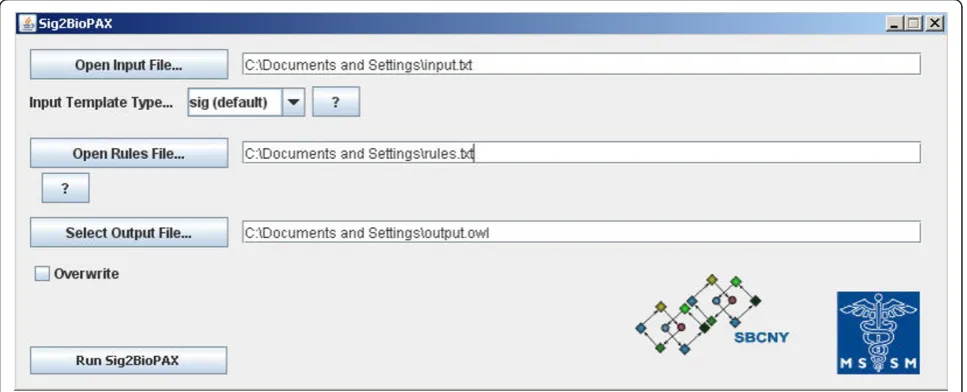
type. In the command line version of the program, these options are passed as command line arguments. For example, to use input file foo.txt, output file bar.owl, the rules file rulesfile.txt, and the overwrite option, the com-mand is: ‘java -jar sig2biopaxv4.jar - cmd -in:foo.txt -out:bar.owl -r:rulesfile.txt -o’. Thesiginput template type is the default input template type. In the GUI ver-sion of the program, the input, output, and rules files can be selected from a file browser and the other options can be set interactively (Figure 2). Sig2BioPAX can be downloaded from the Google Code project host-ing site at http://code.google.com/p/sig2biopax/
We used Sig2BioPAX to convert several network data-sets into the BioPAX format, and some of these networks are available on Pathway Commons [14], an international collaborative database of biomolecular pathways. The datasets we converted to BioPAX are original networks we extracted from the literature for the projects: the pre-synaptome [15], representing protein-protein interactions present in presynaptic nerve terminals of mammalian neurons, and the neuronal signalome [16], representing cell signaling interactions extracted from neuroscience lit-erature describing combined cell signaling pathways in mammalian neurons, the adhesome [17], a network of interaction in focal adhesions; and a kinase-substrate net-work we constructed for the program KEA [18], kinase enrichment analysis, and ChEA [19], which stand for chip-seq/chip enrichment analysis.
Conclusions
As the bulk and complexity of genome-wide molecular data increases, methods for sharing and exchanging data need to be further developed. Effective standard represen-tation of data enables seamless data exchange across plat-forms, tools and databases. However, converting existing
Table 1 A description of the reaction types processed by Sig2BioPAX
Reaction Type Description
Binding Molecules bind to form a complex
Kinase Phosphorylation Kinase catalyzes addition of phosphate group to target molecule
Dephosphorylation Catalyst initiates removal of phosphate group from target molecule
Guanine Nucleotide Exchange GDP removed from complex and replaced with GTP
GTPase activating protein GTP bound to compound becomes GDP
Ubiquitination Ubiquitin molecule is added to target compound
Deubiquitination Ubiquitin molecule is removed from target compound
Sumoylation Small ubiquitin-related modifier is attached to target molecule
Cleavage with Phospholipase C PLC cleaves PIP2 into IP3 and DAG
Cleavage on Cysteine Deactivating cleavage on a cysteine residue of target protein
Inactivating Cleavage Deactivating cleavage of target molecule
Activating Cleavage Cleavage of pro-protein into active form
Protein-protein Interaction Otherwise unspecified reaction between two proteins
Transcription Protein activates or inhibits transcription of gene products
Transcription Factor Promoter Binding Transcription factor and protein bind to create complex
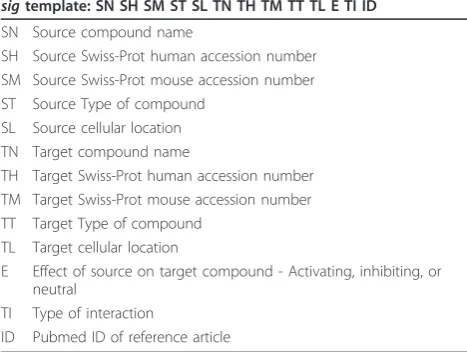
Table 2 A description of an input line using the default input template,sig, and the meaning of the individual elements on the input line
sigtemplate: SN SH SM ST SL TN TH TM TT TL E TI ID
SN Source compound name
SH Source Swiss-Prot human accession number SM Source Swiss-Prot mouse accession number ST Source Type of compound
SL Source cellular location TN Target compound name
TH Target Swiss-Prot human accession number TM Target Swiss-Prot mouse accession number TT Target Type of compound
TL Target cellular location
E Effect of source on target compound - Activating, inhibiting, or neutral
TI Type of interaction
ID Pubmed ID of reference article
and new data into such exchange formats is not trivial. The Sig2BioPAX tool will further enable researchers to easily convert their flat file interaction data into the com-putable BioPAX format so that their data can be reused and interpreted by other researchers worldwide.
Availability and Requirements Project name: Sig2BioPAX
Project home page: http://code.google.com/p/
sig2biopax/
Operating system(s): Platform independent Programming language: Java
Other requirements: Jena 2.6.2 or higher License: GNU GPL
Any restrictions to use by non-academics: none
Acknowledgements
This research was supported by NIH Grants P50GM071558-01A27398, R01DK088541, R01GM054508, R01DA15446, and KL2RR029885-0109. We would like to thank Emek Demir from MSKCC for assistance with the BioPAX specification.
Authors’contributions
AM initiated and managed the project. RLW implemented and tested the Sig2BioPAX Java tool. AM and RLW wrote the manuscript. All authors read and approved the final manuscript.
Competing interests
The authors declare that they have no competing interests.
Received: 10 December 2010 Accepted: 21 March 2011 Published: 21 March 2011
References
1. Demir E, Cary MP, Paley S, Fukuda K, Lemer C, Vastrik I, Wu G, D’Eustachio P, Schaefer C, Luciano J,et al:The BioPAX community standard for pathway data sharing.Nat Biotechnol2010,28(9):935-942.
2. Cline MS, Smoot M, Cerami E, Kuchinsky A, Landys N, Workman C, Christmas R, Avila-Campilo I, Creech M, Gross B,et al:Integration of biological networks and gene expression data using Cytoscape.Nat Protoc2007,2(10):2366-2382.
3. Maere S, Heymans K, Kuiper M:BiNGO: a Cytoscape plugin to assess overrepresentation of Gene Ontology categories in Biological Networks.
Bioinformatics21(16):3448-3449.
4. Zinovyev A, Viara E, Calzone L, Barillot E:BiNoM: a Cytoscape plugin for manipulating and analyzing biological networks.Bioinformatics2008, 24(6):876-877.
5. Cerami E, Bader G, Gross B, Sander C:cPath: open source software for collecting, storing, and querying biological pathways.BMC Bioinformatics
2006,7(1):497.
6. Zanzoni A, Montecchi-Palazzi L, Quondam M, Ausiello G, Helmer-Citterich M, Cesareni G:MINT: a Molecular INTeraction database.FEBS Letters2002,513(1):135-140.
7. Aranda B, Achuthan P, Alam-Faruque Y, Armean I, Bridge A, Derow C, Feuermann M, Ghanbarian AT, Kerrien S, Khadake J,et al:The IntAct molecular interaction database in 2010.Nucleic Acids Research2010, 38(suppl 1):D525-D531.
8. Vastrik I, D’Eustachio P, Schmidt E, Joshi-Tope G, Gopinath G, Croft D, de Bono B, Gillespie M, Jassal B, Lewis S,et al:Reactome: a knowledge base of biologic pathways and processes.Genome Biology2007,8(3):R39. 9. Stark C, Breitkreutz BJ, Chatr-Aryamontri A, Boucher L, Oughtred R,
Livstone MS, Nixon J, Van Auken K, Wang X, Shi X,et al:The BioGRID Interaction Database: 2011 update.Nucleic Acids Res2010. 10. Hermjakob H, Montecchi-Palazzi L, Bader G, Wojcik J, Salwinski L, Ceol A,
Moore S, Orchard S, Sarkans U, von Mering C,et al:The HUPO PSI’s molecular interaction format–a community standard for the representation of protein interaction data.Nat Biotechnol2004,22(2):177-183.
11. Hucka M, Finney A, Sauro HM, Bolouri H, Doyle JC, Kitano H, Arkin AP, Bornstein BJ, Bray D, Cornish-Bowden A,et al:The systems biology markup language (SBML): a medium for representation and exchange of biochemical network models.Bioinformatics2003,19(4):524-531. 12. Jena–A Semantic Web Framework for Java.[http://jena.sourceforge.net/]. 13. Lachmann A, Xu H, Krishnan J, Berger SI, Mazloom AR, Ma’ayan A:ChEA:
transcription factor regulation inferred from integrating genome-wide ChIP-X experiments.Bioinformatics2010,26(19):2438-2444.
14. Cerami EG, Gross BE, Demir E, Rodchenkov I, Babur O, Anwar N, Schultz N, Bader GD, Sander C:Pathway Commons, a web resource for biological pathway data.Nucleic Acids Res2010.
15. Abul-Husn NS, Bushlin I, Morón JA, Jenkins SL, Dolios G, Wang R, Iyengar R, Ma’ayan A, Devi LA:Systems approach to explore components and interactions in the presynapse.PROTEOMICS2009,9(12):3303-3315.
16. Ma’ayan A, Jenkins SL, Neves S, Hasseldine A, Grace E, Dubin-Thaler B, Eungdamrong NJ, Weng G, Ram PT, Rice JJ,et al:Formation of regulatory patterns during signal propagation in a Mammalian cellular network.
Science2005,309(5737):1078-1083.
17. Zaidel-Bar R, Itzkovitz S, Ma’ayan A, Iyengar R, Geiger B:Functional atlas of the integrin adhesome.Nat Cell Biol2007,9(8):858-867.
18. Lachmann A, Ma’ayan A:KEA: kinase enrichment analysis.Bioinformatics
2009,25(5):684-686.
19. Lachmann A, Xu H, Krishnan J, Berger SI, Mazloom AR, Ma’ayan A:ChEA: transcription factor regulation inferred from integrating genome-wide ChIP-X experiments.Bioinformatics26(19):2438-2444.
doi:10.1186/1751-0473-6-5
Cite this article as:Webb and Ma’ayan:Sig2BioPAX: Java tool for converting flat files to BioPAX Level 3 format.Source Code for Biology and Medicine20116:5.
Submit your next manuscript to BioMed Central and take full advantage of:
• Convenient online submission
• Thorough peer review
• No space constraints or color figure charges
• Immediate publication on acceptance
• Inclusion in PubMed, CAS, Scopus and Google Scholar
• Research which is freely available for redistribution