BioMed Central
Page 1 of 6 (page number not for citation purposes)
Lipids in Health and Disease
Open Access
Research
Effect of immunization against ox-LDL with two different antigens
on formation and development of atherosclerosis
Sedigheh Asgary*
1,2, Salb-Ali Saberi
1,2and Shirin Azampanah
1,2Address: 1Basic sciences department, Isfahan Cardiovascular Research Center, Isfahan University of Medical Sciences, Isfahan, Iran and 2Isfahan
University of Medical Sciences. Isfahan Cardiovascular Research Center a WHO Collaborating Center for Research and Training in Cardiovascular Diseases Control, Prevention for Cardiac Patients in EMRO
Email: Sedigheh Asgary* - [email protected]; Salb-Ali Saberi - [email protected]; Shirin Azampanah - [email protected] * Corresponding author
Abstract
Background: Several studies were pointed to oxidized LDL (ox-LDL) as one of the main immunogenes which have important roles in primary lesions of atherosclerosis. In this study, by immunization against ox-LDL with two different antigens in an animal model (rabbit) and consideration of its effect on two different dietary regimens; we tried to clear relation between immune system and atherosclerosis.
Methods: LDL was isolated from hypercholesterolemic rabbits plasma and oxidized with MDA or Cu++. Rabbits were divided to three groups and immunized with MDA-LDL or Cu-LDL or phosphate-buffer (PBS) as a control group. Immunization was repeated after 2, 4, 6, and 8 weeks and concentration of antibodies against ox-LDL was measured in each stage. After immunization, rabbits in each group were divided to two subgroups based on the dietary regimen (fed normal or high cholesterol diet). At the beginning and the end of the study, biochemical factors were measured. Also, fatty streaks in aorta and left and right coronary arteries evaluated.
Results: Immunization with Cu2+-LDL and MDA-LDL induced statistically significant antibodies against ox-LDL. In hypercholesterolemic rabbits immunized with MDA-LDL the level of cholesterol, LDL-cholesterol, triglyceride, fasting blood sugar and fatty streak lesions in aorta and right coronary arteries were significantly decreased as compared with non-immunized high-cholesterol group. Immunization with Cu2+-LDL in hypercholesterolemic rabbits significantly decreased triglyceride, fasting blood sugar, cholesterol and CRP. No significant differences were detected in the fatty streak lesions in this group as compared with non-immunized high-cholesterol diet. In groups under normal diet immunized with MDA-LDL or Cu2+-LDL no significant effect on biochemical factors and atherosclerotic lesions were observed.
Conclusion: This study indicates that although the effect of produced antibodies in several methods and different dietary regimens is different, immunization against ox-LDL is antiatherogenic.
Background
In the recent studies, relation between immune system
and atherosclerosis has been investigated [1-3]. It is clear that this system can be effective on severity of atheroscle-Published: 24 November 2007
Lipids in Health and Disease 2007, 6:32 doi:10.1186/1476-511X-6-32
Received: 22 August 2007 Accepted: 24 November 2007
This article is available from: http://www.lipidworld.com/content/6/1/32
© 2007 Asgary et al; licensee BioMed Central Ltd.
rosis through different immunogenic mechanisms [4-6]. Several studies were pointed to oxidized LDL (ox-LDL) as one of the main immunogenes which have important roles in primary lesions of atherosclerosis [5,6]. Little changes in LDL strongly converted it to immunogenic par-ticle. ox-LDL is a toxic particle that stimulates several cel-lular and humeral responses [7]. The existence of activated macrophages against ox-LDL in atherosclerotic lesions is a marker for primary cellular responses [8]. Different types of antibodies against ox-LDL were recognized in blood stream. These antibodies are measured in both human and animal models [9-12] bind to ox-LDL epitopes and cause atherosclerosis. As, hypercholesterolemic rabbits immunized with homologous, ox-LDL have a markedly reduced neointimal area after balloon injury despite sever hypercholesterolemia, then immunization against athero-sclerosis also is a target to prevent restenosis and further investigation in this field is warranted [13].
However, the atherogenic or athero-protective role of immune system in atherosclerosis is not clearly demon-strated. In this study, by immunization against ox-LDL with two different antigens in an animal model (rabbit) and consideration of its effect on two different dietary reg-imens (fed normal or high cholesterol diet); we tried to clear relation between immune system and atherosclero-sis.
Methods
Isolation and oxidation of LDL
LDL was isolated by ultracentrifuge from healthy New Zealand white rabbits with diet-induced hypercholestero-lemia and modified with MDA and Cu2+. LDL (1.019 < d < 1.063 g/mL) was isolated by sequential ultracentrifuga-tion in the presence of antioxidants and antiproteolytic agents. The density was adjusted to 1.022 g/mL with KBr, then plasma was centrifuged at 65000 rpm for 4 hours at 10°C using a Beckman L7-65 ultracentrifuge with a VTi 65.2 rotor. The supernatant was pipetted off, the density of the infranatant was adjusted to 1.063 g/mL with KBr, and the LDL fraction was isolated by centrifugation at 44000 rpm for 22 hours using a 50.3 rotor. LDL was then extensively dialyzed against EDTA-free phosphate buffer (PBS) and sterile filtered [14].
Cu-LDL was generated by incubating 160 µg LDL per mL PBS, pH 7.35, with 5 µmol/L CuSO4 at 37°C [14,15]. Oxidation of LDL by MDA is carried out according to Foglemen procedure [16].
Immunization of rabbits
Thirty-six New Zealand white male rabbits with the mean weight of 2000 ± 200 grams were prepared from Pasteur's Institute. Animals were fed with normal diet (Super Fosskorn) for two weeks and then were divided into three
groups of twelve rabbits each and matched for age, body weight, and plasma cholesterol levels. Also, environmen-tal characteristics (light, temperature, and assess to water) were similar. The first (n = 12) group was immunized with (160 µg/kg) homologous MDA-modified LDL (protein) and dissolved in PBS and suspended in an equal volume of Freund's adjuvant. The second group (n = 12) was immunized with (160 µg/kg) homologous cu-LDL (pro-tein) and dissolved in PBS and suspended in an equal vol-ume of the same concentration of Freund's adjuvant. The third group (n = 12) was immunized only with PBS (con-trol group). Immunization was repeated with an identical protocol, again after of 2, 4, 6 and 8 weeks.
Experimental animals and dietary regimens
At the end of immunization, each group of rabbits was divided into two subgroups with 6 rabbits and each sub-group was fed normal or high cholesterol diets (normal rabbit diet supplemented with 1% cholesterol) for 2 months. Rabbits were kept on a 12 hour day/night cycle and had unrestricted access to water and food ad libitum.
Biochemical Measurments
Blood samples were collected from central ear artery of overnight fasted rabbits before starting experiments and at the end of study. Plasma cholesterol, triglyceride, high density cholesterol (HDL-C), low density choles-terol(LDL-C), and fasting blood sugar levels were deter-mined using an automated enzymatic assay by auto-analyzer Hitachi 902 and using special kits (Diasys, Ger-many). CRP levels were measured by rabbit CRP Eliza Kit(Rapidbio, USA). ox-LDL antibodies measured with Eliza method (Immunodiagnostica, Germany). Also, external standardization for lipoproteins and fasting blood sugar level was done with the central laboratory of the St. Rafael University Hospital of Leuven in Belgium. The results of two laboratories correlated highly.
Isfahan Cardiovascular Research Center Ethics Committee which is a member of office for human research protec-tions, US department of health and human services, approved the present study, and the animals were han-dled according to guidelines of Isfahan University of Med-ical Sciences for Laboratory Animal Sciences for the care and use of laboratory animals.
Evaluation of atherosclerosis
Lipids in Health and Disease 2007, 6:32 http://www.lipidworld.com/content/6/1/32
Page 3 of 6 (page number not for citation purposes)
were assessed by a pathologist with respect to the presence of fatty streaks. For every animal subject and from each tis-sue specimens, either right coronary artery, left coronary artery or aorta; three consecutive sections were prepared and mounted on one slide. Prepared tissue sections were observed using light microscope. They were all scored on the basis of the scale from zero to four [17].
Statistical analysis
Results were presented as the mean ± SD. Differences in means of biochemical factors and fatty streak scores between groups were statistically analyzed by non-para-metric one-way analysis of variance.
P values < 0.05 were considered statistically significant. A computer program (SPSS 13.0, SPSS Inc. Chicago, IL, USA) was used for statistical analysis.
Results
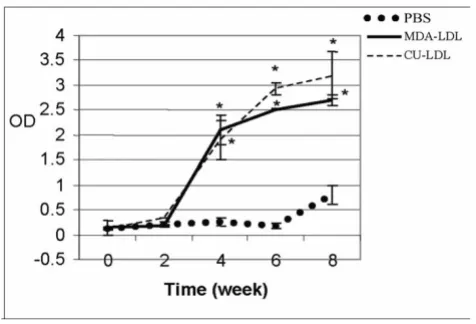
Antibody measurements after 4, 6 and 8 weeks, were sta-tistically more in rabbits immunized with MDA-LDL and Cu-LDL than PBS group (Fig 1).
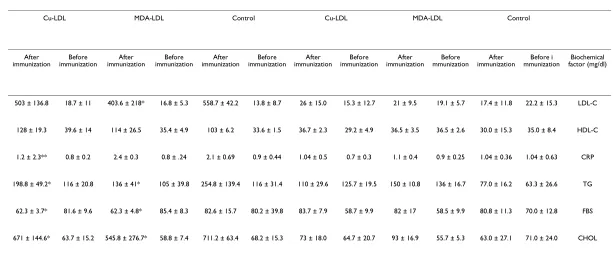
Table 1 summarized the effect of immunization against MDA-LDL and Cu-LDL on the rabbits fed normal diet or high cholesterol diet on biochemical factors.
Immunization with MDA-LDL under high cholesterol diet statistically decreased serum concentration of triglyceride, cholesterol, fasting blood sugar, and LDL-C as compared with non-immunized high-cholesterol group (Table 1). Immunization with Cu-LDL under high cholesterol diet statistically decreased serum concentration of triglyceride, cholesterol, fasting blood sugar and CRP as compared
with non-immunized high cholesterol group (Table 1). Also, it was a significant difference between the mean changes of fatty streak measurement in aorta and right coronary artery in group under high cholesterol diet immunized with MDA-LDL as compared with non-immunized high cholestrol group (Table 2). In the group under high cholesterol diet immunized with Cu-LDL, the mean of CRP was statistically lower than group under high cholesterol diet immunized with MDA-LDL and also hypercholesterolemic group. At the end of the study in groups under normal diet immunized with MDA-LDL or Cu-LDL, no significant difference in the mean of bio-chemical factors or fatty streaks was observed (Table 1 and Table 2).
Discussion
In the present study, significant decrease in fatty streak in aorta and right coronary arteries in immunized rabbits with MDA-LDL fed high cholesterol diet was observed whereas in rabbits immunized with Cu-LDL fed high cho-lesterol diet, no significant changes in fatty streaks was found. In Palinski and Ameli studies (on rabbits fed with high cholesterol diet through immunization with MDA-LDL and Cu-MDA-LDL, respectively); it was found decrease of atherosclerosis severity [18,19]. In the two distinct studies of Palinski and Ameli different animal models, different antigens, different modes of immunizations, and different techniques for evaluation were used but in our study we tried to evaluate the effects in the same study in addition to use two different dietary regimen. Also, in this study, decreasing of cholesterol, LDL-C, triglyceride and fasting blood sugar in group immunized with MDA-LDL fed high cholesterol diet in comparison with control group and decrease of triglyceride, cholesterol, fasting blood sugar and CRP in group immunized with Cu-LDL fed high cho-lesterol diet in comparison with control group were found. Therefore, these results can be an expression of dif-ferences in the mechanism of these two antigens. In sev-eral studies, it was found that CRP as a nonspecific marker for diagnosis of cardiovascular disease can indirectly influence on atherosclerosis [20]. It is suggested to study the effect of immunization on different inflammatory markers and its short and long term effect. Therefore, selection of a suitable antigen can probably influence on increasing of immunization effects on atherosclerosis. Also, in our study, since immunization with MDA-LDL or Cu-LDL did not influence biochemical factors and fatty streaks in normal diet, atherogenic effect of immune sys-tem not be proved. In present study, we also used Freund's adjuvant. Administration of Freund's adjuvant alone can reduce formation of mature atherosclerotic lesions in experimental animal [21,22]. Therefore we can probably ascribe a part of our study results to this adjuvant.
The mean of ox- LDL antibodies in rabbits immunized with MDA-LDL, Cu-LDL, and only PBS in different times
Figure 1
Lipids in Health and Disease
2007
,
6
:32
h
ttp:
//www
.li
pidw
orl
d.com/content/6/1/3
Page
(page number not for citation purposes)
Table 1: Comparison of the mean of biochemical factors before and after immunization in immunized rabbits fed normal and high cholesterol diet
High cholesterol diet Normal diet
Cu-LDL MDA-LDL Control Cu-LDL MDA-LDL Control
After
immunization immunizationBefore immunizationAfter immunizationBefore immunizationAfter immunizationBefore immunizationAfter immunizationBefore immunizationAfter mmunizationBefore immunizationAfter mmunizationBefore i factor (mg/dl)Biochemical
503 ± 136.8 18.7 ± 11 403.6 ± 218* 16.8 ± 5.3 558.7 ± 42.2 13.8 ± 8.7 26 ± 15.0 15.3 ± 12.7 21 ± 9.5 19.1 ± 5.7 17.4 ± 11.8 22.2 ± 15.3 LDL-C
128 ± 19.3 39.6 ± 14 114 ± 26.5 35.4 ± 4.9 103 ± 6.2 33.6 ± 1.5 36.7 ± 2.3 29.2 ± 4.9 36.5 ± 3.5 36.5 ± 2.6 30.0 ± 15.3 35.0 ± 8.4 HDL-C
1.2 ± 2.3** 0.8 ± 0.2 2.4 ± 0.3 0.8 ± .24 2.1 ± 0.69 0.9 ± 0.44 1.04 ± 0.5 0.7 ± 0.3 1.1 ± 0.4 0.9 ± 0.25 1.04 ± 0.36 1.04 ± 0.63 CRP
198.8 ± 49.2* 116 ± 20.8 136 ± 41* 105 ± 39.8 254.8 ± 139.4 116 ± 31.4 110 ± 29.6 125.7 ± 19.5 150 ± 10.8 136 ± 16.7 77.0 ± 16.2 63.3 ± 26.6 TG
62.3 ± 3.7* 81.6 ± 9.6 62.3 ± 4.8* 85.4 ± 8.3 82.6 ± 15.7 80.2 ± 39.8 83.7 ± 7.9 58.7 ± 9.9 82 ± 17 58.5 ± 9.9 80.8 ± 11.3 70.0 ± 12.8 FBS
671 ± 144.6* 63.7 ± 15.2 545.8 ± 276.7* 58.8 ± 7.4 711.2 ± 63.4 68.2 ± 15.3 73 ± 18.0 64.7 ± 20.7 93 ± 16.9 55.7 ± 5.3 63.0 ± 27.1 71.0 ± 24.0 CHOL
LDL-C: Low Density Lipoprotein, HDL-C: High Density Lipoprotein, CRP: C-Reactive Protein, TG: Triglyceride, FBS: Fasting Blood Sugar, CHOL: Cholesterol Measurements were expressed as Mean ± SD
* Statistically significant difference with non- immunized high-cholesterol diet (P < 0.05)
Lipids in Health and Disease 2007, 6:32 http://www.lipidworld.com/content/6/1/32
Page 5 of 6 (page number not for citation purposes)
Conclusion
In the present study, we concluded that immune response to ox-LDL is anti atherogenic; Although, the effect of pro-duced antibodies in various methods and dietary regi-mens was different. Therefore, the hypothesis of the role of protective effects of immune system on atherosclerosis will be strongly debated. As the concept of immuno-therapy is in its early stage of development so it should be evaluated and therefore it is logical to study: when immu-nization should be started which antigen is effective and if dietary regimen or patient condition is effective in decreasing atherosclerosis or not.
Authors' contributions
S. Asgary carried out and directed the study and conceived it and perform its design also prepared the manuscript and participated in its design and approved the final man-uscript.
S. Saberi did laboratory exam.
S. Azampanah participated for data collection.
All of the authors read and approved the final manuscript.
Acknowledgements
The authors gratefully acknowledge research funding from Isfahan Cardio-vascular Research Center, Isfahan University of Medical Sciences, a WHO Collaborating Center (Grant Number 80109).
References
1. Wick G, Amberger A, Kleindienst R, Xu Q: Is atherosclerosis an immunologically mediated disease? Immunol Today 1995,
16:27-33.
2. Libby P, Hansson GK: Involvement of the immune system in human atherogenesis: current knowledge and unanswered questions. Lab Invest 1991, 64:5-15.
3. George J, Harats D, Gilburd B, Shoenfeld Y: Emerging cross-regu-latory roles of immunity and autoimmunity in atherosclero-sis. Immunol Res 1996, 15:315-322.
4. Johannes H: Antibodies to oxidized LDL in atherosclerosis development-clinical and animal studies. Clinica chimica Acta 2004, 348:1-8.
5. Sherer Y, Shoenfeld Y: Immunomodulation for treatment and prevention of atherosclerosis. Auto immunity Reviews 2002,
1:21-27.
6. Afek A, George J, Gilburd B, Rauova L, Goldberg I, Kopolovic J:
Immunization of low density lipoprotein receptor deficient (LDL-RD) mice with heart shock protein 65 (HSP-65) pro-motes early atherosclerosis. J autoimmunity 2000, 14:115-127.
7. Palinski W, Horkko S, Miller E, Steinbrecher UP, Powell HC, Curtiss LK, Witztum JL: Cloning monoclonal autoantibodies to epitopes of oxidized lipoproteins from apolipoprotein E defi-cient mice. Demonstration of epitopes of oxidized low den-sity lipoprotein in human plasma. J Clin Invest 1996, 98:800-814. 8. Palinski W, Rosenfeld ME, Yla-Herttuala S, Gurtner GC, Socher SS, Butler SW, Parthasarathy S, Carew TE, Steinberg D, Witztum JL: Low density lipoprotein under-goes oxidative modification in vivo. proc Natl Acad Sci USA 1989, 86:1372-1376.
9. Yla-Herttuaia S, Pa1inski W, Butler SW, Picard S, Steinberg D, Witz-tum JL: Rabbi- and human atherosclerotic lesions contain IgG that recognizes epitopes of oxidized LDL. Arterioscler 1 Thromb 1994, 14:32-40.
10. Rosenfeld ME, Palinski W, Herttuala S, Bulter S, Witztum JL: Distri-bution of oxidation specific lipid protein adducts and apolipo-protein B in atherosclerosis lesion of varying severity from WHHL rabbits. Arteriosclerosis 1990, 10:336-349.
11. Salonen JT, Yla-Herttuala S, Yamamoto R, Butler S, Korpela H, Salo-nen R, NyssoSalo-nen K, Palinski W, Witztum JL: Autoantibody against oxidised LDL and, progression of carotid atherosclerosis.
Lancet 1992, 339:883-887.
12. Bergmark C, Wu R, De faire U, Lefuert AK, Edenborg SW: Patients with early-onset peripheral vascular disease have increased levels of auto antibodies against oxidized LDL. Arteriovascular thromb Vasc Biol 1995, 15:441-445.
13. Nilsson J, Calara F, Regnstrom J, Nilsson AH, Ameli S, Cercek B, Shah PK: Immunization with homologous oxidized low density lipoprotein reduces neointimal formation after balloon injury in hypercholesterolemic rabbits. Journal of American col-lege of cardiology 1997, 30(7):1886-1891.
14. Redgrave TG, Roberts DCK, West CE: Separation of plasma lipo-proteins by density gradient ultracentrifugation. Anal Biochem 1975, 65:42-49.
15. Lopes Virella M, Koshinen S, Mironova M, Horne D, Klein R, Chas-serean C, Enockson C, Vivella G: The preparation of copper-oxi-dized LDL for measurement of oxicopper-oxi-dized LDL antibodies by EIA. J Atherosclerosis 2000, 152:107-115.
16. Harberland ME, Foglemen AM, Edwards SP: Specificity of recep-tor-mediated recognition of malondialdehyde modified low density lipoproteins. Proc Natl Acade Sci 1981, 79:1712-1716. 17. George J, Mek A, Gilburd B, Levkovitz H, Shaish A, Goldberg I,
Kopolovic Y, Wick G, Shoenfeld Y, Harats D: Hyperimmunization of apo-E-deficient mice with homologous malondialdehyde low-density lipoprotein suppress:s early atherogenesis.
Atherosclerosis 1998, 138:147-152.
18. Palinski W, Miller E, Witztum JL: Immunization of low density lipoprotein (LDL) receptor-deficient) rabbits with homolo-gous malondialdehyde modified LDL reduces atherogenesis.
Proc Natl Acad Sci USA 1995, 92:821-825.
19. Ameli S, Hultgardh-Nilsson A, Regnstrom J, Calara F, Yano J, Cercek B, Shah PK, Nilsson J: Effect of immunization with homologous LDL, and oxidized LDL on early atherosclerosis in hypercho-lesterolemic rabbits, Arterioscler. Thromb Vasco Biol 1996,
16:1074-1079.
20. Riker PM, Rifai N, Ross L, Buring JE, Cook NR: Comparison of C reactive protein and low-density lipoprotein cholesterol lev-els in the prediction of first cardiovascular events. N Eng J Med 2002, 347:1557-1565.
21. Khallou-Laschet J: Atheroprotective effect of adjuvants in apol-ipoprotein E. knockout mice Athero 2000, 184:330-341.
Table 2: Comparison of the development of fatty streak in rabbits immunized with MDA-LDL or Cu-LDL fed normal and high cholesterol diet
Normal diet High cholesterol diet
Cu-LDL MDA-LDL Control Cu-LDL MDA-LDL Control Artery
0.57 ± 0.32* 0.43 ± 0.42* 0.42 ± 0.37* 3.4 ± 1.7 2.4 ± 1.7 * 3.2 ± 1.5 Right coronary
0.1 ± 0.01* 0.5 ± 0.1* 0.5 ± 0.1* 2.8 ± 1.5 2.1 ± 0.5 2.5 ± 1.8 Left coronary
0.5 ± 0.1* 0.5 ± 0.1* 0.5 ± 0.1* 3.5 ± 0.05 2.7 ± 0.52* 3.4 ± 0.15 Aorta
Publish with BioMed Central and every scientist can read your work free of charge "BioMed Central will be the most significant development for disseminating the results of biomedical researc h in our lifetime."
Sir Paul Nurse, Cancer Research UK
Your research papers will be:
available free of charge to the entire biomedical community
peer reviewed and published immediately upon acceptance
cited in PubMed and archived on PubMed Central
yours — you keep the copyright
Submit your manuscript here:
http://www.biomedcentral.com/info/publishing_adv.asp
BioMedcentral 22. Hansen P, Chew M, Zhou J, Daugherty A, Heegaard N, Jensen P,