BMC Medical Research Methodology (2001)
1:2
Consensus statement
The CONSORT statement: revised recommendations for
improving the quality of reports of parallel group randomized trials
David Moher
1
, Kenneth F Schulz
2
and Douglas G Altman
3
Address: 1University of Ottawa, Thomas C. Chalmers Centre for Systematic Reviews, Ottawa, Canada, 2Family Health International and Dept. of Obstetrics and Gynecology, School of Medicine, University of North Carolina at Chapel Hill, North Carolina, USA and 3ICRF Medical Statistics Group and Centre for Statistics in Medicine, Institute of Health Sciences, Oxford, UK for the CONSORT Group
E-mail: David Moher - [email protected]; Kenneth F Schulz - [email protected]; Douglas G Altman - [email protected]
Abstract
To comprehend the results of a randomized controlled trial (RCT), readers must understand its design, conduct, analysis and interpretation. That goal can only be achieved through complete transparency from authors. Despite several decades of educational efforts, the reporting of RCTs needs improvement. Investigators and editors developed the original CONSORT (Consolidated Standards of Reporting Trials) statement to help authors improve reporting by using a checklist and flow diagram. The revised CO NSO RT statement presented in this paper incorporates new evidence and addresses some criticisms of the original statement.
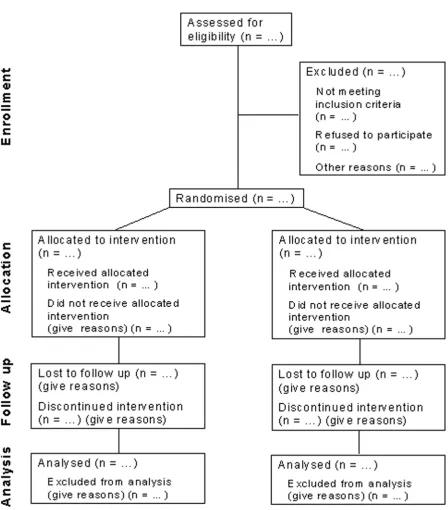
The checklist items pertain to the content of the Title, Abstract, Introduction, Methods, Results and Discussion. The revised checklist includes 22-items selected because empirical evidence indicates that not reporting the information is associated with biasedestimates of treatment effect or the information is essential to judge the reliability or relevance of the findings. We intended the flow diagram to depict the passage of participants through an RCT. The revised flow diagram depicts information from four stages of a trial (enrolment, intervention allocation, follow-up, and analysis). The diagram explicitly includes the number of participants, for each intervention group, included in the primary data analysis. Inclusion of these numbers allows the reader to judge whether the authors have performed an intention-to-treat analysis.
In sum, the CO NSO RT statement is intended to improve the reporting of an RCT, enabling readers to understand a trial's conduct and to assess the validity of its results.
Contributors
Frank Davidoff, MD, Annals of Internal Medicine, (Phil-adelphia, PA); Susan Eastwood, ELS(D), University of California at San Francisco, (San Francisco, CA); Matth-ias Egger, MD, Department of Social Medicine, Universi-ty of Bristol, (Bristol, UK); Diana Elbourne, PhD, London School of Hygiene and Tropical Medicine, (Lon-don, UK); Peter Gøtzsche, MD, Nordic Cochrane Centre, (Copenhagen, Denmark); Sylvan B. Green, PhD, MD,
School of Medicine, Case Western Reserve University, (Cleveland, OH); Leni Grossman, BA, Merck & Co., Inc., (Whitehouse Station, NJ); Barbara S. Hawkins, MD, Wilmer Ophthalmological Institute, Johns Hopkins Uni-versity, (Baltimore, MD); Richard Horton, MB, The Lan-cet, (London, UK); Wayne B. Jonas, MD, Uniformed Services University of the Health Sciences, (Bethesda, MD); Terry Klassen, MD, Department of Pediatrics, Uni-versity of Alberta, (Edmonton, Alberta); Leah Lepage,
Published: 20 April 2001
BMC Medical Research Methodology 2001, 1:2
This article is available from: http://www.biomedcentral.com/1471-2288/1/2
(c) 2001 Moher et al, licensee BioMed Central Ltd.
PhD, Thomas C. Chalmers Centre for Systematic Re-views, (Ottawa, ON); Thomas Lang, MA, Tom Lang Communications, (Lakewood, OH); Jeroen Lijmer, MD, Dept. of Clinical Epidemiology, University of Amster-dam, (AmsterAmster-dam, The Netherlands); Rick Malone, BS, TAP Pharmaceuticals, (Lake Forest, IIL); Curtis L. Mein-ert, PhD, Johns Hopkins University, (Baltimore, MD); Mary Mosley, BS, Life Science Publishing, (Tokyo, Ja-pan); Stuart Pocock, PhD, London School of Hygiene and Tropical Medicine, (London, UK); Drummond Ren-nie, JAMA, Chicago, IIL); David S. Riley, MD, University of New Mexico Medical School, (Santa Fe, NM); Roberta W. Scherer, MD, Epidemiology & Preventive Medicine, University of Maryland School of Medicine, (Baltimore, MD); Ida Sim, MD, PhD, University of California at San Francisco, (San Francisco, CA); Donna Stroup, PhD, MSc, Epidemiology Program Office, Center for Disease Control & Prevention, (Atlanta, GA).
David Moher, Ken Schulz, and Doug Altman participated in regular conference calls, identified participants, con-tributed in the CONSORT meetings and drafted the manuscript. David Moher and Leah Lepage planned the CONSORT meetings, identified and secured funding, in-vited the participants and planned the meeting agenda. The members of the CONSORT group listed above at-tended the consort meetings and provided input in the revised checklist, flow diagram and/or text of this manu-script. David Moher is the Guarantor of the manumanu-script.
Introduction
A report of a randomized controlled trial (RCT) should convey to the reader, in a transparent manner, why the study was undertaken, and how it was conducted and an-alyzed. For example, a lack of adequately reported rand-omization has been associated with bias in estimating the effectiveness of interventions, [1,2]. To assess the strengths and limitations of an RCT, readers need and deserve to know the quality of its methodology.
Despite several decades of educational efforts, RCTs still are not being reported adequately, [3–6]. For example, a review, [5] of 122 recently published RCTs that evaluated the effectiveness of selective serotonin reuptake inhibi-tors (SSRI) as first-line management strategy for depres-sion found that only one (0.8%) paper described randomization adequately. Inadequate reporting makes the interpretation of RCTs difficult if not impossible. Moreover, inadequate reporting borders on unethical practice when biased results receive false credibility.
History of CONSORT
In the mid 1990s, two independent initiatives to improve the quality of reports of RCTs led to the publication of the CONSORT statement, [7] which was developed by an
in-ternational group of clinical trialists, statisticians, epide-miologists and biomedical editors. CONSORT has been supported by a growing number of medical and health care journals, [8–11] and editorial groups, including the International Committee of Medical Journal Editors, [12] (ICMJE, The Vancouver Group), the Council of Sci-ence Editors (CSE), and the World Association of Medi-cal Editors (WAME). CONSORT is also published in Dutch, English, French, German, Japanese, and Span-ish. It can be accessed together with other information about the CONSORT group on the Internet, [13].
The CONSORT statement comprises a checklist and flow diagram for reporting an RCT. For convenience, the checklist and diagram together are called simply CON-SORT. They are primarily intended for use in writing, re-viewing, or evaluating reports of simple two- group parallel RCTs.
Preliminary indications are that the use of CONSORT does indeed help to improve the quality of reports of RCTs, [14,15]. In an evaluation, [14] of 71 published RCTs, in three journals in 1994, allocation concealment was not clearly reported in 61% (n = 43) of the RCTs. Four years later, after these three journals required au-thors reporting an RCT to use CONSORT, the proportion of papers in which allocation concealment was not clear-ly reported had dropped to 39% (30 of 77, mean difference = 22%; 95% confiddifference interval of the differdifference: -38%, -6%).
The usefulness of CONSORT is enhanced by continuous monitoring of the biomedical literature that permits it to be modified depending on the merits of maintaining, or dropping current items and including new items. For ex-ample, when Meinert, [16] observed that the flow dia-gram did not provide important information about the number of participants who entered each phase of an RCT (i.e., enrollment, treatment allocation, follow-up, and data analysis), the diagram could be modified to ac-commodate the information. The checklist is similarly flexible.
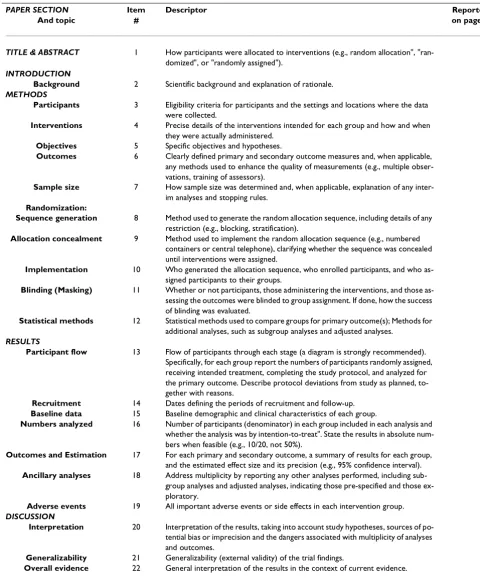
Table 1: Checklist of items to include when reporting a randomized trial
PAPER SECTION Item Descriptor Reported
And topic # on page #
TITLE & ABSTRACT 1 How participants were allocated to interventions (e.g., random allocation", "ran-domized", or "randomly assigned").
INTRODUCTION
Background 2 Scientific background and explanation of rationale.
METHODS
Participants 3 Eligibility criteria for participants and the settings and locations where the data were collected.
Interventions 4 Precise details of the interventions intended for each group and how and when they were actually administered.
Objectives 5 Specific objectives and hypotheses.
Outcomes 6 Clearly defined primary and secondary outcome measures and, when applicable, any methods used to enhance the quality of measurements (e.g., multiple obser-vations, training of assessors).
Sample size 7 How sample size was determined and, when applicable, explanation of any inter-im analyses and stopping rules.
Randomization:
Sequence generation 8 Method used to generate the random allocation sequence, including details of any restriction (e.g., blocking, stratification).
Allocation concealment 9 Method used to implement the random allocation sequence (e.g., numbered containers or central telephone), clarifying whether the sequence was concealed until interventions were assigned.
Implementation 10 Who generated the allocation sequence, who enrolled participants, and who as-signed participants to their groups.
Blinding (Masking) 11 Whether or not participants, those administering the interventions, and those as-sessing the outcomes were blinded to group assignment. If done, how the success of blinding was evaluated.
Statistical methods 12 Statistical methods used to compare groups for primary outcome(s); Methods for additional analyses, such as subgroup analyses and adjusted analyses.
RESULTS
Participant flow 13 Flow of participants through each stage (a diagram is strongly recommended). Specifically, for each group report the numbers of participants randomly assigned, receiving intended treatment, completing the study protocol, and analyzed for the primary outcome. Describe protocol deviations from study as planned, to-gether with reasons.
Recruitment 14 Dates defining the periods of recruitment and follow-up. Baseline data 15 Baseline demographic and clinical characteristics of each group.
Numbers analyzed 16 Number of participants (denominator) in each group included in each analysis and whether the analysis was by intention-to-treat". State the results in absolute num-bers when feasible (e.g., 10/20, not 50%).
Outcomes and Estimation 17 For each primary and secondary outcome, a summary of results for each group, and the estimated effect size and its precision (e.g., 95% confidence interval). Ancillary analyses 18 Address multiplicity by reporting any other analyses performed, including
sub-group analyses and adjusted analyses, indicating those pre-specified and those ex-ploratory.
Adverse events 19 All important adverse events or side effects in each intervention group.
DISCUSSION
Interpretation 20 Interpretation of the results, taking into account study hypotheses, sources of po-tential bias or imprecision and the dangers associated with multiplicity of analyses and outcomes.
Generalizability 21 Generalizability (external validity) of the trial findings.
Revision of the CONSORT statement
Thirteen members of the CONSORT group met in May 1999 with the primary objective of revising the original CONSORT checklist and flow diagram, as needed. The merits of including each item were discussed by the group in the light of current evidence. As in developing the original CONSORT statement, our intention was to keep only those items deemed fundamental to reporting standards for an RCT. Some items not considered essen-tial may well be highly desirable and should still be in-cluded in an RCT report even though they are not included in CONSORT. Such items include institutional ethical review board approval, sources of funding for the trial, and a trial registry number (as, for example, the In-ternational Standard Randomized Controlled Trial Number (ISRCTN) used to register the RCT at its incep-tion [17].
Shortly after the meeting a revised version of the check-list was circulated to the group for additional comments and feedback. Revisions to the flow diagram similarly were made. All of these changes were discussed when CONSORT participants met in May 2000 and the revised statement finalized shortly afterwards.
The revised CONSORT statement includes a 22-item checklist (Table 1) and a flow diagram (Figure 1). Its pri-mary aim is helping authors improve the quality of re-ports of simple two-group parallel RCTs. However, the basic philosophy underlying the development of the statement can be applied to any design. In this regard ad-ditional statements for other designs will be forthcoming from the group, [13]. CONSORT can also be used by peer reviewers and editors to identify reports with inadequate description of trials and those with potentially biased re-sults, [1,2].
During the 1999 meeting the group also discussed the benefits of developing an explanatory document to en-hance the use and dissemination of CONSORT. The doc-ument is patterned on reporting of statistical aspects of clinical research, [18] which was developed to help facil-itate the recommendations of the ICMJEs Uniform Re-quirements for Manuscripts Submitted to Biomedical Journals. Three members of the CONSORT group (DGA, KFS, DM), with assistance from members on some checklist items, drafted an explanation and elaboration document. That document, [19] was circulated to the group for additions and revisions and was last revised af-ter review at the latest CONSORT group meeting.
Changes to CONSORT
• In the revised checklist a new column for "paper section and topic" integrates information from the "subheading" column that was contained in the original statement.
• The "Was it reported?" column has been integrated into a "reported on page #" column, as requested by some journals.
• Each item of the checklist is now numbered and the syntax and order have been revised to improve the flow of information.
• The "Title" and "Abstract" are now combined in the first item.
• While the content of the revised checklist is similar to the original one some items that previously were com-bined are now separate. For example, previously authors were asked to describe "primary and secondary out-come(s) measure(s) and the minimum important differ-ence(s), and indicate how the target sample size was projected". In the new version issues pertaining to out-comes (item 6) and sample size (item 7) are separate, en-abling authors to be more explicit about each. Moreover, some items request additional information. For exam-ple, for outcomes (item 6) authors are asked to report any methods used to enhance the quality of measure-ments, such as multiple observations.
• The item asking for the unit of randomization (e.g., cluster) has been dropped because specific checklists have been developed for reporting cluster RCTs, [20] and other design types, [13] since publication of the orig-inal checklist.
• Whenever possible new evidence is incorporated into the revised checklist. For example, authors are asked to be explicit about whether the analysis reported is by in-tention-to-treat (item 16). This request is based in part on the observations, [21] that (a) authors do not ade-quately describe and apply intention-to-treat analysis and (b) reports that do not provide this information are less likely to report other relevant information, such as losses to follow-up, [22].
Figure 1
Discussion
Specifically developed to provide guidance to authors about how to improve the quality of reporting of simple two-group parallel RCTs, CONSORT encourages trans-parency when reporting the methods and results so that reports of RCTs can be interpreted both readily and ac-curately. However, CONSORT does not address other facets of reporting that also require attention, such as scientific content and readability of RCT reports. Some authors in their enthusiasm to use CONSORT have mod-ified the checklist, [24]. We recommend against such modifications because they may be based on a different process than the one used by the CONSORT group.
The use of CONSORT seems to reduce (if not eliminate) inadequate reporting of RCTs [14,15]. Potentially, the use of CONSORT should have a positive influence on how RCTs are conducted. Granting agencies have noted this potential relationship and in at least in one case, [25] have encouraged grantees to consider in their applica-tion how they have dealt with the CONSORT items.
The evidence-based approach used to develop CON-SORT has also been used to develop standards for re-porting analyses of randomized trials, [26], meta-analyses of observational studies, [27] and diagnostic studies (personal communication - Jeroen Lijmer). Health economists have also started to develop reporting standards, [28] to help improve the quality of their re-ports, [29]. The intent of all of these initiatives is to im-prove the quality of reporting of biomedical research, [30] and by doing so to bring about more effective health care.
The revised CONSORT statement will replace the origi-nal one in those jourorigi-nals and groups that already support it. Journals that do not yet support CONSORT may do so by registering on the CONSORT Internet site, [13]. In or-der to convey to authors the importance of improved quality in the reporting of RCTs, we encourage support-ing journals to reference the revised CONSORT state-ment and the CONSORT Internet address, [13] in their "Instructions to Contributors". As the journals publish-ing the revised CONSORT statement have waived copy-right protection, CONSORT is now widely accessible to the biomedical community. The CONSORT checklist and flow diagram can also be accessed at the CONSORT In-ternet site, [13].
A lack of clarification of the meaning and rationale for each checklist item in the original CONSORT statement has been remedied with the development of the CON-SORT explanation and elaboration document, [19] which can also be found on the CONSORT Internet site, [13]. This document includes reporting the evidence on
which the checklist items are based, including the refer-ences, which annotated the checklist items in the previ-ous version. We encourage journals to also include reference to this document also in their Instructions to Contributors.
Emphasizing the evolving nature of CONSORT, the CONSORT group invites readers to comment on the up-dated checklist and flow diagram through the CONSORT Internet site, [13]. Comments and suggestions will be collated and considered at the next meeting of the group in 2001.
Footnote
The revised CONSORT statement is also published in JAMA (Moher D, Schulz KF, Altman DG, for the CON-SORT group. The CONCON-SORT statement: revised recom-mendations for improving the quality of reports of parallel group randomized trials. JAMA 2001;
285:1987-1991), The Lancet (Moher D, Schulz KF, Alt-man DG, for the CONSORT group. The CONSORT state-ment: revised recommendations for improving the quality of reports of parallel group randomized trials Lancet; 2001; 357:1191-1194), and Annals of Internal Medicine (Moher D, Schulz KF, Altman DG, for the CONSORT group. The CONSORT statement: revised recommendations for improving the quality of reports of parallel group randomized trials. Annals of Internal Medicine; 2001; 134:657-662). Authors can use any one of these references, as well as the reference in BMC Med-ical Research Methodology, when citing CONSORT.
Acknowledgements
The effort to improve the reporting of randomized trials, from its begin-nings with the Standards of Reporting Trials (SORT) group to the current activities of the Consolidated Standards of Reporting Trials (CONSORT) group, have involved a large number of people around the globe. We wish to thank Leah Lepage for keeping everybody all lined up and moving in the same direction.
Financial support to convene meetings of the CONSORT group was pro-vided in part by Abbott Laboratories, American College of Physicians, Glax-oWellcome, The Lancet, Merck, the Canadian Institutes for Health Research, National Library of Medicine, and TAP Pharmaceuticals.
References
1. Schulz KF, Chalmers I, Hayes RJ, Altman DG: Empirical evidence of bias: dimensions of methodological quality associated with estimates of treatment effects in controlled trials.JAMA 1995, 273:408-412
2. Moher D, Pham B, Jones A, Cook DJ, Jadad AR, Moher M, Tugwell P: Does the quality of reports of randomised trials affect esti-mates of intervention efficacy reported in meta-analyses?
Lancet 1998, 352:609-613
3. Jadad AR, Boyle M, Cunningham C, Kim M, Schachar R: Treatment of Attention-Deficit/Hyperactivity Disorder.Evidence Report/ Technology Assessment No.11 (Prepared by McMaster University under Contract No. 290-97-0017), 2000,
4. Thornley B, Adams CE: Content and quality of 2000 controlled trials in schizophrenia over 50 yearsBMJ 1998, 317:1181-1184 5. Hotopf M, Lewis G, Normand C: Putting trials on trial- the costs
review of methodology. J Epidemiol Community Health 1997, 51:354-358
6. Dickinson K, Bunn F, Wentz R, Edwards P, Roberts I: Size and qual-ity of randomised controlled trials in head injury: review of published studies.BMJ 2000, 320:1308-1311
7. Begg CB, Cho MK, Eastwood S, Horton R, Moher D, Olkin I, Rennie D, Schulz KF, Simel DL, Stroup DF: Improving the quality of re-porting of randomized controlled trials: the CONSORT statement.JAMA 1996, 276:637-639
8. Freemantle N, Mason JM, Haines A, Eccles MP: CONSORT: an im-portant step toward evidence-based health care.Ann Intern Med 1997, 126:81-83
9. Altman DG: Better reporting of randomized controlled trials: the CONSORT statement.BMJ 1996, 313:570-571
10. Schulz KF: The quest for unbiased research: randomized clin-ical trials and the CONSORT reporting guidelines.Ann Neurol
1997, 41:569-573
11. Huston P, Hoey J: CMAJ endorses the CONSORT statement.
CMAJ 1996, 155:1277-1279
12. Davidoff F: News from the International Committee of Medi-cal Journal Editors.Ann Intern Med 2000, 133:229-231
13. 2000, [http://www.consort-statement.org]
14. Moher D, Jones A, Lepage L, : Use of the CONSORT statement and quality of reports of randomized trials: a comparative before and after evaluation?JAMA 2001, 285:1992-1995 15. Egger M, Jüni P, Bartlett C, : The value of patient flow charts in
reports of randomized controlled trials: bibliographic study.
JAMA 2001, 285:1996-1999
16. Meinert CL: Beyond CONSORT: Need for improved
report-ing standards for clinical trials.JAMA 1998, 279:1487-1489 17. Chalmers I: Current Controlled Trials: an opportunity to help
improve the quality of clinical research.Curr Control Trials Cardi-ovasc Med 2000, 1:3-8
18. Bailer JC III, Mosteller F: Guidelines for statistical reporting in articles for medical journals: amplifications and explana-tions.Ann Intern Med 1988, 108:266-273
19. Altman DG, Schulz KF, Moher D, Egger M, Davidoff F, Elbourne D, Gøtzsche PC, Lang T, : The revised CONSORT statement for reporting randomized trials: explanation and elaboration.
Annals of Internal Medicine. 2001, 134:663-694
20. Elbourne DR, Campbell MK: Extending the CONSORT state-ment to cluster randomised trials: for discussion.Stats Med
2001, 20:489-496
21. Hollis S, Campbell F: What is meant by intention-to-treat anal-ysis? Survey of published randomized controlled trials.BMJ
1999, 319:670-674
22. Ruiz-Canela M, Martinez-Gonzalez MA, de Irala-Estevez J: Intention-to-treat analysis is related to methodological quality. BMJ
2000, 320
:1007-23. Lee YJ, Ellenberg JH, Hirtz DG, Nelson KB: Analysis of clinical tri-als by treatment actually is it really an option?Stat Med. 1991, 10:1595-1605
24. Bentzen SM: Towards evidence based radiation oncology: im-proving the design, analysis, and reporting of clinical out-come studies in radiotherapy.Radiother Oncol. 1998, 46:5-18 25. O'Toole LB: MRC uses checklist similar to CONSORTs.BMJ
1997, 314
:1127-26. Moher D, Cook DJ, Eastwood S, Olkin I, Rennie D, Stroup DF, : Im-proving the quality of reports of meta-analyses of rand-omized controlled trials: the QUOROM statement. Lancet
1999, 354:1896-1900
27. Stroup DF, Berlin JA, Morton SC, Olkin I, Williamson GD, Rennie D, Moher D, Becker BJ, Sipe TA, Thacker SB: Meta-analysis of obser-vational studies in epidemiology: a proposal for reporting. JA-MA. 2000, 283:2008-2012
28. Siegel JE, Weinstein MC, Russell LB, Gold MR: Recommendations for reporting cost-effectiveness analysis.JAMA 1996, 276 :1339-1341
29. Neumann PJ, Stone PW, Chapman RH, Sandberg EA, Bell CM: The Quality of Reporting in Published Cost-Utility Analyses, 1976-1997.Ann Intern Med 2000, 132:964-972
30. Altman DG: The scandal of poor medical research.BMJ 1994, 308:283-284
Correspondence
Correspondence should be addressed to: Leah Lepage, Thomas C Chalmers Center for Systematic Reviews, Children's Hospital of Eastern Ontario research Insti-tute, Room R235; 401 Smyth Road, Ottawa, Ontario, KIH 8LI, Canada. Email: [email protected]
Publish with BioMedcentraland every scientist can read your work free of charge
"BioMedcentral will be the most significant development for disseminating the results of biomedical research in our lifetime."
Paul Nurse, Director-General, Imperial Cancer Research Fund
Publish with BMc and your research papers will be:
available free of charge to the entire biomedical community
peer reviewed and published immediately upon acceptance
cited in PubMed and archived on PubMed Central
yours - you keep the copyright
[email protected] Submit your manuscript here:
http://www.biomedcentral.com/manuscript/
BioMedcentral.com