Montana Law Review
Volume 54
Issue 2
Summer 1993
Article 4
July 1993
Auditor Malpractice: Identifying High-Risk
Engagements by the Use of Multivariate Analysis
Richard S. Dalebout
Brigham Young University
James D. Stice
Brigham Young University
Follow this and additional works at:
https://scholarship.law.umt.edu/mlr
Part of the
Law Commons
This Article is brought to you for free and open access by The Scholarly Forum @ Montana Law. It has been accepted for inclusion in Montana Law Review by an authorized editor of The Scholarly Forum @ Montana Law.
Recommended Citation
Richard S. Dalebout and James D. Stice,Auditor Malpractice: Identifying High-Risk Engagements by the Use of Multivariate Analysis,54 Mont. L. Rev. (1993).
AUDITOR MALPRACTICE: IDENTIFYING
HIGH-RISK ENGAGEMENTS BY THE USE OF
MULTIVARIATE ANALYSIS
Richard S. Dalebout*
James D. Stice**
I. INTRODUCTION
In 1991, the six largest accounting firms in the nation spent
$477 million settling and defending lawsuits.
1These lawsuits, most
asserting error in the auditing process, were initiated by clients of
the auditor
2and by third parties with whom the auditor had not
dealt.
3Even if an auditor is not legally at fault, considerable
ex-pense and professional embarrassment is associated with a
mal-practice lawsuit.
4Thus, although an auditor who is a defendant
wishes to avoid legal liability, he or she would obviously much
rather not be a defendant at all.
This Article goes beyond the pyrrhic victory of "winning" a
lawsuit and focuses on a statistics-based strategy for avoiding an
auditor malpractice lawsuit altogether. This Article proposes a
sta-tistical model that classifies audit engagements according to their
potential to result in a lawsuit against an auditor. By using this
model, an auditor may avoid audit engagements that pose a high
risk of a lawsuit against the auditor. The model described in this
Article is different'from other methods of identifying high-risk
en-gagements because it is based on the formal consideration of
mul-tiple variables ("multivariate" analysis) instead of a single variable
("univariate" analysis).
* Associate Professor of Business Law, Brigham Young University.
** Assistant Professor of Accounting, Brigham Young University.
1. ARTHUR ANDERSEN & CO. ET AL., THE LIABILITY CRISIS IN THE UNITED STATES: IM-PACT ON THE ACCOUNTING PROFESSION 2 (1992).
2. See, e.g., 1136 Tenants' Corp. v. Max Rothenberg & Co., 319 N.Y.S.2d 1007 (App. Div. 1971) (regarding an apartment house owner suing certified public accountants for negli-gent performance of services).
3. Compare Credit Alliance Corp. v. Arthur Andersen & Co., 483 N.E.2d 110, 118-19
(N.Y. 1985) (requiring privity for liability to third persons) with H. Rosenblum, Inc. v. Ad-. ler, 461 A.2d 138, 153 (N.J. 1983) (holding privity not required for liability to third persons; however, an auditor is liable to reasonably foreseeable recipients of audited financial statements).
4. ANDERSON ET AL., supra note 1, at 3-4.
5. Auditors refer to the agreement and relationship between themselves and their
cli-ent as an "engagemcli-ent."
1 Dalebout and Stice: Auditor Malpractice
I MONTANA LAW REVIEW
A. Univariate Analysis
In the past, researchers have attempted to identify high-risk audit engagements by isolating and studying one characteristic at a time.' If the single characteristic approach is correct, then the sin-gle characteristic (once it is correctly identified) can be used to warn of trouble, like the red letter on Hestor Pryne's dress.7 Sev-eral studies have used the single characteristic approach. For ex-ample, in one study researchers looked at the size of the audit cli-ent and concluded that a greater risk of suit exists in auditing a "big" company than exists in auditing a "small" company.8 In an-other study researchers looked at the "quality" of the auditors and concluded that "better quality" auditors are sued less frequently than other auditors.'
If the first of these two studies is more accurate, then an audi-tor relying on the first study to avoid being sued will agree to audit small companies and decline to audit big companies. On the other hand, if the second study is more accurate, then a prospective au-ditor will ignore the size of the proposed audit client and focus on improving quality. There is no help for an auditor in deciding which of these characteristics (company size or auditor quality) is truly the single characteristic that identifies high-risk audit en-gagements. Nor is there any help for an auditor in relation to the well-founded suspicion1 ° that both of these characteristics, and others, are all determinants of high-risk audit engagements. The weakness inherent in these two studies, and in any other study that focuses on only one variable at a time, is tht an event is often predicted by several cues. A forecast of a particular event that fails to account for all the relevant cues necessarily will be flawed.
6. One study, for example, focused on the single characteristic of the length of time in the auditor-client relationship, suggesting audit engagements in which the auditor is newly acquainted with a client are particularly litigation-prone. Kent St. Pierre & James A. Anderson, An Analysis of the Factors Associated with Lawsuits Against Public
Account-ants, 59 ACCT. REV. 242, 256 (1984). Another study focused on whether the auditor was a
member of a large national ("Big Eight") accounting firm, suggesting that members of these accounting firms are better auditors and thus less subject to litigation. Zoe-Vonna Palmrose,
An Analysis of Auditor Litigation and Audit Service Quality, 63 ACCT. REV. 55, 72 (1988). 7. In Nathaniel Hawthorne's, The Scarlet Letter, Hestor Pryne committed adultery with a Puritan clergyman. Pregnancy revealed Hestor (although the sin of the clergyman remained undiscovered) and she was thereafter required to wear the scarlet letter "A" on her dress to warn others of her fallen state. NATHANIEL HAWTHORNE, THE SCARLET LETTER
(1850).
8. Joseph J. Schultz, Jr. & Sandra G. Gustavson, Actuaries' Perceptions of Variables Affecting the Independent Auditor's Legal Liability, 53 ACCT. REV. 626, 632 (1978).
9. Palmrose, supra note 6, at 71-72. 10. See discussion infra part II.
[Vol.'54
276
2 Montana Law Review, Vol. 54 [1993], Iss. 2, Art. 4
AUDITOR MALPRACTICE
B. Multivariate Analysis
Multivariate analysis" differs from univariate analysis in that multivariate analysis simultaneously analyzes all independent vari-ables, not just one. In relation to the identification of high-risk audit engagements, multivariate analysis simultaneously analyzes many characteristics or variables, in order to identify which pro-posed audit engagements present a high risk of a law suit.
The research on which this Article is based identifies nine characteristics that, when taken together, identify high-risk audit engagements." The nine characteristics are:
1. Financial condition of the audited company, 2. Growth in the sales of the audited company, 3. Market value of the audited company, 4. Auditor tenure,
5. Amount of accounts receivable in relation to the total assets of the audited company,
6. Amount of inventory in relation to the total assets of the audited company,
7. Extent of fluctuations in the market value of the audited company,
8. Auditor independence, and 9. Auditor quality.
Multivariate analysis considers all identified characteristics and also discriminates between those characteristics to show their relative importance. The likelihood that an auditor will be sued is hypothesized to be affected by all of the nine characteristics. The nine characteristics are not all equally important, however, and the process of analysis must discriminate between them. Multivariate analysis performs both of these functions in relation to high-risk audit engagements by: (1) simultaneously evaluating all relevant characteristics and (2) discriminating between those characteristics to determine their relative importance.
11. See infra note 40 and accompanying text (the form of analysis used is "ordinary
least squares").
12. "Multivariate" analysis addresses the relationship between auditors and their cli-ents by simultaneously analyzing all independent variables and their relationship to a de-pendent variable. Rather than ignore the interactive effects of the indede-pendent variables (as is the case with univariate analysis), multivariate analysis analyzes each variable in turn while holding the value of all other independent variables constant. This technique recog-nizes that an event of interest is typically a function of several cues which act to influence the outcome, thus addressing the omitted variable limitation associated with univariate analysis. See ROBERT S. PINDYCK & DANIEL L. RUBINFELD, ECONOMETRIC MODELS AND
Eco-NOMIC FORECASTS 75-106 (2d ed. 1981).
13. See discussion of each of these nine characteristics infra part II.
1993]
3 Dalebout and Stice: Auditor Malpractice
MONTANA LAW REVIEW
C. Outline of the Article
This Article examines in detail the nine characteristics of a high-risk audit engagement listed above. Data used in relation to the nine characteristics are taken from a Test Sample of compa-nies and auditors who have been involved in auditor litigation, and from a Control Sample of companies and auditors who have not been involved in auditor litigation. The data are used in a mul-tivariate analysis to construct a model that can identify high-risk engagements in practice. This Article then explains use of the model in practice, verifies the model, and discusses limitations of the model. Each of these concerns is discussed as follows:
1. Part II examines in detail the nine identified characteristics of a high-risk audit engagement.
2. Part III describes the Test Sample. The Test Sample con-sists of data describing forty-nine businesses, and the auditors of those businesses. Each of the auditors was sued as a result of au-diting a business in the Test Sample.
3. Part III also describes the Control Sample. The Control Sample consists of data describing forty-nine different businesses and their auditors. The data in the Control Sample differ from that in the Test Sample because the auditors in the Control Sam-ple were not sued after auditing the businesses in the Control Sample. Data from the Control Sample are used to test the accu-racy of calculations based on data from the Test Sample.
4. Part IV describes a multivariate model. The model uses the "ordinary least squares" method to simultaneously analyze the nine characteristics of high-risk engagements that are described in Part II. Data for the calculations come from the Test Sample and the Control Sample. The model reveals the relative importance of the nine characteristics described in Part II, showing which of those characteristics are significant and which are not.
5. Part V describes how the model can be used in practice. This is done by applying the model to a company from the Test Sample and a company from the Control Sample. The "litigation score" (use of the model results in a "litigation score") for the company from the Test Sample is substantially higher than the litigation score for the company from the Control Sample.
6. Part VI describes verification of the model. Quantitative differences between the data in the Test Sample and the data in the Control Sample are demonstrated by comparing the accumu-lated litigation scores of all of the businesses (and auditors) in the Test Sample with the accumulated litigation scores of all of the businesses (and auditors) in the Control Sample.
[Vol. 54
4 Montana Law Review, Vol. 54 [1993], Iss. 2, Art. 4
AUDITOR MALPRACTICE
7. Part VII explains limitations on the use of the model.
II. CHARACTERISTICS OF A HIGH-RISK ENGAGEMENT
Designing a multivariate model to forecast high-risk audit en-gagements requires identifying the pre-engagement characteristics of auditors and their business clients that are associated with an increased risk of a lawsuit. This Part contains a list of characteris-tics of auditors and their business clients that were hypothesized to relate to subsequent litigation. Each characteristic is discussed separately with an explanation why that particular characteristic has a significant relationship with high-risk audit engagements. A description of the nine characteristics follows.
A. Poor Financial Condition
Auditing a business in poor financial condition may present a high degree of risk that the auditor will be sued.4 If the business is in declining financial health there is an increased chance it will fail altogether, giving rise to losses on the part of investors or credi-tors." Losses by investors or creditors invite litigation. This char-acteristic was derived from research that established a negative re-lationship between lawsuits filed against auditors and the financial condition of the company audited: the better the financial condi-tion of the company, the less likely that the auditor will be sued.'6 And vice versa: the worse the financial condition of the company, the more likely that the auditor will be sued.'7
How can an auditor know if a prospective client is in poor fi-nancial condition before performing a proposed audit? In many cases the financial ills of the company are plain to see. At other times, however, the financial malaise of the prospective client is only suspected. In all of these cases, analytical models may be used that evaluate the financial condition of a business. An example of such a model is the "Altman Z-score," which is used to evaluate businesses as a going concern and to predict the likelihood of bankruptcy.'8 Using the Altman Model, a low score indicates a
14. Zoe-Vonna Palmrose, Litigation and Independent Auditors: The Role of Business
Failures and Management Fraud, AUDITING J. PRAC. & THEORY, Spring 1987, at 90, 91, 96; St. Pierre & Anderson, supra note 6, at 242, 246-47.
15. Palmrose, supra note 14, at 96. 16. Palmrose, supra note 6, at 64. 17. Id.
18. See Edward I. Altman & Thomas P. McGough, Evaluation of a Company As a
Going Concern, J. ACCT., Dec. 1974, at 50, 51-52. See generally James A. Ohlson, Financial
Ratios and the Probabilistic Prediction of Bankruptcy, J. ACCT. RES., Spring 1980, at 109;
Michelle M. Hamer, Failure Prediction: Sensitivity of Classification Accuracy to
Alterna-1993] 279
5 Dalebout and Stice: Auditor Malpractice
MONTANA LAW REVIEW
high probability of bankruptcy and a high score indicates a low probability of bankruptcy. In the model and tables that follow, the company's financial condition is assigned the name FC. The opera-tional measure of FC is the Altman Z-score for the year preceding the year of the alleged error.
B. Growth in the Sales of the Client
Changes in a business may disrupt the flow of information through its accounting system. If the business' control procedures are not designed to anticipate these changes, the possibility of er-rors or irregularities increases, and with this comes an increased risk of litigation. Sales growth is a significant measure of change. Rapid sales growth on the part of a prospective client reflects an increased risk of litigation for the auditor. In the model and tables that follow, the characteristic of the sales growth of a company is assigned the name GROWTH. The operational measure of GROWTH is the extent of sales growth calculated by comparing sales figures from the end of one accounting year to the figures from the end of the next accounting year.19
C. Client Market Value
The greater the market value of the audited company, the greater the likelihood that its auditor subsequently may be sued.20 This is because the same auditor error will cause greater financial damage to a large company than a small company. The greater the amount of the loss incurred by investors, the more they will be
inclined to file suit.21
A high correlation exists between the market value of an au-dited company and the amount of decline (damage) to that market value caused by claimed auditor error.22 As an example, suppose that two separate companies are audited: Company A has a total market value of one million dollars and Company B has a total market value of 500 million dollars. If the auditors of these compa-nies each make a five percent error (one study indicates that the
tive Statistical Methods and Variable Sets, J. ACCT. & PuB. POL'Y, Winter 1983, at 289,
289-92.
19. In more precise terms, change in sales is measured as the difference between sales in the period preceding the period of the error (period t) and sales in period t-1, divided by sales in period t-1.
20. See Robert L. Kellogg, Accounting Activities, Security Prices, and Class Action
Lawsuits, 6 J. ACCT. & ECON. 185, 187-88 (1984). 21. See id.
22. See id. at 202 (Kellogg finds a correlation of .896 between client market value and damages from alleged audit error.).
280 [Vol. 54
6 Montana Law Review, Vol. 54 [1993], Iss. 2, Art. 4
AUDITOR MALPRACTICE
errors of auditors do not vary according to the size of the audited company),2" the amount of loss to Company A is $50,000, but the
amount of loss to Company B is 25 million dollars. Accordingly, in this example, the audit of Company B presents a higher risk of litigation than the audit of Company A. In the model and tables that follow, the characteristic of the market value of a company is assigned the name SIZE. The operational measure of SIZE is the market value of the audited company at the beginning of the year
in which an audit error is claimed.
D. Auditor Tenure
An auditor with a history of audit experience with a particular client may tend to conduct a better audit, and a better audit reduces the risk of lawsuits against the auditor.2 4 When a new au-ditor is becoming accustomed to the client's procedures, an in-creased risk of committing errors exists as a result of unfamiliarity.2 5
In the model and tables that follow, the characteristic of the auditor's experience with the audited company is assigned the name TENURE. Generally, an auditor becomes more efficient through each of the first five years of experience with a client, and the risk of suit correspondingly diminishes as the increased effi-ciency is translated into better audits. This relationship, however, is not linear. After the first five years of experience the auditor's efficiency does not continue to grow at the same rate.26 Accord-ingly, the operational measure of TENURE is the value of 0 if the tenure of the auditor is five years or less, and 1 otherwise.
E. Accounts Receivable
A company in which accounts receivable represent a relatively large percentage of total assets may present a prospective auditor with a greater risk of subsequent litigation. 7 This increased risk exists because accounts receivable require a subjective judgment to determine their value. In addition, accounts receivable that re-present a large percentage of total assets re-present a greater risk of
23. See id. The conclusion that the errors of auditors do not vary according to the size
of the audited company is reached by an independent calculation of the data in table A.1 of Kellogg's article. See id.
24. See St. Pierre & Anderson, supra note 6, at 247.
25. Id.
26. Id. at 247-49.
27. Dan A. Simunic, The Pricing of Audit Services: Theory and Evidence, 18 J. ACCT. RES. 161, 173 (1980); St. Pierre & Anderson, supra note 6, at 247.
1993]
7 Dalebout and Stice: Auditor Malpractice
MONTANA LAW REVIEW
potential litigation because a small percentage error in an account with a relatively large balance can result in a material misstate-ment. In the model and tables that follow, the characteristic of ac-counts receivable in relation to total assets is assigned the name A/ R. The operational measure of A/R is the ratio of accounts receiva-ble to total assets that is taken from the balance sheet from the audit for the year previous to the audit year in which an error is claimed.
F. Inventory
The characteristics of inventory are similar to the characteris-tics of accounts receivable. A company in which inventory repre-sents a relatively large percentage of total assets may present a prospective auditor with a greater risk of subsequent litigation. This increased risk exists because inventory, like accounts receiva-ble, requires a subjective judgment to determine its value. In addi-tion, because inventory typically represents a large percentage of total assets, it presents a greater risk of potential litigation because a small percentage error in an account with a relatively large bal-ance can result in a material misstatement.2 8 In the model and ta-bles that follow, the characteristic of inventory in relation to total assets is assigned the name INV. The operational measure of INV is the ratio of inventory to total assets that is taken from the bal-ance sheet from the audit for the year previous to the audit year in which an error is claimed.
G. Client Market Value Variation
A company that experiences wide fluctuations or variations in its market value presents a greater risk that its auditor will be sued. This is because investors in such a company are periodically faced with large unexplained losses (or gains). Investors who, for example, purchase stock when a company market value is high may thereafter sue the auditor when the market value of the com-pany falls, claiming that material information was not disclosed in audited financial statements.2" The higher the variability in the market value of a company, the greater the probability of a lawsuit against the auditor. In the classification model and tables that
fol-28. Simunic, supra note 27, at 173.
29. Nicholas Dopuch et al., Predicting Audit Qualifications with Financial and
Mar-ket Variables, 62 ACCT. REV. 431, 437 (1987) ("Lawsuits against auditors usually take place after the value of the equity falls precipitously because plaintiffs need only establish reli-ance on financial statements that did not disclose major uncertainties.").
[Vol. 54
8 Montana Law Review, Vol. 54 [1993], Iss. 2, Art. 4
AUDITOR MALPRACTICE
low, the characteristic of fluctuations or variation in the market value of the audit company is assigned the name VAR. The opera-tional measure of VAR is the extent to which the rise and fall of the value of company stock varies from the rise and fall of the ma-jor stock markets as measured by the Standard and Poor's 500 In-dex. These so-called "abnormal returns" are measured for the six month period prior to the beginning of the year in which an error is claimed."
H. Auditor Independence
Auditor independence focuses on the willingness of an auditor to report an error made by the company in its financial statements once the error is discovered. Studies suggest that auditor dence may reduce the potential for suit because a truly indepen-dent auditor will report material information with candor, over the objections of the client if necessary. 1 The factor most often cited as affecting auditor independence is the degree of the auditor's de-pendence on the audit fees of the client being audited: "[I]t is doubtful whether there can be independence in both fact and ap-pearance if the fees from one client make up a significant part of the total income of the firm."3 If an auditor risks losing a
signifi-cant portion of total audit fees as a result of a disagreement with a client, the auditor is more likely to be "convinced" of the client's point of view. Under these circumstances, the auditor increases the possibility of litigation.
In the model and tables that follow, the characteristic of audi-tor independence is assigned the name INDEPNT. Calculating au-ditor independence requires some knowledge of the audit fees in-volved. Because audit fees are not public information, an approximation is used. The gross sales of a company is a common measure of its size and audit fees are usually a function of com-pany size;33 therefore, the gross sales of a company may be used as a substitute for the size of the audit fee.
The operational measure of INDEPNT is a ratio calculated by using the gross sales of all the audit clients of the auditor as a
30. Id. (The higher the variance in abnormal returns, the greater the probability that
any loss incurred can be attributable to factors other than market.).
31. See, e.g., Michael Firth, Auditor-Client Relationships and Their Impact on Bank-ers' Perceived Lending Decisions, 11 ACCT. & Bus. REs. 179, 186 (1981); Randolph A.
Schockley, Perceptions of Audit Independence: A Conceptual Model, 5 J. AcCT. AUDITING &
FIN. 126, 140-42 (1982).
32. ALVIN A. ARENS & JAMES K. LOEBBECKE, AUDITING: AN INTEGRATED APPROACH 82
(3d ed. 1984).
33. Simunic, supra note 27, at 161-90.
1993]
9 Dalebout and Stice: Auditor Malpractice
MONTANA LAW REVIEW
denominator and the gross sales of the company being classified as the numerator. For example, if the gross sales of all companies au-dited amount to $1,000,000, and the gross sales of the company being classified amount to $100,000, the degree of dependence is one over ten and the degree of independence (INDEPNT) is nine over ten.
I. Auditor Quality
A better auditor may conduct-a better audit and thereby re-duce the litigation risk. Investigation of auditor quality has identi-fied non-Big Eights" auditors as being more likely to be involved in litigation than Big Eight auditors.3 5 In the model and tables that follow, the characteristic of auditor quality is assigned the name QUALITY. The operational measure of QUALITY is the value of 0 if the auditor is a non-Big Eight auditor, and 1 if the auditor is a Big Eight auditor.
III. TEST AND CONTROL SAMPLES
Multivariate analysis requires data for use in making compari-sons. The procedure used, in relation to each of the nine character-istics above, is to obtain two samples of data: the first sample from auditors and their clients where lawsuits have resulted, and the second sample from auditors and their clients where lawsuits have not resulted. The two samples are then compared using mul-tivariate analysis to discern differences and determine the extent of those differences in relation to each of the nine characteristics. The differences and the extent of these differences form the basis of a model (still using multivariate analysis) that can forecast high-risk audit engagements. With the model in hand, an auditor facing a proposed audit engagement can insert information relating to the auditor and the proposed client into the model and calculate the degree of risk of being sued. The specific details of the two data samples follow.
34. The accounting firms of Arthur Andersen, Peat Marwick, Ernst & Whinney, Coopers & Lybrand, Price Waterhouse, Arthur Young, Deloitte Haskins & Sells, and Touche Ross traditionally were known as the Big Eight. As a result of mergers the former Big Eight are reduced in number to six and are now known as Arthur Andersen, Peat Marwick Main & Co., Ernst & Young, Coopers & Lybrand, Price Waterhouse, and Deloitte & Touche.
35. Palmrose, supra note 6, at 72.
284 [Vol. 54
10 Montana Law Review, Vol. 54 [1993], Iss. 2, Art. 4
1993] AUDITOR MALPRACTICE
A. Test Sample
A Test Sample was prepared which includes data concerning
forty-nine businessess a and the auditors of those businesses. The businesses were chosen from those listed on a national securities exchange because those businesses have uniform information re-porting requirements. Between the years 1965 and 1985, an auditor of each of these businesses was the subject of a lawsuit claiming auditor error relating to the audit of that business.
B. Control Sample
A Control Sample was prepared which includes data from
forty-nine different businesses" and the auditors of those busi-nesses. These businesses were matched according to time period and industry with the businesses in the test sample.9 Apart from that matching, the businesses in the Control Sample were selected at random. No history of audit-related litigation existed in relation to these businesses and their auditors.
IV. MULTIVARIATE MODEL
Multivariate analysis requires that data (the Test and Control
36. The businesses were engaged in either wholesale trade, retail trade, construction, -mining, manufacturing, or transportation.
37. A business was included in the Test Sample if market and financial information relating to the audited business was available for the year prior to the claimed act of mal-practice. For example, if an error was claimed for an engagement which began on January, 1984, the resulting lawsuit was used in the Test Sample if market and financial information regarding the audited business was available for the year January 1, 1983, through Decem-ber 31, 1983.
No attempt was made to determine whether the auditor who was sued in any of the 49 cases was "right" or "wrong.' in any legal, professional, or moral sense. The sole objective in the examination was to identify the pre-engagement market and financial characteristics which the companies in the Test Sample had in common. Information concerning the law-suits was taken from the Wall Street Journal Index and the Securities and Exchange Com-mission Accounting Series Releases. Financial institutions were not included because they are dissimilar. Financial institutions, for example, do not have inventory and their assets are almost exclusively accounts receivable. Market and financial statement data for the Test Sample and the Control Sample were collected from the following sources: COMPUSTAT, Center for Research in Stock Prices, Moody's Industrial Manual, Moody's Transportation Manual, Moody's Bank and Finance Manual, and the Daily Stock Price Record for the New York Stock Exchange, American Stock Exchange, and NASDAQ (National Association of Securities Dealers Automated Quotes).
38. The businesses were engaged in either wholesale trade, retail trade, construction, mining, manufacturing, or transportation.
39. The businesses in the Control Sample were matched as to time period and
try with businesses in the Test Sample because those characteristics (time period and indus-try) are recognized as variables which might otherwise skew the comparison between .the two samples.
11 Dalebout and Stice: Auditor Malpractice
MONTANA LAW REVIEW
Samples described in Part III) relating to all hypothesized vari-ables affecting an outcome (the nine characteristics described in Part II) be analyzed at the same time. This analysis resulted in the Multivariate Model that is described in Table 1 and discussed in this Part.
The actual form of multivariate analysis used in the creation of the model is called "ordinary least squares." 0 The ordinary least squares method is used to estimate both the coefficient asso-ciated with each characteristic and the statistical significance of that coefficient. According to the model, the higher the litigation score, the greater the likelihood that a lawsuit may be filed against the auditor.
40. WILLIAM MENDENHALL ET AL., MATHEMATICAL STATISTICS WITH APPLICATIONS 425-30
(2d ed. 1981) ("least squares" is a statistical method used to determine the relative value of
a number of variables).
[Vol. 54
12 Montana Law Review, Vol. 54 [1993], Iss. 2, Art. 4
1993] AUDITOR MALPRACTICE 287
TABLE 1
MULTIVARIATE MODEL
L = 3.625- .083FC + .182GROWTH + .069SIZE - .15ITENURE + .4151NV + 65.27VAR
+ .541A/R -4.OOOINDEPNT -.062QUALITY.
Where L = The litigation score
FC = The Z-score of the client
(p=.002)
GROWTH = The change in sales for client
(p= .034)
SIZE = The natural log of the market value of the firm (p=.0 4 9)
TENURE = The number of years the auditor has worked for the client
(p=.081)
INV = The ratio of inventory to total assets
(p =.108)
VAR = The variance of abnormal returns for the client (p =.129)
A/R = The ratio of accounts receivable to total assets
(p =. 159)
INDEPNT = I -client sales/total sales of all clients of given auditor
(p= .247)
QUALITY = the quality classification of the auditor
(p= .348)
13 Dalebout and Stice: Auditor Malpractice
MONTANA LAW REVIEW
A. Explanation of the Multivariate Model
A study to identify high-risk audit engagements should: (1) si-multaneously analyze all relevant characteristics, and (2) discrimi-nate between those characteristics to determine their relative im-portance. In relation to high-risk audit engagements, the multivariate statistical method of ordinary least squares satisfies both of those requirements: (1) all of the characteristics described in Part II are simultaneously analyzed in the model, and (2) the relative importance of the characteristics in the model is evaluated by a t-test.
B. T-Test
A t-test is a component of the ordinary least squares method of multivariate analysis.4 1 A t-test shows the statistical significance of different variables (for example, data from the Test Sample and data from the Control Sample discussed in Part III). Taking the change in sales4 2 of a client as an illustration, the multivariate analysis compares data from the Test Sample with data from the Control Sample. The t-test result indicates whether data from the Test Sample (companies and auditors that were sued) is signifi-cantly different from data from the Control Sample (companies and auditors that were not sued).
A t-test result is given in terms of probability, and is ex-pressed by using the letter "p." Thus, for example, the probability that GROWTH data from the Test Sample differ from GROWTH data from the Control Sample is expressed as "p=.034." The lower the "p-value," the greater the likelihood that data in the two sam-ples significantly differ. A traditional benchmark in relation to p-values is p=.10; a p-value that is p=.10 or less is considered statis-tically significant. Accordingly, the characteristic of GROWTH, with a p-value of p=.034, is statistically very significant. In other words,' the chance of the GROWTH data from the Test Sample and the GROWTH data from the Control Sample coming from a common pool is less that 4 in 100. Thus, in relation to company GROWTH, a very high degree of probability exists that the data from the Test Sample (companies and auditors that are sued) dif-fer from the data from the Control Sample (companies and audi-tors that are not sued).
Expressed more simply, the result of p=.034 in relation to GROWTH means that companies associated with litigation against
41. PINDYCK & RUBINFELD, supra note 12, at 38.
42. Change in sales is identified in the model as GROWTH.
[Vol. 54
14 Montana Law Review, Vol. 54 [1993], Iss. 2, Art. 4
AUDITOR MALPRACTICE
auditors have a greatly different pattern of sales growth than do companies where no history of litigation against auditors exists. Accordingly, examination of this characteristic is valuable in fore-casting potential lawsuits.
C. P-Values of the Characteristics
The p-value of each of the nine characteristics is given in the model (Table 1). For convenience in reading, the characteristics are arranged in the Model with the most significant characteristics at the top and the least significant characteristics at the bottom. The p-value of each of the nine characteristics may be examined and a judgment reached about how significant each characteristic is in forecasting potential lawsuits.
As noted above with respect to GROWTH, four of the nine characteristics-FC, GROWTH, SIZE, and TENURE-have p-values of less than p=.10. Thus: (1) the financial condition of the company to be audited (FC), (2) the sales growth of the company to be audited (GROWTH), (3) the overall market value of the company to be audited (SIZE), and (4) the number of years the auditor has audited the company (TENURE), are all highly signifi-cant characteristics in the search for high-risk audit engagements. Indeed, with a p-value of p=.002, the financial condition (FC) of the company to be audited is an exceptionally significant characteristic.
Three of the characteristics-INV, VAR, and A/R-have p-values which are greater than p=.10, but barely so."- Because they are close to being statistically significant (by the traditional mea-sure of p=.10), the following characteristics are helpful in identify-ing a high-risk audit engagement: (1) the ratio of inventory to total assets of the company to be audited (INV), (2) the fluctuations in the market value of the company to be audited (VAR), and (3) the ratio of accounts receivable to total assets of the company to be audited (A/R).
Two of the characteristics-INDEPNT and QUALITY-have p-values which are substantially greater than p=.10. Thus: (1) the independence of the auditor (INDEPNT) and (2) the quality of the auditor (QUALITY) do not appear to have statistically verifia-ble significance for the purpose of identifying high-risk engagements.
43. INV, for example, has a p=value of p-.108.
1993] 289
15 Dalebout and Stice: Auditor Malpractice
290 MONTANA LAW REVIEW [Vol. 54
V. USE OF THE MODEL FOR CLASSIFICATION
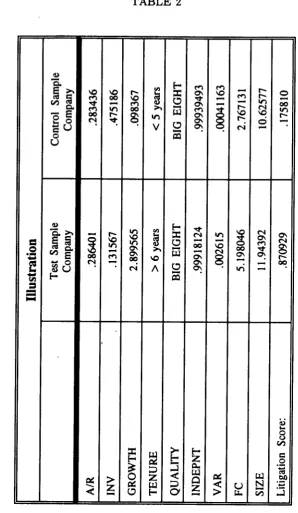
How can the model be used in practice? Two companies were selected to illustrate how the model can be applied to identify high-risk audit engagements. One company was taken from the Test Sample (auditors of this company had been sued), and the other company was taken from the Control Sample (auditors of this company had not been sued). The companies were chosen from the same industry and from the same time period so that market and financial comparisons would be relevant. Except for these limitations, the companies were selected at random from the two samples. The operational measure of each of the characteris-tics described in Part II was placed in the model with respect to each company, with the results described in Table 2.
16 Montana Law Review, Vol. 54 [1993], Iss. 2, Art. 4
1993] AUDITOR MALPRACTICE 291
TABLE 2
17 Dalebout and Stice: Auditor Malpractice
MONTANA LAW REVIEW
As noted at the beginning of Part IV, the higher the litigation score, the greater the likelihood that a lawsuit may be filed against the prospective auditor. The purpose of the illustration above is to see if a randomly selected company and auditor who have been sued would, in fact, have a higher litigation score than a company and auditor who have not been sued.
In the illustration above, the litigation score for the company from the Test Sample (companies and auditors who have been sued) is much higher (.870929) than the litigation score (.175810) for the company from the Control Sample (companies and auditors who have not been sued). Accordingly, an auditor might be more willing to audit the Control Sample company than the Test Sam-ple company because the risk of suit is significantly lower.
What differences between the two companies lead to their dif-ferent litigation scores? With respect to A/R, QUALITY, and IN-DEPNT, the two companies are not significantly different. Refer-ence to the p-values in the model, however, shows that these three characteristics with high p-values-A/R, QUALITY, and IN-DEPNT-are the least significant of all variables tested.
The first characteristic that distinguishes the two businesses in the table above is GROWTH. The Test Sample company has experienced significant growth in sales, both absolutely and in rela-tion to the Control Sample company. The p-values in the model show that the filing of lawsuits is strongly associated with a signifi-cant growth in sales. Second, the Test Sample company has a much higher market value (SIZE) than the Control Sample firm and, third, the Test Sample company has been audited less than six years by the proposed auditor (TENURE). All three of these characteristics-growth in sales, high market value, and a rela-tively new auditor-are significant indicators of future litigation.
On the other hand, the Control Sample company has a much higher percentage of its assets tied up in inventory (INV). This variable, however, with a p-value of .108 in the model, does not contribute as much to the litigation risk as do the other variables.
VI. VERIFICATION OF THE MODEL
A premise on which the model is based is that data from the Test Sample (companies and auditors who have been sued) quan-titatively differs from data from the Control Sample (companies and auditors who have not been sued). To test the premise that data from the two samples is quantitatively different, a litigation score was calculated for each business/auditor pair in the Test Sample and each business/auditor pair in the Control Sample. Fi-[Vol. 54
18 Montana Law Review, Vol. 54 [1993], Iss. 2, Art. 4
1993] AUDITOR MALPRACTICE 293
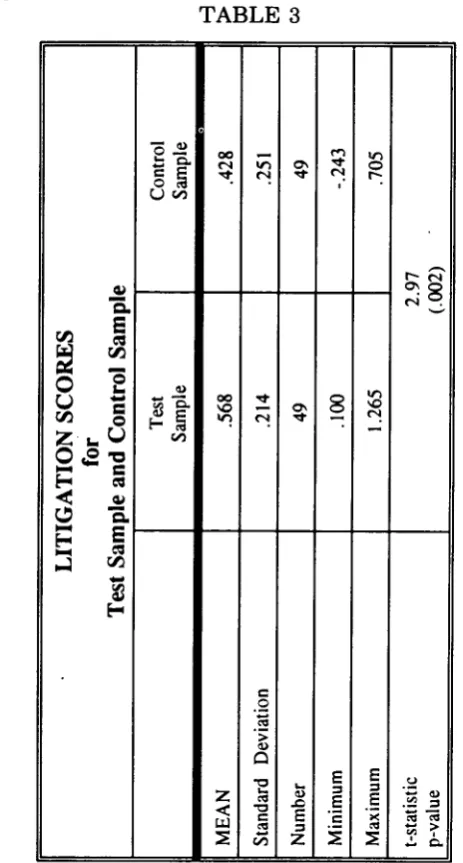
nally, all litigation scores for the businesses and auditors in the Test Sample were totaled and averaged, and all litigation scores for the businesses and auditors in the Control Sample were totaled and averaged. The average litigation score for businesses and audi-tors in the Test Sample will be higher than the average litigation score for businesses and auditors in the Control Sample if, quan-titatively, the data in the two samples truly differ. Table three is a comparison of the average litigation scores for the Test and Con-trol Samples.
TABLE 3
00 W
U'-o
E€
E E)
z a
C
19 Dalebout and Stice: Auditor Malpractice
MONTANA LAW REVIEW
Do the businesses and auditors described in the Test Sample
quantitatively differ from the businesses and auditors described in
the Control Sample? Clearly, they do. The mean litigation score
for those in the Test Sample is .586 and the mean litigation score
for those in the Control Sample is .428. The higher the litigation
score produced by the model, the greater the chance of litigation.
The probability that these two samples are factually the same
groups is p=.002. Remember that a p-value of p=.10 or less is
considered statistically significant. The p-value of p=.002 in the
comparison above may, therefore, be described as statistically very
significant.
VII. LIMITATIONS ON USE OF THE MODEL
It is a truism that the perfect mousetrap has not been
in-vented. The same applies to statistics-based forecasting models. In
both cases the hope is that each new model will be somewhat
bet-ter than the ones before. The multivariate model described in this
Article is, in fact, a new model. Because this model is based on
multivariate analysis, it is more accurate than the univariate
analy-sis models that came before.
However, some limitations with the multivariate model do
ex-ist. The first limitation is that a forecasting model is no better than
its factual base. The principal factor dividing businesses into the
Test Sample or the Control Sample was whether the auditor of
each business had been sued. The difficulty is that the decision to
file suit against an auditor inevitably includes considerations that
are not taken into account in the model. For example, the filing of
a frivolous lawsuit against an auditor results in the audited
busi-ness being placed in the Test Sample, with the operational
mea-sures from that business thereafter skewing results related to the
Test Sample. On the other hand, some auditors commit
malprac-tice but are not sued. Perhaps a negligent misstatement occurs
that exposes the auditor to error, but investors or creditors never
discover the error and never file suit. In this instance the audited
business is placed in the Control Sample because the auditor is
lucky and was not sued. Nevertheless, operational measures from
this business skew results related to the Control Sample.
A second limitation is one inherent in all statistical models.
The litigation score that comes from using the model is a
state-ment of statistical tendencies; it is not a true forecast of the future.
The litigation score developed in this study serves to analyze
quan-tifiable information and provide it as an additional item of
infor-mation for the auditor to consider. The litigation score is not,
how-[Vol. 54
20 Montana Law Review, Vol. 54 [1993], Iss. 2, Art. 4
AUDITOR MALPRACTICE
ever, a substitute for legal analysis or the consideration of other more subjective factors, such as the auditor's opinion of the integ-rity of company management.
VIII. CONCLUSION
An auditor who is sued will usually lose money and profes-sional prestige as a consequence of the suit, regardless of the legal outcome. Although it is preferable to win when sued, the prudent auditor would rather not be sued at all. The prudent auditor recog-nizes that it is quite possible to lose the financial and professional war, while winning legal battles. Because prudent auditors wish to avoid litigation regardless of whether they ultimately "win" or "lose," auditors should rely on many factors, both objective and subjective, when analyzing the risk of a lawsuit. The multivariate model described in this Article provides an additional analytical tool with which auditors can anticipate and avoid engagements that have a greater potential of resulting in litigation.
1993]
21 Dalebout and Stice: Auditor Malpractice
22 Montana Law Review, Vol. 54 [1993], Iss. 2, Art. 4