Available Online at www.ijpret.com 23
INTERNATIONAL JOURNAL OF PURE AND
APPLIED RESEARCH IN ENGINEERING AND
TECHNOLOGY
A PATH FOR HORIZING YOUR INNOVATIVE WORK
OPTIMIZATION IN DESIGN AND FABRICATION OF MATERIAL HANDLING
SYSTEM FOR WELDING RODS
SACHIN NAIK1, PROF. DR. A. R. BAPAT2
1. M. Tech Scholar, Abha Gaikwad Patil College of Engg., Nagpur.
2. Dean, Department of Mechanical Engineering, Tulsiram Gaikwad Patil college of Engg, Nagpur.
Accepted Date: 14/08/2015; Published Date: 01/09/2015
\
Abstract: - Automation in production is need of today’s industry. Automation enhances the
production, increases accuracy, improves quality and reduces the chances of accidents. Keeping this in mind I visited ‘Weld Well Industries Pvt. Ltd’, the manufacturers of welding rods. The cut rods are 300mm in length and 2.5mm, 3.15mm and 4mm in diameter. Presently the wire rods are being cut by the cutting machine and are collected in a pot. Then the worker picks those rods and arranges them in a rack. The company needs a system which will enable them to stack the rods directly in the rack without any human intervention. The main objective of this project is to design a system which will solve the
above problem as discussed.
Keywords: Stacking of rods, welding electrode process, automation for collection of bare
electrodes
Corresponding Author: MR. SACHIN NAIK
Access Online On:
www.ijpret.com
How to Cite This Article:
Sachin Naik, IJPRET, 2015; Volume 4 (1): 23-32
Available Online at www.ijpret.com 24 INTRODUCTION
Welding electrodes are used in welding various metals in the fabrication of equipment for chemical & Allied industries, construction of steel structures such as bridges, factory sheds, in the manufacture of ships, Vehicles and engineering equipment. Mild steel is welded by electrodes to a maximum among all the metals & Alloys. Therefore M.S. Welding Electrode is the most widely used core wire. Besides this, special grade electrodes are being developed for specific applications.
Welding electrodes comprise basically of steel core wire and coating ingredients or flux mild steel core wires are used in majority of unalloyed steel electrodes. Besides mild steel, nickel, Nickel-copper, Nickel irons are also used in MIG & TIG welding.
Stainless steel wires are also used for welding in fertilizer, chemical & surgical instrument making industry. Coating ingredients are basically rutile, potassium silicate, sodium silicate and minerals like quartz, calcite and mica. Ferro-alloys are also used in the formulations of fluxes. [1]
2.0 PROBLEM AREA
Weldwell Electrodes Pvt. Ltd was established in the year 1985, the company got reputation in the field of electrode making from last 30 years, and hence are one of the trustworthy manufacturers and suppliers of a gigantic compilation of Welding Electrodes & Mig Wire. Main product of the company consists of Mild Steel Electrodes, Low Hydrogen Electrodes and Creep Resistant Electrode that are manufactured as per the preset IS, AWS, LRS, DNV, BV, IRS, ABS, BIS and DIN standards.
To improve the product Quality Company frequently does third party inspection, R & D on the existing and for new components. They have marked their presence in the business, with huge impact and proved themselves as an example for their peers. In these years, they have gained immense trust and dependence of the customers and garnered an unmatched position in the business.
3.0 NEED OF COMPANY
Available Online at www.ijpret.com 25
Speed of wire cutting is around 400 electrodes per minute and it is collected in a container. The worker collects these rods by hand and stacks in the trolley. The company wants the cut electrodes to get stacked automatically in the container.
CAD and FEM tools are used to check the trolley and other parts design for safety and actual implementation work. Distance travelled by bare rods after getting cut is calculated by work energy principle. Accordingly the slot in the plastic pipe is provided.
The guides provided just below the slot ensure proper falling of the rods in the trolley. The compartments in the trolley are according to size of the rods ensure the horizontal position of the rod.
4.0 STEPS INVOLVED IN ELECTRODE MANUFACTURING
4.1 Step I: Wire Drawing
Wire drawing is a process employed to produce wire from rod by pulling the rod and wire through one or more dies in order to reduce the cross-sectional area until a final product of the desired cross-section is achieved.
"Rod" is a term used to denote hot-rolled, undrawn stock used in the wire drawing process. "Wire" is the term used to denote the product of drawing, i.e., rod which has been reduced in cross-sectional area.
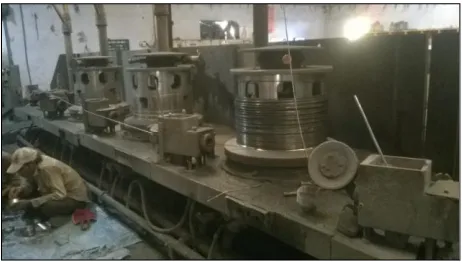
A 5 mm diameter wire is drawn through the rollers by two step reduction process. In Each step 0.5mm dia. is reduced.
Available Online at www.ijpret.com 26 Figure 4.2: Dry Drawing Lubricant used by Weld well company
4.2 Step II: Wire Cutting
The wire drawn from the Step-I is then cut into the required lengths by cutting machine as is collected in the container as shown.
Figure 4.3: Cut wire collected in container
4.3 Step III: Flux Coat Preparation
Available Online at www.ijpret.com 27 Figure 4.4: Powder formed for flux coat preparation
4.4 Step IV: Flux Coating
When a flux-coated electrode is heated up, part of the flux burns and forms a gaseous shield which keeps the oxygen away from the weld. This prevents the formation of a poor weld which occurs when iron burns in oxygen. Another part of the flux melts and mixes with the weld pool, the impurities of which float and are easily removed when the weld joint cools down.
Flux coating on the electrodes ensures a weld with good mechanical properties, chemical composition and weld metal cleanliness
Figure 4.5: Flux coating by extrusion
4.5 Step V: Flux Drying (De-moisturizing)
Available Online at www.ijpret.com 28
After they have dried, they should be stored in a moisture proof container. Bending the electrode can cause the coating to break loose from the core wire. Electrodes should not be used if the core wire is exposed.
Electrodes that have an "R" suffix in the AWS classification have a higher resistance to moisture.
Figure 4.6: Flux de-moisturizing in oven
4.6 Step VI: Finishing [1]
The flux at end of the welding rod is removed by brush and other end is chamfered by means of grinder. It is done so that one end must be properly gripped to the welding holder and proper arc formation at other end. Both these process are done at a time.
Figure 4.7: Finishing of electrodes
4.7 Step VII: Quality Checking & inspection
Available Online at www.ijpret.com 29 Figure 4.8: Inspection of electrode
5.0 SOLUTION TO PROBLEM
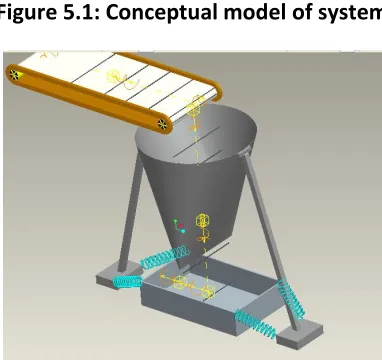
Figure 5.1: Conceptual model of system
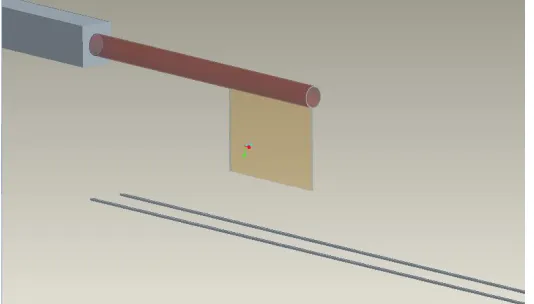
Available Online at www.ijpret.com 30 Figure 5.3: Electrode exit arrangement (Design II)
Figure 5.4: Spring stopper having weight sensor
Available Online at www.ijpret.com 31 Figure 5.6: Drafting of the trolley prepared
6.0 CONCLUSION
After the cutting of wire, the bare rods are collected in container which is further stacked in a trolley manually. Two operators were engaged for the collection and stacking of wire rods in the trolley.
The time needed for collection and stacking of 100 bare rods was around 4.5 to 5 mins with existing system.
The proposed system eliminates the one of the operators. Also the time required for the collection of 100 bare rods is reduced to around 2.5 to 3 mins. Hence adopted by the company for the future work.
7.0 REFERENCE
1. Company website for details: http://www.weldwellelectrodes.com
2. Yrd. Doç. Dr. Oguzhan Yılmaz, “Electrode Materials and electrode selection”, Department of
Mechanical Engineering, University of Gaziantep, Welding Technology, pp 1-30.
3. Harald Strolimeier and Gottlieb Pernkopf, Kapfenberg,, “Apparatus for Stacking and packing
cylindrical or rod-shaped work pieces-patent.” United States Patent Office, 2012.
4. Bob Romig, “Stacking Lumber for Drying.”, The OHIO State University US. School Natural
Available Online at www.ijpret.com 32
5. Vincent m. Altamuro, “Materials Handling Systems”, Columbus McKinnon Corp
6. Nimmo Jr., Philip E. (Wayne, NJ) , Townsend, Richard A. (Rockaway, NJ), “Ribbon package
and process for production thereof US 3735862 A”, Sun Chemical Corporation (New York, NY).
7. Haley, “Magnetic material feed control US 2962150 A”, United States Patent Office
8. Hoar, “Counting and packaging apparatus US 2632588 A”, United States Patent Office
9. Roland W. Wagner, William K. Switzer, “Apparatus for and method of accumulating and