Enhancing Extension Program Effectiveness by Examining
Regional Differences in High Water Users
Pei-wen Huang Alexa J. Lamm Michael D. Dukes
University of Florida
Competition for water sources in urban areas of Florida has increased due to increased population and human activities. High water users have been identified as a specific group on which Extension should focus water conservation
education due to their low awareness of water issues and active landscape water use. In order to ensure the effectiveness of Extension programs targeting high water users statewide, this study sought to explore regional differences in water conservation behavior engagement within Florida high water users. An online survey was conducted to capture responses of high water users (N = 932) in three distinct regions for this comparative study. Respondents were asked to indicate their current engagement in water use behavior, application of water
conservation strategies, and likelihood of engaging in water conservation and related societal behaviors. Regional differences were found in all four examined constructs. The findings imply Extension educators should tailor educational programs to regional audiences’ behavior patterns instead of designing statewide programs to ensure program effectiveness.
Keywords: Extension education, audience segmentation, water, landscape, conservation
Introduction
(USEPA) has set the goal of water protection in the U.S. as to “protect and restore waters to ensure that drinking water is safe and sustainably managed, and that aquatic ecosystems sustain fish, plants, wildlife, and other biota, as well as economic, recreational, and subsistence activities” (USEPA, 2014a, para. 2). According to the strategic plan USEPA developed about water
protection, environmental education associated with water should be enhanced by outreach services to communities and stakeholders which is the role that Extension has served (USEPA, 2014b).
According to the estimated national water use report published by Maupin et al. (2014), public supply was one of the top sources of water withdrawals in the U.S. in 2010, particularly in suburban and urban areas (USEPA, 2014d). Based on the national statistics, about 70% of the daily water consumption in the U.S. is for indoor uses, including drinking, food preparation, washing clothes and dishes, and flushing toilets, and 30% is for outdoor uses, including watering lawns and gardens or maintaining pools, ponds, or other landscape features in a domestic
environment (Maupin et al., 2014; USEPA, 2014d). As the national population continues to grow, increased competition for water resources is expected due to increased demands (USEPA, 2014c). In order to relieve the pressure of water demands, additional water sources and water conservation strategies have been sought and applied (Maupin et al., 2014).
Florida, a state abundant in water resources, is known as the state with “the most plentiful freshwater aquifers in the United States” (Florida Department of Environmental Protection [DEP], 2015, para. 1). Recently, increased pressure on water resources have been reported in Florida due to a growing population, prosperous tourism, and an active agricultural industry (Barnett, 2007; Leal, Rumble, & Lamm, 2015; Marella, 2013). According to the DEP (2014), public water supply demand has exceeded agricultural water demands. Florida residents consume a large volume per capita at 134 gallons per day (Marella, 2014). Within the daily water consumption, indoor and outdoor water uses split the amount of water in half. The
primary outdoor water use in Florida is for landscape irrigation, although “more than 50% of the water typically applied to lawns is lost to evaporation or runoff due to overwatering” (South Florida Water Management District, 2008, p. 3). Urbanization, as a result of increased
population in Florida, has led to increased water use for landscape irrigation (Haley, Dukes, & Miller, 2007). In spite of the high water consumption of landscape irrigation, many Florida residents are not aware of how the landscape management practices they use can impact the environment (Israel & Knox, 2010).
landscape management including a preference for hiring a contractor to manage their landscape instead of managing their own. This group of high water users tend to consume large amounts of water for landscape irrigation (Davis & Dukes, 2014; Huang, Lamm, & Dukes, 2016). Given their low engagement in water conservation behaviors, additional attention should be paid to high water users when developing water conservation education (Huang et al., 2016).
Extension has made efforts to provide information and educational programs to various publics about how to properly manage water and conserve water resources (Huang & Lamm, 2015a; University of Florida Extension, 2014; Warner & Schall, 2015). Extension educators should reach urban clientele and rural clientele differently due to their varying needs, and Extension programs should be developed with a focus on information relevancy to better communicate with diverse audiences (Monaghan, Warner, Telg, & Irani, 2014; Wagner & Kuhns, 2013).
Additionally, even if facing audiences with similar characteristics, audience members are likely to differ by regions in perceptions and practice implementation even within a single state (Benham, Braccia, Mostaghimi, Lowery, & McClellan, 2007). Therefore, by identifying the regional water conservation behavioral differences in high water users in Florida, regional Extension educators can better develop programs tailored to their audience’s need. Extension educators may utilize high water users’ tendencies to perform given types of water conservation behaviors to inform program development leading to enhanced positive learning outcomes as a result (Huang & Lamm, 2015b; Huang et al., 2016).
Conceptual Framework
This study was designed around the concept of audience segmentation (Andreasen, 2006; Kotler & Roberto, 1989). As derived from the traditional mass marketing approach, audience
segmentation emphasizes the importance of social power within a group exhibiting similar characteristics, like geographical characteristics, sociodemographic attributes, psychological profiles, and/or behavioral characteristics that can be used in social marketing for behavior change (Andreasen, 2006; Kotler & Roberto, 1989). To target a homogeneous group with shared identified needs, the influences expected during the marketing process can be enhanced
(Andreasen, 2006; Kotler & Roberto, 1989). By segmenting audiences, programs can be developed to better utilize resource allocation while being organized based on audiences’ specific motivation factors, needs, and interests (Andreasen, 2006; Kahlor & Stout, 2009).
As an important component of social marketing, audience segmentation has been frequently used in environmental conservation studies (Shaw, 2009). In addition, Adhikarya (1994) suggested that audience segmentation should be used in Extension programming to enhance the
effectiveness of programs by providing proper information to proper audiences with their needs in mind. Since heterogenous group may hinder the effectiveness of Extension educators’
to communicating with nonindustrial private forest landowners. Kuipers et al. (2013) identified four groups within these nonindustrial private forest landowners. Each of the four groups had different forest ownership reasons and values and preferred communication channels. Despite the lack of use of Extension services of these nonindustrial private forest landowners in the target location of the study, outreach services and information were suggested to be provided in ways that resonate with forest landowners’ associated topics of interest via the channels they preferred to use (Kuipers et al., 2013).
Individuals’ demographic characteristics, experiences applying a given practice, frequency of using Extension services, level of information sharing, and extent of concern about community norms can also be used to segment publics into groups (Israel & Hague, 2002). As a result, audience segmentation can be a useful strategy for program recruitment to ensure program effectiveness (Israel & Hague, 2002). In the case of Extension programs focused on high water users in Florida, multiple studies have indicated the importance of audience segmentation to properly approach this specific audience separately from the general public. Monaghan et al. (2013) conducted a case study about water conservation practices in a county of Florida to examine homeowners’ demographic and lifestyle characteristics and their characteristics of landscape water use. The findings of Monaghan et al.’s (2013) study indicated that a specific group of homeowners was identified as exhibiting a limited level of engagement in water
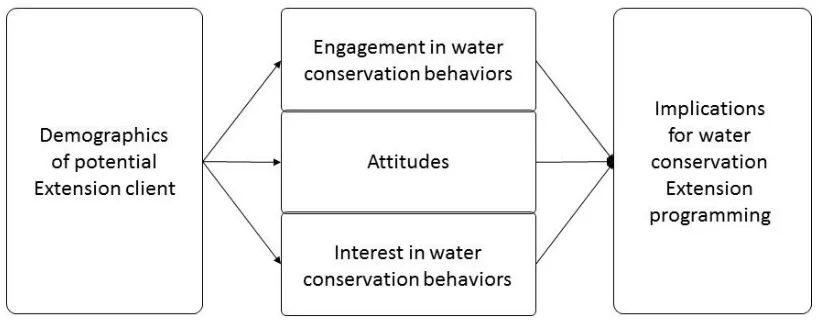
conservation practices and interest in learning about water conservation strategies, which implied less care about water consumption issues than the general public. Huang et al.’s (2016) study confirmed these findings by comparing high water users who had shared characteristics with the respondents in Monaghan et al.’s (2013) study to the general public in the state of Florida. Based on high water users’ specific needs and behavioral patterns, a need to develop water conservation programs relevant to these high water users existed (Huang et al., 2016). Based on the previous literature, a conceptual model was designed and used in Huang et al.’s (2016) study and will be used as the foundation for this research (see Figure 1).
This study was designed to further explore the need of audience segmentation by regions within a single state to inform Extension programming approaches. The findings will provide
implications for Extension educators to better develop water conservation programs tailored to regional high water users’ engagement, attitudes, and interests in water conservation behaviors. Extension educators can apply the findings of this study to their programming to enhance the persuasiveness of the message and the potential of audiences’ adoption of water conservation behaviors.
Purpose and Objectives
The purpose of this study was to identify differences in levels of engagement in water
conservation behaviors among high water users in different urban areas of Florida in order to develop Extension programs tailored to region-specific high water users’ adoption of water conservation behaviors. The objectives were to compare:
1. The water use behaviors in which high water users of the three regions currently engage;
2. The water conservation strategies high water users of the three regions currently apply;
3. The water conservation behaviors in which high water users of the three regions would like to engage; and
4. The societal behaviors associated with water conservation in which high water users of the three regions would like to engage.
Methods
The survey instrument was researcher-adapted originally from the 2012 RBC Canadian Water Attitudes Study (Patterson, 2012). The questionnaire was used in Huang and Lamm’s (2015a) study and used again in this study as follow-up research. Questions examining respondents’ water use behaviors, current engagement in water conservation strategies, likelihood of engaging in water conservation and societal behaviors associated with water conservation, and
demographics were asked. Once the survey was distributed, the first 50 responses were analyzed in order to ensure the construct reliability was .7 or higher (Kline, 2000) for further data
collection.
First, respondents were asked to indicate their frequency of performing seven water use
behaviors on a five-point Likert-type scale with response options of 1 = Never, 2 = Almost Never, 3 = Sometimes, 4 = Almost Every Time, and 5 = Every Time. Does Not Apply was provided as an option in this question with the responses treated as missing values. Reliability for the
measurement of water use behavior was calculated a priori and found reliable with a Cronbach’s of .77.
Respondents’ self-reported application of water conservation strategies was measured using nine statements asking respondents to indicate if they applied certain strategies by indicating Yes, Unsure, or No. Likelihood of engaging in water conservation behaviors was measured by asking respondents to indicate how likely they were to engage with 14 items using a five-point Likert-type scale with resonse options of 1 = Very Unlikely, 2 = Unlikely, 3 = Undecided, 4 = Likely, and 5 = Very Likely. Respondents’ likelihood of engaging in certain societal behaviors associated with water conservation was measured using eight items with the same five-point Likert-type scale. Respondents were able to choose Does Not Apply for these two behavior questions, and responses of Does Not Apply were transformed as missing values. The measurements of water conservation behaviors and societal behaviors associated with water conservation were calculated a priori and found to be reliable with Cronbach’s of .83 and .87, respectively. Lastly, respondents were asked to answer demographic questions, including sex, race/ethnicity, age, ZIP code (later converted to rural-urban continuum codes), annual household income, educational level, political beliefs, and participation in an HOA.
In order to ensure face and content validity of the instrument a panel of experts reviewed the survey. The panel of experts included the Chief Executive Officer of the Florida Nursery, Growers and Landscape Association; an assistant professor and Extension specialist in water economics and policy; the Director of the Center for Landscape Conservation and Ecology; the Director of the University of Florida Water Institute; the Director and Associate Director of the Center for Public Issues Education; an assistant professor specializing in agricultural
A nonprobability opt-in quota sampling method was used in this study by collaborating with a public opinion survey research company. Increased public opinion research has been conducted using nonprobability sampling methods (Baker et al., 2013). However, using a nonprobability opt-in sampling method, responses were collected gradually until reaching the specifically set quotas. As a result, participation rates are used in such a sampling procedure instead of response rates (Baker et al., 2013). A total of 932 complete responses were collected from 1,465 invited individuals, resulting in a participation rate of 64%. Quotas were set for the three regions to ensure the sample size in each region was large enough to be representative of the population of interest (Baker et al., 2013). Due to the use of a nonprobability sampling method, this study has limitations, including nonparticipation biases, selection, and exclusion, leading to limited interpretations of the results that can only be applied to the respondents (Baker et al., 2013). In this study, data were not weighted because of the use of quotas a priori to identify targeted respondents. The collected data ere analyzed using SPSS® 22.0 for descriptive statistics to reach the objectives of this study. Chi-square analysis was used to examine the existence of
differences among regions.
Table 1. Demographic Characteristics by Region
Characteristic
Southeast (N = 201)
Southwest (N = 219)
Central (N = 512)
n % n % n %
Sex
Female 97 48.3 110 50.2 277 54.1
Male 104 51.7 109 49.8 235 45.9
Race
African American 11 5.5 9 4.1 21 4.1
Asian 2 1.0 4 1.8 8 1.6
Caucasian/White (Non–Hispanic)
186 92.5 206 94.1 479 93.6
Native American 0 0 0 0.0 5 1.0
Other 4 2.0 0 0.0 9 1.8
Hispanic Ethnicity 19 9.5 3 1.4 41 8.0
Age
20-29 5 2.5 1 0.5 15 2.9
30-39 15 7.5 13 5.9 64 12.5
40-49 17 8.5 17 7.8 74 14.5
50-59 44 21.9 35 16.0 109 21.3
60-69 73 36.3 83 37.9 156 30.5
70-79 41 20.4 63 28.8 84 16.4
80+ 6 3.0 7 3.2 10 2.0
Rural-Urban Continuum Metro areas 1 million population or more
178 88.6 122 55.7 505 99.2
Metro areas of 250,000 to 1 million population
19 9.5 82 37.4 2 0.4
Metro areas of fewer than 250,000 population
4 2.0 1 0.5 2 0.4
Urban population of 20,000 or more, adjacent to a metro area
0 0.0 11 5.0 0 0.0
Urban population of 20,000 or more, not adjacent to a metro area
0 0.0 1 0.5 0 0.0
Income
Less than $49,999 0 0.0 0 0.0 0 0.0
$50,000 to $74,999 42 20.9 61 27.9 141 27.5
$75,000 to $149,999 101 50.2 118 53.9 242 47.3
$150,000 to $249,999 40 19.9 26 11.9 101 19.7
(Table 2 continued) Southeast Southwest Central
Characteristic n % n % n %
Education
Less than 12th grade 0 0.0 0 0.0 1 0.2
High school graduate 13 6.5 15 6.8 27 5.3
Some college, no degree 27 13.4 50 22.8 76 14.8
2-year college degree 14 7.0 15 6.8 65 12.7
4-year college degree 78 38.8 71 32.4 206 40.2 Graduate or Professional
degree
69 34.3 68 31.1 137 26.8
Political Beliefs
Very Liberal 9 4.5 11 5.0 27 5.3
Liberal 59 29.4 34 15.5 88 17.2
Moderate 72 35.8 87 39.7 197 38.5
Conservative 51 25.4 68 31.1 159 31.1
Very Conservative 10 5.0 19 8.7 41 8.0
HOA Member
Yes 123 61.2 154 70.3 379 74.0
No 78 38.8 65 29.7 133 26.0
Results
Water Use Behaviors
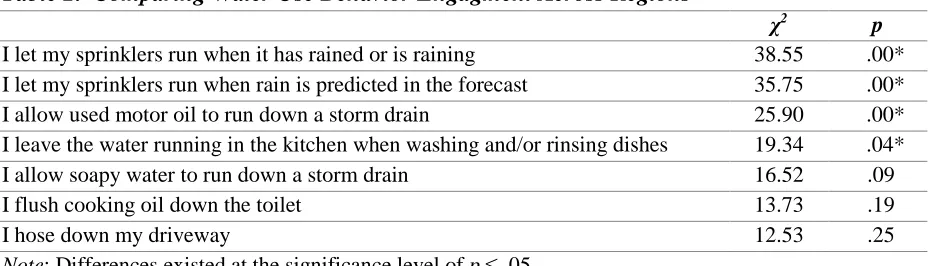
Objective one compared the water use behaviors in which high water users of the three regions currently engage (Table 2). Differences in four water use behaviors were found. Specifically, behaviors with regional differences included “I let my sprinklers run when it has rained or is raining” (χ2(10) = 38.55, p = .00), “I let my sprinklers run when rain is predicted in the forecast”
(χ2(10) = 35.75, p = .00), “I allow used motor oil to run down a storm drain” (χ2(10) = 25.90, p = .00), and “I leave the water running in the kitchen when washing and/or rinsing dishes” (χ2(10)
= 19.34, p = .04).
Table 2. Comparing Water Use Behavior Engagment Across Regions
χ2
p I let my sprinklers run when it has rained or is raining 38.55 .00* I let my sprinklers run when rain is predicted in the forecast 35.75 .00* I allow used motor oil to run down a storm drain 25.90 .00* I leave the water running in the kitchen when washing and/or rinsing dishes 19.34 .04* I allow soapy water to run down a storm drain 16.52 .09
I flush cooking oil down the toilet 13.73 .19
I hose down my driveway 12.53 .25
Water Conservation Strategies
High water users’ application of water conservation strategies were compared among three regions (Table 3). Significant differences among regions were found in four water conservation strategies, including “I use a smart irrigation controller” (χ2(4) = 39.20, p = .00), “I have
low-water consuming plant materials in my yard” (χ2(4) = 18.44, p = .00), “I use high efficiency sprinklers” (χ2(4) = 11.77, p = .02), and “I have low-flow shower heads installed in my home” (χ2(4) = 10.94, p = .03).
Table 3. Comparing Water Conservation Strategy Application Across Regions
χ2 p
I use a smart irrigation controller 39.20 .00*
I have low-water consuming plant materials in my yard 18.44 .00*
I use high efficiency sprinklers 11.77 .02*
I have low-flow shower heads installed in my home 10.94 .03* I use recycled wastewater to irrigate my lawn/landscape 7.49 .11
I use drip (micro) irrigation 5.92 .21
I have water-efficient toilets installed in my home 5.88 .21 I use rain barrels to collect water for use in my garden/lawn 2.95 .57 I have retrofitted a portion of my landscape so that it is not irrigated 0.56 .97 Note: Differences existed at the significance level of p ≤ .05.
Water Conservation Behaviors
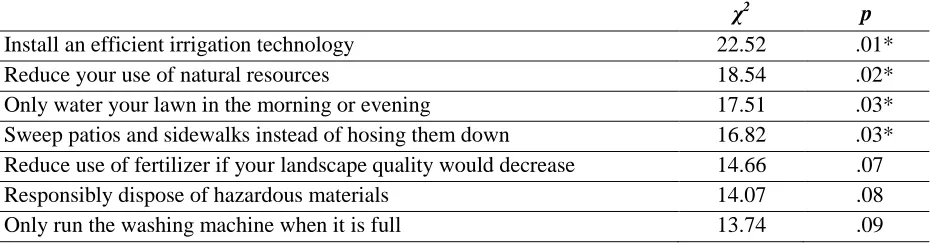
Regional differences in high water users’ possible engagement in water conservation behaviors were also examined (Table 4). Within the 14 listed water conservation behaviors, regional differences were found in four behaviors: “Install an efficient irrigation technology” (χ2(8) =
22.52, p = .01), “Reduce your use of natural resources” (χ2(8) = 18.54, p = .02), “Only water your lawn in the morning or evening” (χ2(8) = 17.51, p = .03), and “Sweep patios and sidewalks instead of hosing them down” (χ2(8) = 16.82, p = .03).
Table 4. Comparing Likelihood of Engaging in Water Conservation Behaviors Across Regions
χ2
p Install an efficient irrigation technology 22.52 .01*
Reduce your use of natural resources 18.54 .02*
(Table 4 continued) χ2
p Modify my landscape so that a portion is not irrigated 8.83 .55
Use biodegradable cleaning products 8.41 .40
Reduce use of pesticides if your landscape quality would decrease 8.24 .41 Keep a timer in the bathroom to help you take a shorter shower 8.13 .42
Only run the dishwasher when it is full 4.80 .78
Avoid purchasing plants that require a lot of watering 4.48 .81 Reduce the number of times a week you water your lawn 4.40 .82 Note: Differences existed at the significance level of p ≤ .05.
Societal Behaviors Related to Water Conservation
The examination among high water users’ differences in potential engagement in societal behaviors related to water conservation in three regions can be seen in Table 5. Only one out of eight listed societal behaviors were found statistically significantly different among three regions: “Visit springs, lakes, state parks, etc., to learn about water issues” (χ2(8) = 19.29, p = .01).
Table 5. Comparing Likelihood of Engaging in Societal Behaviors Across Regions χ2
p Visit springs, lakes, state parks, etc., to learn about water issues 19.29 .01* Volunteer for a stream clean up or wetland restoration event 11.93 .15 Vote for candidates who support water conservation 10.07 .26 Vote to support water conservation programs 9.43 .31 Buy a specialty license plate that supports water protection efforts 8.69 .37 Support water restrictions issued by my local government 7.99 .44 Donate to an organization that protects water 7.68 .47
Join a water conservation organization 2.44 .96
Note: Differences existed at the significance level of p ≤ .05.
Conclusion and Implications
The findings of this study explored the regional differences in Florida high water users with foci on their water use behaviors, application of water conservation strategies, and engagement in water conservation behaviors. Due to the nature of this study, the findings are not generalizable but can be used as a case study of Florida high water users in the three regions of interest
(Southeast, Southwest, and Central Regions) that Florida Extension educators working on water conservation should take into account particularly.
that a segmented group of audiences with similar characteristics may differ in their behaviors in different regions within a state was supported by this study. Previous research identified high water users as a specific target audience for Extension with shared demographic characteristics and behavioral patterns (Davis & Dukes, 2014; Huang et al., 2016; Monaghan et al., 2013). The findings of this study revealed high water users had different responses as related to their
behaviors based on where they live, which aligns with Kuipers et al.’s (2013) study that found broad audiences can be separated into minor groups.
High water users in the three regions also performed behaviors related to landscape irrigation, used motor oil management, and dish cleansing differently. These findings imply a need to cover information about these behaviors differently in Florida’s local Extension programs related to water conservation across the three regions, which supported the study of Kuipers et al. (2013). As for water conservation strategies in the landscape, high water users in the three regions
applied water-conserving irrigation controllers, sprinklers, and plant materials differently. Differences also occurred in their indoor water conserving practices, including their use of water efficient shower heads. Similar to Benham et al. (2007), these findings imply different levels of adoption are based on where an individual lives.
High water users also showed regional differences when it came to willingness to act on water conservation behaviors. The findings imply high water users in the different regions have different levels of willingness to change their behaviors in terms of daily landscape irrigation management, use of natural resources, and outdoor cleaning. Similarly, differences were also found in societal behaviors related to water conservation. These differences imply high water users in different regions may consider the importance differently because of their engagement related to visiting sites that emphasize the importance of natural resources.
Recommendations
As the urban population continues to grow, water conservation will continue to be a critical issue around which Extension educators should build programs (Haley et al., 2007; Wagner & Kuhns, 2013). High water users have been identified as a group of urban audiences that Extension educators have difficulty impacting (Monaghan et al., 2013). This study explored this specific audience with more depth in differences in behavior patterns within the group. The findings of this study provided insight into how Extension educators should pay attention to regional differences in their target audiences when developing Extension educational programs. It is expected that program effectiveness can be improved by tailoring materials relevant to local high water users’ needs and behavior patterns (Adhikarya, 1994; Kuipers et al., 2013).
University of Florida Extension has developed the Florida-Friendly LandscapingTM Program to provide guidance and recommendations to homeowners, home buiders, home developers, and green industry workers about how to properly establish environmentally sustainable landscapes statewide (Florida-Friendly LandscapingTM Program, 2014). Extension educators in each Florida county reach high water users differently. Within the areas studied, some counties have
contacted high water users directly through Extension educators’ individual home visits, while other counties have cooperated to provide multicounty water conservation workshops to property managers and HOA board members in order to enhance influences on individual homeowners’ engagement in water conservation. Positive impacts on water conservation have been reported across these areas with results indicating over 75,000,000 gallons of water saved per year.
Although high water users approach their water use and water conservation behaviors differently than the general public (Huang et al., 2016), specific behavioral similarities and differences among high water users living in different regions were identified in this study. Therefore, educational programs targeting high water users should be developed and distributed to two levels: a) the similarity identified in behavior patterns can be included as common suggestions that state Extension educators can use in a broader spectrum and b) the identified differences in behavior patterns should be used by Extension educators working in the studied regions to reframe the materials they currently have. The key recommendation of this study is Extension educators need to understand that audiences may respond to the list of recommendations differently by region. For example, Extension educators working at Orlando and Miami/Fort Lauderdale may have to promote different water conservation behaviors to their high water user audiences based on their tendency to engage in certain water conservation behaviors. As a result, addressing and utilizing such regional behavioral differences may enhance positive impacts on local audiences.
qualitative methods to understand the audiences in depth about personal factors associated with their water use. Existing water conservation programs targeting high water users can be
evaluated in future studies to examine challenges, obstacles, and promising factors of the programs. The examination of existing programs can include the program development
strategies recommended in this study to further confirm the findings. For example, evaluations should be conducted in water conservation programs implemented in different counties targeting high water users. The results from the evaluations can then be compared to see if programs were developed differently tailored to local audiences’ needs and interests. Moreover, existing
programs should be revised based on the recommendations of this study and then evaluated to explore the improvement of programmatic impact. By understanding this, the sustainability of state water resources would be enhanced by receiving increased high water users’ support of water conservation.
References
Adhikarya, R. (1994). Strategic extension campaign: A participatory-oriented method of agricultural extension. Rome, Italy: Food and Agriculture Organization of the United Nations. Retrieved from http://www.fao.org/docrep/u8955e/u8955e00.htm
Andreasen, A. R. (2006). Social marketing in the 21st century. Thousand Oaks, CA: Sage. Baker, R., Brick, J. M., Bates, N. A., Battaglia, M., Couper, M. P., Dever, J. A., . . . Tourangeau,
R. (2013). Report of the AAPOR task force on non-probability sampling. Oakbrook Terrace, IL:American Association for Public Opinion Research. Retrieved from
https://www.aapor.org/AAPOR_Main/media/MainSiteFiles/NPS_TF_Report_Final_7_re vised_FNL_6_22_13.pdf
Barnett, C. (2007). Mirage: Florida and the vanishing water of the Eastern U.S. Ann Arbor, MI: University of Michigan Press.
Benham, B. L., Braccia, A., Mostaghimi, S., Lowery, J. B., & McClellan, P. W. (2007).
Comparison of best management practice adoption between Virginia’s Chesapeake Bay Basin and southern rivers watersheds. Journal of Extension, 45(2), Article 2RIB3. Retrieved from http://www.joe.org/joe/2007april/rb3.php
Davis, S. L., & Dukes, M. D. (2014). Methodologies for successful implementation of smart irrigation controllers. Journal of Irrigation and Drainage Engineering, 141(3). doi:10.1061/(ASCE)IR.1943-4774.0000804#sthash.2gwYZNRI.dpuf
Florida Department of Environmental Protection. (2014). Water use trends in Florida. Retrieved from https://www.dep.state.fl.us/water/waterpolicy/docs/factsheets/wrfss-water-use-trends.pdf
Florida Department of Environmental Protection. (2015). Florida Department of Environmental Protection water resource protection programs. Retrieved from
Florida-Friendly LandscapingTM Program. (2014). Florida-Friendly LandscapingTM Program. Retrieved from http://fyn.ifas.ufl.edu/
Friedman, M. J. (Ed.). (2011). Global water issues. Washington, DC: U.S. Department of State, Bureau of International Information Programs.
Haley, M. B., Dukes, M. D., & Miller, G. L. (2007). Residential irrigation water use in Central Florida. Journal of Irrigation and Drainage Engineering, 133(5), 427–434.
doi:10.1061/(ASCE)0733-9437(2007)133:5(427)#sthash.JOMAzSGD.dpuf Huang, P., & Lamm, A. J. (2015a). Impact of experience and participation in Extension
programming on perceptions of water quality issues. Journal of International Agricultural and Extension Education, 22(3), 35–49. doi:10.5191/jiaee.2015.22303 Huang, P., & Lamm, A. J. (2015b). Understanding public engagement in water conservation
behaviors and knowledge of water policy: Promising hints for Extension. Journal of Extension, 53(6), Article 6RIB1. Retrieved from http://www.joe.org/joe/2015december/ rb1.php
Huang, P., Lamm, A. J., & Dukes, M. D. (2016). Informing Extension program development through audience segmentation: Targeting high water users. Journal of Agricultural Education, 57(2), 60–74. doi:10.5032/jae.2016.02060
Israel, G. D., & Hague, G. W. (2002). A recruiting challenge for Extension education: A comparison of nonparticipants and participants in homeowner landscaping programs. Journal of Agricultural Education, 43(4), 76–87. doi:10.5032/jae.2002.04076
Israel, G. D., & Knox, G. W. (2010). Reaching diverse homeowner audiences with environmental landscape programs: Comparing lawn service users and nonusers (AEC363). Gainesville, FL: University of Florida.
Kahlor, L., & Stout, P. (2009). Communicating science: New agendas in communication. New York, NY: Routledge.
Kline, P. (2000). The new psychometrics: Science, psychology and measurement. New York, NY: Routledge.
Kotler, P., & Roberto, E. L. (1989). Social marketing. Strategies for changing public behavior. New York, NY: The Free Press.
Kuipers, B. T., Shivan, G. C., & Potter-Witter, K. (2013). Identifying appropriate
communication means for reaching nonindustrial private forest landowners. Journal of Forestry, 111(1), 34–41. doi:10.5849/jof.12-006
Leal, A., Rumble, J. N., & Lamm, A. J. (2015). Setting the agenda: Exploring Florida residents’ perceptions of water quality and quantity issues. Journal of Applied Communications, 99(3), 53–67. Retrieved from http://journalofappliedcommunications.org/images/stories/ issues/2015/jac_v99_n3_article4.pdf
Marella, R. L. (2014). Water withdrawals, use, and trends in Florida, 2010 (Scientific
Investigations Report 2014–5088). Retrieved from http://pubs.usgs.gov/sir/2014/5088/ pdf/sir2014-5088.pdf
Maupin, M. A., Kenny, J. F., Hutson, S. S., Lovelace, J. K., Barber, N. L., & Linsey, K. S. (2014). Estimated use of water in the United States in 2010: U.S. Geological Survey Circular 1405. Retrieved from http://pubs.usgs.gov/circ/1405/pdf/circ1405.pdf.
Monaghan, P., Ott, E., Wilber, W., Gouldthorpe, J., & Racevskis, L. (2013). Defining audience segments for Extension programming using reported water conservation practices. Journal of Extension, 51(6), Article 6FEA8. Retrieved from http://www.joe.org/joe/ 2013december/a8.php
Monaghan, P., Warner, L., Telg, R., & Irani, T. (2014). Improving Extension program development using audience segmentation (Publication AEC526). Gainesville, FL: University of Florida Institute of Food and Agricultural Sciences. Retrieved from http://edis.ifas.ufl.edu/wc188
Oki, T., & Kanae, S. (2006). Global hydrological cycles and world water resources. Science, 313(5790), 1068–1072. doi:10.1126/science.1128845
Patterson, L. (2012). 2012 RBC Canadian water attitudes study. RBC Blue Water Project. Retrieved from http://www.rbc.com/community-sustainability/environment/rbc-blue-water/index.html
Shaw, B. R. (2009). Using temporally oriented social science models and audience segmentation to influence environmental behaviors. In L. Kahlor & P. A. Stout (Eds.), Communicating science: New agendas in communication (pp. 109–130). New York, NY: Routledge. South Florida Water Management District. (2008). Water conservation: A comprehensive
program for South Florida. Retrieved from http://sfwmd.gov/portal/page/portal/ xrepository/sfwmd_repository_pdf/waterconservationplan.pdf
University of Florida Extension. (2014). Water. Retrieved from http://solutionsforyourlife. ufl.edu/environment/water_resources.shtml
U.S. Environmental Protection Agency [USEPA]. (2014a). An introduction to the water elements of EPA’s strategic plan. Retrieved from http://water.epa.gov/aboutow/goals_objectives/ goals.cfm
U.S. Environmental Protection Agency [USEPA]. (2014b). Fiscal year 2014-2018 EPA strategic plan. Retrieved from http://nepis.epa.gov/Exe/ZyPDF.cgi/P100KB1L.PDF?Dockey= P100KB1L.PDF
U.S. Environmental Protection Agency [USEPA]. (2014c). Tomorrow & beyond. Retrieved from http://www.epa.gov/watersense/our_water/tomorrow_beyond.html
U.S. Environmental Protection Agency [USEPA]. (2014d). Water use today. Retrieved from http://www.epa.gov/watersense/our_water/water_use_today.html
Wagner, K., & Kuhns, M. (2013). Meeting horticulture clientele interests in an urban setting: A needs assessment for reduced pesticide and pollinator education in the Greater Salt Lake Area. Journal of the NACAA, 6(1). Retrieved from
http://www.nacaa.com/journal/index.php?jid=221
Warner, L. A., & Schall, W. L. (2015). Using social marketing principles to understand an Extension audience’s landscape water conservation practices. Journal of Human Sciences and Extension, 3(1), 46–62. Retrieved from
http://media.wix.com/ugd/c8fe6e_bc167de42310421da5f8fa20aff42b85.pdf
Young, G. J., Dooge, J. C. I., & Rodda, J. C. (1994). Global water resource issues. New York, NY: Cambridge University Press.
Pei-wen Huang is a research coordinator in the Department of Family, Youth and Community Sciences at the University of Florida, PO Box 110310, Gainesville, FL 32611.
Alexa J. Lamm is an assistant professor in the Department of Agricultural Education and
Communication and the associate director of the UF/IFAS Center for Public Issues Education at the University of Florida, 121F Bryant Space Science Center, Gainesville, FL 32611.
Michael D. Dukes is a professor in the Department of Agricultural and Biological Engineering and the Director for the UF/IFAS Center for Landscape Conservation and Ecology at the University of Florida, 205 Frazier Rogers Hall, Gainesville, FL 32611.
Acknowledgements