Available Online at www.ijpret.com 63
INTERNATIONAL JOURNAL OF PURE AND
APPLIED RESEARCH IN ENGINEERING AND
TECHNOLOGY
A PATH FOR HORIZING YOUR INNOVATIVE WORK
WIRELESS SENSOR NETWORK FOR ASSET TRACKING
ANUP POLGAVANDE, PROF. I. S. JADHAV, DR. K. P. RANE
Department of Electronics & Telecommunication, Godavari College of Engineering, Jalgaon.
Accepted Date: 26/02/2015; Published Date: 01/03/2015
\
Abstract:A wireless network protocol is propos to minimize the power consumption based on available energy and wireless link conditions in the distributed system. RFID implementation has experienced an annual growth rate of 24%. Since the year 2000, rapid growth in the market for RFID is creating the economies of scale necessary to bring costs down to the point where RFID tags will soon be competitive with printed barcodes. Here I proposed radio-based ‘tagging’ system which makes it possible to track down test equipment and computers within the premises. RFID is most widely used technology. This technology is used in tracking applications. Current tracking systems are costly over wireless data transmission systems. This project is provides a new tracking solution for commercial purpose. The device consists of a RFID reader and a control program with a guide user interface. The RFID tags are attached to the assets with unique identification for each asset. In order to provide tracking solution, (Radio Frequency Identification Device (RFID) technology is used to associate each user with a unique identification. RFID comprises a reader and a tag. The reader receives the identity of an object from the embedded tag wirelessly using radio waves and then compares it with the corresponding identification stored in the database. This project focuses on to make a user friendly device for making compatible tracking solution to the user. This system works on the “On Demand” principle. By using this system user can find how many assets are present in the selected area with its details at a time on one click only.
Keywords: Asset Tracking, RFID, Tag, Reader.
Corresponding Author: MR. ANUP POLGAVANDE
Access Online On:
www.ijpret.com
How to Cite This Article:
Anup Polgavande, IJPRET, 2015; Volume 3 (7): 63-73
Available Online at www.ijpret.com 64
INTRODUCTION
A ubiquitous world means that many kinds of computing devices are scattered everywhere and capture an amount of data about our world. The technologies related to wireless sensor networks and sensor nodes have made the ubiquitous idea come true. A small size sensor node with a wireless communication facility can be installed at everywhere, produce a lot of data related to the real world, and transmit them. A WSN (Wireless Sensor Network) consists of not only a few wireless sensor nodes but a large number of them according to the requirements of applications. The coverage of the sensor network also varies from a house to a country.
There are many applications based on the WSN such as structure health monitoring, environment monitoring, surveillance, supply chain management, military applications, intruder detection, fire detection, building administration, asset tracking etc.
A senor node has the sensing capability that provides various sensed values such as temperature, humidity, position and light, etc. The type of the sensed value is determined by the requirement of the target application. Each application acquires its required data from the sensor nodes and produces valuable information that helps users to process their business easily and efficiently. A sensor node has a self -organization capability that establishes a sensor network automatically. Sensor nodes are able to communicate among themselves and form the sensor network without people’s intervention. The self-organization enables people to rapidly establish the sensor network. When people put the nodes at specific positions, the nodes make wireless connections among them. The nodes actively participate in creating a ubiquitous world.
Asset tracking refers to tracking an assets, either by scanning barcode tags attached to the assets or by using smart tags, like 'passive' RFID tags, which broadcast their location, but they have limited transmission range (typically a few centimeters). For longer-range "smart tags" are used. Well known smart tags are 'active' RFID tag where a radio transmitter is powered by a battery and can transmit up to several meters in optimum conditions. RFID-based Asset Tracking requires an infrastructure to be put in place before the where about of tags may be ascertained. An asset tracking service based on low power wireless sensor networks.
Available Online at www.ijpret.com 65 At its most basic, RFID systems consist of small transponders, or tags, attached to physical objects. RFID tags may soon become the most pervasive microchip in history. When wirelessly interrogated by RFID transceivers, or readers, tags respond with some identifying information that may be associated with arbitrary data records. Thus, RFID systems are one type of automatic identification system, similar to optical bar codes.
The origins of RFID technology lie in the 19th century when luminaries of that era made great scientific advances in electromagnetism. Of particular relevance to RFID is Michael Faraday’s discovery of electronic inductance, James Clerk Maxwell’s formulation of equations describing electromagnetism, and Heinrich Rudolf Hertz’s experiments validating Faraday and Maxwell’s predictions. Their discoveries laid the foundation for modern radio communications.
Our proposed system is for tracking of registered objects using RFID sensors. This system designed in such a way that, whenever we need to track the asset user can initialize the system by sending query. This system is query based system. This system consists of transmitter which transmits the ID of object. One reader is placed in each room. The Graphical User Interface (GUI) is designed for the interaction of the system with user. This Graphical User Interface (GUI) displays the final result of the system.
OBJECTIVE -
This project proposes designing a system which will help us to track assets, some of the most important objects which are costly and needful. This project based on the radio-based ‘tagging’ system which makes it possible to track down test equipment and computers within the premises. My objective behind this project is providing automation in the institutional system. With the help of this technology laboratory assistant can monitor all the lab equipment on the screen whenever he required. For this purpose in this project radio frequency identification is selected.
When my system installed will help reduce the human efforts and time. The system will use RFID tags and sensors to do the job of tracking the objects and notify the user where they are, who has them.
PROPOSED SYSTEM -
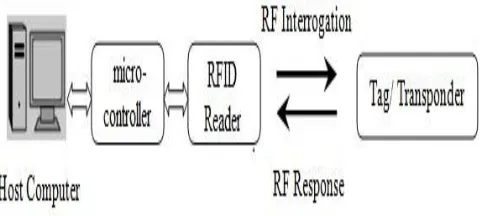
Available Online at www.ijpret.com 66 instant reply. Following Fig. 2.2 shows the block diagram of proposed system. Utilization of such methods
often incurs significant financial and operational costs to asset owners based on usage scenarios such as high number of assets, Asset tracking service is an ideal application for a low cost and low-power wireless network. In this system I considered only one monitoring system which monitors all assets placed in the campus. Quick response of tag is important for this system.
The RFID tag is composed of two essential elements: designed antenna and an RFID chip. Some RFID tags also equip memory. According to the requirement, the RFID tag can be designed as different contours or shapes such as: card, wrist belt, button, ornament, 3D toy, tattoo, etc. Each of these RFID tags records a unique identification (UID) and finite information. The antenna of the RFID tag is designed and used to absorb the electromagnetic wave for the power supply of the RFID tag and communicate with the RFID reader. In addition, according to the size and design of the antenna, the induction distance between RFID tag and RFID reader will be limited. Based on the power of the RFID tag.
Fig. RFID System
The Tracking System consists of
I. RFID reader,
II. RFID tags,
III. Microcontroller
Three basic types of RFID tag are proposed:
Available Online at www.ijpret.com 67 ii. Active RFID Tag
iii. Semi-Passive RFID Tag
The Passive RFID tag is triggered when a user with the RFID tag approaches the antenna of RFID reader. Then, the information recorded in the RFID tag is transmitted through the antenna to the RFID reader. The RFID reader will parse the signal into the digital and computing content. At last, the gained content from RFID tag can be further utilized. Typical applications of passive RFID tag are tickets and guard cards. An Active RFID Tag indicates that the tag owns a battery and can actively broadcast the Information about this tag even there is no RFID reader which inducts this tag. Since there is a battery in the tag, more functions such as temperature sensing, pressure sensing, humidity sensing, etc., are embedded. The information gained from the embedded functions is transmitted actively. When the RFID reader approaches the active RFID tag, the reader can obtain the information. Typical applications of passive RFID tag are wireless sensors.
A Semi-Passive RFID Tag seems an RFID tag with an on-off switch. In general, the semi passive RFID tag also equips a battery and some embedded functions. For the most part, this RFID tag works as a passive RFID tag. When an RFID reader approaches and inducts the tag, this tag is triggered. After triggered by the reader, this tag turns on the battery and executes the functions. Then, the information from the functions can be translated to the RFID reader. At last, the RFID tag turns off the battery for power saving.
Fig. Block Diagram of Proposed System
Available Online at www.ijpret.com 68 To implement this system, there is great consideration for choosing the RFID reader and tags, as well as choosing the interface for communication between the objects, the device, and the owner. The system should consider the basic requirements seen in Table.
The requirements in Table should be considered as a basic foundation for the system. In order to show the proof of concept before final implementation, the RFID reader will be tested on computer. The computer will be connected to the RFID reader and the RFID reader will be used to communicate with the tags. The software developed for this system will provide the user the ability to identify their objects. This system capable of track several objects presented in premises. As a part of the interface between the user and the device, the user can modify the list of items to be tracked as well as label each item.
Table 1: Basic System Requirement
Hardware
RFID reader 1. Small size for portability
2. Reading range about 12 meters and above 3. Power consumption (should stay on long enough to run multiple applications)
RFID tags 4.Active tags for long distance response 5.Small size to fit on object.
6.Have own antenna for quick response Controller 7. Ability to interface with RFID readers
Software
Tracking 1. Keep track of at least 4 objects. Identification 2.Unique ID on each object
3. ID – Name and Number Detection System 4.Blink the LED
5.Only one ID respond at a time
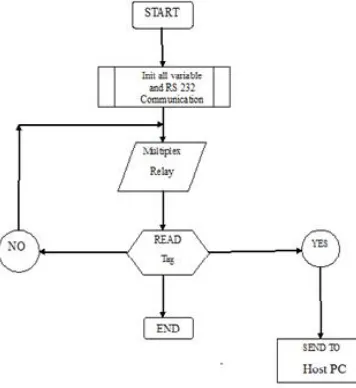
PROGRAM FLOW -
Available Online at www.ijpret.com 69
Fig. Program Flowchart
IMPLEMENTATION PLAN
Available Online at www.ijpret.com 70
RFID TOPOLOGY
An RFID system consists of a tag made up of a microchip with an antenna, and an interrogator or reader with an antenna. The reader sends out electromagnetic waves. The tag antenna is tuned to receive these waves. A passive RFID tag draws power from the field created by the reader and uses it to power the microchip's circuits. The chip then modulates the waves that the tag sends back to the reader, which converts the new waves into digital data. In its minimalist configuration the micro-topology requires just four sub-systems, as follows [4]
I. Tag.
II. Reader.
I) Tags
The basic RFID building blocks are miniature electronic devices known as Tags which talk to Readers. The RFID tags, also known as transponder, are usually small pieces of material, typically comprising three components: an antenna, a microchip unit containing memory storage an encapsulating material. Tag are embedded or attached to an item. The Tag has memory which stores information as either read only, write once or unlimited read/write. Tags typically range in size from a postage stamp to a book, depending on read distance and features. RFID tags come in a wide variety of shapes and sizes [4].
II) Reader
Available Online at www.ijpret.com 71
Fig. Basic RFID Interface
RESULTS
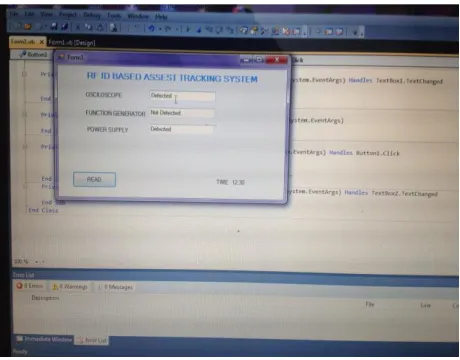
The system is successfully implemented by overcoming the entire problem regarding guides, which gives the results of assets tracking. Whenever we give query from the GUI, microcontroller power-up the reader. Tags are in active mode, tag sends their presence to the reader and reader forwarded this information to the control system. Tags have its own broadcast antenna and as a result of this range of these tags are increased. This system has more accuracy than other asset tracking systems. In this, I tried to minimize read time of tag and maximize response time. Following picture shows the output of the system. Here I used three tags for demonstrate the system.
Available Online at www.ijpret.com 72
CONCLUSION
The developed asset tracking system refers to the wireless sensor network. Currently in many equipment storage yards or facilities that are used for large equipment storage, locating assets is done manually, often using technologies such as barcodes. Utilization of such methods often incurs significant financial and operational costs to asset owners based on usage scenarios such as high number of assets, Asset tracking service is an ideal application for a low cost and low-power wireless network. In this system I considered only one monitoring system which monitors all assets placed in the campus. Quick response of tag is important for this system. Asset tracking is an emerging market that depends on technology advances in both short range and long distance wireless communications. This project focuses on to make a user friendly device for making compatible tracking solution to the user. This system works on the “On Demand” principle. By using this system user can find how many assets are present in the selected area with its details at a time on one click only. Even with low basic hardware cost, my proposed system offers improved performance along with minimum maintenance than other.
FUTURE SCOPE
Future work includes combining RFID with a long distance reader with an automatic detection of object tag by using UHF frequencies, and make compatible long range tag for tracking purpose. In future, focus can be on security of assets and how security application interfaces to this system so that it can become more user friendly.
REFERENCES
1. I. D. Robertson, M. BIewett, J. Amin, F. DonnelIy, P. Hawood and A, Woohen “A Simple Radio-Frequency System for Asset Tracking Within Buildings” IEEE 1999
2. N. Rajendran, Pushap Kamal, Debabrata Nay & S. Albert Rabara. “WATS-SN: A Wireless Asset Tracking System using Sensor Networks” Proceedings of the 21st International Annual Joint Conference of the IEEEComputer and Communications Societies (7NFOCOM2002/, June 2005)
3. Kwangsoo Kim, Jongarm Jun, Sunjoong Kim, and Byung Y. Sung “Medical Asset Tracking Application with Wireless Sensor Networks “ IEEE, Department of Computer Engineering, University Tun Hussein Onn Malaysia in 2008.
4. Steven Chan, Adam Connell, Eribel Madrid, Dongkuk Park, Dr. Ridha Kamoua, Member, IEEE
Available Online at www.ijpret.com 73 5. Anup Polgavande, Prof. D. A. Patil “Wireless Sensor Network for Asset Tracking – A Review” ICMSET-2014
6. Anup Polgavande, Madhura Bonde, Prof. D. A. Patil, Dr. K.P.Rane “A Review On RFID Based