Volume 9, Number 1, pp. 11–20. http://www.scpe.org c 2008 SCPE
LEARNING OBJECTS’ ARCHITECTURE AND INDEXING IN WELSA ADAPTIVE
EDUCATIONAL SYSTEM∗
ELVIRA POPESCU‡,§,†, COSTIN B ˘ADIC ˘A‡, AND PHILIPPE TRIGANO§
Abstract. In this paper we present an intelligent way of organizing learning material in an adaptive educational hypermedia system. We describe the use of instructional metadata which facilitates both the detection of student learning style and the application of various adaptation techniques. The advantage of our approach is that it is independent of a particular learning style model. Furthermore, the author has to supply only the annotated learning content (the static description) while the adaptation logic (the dynamic description) is provided by the system. The approach is implemented in an adaptive educational system called WELSA and illustrated with a course module in the area of Artificial Intelligence.
Key words. learning object, educational metadata, adaptive educational hypermedia, learner modelling, learning style
1. Introduction. Educational metadata is a special kind of metadata that provides information about learning objects. A learning object represents any reproducible and addressable digital resource that can be reused to support learning [20]. Currently there are several initiatives for standardizing educational metadata, addressing the issues of reusability, interoperability, discoverability, sharing and personalization [4].
IEEE LOM (Learning Object Metadata)[19] is the most prominent standard, being elaborated by the IEEE Learning Technology Standards Committee. IMS Global Learning Consortium also contributed to the draft-ing of the IEEE LOM and consequently the current version of IMS Learndraft-ing Resource Metadata specification (IMS LRM v.1.3 [19]) is based on the IEEE LOM data model. LOM contains nine categories of metadata: General, Lifecycle, Meta-metadata, Technical, Educational, Rights, Relation, Annotation and Classification. The attributes that are relevant from the point of view of instruction and pedagogy are those pertaining to
the Educational category, particularly theLearning Resource Type. Its possible values are: Exercise,
Simula-tion, Questionnaire, Diagram, Figure, Graph, Index, Slide, Table, Narrative Text, Exam, Experiment, Problem Statement, Self Assessment, Lecture.
Another widely known standard isSCORM (Sharable Content Object Reference Model)[2] which originates
from e-learning requirements of the US Armed Forces, being produced by ADLNet (Advanced Distributed Learning Network) initiative. SCORM includes three types of learning content metadata: raw media metadata (that provide information about assets independently of learning content), content metadata (that provide information about learning contents, independently of a particular content aggregation) and course metadata (that provide information about the content aggregation).
Dublin Coremetadata standard [12] is a simple yet effective general-purpose metadata scheme, for describing a wide range of networked resources. It was developed within the Dublin Core Metadata Initiative (DCMI). At present, there is a joint DCMI/IEEE LTSC Task Force activity, with the objective of developing a representation of the metadata elements of the IEEE LOM in the Dublin Core Abstract Model.
The main problem with these specifications is that they fail to include the instructional perspective [29].
In case of LOM, the propertyLearning Resource Type attempts to address this issue, but mixes instructional
and technical information. Thus some of the values describe the instructional role of the resource (Exercise,
Simulation, Experiment), while others are concerned with their format (Diagram, Figure, Graph, Slide, Table).
Moreover, some important instructional types are missing, such asDefinition, ExampleorTheorem. In order to
overcome this issue, Ullrich introduced an instructional ontology, which is domain independent and pedagogically sound [29]. One of the most important advantages of this ontology is its pedagogical flexibility, being independent of a particular instructional theory. Moreover, as we will show in section 3, the ontology can also be enhanced to serve adaptivity purposes, from the point of view of various learning styles.
The rest of the paper is structured as follows: the next section gives a short overview of adaptive educational systems that focus on the learning style of the students and sketches our approach. Section 3 describes the
∗This is an extended version of the paper: Elvira Popescu, Costin B˘adic˘a, Philippe Trigano: Description and Organization of Instructional Resources in an Adaptive Educational System Focused on Learning Styles. In:Advances in Intelligent and Distributed Computing, Proc. IDC 2007, Craiova, Romania,Studies in Computational Intelligence, 78, 177–186, Springer, 2008.
†This author was supported by the Romanian Ministry of Education and Research, through CNCSIS grant TD 169/2007. ‡Software Engineering Department, University of Craiova, Romania ({popescu elvira, badica costin}@software.ucv.ro). §Heudiasyc, UMR CNRS 6599, Universit´e de Technologie de Compi`egne, France ([email protected]).
suggested organization of the learning resources and introduces the educational metadata that we propose to be used. Sections 4 and 5 illustrate the use of these metadata for learner modelling and adaptation provisioning respectively. Section 6 briefly introduces WELSA, an adaptive educational hypermedia system based on the above approach and describes a course module in the area of Artificial Intelligence, that was created and deployed using WELSA. Finally, some related works are presented in section 7 and conclusions are drawn in section 8.
2. Learning Style-based Adaptive Educational Systems. One of the most important goals of today’s research in e-learning refers to the provision of an adaptive educational experience, that is individualized to the particular needs of the learner, from the point of view of knowledge level, goals or motivation. The purpose of this adaptation is to maximize the subjective learner satisfaction, the learning speed (efficiency) and the assessment results (effectiveness) [3].
Learning style-based adaptive educational systems (LSAES) are a special case of adaptive educational systems (AES), which focus on students’ learning preferences as the adaptation criterion. According to [21], learning styles represent a combination of cognitive, affective and other psychological characteristics that serve as relatively stable indicators of the way a learner perceives, interacts with and responds to the learning en-vironment. At present there is a large number of learning style models proposed in the literature (over 70 according to [10]), which differ in the learning theories they are based on, the number and the description of the dimensions they include. There are also a few educational systems that deal with them [27]. Some exam-ples include: INSPIRE [23] (based on Honey and Mumford learning style model [18]), EDUCE [22] (based on Gardner’s theory of multiple intelligences [15]), CS383 [8], Heritage Alive Learning System [9] and ILASH [5] (all based on Felder-Silverman learning style model [14]).
The main problem of the above systems is that they only take into account a single learning style model. Moreover, most of them use an explicit learner modelling method, asking the student to fill in a specialized psychological questionnaire. The resulted membership to a particular learning style is then stored once and for all in the student model kept by the system and it is subsequently used for adaptation. A few systems also adopt an implicit learner modelling method, trying to dynamically identify the student learning preferences by monitoring and analyzing student behaviour while it is using the system. The approach that we propose in [26] belongs to the latter category; furthermore it is not tied to a particular learning style model, but it integrates the most relevant characteristics from several models proposed in the literature, such as:
• perception modality (visual vs. verbal)
• processing information (abstract concepts and generalizations vs. concrete, practical examples; serial
vs. holistic; active experimentation vs. reflective observation; careful vs. not careful with details)
• reasoning (deductive vs. inductive)
• organizing information (synthesis vs. analysis)
• motivation (intrinsic vs. extrinsic; deep vs. surface vs. strategic vs. resistant approach)
• pacing (concentrate on one task at a time vs. alternate tasks and subjects)
• social aspects (individual work vs. team work; introversion vs. extraversion; competitive vs.
collabora-tive).
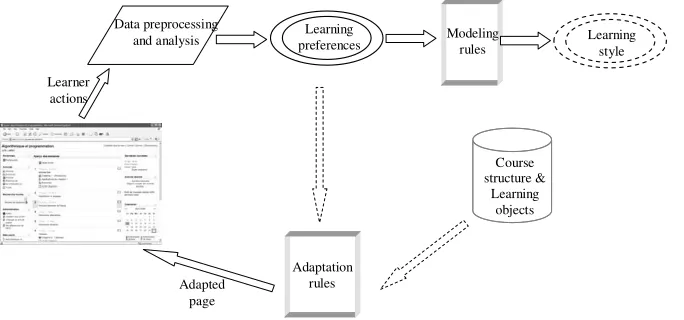
Our first objective is to dynamically model the learner, i. e. to identify the learning preferences by analyzing the behavioural indicators and then, based on them, infer the belonging to a particular learning style dimension. The second objective is to consequently adapt the navigation and the educational resources to match the student learning preferences (see figure 2.1 for a schematic description of the process). In order to achieve these two objectives, we need an intelligent way of organizing the learning material as well as a set of instructional metadata to support both learner modelling and adaptation processes.
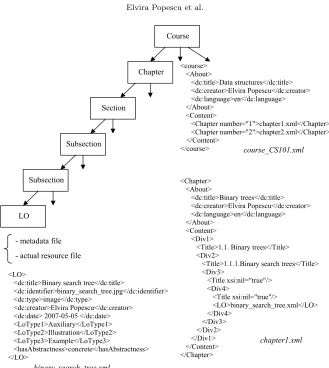
3. Organizing the Educational Material in an LSAES. According to [20], learning objects represent any digital resources that can be reused to support learning. In our case, the most complex learning object (with the coarsest granularity) is the course, while the finest granularity learning object is the elementary educational resource. We have conceptualized the learning material using the hierarchical organization illustrated in figure 3.1: each course consists of several chapters, and each chapter can contain several sections and subsections. The lowest level subsection contains the actual educational resources. Each elementary learning object corresponds to a physical file and has a metadata file associated to it.
Data preprocessing
and analysis preferencesLearning Modeling rules
Learning style
Course structure &
Learning objects
Adaptation rules Learner
actions
Adapted page
Fig. 2.1.Schematic representation of our LSAES
• high degree of reuse of the educational resources
• detailed learner tracking (since we are able to acquire and use all the information about what and how
learning resources are accessed by which learners at a particular moment)—see section 4
• fine granularity of adaptation actions—see section 5.
As far as the educational metadata is concerned, one possible approach (which is used in [16]) would be to associate to each learning object the learning style that it is most suitable for. One of the disadvantages of this approach is that it is tightly related to a particular learning style. Moreover, the teacher must create different learning objects for each learning style dimension and label them as such. This implies an increase in the workload of the teacher, and also the necessity that she/he possesses knowledge of the learning style theory. Furthermore, this approach does not support dynamic learner modelling, since accessing a learning object does not offer sufficient information regarding the student (a learning object can be associated with several learning styles).
Instead, we propose a set of metadata that describe the learning object from several points of view, including: instructional role, media type, level of abstractness and formality, type of competence etc. These metadata were created by enhancing core parts of Dublin Core [12] and Ullrich’s instructional ontology [29] with some specific extensions to meet the requirements of an LSAES. For example, some of the descriptors of a learning object that we propose are:
• title (the name given to the resource)→dc:title
• identifier (a reference to the actual resource, such as its URL)→dc:identifier
• type(the nature of the content of the resource, such as text, image, animation, sound, video)→dc:type
• format (the physical or digital manifestation of the resource, such as the media-type or dimensions of
the resource)→dc:format
• instructional role that can be either i)fundamental: definition, fact, law (law of nature, theorem) and
process (policy, procedure) or ii)auxiliary: evidence (demonstration, proof), explanation (introduction,
conclusion, remark, synthesis, objectives, additional information), illustration (example, counter
exam-ple, case study) and interactivity (exercise, exploration, invitation, real-world problem) → LoType1,
LoType2, LoType3, LoType4.
<course> <About>
<dc:title>Data structures</dc:title> <dc:creator>Elvira Popescu</dc:creator> <dc:language>en</dc:language> </About>
<Content>
<Chapter number="1">chapter1.xml</Chapter> <Chapter number="2">chapter2.xml</Chapter>
</Content>
</course> course_CS101.xml
<Chapter> <About>
<dc:title>Binary trees</dc:title> <dc:creator>Elvira Popescu</dc:creator> <dc:language>en</dc:language> </About>
<Content> <Div1>
<Title>1.1. Binary trees</Title> <Div2>
<Title>1.1.1.Binary search trees</Title> <Div3>
<Title xsi:nil="true"/> <Div4>
<Title xsi:nil="true"/>
<LO>binary_search_tree.xml</LO> </Div4>
</Div3> </Div2> </Div1> </Content> </Chapter>
chapter1.xml <LO>
<dc:title>Binary search tree</dc:title>
<dc:identifier>binary_search_tree.jpg</dc:identifier> <dc:type>image</dc:type>
<dc:creator>Elvira Popescu</dc:creator> <dc:date> 2007-05-05 </dc:date>
<LoType1>Auxiliary</LoType1> <LoType2>Illustration</LoType2> <LoType3>Example</LoType3>
<hasAbstractness>concrete</hasAbstractness> </LO>
binary_search_tree.xml LO
Subsection
Course
Chapter
Section
Subsection
- metadata file
- actual resource file
Fig. 3.1.Suggested organization of the learning content in an LSAES
4. Educational Metadata and Learner Modelling. The first step towards dynamic learner modelling comprises tracking and monitoring of student interactions with the system. Student observable behaviour in an educational hypermedia system includes: i) navigational indicators (number of hits on educational resources, navigation pattern); ii) temporal indicators (time spent on different types of educational resources proposed); iii) performance indicators (total learner attempts on exercises, assessment tests). Based on the interpretation of these observable facts, the system can infer different learning preferences. Knowing of the media type, the instructional role as well as other characteristics of the learning object the student interacts with is essential for an accurate identification of the learning preferences. Figure 4.1 illustrates the possible use of some of the learning object metadata.
5. Educational Metadata and Adaptation Logic. In the context of our work, modelling the learner is not a goal in itself.
The value of possessing a student model lies in its usability for providing a learning experience which is most beneficial for the student. Specifically, this could mean several things: in some cases, the most suitable attitude is to offer to the student the educational resources that better match his/her learning preferences, in terms of media type, browsing order of resources, communication and collaboration facilities, level of navigation guidance etc. In other situations, students could benefit more from being faced with a mismatched learning environment, which provides the necessary challenge to boost learning [22]. Moreover, when learners are firstly offered an educational content that doesn’t match well their learning preferences, they will usually not limit themselves to that particular resource, being inclined to access more of the available resources on the subject.
Learning preference Behavioral indicators Corresponding metadata tag
Visual preference High amount of time spent on contents with graphics, images, video
<dc:type>image</dc:type> <dc:type>video</dc:type> Verbal preference High amount of time spent on reading
text
<dc:type>text</dc:type> <dc:type>audio</dc:type> Abstract concepts
and generalizations
Access of abstract content first (concepts, definitions)
High amount of time spent on abstract content <LoType2>Definition</LOType2> <LoType2>Law</LOType2> <hasAbstractness>abstract</hasAbstractness> Concrete, practical examples
Access of concrete content first (examples)
High amount of time spent on concrete content <LoType2>Illustration</LoType2> <LoType2>Fact</LOType2> <hasAbstractness>concrete</hasAbstractness> Active experimentation
Access of practical content (simulations, exercises, problems…) before theory
<LoType2>Interactivity</LoType2>
Reflective observation
Access of theoretical content before practical content
<LoType1>Fundamental</LoType1>
Synthetic High performance on exercises requiring synthesis competency
<hasCompetency>synthesis</hasCompetency>
Analytic High performance on exercises requiring analysis competency
<hasCompetency>analysis</hasCompetency>
Fig. 4.1.Correspondence between learning preferences and educational metadata
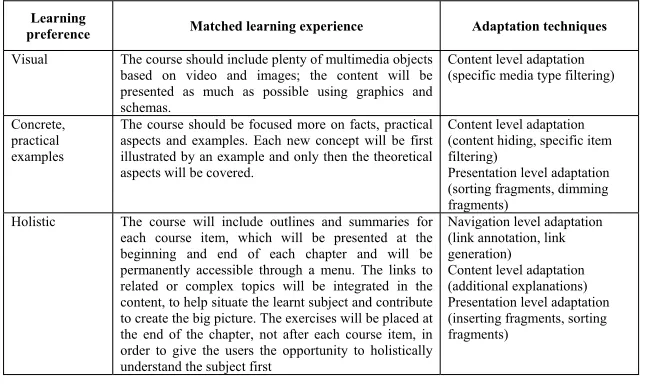
approach is that it allows complete independence between the learner model and the pedagogical model: various adaptation actions can be associated with each learner preference. Furthermore, we could combine several pedagogical goals, using some of the identified learning preferences to improve the efficiency of the learning process (matching), others to provide the needed challenge and variety or to develop weaker skills (mismatching) and others to increase student’s self-awareness about her/his strengths and weaknesses in the learning process (open model approach). Figure 5.1 illustrates a possible use of the detected learning preferences for a particular student. The adaptation techniques suggested are classified according to the levels of adaptation identified in [7] and [3].
Learning
preference Matched learning experience Adaptation techniques
Visual The course should include plenty of multimedia objects based on video and images; the content will be presented as much as possible using graphics and schemas.
Content level adaptation (specific media type filtering)
Concrete, practical examples
The course should be focused more on facts, practical aspects and examples. Each new concept will be first illustrated by an example and only then the theoretical aspects will be covered.
Content level adaptation (content hiding, specific item filtering)
Presentation level adaptation (sorting fragments, dimming fragments)
Holistic The course will include outlines and summaries for each course item, which will be presented at the beginning and end of each chapter and will be permanently accessible through a menu. The links to related or complex topics will be integrated in the content, to help situate the learnt subject and contribute to create the big picture. The exercises will be placed at the end of the chapter, not after each course item, in order to give the users the opportunity to holistically understand the subject first
Navigation level adaptation (link annotation, link generation)
Content level adaptation (additional explanations) Presentation level adaptation (inserting fragments, sorting fragments)
Fig. 5.1.Ways of providing adaptivity for different learning preferences
As we can see, the adaptation techniques can be decomposed into elementary adaptation actions (sort-ing/inserting/removing learning objects) based on various criteria, all of which are included in the metadata:
• media type→dc:type
• instructional role→LoType1, LoType2, LoType3, LoType4
• level of abstractness→hasAbstractness
• type of competency required (in case of exercises)→hasCompetency
6. An AI course module implemented in WELSA. Based on the above approach, we have developed an educational hypermedia system called WELSA, which offers the following functionalities:
• anauthoring tool for the teachers, allowing them to create courses conforming to the internal WELSA format, as described above;
• acourse playerfor the students, enhanced with a learner tracking functionality (monitoring the student interaction with the system);
• an analysis tool allowing the researcher to interpret the behaviour of the student and identify the corresponding learning styles.
In order to validate our approach we have designed a course module in the area of Artificial Intelligence and implemented it in WELSA. The course module deals with search strategies and solving problems by searching and it is based on the fourth chapter of Poole, Mackworth and Goebel’s AI textbook [24]. The course consists of 4 sections and 9 subsections, including a total of 46 learning objects (LOs). From the point of view of the media
type, the course includes both“text” LOs (35), as well as“image”, “video” and“animation” LOs (11). From
the point of view of the instructional role, the course consists of 12“Fundamental”LOs (5 “Definition”and 7
“Algorithm”) and 34 “Auxiliary” LOs (4“Additional Info”, 1“Demonstration”, 14“Example”, 5“Exercise”, 3 “Exploration”, 5 “Introduction”, 1 “Objectives” and 1 “Remark”). The course also includes access to two communication tools, one synchronous (chat) and one asynchronous (forum) and offers two navigation choices—
either by means of theNextand Previousbuttons, or by means of theOutline.
Initially, only the first LO on each page is expanded, the rest being shown in a strechtext format, including only the resource title and some visual cues such as icons for the instructional role and the media type. However, the student has the possibility to expand any LOs on the page and “lock” them in the expanded format. She/he can thus choose between having several LOs available at the same time or concentrating on only a single LO at a time.
Figure 6.1 shows a snapshot from the “Blind Search Strategies” section, more specifically the Depth-First
Search subsection. The fragment includes one LO withLoType2=“Definition”anddc:type=“text”and one with
LOType3=“Example”anddc:type=“animation”, both in an expanded state.
Fig. 6.1.A snapshot of WELSA course player
Fragments of the corresponding XML files are included in the Appendix (course.xml, chapter.xml,
7. Related Works. Currently there are several works that address aspects related to ontologies and metadata for personalized e-learning, such as: [1, 6, 13, 16, 17, 28]. A few of them, that we will briefly discuss here, also take into consideration learning styles.
In case of [16] the ontology is tied to a particular learning style model, namely Felder-Silverman (FSLSM)
[14]. There is a special class,LearningStyle, which represents the FSLSM dimension associated to a particular
learning object (active-reflective, visual-verbal, sensing-intuitive, sequential-global). Thus all learning objects have to be indexed according to FSLSM in order to allow for delivering of adapted content.
Paper [6] proposes a learning style taxonomy, based on Curry’s onion model [11]. In the LAG adaptation model, each learning style can be associated with a specific instructional strategy, which can be broken down into adaptation language constructs, which in their turn can be represented by elementary adaptation techniques. It is the role of the author to specify not only the annotated learning content (the static description) but also the adaptation logic (the dynamic description).
Finally, paper [28] introduces the concept of Open Learning Objects, which represent distributed multimedia objects in SVG format. They incorporate inner metadata in XML format which is structured on several levels (content, adaptation, animation. . . ). Each Open Learning Object is tied to a particular learning style dimension; however any learning style model can be employed, by configuring the adaptation markup.
8. Conclusions. In this paper we sketched an intelligent way of organizing the learning resources in an LSAES. Based on Dublin Core metadata [12] and Ullrich’s instructional ontology [29], we introduced a set of educational metadata that are independent of any learning style. We then showed how these metadata can be employed for modelling the learner and applying various adaptation techniques. The approach was illustrated with a course module in the area of Artificial Intelligence, which was created and deployed using WELSA, our dedicated adaptive educational system. As future work, we intend to validate our approach through experimental research, evaluating WELSA in real-world settings.
Appendix. Examples of course, chapter and metadata files.
course.xml.
<?xml version="1.0" encoding="UTF-8"?>
<course xmlns:p="http://purl.org/dc/elements/1.1/"
xmlns:xsi="http://www.w3.org/2001/XMLSchema-instance" xsi:noNamespaceSchemaLocation="course.xsd"
xsi:schemaLocation="http://purl.org/dc/elements/1.1/ http://dublincore.org/schemas/xmls/qdc/2006/01/06/dc.xsd"> <About>
<title>Artificial Intelligence</title> <identifier>CS104</identifier> <creator>Elvira Popescu</creator> <date>12-01-2008</date>
<subject>Artificial Intelligence</subject>
<description>This is an introductory course on AI</description> <language>en</language>
<source>Computational Intelligence - D. Poole, A. Mackworth, R. Goebel</source> . . .
</About> <Content>
<Chapter number="1">Computational Intelligence and Knowledge</Chapter> <Chapter number="2">A Representation and Reasoning System</Chapter> <Chapter number="3">Using Definite Knowledge</Chapter>
<Chapter number="4">Searching</Chapter>
<Chapter number="5">Representing Knowledge</Chapter> <Chapter number="6">Knowledge Engineering</Chapter> <Chapter number="7">Beyond Definite Knowledge</Chapter> <Chapter number="8">Actions and Planning</Chapter> <Chapter number="9">Assumption-Based Reasoning</Chapter> <Chapter number="10">Using Uncertain Knowledge</Chapter> </Content>
</course>
chapter.xml.
<?xml version="1.0" encoding="UTF-8"?>
<Chapter xmlns:dc="http://purl.org/dc/elements/1.1/" xmlns:xsi="http://www.w3.org/2001/XMLSchema-instance" xsi:noNamespaceSchemaLocation="chapter.xsd"
xsi:schemaLocation="http://purl.org/dc/elements/1.1/ http://dublincore.org/schemas/xmls/qdc/2006/01/06/dc.xsd"> <About>
. . . </About> <Content>
<Div1>
<Title>Why Search?</Title> <Div2>
<Title></Title> <Div3>
<Title>Why Search?</Title> <Div4>
<Title></Title>
<LO>search_introduction.xml </LO> <LO>search_def.xml </LO> <LO>search_objectives.xml </LO> </Div4>
</Div3> </Div2> </Div1> <Div1>
<Title>Graph Searching</Title> <Div2>
<Title></Title> <Div3>
<Title>Graph Searching</Title> <Div4>
<Title></Title>
<LO>graph_search_introduction.xml</LO> <LO>graph_search_example.xml</LO> </Div4>
</Div3> <Div3>
<Title>Formalizing Graph Searching</Title> <Div4>
<Title></Title>
<LO>fgraph_search_definition.xml</LO> <LO>fgraph_search_example.xml</LO> <LO>test_graph_searching.xml</LO> </Div4>
</Div3> </Div2> </Div1> <Div1>
<Title>A Generic Searching Algorithm</Title> <Div2>
<Title></Title> <Div3>
<Title>A Generic Searching Algorithm</Title> <Div4>
<Title></Title>
<LO>generic_search_introduction.xml</LO> <LO>generic_search_example1.xml</LO> <LO>generic_search_procedure1.xml</LO> <LO>generic_search_example2.xml</LO> <LO>generic_search_demonstration.xml</LO> <LO>generic_search_addinf.xml</LO> <LO>generic_search_costs.xml</LO> </Div4>
</Div3> <Div3>
<Title>Finding Paths</Title> <Div4>
<LO>generic_search_paths_introd.xml</LO> <LO>generic_search_paths_procedure.xml</LO> <LO>generic_search_paths_example.xml</LO> <LO>test_generic_search.xml</LO>
</Div4> </Div3> </Div2> </Div1> <Div1>
<Title>Blind Search Strategies</Title> <Div2>
<Title></Title> <Div3>
<Title>Blind Search Strategies</Title> <Div4>
<LO> blind_strategies_introduction.xml</LO> <LO> tutorial_text.xml</LO>
<LO> tutorial_video.xml</LO> </Div4>
<Div3>
<Title>Depth-First Search</Title> <Div4>
<LO> depth_first_definition.xml</LO> <LO> depth_first_simple_example.xml</LO> <LO> depth_first_procedure.xml</LO> <LO> depth_first_example_txt.xml</LO> <LO> depth_first_example_anim.xml</LO> <LO> depth_first_example_sim.xml</LO> <LO> depth_first_addinf.xml</LO> <LO> test_DFS.xml</LO>
</Div4> </Div3> <Div3>
<Title>Breadth-First Search</Title> <Div4>
<LO> breadth_first_definition.xml</LO> <LO> breadth_first_simple_example.xml</LO> <LO> breadth_first_procedure.xml</LO> <LO> breadth_first_example_txt.xml</LO> <LO> breadth_first_example_anim.xml</LO> <LO> breadth_first_example_sim.xml</LO> <LO> breadth_first_addinf.xml</LO> <LO> test_BFS.xml</LO>
</Div4> </Div3> <Div3>
<Title>Lowest-Cost-First Search</Title> <Div4>
<LO> lcost_first_definition.xml</LO> <LO> lcost_first_simple_example.xml</LO> <LO> lcost_first_procedure.xml</LO> <LO> lcost_first_example_txt.xml</LO> <LO> lcost_first_example_anim.xml</LO> <LO> lcost_first_example_sim.xml</LO> <LO> lcost_first_addinf.xml</LO> <LO> test_LCFS.xml</LO> </Div4>
</Div3> </Div2> </Div1> </Content> </Chapter>
depth first definition.xml. <?xml version="1.0" encoding="UTF-8"?> <LO xmlns:dc="http://purl.org/dc/elements/1.1/"
xmlns:xsi="http://www.w3.org/2001/XMLSchema-instance" xsi:noNamespaceSchemaLocation="metadata.xsd"
xsi:schemaLocation="http://purl.org/dc/elements/1.1/ http://dublincore.org/schemas/xmls/qdc/2006/01/06/dc.xsd"> <title>Definition</title>
<identifier>depth_first_definition.html</identifier> <type>text</type>
<format>text/html</format> . . .
<LoType1>Fundamental</LoType1> <LoType2>Definition</LoType2>
<hasAbstractness>neutral</hasAbstractness> <hasFormalness>informal</hasFormalness> </LO>
REFERENCES
[1] Al-Khalifa H. S., Davis H. C.: The Evolution of Metadata from Standards to Semantics in E-Learning Applications. Pro-ceedings of Hypertext’06,Odense, Denmark (2006).
[2] ADL SCORM.http://www.adlnet.gov/scorm/index.aspx
[3] ALFANET—D8.2 Public final report.http://rtd.softwareag.es/alfanet/ (2005).
[4] Anido L., Fernandez M., Caeiro M., Santos J., Rodriguez J., Llamas M.: Educational metadata and brokerage for learning resources.Computers and Education, Elsevier, 38 (2002) 351–374.
[5] Bajraktarevic N., Hall W., Fullick P.: Incorporating learning styles in hypermedia environment: Empirical evaluation. Procs. Workshop on Adaptive Hypermedia and Adaptive Web-Based Systems(2003) 41–52.
[6] Brown E., Cristea A., Stewart C., Brailsford T.: Patterns in Authoring of Adaptive Educational Hypermedia: A Taxo-nomy of Learning Styles.Educational Technology and Society, 8, (2005) 77–90.
[8] Carver C. A., Howard R. A., Lane W. D.: Enhancing student learning through hypermedia courseware and incorporation of student learning styles.IEEE Transactions on Education, 42 (1999) 33–38.
[9] Cha H. J., Kim Y. S., Park S. H., Yoon T. B., Jung Y. M., Lee J. H.: Learning styles diagnosis based on user interface behaviors for the customization of learning interfaces in an intelligent tutoring system.Proc. 8th Intl. Conf. on Intelligent Tutoring Systems, LNCS, Vol. 4053, Springer (2006).
[10] Coffield F., Moseley D., Hall E., Ecclestone K.: Learning styles and pedagogy in post-16 learning. A systematic and critical review. Learning and Skills Research Centre, UK (2004).
[11] Curry L.:Integrating Concepts of Cognitive or Learning Style: A Review with Attention to Psychometric Standards. Ottawa, ON: Canadian College of Health Service Executives (1987).
[12] Dublin Core Metadata Initiativehttp://dublincore.org/
[13] Dolog P., Henze N., Nejdl W., Sintek M.: Personalization in distributed eLearning environments, Proc. Intl. Conf. WWW2004 (2004).
[14] Felder R. M., Silverman L. K.: Learning and teaching styles in engineering education. Engineering Education, Vol. 78, No. 7 (1988).
[15] Gardner H.:Multiple Intelligences: The Theory in Practice. Basic Books, New York (1993).
[16] Gascuena J., Fern´andez-Caballero A., Gonzalez P.: Domain Ontology for Personalized E-Learning in Educational Systems. Proc. 6th IEEE Intl. Conf. on Advanced Learning Technologies—ICALT 2006, IEEE Computer Society Press (2006).
[17] Geser G. (Ed.):OLCOS Roadmap 2012—Open Educational Practices and Resources, Austria (2007).
[18] Honey P., Mumford A.:The learning styles helper’s guide. Maidenhead: Peter Honey Publications Ltd. (2000). [19] IEEE LOMhttp://ltsc.ieee.org/wg1
[20] IMS MD:http://www.imsglobal.org/metadata/index.html
[21] Keefe J. W.: Learning style: an overview.NASSP’s Student Learning Styles: Diagnosing and Prescribing Programs (1979) 1–17.
[22] Kelly D., Tangney B.: Adapting to intelligence profile in an adaptive educational system. Interacting with Computers, Elsevier, 18 (2006) 385–409.
[23] Papanikolaou K. A., Grigoriadou M., Kornilakis H., Magoulas G. D.: Personalizing the interaction in a Web-based educational hypermedia system: the case of INSPIRE.User-Modeling and User-Adapted Interaction, 13 (2003) 213–267. [24] Poole D., Mackworth A., Goebel R.:Computational Intelligence: A Logical Approach. Oxford University Press (1998). [25] Popescu E., B˘adic˘a C., Trigano P.: Rules for Learner Modeling and Adaptation Provisioning in an Educational Hypermedia
System.Proc. SYNASC 2007 (workshop RuleApps), IEEE Computer Society Press (2007), 492–499.
[26] Popescu E., Trigano P., B˘adic˘a C.: Towards a Unified Learning Style Model in Adaptive Educational Systems.Proc. 7th IEEE Intl. Conf. on Advanced Learning Technologies—ICALT 2007, IEEE Computer Society Press (2007), 804–808. [27] Popescu E., Trigano P., B˘adic˘a C.: Adaptive Educational Hypermedia Systems: A Focus on Learning Styles.Proc. 4th
IEEE Intl. Conf. on Computer as a Tool—EUROCON 2007, IEEE Press (2007), 2473–2478.
[28] Shi H., Rodriguez O., Chen S., Shang Y.: Open Learning Objects as an Intelligent Way of Organizing Educational Material. International Journal on E-Learning, 3(2) (2004) 51–63.
[29] Ullrich C.: The Learning-Resource-Type is Dead, Long Live the Learning-Resource-Type!.Learning Objects and Learning Designs, 1 (2005) 7–15.
Edited by: Maria Ganzha, Marcin Paprzycki
Received: March 23, 2008