IRJE | Vol. 3 | No. 2| Year 2019 |E-ISSN: 2580-5711 442
EFL Students' Needs of Digital Literacy to Meet the Demands
of 21
stCentury Skills
ERYANSYAH1 , ERLINA2, FIFTINOVA3, ARI NURWENI4
Abstract
This study was a survey study which was aimed at looking at EFL students’ current knowledge and skills of ICT. The research questions of this study were(1) What levels of digital literacy are the EFL students?, (2) What are the factors affecting EFL students in using ICT in language learning?, and (3) What are the students' needs to improve their digital literacy skills to meet the demands of the 21st century skills?
Two groups of EFL students from two state-owned universities in the southern part of Sumatra were involved in this study. A set of questionnaires adapted from Ravitz (2014) was used. The findings showed that EFL students’ current level of digital literacy was categorized low. Factors affecting them from using ICT in language learning properly were limited use of ICT applications as a tool for language learning and limited access to computers and internet applications on campus. What the EFL students needed to improve their digital literacy skills was the availability of computers with internet applications to be used anytime on campus, ICT training for both teachers and students, and continuous integration of ICT in language learning.
Keywords
Digital technology, ICT, digital native, digitally literate
1. Language and Arts Education Department, Faculty of Teacher Training and Education, Sriwijaya
University, Palembang, Indonesia; [email protected].
2. Language and Arts Education Department, Faculty of Teacher Training and Education, Sriwijaya
University, Palembang, Indonesia; [email protected].
3. Language and Arts Education Department, Faculty of Teacher Training and Education, Sriwijaya
University, Palembang, Indonesia; [email protected].
4. Language and Arts Education Department, Faculty of Teacher Training and Education, Lampung
IRJE | Vol. 3 | No. 2| Year 2019 |E-ISSN: 2580-5711 443 Introduction
Teaching EFL students today is different from the one we did several decades ago, especially in terms of technology used in language teaching. Several decades ago, we still used a tape player, video player, and blackboard or whiteboard as media used in the classroom. Today those media have been replaced by digital technologies such as mp3 replacing tape cassette, mp4 replacing videotapes, and smart board replacing blackboard and whiteboard. All those teaching media can be controlled from a single computer. The communication between teacher and students outside class hours have changed too. We used to communicate through landlines and mobile phones. Today our communication is made through digital-based technologies such as smartphones or tablets with various applications (Instagram, email, short text messages, WhatsApp, video calls from WhatsApp, Gmail, Facebook, and Skype) (Kuldip-Singh & Samah, 2018; Miakotko, 2017). The massive use of those applications indicates that most people today including the EFL teachers and students today are active users of digital technologies.
Digital technologies have been used in teaching and learning activities in most developed countries for more than 25 years (Passey et al., 2016). They named digital technologies as ICT, Information and Communication Technology. In contrast, the use of ICT in the classroom in many developing countries like Indonesia is still a new phenomenon. ICT has not been integrated into the classroom yet especially in EFL classes. A study conducted by Kurniawati, Maolida, and Anjaniputra (2018) concluded that EFL teachers today were still in the stage of adapting digital media to their EFL classes. They still had limitations in using digital media. Although the use of ICT has been introduced in education since 2001 based on the Decree of the Ministry of State Apparatus Utilization No. 133/M.PAN/5/2001, EFL teachers are still reluctant to integrate it in their EFL teaching (Durriyah & Zuhdi, 2018). One of the causes, as explained by Lubis (2018), is that “time allocation and technical problems become the major constraints to conduct a proper integration” (p. 18). Price-Dennis, Wiebe, and Fowler-Amato (2014 as cited in Durriyah & Zuhdi, 2018, p. 54) add that “a gap between availability and use of digital technologies in classroom” also affect teachers’ reluctance to integrate digital technologies or ICT in the classroom. Realizing that EFL teaching today has changed and the change has involved digital technology or ICT, EFL teachers and/or EFL students who are the prospective EFL teachers must have anticipated the changes. Although they are digital natives1, there is no
guarantee that they are digitally literate. Data from Kominfo (2014) shows that there were 82 million internet users in Indonesia in 2014 which was the 8th largest users in the world. That
number must have increased significantly this year. Despite the big number, according to
1Digital natives are those who are born in the digital era and are the native speakers of “the digital language of
IRJE | Vol. 3 | No. 2| Year 2019 |E-ISSN: 2580-5711 444
Tampubolon (2017), most Indonesians, in reality, do not have a strong understanding of how the digital world works. A large number of them are still digitally illiterate. They use digital technology mainly only as a medium for communication or information sharing.
The above condition is relevant to what was stated by Spires and Bartlett (2012) that although the students today are digital natives, they lack complete knowledge of digital literacy. They are not very aware of how the actual use of technology has influenced their learning. As a result, they sometimes ignore ethics in using social media. In the Indonesian context, Supratman and Wahyudin (2017) found that the lack of digital literacy education has caused many Indonesian students do not know how to use social media wisely and responsibly. Based on the explanations above, it is obvious that being digitally literate is important for everyone in this digital era including those who are in higher education. For university students, as claimed by Fieldhouse and Nicholas (2008), being digitally literate allows them to have the skills to think critically on how to determine the information received is credible and possessing the information, and the skills to contextualize, analyze, and synthesize any information found online. In short, digital literacy is becoming a skill necessary for everyone in this 21st century. Knowing students’ lack of digital literacy skills
and realizing the importance of being digitally literate in the 21st century, the authors
considered it was important to teach digital literacy skills to students including those, the prospective EFL teachers who were in the last year of their study at university. Before teaching digital literacy to them, it was deemed necessary to find out their current level of digital literacy and their needs of digital literacy to meet the demands of the 21st century
skills. For that reason, this study was conducted to investigate EFL students’ current level of digital literacy and their needs for digital literacy to meet the demands of 21st century skills.
This study was a survey study involving English education study program students from two state-owned universities in two big cities in the southern part of Sumatra. The focus of this study was to investigate EFL students’ current level of digital literacy and their needs of digital literacy to meet the demands of 21st century skills. The purpose of the study
was aimed at looking at EFL students’ current level of digital literacy, finding out factors affecting EFL students in using ICT in language learning, and identifying EFL students’ needs to improve their digital literacy skills to meet the demands of the 21st century skills. To
achieve the purpose of the study, these research questions guided the study: (1) What levels of digital literacy are the EFL students?, (2) What are the factors affecting EFL students in using ICT in language learning?, and (3) What are the students' needs to improve their digital literacy skills to meet the demands of the 21st century skills?
Literature Review Digital technology
IRJE | Vol. 3 | No. 2| Year 2019 |E-ISSN: 2580-5711 445
and school environments” (Lee & Finger, 2010, p. 15).This term is used interchangeably with educational technology, computer-based technologies, learning technology, and ICT. Among those terms, ICT (Information and Communication Technology) is the most commonly used term (Lee & Finger, 2010). Therefore, the term ICT will be mostly used in the rest of this article.
ICT has changed the ways people do their daily activities. It affects them at least in three main sectors, that is, education, communication, and entertainment and leisure. In terms of education, the advancement of technology today has changed the ways teaching and learning activities performed in the class. Ciroma (2014) found out that,
Worldwide research has shown that ICT can lead to improved student learning and better teaching methods. A report made by the National Institute of Multimedia Education in Japan proved that an increase in student exposure to educational ICT has a significant impact on student’s achievement, especially in terms of knowledge, comprehension, practical skill and presentation skill in subject areas such as mathematics, science, and social study. (p. 99)
The above explanation indicates that the integration of ICT in the classroom gives benefits to both teachers and students. Through ICT, teachers can use a lot of images to improve retention of students’ memory, explain difficult instruction and ensure students’ understanding of the material discussed, and create more exciting class instruction, attract students’ attention and improve their concentration (Lachica, 2015; Mogekwu, 2015).
ICT has also changed the role of a teacher in the classroom. The teacher is no longer the only source of knowledge. He or she facilitates the creation of knowledge and skills. This condition changes students’ behaviors from passive to active students. Being facilitated by the teacher, students can collaborate with others to discover new knowledge and skills. In brief, the integration of ICT in the classroom transforms the teaching and learning process in the class from teacher-centered to be student-centered (Lachica, 2015).
The impact of ICT on entertainment is that ICT has enabled people to have more entertainment offered. People spend less time outside during their leisure time as they can find any entertainment they need through their gadgets (such as smartphones, tablets, or laptops) to watch online movies on YouTube or paid movies, listen to MP3 songs, or play online games. They can even watch TV or movies for the whole family at home using home internet and cable TV.
Impact of ICT on EFL teaching and learning
IRJE | Vol. 3 | No. 2| Year 2019 |E-ISSN: 2580-5711 446
Hussain (2018)assert that the use of ICT in the language classroom affects the increase of students’ autonomous learning, motivation, and performance in EFL learning. For EFL teachers, Houcine (2011) summarizes six impacts of the use of ICT on EFL teaching.
(1) The possibility to adapt easily the teaching materials according to circumstances, learner’s needs and response; (2) ICT allows to react upon and enables the use of recent/daily news, it offers access to authentic materials on the web; (3) Quick feedback is made possible; (4) Possibility to combine/use alternately (basic) skills (text and images, audio and video clip...); (5) Lectures become more interesting and less ordinary which boosts learners’ engagement; (6) ICT enables to focus on one specific aspect of the lesson (pronunciation, vocabulary...). (Houcine, 2011, pp. 1-2)
The above explanation shows that the use of ICT in language teaching has given positive impacts for both teachers and students. The integration of ICT in language teaching makes EFL teaching more effective in enhancing language learning as stated by Cetto (2010), “In my experience, technology has broadened the spectrum of interaction while empowering the students’ learning process by providing better opportunities for language usage” (p. 121).
Importance of being digitally literate
As most of the undergraduate students today are digital natives, they have been exposed to the use of digital technology (smartphones, tablets, laptops, desktops, music and movie players, etc.). It is believed that many of them are digitally literate. This condition is an opportunity for EFL teachers. They can integrate ICT into their EFL classrooms. They can use smartphones, for example, to develop students’ language skills (listening, speaking, reading, and writing) by adapting any authentic materials available on the internet that are appropriate to be used for their students. They can share the materials using smartphone applications such as WhatsApp, Facebook, Instagram, etc.
To run an ICT-based EFL teaching well, both EFL teachers and students must be digitally literate. The meaning of the term literate used here is different from its literal meaning found in a dictionary, that is, having the capability of reading and writing. The advancement of technology and the internet today has integrated the word literacy with digital
literacy. Jones and Flannigan (2006)define,
IRJE | Vol. 3 | No. 2| Year 2019 |E-ISSN: 2580-5711 447
In brief, being digitally literate here can be interpreted as having the ability to navigate digital media for information and communication and to utilize them effectively, creatively, and responsibly. There are three components that EFL teachers and students need to have to be indicated that they are digitally literate. Those components are information literacy (IL), information and communication technology (ICT) skills, and media literacy (ML)(Chu, Reynolds, Tavares, Notari, & Lee, 2017). Chu et al. (2017) further explain,
IL is the ability to effectively and ethically select, evaluate and use information to gain, apply and share their knowledge…, ICT skills … refer to the ability to use digital technology, communication tools, and/or networks to access, manage, integrate, evaluate and create bodies of information, [and] ML … is associated with the ability to access, analyze, evaluate and communicate messages in a variety of forms. (p. 22)
Being digitally literate is deemed very important today. Since digital media are available almost everywhere today and most of students today are already digital natives, the EFL teachers who are digitally literate can utilize ICT to create new ways of teaching and learning within or outside the classroom. But, EFL students’ current level of digital literacy skills and any factors affecting the implementation of ICT in the class should be identified before the ICT program is properly integrated into EFL teaching. In this way, students’ need for digital literacy is to meet the demand of the 21st century skills can be properly
programmed.
Methodology Research design
IRJE | Vol. 3 | No. 2| Year 2019 |E-ISSN: 2580-5711 448 Sampling procedure
This study employed convenience sampling as its sampling method. Fraenkel and Wallen (2005) explain that convenience sampling refers to “a group of individuals who (conveniently) are available for study” (p. 75). The samples of this study were the 7th
semester students of English education study programs from two state-owned universities explained earlier. They were targeted in this study since they were the end product of an undergraduate program, in this case, the English Education Study Program. In addition, they were conveniently available for this study as they had fewer subjects taken in this semester compared to the 5thor 3rdsemester students. In other words, they had more available time to
be involved in this study. Therefore, they were considered ideal to be suited as the sample in this study.
There were 62 EFL students from the English education study program of State-owned university A and 57 students from the English education study program of State-owned university B participating in this study. The genders of those participants can be found in the following table.
Table 1.Participant genders
State-owned University A State-owned University B
Male Percentage Female Percentage Male Percentage Female Percentage 8 12.9% 54 87.09% 6 10.52% 51 89.47%
Data from table 1 above show that the majority of research participants in both state-owned universities were female. This phenomenon as occurred in the last two decades that more female students pursuing their studies in the faculty of teacher training and education. Data from Kemendikbudin 2016 and 2017 reveal that an increasing percentage of female teachers teaching in junior and senior high schools (Kemendikbud, 2016, 2017). This tendency seems to continue as the prospective teachers as shown in Table 1 above are dominated by female students.
Data collection and analysis
IRJE | Vol. 3 | No. 2| Year 2019 |E-ISSN: 2580-5711 449
The questionnaire had five sections. The first four sections came with rated items. The first section regarding the use of technology as a tool for language learning asked the participants to rate their responses from almost never to almost daily. The second section, asking participants’ frequency in using computer and internet applications, asked them to rate their response from never to very frequently. The third section, asking their skills in using computer and internet applications, asked them to rate their responses from do not know to very good. The fourth section, asking their attitude toward the use of ICT in language learning, asked them to rate their responses from strongly disagree to strongly agree. Meanwhile, the last section provided participants with a list of factors affecting the use of ICT for language learning. They were asked to choose any factors affecting them in using digital technology. The collected data from the questionnaires were analyzed descriptively based on the frequencies and percentages of participants’ responses using Microsoft excel. Only the highest rating from each section of the questionnaire was analyzed. The findings from each section of the questionnaire were presented in the form of tables. Each table presented the findings from both groups of participants as can be seen from table 2 to table 6.
Ethical consideration
As this study involved two groups of students as research participants from two state-owned universities in the southern part of Sumatra, ethical issues such as access to research participants, informed consent, confidentiality, and anonymity were considered. To get access to research participants, the authors as researchers in this study asked formal permission from the deans of the faculty of teacher training and education of the two universities to undertake the research. When the authors as researchers met the research participants for collecting data, the research participants were informed about the research aims and procedures, benefits of their involvement in the study, and consent form informing them about their involvement in the study, protection for their confidentiality, and entitlement of withdrawing their participation.
Findings
IRJE | Vol. 3 | No. 2| Year 2019 |E-ISSN: 2580-5711 450
Data findings from the questionnaires from both groups of research participants were presented in pairs where only the highest scale from each questionnaire was compared and contrasted as seen in the following tables.
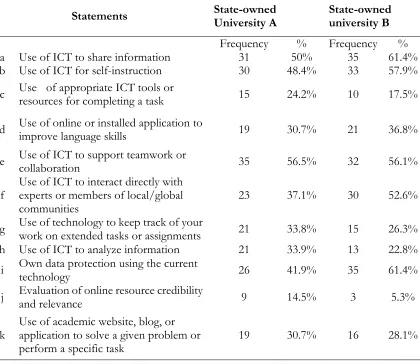
Table 2.Use of ICT as a tool for language learning in the classroom
Statements State-owned University A State-owned university B
Frequency % Frequency % a Use of ICT to share information 31 50% 35 61.4% b Use of ICT for self-instruction 30 48.4% 33 57.9%
c Use of appropriate ICT tools or resources for completing a task 15 24.2% 10 17.5%
d Use of online or installed application to improve language skills 19 30.7% 21 36.8%
e Use of ICT to support teamwork or
collaboration 35 56.5% 32 56.1%
f Use of ICT to interact directly with experts or members of local/global
communities 23 37.1% 30 52.6%
g Use of technology to keep track of your work on extended tasks or assignments 21 33.8% 15 26.3% h Use of ICT to analyze information 21 33.9% 13 22.8%
i Own data protection using the current
technology 26 41.9% 35 61.4%
j Evaluation of online resource credibility and relevance 9 14.5% 3 5.3%
k Use of academic website, blog, or application to solve a given problem or
perform a specific task 19 30.7% 16 28.1%
IRJE | Vol. 3 | No. 2| Year 2019 |E-ISSN: 2580-5711 451
or 52.6%). In brief, students from state-owned university B used ICT as tools for language learning in the classroom more than those in state-own university A.
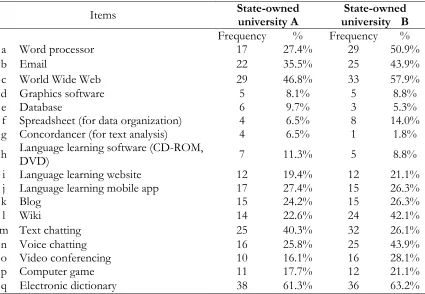
Table 3.Self-rating of the frequency of using computer and internet applications
Items State-owned university A university B State-owned Frequency % Frequency % a Word processor 17 27.4% 29 50.9%
b Email 22 35.5% 25 43.9%
c World Wide Web 29 46.8% 33 57.9% d Graphics software 5 8.1% 5 8.8%
e Database 6 9.7% 3 5.3%
f Spreadsheet (for data organization) 4 6.5% 8 14.0% g Concordancer (for text analysis) 4 6.5% 1 1.8% h Language learning software (CD-ROM, DVD) 7 11.3% 5 8.8% i Language learning website 12 19.4% 12 21.1% j Language learning mobile app 17 27.4% 15 26.3%
k Blog 15 24.2% 15 26.3%
l Wiki 14 22.6% 24 42.1%
m Text chatting 25 40.3% 32 26.1% n Voice chatting 16 25.8% 25 43.9% o Video conferencing 10 16.1% 16 28.1% p Computer game 11 17.7% 12 21.1% q Electronic dictionary 38 61.3% 36 63.2%
IRJE | Vol. 3 | No. 2| Year 2019 |E-ISSN: 2580-5711 452 Table 4.Self-rating of skills in using computer and internet applications
Statements
State-owned University A
State-owned university B
Frequency % Frequency %
a Word processing applications (e.g., MS Word) 30 48.4% 25 43.9% b Spreadsheet applications (e.g., MS Excel) 16 25.8% 10 17.5% c Database applications (e.g., MS Access) 5 8.1% 2 3.5% d Presentation applications (e.g., MS PowerPoint) 28 45.2% 25 43.9% e Communication applications (e.g., Skype) 9 14.5% 11 19.3% f Learning management systems (e.g., Moodle) 1 1.6% 1 1.8% g Virtual worlds (e.g., Second Life) 4 6.5% 4 7.0% h Social networking services (e.g., Facebook) 23 37.1% 26 45.6%
i Blogs (e.g., Blogger) 14 22.6% 13 22.8%
j Wikis (e.g., PBworks) 7 11.3% 14 24.6% k Podcasts (e.g., Apple Podcasts) 12 19.4% 6 10.5% l File sharing sites (e.g., Dropbox) 15 24.2% 13 22.8% m photo sharing sites (e.g., Picasa) 14 22.6% 22 38.6% n Video sharing sites (e.g., YouTube) 28 45.2% 24 42.1% o Web design applications (e.g.,
Dreamweaver) 8 12.9% 8 14.0%
p Web search engines (e.g., Google) 35 56.5% 35 61.4% q Dictionary apps (e.g., Dictionary.com) 38 61.3% 38 66.7%
IRJE | Vol. 3 | No. 2| Year 2019 |E-ISSN: 2580-5711 453
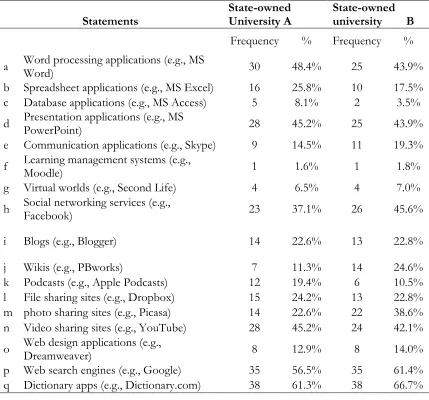
in using social network services, 25 students or 43.9% were proficient in using word processing applications, another 25 students or 43.9% were capable of using presentation application, and 24 students or 42.1% were experienced in sharing videos online.
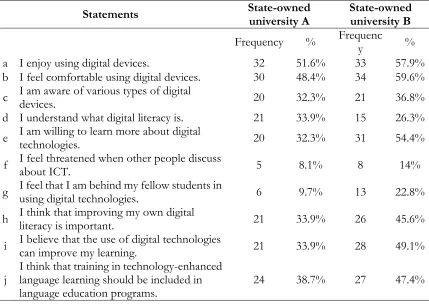
Table 5.Self-rating of attitude toward the use of ICT
Statements State-owned
university A
State-owned university B
Frequency % Frequency % a I enjoy using digital devices. 32 51.6% 33 57.9% b I feel comfortable using digital devices. 30 48.4% 34 59.6% c I am aware of various types of digital devices. 20 32.3% 21 36.8% d I understand what digital literacy is. 21 33.9% 15 26.3% e I am willing to learn more about digital technologies. 20 32.3% 31 54.4%
f I feel threatened when other people discuss about ICT. 5 8.1% 8 14%
g I feel that I am behind my fellow students in using digital technologies. 6 9.7% 13 22.8%
h I think that improving my own digital literacy is important. 21 33.9% 26 45.6%
i I believe that the use of digital technologies can improve my learning. 21 33.9% 28 49.1%
j I think that training in technology-enhanced language learning should be included in language education programs.
24 38.7% 27 47.4%
IRJE | Vol. 3 | No. 2| Year 2019 |E-ISSN: 2580-5711 454 Table 6.Factors affecting the use of ICT for language learning
Statements
State-owned university
A
State-owned university
B
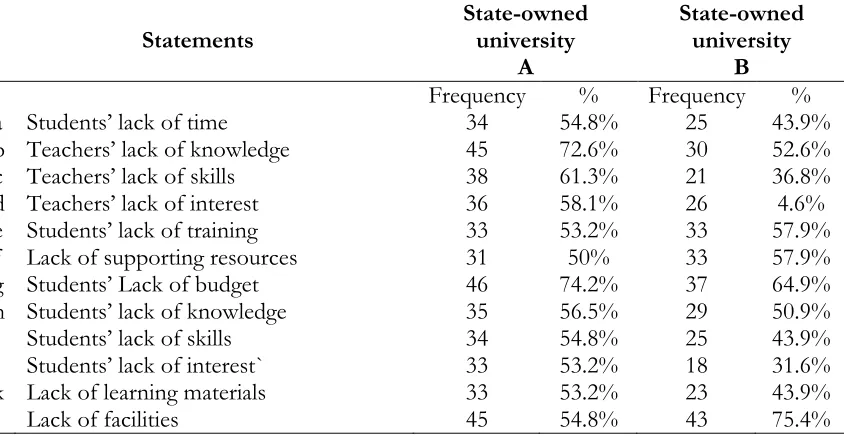
Frequency % Frequency % a Students’ lack of time 34 54.8% 25 43.9% b Teachers’ lack of knowledge 45 72.6% 30 52.6% c Teachers’ lack of skills 38 61.3% 21 36.8% d Teachers’ lack of interest 36 58.1% 26 4.6% e Students’ lack of training 33 53.2% 33 57.9% f Lack of supporting resources 31 50% 33 57.9% g Students’ Lack of budget 46 74.2% 37 64.9% h Students’ lack of knowledge 35 56.5% 29 50.9% i Students’ lack of skills 34 54.8% 25 43.9% j Students’ lack of interest` 33 53.2% 18 31.6% k Lack of learning materials 33 53.2% 23 43.9% l Lack of facilities 45 54.8% 43 75.4%
Table 6 lists all possible factors that could affect the development of students’ digital literacy skills. Students from state-owned university A considered all the factors listed in the table affecting them from using ICT in the classroom properly. When they were ranked in terms of frequencies from the highest to the lowest, it can be seen that 46 students (74.2%) consider lack of budget as one of the factors inhibiting them from using ICT for language learning properly, 45 students (72.6%) considered teachers’ lack knowledge, 38 students (61.3%) considered teachers’ lack of skills, 36 students (58.1%) considered teachers’ lack of interest, 35 students (56.5%) considered students’ lack of knowledge, 34 students (54.8%) considered students’ lack of time, 34 students (54.8%) considered students’ lack of skills, 33 students (53.2%) considered students’ lack of training, interest, and learning materials, 31 students (50%) considered lack of supporting devices.
Different from students of state-owned university A, those from state-owned university B considered 6 factors as the main factors affecting them from using ICT for language learning properly. They are lack of facilities (43 students or 75.4%), students’ lack of budget (37 students or 64.9%), students’ lack of training (33 students or 57.9%), lack of supporting devices (33 students or 57.9%), teachers’ lack of knowledge (30 students or 52.6%), and students’ lack of knowledge (29 students or 50.9%).
Discussion
IRJE | Vol. 3 | No. 2| Year 2019 |E-ISSN: 2580-5711 455
EFL students’ needs to improve their digital literacy skills to meet the demands of the 21st
century skills. The findings derived from data analysis of questionnaires given to both groups of participants involved in this study indicated that in terms of ICT use as a tool for language learning in the class, the findings indicated that ICT had been used as a tool for language learning in the classroom. Both groups shared similar ideas that ICT had been used to support teamwork or collaboration, to share information, and to be used for self-instruction. However, data from Table 2 reveal that more ICT tools were very limitedly used by participants from both groups. This means that although ICT had been used as a tool in language learning, it had not been used optimally.
Regarding the frequency of using computer and internet applications, data findings from Table 3 show that participants from State-owned university B had used computers and internet applications (word processor, world wide web, Wiki, voice chatting, electronic dictionaries) more frequently than those from state-owned university Ac(world wide web, voice chatting and electronic dictionary). These findings are relevant to the previous findings where participants from state-owned university B used more ICT applications than those in state-owned university A (see Table 2). However, the limited number (with percentages under 30%) of students using other computer and internet applications indicates that access to use computer and internet applications seemed to be limited.
From students’ self-rating on their skills in using computers and internet applications as shown in Table 4, only two internet applications (web search engines and dictionary applications) that were claimed by more than 60% of participants from both groups. That only two skills among the thirteen skills of using computer and internet applications claimed by both groups of participants indicate that the majority of the participants had low skills in using computer and internet applications. In other words, their digital literacy skills could be categorized low. This finding seemed to be related to the first two findings described above, less use of ICT applications as a tool in language learning and limited access to computer and internet applications. These two factors seemed to have contributed to students’ low knowledge and skills in using computer programs and internet applications.
Notwithstanding the participants in both groups had limited access and low knowledge and skills in using computers and internet applications, data in Table 5 show that they had a positive attitude toward the importance of digital literacy in language learning. Both groups confirmed that they enjoyed using digital devices and felt comfortable using the devices. They also shared the same idea about the importance of ICT training in language education programs. The table also reveals very limited number of students confirming they felt threatened when others talked about digital technologies (6 of 62 students from State-owned university A and 8 of 57 students from State-owned university B) and felt behind their fellows in using digital technology (8 of 62 students from State-owned university A and 13 of 57 students from State-owned university B) further confirm that majority of them had positive attitude toward the use of ICT in language learning.
IRJE | Vol. 3 | No. 2| Year 2019 |E-ISSN: 2580-5711 456
students. In terms of institutional factors, both groups shared the same opinion that lack of facilities, lack of supporting devices, and lack of training given by the institution as the most dominant factor affecting their full literacy of ICT. From the teacher factor, both groups shared a similar problem, that is, teachers’ lack of knowledge of ICT as the affecting factor. Related to teacher factor, participants from state-owned university A seemed to be more aware. They identified two other factors from the teacher's side, i.e. lack of skill and interest in ICT. Finally, in terms of student factors, participants in both groups were on the same boat. They considered a lack of budget and skills in ICT to be their problems. The other two problems related to students were added by participants from state-owned university A. They are lack of knowledge of ICT and less time to study ICT.
All the findings discussed above seem to be relevant to whatSpires and Bartlett (2012), Supratman and Wahyudin (2017), and Tampubolon (2017)have stated earlier that even though the EFL students today are digital natives, they still lack digital knowledge and skills. In other words, they are not digitally literate. Although some activities have been done to improve students’ digital literacy (as seen in Table 2), they are still unsatisfactory (Kurnia & Astuti, 2017). Therefore, more efforts must be done to improve EFL students’ digital literacy. The authors agree with Azmi (2017); Houcine (2011); Hussain (2018); Papadima-Sophocleous et al. (2014)that the use of ICT in language learning not only increases EFL students’ digital literacy, but it also improves their performance in language learning.
To use ICT as a tool for language learning optimally, EFL students’ current digital literacy skills must be known and any problems or factors affecting the development of their digital literacy skills must be identified. This study found that EFL students’ low digital literacy skills were caused by limited use of ICT applications as a tool for language learning and limitation to access computers and internet applications. The first factor seemed to be caused by EFL teachers who seemed to be reluctant to integrate ICT in their EFL teaching and learning activities. As reported by Kurniawati et al. (2018), the EFL teacher themselves were still in the stage of adapting ICT in their EFL teaching. They still had limitations in using digital devices. The second factor can be caused by the students themselves such as lack of budget, less training on ICT, and limited time to access computer and internet applications. The less availability of free computer and internet applications on campus with their supporting devices and less training to learn digital devices and resources contributed to EFL students’ low digital literacy skills as well. If all the problems above could be resolved, EFL students’ low digital literacy skills could be improved and the students could “take advantage of the [digital] tools and resources for language learning in authentic contexts” (Son, Park, & Park, 2017).
Conclusion, Limitations, and Implications
IRJE | Vol. 3 | No. 2| Year 2019 |E-ISSN: 2580-5711 457
their needs to meet the demand of the 21st century skills. Data findings from the
questionnaire showed that ICT was already used as a tool for language learning and students had a positive attitude toward the use of ICT in language learning. Although in general, they had basic knowledge and skills in using computers and internet applications, they were not fully literate in using ICT. Several factors affected them from fully literate in ICT such as lack of ICT facilities and supporting devices, teachers’ lack of knowledge and skills of ICT, students’ lack of budget and skills of ICT. In brief, what students need to improve their digital literacy in ICT was the availability of public computers with internet access that can be accessed by students anytime, the need for ICT training for both teachers and students, and the continuous integration of ICT in language learning.
Several limitations had been identified related to the results of this study including its non-generalizability, limited number of samples, time constraints, and less varied research instruments. However, research findings still provided valuable information. On this basis, the authors recommend further study investigating EFL students’ digital literacy which involves more samples from several universities in Indonesia, various research instruments, and a longer time to conduct the study. In this way, a more generalized conclusion can be made regarding the current condition of EFL students’ digital literacy and a more appropriate plan can be designed to improve EFL students’ digital literacy to meet the demands of the 21st century skills.
The findings of this study, although on a small scale, provide valuable information regarding the current condition of EFL students’ digital literacy. They strengthened the previous claim that being digital natives does not guarantee someone is digitally literate(Spires & Bartlett, 2012; Tampubolon, 2017). The research findings also contribute to the literature on the current condition of EFL students’ digital literacy in tertiary education in Indonesia. The authors believe that the findings of this study will help to develop people’s awareness of the importance of being digitally literate in the era of digital technology.
References
Azmi, N. (2017). The benefits of using ICT in the EFL classroom: From perceived utility to potential challenges. Journal of Educational and Social Research, 7(1), 111-118.
Cetto, M. (2010). Technology and second language teaching. Brujula, 8, 119-121. Chu, S. K. W., Reynolds, R. B., Tavares, N. J., Notari, M., & Lee, C. W. Y. (2017).
Twenty-first century skills and global education roadmaps. In S. K. W. Chu, R. B. Reynolds, N. J. Tavares, M. Notari, & C. W. Y. Lee (Eds.), 21st century skills development through inquiry-based learning: From theory to practice (pp. 17-32). Singapore: Springer Singapore.
IRJE | Vol. 3 | No. 2| Year 2019 |E-ISSN: 2580-5711 458
Durriyah, T. L., & Zuhdi, M. (2018). Digital literacy with EFL student teachers: Exploring Indonesian student teachers' initial perception about integrating digital technologies into a teaching unit. International Journal of Education and Literacy Studies, 6(3), 53-60. Fieldhouse, M., & Nicholas, N. (2008). Digital literacy as information Savvy: The road to
information literacy. In M. Knobel & C. Lankshear (Eds.), Digital literacies concepts,
policies and practices (pp. 43-72). New York, NY: Peter Lang Publishing.
Fraenkel, J. R., & Wallen, N. E. (2005). How to design and evaluate research in education. New York, NY: McGraw-Hill Publishing Company.
Houcine, S. (2011). The effects of ICT on learning/teaching in a foreign language. Paper presented at the International Conference "ICT for Language Learning" 4th Edition, Florence, Italy.
https://conference.pixel-online.net/conferences/ICT4LL2011/common/download /Paper_pdf/IBL69-437-FP-Houcine-ICT4LL2011.pdf
Hussain, Z. (2018). The effects of ICT-based learning on students ’vocabulary mastery in junior high schools in Bandung. International Journal of Education and Literacy Studies, 10(2), 149-156.
Jones, B., & Flannigan, S. L. (2006). Connecting the digital dots: Literacy of the 21st century.
Educause Quarterly, 29(2), 8-10.
Kemendikbud. (2016). Ikhtisar data pendidikan dan kebudayaan. Jakarta, Indonesia: Pusat Data dan Statistik Pendidikan dan Kebudayaan.
Kemendikbud. (2017). Ikhtisar data pendidikan dan kebudayaan. Jakarta, Indonesia: Pusat Data dan Statistik Pendidikan dan Kebudayaan.
Kominfo, K. K. I. d. T. R. I. (2014). Pengguna Internet di Indonesia Capai 82 Juta Retrieved from
https://kominfo.go.id/index.php/content/detail/3980/Kemkominfo%3A%C3%B EPengguna%C3%BEInternet%C3%BEdi%C3%BEIndonesia%C3%BECapai%C3 %BE82%C3%BEJuta/0/berita_satker
Kuldip Singh, M., & Samah, N. (2018). Impact of Smartphone: A Review on Positive and Negative Effects on Students. Asian Social Science, 14, 83-89.
doi:10.5539/ass.v14n11p83
Kurnia, N., & Astuti, S. I. (2017). Researchers find Indonesia needs more digital literacy education. The Conversation. Retrieved from
http://theconversation.com/researchers-find-indonesia-needs-more-digital-literacy-e ducation-84570
Kurniawati, N., Maolida, E. H., & Anjaniputra, A. G. (2018). The praxis of digital literacy in the EFL classroom: Digital-immigrant vs digital-native teacher. Indonesian Journal of
Applied Linguistics, 8(1), 28-37. doi:10.17509/ijal.v8i1.11459
IRJE | Vol. 3 | No. 2| Year 2019 |E-ISSN: 2580-5711 459
Lee, M., & Finger, G. (2010). The challenge: Developing a networked mode of schooling. In M. Lee & G. Finger (Eds.), Developing a networked school community (pp. 3-14). Victoria, Australia: Acer Press.
Miakotko, L. (2017). The impact of smartphones and mobile devices on human health and life. Retrieved from http://www.nyu.edu/classes/keefer/waoe/miakotkol.pdf
Mogekwu, M. (2015). The imperative of dealing with some fundamental infrastructural challenges as a prerequisite to the integration of ICT to educational curricula in Africa. In C. U. Nwokeafor (Ed.), Information communication technology (ICT) integration to
educational curricula (pp. 1-14). Lanham, MD: University Press of America.
Papadima-Sophocleous, S., Giannikas, C. N., & Kakoulli-Constantinou, E. (2014). ICT in EFL: The global effect of new technologies in the language classroom. Paper presented at the Proceedings of the 2014 EUROCALL Conference CALL Design: Principles and Practice, Groningen, The Netherlands.
Passey, D., Laferrière, T., Yazbak-Abu Ahmad, M., Bhowmik, M., Gross, D., Price, J., . . . Shonfeld, M. (2016). Educational digital technologies in developing countries
challenge third party providers. Journal of Educational Technology Society, 19(3), 121-133. Prensky, M. (2001). Digital natives, digital immigrants part 1. On the horizon, 9(5), 1-6. Ravitz, J. (2014). A survey for measuring 21st century teaching and learning: West Virginia 21st Century
Teaching and Learning Survey. Richmond, CA: West Virginia Department of Education.
Son, J.-B., Park, S.-S., & Park, M. (2017). Digital literacy of language learners in two different contexts. JALT CALL Journal, 13(2), 77-96.
Spires, H. A., & Bartlett, M. E. (2012). Digital literacies and learning: Designing a path forward. Friday Institute White Paper Series, 5.
Supratman, L. P., & Wahyudin, A. (2017). Digital media literacy to higher students in Indonesia. International Journal of English Literature and Social Sciences, 2(5), 51-58. Tampubolon, H. D. (2017). Digital literacy for all. The Jakarta Post. Retrieved from
https://www.thejakartapost.com/life/2017/01/31/digital-literacy-for-all.html
Biographical notes
ERYANSYAH is an assistant professor at Language and Arts Education Department, Faculty of Teacher Training and Education, Sriwijaya University in Palembang, Indonesia. He obtained his Ph.D. in Applied Linguistics at Waikato University, New Zealand. His research interests include the impacts of digital technology on language learning. Email: [email protected].
IRJE | Vol. 3 | No. 2| Year 2019 |E-ISSN: 2580-5711 460 FIFTINOVA is an assistant professor at Language and Arts Education Department, Faculty of Teacher Training and Education, Sriwijaya University in Palembang, Indonesia. She obtained her master degree at Indonesian Education University, Bandung, Indonesia. Email: [email protected].
ARI NURWENI is an associate professor at Language and Arts Education Department, Faculty of Teacher Training and Education, Lampung University, Bandar Lampung, Indonesia. She obtained her doctoral degree in Linguistics at Gajah Mada University, Yogyakarta, Indonesia. She is currently the Head of English Education Study Program, Language and Arts Education Department, Lampung University. Email: