Available Online at www.ijpret.com 397
INTERNATIONAL JOURNAL OF PURE AND
APPLIED RESEARCH IN ENGINEERING AND
TECHNOLOGY
A PATH FOR HORIZING YOUR INNOVATIVE WORKFACE RECOGNITION SYSTEM
NEHA P. PATIL, SHWETA SURYAWANSHI, SNEHLATA V. BHOKARE
Pad. Dr. D. Y. Patil Institute of Engg., Management and Research, Akurdi, Pune
Accepted Date: 15/03/2016; Published Date: 01/05/2016
\
Abstract: Face recognition presents a challenging problem in the field of image analysis and computer vision. A
lot of work has been done on different features of faces using number of variety of algorithms, related to face
recognition. But at the end, one difficulty is remaining-handling of the variations in expression, pose, and
illumination when only a limited number of training samples are available. Though it is a dimensionality
reduction approach, existing PCA-based face recognition systems are hard to scale up because of the
computational cost and memory-requirement burden. In this paper, face recognition is done by Principal
Component Analysis (PCA) and by Discrete Cosine Transform (DCT). Also, an Improved Principal Component
Analysis (IPCA) is proposed for face recognition which is related to direct PCA face creation using eigenvalues
and eigenvectors instead of forming an eigenface. The proposed method is tested on ORL face database and
self-database. Euclidean distance is used for the recognition procedure. The same algorithm is developed using
MATLAB which is an efficient tool.
Keywords: face recognition, principal component analysis, eigenvalues, eigenvectors, PCA faces.
Corresponding Author: MS. NEHA P. PATIL Access Online On:
www.ijpret.com
How to Cite This Article:
Neha P. Patil, IJPRET, 2016; Volume 4 (9): 397-408
Available Online at www.ijpret.com 398 INTRODUCTION
3. AIMS AND OBJECTIVES
3.1 Aim
To develop and implement a robust technique for human face recognition based on Principal Component Analysis (PCAfaces approach)
3.2 Project Objectives
1. Study the basic concepts of pattern and face recognition problem and their relevance in digital image processing.
2. Study the different approaches to face recognition problem: Feature based recognition and Principal Component Analysis (PCA) method.
3. Develop different steps involved in face recognition using PCA -PCAface approach.
4. Simulate and implement the developed algorithm using MATLAB software with standard test image databases.
PCA THEORY:
Principal component analysis in signal processing can be described as a transform of a given set of n input vectors each of length K formed in the n-dimensional vector x = [x1, x2, ... ,xn]T into a vector y according to
Each row of x have K variables belonging to one input.
mx represents the mean or expectation of all input variables defined as:
Available Online at www.ijpret.com 399
The covariance matrix is given by:
As x is a n dimensional vector so Cx is a nXn vector where each element is given by:
Rows of A are orthogonal to each other. We choose the number of rows to be present in A, which is less than or equal to n, and represent the dimension to which we want to reduce y.
4. IPCA ALGORITHM
4.1 Training the system
1) Acquire the set of face images known as the training set. Basically the images in the training set are of size M x N so we have to represent the original images in the form of vectors i.e., of the size MN x1.
2) Let us denote these vectors as Γ1, Γ2, ...., ΓP , where p=no of images in the training set.
3) Now find the average face of the above set by using the formula Ψ = (1/N)∑𝒑𝒊=𝟏𝜞i . Ψ is the mean image with dimensions MN x 1.
4) The centered images are found by Фi= Γi -Ψ where i=1..p.
5) The Covariance matrix is constructed as C=A.AT , where A = [Ф1 ,Ф
2 ….Фp] ,the dimensions of
Cis MN x MN, here we can observe that the dimensionality is very high so let us take the reverse case as C = AT .A so that dimensionality has been reduced to p x p.
Available Online at www.ijpret.com 400 Fig.1. Proposed Block Diagram of IPCA
7) Order the EigenVectors with respective to EigenValues. The difference is here. Keep all the eigenvectors associated with non-zero eigenvalues without rejecting them. This matrix of eigenvectors is the eigenspace Nvectors , where each column of Nvectors is an Eigenvector V =[v1 |
v2 | ... | v p].
8) Project the centered training images into the EigenSpace, calculate the dot product of the image with each of ordered Eigenvectors. Therefore, the dot product of the image and the first Eigenvector will be the first value in the new vector. This is the first PCA component. In this way we calculate all the 100 PCA components having dimensions (112×92)×100. The new vector of the projected image will contain as many values as Eigenvectors. This is called as PCA face.
9) Now, take dot product of individual PCA component and first image.This value will be Ω1 .In
this way, we can find Ω= {Ω2 , Ω3, Ω4 ,…, Ω100 }.
4.2 Testing the system
Here the input image is given to the face recognition system for recognition.
1) The input image is converted to a vector of size MNx1. This vector is considered as Γ.
Available Online at www.ijpret.com 401
2) Dot product of individual PCA component and Фinput . Therefore, ΩB = {ΩB1, ΩB2, ΩB3,… ΩB100}.
3) Calculate the Euclidean distance by using formula
Є2
i =|| Ωinput - Ωi ||2
4) The image with the least Euclidean distance is considered as the closest image.
5. IMPLEMENTATION
5.1 Formation of Library face Database
Database for different set of conditions is maintained. Ten different expressions for ten different people thus creating a 10x10 that is equal to 100 different set of face images. Rotated images in left and right direction and different illumination conditions are also considered while making the training set. Size variations in an input face image can also change the output therefore input images by varying their size are also taken for recognition. Figure 3 shows a single face image for ten different expressions
Fig.3. A single face image for ten different expressions
5.2 Recognition and learning phase.
After choosing a training set and constructing the weight vectors of face library members, now the system is ready to perform the recognition process. User initiates the recognition process by choosing a face image.
DCT
Available Online at www.ijpret.com 402
The mid frequency region coefficients represent the general structure of the face in the image. Hence we can’t ignore all the low frequency components for achieving illumination invariance and also we can’t truncate all the high frequency components for removing noise as they are responsible for edges and finer details.
Here we are going to consider following approach for feature extraction:
Holistic approach (we take the DCT of the whole image)
In holistic approach we take the DCT of the whole image and extract the feature vector from it.
HOLISTIC APPROACH
We take DCT of the image. Here our image size is 480 x 480. Next we convert the DCT of the image into a one dimensional vector by zigzag scanning. We do a zigzag scanning so that in the vector the components are arranged according to increasing value of frequency.
Depending on the experiments done using PCA and DCT, we got the accuracy rate : 78.125% for PCA and : 80.333% for DCT
6. EXPERIMENTS AND RESULTS
6.1 Experiments
Face recognition using IPCA:
Available Online at www.ijpret.com 403
system, consists of 10 objects with each having 10 poses(includes lightening conditions also).means there are 100 face images for training purpose. And for the testing I am going to use all 100 images. The primitive size in the database is 112x92.
Now, according to algorithm, first step is to find out mean image of the 100 images.
By using MATLAB code, mean image is as shown below:
The average face of the above set by using the formula Ψ = (1/N)∑𝒑𝒊=𝟏𝜞i . Ψ is the mean image with dimensions 112 x 92 x 1.
Fig.4. Mean Image of 100 Faces
According to the IPCA Algorithm, PCA face is shown as by using matlab:
Fig.5. PCA Face
Using GUI window:
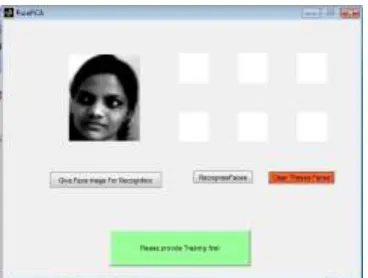
Available Online at www.ijpret.com 404 Fig. 6. Given input image
Fig. 7. Recognized faces
For giving other image, first clear these faces and then give other Image:
Next input:
Available Online at www.ijpret.com 405
Output:
Fig. 9. output of fig.8
6.2 Results
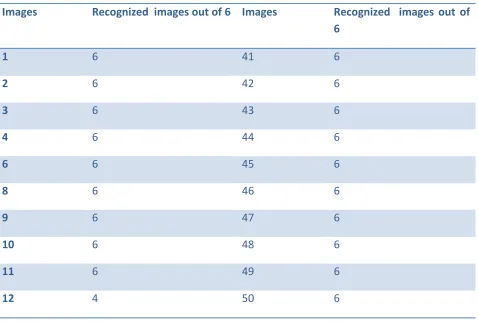
According to the above experiments on ORL Database, we get following observation table 8.2.1:
Table 6.2.1 Recognized images out of 6 for 100 images
Images Recognized images out of 6 Images Recognized images out of 6
1 6 41 6
2 6 42 6
3 6 43 6
4 6 44 6
6 6 45 6
8 6 46 6
9 6 47 6
10 6 48 6
11 6 49 6
Available Online at www.ijpret.com 406
13 6 51 6
14 6 52 6
15 6 53 6
16 6 54 6
17 6 55 6
18 3 56 6
19 3 57 6
20 6 58 6
21 6 59 6
22 6 60 6
23 6 83 5
24 6 84 6
25 6 86 5
26 6 88 5
27 6 89 5
28 6 91 5
29 5 93 6
30 6 94 5
64 5 96 6
66 5 77 6
71 6 78 6
Available Online at www.ijpret.com 407
73 6 80 6
74 6 97 6
75 6 99 6
76 6 100 5
We get the following plot:
Fig.10. Graph of No. of Images Vs Recognized Images
6.3 Observations:
From the graph, it can be shown that out of 100:
64 images recognized correctly, that is 100 %.
11 images recognized 83.33%.
19 images recognized 66.66%.
Remaining 6 are not recognized properly.
Available Online at www.ijpret.com 408 CONCLUSION
In this paper, the basic PCA and DCT algorithm is introduced and depending on the limitations of these methods, a new Face recognition method is presented using Improved Principal Component Analysis (IPCA). The principal components are selected by using both eigenvectors and eigenvalues and PCA Face is formed directly without finding Eigen faces. This reduces complexity. With these eigenvectors, the input images are classified based on Euclidian distance. The proposed method was tested on ORL face database and Self-Database. As shown in the results, the proposed IPCA method has the greater accuracy with consistency than the existing method of PCA and DCT. The recognition rate is greater even with the small number of training images which demonstrated an improvement in comparison with previous methods.
REFERENCES
1. Rabia Jafri and Hamid R. Arabnia, “A Survey of Face Recognition Techniques”, Journal of
Information Processing Systems, Vol.5, No.2, June 2009
2. W. Zhao, R. Chellappa, J. Phillips, and A. Rosenfeld, “Face recognition in still and video images: A literature survey”, ACM Comput Surv vol. 35, pp. 399–458, 2003.
3. J. R. Solar, and P. Navarreto, “Eigen space-based face recognition: a comparative study of different approaches”, IEEE Transactions on Systems man And Cybernetics- part c: Applications,
vol. 35, no.3, 2005.
4. E. Gomathi, Dr. K. Baskaran, “ Recognition of Faces using Improved Principal Component Analysis”, Second International Conference on Machine Learning and Computing,2010.
5. M. Turk, and A. Pentland, “Eigen faces for face recognition”, Journal cognitive neuroscience,
vol. 3, no.1, 1991.
6. M. Turk and A. Pentland, "Eigenfaces for Recognition", Journal of Cognitive Neuroscience, vol. 3, no. 1, pp. 71-86, 1991.
7. Sanjay Kr Singh, Ashutosh Tripathi, Ankur Mahajan, Dr S Prabhakaran, “ Analysis of Face Recognition in MATLAB”, International Journal of Scientific & Engineering Research, Volume 3, Issue 2, February 2012.
8. Gerard Blanchet and Maurice Charbit, “Digital Signal and Image Processing Using MATLAB” book.
9. Rafael C.Gonzalez, Richard E. Woods, Steven L. Eddins. “Digital Image Processing Using MATLAB.