Recent Trends in Methods & Calculations of Adjusting Isotonicity
Ajay Kumar*, V.K. Maurya
R. K. Pharmacy College, Kashipur, Surai, Sathiaon, Azamgarh, India
Article Information Received 1 March 2018
Received in revised form 14 Aug 2018 Accepted 15 August 2018
Abstract
Lachrymal fluid is isotonic with blood having Associate in nursing isotonicity value like that of
a 0.9% NaCl resolution. Ideally, Associate in nursing ophthalmic resolution ought to have this
isotonicity value; however the attention will tolerate isotonicity values as low as that of a 0.6%
NaCl resolution and as high as that of a two NaCl resolution while not marked discomfort.
Some ophthalmic solutions square measure essentially hypertonic so as to reinforce
absorption and to supply a level of the active ingredients robust enough to exert a prompt
and effective action. The quantity of such resolution used is little as a result of, on
administration; the dilution with lachryma fluid takes place apace with stripped discomfort
from the hyper tonicity that is merely temporary. However, any adjustment toward isotonicity
by dilution with tears is negligible wherever massive volumes of solutions square measure
used as colliery to clean the eyes. It is, therefore, vital that solutions used for this purpose be
around isotonic. Keywords:
Lachrymal fluid, Ophthalmic solution, Isotonicity, Hypertonic, Colliery, NaCl solution Corresponding Author: E-mail : [email protected] Mob.: +919473726058
1 Introduction
Tonicity could be a live of effective osmolarity in cell biology.
Osmolarity and osmolarity area unit properties of a specific
answer, freelance of any membrane. Osmolarity could be a
concentration scale to precise the entire concentration of matter
particles and is directly associated with any of the four
colligative properties. it's derived from concentration by
resolution within the dissociation of electrolytic solutes tension
could be a property of an answer in respect to a specific
membrane, Associate in Nursingd is capable the total of the
concentrations of the solutes that have the capability to exert an
diffusion force across the membrane tension depends on matter
porosity. The permeable solutes don't have an effect on tension.
If a semi-permeable membrane is employed to separate
solutions of various matter concentrations, a development
referred to as diffusion happens to determine concentration
equilibrium. The pressure driving this movement is named force
per unit area and ruled by the quantity of particles of substance
in a very resolution. If substance could be a non-electrolyte,
then range of particles is decided alone by the substance
concentration. If the substance is a solution, the amount of
particles is ruled by the concentration and degree of
dissociation of the substance.
The distinction between the isotonic and isotonic terms comes
with the belief that red somatic cell membrane don't seem to be
good semi-permeable membranes however enable passage of
some solutes, like alcohol, sal ammoniac, glycerin,
water-soluble vitamin, acid etc. As carboxylic mentioned earlier a pair
of resolution of element acid, once physically measured, is
found to be isotonic (containing a similar range of particles)
with blood and not isotonic(exerting equal pressure or tone)
with blood however is isotonic with tears. This distinction
doesn't have any nice significance and, therefore, isotonicity
values are calculated on the premise of the amount of particles
in answer. The clinical significance of all this can be to insure
that isotonic or isotonic solutions don't harm tissue or turn out
pain once administered.
2 Tonicity is usually classified in 3 types
Hypertonosity
A solution having higher osmotic pressure than the body fluids
(0.9% NaCl) is known as hypertonic solution. These solutions
UK Journal of Pharmaceutical and Biosciences
Available at www.ukjpb.com
UK J Pharm & Biosci, 2018: 6(4); 29 draw water from the body tissues to dilute and establish
equilibrium. An animal cell in a hypertonic environment is
surrounded by a higher concentration of impermeable solute
than exists in the inside of the cell.
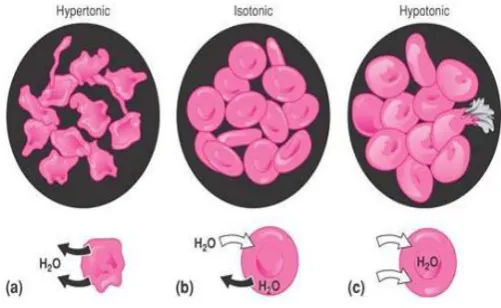
For example, if 2% NaCl solution is added to blood
(defibrinated),osmotic pressure directs a net movement of water
out of the cell, causing it to shrink (the shape of the cell
becomes distorted) and wrinkled (crenated),as water leaves the
cell. This movement is continued until the concentrations of salt
on both sides of the membrane are identical. Hence, 2% NaCl
solution is hypertonic with the blood.
Isotonosity
Solutions that have identical force per unit (area) as that of
bodily fluids are afore said to be isotonic with the body fluid.
Body fluids like blood and tears have pressure comparable to
that of zero.9% NaCl or glucose binary compound solution;
therefore, a 0.9%NaCl or five the troubles, glucose resolution is
named as isotonic or isotonic. The term isotonic means that
equal tone, and is employed interchangeably with isotonic with
regard to specific body fluids. For example, a 0.9% w/v
resolution of NaCl in water is taken into account to be isotonic in relevancy RBC’s and their semi-permeable membrane.
Requirements of isotonic solutions square measure that they
need to not cause any contraction or swelling of the tissues.
The product should not turn out discomfort once put in within
the eye, nasal tract, blood, or alternative body tissue. On
addition of zero.9gm NaCl/100ml (0.9%) in to blood
(defibrinated), the cells retain their traditional size. solution
ought to be restricted to solutions having equal force per unit
area with relation to a specific membrane.
The addition of any compound to an answer affects its
isotonicity, inflicting changes in force per unit area of an answer.
It shouldn't be affected solely by medication however
additionally by any buffer parts value-added within the
formulation. Therefore, it's necessary to feature extra Nacl to
bring the answer to isotonicity. Adjustment of isotonicity is
needed for many indefinite quantity forms like epithelial duct
solutions, e.g., IV infusions, irritating solutions, lotions for open
wounds, body covering injections, preparations meant for
diagnostic applications, solutions meant for intra thecal
injections, nasal drops and ophthalmic drops.
Hypotonosity
A answer with low pressure than body fluids is thought as
hypotonic solution. The consequences of administering a
hypotonic answer square measure usually additional severe
than with hypertonic solutions, since busted cells will repaired.
Hypertonic solutions show the other impact compared to
hypertonic solutions wherever cyber web movement of water
into the cell causes them to swell. If the cell contains additional
tight substance than its surroundings, water enters it just in case of animal cells, they swell till they burst; however this doesn’t
happen to plant cells, i.e., they are do not burst as a result of
the reinforcement their cyto membrane provides. If 0.2% NaCl
answer is accessorial to blood (defibrinated), the cells swell and
burst. Therefore, 0.2% NaCl answer is hypotonic with relevance
the blood (Fig 1).
Fig 1: Showing a. Hypertonic b. Isotonic c. Hypotonic
3 Method for determine tonicity value
Many chemicals and medicines area unit utilized in
pharmaceutical formulations. These substances contribute to
the tautness of the answer. Hence, strategies area unit required
to verify the tautness and alter isotonicity. 2 strategies
accustomed verify tautness valve area unit delineate below
Hemolytic Method
Isotonicity valve is calculated by exploitation the lysis
methodology during which the result of varied solutions of drug
is ascertained on the looks of red blood cells suspended in
answer. During this methodology, RBC suspended in numerous solutions and also the look of RBC’s is ascertained for swelling,
bursting, shrinking and wrinkling of the blood cells. In hypertonic
solutions, the oxyhemoglobin discharged is proportional to the
amount of cells haemolysed; just in case of hypertonic
solutions, the cells shrink and become wrinkled or scalloped
whereas just in case of isotonic solutions the cells don't
modification their morphology.
Cryoscopy Method
Isotonicity values are determined from the colligative properties
of the solutions. For this purpose, melting point depression
property is most extensively used. The melting point of water is
0 ᵒC, and once any substance like NaCl is added to that, the melting point of water decreases. The physical change point of
depression of blood is -0.52 ᵒC. Hence, the drug resolution should be -0.52 ᵒC.
This solution shows vapor pressure level capable the blood.
UK J Pharm & Biosci, 2018: 6(4); 30 Several strategies are accustomed change the isotonicity of
pharmaceutical solutions. Isotonicity may be calculated from the
colligative properties of drug solutions. If solutions ar injected or
introduced in to eyes and nose, these ar to be created isotonic
so as to avoid hematolysis of RBC’s and to avoid pain and
discomfort. This can be potential for either factory-made or
impromptu ready solutions. By victimization the acceptable
calculations supported colligative properties of solutions; it's
simple to work out the number of adjusting agents to be
accessorial. It helps to beat the aspect effects caused from
administering solutions that contain adjusting agents less or
quite isotonic solutions. The 3 of times used strategies to
calculate isotonicity of the solutions is delineated below.
Class-1 Methods
Nacl or another substance is accessorial to the answer of the
drug to lower thetemperature of the answer to -0.52ᵒC and so build the answer isotonic.
Examples of this class-
1) Cryoscopic technique
2) Sodium chloride equivalent technique.
Class-2 Methods
Water is accessorial to the drug during a sufficient quantity to
form it isotonic. Then the preparation is delivered to its final
volume with associate degree isotonic or buffered isosmotic
solution.
Cryoscopic technique
In this methodology, the number of every substance needed for
associate degree solution is often calculated from the melting
point depression values. An answer that is isotonic with blood
encompasses a ∆Tf of 0.52ᵒC. Therefore, the melting point of
drug answer should be adjusted to the present valve. Several
pharmaceutical text books typically list the melting point of
depression required to attain isotonicity from these values just in
case of drug solutions, if it's impracticable to regulate tension by
sterilization the drug concentration, then associate degree
adjusting substance is additional to attain desired tension (Table
1).
The weight (in grams) of adjusting substance is often calculated
in manner represented below for instance, the drug
concentration in 100ml answer could be grams, then
∆Tf ( For drug solution) =ax
∆Tf of 1% drug solution = x
If w be in grams of the adjusting substance to be accessorial to
a hundred cubic centimeter of drug resolution to create it
isotonic then:
∆Tf (For adjusting solution) = w × ∆Tf of 1% adjusting
substance
= w × b
For isotonic solution
or
x + wb = 0.52
w = 0.52 – x/b
If NaCl is used as adjusting substance whose ∆Tf of solution is
0.580C than w = 0.52 – x/0.58
Sodium chloride equivalent method
Tonicity equivalent or common salt equivalent methodology is
employed to regulate the tautness of pharmaceutical solutions.
Sodium chloride equivalent (E) of a drug is that the quantity of
common salt that's corresponding to one gram of the drug. The
percent of binary compound needed for adjusting the isotonicity
is calculated victimization the subsequent equation.
PSA = 0.9 – (PSM × E of medicament)
Where,
PSM = Percent strength of medicament
PSA = Percent of sodium chloride for a adjustment of
isotonosity
Table 1: Freezing point depression ∆Tf and E values of
some drugs added substances
Solution, 1% w/v drug ∆Tf E
Boric acid 0.29 0.50
Sodium Chloride 0.58 1.00
Potassium Chloride 0.45 0.76
Calcium gluconate 0.09 0.16
Pilocarpine nitrate 0.14 0.23
L ISO Method
The E NaCl worth of tonus adjusting substances may be
calculated from the substances. The L iso values of the tonus
adjusting substances square measure given in table and square
measure mentioned as constants in several references.
In this technique, the melting point depression equation is
employed to calculate the quantity of the isotonicity.
Above equation is employed to calculate the number of
adjusting substance (sodium chloride) needed for creating the
answer isotonic. it's valid for one hundred metric capacity unit
resolution (Table 2).
UK J Pharm & Biosci, 2018: 6(4); 31
Type of substance Examples L ISO
values
Non-electrolytes Sucrose,
Propylene glycol 1.9
Weak- electrolytes Boric Acid,
Phenobarbital 2.0
Uni-divalent electrolytes Sodium chloride 3.4
Di-divalent electrolytes Zinc sulphate 2.0
Tri-univalent electrolytes Aluminium
chlroride 6.0
Tetra borate-electrolytes Sodium borate 7.6
5 Conclusion
Tonicity is a measure of the effective osmotic pressure gradient,
as defined by the water potential of two solutions separated by
a semipermeable membrane. In other words, tonicity is the
relative concentration of solutes dissolved in solution which
determine the direction and extent of diffusion. It is commonly
used when describing the response of cells immersed in an
external solution.Unlike osmotic pressure, tonicity is influenced
only by solutes that cannot cross the membrane, as only these
exert an effective osmotic pressure. Solutes able to freely cross
the membrane do not affect tonicity because they will always be
in equal concentrations on both sides of the membrane. It is
also a factor affecting imbibition.
6 Conflict of interests
None
7 Author’s contributions
AK carried out literature review and draft the manuscript. VKM
participated in collection of data. Both authors read and
approved the final manuscript.
8 References
1. United States Pharmacopeial Convention, Inc. United States
Pharmacopeia 29- National Formulary 24. Rockville MD:
U.S. Pharmacopeial Convention, Inc. 2005; 3261.
2. Price JC. Glycerin. In: Rowe RC, Sheskey PJ and Owen
SC, eds. Handbook of Pharmaceutical Excipients. 5th ed.
Washington DC: American Pharmaceutical Association.
2005; 301-303.
3. Day A. Dextrose. In: Rowe RC, Sheskey PJ and Owen
SC, eds. Handbook of Pharmaceutical Excipients. 5th ed.
Washington DC: American Pharmaceutical Association.
2005; 231-233.
4. Armstrong NA. Mannitol. In: Rowe RC, Sheskey PJ and
Owen SC, eds. Handbook of Pharmaceutical Excipients. 5th
ed. Washington DC: American Pharmaceutical Association.
2005; 449-453.
5. Owen SC. Potassium Chloride. In: Rowe RC, Sheskey PJ
and Owen SC, eds. Handbook of Pharmaceutical
Excipients. 5th ed. Washington DC: American
Pharmaceutical Association. 2005; 600-602.
6. Emmens CW. The motility and viability of rabbit
spermatozoa at different hydrogen-ion concentrations. J Physiol. 1947; 106(4): 471–481.
7. Pholpramool C, Chaturapanich G. Effect of sodium and
potassium concentrations and pH on the maintenance of
motility of rabbit and rat epididymal spermatozoa. J
Reprod Fertil. 1979; 57(1): 245–251.
5. Bagger PV, Byskov AG, Christiansen MD. Maturation of
mouse oocytes in vitro is influenced by alkalization during their isolation. J Reprod Fertil. 1987; 80(1): 251–255.
6. Downs SM, Mastropolo AM. Culture conditions
affect meiotic regulation in cumulus cell-enclosed
mouse oocytes. Mol Reprod Dev. 1997; 46(4):
551– 566.
7. Leclerc C, Becker D, Buehr M, Warner A. Low intracellular
pH is involved in the early embryonic death of DDK mouse
eggs fertilized by alien sperm. Dev Dyn. 1994; 200(3):
257–267.
8. Owen SC. Sodium Chloride. In: Rowe RC, Sheskey PJ
and Owen SC, eds. Handbook of Pharmaceutical
Excipients. 5th ed. Washington DC: American
Pharmaceutical Association. 2005; 671-674.
9. Lane M, Bavister BD. Regulation of intracellular pH in
bovine oocytes and cleavage stage embryos. Mol Reprod
Dev. 1999; 54(4): 396–401.
11. Lane M, Lyons EA, Bavister BD. Cryopreservation reduces
the ability of hamster 2-cell embryos to regulate
intracellular pH. Hum Reprod. 2000; 15(2): 389–94.
12. Edwards LJ, Williams DA, Gardner DK. Intracellular pH of
the preimplantation mouse embryo: effects of extracellular
pH and weak acids. Mol Reprod Dev. 1998; 50(4): 434–
42.
13. Squirrell JM, Lane M, Bavister BD. Altering
intracellular pH disrupts development and
cellular organization in preimplantation
hamster embryos. Biol Reprod. 2001; 64(6): 1845–54.
14. Zander-Fox D, Mitchell M, Thompson JG, Lane M.
Alterations in mouse embryo intracellular pH by DMO
during culture impair implantation and fetal growth.
UK J Pharm & Biosci, 2018: 6(4); 32 15. Fitzharris G, Baltz JM. Granulosa cells regulate
intracellular pH of the murine growing oocyte via gap
junctions: development of independent homeostasis
during oocyte growth. Development. 2006;133(4): 591–9.
16. FitzHarris G, Siyanov V, Baltz JM. Granulosa cells
regulate oocyte intracellular pH against acidosis in
preantral follicles by multiple mechanisms. Development. 2007;134(23):4283– 95.
17. Phillips KP, Baltz JM. Intracellular pH regulation by