Index Terms—Business Intelligence, Data Mining, Strategic Management.
Abstract—Business Intelligence (BI) is becoming an important IT framework that can help organizations managing, developing and communicating their intangible assets such as information and knowledge. Thus it can be considered as an imperative framework in the current knowledge-based economy arena.
In this paper, we will explain the role BI is playing in providing organizations with a way to plan and achieve their business strategy. We will experiment this role using a case study in the field of high education, especially helping one of the new private university in Syria (Arab International University)planning and achieving their business strategy.
I. INTRODUCTION
usiness Intelligence is becoming vital for many organizations, especially those have extremely large amount of data. Decision makers depend on detailed and accurate information when they have to make decisions. BI can provide decision makers with such accurate information, and with the appropriate tools for data analysis.
BI is an umbrella term that combines architectures, tools, data bases, applications, practices, and methodologies [20, 6]. Gartner Group (1996) (the first company used BI in marker in the mid-1990) defined BI as “information and applications available broadly to employees, consultants, customers, suppliers, and the public. The key to thriving in a competitive marketplace is staying ahead of the competition. Making sound business decisions based on accurate and current information takes more than intuition. Data analysis, reporting, and query tools can help business users dig in the mine of data to extract and/or synthesize valuable information from it – today these tools collectively fall into category called Business Intelligence” [9]. Many organizations who developed successful BI solutions, such as Continental Airlines, have seen investment in BI generate increases in revenue and cost saving equivalent to 1000% return on
Manuscript received September 30, 2009.
Mouhib Alnoukari is with the Arab International University, Damascus, Syria (phone: +963-015-2050; fax: +963-015-860385; e-mail: [email protected]).
investment (ROI) [22].
An important question that was raised by many researchers [16, 18] as to what was the main reason pushing companies to search for BI solutions, and what differentiates BI from Decision Support System (DSS) systems? In fact, over the last decades, organizations developed a lot of Operational Information Systems (OIS), resulting in a huge amount of disparate data that are located in different geographic locations, on different storage platforms, with different forms. This situation prevents organization from building a common, integrated, correlated, and immediate access to information at its global level. DSS evolved during the 1970s, with the objective of providing organization’s decision makers with the required data to support decision-making process. In the 1980s, Executive Information System (EIS) evolved to provide executive officers with the information needed to support strategic decision-making process. BI evolved during the 1990s as data-driven DSS, sharing some of the objectives and tools of DSS and EIS systems.
BI architectures include: data warehousing, business analytics, business performance management, and data mining. Most of BI solutions are dealing with structured data [1]. However, many application domains require the use of unstructured data (or at least semi-structured data), e.g. customer e-mails, web pages, competitor information, sales reports, research paper repositories, and so on [4, 21].
Any BI solution can be divided into the following three layers [1]: data layer, which is responsible for storing structured and unstructured data for decision support purposes. Structured data is usually stored in Operational Data Stores (ODS), Data Warehouses (DW), and Data Marts (DM). Unstructured data are handled by using Content and Document Management Systems. Data are extracted from operational data sources, e.g. SCM, ERP, CRM, or from external data sources, e.g. market research data. Data are extracted from data sources that are transformed and loaded into DW by ETL tools. Logic layer provides functionality to analyze data and provide knowledge. This includes OLAP, data mining. And finally access layer, realized by some sort of software portals (BI portal).
Our main focus in this paper is to explain the role of BI solution that helps organizations in formulating,
Using Business Intelligence Solutions for
Achieving Organization’s Strategy: Arab
International University Case Study
Mouhib Alnoukari
Arab International University, Damascus, Syria
implementing, and achieving their strategy. Many researchers [5, 17, 10, 12] were highlighting the IT alignment in general, with business, without specifying what are the technologies, and tools that can help organizations in achieving their strategy.
The rest of this paper will be organized as the follows, the next section will explain the role BI is taking as an IT-enabler to achieve organization’s strategy; such role will be highlighted by using strategic alignment model proposed by Henderson and Venkatraman (1993), explaining how this alignment can help organizations in becoming flexible organizations, concluding how could BI solution provide organizations with sustainable competitive advantages. BI role as a strategic solution will be then experimented using a case study at the higher education field (Arab International University), explaining how the solution implemented at this university helped achieving their main strategic goal, improving quality in their higher education system.
II. BUSINESS INTELLIGENCE AS AN ITENABLER TO ACHIEVE
ORGANIZATION’S STRATEGY
In recent years, IT in general, and BI as a strategic framework, is becoming increasingly important in strategic management, supporting business strategies. IT-enabled strategic management addresses the IT role in strategy formulation and implementation processes [19]. Drucker, the pioneer of management by objectives, was one of the first who recognized the dramatic changes IT brought to management. Strategic management theories were largely geared towards gaining competitive advantages. Porter (1979) proposed a number of very influential strategic analysis models, such as the five-forces model of competition, the value chain and generic competitive strategies. Porter (1979) said “The essence of strategy formulation is coping with competition” [14].
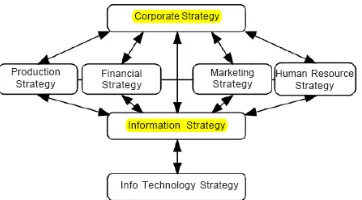
Many researchers have indicated the importance of IT alignment with business strategy in order to enhance corporate strategy [5, 17], (Figure1).
Strategic Alignment Model developed by Henderson and Venkatraman (1993) was one of the first models that described in an explicit way the interrelationships between business strategies and IT strategies [10]. This model is based on two main concepts (Figure2): strategic fit that recognizes
the need to position the firm in an external marketplace where growth can take place, and functional integration which addresses how to best structure internal systems to execute the business strategy of the firm [12].
IT alignment is not simply formulating IT strategy to fit business strategy. It has to consider external forces and the environment uncertainty. Such alignment helps organizations becoming flexible organizations.
As a result of accelerations in the rates of innovation and technological changes, markets evolve rapidly, products’ life cycles get shorter and innovation becomes the main source of competitive advantage. Therefore, organizations seek flexibility to meet market demands.
Drnevich et al. (2006) explained that flexibility-based perspectives evolved from Schumpeter’s concept of creative destruction [8]. Operationalization of these perspectives in strategic management is done through dynamic capabilities and real options views. Dynamic capabilities view refers to the firm’s abilities to maintain and adapt its internal resources to environment changes to maintain sustainability of competitive advantages. It refers to the capability of acquiring new ways of competitive advantage. It involves continuous search, innovation and adaptation of firm resources and capabilities to uncover and tape new sources of competitive advantages. Real options view is effective in dealing with issues of uncertainty. It allows the firm to defer investment decisions until uncertainties are resolved.
New IT organizational adoption facilitates the transition into flexible organizations. Business Intelligence is one of these new IT frameworks that can help such transition. BI technologies become a source of competitive advantages and differentiation [13, 11]. Tang and Walters (2006) mentioned that competitive advantage became a hot strategic management topic [19]. They also view that generating new knowledge in a continued way is the single way to obtain competitive advantage.
There are many reasons for organization to adopt business intelligence systems in order to achieve organization’s
strategy:
• Business Intelligence is considered as an extension to corporate strategy activities. Herring (1988) considered that “Strategy can be no better than the information from which it is derived” [11].
• Data analytics can be used effectively to build future business strategy.
• Data analytics and data mining could reveal hidden reasons for some deficiencies as well as possible high-yielding new investments.
• Corporations need to be sure that they are receiving the right information related to their long-term strategy.
Herring (1988) considered that business intelligence can help organizations in [11]:
• Supporting the strategic decision making process of the corporation.
• Supporting corporation SWOT analysis
• Supporting strategic planning and processes.
All the mentioned benefits should provide organizations with sustainable competitive advantages.
III. ARAB INTERNATIONAL UNIVERSITY BISOLUTION
Arab International University (AIU) is a new private university in Syria. Being a 3-year old university, it began to find difficulties in managing the huge data deployed from its different information systems. The academic system, financial system, HR system, and Quality Assurance Automated System (QAAS) system, are at the core of the university daily operations [3].
As most of the university information systems were provided from different sources, there was an urgent need to integrate data from all these sources into one data warehouse in a manner that could help the university in making use of all data to assure quality
The data gathered in order to produce the university BI solution and help in enhancing education quality are:
• Academic data (registration, examination, enrollment, etc).
• Financial data (student fees, staff salaries, orders, sales, etc.).
• Human Resources data (staff personal information).
• QAAS data (student feedback, GPA differences, drop ratio, plan completion, industry feedback, etc).
An enterprise data warehouse is built to hold all the previous data. The data sources were provided from different sources (Oracle databases, SQL Server data bases, excel). The data warehouse was built using Oracle 11g data base.
The ETL was built by using ETL package in Oracle Warehouse Builder.
The solution developed (by AIU developers) followed ASD-DM paradigm for BI solution. ASD-DM paradigm suggests three agile modeling steps (specifically Adaptive Software Development (ASD)) to develop a successful BI
model [2].
The BI solution could provide university’s top management with reports to uncover trends in the students and instructors’ performance in a manner that would be impossible or at least extremely tedious without data warehouses and data mining.
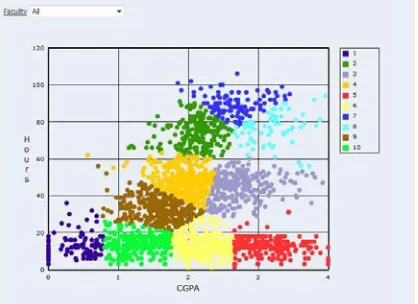
One of the main strategic goals of the AIU is to enhance students GPA. Figure 3 shows the correlation between student’s accumulative GPA and their credit hours. It shows that students with higher accumulative hours are getting higher accumulative GPA. On the other hand it was very clear that there is strong correlation between students’ level of English and accumulative GPA as shown in figure 4. Clustering each faculty’s students according to their cumulative GPAs, and their completed hours helps the university’s academic advisors focus on special groups, especially the group of students that are likely to drop out (Figure 5). Correlation between credit hours and AGPA changes shows a clear picture about the optimal number of the credit hours the students would take to increase their AGPA. Figure 5 Shows that this ranges between 2-12 and 20-22 hours. This provides the AIU decision makers with the reasons to find out how to help students to enhance their AGPAs while getting the required credit hours in each
Fig. 3. AIU students clustered according to their accumulative GPA & their credit hours.
semester (which varies between 16-19 hours).These results helped AIU to update their education system in order to force students to enhance their English level by adding more English teaching hours at the early phases.
AIU BI solution is able to provide AIU managers with a set of reports that can help them evaluating the university current strategy. AIU BI solution’s reporting includes:
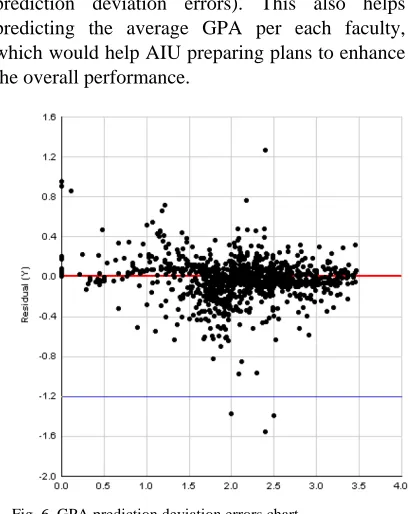
• Predicting students GPAs. Different algorithms were used for prediction. Evaluation of the results for each algorithm permit choosing the best method with the highest predictive confidence. SVA algorithm was chosen with more than 70% predictive confidence (Figure 6 shows GPA prediction deviation errors). This also helps predicting the average GPA per each faculty, which would help AIU preparing plans to enhance the overall performance.
• Market basket analysis report helps in preparing the time table for each semester. The resultant time table would contain a set of highly interrelated courses that students require. This means that two courses with high association correlation don’t overlap in the time table, also these two courses should be enrolled in the same semester, and not wait for one or two semesters. This analysis helps achieving one of the main AIU strategic goals by
enhancing the total number of enrolled courses (Figure 7). This has an immediate financial revenue increase.
• Analysis of the total number of students’ presence per different time ranges per days helps AIU achieving one of its strategic goals by enhancing services provided to its students and optimizing costs (Figure 8). Such analysis helps AIU preparing the optimal plans for transportation, restaurants, library services, and others.
• Identifying students likely to drop out using the students predicted GPA results (Figure 6).
• Classifications of students’ results according to different subjects (Figure 4).
IV. CONCLUSION
In this paper, we explained the use of BI solution in formulating, implementing, and achieving organization’s strategy. We also demonstrated how BI solution could provide organizations with sustainable competitive advantages.
This work can be extended by integrating knowledge management with BI solutions, as it can help deriving more
Fig. 5. Credit hours relation’s with the AGPA changes.
Fig. 6. GPA prediction deviation errors chart.
Fig. 7. Currents enrolled university courses.
value (knowledge) from the explosion of textual information, which can add more inputs to the strategic decision.
Another important factor is the use of agile methodologies in order to manage the high-speed high-change current environment. Such complex and dynamic environment highly affect organization’s strategy.
REFERENCES
[1] M. Alnoukari, and W. Alhussan., “Using Data Mining Techniques for Predicting Future Car market Demand”, International Conference on Information & Communication Technologies: From Theory to Applications,
IEEE Conference, Syria, 2008.
[2] M. Alnoukari, Z. Alzoabi, and S. Hanna, “Using Applying Adaptive Software Development (ASD) Agile Modeling on Predictive Data Mining Applications: ASD-DM Methodology”, International Symposium on
Information Technology, ITSIM 08, Malaysia, 2008.
[3] Z. Alzoabi, F. Diko, and M. Alnoukari, “Enhancing Education Quality Assurance Using information Systems- QAAS System”, International
Symposium on Information Technology, ITSIM 08, Malaysia, 2008.
[4] H. Baars, and H. G. Kemper, “Management Support with Structured and Unstructured Data- An Integrated Business Intelligence Framework”,
Information Systems Management, 25: pp. 132–148, 2007.
[5] D. Boddy, A. Boonstra, and G. Kennedy, Managing Information Systems:
An Organisational Perspective, (2nd edition). Harlow: Pearson. 2005
[6] F. Cody, J. T. Kreulen, V. Krishna, and W. S. Spangler, “The Integration of Business Intelligence and Knowledge Management”, Systems Journal, Vol. 41, No. 4, pp. 697–713.
[7] T. Corbitt, “Business Intelligence and Data Mining”, Management
Services Magazine, November 2003.
[8] P. Drnevich, J. Hahn, and M. Shanley, “Toward a Strategic Perspective of Information Technology”, IT-Enabled Strategic Management, Idea Group Publishing, pp. 16-37, 2006.
[9] Gartner Group (September, 1996). Retrieved November 12, 2005, from
[10] W. V. Grembergen, S. D. Haes, and E. Guldentops, “Structures, Processes and Relational Mechanisms for IT Governance”, Strategies for
Information Technology Governance, by Wim Van Grembergen (ed), Idea
Group Publishing, 2004.
[11] J. P. Herring, “Building a Business Intelligence Systems”, Journal of
Business Strategy, May/June 1988.
[12] J. D. Katz, “The Integral Role of Information Technology in Achieving Business Strategy Success: Managing the Information Resources of Global Competitors”, Advanced Topics in Global Information Management, by Tan
F. B., Idea Group Publishing, pp. 42-62, 2002.
[13] M. Pérez-Valls, J. M. Ortega-Egea, and J. A. Plaza-Úbeda, “Relationship between New Information Technologies and Flexible Organizational Forms”,
IT-Enabled Strategic Management, Idea Group Publishing, pp. 1-16, 2006.
[14] M. E. Porter, “How competitive forces shape strategy?”, Harvard
Business Review 57, April/Mai 1979, pp. 137-145.
[15] M. E. Porter, “Competitive Strategy—Techniques for Analyzing Industries and Competitors”, New York: Free Press. 1980.
[16] D. J. Power, “A Brief History of Decision Support Systems”.
DSSResources.COM, World Wide Web, http://DSSResources.COM/history/dsshistory.html, version 4.0, March 10,
2007.
[17] R. Sabherwal, and Y. E. Chan, “Alignment Between Business and IS Strategies: A Study of Prospectors, Analyzers, and Defenders”. Information
Systems Research, 12(1), 11-33. 2001.
[18] M. Shariat, R. Jr. Hightower, “Conceptualizing Business Intelligence Architecture”, Marketing Management Journal, Volume 17, Issue 2, pp. 40 – 46, 2007.
[19] Z. Tang, and B. Walters, “The Interplay of Strategic Management and Information Technology”, IT-Enabled Strategic Management, Idea Group Publishing, pp. 1-16, 2006.
[20] E. Turban, J. E. Aronson, T. P. Liang, R. Sharda, Decision Support and
Business Intelligence Systems, 8th edition, Pearson Prentice Hall, 2007.
[21] C. H. Wee, and M. L. Leow, “Competitive Business Intelligence in Singapore”, Journal of Strategic Marketing 1, pp. 112-139, 1994.