6105 OPTIMIZED AND VALIDATEDSTABILITY INDICATING RP-HPLC METHOD
FOR THE DETERMINATION OF PRISTINAMYCIN IN BULK AND PHARMACEUTICAL FORMULATIONS
Jonnala P. Srinivasa Reddy1*, Dr. T. Vijaya Bhaskara Reddy1, N. Sowjanya Reddy1and Dr. T. Parthasarathy*
Department of Chemistry, Dravidian University, Srinivasavanam,Kuppam -Andhra Pradesh, India
*Corresponding author E-mail: [email protected]
ARTICLE INFO ABSTRACT
Key Words
Pristinamycin, RP-HPLC, Repeatability ,Accuracy, Precision and
Reproducibility and Linearity.
A reverse phase high performance liquid chromatographic method (RP-HPLC) was developed for the determination of the amount of Pristinamycin present in bulk and pharmaceutical formulations. Waters- Alliance HighPerformance Liquid Chromatographic system equipped with Auto Sampler, PDA detectorand Symmetry C18 (250 x 4.6mm, 5, Make: ACE-5) column were used for the method development.Separation of the components were carried out by using 0.2% ortho phosphoric acid and acetonitrile in the ratio 63:37 v/vas mobile phase at a flow rate of 1.5 mL per minute and the detection of the components was carried out at a wavelength of 206nm. System suitability parameters such as retention time, tailing factor and USP theoretical plate countof the developed method were found to be 3.31minute, 1.02 and 3750respectively. The linearity between area of the peak and concentration of the drug was found to be 25-150μg/mL.The %mean recovery of Pristinamycinwere found to be 99.08(50%),99.37(100%) and 99.85(150%) respectively.From the study of forced degradation the percent of recovery of the drug was found to be 79.98, 84.62, 81.00, 88.09 and 85.57under different degradation conditions such as acid (0.5N HCl), alkali (0.5N NaOH), peroxide (3%H2O2) and UV light.The developed method was found to be simple, fast, repeatable,reproducible, robust, rugged and economichence it can be used as a new analytical method for the analysis of pharmaceutical formulations in any pharmaceutical industries.
INTRODUCTION
Pristinamycinalso spelled pristinamycine, is an antibiotic used primarily in the treatment of staphylococcal infections, and to a lesser extent streptococcal infections. It is a streptogramin group antibiotic, similar to virginiamycin, derived from the
bacterium Streptomyces pristinaespiralis. Pristinamycin is a mixture of two components that have a synergistic antibacterial action. Pristinamycin IA is a macrolide, and results in pristinamycin's having a similar spectrum of action An Elsevier Indexed Journal ISSN-2230-7346
6106 to erythromycin. Pristinamycin
IIA (streptogramin A) is a depsipeptide.PI and PII are coproduced by S. pristinaespiralis in a ratio of 30:70. Each compound binds to the bacterial 50 S ribosomal subunit and inhibits the elongation process of the protein synthesis, thereby exhibiting only a moderate bacteriostatic activity. However, the combination of both substances acts synergistically and leads to a potent bactericidal activity that can reach up to 100 times that of the separate components.Despite the macrolide component, it is effective against erythromycin-resistant staphylococci and
strepcococci. It is active
against
methicillin-resistant Staphylococcus aureus (MRSA). Its usefulness for severe infections, however, may be limited by the lack of an intravenous formulation owing to its poor solubility.Pristinamycin is chemically known as N-(3-benzyl-12-ethyl-4,16- dimethyl-2,5,11,14,18,21,24-heptaoxo-19-
phenyl-17-oxa-1,4,10,13,20- pentazatricyclo[20.4.0.06,10]hexacosan-
15-yl)-3-hydroxypyridine-2- carboxamide;(12Z,17Z,19Z)-21-hydroxy- 11,19-dimethyl-10-propan-2-yl-9,26-
dioxa-3,15,28- triazatricyclo[23.2.1.03,7]octacosa-
1(27),6,12,17,19,25(28)-hexaene-2,8,14,23-tetrone, C71H84N10O17, molecular weight 1349.506g/mol. MallikharjunaraoNagasarapuet.al1develope d developed a stability indicating RP-HPLC method for the assay of
Pristinamycin in bulk and
formulation.John NG2developed a Successful oral pristinamycin therapy for osteoarticular infections due to methicillin-resistant Staphylococcus aureus (MRSA) and other Staphylococcus spp.V.Loncle et.al3 developed Analysis of Pristinamycin-Resistant Staphylococcus epidernidis Isolates Responsible for an Outbreak in a Parisian Hospital.Suresh
Kannan V et.al4 developed
spectrophotometric method for estimation
of Pristinamycin bulk and pharmaceutical dosage form.S.Drogue et.al5 developed Separation of pristinamycins by high-speed counter-current chromatography I. Selection of solvent system and preliminary preparative studies.AndreM.A Van Wageningen et.at6 developed Sequencing and analysis of genes involved in the biosynthesis of a vancomycin group antibiotic.The aim of the present study was to develop and validate rapid, simple, and selective liquid chromatography method for Pristinamycin quality control in tablets.
Figure1: Molecular structure of Pristinamycin
Materials and Methods
Equipment: Waters-Alliance HPLC system equipped with auto sampler, binary gradient pump, and PDA detector was used for the separation. An analytical column; Symmetry C18 (250mm x 4.6mm, 5m, Make: ACE-5) was used in the analysis. Chromatographic software Empower -3was used for data collection and processing.Double beam, 1cm length quartz coated optics and wavelength
range190-400nm UV-Visible
Spectrophotometer is used for measuring absorption spectrum.
6107 formulations of Pristinamycin were
purchased from the local market. The HPLC grade water was prepared by double glass distillation and filtration through 0.45 mm filters. Acetonitrile of HPLC grade was obtained from E.Merck. (India) Ltd., Mumbai. Ortho phosphoric acid analytical grade are purchased from Qualigens Fine Chemicals Ltd., Mumbai.The mobile phase was prepared by mixingthoroughly, 0.2 % Acetonitrile and ortho phosphoric acid in 37:63 (v/v) mobile phase was prepared and degassed for 10 minutes by sonication. Water: ACN (60:40 v/v) was used as diluent. The pH of the resulting solution was adjusted and filtered through 0.45µm membrane filter. Preparation of standards: Stock solution (1 mg/mL )of the Pristinamycin was prepared by dissolving accurately weighed100mg of Pristinamycin standard in 100mL of diluent in avolumetric flask, sonicated and made up to the mark. Further working standard (100µg/mL ) was prepared by transferring 10mL of the stock solution into 100mL volumetric flask and diluted up to the mark with diluent, sonicated and filter through 0.45µm filter. A series dilute solutionranging from 25.0-150.0 µg/mLwere prepared by taking different aliquots (0.25 – 1.50mL) of the stock solution and diluted in similar manner. Preparation of test solution: Twenty tablets of Pristinamycin were accurately weighed and finely powderedin a mortar. An amount of tablet mass equivalent to 25mg was transferred to a 250mL volumetric flask and dissolved in 100 mL of diluentand then the flask was placed in sonicator for 30 min. The resulting solution was diluted to volume with diluent and then filtered through 0.45µm membrane. Further sample (100µg/mL ) was prepared by transferring 10mL of the stock solution into 10mL volumetric flask and diluted up to the mark with diluent, sonicated and filter through 0.45µm filter.
Developing optimum chromatographic conditions: Absorption spectrum of Pristinamycin working standard was scanned from 200nm to 400nm range of wavelength with 2nm variation. From the absorbance spectrum it was found that 206 nm was the wavelength of maximum absorbance. The chromatographic separation was carried out under the isocratic conditions. The mobile phase was allowed to flow through the column at a flow rate of 1.5mL/min for 2 minutes to equilibrate the column at ambient temperature. Chromatographic separation was achieved by injecting a volume of 10 µl of standard into Symmetry C18 (250mm x 4.6mm, 5m, Make: ACE-5) column, the mobile phase of composition 0.2% orthophosphoric acid and Acetonitrile in the ratio 63:37 v/v was allowed to flow through the column. Detection of the component was carried out at a wavelength of 206 nm. After some
different trails withvarying
chromatographic parameters such as column, flow rate and injection volume were tested for obtaining best system suitability parameters such as peak shape, minimum run time and less tailing factor. The set of chromatographic conditions and the suitability parameters in four different trails were presented in I and Table-II respectively.
RESULTS AND DISCUSSION
6108 Table-I: Optimization of the proposed HPLC method
Chromatographic conditions in different trails Trail
Number
Column Flow Rate
mL/min
Wavelength nm
Column TempoC
Run Time min
1 ACE-5, C18 -HL
(250 mmx 4.6 mmx 5μm)
10 206 40 10
2 ACE-5, C18 -HL
(250 mm x 4.6 mm x 5μm)
12 206 35 15
3 ACE-5, C18 -HL
(250 mm x 4.6 mm x 5μm)
15 206 45 12
4 ACE-5, C18 -HL
(250 mm x 4.6 mm x 5μm)
15 206 40 10
Optimized experimental conditions are achieved in Trail-4
Table-II: Chromatographic parameters obtained in various trails
Trail Number
Retention Time min
Peak area
Height Plate count
Tailing factor
Remarks
1 2.82 195810 66233 2747 1.64 Peak appears to be sharp having high
tailing factor and an additional unknown peak was appeared
2 3.00 3137446 18025 11509 1.41 Peak shape was broad and diffused
3 3.50 2742864 43261 13598 1.34 Peak shape was not symmetric
4 3.31 2357904 43914 3750 1.02 Peak was symmetric having high area,
height, plate count, valid tailing factorand comparable retention time
relative to other chromatograms
Table-III: Intra –Day and Inter-Day Precision of the proposed method
Injection Area Area
Intraday precision Inter day precision
Injection-1 2374647 2362254
Injection-2 2389435 2377449
Injection-3 2378819 2381227
Injection-4 2465466 2370243
Injection-5 Injection-6
2368944 2389054
2343256 2350655
Average 2394394 2364181
Standard Deviation 35733.9 15019.2
6109 Table-IV: Linearity of the peak area against amount of the drug
Level No Concentrationµg/mL Area
1 25 589411
2 50 1170650
3 75 1756406
4 100 2357904
5 6
125 150
2920982 3553921 Slope
Correlation Coefficient
23629 0.9998
Table -V(i): Accuracy of the proposed method
%Concentration Amount Added
Amount Found
% Recovery Mean Recovery
50% 50 49.63 99.26%
50% 50 49.78 99.55% 99.08%
50% 50 49.21 98.42%
Table -V(ii): Accuracy of the proposed method
%Concentration Amount Added
Amount Found
% Recovery Mean Recovery
100% 100 99.56 99.56%
100% 100 99.37 99.37% 99.37%
100% 100 99.19 98.19%
Table -V(iii): Accuracy of the proposed method
%Concentration Amount Added
Amount Found
% Recovery Mean Recovery
150% 150 149.99 99.99%
150% 150 149.76 99.84% 99.85%
150% 150 149.57 99.71
Table- VI Study of Robustness of the proposed HPLC method
S.No. Parameter
Retention time
Plate count
Tailing factor
Mobile phase 1.3mL/min 2.81 3308 1.14
1 Mobile phase 1.5mL/min 3.40 4134 1.17
Mobile phase 1.7mL/min 4.19 3676 1.29
Column Temp 38ºC 3.37 3454 1.22
2 Column Temp 40ºC 3.40 4156 1.17
Column Temp 42ºC 3.38 3470 1.20
wavelength 204nm 3.25 3547 1.21
3 wavelength 206nm 3.31 3750 1.05
6110 Table -VII: Study of degradation of the drug
Degradation Parameter
%Assay %Degradation Purity Angle
Purity Threshold
Acid 79.98 19.68 0.320 0.605
Base 84.62 15.04 0.244 0.902
Peroxide 88.09 11.57 0.109 0.655
UV 85.57 14.09 0.178 0.506
Table -VIII: Assay data of Pristinamycin Tablets
Tablet Label
Claim(mg)
Amount Found(mg/
tablet)
% Label claim*± S.D
%Recovery
Pristinamycin 500 499.90 99.89±0.125% 99.43
Figure 2: A typical chromatogram of Blank
Figure 3: A typical chromatogram of Pristinamycin standard
6111 Figure5: Linearity plot of peak area against to amount of Pristinamycin
Typical chromatograms for standard and test were shown in Figure2 and Figure3 respectively.
Intraday and inter day precision: Intraday precision of a method was the study of repeatability of the results. The repeatability was determined by injecting working standard (100µg/mL) solution of Pristinamycinfive times, chromatograms were obtained, and the %RSD of the area of fivereplicates was calculated and found to be 1.49%.The intermediate precision of the method was the study of reproducibility of the results in different days and was determined on five replicates from same lot by spiking. The %RSD of the area of five chromatograms was evaluated and found to be 0.64%. The results thus obtained were shown in Table-III and present within the acceptance criterion of NMT 2% RSD.
Linearity: To determine the linearity of the proposed method, a series of six different concentrated solutions of the standard Pristinamycinwere prepared and about 10µL of each solution was injected in duplicate into the HPLC system, chromatograms were recorded under the optimum chromatographic conditions. A plot between mean peak area and concentration was found to be linear in the range of concentration 25-150.0% and it was presented in Figure4. Slopeand
correlation coefficient were calculated by least square regression method and were presented in Table-IV.
Accuracy: Accuracy of the proposed method was determined by analyzing Pristinamycin sample spiked at three different concentration levels in triplicate. To find out the accuracy a known amount of standard drug was added to the fixed amount of pre-analyzed sample solution at three different concentration levels in triplicate. Percent recovery of the drug was calculated by comparing the area before and after the addition of the standard drug. The mean recovery of the drug was found to be 99.4% andshown in Table -V.
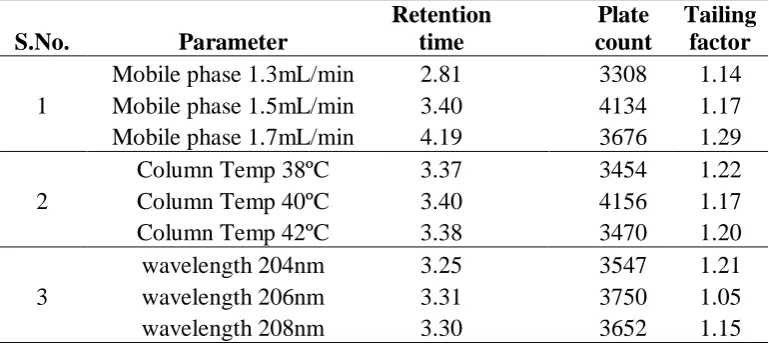
Robustness: The study of robustness was performed by slight modification in chromatographic conditions such as flow rate, wavelength and column temperature. The working standard solution of Pristinamycinwas analyzed under these new set of experimental conditions. Only one parameter was changed while the others were kept unaltered. The system suitability parameters were evaluated as per the test method in all the cases and found to be within limits shown in Table-VI.
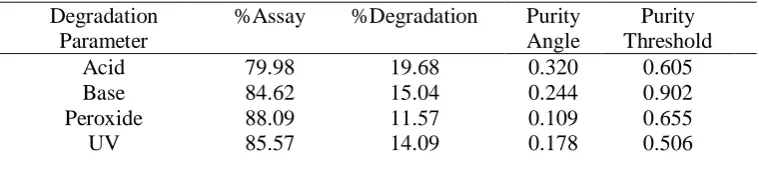
6112 of different stressed conditions like acid,
base, peroxide, photolytic and UV lightwere studied. The drug standard was exposed to 0.5NHCl solution, 0.5N NaOH and 3% peroxide solutions for 24 hours at UV light. To study the percent of degradation in the presence of lightthe standard was exposed to UV light for about 24 hours. In each case a working standard (100µg/mL) solution was prepared, injected into the system and the chromatograms were recorded. The amount of drug degraded was calculated by comparing the area of the standard with that of the area of the degraded sample. The results are presented in Table-VII.
Assay: The Developed method was functionalized for the tablet of Pristinamycin and the mean % assay was found to be 100%.The results of % assay were shown in Table-VIII.
CONCLUSION:
The system suitability parameters such as tailing factor and number of theoretical plates are found to be within the limits and the retention time of the component was found to be 3.31min. The intra-day precision and inter-day precision of a method was expressed in terms of %RSD found to be less than 2.0. The percentage recovery (accuracy) of the drug at three different concentration levels and the mean percent of recovery were found to be within the specified limits. The proposed method was linear in the range of concentration 25-150% with good correlation coefficient. Degradation of the drug under different stressed conditions was found to be negligible. Hence the proposed method was found to be simple, fast, precise, accurate, rugged, robust and economic; therefore, the method can be used for routine analysis in quality control.
REFERENCES:
1. Nagasarapu mallikarjunarao, The Research gate, Scipham, 2016, 84, 279-287.
2. John NG, 2005, Journal of Antimicrobial chemotherapy, Volume 55, issue 6, 1008–1012. 3. V. Loncle, Antimicrobial agents
and chemotherapy, 1993,
volume37(10), 2159-2165.
4. Suresh Kannan V, World journal of Pharmaceutical research, 2016, volume 6(2), 1027–1036.
5. S.Drogue, Journal of
Chromatography A, 1992, Volume 593(1-2), 363–371.