time-consuming, complex and error-prone process. In this paper, we present a sequence similarity parallelization technique using the Apache Storm as a stream processing framework with a data parallel programming model. Storm automatically parallelizes computations via a special user-defined topology that is represented as a directed acyclic graph. The proposed technique collects streams of data from a disk and sends them sequence by sequence to clustered computers for parallel processing. We also present a dispatching policy for balancing the cluster workload and managing the cluster heterogeneity to achieve more than 99 percent parallelism. An alignment-free method, known asn-gram modeling, is used to calculate similarities between the sequences. To show
the cost-performance superiority of our method on clustered commodity computers over serial processing in powerful computers, we simply use UniProtKB/SwissProt dataset for evaluation of the performance of sequence similarity as an interesting large-scale Bioinformatics application.
Key words: commodity cluster, parallelization, sequence similarity, Apache Storm
AMS subject classifications. 68W10, 68R10
1. Introduction. As a result of increases in the size of available genome sequence data, the processing and storage of such data have become one of the major challenges in modern genomic research. Bioinformatics applications such as finding genes in DNA sequences, or aligning similar proteins, all need complex computations and vast amounts of processing power beside massive memory capacity. Therefore, there is high demand for faster algorithms and more powerful computers to reduce the execution time of these applications.
For Bioinformatics applications, the primary form of information are raw DNA and protein sequences. Therefore, one of the first steps toward obtaining information about a new biological sequence is to compare it with a set of known sequences in existing sequence databases [1]. The results of comparisons often suggest functional, structural, or evolutionary analogies between sequences. For a given sequence, searching in sequences of protein databases is one of the most fundamental and important tools for predicting the structural and functional properties of uncharacterized proteins.
The similarity between two sequences (gene or protein) indicates that they may be derived from the same ancestral sequence by an evolution. This evolutionary similarity is called homology and similar sequences are known as homologous [2].
The most common metric showing the similarity between two instances is their distance. Computing distances between sequences in large datasets is a computationally intensive task [1]. To handle the complexity of this task,we can take advantage of parallelization techniques. Pairwise calculation provides a natural target for parallelization because all elements of the distance matrix are independent [1].
Using network-attached workstations as a platform for distributed and parallel computing is becoming more and more popular. This is due to the fact that todays desktop machines are extremely powerful as well as affordable. In contrast, dedicated supercomputers are often very expensive, so most research groups have only limited access to such machines. Commodity computers may be slower than commercial supercomputers, but they are readily accessible and usable for many tasks. Small networks of commodity computers can be used for coarse-grain parallelization of database searches. As a result, in response to the rapid increase in the amount of data generated by the new technologies, such as next-generation sequencing (NGS), researchers can use parallelization strategies and distributed systems on commodity clusters to accelerate the search in such datasets. However, the users of Bioinformatics tools are typically unaware of the advantages of emerging technologies in distributed computing. This is due to the difficulty of converting sequential jobs to distributed
∗Department of Electrical Engineering and Information Technology, Iranian Research Organization for Science and Technology,
Tehran, Iran ([email protected], [email protected]).
ones and the challenge of understanding distributed technologies well enough to create and manage a distributed environment [3]. Therefore, it can be useful to show how to parallelize Bioinformatics applications that can be followed by Bioinformaticians.
A practical study on using parallel computing to speed up the Bioinformatics problems has different as-pects. A rich and complex study of parallel computing techniques and technologies for solving Bioinformatics problems has been explored in [1]. In this paper, we use sequence similarity as a case study of Bioinformatics problems for applying parallelization strategy. But, we focus on alignment-free sequence similarity methods. So, parallelization strategy for alignment-based methods such as BLAST [4, 5] is out of scope of this work. On the other hand, we try to find a software parallel solution to sequence comparison, and hardware parallel solutions are not in our scope. Various parallel architectures for sequence similarity search are compared in [6]. Moreover, some researchers in this scope have used parallel technologies such as GPU to speed up the sequence analysis algorithms [7, 8, 9]. In this paper, we concentrate on having applications that are run both in parallel and in a distributed manner and ignore solutions that only consider running applications in parallel like GPU solutions. We use commodity clustered computers to distribute sequence searches much the same as other researches that have parallelized sequence searches on workstation clusters, such as the work in [10] that uses an alignment-based method. There are also other works that emphasis on parallelization of sequence similarity search [11, 12, 13, 14], but few works use streaming to overcome big data challenges [15, 16, 17]. For example, [15] has proposed a stream-based approach for NGS read alignment based on the IBM InfoSphere Streams computing platform deployed on Amazon EC2.
We also use stream processing for a data and compute-intensive scientific problem (i.e. DNA sequence analysis). But, as a software solution, our strategy is based on a high-level parallel programming paradigm in an open source stream processing framework named Apache Storm. In order to get an efficient use of Storm on a heterogeneous commodity cluster, we have developed a scheduler to balance the workload on processing nodes. The used similarity method, in our work, is based on n-gram that is derived from statistical language modeling that uses the Markov chains representation together with cross-entropy from information theory to get a measure of similarity between n-grams [18]. We use stream processing to overcome computation challenges as well as memory challenges in this type of sequence similarity search method [19, 20].
More precisely, our contributions are as follows:
• We use protein-sequence streaming as a data partitioning strategy and utilize stream processing for coarse-grain search in a large database. Using protein-sequence streaming instead of database parti-tioning, we can reduce the cost of storage in some solutions such as in cloud computing.
• We build a task dispatching strategy (i.e., a weighted round-robin scheduler) to provide a balanced workload among heterogeneous clustered computers. In this strategy, we dispatch tasks with corre-sponding data to processing elements. So, each element takes proper sized subsets of the dataset, according to its computing power.
• We deploy Apache Storm for parallelization of a word-based sequence similarity search method in a semi-automatic programmer directed manner.
The rest of this paper is organized as follows. Section 2 outlines the scope of the work, the method used for sequence similarity and the parallel framework used in this paper. Section 3 describes the parallelization concerns of our work and used strategy to overcome these concerns in a real heterogeneous distributed environment. Section 4 presents how we have evaluated the performance and effectiveness of our proposed strategy. Section 5 concludes the paper.
2. Background.
2.1. Sequence comparison. Sequence comparison is used to detect the similarity of proteins for explain-ing phylogenetic relations between them. Existexplain-ing sequence comparison methods can be classified into two main categories:
1. Alignment-based methods. 2. Alignment-free methods.
memory usage are disadvantages of all these three methods [19, 20]. Nonetheless, word-based methods have received credit in high-throughput classification of genome sequences and are deployed for diverse objectives in genomics such as sequence clustering and word similarity searches [29].
Some of the word-based methods [30, 31], determine the similarity between sequences by using a Markov model to estimate the probability that a sequence is relevant to a given query with respect to their word frequencies. In this paper, we deploy a similar method to calculate similarities between sequences, which is described in Section 2.2.
2.2. Similarity method. Amino acids consist of 20 different symbols that can be considered as the alphabet of a hypothetical language. Protein sequences can also be treated as texts written in this language. With this analogy, we can apply statistical language techniques in biological sequence analysis [18].
The unique order of amino acids in sequences affects the similarity of proteins. These orders can be obtained byn-gram based modeling techniques and used in similarity methods with cross-entropy related measures [18]. In these techniques, a Markov chain is built forn-gram models. For example, in Drosophila gene eyeless sequence [32], amino acids in the range of 30 to 40 are EAV EAST ASH. Available tokens of this gene in 2-gram model are continuous base pairs with length 2, which are{EA, AV, V E, EA, AS, ST, T A, AS, SH}, while in the 3-gram model, are continuous base pairs with length 3, which are {EAV, AV E, V EA, EAS, AST, ST A, T AS, ASH}.
The Shannon entropy [33] can be used to show how a sequence is fitted by an n-gram model, which is estimated by equation 2.1 [34].
H(x) =−∑ w∗
P(wn
i)logP(wi+n−1|win−1) (2.1)
In equation 2.1,wn
i corresponds to{wi, wi+1, . . . , wi+n−1}. The summation is over all feasible combinations
of successivew with sizen, i.e. w ={{w1, w2, . . . , wn}, {w2, w3, . . . , wn+1}, . . .}. P(wni) is a joint probability that can be broken down using the Chain Rule to yield equation 2.2.
P(wn
i) =P(wi)P(wi+1|wi)P(wi+2|w2i) . . . P(wi+n−1|wni−1) = i+∏n−1
k=i
P(wk|wik−i) (2.2)
In equation 2.2, P(wi+n−1|wni−1) is the conditional probability of the nth word of a n-gram with respect to the previousn−1 words. Using the maximum likelihood estimation (MLE) [33], this term can be estimated by using then-gram frequencies:
P(wi+n−1|win−1) =
C(wni−1 wi+n−1)
C(wn−1
i )
= C(w
n i) C(wn−1
i ) (2.3)
In equation 2.3, C(wn
i) is the count of wni. For example, in the aforementioned Drosophila gene eyeless sequence [32], the probability of bigram AS is:
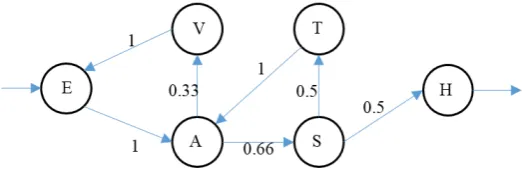
P(A|S) =C(AS) C(A) =
2 3 = 0.66
Fig. 2.1.The bigram model of the sequence of EAVEASTASH
If equation 2.1 is applied to two different sequencesX andY, the outcomes show which sequence is better fitted by the model, but cannot be used for their direct comparison. Thus, the similarity between two sequences must be represented as equation 2.4.
H(x, y) =−∑ w∗
PX(win)logPY(wi+n−1|wni−1) (2.4)
In equation 2.4, PX(wni) relates to the subject sequence X and PY(wi+n−1|win−1) relates to the query sequence Y whose model has to be estimated. Variable wn
i runs over all the words (orn-grams) of the query protein sequence.
Now, if we letSrbe a subject sequence andS=S1, S2, . . . , SN be the target protein database, then we can compute the similarity between them by using equation 2.4. The first step is the computation of reference score for the subject protein by calculatingH(Sr, Sr). Next, each sequence in the target database,Si(i= 1, . . . , N) is given as the model sequence for calculatingH(Sr, Si). After these calculations, we can haveNdissimilarities that are the absolute differences against the reference scoreD(Sr, Si) =|H(Sr, Si)−H(Sr, Sr)|, for alli= 1, . . . , N. Finally, by ordering these N dissimilarity measures, we can simply find the most similar sequences with the lowest distance to the subject sequence.
For protein coding genes, a tuple size of 3 can be a good choice [35] with less sensitivity and computation, but for more accuracy in this paper, we have chosenn= 4.
2.3. Apache Storm. Apache Storm is a real-time stream processing framework built by Twitter that is available as an Apache project [36]. After the batch processing became popular, it was realized that in many cases, the turnaround time was unacceptable. Given the needs for low-latency asynchronous stream processing solutions, Storm has tried to address these needs.
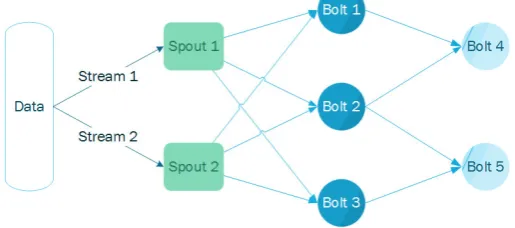
Fig. 2.2.An example of Storm topology (components with the same color have the same work)
Fig. 2.3.An example program in Storm
The Storm resource manager divides nodes into slots and for each worker node, the user configures how many slots exist on that node. The Storm default scheduler uses a simple round-robin strategy [37]. When a job is submitted to the master, the scheduler counts all available slots on the worker nodes and assigns worker instances to nodes one by one in a round-robin manner. It deploys workers so that each node in a topology has almost an equal number of worker instances. The scheduler gets a job and decomposes it into tasks based on the topology, which can be delivered to slots.
Here are some reasons why Storm has been chosen as our choice for stream processing. Firstly, it is one of the leading open source stream processing tools that guarantees scalable, reliable and fault-tolerant processing of data. Secondly, compared with other leading open source tools such as Apache Spark, Storm processes the incoming streams in real time without any intentional latency. Thirdly, Storm has an easy programming paradigm (in contrast to map-reduce in Spark) and is usable with many programming languages (supports both JVM and non-JVM languages) without requiring any additional new concepts (such as Resilient Distributed Dataset (RDD) in Spark). Figure 2.3 shows a simple example Java code in Storm for the topology represented by Figure 2.2.
At last, but not least, Storm can be deployed on clustered commodity computers with low memory (1GB) and old architecture, while Spark needs high memory capacity for in-memory processing.
Sequence comparison tasks can run on parallel processors using either coarse-grain or fine-grain methods [6]. In a coarse-grain method, sequences are partitioned equally among the processing elements that are appropriate for searches in a large database. So equal sized subsets of the database are assigned to processing elements, one subset to one processing element. Then, each element performs sequence analyses independently on its subset of the database. If there is a small number of sequences, coarse-grain parallelism may not be a good method. In these cases, a fine-grain method can be used to get a better speedup [6]. In our work, in order to evaluate the search in a huge database on a commodity cluster, we use coarse-grain parallelization to minimize the interactions between parallel processes.
Manually developing parallel programs is a time consuming, complex and error-prone process. Up to now, various tools have been available to assist programmers in converting serial programs into parallel ones. Designing and developing parallel programs by these tools requires the use of a parallel programming model such as a message passing or a data-parallel model. In distributed-memory parallel computation, a data-parallel model does not need to pass messages and thus makes the programming easier. A well-known representation of the data-parallel model is a Directed Acyclic Graph (DAG) in which nodes represent application tasks and directed arcs represent inter-task dependencies. One such tool that offers semi-automatic parallelization and follows the data-parallel model in a DAG is the Apache Storm that was described in Section 2.3.
The Storm programming model provides a distributed model for processing of streams on processing el-ements, wherein each element processes the input stream. Since batch processing is a specialization of the stream processing [38], we can use stream processing frameworks to do batch processing works. In this sense, we can aggregate the streams arriving in a time period and pass the aggregate to a processing element. So, Storm assumes the incoming streams as a batch and a set of batch tasks can be executed in parallel in a stream processing framework. In this manner, each task takes a chain of inputs, processes them using a user-defined function, and produces a result.
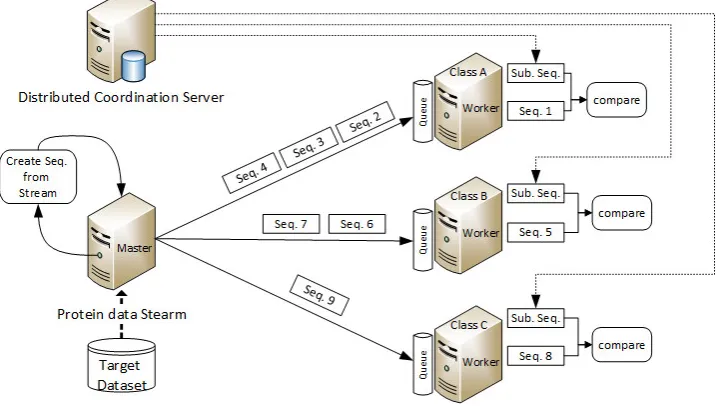
For sequence similarity, in this paper, a simple topology is used in Storm. In this topology, a Spout receives data and constructs a sequence from character streams to prepare the data elements in protein-sequence streaming. The Spout sends the result to main processing elements (i.e. Bolts) to compare them with the subject sequence. It sends sequences asynchronously to Bolts via a queue channel, so Bolts have their input data ready for execution. If the queue does not get empty during execution, with a sufficient number of Bolts, we can fully utilize the CPU cycles of the nodes. The subject sequence can be retrieved from a distributed coordination system such as Apache Zookeeper [39]. Sequences are sent from Spout to Bolts with a statically balanced Weighted Round Robin method that is described later (Algorithm 2). This architecture is illustrated in Figure 3.1.
For all schedulers in a distributed system, fairness is a critical feature to be considered. The round robin strategy as the default Storm scheduler in a shared heterogeneous cluster, which has multiple nodes with different hardware configurations, may not be fair. In default scheduling, although the processing is done in parallel, a job waits for its slowest worker to finish.
To balance the workload, we must partition the database into a number of portions according to the number and the power of processors allocated. To do this, our scheduling algorithm gets benchmarking data (as described in Algorithm 1) and then dispatches data elements according to their class weights to balance the workload of the cluster (as described in Algorithm 2).
By using the weights that are taken from benchmarks, the scheduling described in Algorithm 2 minimizes the imbalance ratio in comparison to the default scheduler; the imbalance ratio is the ratio of largest and smallest load on a processing instance, that we measure it in the next section.
In the next section, we compare the performances of the default scheduling and our proposed scheduling, as well as the cost-adjusted-performance of the clustering.
Fig. 3.1.Sequence similarity distributed computing system overview
Algorithm 1Prepare information for choosing tasks
Input: Benchmark is information receive from benchmarking phase
Output: W orkersM etais a List of workers’ metadata
1: Info{
id, ◃ id of a worker that is running on a node
weight, ◃ class weight of the worker
counter ◃ the count of tasks must execute on the worker };
2: cluster←fetch running workers
3: for eachworker∈clusterdo
4: id←identification number of the worker
5: weight←derive the weight of node fromBenchmarkusing GCD
6: counter←weight∗f actor ◃ f actor used to round the weight to a proper counter (normally is 10)
7: tmpInf ←(Inf o)[Id, weight, counter]
8: W orkersM eta.add(tmpInf)
9: end for
10: returnW orkersM eta
and sensitivity [40]. In this section we measure the imbalance load ratio and the speedup of our solution. At last, we investigate the cost-adjusted-performance that is the product of execution time multiplied by the deployment cost.
For evaluation, the proposed method has been applied to publicly available protein database SWISS-PROT [41] as the target database to compare with the genome HIV-gp120 as a query sequence [42]. The input data (target and query) are all FASTA formatted sequence files. Characteristics of the target dataset and the query sequence are shown in Tables 4.1 and 4.2 respectively.
Algorithm 2Choose worker for processing the sequence
Input: T ask is a task for comparing two sequence, W orkersM etais a List of workers’ metadata
Output: workeris the id of a worker to running thetask
1: Letnbe the size ofW orkersM etaList
2: LetworkerInf[1. . . n] be an Array ofInf oinitiated fromW orkersM eta
3: worker← −1
4: Label:W orkerSelection
5: i←0
6: whilei < ndo
7: counter←workerInf[i].counter
8: if counter >0then
9: worker←workerInf[i].id
10: counter←counter−1
11: break
12: end if 13: i←i+ 1
14: end while
15: if worker=−1then
16: for allworker∈workerInf do
17: worker.counter←worker.weight∗f actor
18: end for
19: gotoW orkerSelection
20: end if
21: returnworker ◃Send Task to Worker
Table 4.1
SWISS-PROT dataset characteristics
Characteristic value
Name SWISS-PROT
Number of sequences 460,903
Shortest sequence 6
Longest sequence 35,213
Average nucleotides per sequence 374 Total number of nucleotides 172,370,171
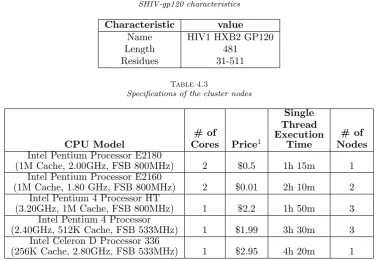
Our test cluster had 10 compute nodes, each with 1GB memory and Intel processors with different archi-tectures. Specifications of nodes deployed in the cluster, the execution time for each node to compare subject sequence with previously known target sequences in the dataset, and the number of each node are stated in Table 4.3. Compute nodes ran Apache Storm 0.9.3 under Ubuntu-12.04 to execute 1 or 2 workers per node according to the number of cores.
To evaluate our cluster, lets consider a cluster wherein we are given m workers for scheduling that are indexed by the setW =w1, .., wm. There are additional givenntasks for scheduling that are indexed by the set T =t1, .., tn. LetTi be the set of tasks scheduled onwi. Then, the load of the workeri(that is wi) is defined by equation 4.1.
ℓi=
∑
ti∈T
Ci,j (4.1)
CPU Model
# of
Cores Price1
Thread Execution
Time
# of Nodes
Intel Pentium Processor E2180
(1M Cache, 2.00GHz, FSB 800MHz) 2 $0.5 1h 15m 1
Intel Pentium Processor E2160
(1M Cache, 1.80 GHz, FSB 800MHz) 2 $0.01 2h 10m 2
Intel Pentium 4 Processor HT
(3.20GHz, 1M Cache, FSB 800MHz) 1 $2.2 1h 50m 3
Intel Pentium 4 Processor
(2.40GHz, 512K Cache, FSB 533MHz) 1 $1.99 3h 30m 3
Intel Celeron D Processor 336
(256K Cache, 2.80GHz, FSB 533MHz) 1 $2.95 4h 20m 1
is called the makespan of the schedule and is given by equation 4.2.
ℓmax= max i∈{1,...,m}ℓi
(4.2)
In our test case, lets assume that T is the set of sequence comparison tasks that is submitted to the master. Each task is composed of two subtasksta andtb. ta is the task of constructing a sequence from Stream andtb is the comparison of the sequence with the subject sequence. Since ta is a lightweight task with respect totb, i.e. tb≫ta, and ta always runs on a fixed node (Spout node), we can ignore it from calculations. In addition, if we assume all sequences have the same length, so all tasks would be identical. In our dataset, the difference between sequence lengths is not significant, so for simplicity in calculations, we can assume that all tasks are identical. Sequence comparison tasks have also no data dependencies and are independent of each other in a non-preemptive manner.
Our cluster of computers was composed of 7 one core PCs and 3 double core PCs. To achieve a high level of parallelism, we used a fixed number of workers on each node according to its number of cores. Since we set cores per node as computing resources, we had 13 workers. One worker was used as Spout to collect and dispatch data sequentially. Therefore, twelve (m= 12) workersW =w1, w2, . . . , w12 were left for sequence comparison
in parallel. Scheduling was carried out at worker level and each worker used First-In, First-Out (FIFO) method for performing the sequence comparison tasks.
By benchmarking, we estimated the time taken by each worker on a node to perform each task. The nodes in the cluster were classified by system benchmarking before submitting a topology. In the benchmarking phase, we ran several sequence comparisons on each node to get a task execution time. A task execution time was measured based on the number of sequences processed in a time period. The benchmarking results are stated in Table 4.4.
In this work, the workers are classified in p classes asG={wg1, wg2, . . . , wgp} whereingi is an index for
class i. So, the makespanwill be ℓmax = maxi∈{1,...,p}ℓgi. Wherein ℓgi = ∑
tj∈TgiCgi,j denotes the load of
Table 4.4
Execution time and performance on each type of node in the cluster testbed
Class (p)
# of Slots
Job Completion
Time Sequences
Task execution time
per
worker (core) Performance(sequence second )
1 2 75m = 4500s 460,903 0.0097 102
2 3 110m = 6600s 460,903 0.0143 70
3 4 130m = 7800s 460,903 0.0169 59
4 3 210m = 12600s 460,903 0.0273 36
5 1 260m = 15600s 460,903 0.0338 29
wgi, in which, tasktj takesCgi,j units of time if scheduled on a worker with classi, andTgi denotes the set of
tasks scheduled on wgi.
The Storm default scheduler uses a simple round-robin strategy that grants the same number of tasks (sizeof Tm ) to each worker. In our test case, each task is a sequence comparison from the dataset with the subject sequence that is 460903 tasks of sequence comparison. Therefore, the makespan of the default scheduler at Storm is the following:
ℓmax=
∑
tj∈Tg5
Cg5,j =
460903
12 ×Cg5,j = 38409×0.0338≈1,298
in which,
Tg5 ={tk, tk+12, tk+(2×12), . . . , tk+(38408×12)} |1≤k≤12, Cg5,j ≈0.0338
To efficiently use a parallel computer system, a balanced workload among the processors is required. To compare the effectiveness of balancing the workload, the percentage of load imbalance (PLIB) [43] is defined by equation 4.3.
P LIB=ℓmax−ℓmin ℓmax
×100 (4.3)
P LIB is the percentage of the overall processing time that the first finished processor must wait for the last processor to finish. This number also indicates the degree of parallelism. For example, ifP LIBis less than one, we achieve over a 99 percent degree of parallelism. Therefore, a computational method with a lowerP LIB is more efficient than another one with a higher P LIB. The workload is perfectly balanced if P LIB is equal to zero [43].
For default scheduler,P LIB is obtained as follows:
ℓmin=
∑
tj∈Tg1
Cg1,j =
460903
12 ×Cg1,j = 38409×0.0097≈373
P LIB=ℓmax−ℓmin ℓmax
×100 = 1298−373
1298 ×100≈71
Therefore, in this case, we have less than 29 percent parallelism. In this work, the goal is to minimize the makespan, i.e. the completion time of the last tasks in the schedule. For this goal, we have to achieve ideal workload balance, where P LIB= 0. In our proposed scheduling method, each worker gets tasks according to its computation power (or weight). This means thatℓ1≈ℓ2≈. . .≈ℓ12.
. . .+
d = 7.5 + 11 + 13 + 21 + 26 = 78.5 So,
W eightg1= 10.4, W eightg2 = 7.1, W eightg3 = 6, W eightg4= 3.7, W eightg5= 3
In our test case, Storm selects one slot of a node in class 3 as master process. So we have
Tgi=
460903
10.4×2 + 7.1×3 + 6×3 + 3.7×3 + 3 =
460903 74.2
ℓg1 =
∑
tj∈Tg1
Cg1,j = 6212×10.4×0.0097≈627
ℓg2 =
∑
tj∈Tg2
Cg2,j = 6212×7.1×0.0143≈631
ℓg3 =
∑
tj∈Tg3
Cg3,j = 6212×6×0.0169≈630
ℓg4 =
∑
tj∈Tg4
Cg4,j = 6212×3.7×0.0273≈627
ℓg5 =
∑
tj∈Tg5
Cg5,j = 6212×3×0.0338≈630
ℓmax= maxℓgi ≈631
Thus, we expect that our scheduler should perform twice better than the default scheduler (based on their ℓmax, i.e. 631 compared to 1298), which is also shown by our experimental results in Figure 4.1.
Figure 4.1 shows the turnaround times under the default scheduler and our proposed scheduling method according to the class of nodes in the cluster; the turnaround time includes time to load workers, submission time of tasks to workers, scheduling time, synchronization time, inter-node communication time, and delays in acknowledging.
Experimental results in Figure 4.1 show that our proposed method produces a smaller P LIB than the default scheduler.
P LIB= ℓmax−ℓmin ℓmax
×100 = 631−627
631 ×100≈0.6
Our scheduling method also achieved more than 99 percent degree of parallelism.
Program speedup is another important measure of the performance of a parallel program. By conventional definition of the speedup, if machine M1 can solve problemP in time T1 and machine M2 can solve the same
problem in timeT2, the speedup of machineM1over machineM2on problemP is represented by equation 4.5.
SP = T1
T2
Fig. 4.1.Comparison of turnaround times for each class of physical nodes and the whole cluster
If machine M2 is composed of m identical instances of the base processor of M1, then we would expect
m processors to solve the solution m times faster than a single processor. But this expectation is used in homogeneous clusters. For simple calculation of speedup in heterogeneous clusters, based on [44], if our cluster is a set H ={M1, M2, . . . , Mm}of mdistinct machines, the speedup of a heterogeneous clusterC on problem P is defined by equation 4.6.
SP =
min{TM1 P , T
M2 P , . . . , T
Mm
P } TC
P (4.6)
In equation 4.6,TMk
P is the execution time on machineMk to solve problemP. In other words, the fastest machine is selected for comparison to the cluster. For our cluster with m = 13 based on equation 4.6 the speedup is:
SP =
min{4500,6600,7800,12600,15600}
1170 =
4500 1170 = 3.8
But this is not a good measure of speedup for our heterogeneous system due to the difference in nodes performance (slowest machine is 3.5 times slower than the fastest machine). An extension of the relative speedup for heterogeneous systems has been presented in [45], which is proved to be an appropriate tool for the evaluation of the speedup of parallel discrete event simulation in heterogeneous execution environments. So, accordingly, the relative speedup in this paper is calculated by equation 4.7.
rP = Ne TC
P ×Pc (4.7)
In equation 4.7,Neis the number of events in the system. The cumulative performance of the heterogeneous system can this be defined by equation 4.8.
Pc= N T
∑
i=1
Pi×Ni (4.8)
Let us denote the number of CPU types in a heterogeneous system byN T, the number and the performance of CPU cores available from type i by Ni and Pi, respectively. Since our problem is near to discrete event simulation, the relative speedup or efficiency of our cluster will be:
over given cluster 13 $16.04 19.5m
rP =
460903
787×1170 ≈%50
This value is not bad at all for such heterogeneous clusters [45] with low network bandwidths, especially when the speedup is limited by the serial section (i.e. Spout) of the program.
Scalability becomes the basic need for distributed systems. Because of some problems such as heterogeneity of our cluster and lack of more nodes, we cannot practically test the scalability of our solution. However, we try to measure the scalability of our solutions compared to other similar works that scale well.
A similar work to ours is a streaming approach in a distributed architecture for scaling up natural language processing methods [46] which also leverages Storm. This work describes a series of experiments carried out with the goal of analyzing the scaling capabilities of the language processing. It shows that the use of Storm is effective and efficient for scalable distributed language processing across multiple machines when processing texts on a medium and large scale. Likewise, as mentioned earlier, the used similarity method in this work is a form of natural language processing [31] and implemented using Storm in a heterogeneous distributed environment. So, we can conclude our solution is scalable in nature and is efficient in the same environment.
Storm was originally aimed for processing twitter streams at scale [36]. The authors in [47] propose an event detection approach using Apache Storm to detect events within social streams like Twitter that can scale to thousands of posts every second. It is really a big challenge to analyze the bulk amount of tweets to get relevant and different patterns of information on a timely manner. We observed that the sequence similarity algorithm is an embarrassingly parallel problem that is highly parallel and can be deployed on a distributed system. We can consider sequences as events and similarity of a sequence with the reference as a rule to detect events. It has one Spout that reads events from document (dataset for our case) and a pipeline topology like ours. So, through experimentation on a large Twitter dataset by mentioned paper, we can conclude that our approach can scale to the equivalent size of data.
As a last example, the authors in [48], have addressed the problem of data stream clustering by developing scalable distributed algorithms that run on the Apache Storm. They demonstrate experimentally that they are able to gain close to linear scalability up to the number of physical machines. Likewise, our used similarity method was applied to the clustering sequences, based on Markov chains representation known as n-gram in statistical language modeling [18]. We used this sequence clustering strategy in a stream processing manner on Storm. Therefore, with an optimistic attitude, we can conclude that our solution is scalable at the same level as this work. However, there are some other works that can be used to inference the scalability of our solution [49, 50, 51].
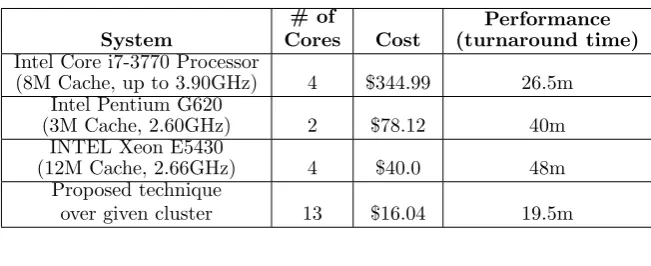
In order to evaluate the performance-per-cost, we just use CPU costs as an approximation of system cost. In our test case, the relation between computer system prices and CPU prices is perfect. The modern and more expensive CPUs need modern and more expensive motherboards, RAMs and also need more power consumption. So we ignore these costs and simply compare CPU costs. The cost of the total cluster and other systems based on the lowest prices (obtained from retail marketplaces) are shown in Table 4.5.
Fig. 4.2. Comparison of Cost-adjusted-performance of our testbed with proposed method and other types of testbeds
results show that a commodity cluster with our proposed scheduling method has a better performance-per-cost than other systems.
Although the proposed cluster has more cores, but it demonstrates the lowest cost-adjusted-performance (or highest performance-per-cost) compared to other single systems. The relative importance of equipment cost makes traditional server solutions less appealing for solving our problem because they increase performance, but decrease the performance-per-cost.
5. Conclusions and future works. Clustered commodity computers have already experienced enormous attention and used as a cost-effective platform for distributed and parallel processing of data/compute-intensive applications, compared to more expensive dedicated supercomputers. In Bioinformatics, searching in a database is the most widely used technique and is one of the most common targets to use parallelization in Bioinformatics. In this work, for parallelize sequence similarity methods, we use Storm as a stream processing framework. The Storm framework automatically provides some specifications for parallel computing, such as the scheduling, synchronization, and inter-machine communication. But other specifications, especially partitioning the input data and balancing the workload should be explicitly programmed using a given strategy such as the strategy we have proposed in this paper. Streaming can be a good choice instead of database partitioning when the cost of storage and/or bandwidth is important.
In a perfect world of parallelization, for n processors, the runtime should be n times faster than doing the same work on one processor. However, in a real world, the performance of a parallelization is decreased due to the interaction between processes and synchronization. Moreover, the heterogeneity affects the workload balancing; dividing the jobs equally across machines in a heterogeneous cluster leads to load imbalance. So, efficient scheduling of applications based on the characteristics of computing nodes can yield significant speedups. In this paper, we tried to alleviate these obstacles by running coarse-grain CPU-intensive tasks on loosely-coupled workers with the same workload according to their power.
balancing the workload and also the programming paradigms of parallel systems such as MapReduce. In our future work we are going to consider sequence lengths in calculating loads on each node and use a dynamic workload balancer to avoid benchmarking.
REFERENCES
[1] A. Y. Zomaya,Parallel Computing for Bioinformatics and Computational Biology, WileySeries on Parallel and Distributed Computing, Wiley-Interscience, 2005.
[2] G. A. Petsko and D. Ringe,From Sequence to Function: Case Studies in Structural and Functional Genomics, Primers in biology, New Science Press Sunderland, MA,London, 2004.
[3] A. Matsunaga, M. Tsugawa, and J. Fortes,Cloudblast: Combining mapreduce and vir-tualization on distributed resources for bioinformatics applications, in 2008 IEEE FourthInternational Conference on eScience, Dec 2008, pp. 222-229. [4] A. E. Darling, L. Carey, and W. Feng,The Design, Implementation, and Evaluation of mpiBLAST, in ClusterWorld
Conference, San Jose, California, June 2003.
[5] H. Lin, X. Ma, P. Chandramohan, A. Geist, and N. Samatova,Efficient data access for parallel blast, in 19th IEEE International Parallel and Distributed Processing Symposium, April 2005, pp. 72b72b.
[6] R. Hughey,Parallel hardware for sequence comparison and alignment, CABIOS, 12(1996), pp. 473-479.
[7] E. F. d. O. Sandes, G. Miranda, A. C. M. A. d. Melo, X. Martorell, and E. Ayguad,Cudalign 3.0: Parallel biological sequence comparison in large gpu clusters, in 2014 14thIEEE/ACM International Symposium on Cluster, Cloud and Grid Computing, May 2014,pp. 160-169.
[8] M. C. Schatz, C. Trapnell, A. L. Delcher, and A. Varshney,High-throughput sequence alignment using graphics pro-cessing units, BMC Bioinformatics, 8(2007), p. 474.
[9] H. Jiang and N. Ganesan, CUDAMPF: a multi-tiered parallel framework for ac-celerating protein sequence search in HMMER on cuda-enabled GPU, BMC Bioinformatics,17 (2016), p. 106.
[10] R. C. Braun, K. T. Pedretti, T. L. Casavant, T. E. Scheetz, C. L. Birkett, and C. A.Roberts,Parallelization of local blast service on workstation clusters, Future Gener. Comput. Syst., 17 (2001), pp. 745-754.
[11] A. S. Deshpande, D. S. Richards, and W. R. Pearson,A platform for biological sequence comparison on parallel computers, Computer Applications in the Biosciences, 7(1991), pp. 237-247.
[12] T. Rognes, Paralign: a parallel sequence alignment algorithm for rapid and sensitive database searches, Nucleic Acids Research, 29 (2001), p. 1647.
[13] X. l. Yang, Y. l. Liu, C. f. Yuan, and Y. h. Huang,Parallelization of blast with mapreduce for long sequence alignment, in 2011 Fourth International Symposium on Parallel Architectures, Algorithms and Programming, Dec 2011, pp. 241–246. [14] M. C. Schatz,Cloudburst: highly sensitive read mapping with mapreduce, Bioinformatics, 25 (2009), p. 1363.
[15] R. Kienzler, R. Bruggmann, A. Ranganathan, and N. Tatbul,Large-Scale DNA Sequence Analysis in the Cloud: A Stream-Based Approach, Springer Berlin, Berlin, Heidelberg, 2012, pp. 467–476.
[16] B. Wolf, P. Kuonen, and T. Dandekar,Multilevel parallelism in sequence alignment using a streaming approach, Nesus 2015 workshop, (2015).
[17] S. A. Issa, R. Kienzler, M. El-Kalioby, P. J. Tonellato, D. Wall, R. Bruggmann, and M. Abouelhoda,Streaming support for data intensive cloud-based sequence analysis, BioMed Research International, (2013), p. 16.
[18] A. B. Marta and N. Robu,A study of sequence clustering on proteins primary structure usinga statistical method, Acta Polytechnica Hungarica, 3 (2006), pp. 1727.
[19] G. Lu, S. Zhang, and X. Fang,An improved string composition method for sequence comparison, BMC Bioinformatics, 9 (2008), p. S15.
[20] C. Yu, R. L. He, and S. S.-T. Yau,Protein sequence comparison basedon k-string dictionary, Gene, 529 (2013), pp. 250–256. [21] S. F. Altschul, T. L. Madden, A. A. Schaffer, J. Zhang, Z. Zhang, W. Miller, and D. J. Lipman,Gapped blast and
psi-blast: a new generation of protein database search programs, Nucleic Acids Res, 25 (1997), pp. 3389–3402.
[22] D. H. Huson and C. Xie,A poor mans blastx high-throughput metagenomic protein database search using pauda, Bioinfor-matics, 30 (2013), p. 38.
[24] W. R. Pearson and D. J. Lipman,Improved tools for biological sequence comparison, in Proceedings of the National Academy of Sciences of the United States of America, 85 (1988), pp. 2444–2448.
[25] C. Yu, M. Deng, and S. S.-T. Yau,DNA sequence comparison by a novel probabilistic method, Information Sciences, 181 (2011), pp. 1484–1492.
[26] K. Song, J. Ren, Z. Zhai, X. Liu, M. Deng, and F. Sun,Alignment-free sequence comparison based on next-generation sequencing reads, Journal of Computational Biology, 20 (2013),pp. 64–79.
[27] C. A. Leimeister, M. Boden, S. Horwege, S. Lindner, and B. Morgenstern,Fast alignment-free sequence comparison using spaced-word frequencies, Bioinformatics, 30 (2014), pp. 1991–1999.
[28] M. N. Davies, A. D. Secker, A. A. Freitas, J. Timmis, E. Clark, and D. R. Flower,Alignment-independent techniques for protein classification, Current Proteomics, 5 (2008), pp. 217–223.
[29] T. Z. DeSantis, K. Keller, U. Karaoz, A. V. Alekseyenko, N. N. Singh, E. L. Brodie, Z. Pei, G. L. Andersen, and N. Larsen,Simrank: Rapid and sensitive general-purpose k-mer search tool, BMC Ecology, 11 (2011),p. 11.
[30] L. Fu, B. Niu, Z. Zhu, S. Wu, and W. Li,Cd-hit: accelerated for clustering the next-generation sequencing data, Bioinfor-matics, 28 (2012), p. 3150.
[31] A. B. Marta, I. Pitas, and K. Lyroudia, Statistical Method of Context Evaluation for Biological Sequence Similarity, Springer US, Boston, MA, 2006, pp. 99–108.
[32] UniProtKB, Eyeless protein, www.uniprot.org/uniprot/O96791.
[33] C. D. Manning and H. Schutze,Foundations of Statistical Natural Language Processing, MIT Press, Cambridge, MA, USA, 1999.
[34] D. H. V. Uytsely and D. V. Compernolle,Entropy-based context selection in variable-length n-gram language models, in IEEE BENELUX Signal Processing Symposium, 1988.
[35] K. Yang and L. Zhang,Performance comparison of gene family clustering methods with expert curated gene family data set in Arabidopsis thaliana, Planta, 228 (2008), pp. 439–447
[36] A. Toshniwal, S. Taneja, A. Shukla, K. Ramasamy, J. M. Patel, S. Kulkarni, J. Jackson, K. Gade, M. Fu, J. Donham, N. Bhagat, S. Mittal, and D. Ryaboy, Storm@twitter, in Proceedings of the 2014 ACM SIGMOD International Conference on Management of Data, SIGMOD14, New York, NY, USA, 2014, ACM, pp. 147–156.
[37] M. Rychly, P. koda, and P. mr, Scheduling decisions in stream processing on heterogeneous clusters, in 2014 Eighth International Conference on Complex, Intelligent and Software Intensive Systems, July 2014, pp. 614–619.
[38] J. Kreps,I Heart Logs: Event Data, Stream Processing, and Data Integration, OReilly Media,2014.
[39] P. Hunt, M. Konar, F. P. Junqueira, and B. Reed, Zookeeper: Wait-free coordination for internet-scale systems, in Proceedings of the 2010 USENIX Conference on USENIX Annual Technical Conference, USENIXATC10, Berkeley, CA, USA, 2010, USENIX Association, pp. 11–11.
[40] A. M. Aji and W. Feng,Optimizing performance, cost, and sensitivity in pairwise sequence search on a cluster of PlaySta-tions, in 8th IEEE International Conference on BioInformatics and BioEngineering, BIBE, Athens, 2008.
[41] E. Boutet, D. Lieberherr, M. Tognolli, M. Schneider and A. Bairoch,UniProtKB/Swiss-Prot, Methods in Molecular Biology, 406 (2007), pp. 89–112.
[42] gp120 - ENV Glycoprotein 120, http://www.bioafrica.net/proteomics/ENV-GP120prot.html.
[43] T. K. Yap, O. Frieder and R. L. MartinoParallel Computation in Biological Sequence Analysis, IEEE Transactions on Parallel and Distributed Systems, 9(1998), pp. 283–294.
[44] V. Donaldson, F. Berman and R. Paturi,Program Speedup in a Heterogeneous Computing Network, Journal of Parallel and Distributed Computing, 21(1994), pp. 316–322.
[45] G. Lencse and I. Derka,Testing the Speedup of Parallel Discrete Event Simulation in Heterogeneous Execution Environ-ments, in Proc. ISC’2013, 11th Annu. Industrial Simulation Conf., Ghent, Belgium, 2013.
[46] R. Agerri, X. Artola, Z. B. G. Rigau and A. Soroa,Big data for Natural Language Processing: A streaming approach, Knowledge-Based Systems, 79(2015), pp. 36–42.
[47] R. McCreadie, C. Macdonald, I. Ounis, M. Osborne and S. Petrovic,Scalable Distributed Event Detection for Twitter, in IEEE International Conference on Big Data, Silicon Valley, CA, USA, 2013.
[48] P. Karunaratne, S. Karunasekera and A. Harwood,Distributed stream clustering using micro-clusters on Apache Storm, Journal of Parallel and Distributed Computing, 2016.
[49] X. Gao, E. Ferrara and J. Qiu, Parallel clustering of high-dimensional social media data streams, 15th IEEE/ACM International Symposium on Cluster, Cloud and Grid Computing, 2015.
[50] W. Inoubli, S. Aridhi, H. Mezni and A. Jung,Big Data Frameworks: A Comparative Study, CoRR, abs/1610.09962(2016). [51] M. A. Lopez, A. Lobato and O. C. M. B. Duarte,A performance comparison of Open-Source stream processing platforms,
in IEEE Global Communications Conference (Globecom), Washington, USA, 2016.
Edited by: Fr´ed´eric Loulergue
Received: August 29, 2016