Available Online at www.ijpret.com 24
INTERNATIONAL JOURNAL OF PURE AND
APPLIED RESEARCH IN ENGINEERING AND
TECHNOLOGY
A PATH FOR HORIZING YOUR INNOVATIVE WORK
ANALYSIS OF CASTING DEFECTS OF DIVERTER WHEEL AND CREDENTIALS OF
CORRECTIVE ACTIONS
PETLE SB1, SHIRBHATE A2, VIDHATE NR3
1. Student of Department of Production Technology & Management, PRMIT&R, Badnera. 2. Associate Professor Department of Production Technology & Management, PRMIT&R, Badnera.
3. General Manager, Jadhao Stell Alloy, Amravati.
Accepted Date: 03/07/2014; Published Date: 01/08/2014
\
Abstract: Paper presents analysis of casting defects and identification of remedial measures carried out at Jadaho Alloy steel Ltd, Amravati, Maharashtra, India. Analytical study carried out on Diverter Wheel Castings revealed that the contribution of the four prominent defects in casting rejections are blow hole, pinhole, and Shrinkage. It was noticed that these defects are frequently occurring at particular locations. Systematic analyses were carried out to understand the reasons for defects occurrence and suitable remedial measures were identified. The artifact presents method selected for the construction of models of reasoning, i.e. the method based on Taguchi Analytical Method. The solutions based on the use of Taguchi Analytical Method have already found some approval in a number of practical applications.
Keywords: Recognize of casting defects, identification of defect causes, Taguchi Analysis, ANOVA’s
Corresponding Author: Mr. SACHIN B. PETLE
Access Online On:
www.ijpret.com
How to Cite This Article:
Petle SB, Shirbhate A,Vidhate NR; IJPRET, 2014; Volume 2 (12): 24-31
Available Online at www.ijpret.com 25
INTRODUCTION
Foundry industries in developing countries suffer from poor quality and productivity due to involvement of number of process parameters in casting process. Even in a completely controlled process, defects in casting are observed and hence casting process is also known as process of uncertainty which challenges explanation about the cause of casting defects. Casting defects analysis is the process of finding the root cause of occurrence of defects in the rejection of casting and taking necessary steps to reduce the defects and to improve the casting yield. Techniques like cause-effect diagrams, design of experiments (DoE), casting simulation, if-then rules (expert systems) and artificial neural networks (ANN) are used by various researchers for analysis of casting defects. In this paper, a new method of casting defects analysis is proposed which is combination of DoE (Taguchi method) and computer aided casting simulation technique and discussed in the following sections.
In this proposed method of casting defect analysis, the DoE (Taguchi method) is used for analysis of sand and mould related defects such as sand drop, bad mould, blow holes, cuts and washes, etc. Whereas computer aided casting simulation technique is used for methoding, filling and solidification related defects such as shrinkage porosity, hot tears, etc.
The literature review indicates that the Taguchi method is the best option for design of experiments when number of process parameter are involved in the process. Taguchi approach is suitable in experimental design for designing and developing robust products or processes irrespective of variation in process parameter (within set limits) and or variation in environmental conditions. The present research as associated with sand casting process which involves various parameters at different levels and affects the casting quality. Considering these features of Taguchi method, it is used to reduce the % of rejection due to sand and moulding related defects by setting the optimum values of the process parameters of the green sand casting.
Available Online at www.ijpret.com 26
make the product or process get affected minimally by the noise factors. The Taguchi method is mainly based upon the technique of matrix manipulations. The experimental matrices are special orthogonal arrays, which allow the simultaneous effect of several process parameters to be studied efficiently. The purpose of conducting an orthogonal experiment is to determine the optimum level for each factor and to establish the relative significance of the individual factors in terms of their main effects on the response. Taguchi suggests signal-to-noise (S/N) ratio as the objective function for matrix experiments. The S/N ratio is used to measure the quality characteristics as well as the significant machining parameters through analysis of variance (ANOVA). Taguchi classifies objective functions into three categories such as smaller the better type, larger the better type and nominal the best type. The optimum level for a factor is the
level that results in the highest value of S/N ratio in the experimental region.
III. DESIGN OF EXPERIMENT METHOD FOR CASTING DEFECTS ANALYSIS OF DIVERTER WHEEL
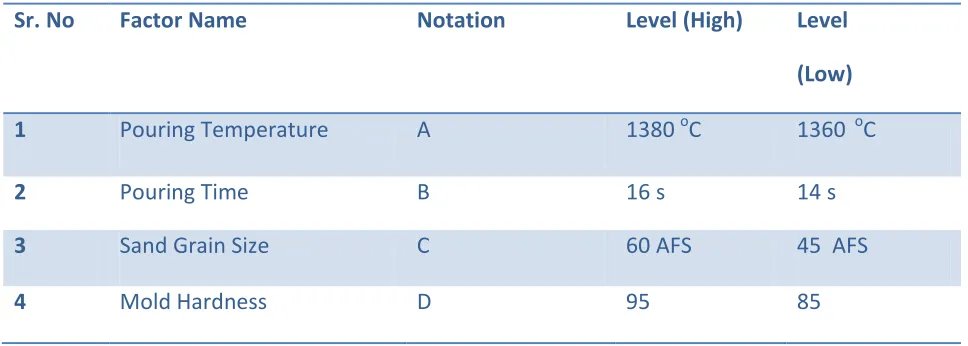
Process parameters of green sand casting that influences the identified defects in casting Diverter Wheel with their levels are shown in table 1.1 Out of four selected process parameters, all parameter is at two levels. Therefore, L orthogonal array is selected for the experimentation. Two parameters interactions such as A*B and A*C was considered. The response variable was the % rejection of casting due to defects which is ratio of rejection due to considered process parameters to the quantity poured. As per L8 orthogonal array 8 experiments were performed randomly. Each experiment was performed thrice and average % of rejection in each experiment was considered as the response variable. Methodology used to achieve optimized process parameters using DoE is as given below:
Table 1 Optimization Factor
Sr. No Factor Name Notation Level (High) Level
(Low)
1 Pouring Temperature A 1380 oC 1360 oC
2 Pouring Time B 16 s 14 s
3 Sand Grain Size C 60 AFS 45 AFS
Available Online at www.ijpret.com 27
IV. Taguchi Design for Optimizing the Factor like Sand Grain Size, Mold Hardness, Pouring Temperature & Pouring Rate
Taguchi Orthogonal Array Design
L8 (2**4) Factors: 4 Runs: 8
Columns of L8 (2**7)
Table 2 Orthogonal Arrays L8
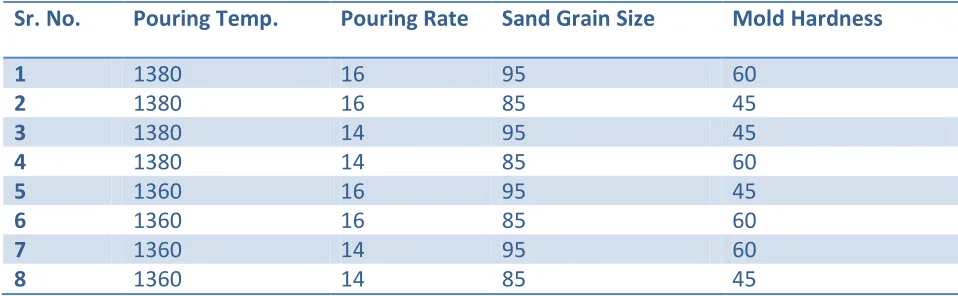
Table 3 Experimental Arrays L8
Sr. No. Pouring Temp. Pouring Rate Sand Grain Size Mold Hardness
1 1 1 1 1
2 1 1 2 2
3 1 2 1 2
4 1 2 2 1
5 2 1 1 2
6 2 1 2 1
7 2 2 1 1
8 2 2 2 2
Sr. No. Pouring Temp. Pouring Rate Sand Grain Size Mold Hardness
1 1380 16 95 60
2 1380 16 85 45
3 1380 14 95 45
4 1380 14 85 60
5 1360 16 95 45
6 1360 16 85 60
7 1360 14 95 60
Available Online at www.ijpret.com 28
Table 4 Experimental Trials Results and S/N Ratio
Average Trials 19.29
Standard Deviations 23.16
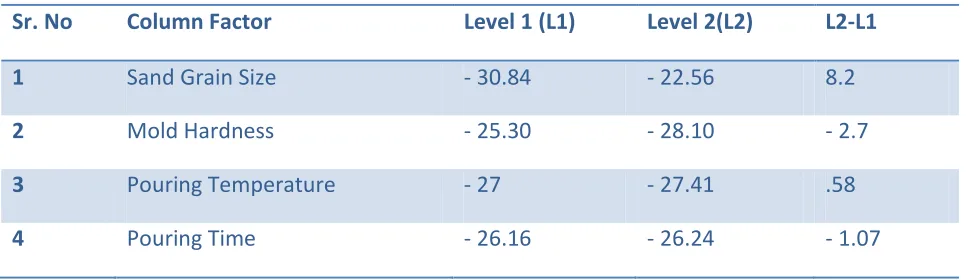
Table 5 Average effects of factor and interaction
Sr. No Column Factor Level 1 (L1) Level 2(L2) L2-L1
1 Sand Grain Size - 30.84 - 22.56 8.2
2 Mold Hardness - 25.30 - 28.10 - 2.7
3 Pouring Temperature - 27 - 27.41 .58
4 Pouring Time - 26.16 - 26.24 - 1.07
Sr. No. Trial 1 Trial 2 Trial 3
1 10 20 40
2 60 10 10
3 10 20 100
4 10 20 40
5 13 10 0
6 10 20 0
7 20 0 0
Available Online at www.ijpret.com 29
2 1
1
0
-1
-2
2 1
2 1
1
0
-1
-2
2 1
Pouring Tempreture
M
e
a
n
o
f
S
N
r
a
ti
o
s
Pouring Rate
Sand Grain Size Mold Hardness
Main Effects Plot for SN ratios
Data Means
Signal-to-noise: Nominal is best (10*Log10(Ybar**2/s**2))
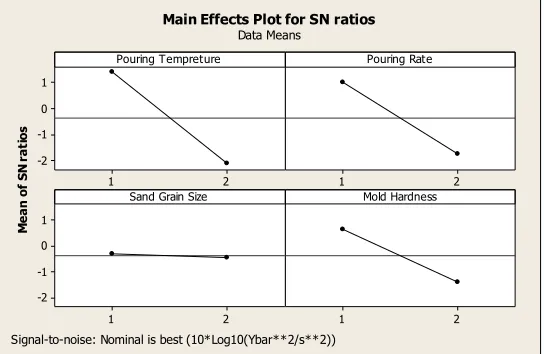
Fig. 1 Main Effects Plot for SN ratios
Table 6 No. of Interaction between two factors calculated = 6.
Available Online at www.ijpret.com 30
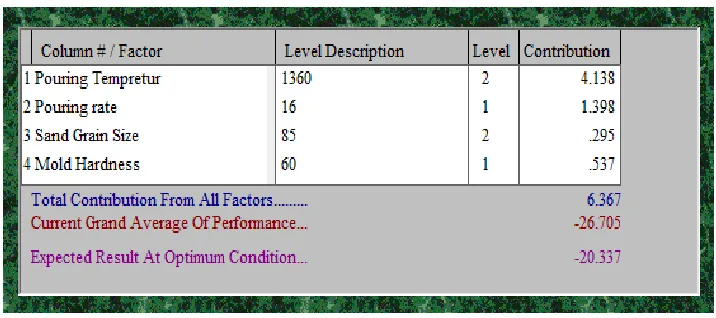
Table 8 ANOVAs Result Optimal condition and performance factor (S/N) Ratio
RESULT
By conducting the Taguchi analysis it is found that required parameter for reducing the percentage defects are 2 1 2 1 that is Pouring Temperature is 1360, Pouring Rate is 16, sand Grain Hardness is 85 and Mold Hardness is 60
CONCLUSION
Design of experiments method such as Taguchi method can be efficiently applied for deciding the optimum settings of process parameters to have minimum rejection due to defects for a new casting minimum rejection due to defects for a new casting as well as for analysis of defects in existing casting. With Taguchi optimization method the % rejection of castings due to blowholes short pouring and pinhole related defects is reduced from 10 % to a maximum up to 3.59 %.
REFERENCES
1. Leeladhar Nagdeve, Vedansh Chaturvedi, Jyoti Vimal Parametric Optimization Of Abrasive Water Jet Machining Using Taguchi Methodology Volume 2, Issue 6 (June 2012) Issn: 2249-3905
2. A. Pavan Kumar, B. Jyothu Naik, Ch. Venkata Rao, Sadineni Rama Rao Optimization Of Casting Parameters For Casting Of Al/Rha/Rm Hybrid Composites Using Taguchi Method
3. Dr. Osama S. Muhammed, Haitham R. Saleh, Hussam L. Alwan Using Of Taguchi Method To
Available Online at www.ijpret.com 31
4. Rasik A Upadhye Optimization Of Sand Casting Process Parameter Using Taguchi Method In Foundry International Journal Of Engineering Research & Technology (Ijert) Vol. 1 Issue 7, September - 2012 ISSN: 2278-0181
5. Sachin B. Petle, Prof. Dr. Anoop Shirbhate Casting Defect Analysis In Diverter Wheel And Preventive For Quality Improvement Of Casting-Review Vol. 3 - Issue 1 (January - 2014) E-Issn: 2278-0181
6. Prof B.R. Jadhav, Santosh J Jadhav Investigation And Analysis Of Cold Shut Casting Defect And Defect Reduction By Using 7 Quality Control Tools Jadhav, Et Al, International Journal Of Advanced Engineering Research And Studies E-Issn2249–8974
7. Achamyeleh A. Kassie, Samuel B. Assfaw Minimization of Casting Defects Iosr Journal of Engineering (Iosrjen) E-Issn: 2250-3021, P-Issn: 2278-8719 Vol. 3, Issue 5 (May. 2013), ||V1 || Pp 31-38