BASIC EDUCATION ASSISTANCE FOR MINDANAO
FIRST YEAR SCIENCE
MATTER AND ITS PROPERTIES
MODULE I — DOES IT MATTER?
COPYRIGHT NOTICE
Section 9 of the Presidential Decree No. 49 provides: “No copyright shall subsist in
any work of the Government of the Philippines. However, prior approval of the
government agency or office within the work is created shall be necessary for
exploitation of such work for profit.” This material has been developed within the
Basic Education Assistance for Mindanao (BEAM) project. Prior approval must be
given by the author(s) or the BEAM Project Management Unit and the source must
be clearly acknowledged.
FIRST YEAR SCENCE: MATTER AND ITS PROPERTIES MODULE 1 — DOES IT MATTER?
Mind Map
The Mind Map displays the organization and relationship between the concepts and activities in this Learning Guide in a visual form. It is included to provide visual clues on the structure of the guide and to provide an opportunity for you, the teacher, to reorganize the guide to suit your particular context.
Scientists may seem quiet, but they are explorers and adventurers. Sometimes, they explore the farthest parts of the universe. Other times, they discover strange new life forms here on Earth. Sometimes they look at what is right in front of us.
Matter is the stuff that makes up everything around you and the whole universe. You are made of matter, the air around you is made of matter, and the Earth beneath your feet is made of matter.
1. Activating Prior Learning
This stage aims to engage or focus the learners by asking them to call to mind what they know about the topic and connect it with their past learning. Activities could involve making personal connections.
Background or purpose
Students have general knowledge about matter.
Strategy
Jigsaw Puzzle — a strategy that requires the assembly of numerous small pieces. In this lesson, each piece has a small part of a letter on it; when complete, the jigsaw puzzle produces 1 complete letter.
Graffiti Wall — an activity that encourages groups to think of ideas related to a posted word. These ideas will be recorded on spaces provided.
Activity
A. Ask each group of students to arrange the pieces of a jigsaw puzzle to form a letter and request them to post their output on the board. All outputs arranged should read M-A-T-T-E-R.
FIRST YEAR SCENCE: MATTER AND ITS PROPERTIES MODULE 1 — DOES IT MATTER?
Roundup
Summarize ideas presented and appreciate their responses.
2. Setting the Context
This stage introduces the students to what will happen in the lessons. The teacher sets the objectives/expectations for the learning experience and an overview how the learning experience will fit into the larger scheme.
Strategy: Song (“Properties of Matter”)
Song is a very good tool to motivate the students' learning process and it also works as a break from the routine. It makes the students more sensitive to the sounds and the lesson becomes more interesting and powerful. (http://www.truenet.com.br/marcos/how_to_use_songs.htm)
Activity
Let students recall the nursery rhyme “Oh, dear what can the matter be?” Using this tune let them sing the song “matter.”
MATTER
Oh, dear, what can this matter be? Oh, dear, what can this matter be? Oh, dear, what can this matter be? Plasma, solid, liquid or gas?
Ask them to identify the focused concept of the song and request them to write their responses on the board.
Inform them that plasma is another state of matter. Plasmas are a lot like gases, but the atoms are different because they are made up of free electrons and ions of the element. You may enhance this discussion using Teacher's Resource Sheet 3, Plasma Basics, page 11. Emphasize that the objective of the topic is to distinguish solids, liquids and gases based on observable properties.
Formative Assessment
Class participation checklist Reflection journalRoundup
Students recognize that matter exists in four states-- solid, liquid, gas, and plasma. Plasma examples are interstellar gases and stars. They consist of free moving ions and electrons.
3. Learning Activity Sequence
FIRST YEAR SCENCE: MATTER AND ITS PROPERTIES MODULE 1 — DOES IT MATTER?
places in the classroom where groups of students go from one station to another in a round robin manner and do the task indicated in each learning station.
Activity
(Refer to Teacher Resource Sheet 1, Page 7)
Divide the class into groups. Set up 3 learning stations in strategic locations around the room (you may adjust the number of learning stations to the number of students). Each group will rotate in these stations bringing with them a Table (refer to attachment 1) to record their observations. (3 minutes/station)
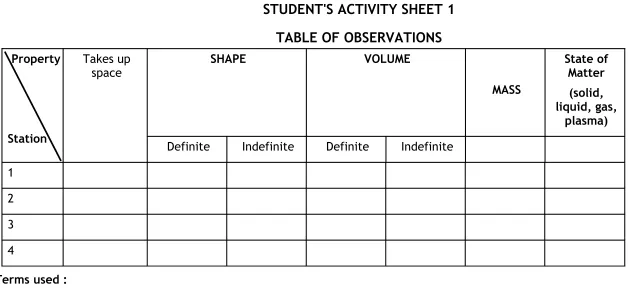
Guide students to read and follow instructions in each learning station and ask them to record observations in the table shown in Student Activity Sheet 1, page 14. If the description of the material fits the object/s observed, request them to draw a happy face on the appropriate box, if it does not, let them leave the space open.
Process their output by soliciting ideas from each group’s reporter.
Formative Assessment
• Group participation checklist
• Reflection Journal
Roundup
Solids, liquids, and gases have observable characteristics. Two of those characteristics, shape and volume, may be used to distinguish among the four states of matter.
4. Check for Understanding of the topic or skill
This stage is for teachers to find out how much students have understood before they apply it to other learning experiences.
Background or purpose
Students’ observation of the characteristics of solid, liquid and gas will help them identify their similarities and differences.
Strategy- CLASSIFICATION KEY
Classifying is a systematic procedure used to impose order on collections of objects or ideas. Making a key to illustrate flow of ideas and descriptions would make classification easy.
Activity
(Refer to Teacher Resource Sheet 3, page 12 and Student Activity Sheet 2, page 15)
A. From the observations gathered in the activity let the students make a classification key. This will be done by asking them to fill in the spaces provided with concepts they learned. B. Following the flow of concepts, get them to describe each state using the specific terms
used in the classification key.
Formative Assessment
• Checking student responses
• Reflection journal
Roundup
FIRST YEAR SCENCE: MATTER AND ITS PROPERTIES MODULE 1 — DOES IT MATTER?
5. Practice and Application/Closure
In this stage, students consolidate their learning through independent or guided practice and transfer their learning to new or different situations. This also brings the series of lessons to a formal conclusion. Teachers may refocus the objectives and summarize the learning gained. Teachers can also foreshadow the next set of learning experiences and make the relevant links.
Background or purpose
Students are aware of the similarities and differences among the states of matter which will prepare them to cite the uniqueness of each state in a song.
Strategy: Fill-and-sing
Songs are an essential part of teaching. Songs also help in teaching English because they incorporate all the language skills:
(1) Listening (to the song) — Following the song to become familiar with the words and tune. (2) Reading (following the lyrics to determine the words)
(3) Writing (filling in the blanks) — writing the lyrics (4) Speaking (singing the song)
(http://www.truenet.com.br/marcos/how_to_use_songs.htm)
Activity
Guide the students in completing the song in Student Activity Sheet 3, page 16, “Solid, Liquid, Gas” and let them sing it. Answers are provided in Teacher Resource Sheet 4, page 13. Let students cite specific examples/situations about how the four states of matter affect each other (e.g. Man (basically solid) cannot live without drinking water (liquid) and inhaling oxygen (gas).
Formative Assessment
• Check student responses
• Reflection Journal
Roundup
Students generalize that matter exists in four states which have different observable characteristics such as shape and volume.
Lead them to appreciate the usefulness/relevance of matter in their life in whatever state it may exist.
Teacher Evaluation
(To be completed by the teacher using this Teacher’s Guide) The ways I will evaluate the success of my teaching this unit are:
FIRST YEAR SCENCE
MATTER AND ITS PROPERTIES — DOES IT MATTER?
TEACHER RESOURCE SHEET 1
ROTATING LEARNING STATIONS
These are designated places which contain set-up designed to investigate concepts
or perform activities that would allow students to understand a concept. They are
installed in strategic places in the classroom where group of students go from one
station to another in a round robin manner and do the TASK indicated in each
learning station.
Objective:
Observe and record the characteristics (shape, volume, mass) of solid,
liquid, gas, and plasma
Materials (for 3 set-up):
•
5 ziplock bags of various sizes
•
1 Small rectangular box
•
2 Empty plastic bottles of different sizes
•
1 (100ml) graduated cylinder
•
1 balloon pump
•
triple beam balance
General direction:
Divide the class into groups. Set up 3 learning stations in strategic locations around
the room (you may adjust the number of learning stations, with the same set of
setups, to the number of students). Each group will rotate in these stations (3
minutes/station) bringing with them a Table (refer to Student Activity Sheet 1,
page 14) to record their observations.
FIRST YEAR SCENCE
MATTER AND ITS PROPERTIES — DOES IT MATTER?
Station 1:
Materials:
ziplock bag, 1 small rectangular box, 1 ruler
Procedure:
1. Observe the rectangular box on the table. See if it takes up space.
2. Describe its shape (definite or indefinite).
3. Measure and multiply the length, width and height of the rectangular box to
get its volume (cm
3).
4. Put the box in the ziplock bag. Observe if its volume changes.
5. Take the mass (in grams) of the rectangular box.
Station 2:
Materials:
100 ml of colored water in a plastic bottle, 2 ziplock bags of
different sizes
Procedure:
1. Observe the 100 ml of water in the bottle. See if it takes up space.
Describe its shape in the bottle.
2. Completely transfer the content of the bottle to a bigger bag then to a
smaller one.
Notice if the shape was changed as you transfered it into different
containers.
3. Pour the water into its original container.
Observe if the volume (100 ml) was changed after putting it in different
containers.
FIRST YEAR SCENCE
MATTER AND ITS PROPERTIES — DOES IT MATTER?
Station 3:
Materials: 2 ziplock bags of different sizes
Procedure:
1. Scoop air using the larger ziplock bag and seal it. Observe and describe the
shape of the air inside and the space it occupied.
2. Using the smaller ziplock bag, scoop air again and seal it. Observe and
describe the shape of the air inside and the space it occupied.
3. Take the mass (in grams) of air inside the ziplock bag. Do this by subtracting
the mass of the ziplock bag from the mass of the ziplock bag with air.
Station 4:
Directions: Read the information and describe the shape and volume of plasma. Take
note on how it differs from the other states of matter.
Plasma has neither a definite volume nor a definite shape. It is
often seen in ionized gases. It is distinct from a gas because it
possesses unique properties. Free electrical charges (not
bound to atoms or ions) cause plasma to be electrically
FIRST YEAR SCENCE
MATTER AND ITS PROPERTIES — DOES IT MATTER?
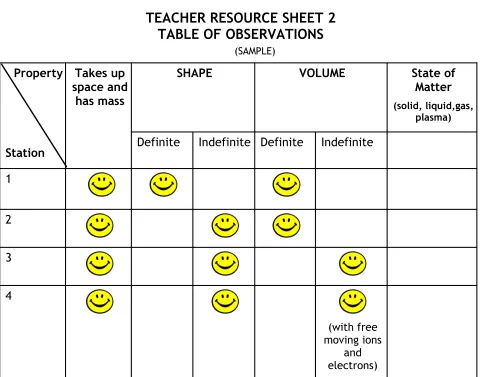
[image:10.595.57.540.123.500.2]TEACHER RESOURCE SHEET 2
TABLE OF OBSERVATIONS
(SAMPLE)
Property
Station
Takes up
space and
has mass
SHAPE
VOLUME
State of
Matter
(solid, liquid,gas, plasma)
Definite
Indefinite Definite
Indefinite
1
2
3
4
(with free moving ions
FIRST YEAR SCENCE
MATTER AND ITS PROPERTIES — DOES IT MATTER?
TEACHER'S RESOURCE SHEET 3
Plasm a Basic s
Plasmas are a lot like gases, but the atoms are different because they are made up of free electrons and ions of the element. Plasma has neither a definite volume nor a definite shape. You don't find plasmas too often when you walk around. They aren't things that happen regularly on Earth. If you have ever heard of the Northern Lights or ball lightning, you might know that those are types of plasmas. It takes a very special environment to keep plasmas going. They are different and unique from the other states of matter.
Finding A Plasma
You won't find plasmas just anywhere. However, there may be some in front of you. Think about a fluorescent light bulb. They are not like regular light bulbs. Inside the long tube is a gas. Electricity flows through the tube when the light is turned on. The electricity acts as that special energy and charges up the gas. This charging and exciting of the atoms creates glowing plasma inside the bulb.
Another example of plasma is a neon sign. Just like a fluorescent light, neon signs are glass tubes filled with gas. When the light is turned on, the electricity flows through the tube. The electricity charges the gas, possibly neon, and creates plasma inside of the tube. The plasma glows a special color depending on what kind of gas is inside.
You also see plasma when you look at stars. Stars are big balls of gases at really high temperatures. The high temperatures charge up the atoms and create plasma. Stars are another good example of how the temperature of plasmas can be very different. Fluorescent lights are cold compared to really hot stars. They are still both forms of plasma, even with different physical characteristics. http://www . chem4kids.com/files/ matter_plasma.html
FIRST YEAR SCENCE
MATTER AND ITS PROPERTIES — DOES IT MATTER?
TEACHER'S RESOURCE SHEET 4
STATES OF MATTER CLASSIFICATION KEY
GUIDE:
Descriptions
1. Description common to solid, liquid, gas and plasma
2. Description common to solid and liquid
3. Description that only applies to gas and plasma
4. Description that applies to solid only
5. Description that applies to liquid, gas and plasma
States of Matter
6. State of Matter as described by 1, 2 and 4.
7. State of Matter as described by 1, 2 and 5.
8. and 9. States of Matter as described by 1, 3 and 5.
1. OCCUPIES SPACE
AND HAS MASS
2. DEFINITE VOLUME
4. DEFINITE SHAPE
5. INDEFINITE SHAPE
8. GAS
9. PLASMA
3. INDEFINITE
VOLUME
7. LIQUID
FIRST YEAR SCENCE
MATTER AND ITS PROPERTIES — DOES IT MATTER?
TEACHER'S RESOURCE SHEET 5
FILL AND SING ACTIVITY
Solid, Liquid, Gas, Plasma
(Tune: Oh Dear What Can the Matter Be?)
Chorus:
Oh, dear, what can this matter? (3x)
Plasma, solid, liquid or gas
I
This solid has shape, can be cut and has particles
Rice, candies, veggies and fruits
Dress, shoes, and all you can hold
Plasma, solid, liquid or gas?
II
Liquid takes space of any container
A cup, a cylinder or maybe a bottle
Water we drink that will make us all better
Plasma, solid, liquid or gas?
III
LEARNING GUIDE
(INSERT YEAR LEVEL, SUBJECT, UNIT AND MODULE NAME)
[image:14.842.62.690.111.403.2]STUDENT'S ACTIVITY SHEET 1
TABLE OF OBSERVATIONS
Property
Station
Takes up
space
SHAPE
VOLUME
MASS
State of
Matter
(solid,
liquid, gas,
plasma)
Definite
Indefinite
Definite
Indefinite
1
2
3
4
Terms used :
Definite
: — Clearly defined (http://www.answers.com/topic/definite)
FIRST YEAR SCENCE
MATTER AND ITS PROPERTIES — DOES IT MATTER?
STUDENT'S ACTIVITY SHEET 2
STATES OF MATTER CLASSIFICATION KEY
GUIDE:
Descriptions
1. Description common to solid, liquid, gas and plasma
2. Description common to solid and liquid
3. Description that only applies to gas and plasma
4. Description that applies to solid only
5. Description that applies to liquid, gas and plasma
States of Matter
6. State of Matter as described by 1, 2 and 4.
7. State of Matter as described by 1, 2 and 5.
8. and 9. States of Matter as described by 1, 3 and 5.
1. OCCUPIES SPACE
AND HAS MASS
2. DEFINITE VOLUME
4. DEFINITE SHAPE
5. INDEFINITE SHAPE
8. GAS
9. PLASMA
3. INDEFINITE
VOLUME
7. LIQUID
6. SOLID
6.
7.
8.
9.
4.
5.
2.
3.
FIRST YEAR SCENCE
MATTER AND ITS PROPERTIES — DOES IT MATTER?
STUDENT'S ACTIVITY SHEET 3
FILL AND SING ACTIVITY
Solid, Liquid, Gas, Plasma
(Tune: Oh Dear What Can the Matter Be?)
Chorus:
Oh, dear, what can this matter? (3x)
Plasma, solid, liquid or gas
I
This _______ has shape, can be cut and has particles
Rice, candies, veggies and fruits
Dress, shoes, and all you can hold
Plasma, solid, liquid or gas?
II
_______ takes space of any container
A cup, a cylinder or maybe a bottle
Water we drink that will make us all better
Plasma, solid, liquid or gas?
III
FIRST YEAR SCENCE
MATTER AND ITS PROPERTIES — DOES IT MATTER?
ASSESSMENT TOOL
RUBRIC FOR WORKING SKILLS
CRITERIA 4 3 2 1
Focus on task Consistently stays focused on the task and what needs to be done. Very self-directed
Focuses on the task and what needs to be done most of the time.
Focuses on the task and what needs to be done some of the time.
Rarely focuses on the task and what needs to be done.
Working with
others Almost always listens to, shares with, and supports the efforts of others. Tries to keep people working well together.
Usually listens to, shares, with, and supports the efforts of others. Does not cause "waves" in the group.
Often listens to, shares with, and supports the efforts of others, but sometimes is not a good team member.
FIRST YEAR SCENCE
MATTER AND ITS PROPERTIES — DOES IT MATTER?
CLASS PARTICIPATION CHECKLIST
Directions: Check the box that corresponds to the observed behavior of the student. This
tool will be used in the entire duration of the class.
Name of students Attention to task
Ability to follow directions
Listens to others ideas
Alertness in responding
Does not disrupt the class
1.
2.
3.
4.
5.
6.
7.
8.
9.
10.
11
12
13
14
15
16
17
18
FIRST YEAR SCENCE
MATTER AND ITS PROPERTIES — DOES IT MATTER?
REFLECTION JOURNAL
Direction:
Please fill in the dialog boxes with the information needed based on the learning
activity you have just experienced.
Where can I use this?
What did I learn today?
What things are unclear to me?
FIRST YEAR SCENCE
MATTER AND ITS PROPERTIES — DOES IT MATTER?
REFLECTION JOURNAL
Learning occurs when we take in information, think about it and make sense of it.
Learning also requires that we can see how to apply new information and where to
apply it. Writing about what we did and what we have learned will teach us to
become more thoughtful, reflective and analytic.
Directions:
Please fill in the columns with the information needed based on the learning
activity you have just experienced.
Thing/s I learned in this
topic
When / where
can I use this? Concepts that I did not understand well
How I felt while doing the following activities?
How I felt after completing the
tasks?
In singing the song:
In doing individual tasks:
In doing group activity: