PhD Dissertation
International Doctorate School in Information and Communication Technologies
DISI - University of Trento
On Neighbors, Groups and Application Invariants in
Mobile Wireless Sensor Networks
S
¸tefan Gun˘
a
Advisor:
Prof. Gian Pietro Picco
Universit`a degli Studi di Trento
To my family
This thesis, prepared under the supervision of Prof. Gian Pietro Picco, was re-viewed by:
Prof. Christine Julien University of Texas at Austin, USA
Prof. Kay R¨omer University of L¨ubeck, Germany
Abstract
The miniaturization and energy-efficient operation of wireless sensor networks (WSNs) provides unprecedented opportunities for monitoring mobile entities. The motivation for this thesis is drawn from real-world applications including monitoring wildlife, assisted living, and logistics. Nevertheless, mobility unveils a series of problems that do not arise in fixed scenarios. Through applications, we distill three of those, as follows.
Neighbor discovery, or knowing the identity of surrounding nodes, is the precondition for any communication between nodes. As compared to other existing solutions, we pro-vide a framework that approaches the problem from the perspectives of latency (the time required to detect an amount of contacts), lifetime (the time nodes are expected to last) and probability (the fraction of contacts guaranteed to be detected within a given latency). By formalizing neighbor discovery as an optimization problem, we obtain a significant im-provement w.r.t. the state-of-art. We offer a solver providing the optimal configuration and an implementation for popular WSN devices.
Group membership, or knowing the identity of the transitively connected nodes, can be either the direct answer to a requirement (e.g., caring for people that are not self-sufficient), or a building-block for higher-level abstractions. Earlier works on the same problem target either less constrained devices such as PDAs or laptops or, when targeting WSN devices, provide only post-deployment information on the group. Instead, we provide three protocols that cover the solution space. All our protocols empower each node with a run-time global view of the group composition.
Finally, we focus on the behavior of the processes monitored by WSNs. We present a system that validates whetherglobal invariants describing the safe behavior of a monitored system are satisfied. Although similar problems have been tackled before, the invariants we target are more complex and our system evaluates them in the network, at run-time. We focus on invariants that are expressed as first-order logic formulas over the state of multiple nodes. The requirement for monitoring invariants arises in both fixed and mobile environments; we design and implement an efficient solution for each. Noteworthy is that the solution targeting mobility bestows each node with an eventually consistent view on the satisfaction of the monitored invariants; in this context, the group membership algorithms play the role of global failure detectors.
Keywords
Acknowledgments
I owe a great debt of gratitude to many people that have mentored me, collaborated with me, supported me, and shared their friendship throughout all the time I took to develop this work. In front of all, I would like to thank my advisor, Gian Pietro Picco, who has shown me what thorough research is and constantly pushed me to go beyond my limits. Perhaps the two most important lessons that I learned from him is the importance of argumentation and standing for my ideas.
I am also grateful to Christine Julien, Kay R¨omer, and Kamin Whitehouse who took the time to review my work and serve on my defense committee.
I would also like to thank everybody that had a direct contribution to this thesis: Amy L. Murphy (for a joint work that resulted in Chapter 4), Marco Cattani (for the results in Chapter 5), Luca Mottola (for the system in Chapter 6), Gianalberto Chini and especially Davide Molteni who provided tremendous help in the collection of valuable data required to support my work. I am double thankful to Amy, who also provided priceless advices towards the ending of my PhD studies. I would like to extend my gratitude to Daniel Petriceanu who provided insightful feedback on the analytical model in Chapter 4.
Outside of the thesis, I have enjoyed the work with Matteo Ceriotti and Daniele Fachin on the TeenyLimemiddleware, on which they built upon in their efforts in the tower [17] and tunnel [16]. I also owe a lot to Giuliano Mega for the stimulating discussions in front of the coffee machines that helped me keep a broader perspective on computer science.
Most importantly, some of these people have become my friends; I cannot be thankful enough for the quality time spent outside work with Adam, Amy, Chin8, Davide, Giuliano, G.P., Lele, Marco, Matteo, Meritxell, Pierre, Ramona, and Silvia. I also owe a lot to my friends back home, especially Alexandra and Ana, who kept me going on a straight line. Although they have contributed only indirectly to this work, I owe the deepest grati-tude to my parents and to Bogdan, to which I dedicate this thesis and who have always pushed me to pursue my dreams. Their encouragements, advices and support have played a key role in the completion of my studies.
Saving the best for last, I wish to thank Anamaria. Her kindness and endurance had helped me understand the true goals of my life.
Thank you all!
Mult
,
umiri
Sunt profund ˆındatorat tuturor celor de la care am ˆınv˘at,at, cu care am colaborat, m-au ajutat s,i mi-au fost prieteni ˆın timpul ˆın care am realizat aceast˘a lucrare. ˆInaintea oricui altcuiva, vreau s˘a-i mult,umesc ˆındrum˘atorului meu, Gian Pietro Picco, cel care m-a ˆınv˘at,at ce ˆınseamn˘a cercetarea riguroas˘a s,i care m-a ˆındemnat ˆın mod constant s˘a-mi dep˘as,esc limitele. Probabil c˘a cele mai importante dou˘a lect,ii pe care le-am ˆınv˘at,at de la el sunt nevoia de a argumenta s,i de a sust,ine ideile.
Sunt ˆındatorat s,i celor care mi-au revizuit teza s,i au f˘acut parte din comitetul meu de evaluare, Christine Julien, Kay R¨omer s,i Kamin Whitehouse.
Deasemenea, doresc s˘a le mult,umesc s,i celor care au avut o contribut,ie direct˘a la aceasta tez˘a: Amy L. Murphy (pentru rezultatele din Capitolul 4), Marco Cattani (pentru rezultatele din Capitolul 5), Luca Mottola (pentru sistemul din Capitolul 6), Gianalberto Chini s,i ˆın mod special Davide Molteni care mi-au oferit un imens sprijin ˆın colectarea datelor necesare valid˘arii muncii mele. Sunt dublu ˆındatorat fat,˘a de Amy, care mi-a sfaturi de nepret,uit ˆınspre finalul studiilor mele. As, vrea s˘a-i mult,umesc s,i lui Daniel Petriceanu, cel care mi-a oferit sprijin ˆın dezvoltarea modelului din Capitolul 4.
Pe lˆang˘a tez˘a, m-am bucurat s˘a lucrez ˆımpreun˘a cu Matteo Ceriotti s,i Daniele Fachin la middleware-ul TeenyLime, pe care l-au folosit ˆın eforturile lor din turn [17] s,i tunel [16]. ˆIi datorez mult,umiri s,i lui Giuliano Mega, ˆın special pentru discut,iile din fat,a automatelor de cafea care m-au ajutat s˘a ˆımi ment,in o perspectiv˘a larg˘a asupra s,tiint,ei calculatoarelor.
Probabil c˘a cel mai important lucru este faptul c˘a o parte din aceste persoane mi-au devenit prieteni; nu le pot mult,umi suficient pentru momentele petrecute ˆımpreun˘a ˆın afara muncii lui Adam, Amy, Chin8, Davide, Giuliano, G.P., Lele, Marco, Matteo, Meritxell, Pierre, Ramonei s,i Silviei. Sunt ˆındatorat s,i prietenilor de acasa, ˆın special Alexandrei s,i Anei, care m-au ajutat s˘a merg pe o linie dreapt˘a.
Des,i au contribuit numai ˆın mod indirect la aceast˘a tez˘a, le datorez cea mai mare recunos,tiint,˘a p˘arint,ilor mei s,i lui Bogdan, cei c˘arora le-am dedicat aceasta tez˘a s,i cei care m-au ˆındemnat dintotdeauna s˘a-mi urmez visele. ˆIncuraj˘arile, sfaturile s,i ajutorul lor au avut un rol principal ˆın terminarea studiilor mele.
Am p˘astrat ce este mai bun pentru sfˆars,it. ˆIi mult,umesc Anamariei pentru bun˘atatea s,i r˘abdarea pe care mi le-a ar˘atat s,i care m-au ajutat s˘a ˆınt,eleg care sunt obiectivele adev˘arate din viat,˘a.
V˘a mult,umesc!
Contents
1 Introduction 3
1.1 Goals and Motivating Scenarios . . . 3
1.2 Contribution . . . 5
Thesis Outline . . . 7
I Background 9 2 Mobile Wireless Sensor Networks 11 2.1 Why Mobile Wireless Sensor Networks? . . . 11
2.1.1 Mobile WSN Applications . . . 12
2.1.2 Improving the Performance of Static Networks . . . 13
2.2 Networks with Mobile Nodes . . . 14
2.3 Challenges of Mobile Wireless Sensor Networks . . . 16
2.3.1 Networking With Mobile Nodes . . . 17
2.3.2 Application Development . . . 18
2.4 Discussion and Outlook . . . 19
3 Application Scenarios 21 3.1 Assisted Living: The ACubeProject . . . 21
3.1.1 Scenario and Requirements . . . 22
3.1.2 Solution Overview . . . 22
3.2 Study of Wildlife Social Behavior . . . 24
3.2.1 Scenario and Requirements . . . 24
3.2.2 Solution Overview . . . 25
3.3 Supporting Business Processes . . . 27
3.4 Discussion and Outlook . . . 29
II Technical Contribution 31 4 RUTh: Neighbor Discovery Made To Measure 33 4.1 Introduction . . . 33
4.2 Related Work . . . 36
4.4 Latency-driven Discovery . . . 42
4.4.1 Deterministic Discovery . . . 42
4.4.2 Probabilistic Discovery . . . 43
4.5 Lifetime-driven Discovery . . . 45
4.6 Implementation . . . 46
4.7 Evaluation . . . 48
4.7.1 Analytical Study . . . 49
4.7.2 Impact of Model Assumptions . . . 53
4.7.3 Empirical Evaluation . . . 54
4.7.4 RUTh as a Social Contact Sensor . . . 56
4.7.5 RUTh as a Proximity Sensor: Lessons Learned From A Dense Deployment . . . 58
4.8 RUTh in Action: The Assisted Living Application . . . 63
4.8.1 RUTh and Data Collection . . . 64
4.8.2 Results . . . 65
4.9 Discussion and Outlook . . . 67
5 The Group Membership Problem 69 5.1 Introduction . . . 69
5.2 Related Work . . . 71
5.3 Using Logical Clocks . . . 72
5.4 Using Link State Information . . . 73
5.5 Using Distance Vectors . . . 74
5.6 Evaluation . . . 76
5.6.1 Synthetic Mobility Patterns . . . 77
5.6.2 Real-world GPS Traces . . . 82
5.7 Applying RUTh to Group Membership . . . 82
5.8 Discussion and Outlook . . . 83
6 Distributed Monitoring of Application Invariants 85 6.1 Introduction . . . 85
6.2 Specifying Invariants . . . 87
6.3 Monitoring Invariants: Local View . . . 88
6.3.1 Type I Invariants . . . 89
6.3.2 Type II Invariants . . . 90
6.4 Local View Dissemination: Protocols . . . 91
6.4.1 Run-time architecture . . . 91
6.4.2 Flat . . . 93
6.4.3 Tree . . . 94
6.4.4 Communication Delays . . . 96
6.5 Implementation . . . 98
6.6 Evaluation . . . 99
6.6.1 Simulation Experiments . . . 100
6.6.2 Testbed Experiments . . . 108
6.7.1 Slowly Mobile Scenarios . . . 110
6.7.2 Using Group Monitoring in Dynamic Scenarios . . . 111
6.7.3 Choosing a Solution . . . 114
6.7.4 Mobile DICE in Action . . . 117
6.8 Related Work . . . 120
6.9 Discussion and Outlook . . . 120
III Conclusions 123
7 Conclusions and Outlook 125
IV Addendum 129
Bibliography 131
A The Discovery Probability in RUTh 141
List of Tables
4.1 Summary of notation. . . 40
4.2 Electrical characteristics. . . 49
5.1 Protocol parameters. . . 77
6.1 Code memory usage of DICE components. . . 99
List of Figures
1.1 Overview of this thesis. . . 5
2.1 Examples of network topologies with mobile nodes. . . 15
2.2 Networking flow in mobile WSNs. . . 17
3.1 ACube network topology. . . 22
3.2 The mobile node in ACube. . . 22
3.3 ACube software architecture. . . 23
3.4 Nodes used in the wildlife project. . . 25
3.5 Wildlife network topology. . . 25
3.6 Software architecture for monitoring of wildlife. . . 26
3.7 Supply-chain scenario. . . 28
4.1 RUTh tool chain. . . 35
4.2 Low Power Listening. . . 36
4.3 Neighbor discovery protocols. . . 37
4.4 A receive check in LPL (and RUTh). . . 38
4.5 A sample execution of RUTh. . . 39
4.6 Deterministic discovery in RUTh. . . 41
4.7 Latency-driven deterministic discovery. . . 42
4.8 Latency-driven probabilistic discovery. . . 44
4.9 Schedule for a 6-discovery chain. . . 45
4.10 Lifetime-driven discovery. . . 46
4.11 TheRUTh control interface. . . 47
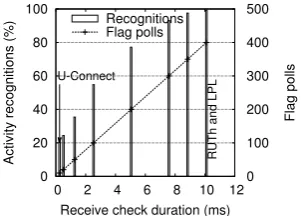
4.12 Current profile of ab = 20 msRUTh beacon. . . 47
4.13 Reliability of channel activity recognition vs. receive check duration. . . 48
4.14 Deterministic behavior: sample protocol configurationshτ(ms), s, T(s)iare shown for τmin = 20 ms. . . 50
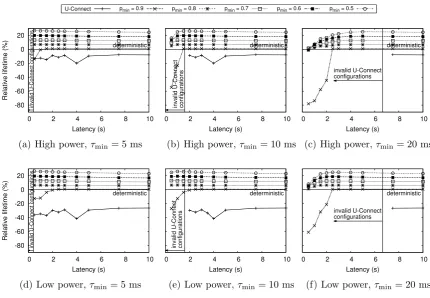
4.15 Latency-driven: relative expected lifetime for U-Connect and variousRUTh configurations. . . 51
4.16 Lifetime-driven: relative discovery latencies for U-Connect and various RUTh configurations. . . 52
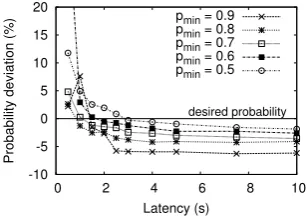
4.17 Discovery probability for τmin = 20 ms, high power. The configuration output hτ, s, Ti is shown for each curve. . . 53
4.19 Neighbor discovery time for T = 1 s,s =T/2b. . . . . 56
4.20 Building and node movement sketch . . . 56
4.21 Total duration of contacts for each node. . . 56
4.22 Timeline showing the contacts for each node in the experiment. Contacts recorded by volunteers are on the horizontal lines called “report”, while contacts recorded by RUTh are on the lines called “mote”. . . 57
4.23 Testbed and mobile node path. . . 59
4.24 Histogram of the PDR function of the distance sender–receiver for our testbed. Averages over 300 packets / node, each broadcast in a dedicated time slot for each node. . . 59
4.25 Definition of contacts. . . 59
4.26 Contacts among fixed nodes missed when using high power and configura-tions hτ, s, Ti. . . 60
4.27 Contacts among fixed nodes missed when using high power, various desired latencies L=T, and configurations hτ, s, Ti compensating for epoch skew. 61 4.28 Contacts among fixed nodes missed when using high power, a desired la-tency L= 2 s and configurations hτ, s, Ti for probabilistic discovery. . . 61
4.29 Missed contacts between the mobile node and the fixed nodes. . . 62
4.30 Mobile node contacts detected inside the virtual range. . . 63
4.31 Distance from ρ forhτ, s, Ti=h167,5,2i measuring δ in Figure 4.25. . . 63
4.32 Periodic broadcast scheme to ensure delivery inACube. . . 64
4.33 ACube test deployment. . . 65
4.34 Round-trip for mobile-to-fixed. . . 66
4.35 Latency function of path length. . . 66
4.36 Event loss analysis. . . 67
4.37 Network overhead. . . 67
5.1 Operation of Links. . . 73
5.2 Operation of Dist. . . 75
5.3 Dist: finding alternative paths over loops. . . 75
5.4 Our synthetic scenario for group movement. . . 78
5.5 Cumulative energy for churn = 20, corresponding to 2 swaps every 10 m. . 79
5.6 Power consumed as a function of churn. . . 80
5.7 Error and detection latency vs time (b = 10 s). . . 81
5.8 Experiments with the real-world GPS traces in [101]. . . 82
6.1 The architecture of the DICE run-time. . . 91
6.2 Local view processing for a invariant whose signature requires monitoring two network-wide maximum. Value changes are shown in bold. . . 92
6.3 Disseminating local view updates in Flat. . . 93
6.4 Disseminating local view updates in Tree. . . 95
6.5 History buffer: motivation and limitations. . . 97
6.6 The DICE tool chain. . . 98
6.8 Average local view changes per node. . . 101
6.9 Average number of sent packets per node. . . 102
6.10 Communication overhead vs. update rate. . . 102
6.11 Average node detection latency. . . 103
6.12 Detection latency for 225 nodes,k = 2. Values on the x-axis have different scales. . . 103
6.13 Global detection latency. . . 104
6.14 Ratio between average node detection and global detection latency. . . 105
6.15 Nodes detecting violations in Tree. . . 105
6.16 Distributions to assess the impact of history size. . . 105
6.17 Impact of history size in Flat. . . 106
6.18 Detection of fast violation pulses. . . 107
6.19 Load distribution in Tree. . . 108
6.20 Laboratory testbed. . . 108
6.21 Real-world results. . . 109
6.22 Example of node relocation in Flat. . . 111
6.23 Updated DICE architecture integrating Flat and group monitoring. . . . 111
6.24 Scenario depicting the limitations of the group monitoring algorithms. . . . 113
6.25 Impact of node mobility. . . 116
6.26 Deployment of mobile nodes. . . 117
6.27 The behavior of DICE with Clocks on mobile nodes. The results show averages over 10 min steps. Note the double scale on the y axis which highlights the peaks for group changes, packets transmitted, local view and temperature changes. . . 118
6.28 Testbed for controlled node departures. . . 119
6.29 Results of controlled departures experiments. . . 119
A.1 Schedule for a 6-discovery chain. Also shown are the helper intervals Im and Jm. . . 142
B.1 The reference network topology used throughout this section. N0 is the node where the maximum appears. . . 149
Chapter 1
Introduction
Wireless Sensor Networks (WSNs) are a large collection of miniaturized untethered com-puting devices with scarce resources, self-organized and collaborating towards a common goal. These networks have been successfully deployed by scientists in a variety of en-vironments and scenarios, e.g., historic buildings [17], road tunnels [16], vineyards [10], forests [114], volcanoes [123]. Although all previous success stories exploit an infras-tructure with fixed nodes, researches have not neglected node mobility. In fact, recent applications such as medical care [23], shepherding [121] and monitoring of wildlife [33] or moving assets [46] denote the interest of the scientific community in transposing WSNs from fixed to mobile environments.
1.1
Goals and Motivating Scenarios
In the context of the fixed-to-mobile paradigm shift, this thesis addresses issues of WSNs mobility from the perspective of three fundamental problems: 1) knowing all nearby nodes,2)knowing all nodes reachable through multi-hop communication, and3)knowing whether nodes behave according to a set of given specifications. Indeed, we maintain that these are key issues in the design of mobile WSNs. To understand why, we briefly focus on one of our research projects,ACube(acube.fbk.eu), where these problems come to the forefront of application requirements.
Funded by the local authorities of Trento, ACube studies how various technologies (WSN, video cameras, microphones, RFID tags) can be used as a means towards an assisted living platform. The resulting system will be deployed in several day-care centers for Alzheimer’s impaired patients. A serious concern of the staff in these centers is the monitoring of:
1.1. Goals and Motivating Scenarios
operated such that packets are received only at close range, which is not required to be highly accurate. Essentially, we use the radio as a proximity sensor.
Addressing this requirement requires solving the first problem tackled by this thesis, that is, discovering all nearby nodes.
2. patients that leave travel groups during trips outside the care centers. Usually, the trips occur in places where infrastructure is lacking. Therefore, an untethered technology such as WSN is useful to detect wandering patients in a fully autonomous and distributed fashion. However, as monitored patients must not feel they are under constant surveillance, they are allowed to exit the direct supervision range of the person attending the group. Consequently, the area to be covered can potentially be large and thus monitoring of groups must be performed across a multi-hop network.
This requirement maps to the second goal set forth for this thesis, i.e., that of knowing all reachable nodes.
3. patients for which the surrounding environment is not appropriate, such as agitated patients not calmed by music. This provides motivation for a system that monitors application-level invariants, essentially predicates that describe the correct behavior of a monitored process. Arguably, monitoring invariants of a single node is simple. We are rather interested in global invariants , that is, those that are expressed over the combined state of several nodes. For instance, in ACube, such an invariant is “when on-body accelerometers report high activity, the music must be on”. Viola-tions of the previous invariant are detected through the observation of both the state of the accelerometer-enabled nodes and that of nodes monitoring music players.
Notice that this requirement is the essence of our third goal: understanding whether nodes conform to a set of given specifications.
The previous research questions are not necessarily specific to our project, rather they are general problems lying at the core of a wider range of application scenarios. For exam-ple, we are collaborating with biologists that analyze the social behavior of roe deer. Their study relies on animal-to-fixed node contact traces (to infer location), on animal-to-animal contact traces (to study social contact) and on how the composition of herds changes over time (to study group behavior). Albeit detection occurs at greater distances, the first two problems emerge again: the discovery of all nearby nodes and that of all reachable nodes. Similarly, the need to monitor global invariants arises in other scenarios such as logistics. For instance, in the management of cold chains, it is essential to strictly control temperature in an uninterrupted series of storage and distribution activities. Faults in the chain can be identified by checking whether the refrigeration fans of a smart container are activated every time the temperature increases above a threshold. Unlike neighbor dis-covery and group membership, demands for global invariants also appear in applications where nodes are fixed, e.g., in business processes like the management of green buildings. We further expand on these scenarios in Chapter 3.
Chapter 1. Introduction
1.2
Contribution
The solutions to each of the aforementioned problems result in three building blocks that cover all three layers of a mobile WSN software stack, as depicted by Figure 1.1:
1. At the MAC layer, we design aneighbor discovery protocol that identifies all nodes in radio range. This building block provides person-to-hazard proximity detection and animal-to-animal contact traces in ACube, respectively the wildlife social study project.
2. At the routing layer, we design several algorithms that monitor group membership, i.e., that identify a node’s transitively connected component. These protocols will be used in ACubeto detect when patients leave their group and also to monitor herds in our wildlife project.
3. Finally, our contribution at the highest level, the application layer, is a system that monitors whether an observed process executes according to specifications. These are provided in a declarative language as a set of global invariants, or predicates expressed over the state of several nodes, and monitored by an efficient run-time. The system can be used either in a mobile (e.g., ACube, logistics) or in a combined fixed environment (e.g., business processes).
We briefly present each individual contribution next.
RUTh: Neighbor Discovery Made to Measure. Neighbor discovery, or knowing the identity of nodes in communication range, is a fundamental problem in mobile WSNs. Discoverylatency and systemlifetime are two key aspects along which this problem can be formulated. We address both in Chapter 4, showing how an optimal maximum lifetime can be achieved for latency-constrained scenarios and, dually, how latency can be traded off to optimally meet strong lifetime requirements. Moreover, by offering a choice between
deterministicandprobabilistic guarantees on discovery latency, we give developers another knob for optimizing their lifetime- or latency-driven application.
co re mo b ili ty p ro to co ls assisted living (ACube)
study of wildlife social behavior business processes mo b ile W SN a b st ra ct io n s fixe d W SN
motivating scenarios technical contribution
MA C ro u ti n g a p p li c a ti o n so ft w a re l a ye r monitoring of global invariants group membership neighbor discovery p ro to co ls logistics
Figure 1.1: Overview of this thesis.
1.2. Contribution
The Group Membership Problem. In Chapter 5, we design and compare protocols that enable nodes to have constant knowledge of which other nodes are reachable through multi-hop communication. An answer to this problem enables human-, animal- or asset-borne wireless devices to detect the joining or leaving of group members in infrastructure-less scenarios.
In contrast with Chapter 4, where we focus on knowing the neighbors within radio range, here we address the discovery of nodes beyond the physical range. We do so by analyzing three points that together cover the solution space. At one extreme, group mem-bership information is proactively and collectively maintained by each node in the group. At the other extreme, dissemination of membership updates is triggered reactively by re-lying on a lower-level neighbor discovery protocol. In the middle lies a solution borrowing ideas from the two extremes. Group membership is maintained mainly as hard-state, however, nodes periodically broadcast state summaries to detect possible inconsistencies. Different protocols exhibit different performance based on the degree of mobility. In this respect, we simulate artificial scenarios that allow us to assess the impact of mobility and group departures. We validate these through simulation of human GPS traces.
Depending on the application, the group monitoring protocols can either be used as stand-alone solutions, or can be used in conjunction with higher-level abstractions, such as the system introduced next.
Distributed Monitoring of Global Invariants. In Chapter 6, we present DICE (“Dis-tributed Invariant CheckEr”), a system which monitors application-level global invariants in a WSN. A DICE invariant is a predicate that can be expressed as a boolean expres-sion or as a linear inequality quantified over the state of multiple nodes. Invariants are specified in a declarative language. For example, referring to the cold chain scenario de-manding the activation of refrigeration fans when the temperature of packages increases over a threshold, in DICE we specify the invariant denoting the correct behavior as:
invariant {forall m: type@m = FOOD_PACKAGE and temp@m > T}
-> exists n: type@n = FAN and isActive@n}
where temp@m denotes the temperature of a food package m, andT is a constant.
An efficient run-time evaluates whether the monitored invariants are violated or com-plied with. The problem can be solved trivially by gathering all data from all nodes at a designated node where it is processed. However, this is inefficient in terms of communi-cation overhead and detection latency. Therefore, we explore two alternate designs:
• a flat, decentralized solution, suitable for mobile, dynamic networks, such as those providing the core motivation for this thesis. Significant in this approach are the group membership algorithms in Chapter 5: these play the role of failure detectors, deciding whether a mobile node is truly departed or still contributing with state to the monitored invariant.
Chapter 1. Introduction
We implement both solutions and compare their performances using large-scale simu-lations and a real-world testbed. Results indicate that, in both cases, invariant viosimu-lations are detected in a timely and energy-efficient manner. For instance, in a 15×15 grid net-work, violations are detected in less than a second and with only a few packets sent by each node.
Thesis Outline
Part I
Chapter 2
Mobile Wireless Sensor Networks
WSNs are a large collection of battery-operated small devices that perform the following steps: i) take sample measurements of the environment, ii) perform a minimal amount of processing, e.g., aggregation or compression of the sampled measurements,iii) transfer these through multi-hop communication to one or more collection points, andiv)possibly, in the case of sensor and actuator networks, operate a device which closes the control loop. The general assumption is that the network is transitively connected and static. As a consequence, WSN architectures, protocols, programming abstractions and their supporting run-time has been designed to support this view.
The work in this thesis deviates from this traditional view on WSNs in the sense that it addresses networks with mobile nodes. Similar paths have already been taken by other researchers. In this chapter we discuss the general motivation (Section 2.1) of mobile WSNs, we analyze the extent at which mobility appears in WSNs (Section 2.2), and we present the challenges of mobile WSNs (Section 2.3). We defer the analysis of the state-of-art topics specifically related to our contribution to the corresponding chapters.
2.1
Why Mobile Wireless Sensor Networks?
We distinguish in the relevant literature two main motivations for WSNs mobility:
• Application requirements intrinsically demand mobile nodes.
One of the early works in the field [80] rightfully argues that WSN represent a non-intrusive, long-term and cost-efficient monitoring solution. Without the tech-nology, some phenomena would otherwise be impossible to observe. The same type of monitoring is required for moving entities, may it be assets, animals or humans. Therefore, in this case, mobility of nodes becomes a functional requirement of ap-plications. We review such applications in Section 2.1.1.
• Mobility improves the performance of static deployments.
2.1. Why Mobile Wireless Sensor Networks?
2.1.1 Mobile WSN Applications
WSNs offer unprecedented opportunities in the monitoring of mobile entities. In this section, we survey some of the most representative systems using mobile sensors applied on animals, humans and moving assets.
Animal study. One of most prominent application of mobile WSNs is in the field of animal study, e.g., badgers [33], turtles [109], zebras [56, 129], and our wildlife project described in Chapter 3. The most representative of these is in fact one of the early works in the field, that is, the ZebraNet project [56, 129], whose goals were to understand how, why, and when zebras undertake long-term migrations.
Shepherding. Applications of WSNs related to animals are not limited to “sense” only. Sensor and actuator networks have been actively employed in the shepherding of do-mesticated animals. In [121], the authors describe a system where an actuator, i.e., an animal-borne electric shock generator, prevents clashes between bulls in on-farm breeding paddocks. A similar system [11] was used to confine cattle within perimeters defined by virtual boundaries.
Asset sensing. Tracking of goods and freight is important in logistics, but also in day-to-day activities. For instance, in [81], the authors design a platform for monitoring freights. The hardware incorporates shock, sound, breach and environmental sensors and features a novel RF wake-up circuitry for greater energy efficiency. With a focus on indoor scenarios, systems such as [126] allow users to search the location of their everyday-use objects through queries issued in web browsers. In other cases, i.e., [66], the mobility of a sensor can be used in the exploration and charting of unknown structures, i.e, water pipes.
Human-centric and participatory sensing. Ongoing research suggests the utilization of human-borne sensors in assisted living systems like [125] and our project described in Chapter 3, health care [23], understanding of social behavior [67], in sports [35], or as a means to increase responsiveness in emergencies [52, 73, 98, 106]. In this context, human-borne motes provide identification [73], position tracking [62], motion control and posture detection [42, 72, 128] and vital sign monitoring [23]. WSNs may be retrofitted into hospitals [23], applied ad hoc at the place of a disaster [106] or can perform tracking and monitoring of individuals in remote places [35, 52].
An important amount of research has been undertaken on the sensing capabilities of cellular phones and other mobile “gadgets” that have lately became pervasive in our soci-ety. From this aspect, researchers are concerned mainly with i)participatory sensing, or on how resources donated by volunteers can be used to monitor a large scale phenomenon such as earthquakes [36], noise map [99], traffic conditions [88], or transit tracking [113], andii)inferring information about the carrier’s context or activities using sensors available on popular phones, e.g., cameras, microphones, accelerometers, gyroscopes [60, 74, 87]. Although most of these works target significantly more powerful platforms, some of the contributions of this thesis, e.g., neighbor discovery, can be transposed to this environment and serve as building blocks towards more complex functionality.
Chapter 2. Mobile Wireless Sensor Networks
An interesting approach is the usage of WSNs on unmanned aerial vehicles, useful to understand atmospheric events, plumes and pollution [3].
Environmental monitoring using mobile entities have also been studied by other com-puter science areas, such as mobile and vehicular ad-hoc networks. For instance, re-searchers [53] envisaged that sensor on board vehicles can be queried to provide environ-mental and geo-imaging data through a SQL. In general, such networks employ devices that are more powerful and energy hungry, and use dedicated protocols (some surveyed in [105]), albeit some of the challenges are similar to the one faced in mobile WSNs, discussed in Section 2.3.
2.1.2 Improving the Performance of Static Networks
Mobility is also employed to address non-functional requirements and improve the per-formance of static networks. We discuss these possibilities next.
Sensing coverage. Two problems of WSNs are finding a node arrangement which maxi-mizes the number of detected events or, dually, which minimaxi-mizes the number of undetected events. As observed in [38, 43], these are actually two facets of the same problem, i.e., sens-ing coverage. When nodes are mobile, sensors can be relocated to increase the coverage in remote regions of the network on a per need basis. Consequently, a dense deployment is likely to become unnecessary, reducing thus the number of nodes and costs. Possible solutions to the coverage problem are described in [5, 43].
Connectivity and reliability. Similar to sensing coverage is the problem of network connectivity. Due to various causes, e.g., radio interference, node failures or node reposi-tioning, the wireless network may become partitioned.
To mitigate this phenomenon, a greater number of nodes can be deployed to increase redundancy and connectivity to remote areas. However, this solution may be cost inef-fective and potentially lead to other problems. For instance, an increased node density raises the risk of channel contention and collisions. The alternatives provided by mobile nodes are:
• mobile nodes can be repositioned to reconnect the severed nodes. This problem is similar to the one of sensing coverage, and the same solutions may be applied to both, e.g., [43].
• mobile nodes can visit nodes and transfer data using one-hop transmissions. This solution works best for collecting data in batches. Note that the same principle works both ways, that is, mobile nodes can disseminate data to fixed nodes, e.g., they may re-program the network with a newer software version. Mobile nodes collecting data are usually referred to in the literature as “data mules” [54, 58, 112].
In general, however, any adopted relocation scheme must ensure that node movement does not break connectivity.
2.2. Networks with Mobile Nodes
in [119], translates to a peak in the rate of energy consumption on nodes close to the root; in result, the operational lifetime of the network shortens considerably. As suggested in [119], this undesirable result can be diminished by a secondary fixed network with long(er) range data links that bypass the overloaded areas of the WSN.
Alternatively, one or more mobile sinks can be relocated to balance the energy con-sumption and increase the lifetime of the network as a whole. This is different from the previous case, where the goal was to increase sensing coverage and connectivity in certain areas of the network. Interesting analytical frameworks are provided in [4, 40, 75, 120], in which sink relocation is formulated as an optimization problem whose goal is to maximize the network lifetime.
Throughput. In addition to lifetime, it is important to asses the performance of net-works. One metric that can be used is the network’s throughput, an indication of how much information can be transmitted over the unit of time.
Interestingly, it has been shown that, at least theoretically, mobility increases the overall throughput of a network at the expense of the delivery delay. Intuitively, the mixture of node mobility, low power transmissions and multi hop communication reduces interference and allows data from more nodes to travel through the network at the same time. The maximum throughput increases fromO(1/√n), wherenis the number of nodes,
for static networks [47] up to O(1) for mobile networks [45].
Security. In ad hoc networks in general and WSN in particular, establishing a secure route between nodes requires the existence of a key which is used by security protocols [59]. The key may be preset [19], or established at runtime [51]. The former may not offer sufficient flexibility and security, since keys are hardcoded in the memory of motes before deployment. The latter raises a circular dependency: in order to distribute a key in a multi-hop network, secure paths must first be established; however, secure paths cannot be established without first distributing a key. The procedures [51] to break this circular dependency are complex and unsustainable by the constrained hardware in WSNs.
Noteworthy is that, from this aspect, mobility indeed helps. Authors of [117] suggest that a simple solution to the problem of key distribution exists when nodes are mobile: once a node enters the direct communication range of another node, the two nodes can directly establish a security association, i.e., they exchange directly the minimal amount of data required to establish the non-repudiation, integrity and confidentiality of mes-sages exchanged afterwards. The security association can be maintained across multi-hop paths once the node moves, and therefore the dependency between routing and security is limited.
2.2
Networks with Mobile Nodes
The aforementioned applications and techniques are supported by networks in which some or all networks nodes are mobile. In this section, we analyze the impact of mobility on network topology. The first step we take in this direction is to distinguish between the elements of a mobile network. We build on a survey [28] that describes networks as consisting of:
Chapter 2. Mobile Wireless Sensor Networks
sink
regular node
(a) A network with relocatable nodes
mobile sink
(b) A network with mobile sinks.
sink
data mule
(c) A network with data mules.
sink
(d) A network with general mobility.
Figure 2.1: Examples of network topologies with mobile nodes.
• Sinks that consume information produced by regular nodes, i.e., they are the des-tination of the data. Networks usually have a single sink, but sometimes solutions using several sinks can be employed for load balancing and reliability [16].
• Support nodes that do not produce, neither consume data. Rather, they leverage on mobility to play the role of an intermediary data collector on behalf of sinks. Networks may have several or no support nodes at all.
As depicted in Figure 2.1 and also presented in [28], mobility in WSN can appear for any of the previous three types of nodes. We review these next.
Relocatable nodes. In Section 2.1.2 we discussed how mobility can increase the sensing coverage, connectivity and reliability of a network. Figure 2.1(a) depicts a network where one of the regular nodes is relocated to reconnect a part of the network which, due to an earlier failure, has been previously disconnected from the sink. It should be noted that this relocated node does not carry any data, but rather it is used to change the network topology. Similarly, it may be used to increasing the sensing coverage. A survey on the topic of connectivity and coverage can be found in [43].
2.3. Challenges of Mobile Wireless Sensor Networks
In more complex cases, a routing structure must be maintained while the sink is moving. For instance, a deployment like in Figure 2.1(b) featuring mobile sinks can be used to load balance the energy consumption and increase the overall network lifetime. Here, differently from the previous case, regular nodes are fixed and form a collection tree rooted at sink (or the nearest one, if several sinks are being used), e.g., like in [4, 40, 120].
Data mules. An approach for the case when both the sink(s) and sensing nodes are static and disconnected requires the existence of one or more special support nodes that play the role of data mules. Like in Figure 2.1(c), data is collected from sensors by a mule using one-hop communication and delivered to the sink once the two are in communication range. In this scenario, the mule solely plays the role of a data carrier. Therefore, the mule must have a large storage capacity. Such a topology is described in [54].
General mobility. When the monitored entities are mobile, e.g., [129] and our wildlife application (Chapter 3), the network experiences the most general form of mobility, as depicted in Figure 2.1(d). In this case, node mobility cannot be described using a struc-ture. Moreover, a node can be an originator of messages, but also a data mule that relays messages on behalf of other nodes. In these networks, also called delay tolerant networks, a contemporaneous end-to-end path between the message originators and source is not guaranteed; routing of packets occurs opportunistically when two nodes encounter one another, as in [130]. This general form of mobility can result from application require-ments (e.g., monitoring of zebras [129]), but can also be exploited to observe phenomena too large to be covered by a fixed network (e.g., as suggested by [3]).
This characterization of mobile WSNs is the first step in understanding the interactions between mobile nodes and their corresponding challenges. We describe these next.
2.3
Challenges of Mobile Wireless Sensor Networks
In Section 2.1.1 we reviewed a wide range of applications entailing mobile nodes. To develop such applications, developers face a number of challenges that emerge at different layers:
• From the networking aspect, developers are concerned with developing energy effi-cient protocols that meet the requirements of the applications.
• The programming platform has a direct impact on the difficulty of the software development process. Expressive and efficient languages, abstractions or middleware platforms make the difference in complex applications.
• The application logic is a difficult problem in itself. Consider, for instance, the shepherding application in Section 2.1.1; a poor decision may result in useless electric shocks applied to the wrong bull.
Chapter 2. Mobile Wireless Sensor Networks
2.3.1 Networking With Mobile Nodes
YES
NO 1. Am I alone?
2. Transfer data
Figure 2.2: Networking flow in
mobile WSNs.
Recent experiments [23] demonstrate that unmodified state-of-art collection protocol, e.g., CTP [44] are un-suitable when mobility appears. Moreover, a study [7] shows that if the paths of two motes intersect, they have a time window during which they can communicate1 that ranges from 61 s down to 2 s for a relative velocity be-tween motes of 1 m/s, respectively 5.55 m/s (20 km/h). Communicating in a mobile environment is thus a diffi-cult task.
From the point of view of communication, we characterize the process using the flow in Figure 2.2:
1. Contact detection. Communication between two nodes is possible only when they are within radio range; at any other point in time, communication attempts are not only futile, but also waste precious energy.
2. The actual data transfer with or without routing of packets. As we have just seen, the time window for communication may be very short. Therefore, when two nodes are in contact, communication efficiency should be at its utmost.
3. Contact detection revisited. Several throughput-related optimizations are possible when two nodes are in contact, e.g., the radio duty-cycling [96] can be disabled. However, once contact is lost, these optimizations are wasteful and must be disabled to increase lifetime.
We review each of the these states next.
Contact detection. Neighbor discovery, or contact detection, is the problem of identify-ing the nodes in radio range. This information is the precondition for any communication between two nodes. Protocols for contact detection can equally identify the departure of neighbors and, consequently, can be used to tear-down any data transfer. Protocols for neighbor discovery fall into two main categories, as follows.
In the first class fall asynchronous protocols that make no assumption on the time when the contact occurs. Two nodes discover each other by exploiting schemes in which sleep intervals are interleaved with beacon broadcasts or samples of channel activity. Generally, the longer the sleep interval is (w.r.t. the durations corresponding to broadcasts and channel samples), the longer both node lifetime and discovery latency are. Our neighbor discovery protocol falls into this category; we discuss similar protocols, e.g., [32, 57, 85, 116], in Chapter 4.
The second class of protocols, thescheduled rendezvous protocols, exploit information on the mobility and patterns of the interaction among nodes. By making assumptions on when nodes are likely to be in contact, these protocols afford longer sleep periods and wake up the radio only at pre-defined times. The wake up schedule can be based on:
1
2.3. Challenges of Mobile Wireless Sensor Networks
• already existing models of the interaction patterns, like in [129],
• already existing knowledge on the route followed by mobile nodes, e.g., a bus carrying a data mule and passing through the vicinity of sensors [18], or
• knowledge gained at run-time from previous encounters [34].
Irrespective of the adopted method, scheduled rendezvous has the advantage of a decreased energy consumption and, implicitly, an increased lifetime. However, such protocols must rely on time synchronization that, considering the disconnected nature of the network, can only come from an external source such as a GPS receiver. Additionally, these protocols are unsuitable for the cases when the interaction patterns are random and when the application demands the detection of contacts that fall outside a pattern.
Data transfer. As described earlier in this section, nodes may have a limited time window during which data transfer can occur. Therefore, during this time, throughput must be maximized. Data transfer can be as simple as an offload to a neighboring mule [54] or a fixed routing structure [23]. Another interesting case appears when the sink is mobile and the routing structure must cope with the mobility of the sink. The general approach in this case is to exploit one ore more fixed nodes in the neighborhood of the sink and build a hierarchical routing scheme. For instance, in [61, 127], the authors describe protocols where mobile sinks select a “proxy” node, that is, a single node that connects a sink to the remainder of the network.
Complex cases entail routing, possibly in an arbitrary fashion across mobile nodes similarly to the case of mobile ad hoc networks. To further increase difficulty, paths can be transiently disconnected, as in the case of delay tolerant networks. However, the subject of end-to-end routing in mobile networks falls outside of the contributions of this thesis; we refer the interested reader to relevant surveys on the topic [105, 130].
2.3.2 Application Development
A decade has passed since the first release of TinyOS [49], the de facto operating system for WSNs. During this time, a wide landscape of programming abstractions and middleware platforms for WSNs [91] have emerged; a proper abstraction reduces the programming hurdle without sacrifices in efficiency. Interestingly, none of the higher level programming platforms explicitly addresses mobile networks. In practice, applications are developed using low level primitives in an ad hoc manner. No reference software architecture for mobile WSNs has emerged so far, even in the case when middleware platforms have been employed in mobile applications. Consider for instance Impala [71], the middleware layer used in the ZebraNet project; although it offers an interesting approach to code modularity, reprogramming, and concurrency, there is no support genuinely dedicated to node mobility.
Chapter 2. Mobile Wireless Sensor Networks
annotation on top of one- or multi-hop neighborhoods. From the perspective of our contribution, RUTh can be in principle employed as a underlying layer to offer these abstractions a view on the one-hop neighborhood and, similarly, our group membership protocols to provide a view of the neighborhood at the multi-hop level.
Differently from the state-of-art, in Chapter 6 we present a run-time solution of our application invariant monitoring system which is designed from start for mobile nodes. Unlike the aforementioned abstractions, DICE is not a general purpose programming solution. Rather, it allows a simple development of applications where the goal is to monitor processes that can be described using logical expressions. DICE makes use of our contributions at the lower levels, for instance, it employs group membership as a global failure detector. However, group monitoring is only a building-block for the run-time and does not appear in the programming abstraction, which to which node mobility is transparent.
2.4
Discussion and Outlook
Chapter 3
Application Scenarios
The research in this thesis is driven by several real-world applications scenarios addressed during the Ph.D. studies. In these applications, node mobility appears at various extents: some applications are based on purely mobile networks, other applications are a mixture of mobile and fixed nodes, while some solutions we describe are applicable to static scenarios. Moreover, at the time when this thesis was written, the applications described in this chapter had different levels of maturity:
• We have already designed, implemented and tested a solution for theACubeassisted living scenario. We present this application in Section 3.1, and we describe the role of our protocols in ACubeand data gathered from a test deployment in Chapter 4.
• We have been recently provided with the hardware enabling the wildlife monitoring project described in Section 3.2. We designed and implemented an initial solution to this problem, which we are currently testing in the field.
• In our group, there is currently ongoing work on applying WSNs as supporting means for business process. We are presently assessing opportunities of applying DICE, the system described in Section 6, in scenarios similar to the those described in Section 3.3.
Next, we discuss each application in more details.
3.1
Assisted Living: The
ACube
Project
1There are no doubts that aging is a widespread phenomenon. In fact, by 2050 there will be more elderly than children and the population’s average age will be 45 everywhere but in Africa [63]. The frequency of degenerative diseases associated to old age will increase accordingly: one person in 85 will be suffering from the Alzheimer’s disease in 2050 [9]. In this somber reality, new technologies are sought to achieve greater efficiency and lower costs in social care.
One application of the research in this thesis is ACube, a project funded by the Au-tonomous Province of Trento. The aim of this project is to build technologies for an
1
3.1. Assisted Living: TheACube Project
assisted living platform that targets people suffering from cognitive impairments, mainly patients suffering from the Alzheimer’s disease.
3.1.1 Scenario and Requirements
The small-size, accuracy, and ease in deployment make WSNs more suitable to be retrofitted in care centers w.r.t. traditional monitoring means, such as video cameras, RFIDs and microphones. In addition, WSNs are less intrusive and can be used to monitor patients in locations where privacy is of concern. In ACube, a number of fixed WSN nodes will be deployed throughout several day-care facilities, while patients and care-givers will carry mobile nodes that
• raise alerts when patients are in the proximity of hazards,
• report social contacts among patients, and between patients and care-providers, and
• detect basic posture changes, i.e., falls or long immobility periods.
mobile node
sink
fixed node range of
mobile node
Figure 3.1: ACubenetwork topology.
Figure 3.2: The mobile node inACube.
Thus, in ACube, the detection and report-ing latencies of such events are important as both increase the responsiveness of social work-ers. Moreover, considering that in ACube mo-bile nodes can be collected and recharged on a daily base, we can trade off lifetime to decrease event detection latency.
3.1.2 Solution Overview
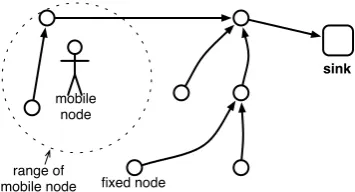
As illustrated in Figure 3.1, our network con-sists of a mixture of mobile and fixed nodes:
• Mobile nodes detect events, i.e., proxim-ity, contacts, falls. They are a scaled down version of the TMote SKY [97] featuring an on-board accelerometer and a recharge-able battery. Figure 3.2 shows the picture of a mobile node, including its casing.
• Fixed nodes play the role of hazard mark-ers and form the infrastructure necessary to relay events on behalf of mobile nodes on a multi-hop path to the sink; the latter is a central node connected to a PC which
dispatches events to operators. InACube, the role of fixed nodes is played by regular TMotes.
Chapter 3. Application Scenarios
TeenyLIME
TinyOS Proximity
Detection Falls &
Immobility
Security Collection
TupleSpace TupleSpace
TupleSpace
TupleSpace Orchestrator
TupleSpace
sensing logic communication
Mobile-To-Fixed Offload TupleSpace
Figure 3.3: ACubesoftware architecture.
that replaces the OS-level communication constructs with a shared memory space span-ning neighboring (1-hop) nodes. The shared memory is provided in the form of a tuple space, i.e., a collection of sequences of typed fields, and is represented by a memory block on each node shared with other nodes within communication range. Along with the higher-level tuple space abstraction, TeenyLimeprovides interfaces that allow a low-level configuration of the underlying hardware. TeenyLime is built on top of TinyOS [49] and applications are developed in the component model inherited from nesC.
The ACube components interact exclusively through the tuple space abstraction, as indicated by the architecture illustrated in Figure 3.3. This allows a high decoupling of components, providing the flexibility to alter or insert only those components required to cope with changes in the deployment or in the project’s requirements. For instance, the software configuration of a fixed node does not include functionality specific to fall and immobility detection, which is available instead on mobile nodes. We overview these components next:
Proximity Detection This component is included on both mobile and fixed nodes and its duty is to notify when mobile carriers approach fixed nodes or other carriers. The operation of this component is based on the neighbor discovery protocol described in Chapter 4.
Falls & Immobility This component is included only in the configuration of mobile nodes. Fall and immobility detection is achieved through an algorithm that uses accelerometers to detect the posture and peaks in the carrier’s movement. The fall detection functionality is out of the scope of this thesis; it is described in [21].
Orchestrator Included on all nodes, the Orchestrator coordinates the activities of other components so that they do not interfere in their operation. It achieves this by mul-tiplexing hardware sensors, controlling the radio duty cycle and scheduling trans-missions according to the radio duty cycle. For instance, this component manages the radio chip in order to address the communication demands of the proximity de-tection and collection components; in this case, the Orchestrator decides when the radio should be on and when transmissions should occur.
3.2. Study of Wildlife Social Behavior
building a collection tree that include mobile nodes. Consequently, these offload data to neighboring fixed nodes that further relay the information further. This process is handled by a specialized component, running on both fixed and mobile nodes. We present the behavior of this component in Chapter 4.
Collection This component is included only on fixed nodes and its purpose is to forward events to the sink along a collection tree formed by all fixed nodes. To build the tree and ensure forwarding, we adapt protocols previously developed in our group to address other deployments [16, 17], as described in Chapter 4.
Security Differently from other components, the Security component lays between Teeny-Lime and TinyOS. Its purpose is to provide an encryption layer that prevents any unauthorized messages to pass through the radio stack. In this respect, we use the software solution available at [29].
RUTh, our neighbor discovery protocol, lies at the core of the software architecture of the WSN in ACube. Its nature, however, poses peculiar challenges to any protocol running on top of it. We discuss these aspects at large and evaluate them in Chapter 4.
3.2
Study of Wildlife Social Behavior
2The understanding of social interactions is a stepping stone towards a better under-standing of evolution, of endangered species, of the mechanisms behind epidemics, of the equilibrium in fragile ecosystems, and of the abilities to adapt to the surroundings. Study of wildlife has been traditionally performed by biologists using direct observation, although the effectiveness of this method is severely hampered by the human intrusion in the environment and impossibility of a full observation coverage in space and time.
Consequently, considerable research efforts have been invested into energy efficient technologies (e.g., GPS [12], RFID [33]) that allow an untethered, non-intrusive, and long term monitoring of wildlife. Along these lines, WSNs are suitable to the wildlife monitor-ing problem because of their small form factor, energy efficiency, and, most important, of their ability to embed application logic into the environment (e.g., [121]).
3.2.1 Scenario and Requirements
We are working with biologists that are analyzing the social behavior of roe deer. They are interested in:
• information on the contacts between animals, and
• information on where deer spend time.
In our wildlife monitoring system, we tag each monitored deer with a node as described in the next section. Our solution must take into account that deer are solitary animals.
2
Chapter 3. Application Scenarios
FRAM
CC2420
MSP430F2618 GSM antenna
GPS module
μSD mount slot
MOTE EXTENSION BOARD
Figure 3.4: Nodes used in the wildlife project.
application server basestation
deer in isolation dee
r group
TCP/I P link GSM
de er
in co ntact 802.15.4
Figure 3.5: Wildlife network topology.
Consequently, the system must be designed to operate at maximum efficiency when nodes are disconnected w.r.t. other nodes. Moreover, deer are difficult to capture [95], thus, differently fromACube, a greater emphasis must be made on lifetime, rather than latency.
3.2.2 Solution Overview
In this project, we use motes purposely designed to meet the previous requirements. Our motes are derived from the TMote SKY [97] and feature a Texas Instruments MSP430F2618, a MCU from the MSP430 family from a more recent generation w.r.t. the one empowering standard TMotes. Compared to the TMote, the new MCU is faster and has larger code storage3; it is necessary to handle a larger amount of peripherals, as follows. We use the standard Chipcon CC2420 transceiver for its networking capabilities, but we also employ it as a “contact sensor”. To increase lifetime, collected data is per-sisted on a FRAM chip, a fast, non-volatile memory, operable at lower voltages w.r.t. to standard Flash memory4. An extension board provides a combination of the following
peripherals: a GPS module, a GSM modem, and aµSD card for additional storage. As per Figure 3.5, we distinguish the following categories of entities in this project:
• All monitored deer bear a mote that features at least a GPS device. These use the radio transceiver to run the neighbor discovery protocol described in Chapter 4. All detected neighbors and localization information are persisted in the FRAM.
• We employ several fixed basestations, each equipped with a GSM modem and SD storage, to collect data from the deer-borne motes. We deploy these in the proximity of feeding stations that biologists expect to be repeatedly visited by deer.
3
The new MCU that we use runs at 16 MHz, has 116 KB of Flash memory and consumes 365µA and 0.5µA when active, respectively when in standby. Comparatively, the MSP430F1611 on standard TMotes runs at 8 MHz, has 48 KB of Flash memory and consumes 330µA and 1.1µA when active, respectively when in standby.
4The Flash memory on the standard TMote is inoperable when the power supply drops below 2.7 V. Instead,
3.2. Study of Wildlife Social Behavior
• The hardware configuration of a fraction of the deer-borne motes includes the GSM modem. These play the role of mobile basestations. While in principle all deer can bear a GSM modem, this solution is not feasible in practice due to cost constraints.
• The basestations, including the deer with GSM modems, report the downloaded data to an application server using a TCP/IP connection established through the GSM modem. The server runs on a PC in our lab.
The wildlife monitoring application is built on top of our TeenyLime middleware and has an architecture similar to the one in the ACube project. Figure 3.6 sketches our solution. Hereafter, we detail the components included in the configuration of deer-borne motes:
Proximity Detection This component is similar to the component bearing the same name in theACubearchitecture described in Section 3.1. Its goal is to detect contacts between deer and between a deer and a basestation. The operation of this component is based on the neighbor discovery protocol described in Chapter 4.
Location Manager Essentially, this component is a driver for the GPS chip. The lo-cation manager acquires the position periodically to maintain fresh information re-garding the satellites in view. Additionally, it refreshes the positioning information when a contact is detected, managed as described next.
Contact Manager A dedicated component is dedicated to manage ongoing contacts between deer. The purpose of this component is to maintain a list containing the other nodes in the range and detect when the contact with one of these is lost. When this occurs, contact information — identity, duration, fresh position sampled from the location manager – is persisted on the FRAM.
Mobile-To-Basestation Offload This component implements the policies of the proto-col transferring data (i.e., contact and position) from mobile nodes to basestations. In this protocol, a basestation plays the role of an arbiter ordering the transmissions of the deer-borne motes in range. Specifically, it gives higher priority to the nodes with a lower amount of available memory and battery. To increase throughput, data transfers occur in bulks, i.e., a deer-borne mote offloads a predetermined amount of data, and without any form of duty-cycling.
TeenyLIME
TinyOS Proximity
Detection
Location Manager
Mobile-To-Basestation
Offload TupleSpace TupleSpace
TupleSpace
Contact Manager
TupleSpace
sensing communication
GSM Reporting
TupleSpace
Mobile-To-Mobile Offload TupleSpace
logic
Chapter 3. Application Scenarios
GSM Reporting The GSM modem is managed by this component. Our experiments show that GPRS data connections are established at a high energy overhead5.
There-fore, we prefer to transfer data to our application server in bulks during infrequent modem connections. All data collected between consecutive GSM offloads are stored on the high capacity µSD card.
Mobile-To-Mobile Offload We are currently investigating methods enabling an op-portunistic multi-hop collection protocol similarly to [129]. Our goal is to enable deer-borne motes to offload their data to other deer-borne motes if the latter have higher changes of delivering data to a basestation. This is part of ongoing unfinished work which ultimately will become the mobile-to-mobile offload component.
The wildlife project provides a straightforward application for the research undertaken in this thesis. Moreover, it provides the possibility to analyze our neighbor discovery protocol in a context where system lifetime bears a higher weight w.r.t. to latency, which instead is more important inACube. We revisit the wildlife application in Chapter 5, where we discuss the opportunities for integratingRUTh, our neighbor discovery protocol, with the group monitoring protocols.
3.3
Supporting Business Processes
Since the inception of the field, scientists leveraged wireless sensor networks (WSNs) to harvest large amounts of environmental data for off-line analysis [80, 83]. Alongside these applications, advances in power efficiency and miniaturization have also enabled the use of WSNs for online monitoring of business processes. The research on global invariants (i.e., properties over data sensed at different nodes) we present in Chapter 6 was originally motivated by scenarios in which nodes are partially mobile. One such scenarios is the management of supply-chains, discussed next.
Supply-chain management. Consider food transportation, a business where$35 billion are literally trashed yearly [50]. Increasingly often, shipped products are equipped with an RFID tag, which however only allows tracking the location of the item at specific points along the supply chain. WSNs devices enable continuous, fine-grained monitoring of the storage conditions, preventing deterioration of goods.
In this context, it is often essential to monitor the temperature of the packages where the food is stored. A typical invariant may concern the relation between the package temperature and the operation of the refrigeration system
(I1) When the temperature of packages is above a threshold, there must be at least one refrigeration fan active.
Nevertheless, the transportation process is subject to further constraints. For instance, a non-uniform load in a container may cause stability problems during transportation. WSN nodes may be installed in a food container to ensure that
5We empirically determined that connecting to a GSM network and establishing a GPRS connection takes
3.3. Supporting Business Processes
(I2)The weight difference between any two sampling points in a container must remain below a threshold.
invariants to monitor
transporter
violated / not violated
package instrumentation
supplier
package manufacturer monitoring system
Figure 3.7: Supply-chain scenario.
Figure 3.7 illustrates how the WSN-based monitoring infrastructure integrates with the transportation process. Package manufactur-ers embed WSN nodes in their products. Food suppliers define the invariants ensuring cor-rect shipping and handling of their products, and install them on the sensors monitoring packages. Transporters receive notifications of invariant violations, and take corrective ac-tions in response. Different suppliers may pro-vide different invariants for different products. Thus, multiple invariants must monitored si-multaneously when products travel together. This scenario decouples the interactions among the various actors, simplifying manage-ment and increasing flexibility.
In the example above, the composition of the system is dynamic; all nodes are mobile. Furthermore, they join and leave the network as transporters load and unload freight. In Chapter 6, we describe a distributed approach to invariant monitoring; this is the key asset of a flexible deployment of mobile nodes, able to operate virtually anywhere in an autonomous fashion.
From Mobile To Fixed Nodes. Some mobile applications can easily be migrated to a fixed environment. Indeed, monitoring of invariants can be equally monitored by the nodes of fixed network. This is, for instance, the case of a scenario in makeSense
(project-makesense.eu), an EU FP7 project to which our research group contributes and whose aim is at simplifying WSNs programming and their integration in business processes.
The aforementionedmakeSense use-case is concerned with the ventilation systems de-ployed in green buildings. A fault of the Heating, Ventilation, and Air-conditioning Con-troller (HVAC) can be identified solely by checking whether the pressure exhibits varia-tions throughout the building. In other words, by detecting violavaria-tions of the invariant
(I3) The difference in pressure between any two sampling points must remain below a threshold.
Chapter 3. Application Scenarios
3.4
Discussion and Outlook
Part II
Chapter 4
RUTh: Neighbor Discovery Made To
Measure
Nei