R E S E A R C H
Open Access
Learning analytics of the relationships
among self-regulated learning, learning
behaviors, and learning performance
Masanori Yamada
*, Atsushi Shimada, Fumiya Okubo, Misato Oi, Kentaro Kojima and Hiroaki Ogata
* Correspondence:
Faculty of Arts and Science, Kyushu University, 744 Motooka, Nishiku, Fukuoka 819-0395, Japan
Abstract
This research aims to investigate the relationship between self-regulated learning awareness, learning behaviors, and learning performance in ubiquitous learning environments. In order to conduct this research, psychometric data about self-regulated learning and log data, such as slide pages that learners read, marker, and annotate, was collected. The accessing activity of device types that stored the learning management system was collected and analyzed by applying path analysis and correlation analysis using data divided into high and low performers. The results indicated that the slide pages which learners read for a duration of between 240 and 299 s had positive effects on the promotion of annotation and the learning
performance directly, and albeit indirectly, the enhancement of self-efficacy was affected by other self-regulated learning factors. The results of the correlation analysis indicated that self-efficacy and test anxiety are a key factor that has different effects on the number of the read slide pages in both high and low performers.
Keywords:Learning analytics, Self-regulated learning, Learning performance
Introduction
Learning analytics is a key subject in educational research all over the world as the findings of learning analytics studies can be applied to improve education, create learn-ing support services, and establish learnlearn-ing models, among other improvements (Gray et al. 2014). One of the key issues in learning analytics is to collect learning logs using information and communication technologies (ICTs).
As ICT advances, the methods of data collection also become more various, in par-ticular ubiquitous technologies (Yin et al. 2014). Ubiquitous technologies allow us to collect not only access logs but also location data. However, psychometric data as well as learning logs should be collected in order to analyze learners’ behaviors for the provision of effective learning support, especially learning styles such as self-regulated learning (SRL) which are thought to be helpful. SRL is closely linked to the concept of autonomy, particularly in the aspects of metacognition, motivation, and learning be-havior (Schunk and Zimmerman 1998; Zimmerman 1986), which enables learners to take responsibility for their own learning.
Goda et al. (2013) suggested that psychometric data on self-regulated learning is use-ful regarding the prediction of the degree of help-seeking and learning performance of
© The Author(s). 2017Open AccessThis article is distributed under the terms of the Creative Commons Attribution 4.0 International
learners. Tseng et al. (2014) reported a significant relationship between learners’ per-ception of SRL, information literacy, and information-searching strategies using the Internet. Their research indicated that information literacy plays an important role in the enhancement of SRL in the ICT era. Artino Jr. and Jones II (2012) revealed that enjoyment and frustration can be positive predictors of metacognition in online learn-ing. Other findings suggest that the use and functions of ICT promote SRL (e.g., Greene et al. 2010), whereas others have focused on developing SRL support systems (e.g., Azevedo 2005; Aleven et al. 2010). If a relationship between self-regulated learn-ing and learnlearn-ing behaviors is found, the results can contribute to support learners effectively. This research aims to examine the relationship between learning behaviors, SRL awareness, and learning performance.
Literacture review Self-regulated learning in a computer-based learning environment
When using ICT, learners can control when, what, and how they learn, without the re-strictions of time, learning space, and printed materials (Cunningham and Billingsley 2003). One of the most popular platforms worldwide, the learning management system (LMS), offers the opportunity to learn outside the classroom using the Internet. To exercise control in online learning, learners have to develop self-regulated learning (SRL) skills (Yukselturk and Bulut 2007). SRL is the active learning process used to regulate and monitor learning cognition, motivation, and behavior and to set personal learning goals, including social aspects (Wolters et al. 2003; Schunk and Zimmerman 2008).
SRL is related to motivation, cognition, and self-control as it is directed toward the accomplishment of learning purposes (Pintrich 1999; Zimmerman and Paulsen 1995). SR learners are those who can prepare a learning plan, adjust it, and apply self-control and self-evaluation (Deci et al. 1996). Goda et al. (2015) suggested that high-level SR learners can control and manage their learning plan in the context of their everyday lives, using a blended learning environment.
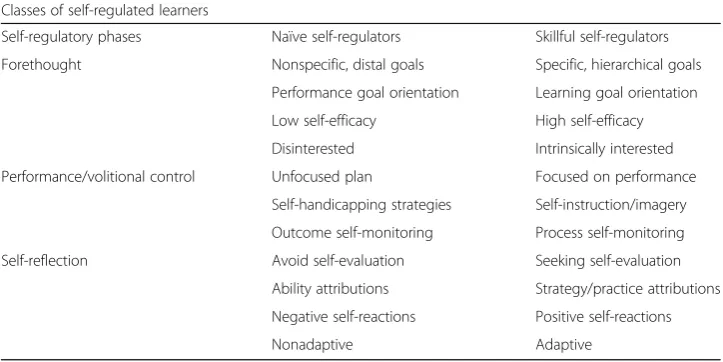
The effects of SRL seem to be different between high and low performers. Schunk and Zimmerman (1998) further compared the learning behaviors of novice and expert SRL learners in each SRL phase (see Table 1). In the forethought phase, skillful learners could articulate their final goals as well as the necessary steps toward accomplishing the same. The features of both the goal and the steps toward it were constructive and clear. Skillful learners also tended to have internal motiv-ation and high self-efficacy. In the performance/volitional phase, skillful learners enhanced their learning by monitoring the learning process. In the self-reflection phase, they sought to evaluate their learning performance independently and tended to attribute its quality to learning strategies and practice. The SRL features of the skillful learners in each phase support learning processes by helping teachers predict learning styles and learning performance.
management, help seeking, and self-regulation. Greene and Azevedo (2010) indicated that learners who do well in an ICT-based environment can manage their learning using cognitive and metacognitive processes, such as ensuring the effectiveness of learning strategies, setting learning objectives, and self-monitoring. Greene et al. (2010) reviewed learning support in four types of ICT-based learning environments. The first is behaviorism, such as drill and practice, in which the same questions are asked and answered repeatedly, followed by the reception of the same feedback. The second is an adaptive or intelligent tutoring system, which supports the activation of metacognition and information retrieval. The third is hypertext and hypermedia, which allow the organization of digital learning materials using linked information. Hypertext and hypermedia work as open-learning material databases. The last one is simulation, which supports cognitive and metacognitive learning, such as information organization, hypothesizing, observation, and learning output. As such, an ICT-based learning envir-onment supports SRL skill acquisition by indirectly promoting the use of cognitive and metacognitive learning strategies.
Learning analytics and SRL
Learning analytics have been the subject of attention in educational research all over the world as the findings of learning analytics studies can be applied to improve educa-tion, create learning supports, establish learning models, and so on (Yin et al. 2014). One of the key issues in learning analytics is to collect learning logs using ICT. As ICT advances, the methods of data collection have been various.
Oi et al. (2015) investigated the relationship between the learning performance and the frequency of links among pages in learning materials using logs. The results re-vealed that high-achievement learners tended to use cognitive learning strategies, such as linking the pages and knowledge with learning materials. Goda et al. (2015) identi-fied seven distinct learning behavior types using learning logs: procrastination, learning habit, random, diminished drive, early bird, chevron, and catch-up. They revealed that the students who had the learning habit type and the chevron type gained higher scores than the procrastination type.
Table 1Differences between naïve and skillful SRLs (Schunk and Zimmerman 1998)
Classes of self-regulated learners
Self-regulatory phases Naïve self-regulators Skillful self-regulators
Forethought Nonspecific, distal goals Specific, hierarchical goals
Performance goal orientation Learning goal orientation
Low self-efficacy High self-efficacy
Disinterested Intrinsically interested
Performance/volitional control Unfocused plan Focused on performance
Self-handicapping strategies Self-instruction/imagery
Outcome self-monitoring Process self-monitoring
Self-reflection Avoid self-evaluation Seeking self-evaluation
Ability attributions Strategy/practice attributions
Negative self-reactions Positive self-reactions
One of the common issues under discussion is how psychological variables affect learning performance in a learning environment using ICT (Greene and Azevedo 2010). Winne (2010) pointed out the great possibility to enhance SRL research using ICT, but he also pointed out the importance of the psychometric data such as belief and contextual thought in SRL research. Psychometric data as well as learning logs should be collected in order to analyze learners’ behaviors for effective learning support, and in particular, learning styles such as SRL should be helpful (Roll and Winne 2015). Goda et al. (2015) focus on the access log analysis, and therefore, they did not mention the relationship between SRL and learning behaviors.
Yamada et al. (2015) indicated that self-efficacy, which is one of the factors of SRL, has a significant correlation with learning behaviors, such as highlighting and annota-tion. Their study indicated that SRL factors directly affect the notion of procrastination and lead to learning performance. However, their limited research did not investigate the relationships between SRL and learning behaviors. Time-related learning awareness, which plays an important role in SRL awareness, can affect learning awareness and per-formance, such as time-management awareness and skill (Zimmerman 1990; Eilam and Aharon 2003; Bernard et al. 2009; Kizilcec et al. 2016). Eilam and Aharon (2003) inves-tigated the process and effects of students’ learning plans and highlighted the differ-ences in the learning planning process between high and low performers. Yamada et al. (2016) demonstrated the causal relationship between time-management awareness, the submission time for learning outcomes on the LMS, and learning performance. Time-related learning awareness and behaviors seem to impact learning awareness and behaviors according to previous research; however, these previous studies did not examine the effects of time-related learning behaviors using learning logs, and the rela-tionships between learning behaviors, SRL awareness, and learning performance. In particular, these previous studies did not consider the perspective of ordinary learning behaviors such as the time used for reading per page of the learning material. This study considered time-related learning behaviors, in particular the reading time for each page of the learning material, and then calculated the number of pages for the reading time segmented by per minute. As a result, using learning logs on the learning support system, this study investigated the effects of reading time per page of the learn-ing material on the use of learnlearn-ing strategies, SRL awareness, and learnlearn-ing perform-ance. In particular, these previous studies did not consider the perspective of ordinary learning behaviors such as the time used for reading per page of the learning ma-terial. This study considered time-related learning behaviors, in particular the read-ing time for each page of the learnread-ing material, and then calculated the number of pages for the reading time segmented by per minute. As a result, using learning logs on the learning support system, this study investigated the effects of reading time per page of the learning material on the use of learning strategies, SRL aware-ness, and learning performance.
Methods
Participants and class
This research was conducted on two information technology courses. One was a 15-week course (course 1), and the other was an 8-15-week course (course 2). The partici-pants were 127 freshman university students in information technology classes (93 students for course 1 (Engineering 57, Science 13, Medical 2, Literature 2, Economics 1, Education 4, and Art technology, 1) and 34 students for course 2 (Engineering 2, Pharmacy 8, Education 7, Medical 9, Law 5, Literature 2, Dentistry 1)). These classes were semi-obligatory for pre-service students who desired to obtain a teaching qualifi-cation. All the students had fundamental computer skills, such as Microsoft office, email, and Net surfing.
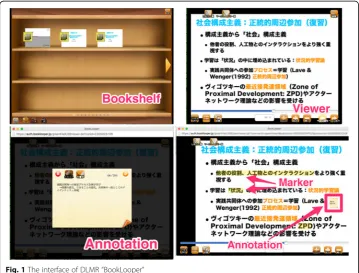
The time allotted for one class per week was 90 min. Teachers asked the students to bring their laptop to the classes. In the first week, the teachers explained the usage and functions of a digital learning material reader (DLMR). The teachers distributed digital learning materials to the students with the use of DLMR and encouraged the students to read the materials in advance before every class. A DLMR allowed the students to access the learning materials on devices such as laptops and smartphones and to use marking and annotation functions whenever and wherever the Internet was available. Figure 1 shows the interface of the DLMR. The DLMR allows the learners to promote the use of cognitive learning strategies such as marker and annotation (Chen et al. 2012). This system has zoom and word retrieve functions, but we did not ask the learners to use these functions, including marker and annotation. The students were required to respond to questionnaires before starting the instruction in the first class (pre-class questionnaire). In every class, learners took the comprehension test at the
beginning. After the comprehension multiple-choice test (10 questions about the current content) in every class, the students took the lecture and worked on basic computer science contents, such as encryption technology, image processing, ontol-ogy, and programming. At the end of the last class, the teachers required the learners to respond to the same questionnaire as the pre-questionnaire (post-class questionnaire).
Data collection and analysis
Two methods were used for the data collection: a questionnaire and log. The Motivated Strategies and Learning Questionnaire (MSLQ: Pintrich and DeGroot 1990), which consists of five factors (Self-Efficacy (SE), Intrinsic Value (IV), Cognitive Strategies (CS), Self-Regulation (SR), Test Anxiety (TA); 44 items in sum, rated on a seven-point Likert scale; see the Appendix) was used for the subjective evaluation of learners’ SRL awareness. The students were asked to complete the MSLQ both before and after the classes. The differences between their responses on the pre-class and post-class ques-tionnaires were analyzed. The second method of data collection was a log that recorded the number of pages that the learners had read and their behavior of marking, book-marking, and annotating. The number of reading pages was counted according to the following reading duration in every 1 min: 10–59, 60–119, 120–179, 180–239, 240– 299, 300–359, 360–419, 420–479, 480–539, 540–599, and over 600 s. However, the slides for which the duration was from 1 to 10 s were eliminated from the data, because the learners did not read the contents (just skipped). The reading time was calculated from the difference between and the sum of the time of page flip logs (forward and back). We counted the frequency of marking and annotation in total throughout the course. Bookmark log was not used for this research, due to very few logs (49 out of 245,096 logs). The learning performance is the final score.
Results
Descriptive data andttest for SRL
The dataset, retrieved from the descriptive data and the results of the test for MSLQ factors, consisted of 121 learners’items after eliminating the missing data. MSLQ data were analyzed using the t test in order to evaluate the differences between pre- and post-course responses from the viewpoint of the improvement of SRL. Path analysis was employed to investigate the relationships between SRL, learning behaviors, and learning performance. Table 2 shows the descriptive data (averages, standard devia-tions) of MSLQ factors and the results of the ttest, and Tables 3 and 4 show the de-scriptive data of the pages, which learners read, and the frequency of marker and annotation function use and the final score.
average decreased. In this class, the individual differences in the perception of intrinsic value appeared to be significant.
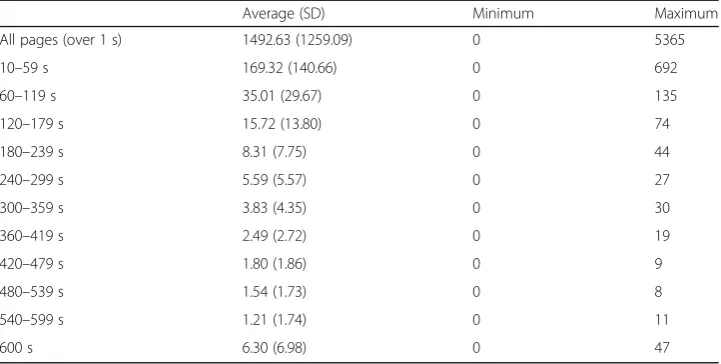
As for the descriptive data on reading pages in all and each duration displayed in Table 3, many learners in these classes read the slides for 10 to 299 s, because the aver-age number of paver-ages did not exceed the standard deviation. However, with the data on the number of pages that learners read for over 300 s, the standard deviation is higher than the average page number. This means that the individual differences in the num-ber of pages that learners read for over 300 s increased. Some learners took a much longer time to read the page, while others did not.
Path analysis
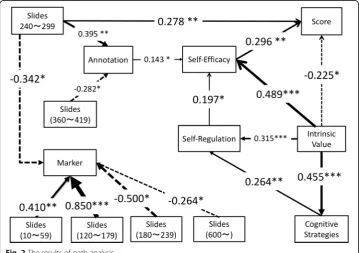
It is important to consider the kinds of learning behavior that improved learners’ SRL factors and learning performance. In order to investigate the overall relationships, a path analysis was employed. Each variable of the SRL is the average difference between the post- and pre-MSLQ questionnaires (see Fig. 2 for the results). The indicators of the model fitting are acceptable: CFI 0.963, TLI 0.948, RMSEA = 0.036, χ2(41) 47.401, p= 0.228. The results indicated that the numbers of slides that learners
Table 2The descriptive data and the results of thettest for MSLQ
Item (minimum-maximum) Average (SD) before the course
Average (SD) after the course
t Sig
Self-efficacy (9 questions) (9–63)
32.54 (8.96) 36.42 (9.20) t(120) = 4.51 p< 0.001
Intrinsic value (9 questions) (9–63)
45.21 (6.29) 44.31 (8.15) t(120) = 1.20
Cognitive strategies (13 questions) (13–91)
60.12 (7.79) 60.63 (8.69) t(120) = 0.68
Self-regulation (9 questions) (9–63)
36.26 (5.63) 36.49 (6.22) t(120) = 0.42
Test anxiety (4 questions) (4–28)
15.17 (4.45) 16.07 (4.34) t(120) = 2.21 p< 0.05
Note: The min-max scores of all the domains in the questionnaire were calculated based on the Likert scale of 1–7
Table 3The descriptive data of the pages that learners read
Average (SD) Minimum Maximum
All pages (over 1 s) 1492.63 (1259.09) 0 5365
10–59 s 169.32 (140.66) 0 692
60–119 s 35.01 (29.67) 0 135
120–179 s 15.72 (13.80) 0 74
180–239 s 8.31 (7.75) 0 44
240–299 s 5.59 (5.57) 0 27
300–359 s 3.83 (4.35) 0 30
360–419 s 2.49 (2.72) 0 19
420–479 s 1.80 (1.86) 0 9
480–539 s 1.54 (1.73) 0 8
540–599 s 1.21 (1.74) 0 11
read from 10 to 59 s and 120 to 179 s promoted the use of the marker function more. However, the numbers of slides read from 180 to 239 s, 240 to 299 s, and over 600 s had a negative effect on the use of the marker function, implying a sig-nificant difference between the two segments that had positive effect. One segment of the “slide number” that learners read from 240 to 299 s promoted the use of the annotation function; however, the slide numbers that learners read from 360 to 419 s had a negative effect on its use. The results also revealed the mediated func-tions of SRL perception between learning behaviors and learning performance. The number of slides that the learners read from 240 to 299 s had both direct and indirect positive effects on learning performance. This time range from 240 to 299 s also promoted the use of annotations. The use of annotations promoted the perception of self-efficacy, and in turn, self-efficacy enhanced learning performance. The awareness of intrinsic value is a fundamental perception that affects other SRL factors and indirectly affects learning performance. The awareness of intrinsic value enhanced the sense of awareness of cognitive learning strategies, self-regulation, and self-efficacy. The awareness of cognitive strategies use enhanced self-regulation, and consequently, self-regulation enhanced self-efficacy. Interestingly, internal value has a directly negative effect on the enhancement of learning performance; that is, learners who placed importance on the learning contents in this class sig-nificantly gained a lower test score than those who did not regard this class as
Table 4The descriptive data of the marker and annotation functions use and final score
Average (SD) Minimum Maximum
Marker use 5.99 (12.15) 0 83
Annotation use 4.23 (9.72) 0 62
Final score 85.84 (11.72) 39.93 100.00
important for them. However, intrinsic value indirectly had positive effects on learning performance, mediated by self-efficacy. We did not find any relationship with test anxiety.
Correlation analysis
Regarding SRL effects on learning performance, in this phase, a correlation analysis (Spearman’s rho) was conducted in order to investigate the relationship between SRL and learning performance, divided into two groups: high performance and low per-formance. The purpose of the analysis was to understand the path analysis results as previous research indicated the differences in SRL awareness between high and low performers (e.g., Zimmerman 1990; Schunk and Zimmerman 1998; Nandagopal and Ericsson 2012).
The learners who gained a score higher than the average of plus 1 SD were catego-rized into the high performance group (N= 14), and those who gained a score less than the average score of minus 1 SD were allocated to the low performance group (N= 19). Tables 5 and 6 show the results of the correlation analysis. The results show the differ-ences between high and low performers. With regard to self-efficacy, the results showed no correlation with test anxiety with the high performer data; however, a high correlation was found with the low performer data. Concerning the correlation between self-efficacy and the slide page number in each reading time segment (1-min segment), almost all the correlations were weak negative; however, very weak to weak positive correlations were found in the low performer data. With regard to intrinsic value, very weak to weak positive correlations with the slide page number in each segment were confirmed; however, a weak negative correlation was found in the low performer data. About the awareness of cognitive learning strategy use, there were weak positive corre-lations with cognitive strategy use, but no correlation was found with the low per-former data. Concerning test anxiety, negative correlations with the slide page number in each segment less than 360 s were confirmed, but mainly a weak positive correlation was found in the low performer data. On the other hand, for the time duration over 360 s, weak positive correlations between test anxiety and the number of pages that learners read were confirmed. With regard to the relationships between cognitive learn-ing strategy use and the number of pages, there were significant differences between high and low performers. The correlation results with the high performer data con-firmed the negative correlation between the number of pages and marker use and between the number of pages and annotation use. On the other hand, middle to strong positive correlations between the number of pages and marker use were confirmed. There were very slight negative correlations between the number of pages and annota-tion use, except for the number of pages with the reading time from 480 to 539 s in the low performer group.
Discussion
that learners read from 180 to 239 s, from 240 to 299 s, and over 600 s inhibited the use of the marker function. In order to consider this point in detail, we referred to the results of the correlation analysis. The results revealed a positive correlation between the number of pages and marker use, and both weak negative and positive correlations between marker use and SRL in low performer data.
The number of slides read from 240 to 299 s had both direct and indirect posi-tive effects on the enhancement of the final score. In order to consider this link-age, considering the indirect path of the number of slides that learners read from 240 to 299 s, the results showed that the learners tend to add annotations on the slides from 240 to 299 s. One possible reason for the relationship between learning behaviors and SRL is that the learning behaviors of the learners depend on the time duration. Reading comprehension requires learners to complexly process input information, such as letter and word recognition, and knowledge integration (Van Gelderen et al. 2007). Walczyk et al. (2007) suggested the relationship between the learning process and disruptive compensatory reading strategies, in that deep read-ing processes such as semantic encodread-ing seem to require more time for informa-tion processing. The time durainforma-tion from 240 to 299 s seems to be the threshold to engage with the learning contents, according to the results of the path analysis. It indicated that learners attempted to comprehend the learning contents and pointed to both clear and unclear parts in the slide that they read for this duration. There-fore, annotation enhanced self-efficacy, which is one of the important elements of SRL. These results were supported by Bernacki et al. (2012), who suggested the effectiveness of annotation in the enhancement of SRL. However, marker use did not promote any SRL elements collected in this research, which differs from the results suggested by Bernacki et al. (2012). A possible reason could be the correla-tions between SRL and its funccorrela-tions. In the high performer data, weak- to middle-level positive correlations between SRL and its function use were confirmed; in particular, annotation had a strong positive correlation with SRL. From these re-sults, the effects of marker use on SRL can be restrained by annotation use.
value and succeeded in gaining high scores, as suggested by Schunk and Zimmerman (1998). The low performer data also indicated a middle- and high-level correlation between SRL factors, but the difference between high and low performers arose from test anxiety. With the higher performer data, we found a low level of correl-ation between the internal value and test anxiety (0.285), but with the low per-former data, there was almost no correlation (0.076). With the low perper-former data, however, test anxiety had a middle-high-level positive correlation with self-efficacy (0.647), but the high performer data did not (0.090) indicate similar results. Low performers seemed to recognize test anxiety as an individual factor, but high per-formers seemed to focus on being aware of intrinsic value with the feeling of test anxiety. These results seem to be consistent with Schunk and Zimmerman (1998), who indicated that an expert regulated learner tends to focus on self-evaluation through self-reflection.
Cognitive learning strategy use is one of the fundamental SRL elements for the quality learning outcomes (e.g., Pintrich and DeGroot 1990). The use of markers did not affect the learning performance and SRL directly, but annotation affected self-efficacy and indirectly affected learning performance in this research. A pos-sible reason is that the annotation feature requires learners to act more cognitively on learning material, but the marker seems to do more cognitively. Annotation, which supports cognitive learning, is one of the most effective tools and learning strategies for the enhancement of motivation and learning outcomes on hyper-media. Chen and Huang (2014) suggested that annotation supports learners’ atten-tion in learning and SRL and, as a result, enhances learning outcomes. Shang (2016) revealed that online annotation on the learning materials enhances the motivation and learning material comprehension significantly. In contrast, the marker is one of the most common tools used with e-books, but the use of this function did not have any significant effects on the enhancement of learning out-comes (van Horne et al. 2016). van Horne et al. (2016) also suggested that the use of highlighting was associated with the delay in reading time and prior use of paper-based textbooks, which are concerned with re-reading behavior. In fact, correlation analysis revealed that positive middle-level correlations were found between awareness and behaviors of the cognitive learning strategies in high learn-ing performers, but not in low learnlearn-ing performers. Annotation seems to be a “cost-effective” tool for learners to enhance their learning outcome, compared with the marker tool. When learners use the marker function and look back at the highlighted pages, learners seem to consider the meaning of the marker and associ-ated information with the marker. Annotation simply supports the learner’s under-standing of learning materials. This feature seems to promote the enhancement of self-efficacy and, indirectly, the learning performance.
Conclusion
This research investigated the relationship between SRL factors, learning behaviors, and learning performance. The results showed that the number of slides read from 240 to 299 s indirectly had a positive influence on the enhancement of SRL learning per-formance. Annotation, which is the learning behavior related with learning strategy, mediated between the slides and SRL. Among the SRL factors, all the relationships be-tween them were positive, but the internal value had a negative effect on the final score. In order to investigate this point in detail, we investigated the differences between high and low performers using correlation analysis. The results showed different correlations between intrinsic value and the number of slides read, with positive correlations among high performers and negative correlations among low performers.
This research contributes useful suggestions to the learning analytics research field. SRL is an important educational theory and concept in education, globally. Previous re-search has tended to capture learners’SRL awareness using questionnaires or observa-tions (e.g., Pintrich and DeGroot 1990; Zimmerman 2008; Cho and Jonassen 2009; Jansen, van Leeuwen, Janssen, Kester, and Kalz 2016). This research examined learning behaviors related with SRL using learning logs and provided viewpoints to consider SRL awareness, which is different from previous studies in SRL research. Learning ana-lytics research tends to focus on the use of logs by utilizing ICT. However, learning an-alytics research mixed with educational psychology methods, such as those used here, can suggest the background of learning behaviors (learning logs). Thus, learning analyt-ics blended with educational psychology methods can provide researchers and practi-tioners with various viewpoints on educational evaluation.
Additionally, this research makes a practical contribution toward designing effective instruction. This research recommends that teachers design their instruction for the enhancement of learners’ self-efficacy by using the awareness of cognitive learning strategies that are directly effective in enhancing internal value and indirectly effective in enhancing self-regulation. For instance, the introduction of useful cognitive learning strategies in a teacher’s class may be a simple idea; however, such introduction also en-tails the use of an effective instructional design method. Further, this research identified several problems on which researchers can focus as part of future research. Particularly, future research can address the following three issues.
Appendix
T7
Table 7Motivated strategies and learning questionnaire (Pintrich and DeGroot 1990)
Factor Item
Self-efficacy Compared with other students in this class, I expect to do well.
I’m certain I can understand the ideas taught in this course.
I expect to do very well in this class.
Compared with others in this class, I think I’m a good student.
I am sure I can do an excellent job on the problems and tasks assigned for this class.
I think I will receive a good grade in this class.
My study skills are excellent compared with those of other students in this class.
Compared with other students in this class, I think I know a great deal about the subject.
I know that I will be able to learn the material for this class.
Intrinsic value I prefer class work that is challenging so I can learn new things.
It is important for me to learn what is being taught in this class.
I like what I am learning in this class.
I think I will be able to use what I learn in this class in other classes.
I often choose paper topics I will learn something from even if they require more work.
Even when I do poorly on a test, I try to learn from my mistakes.
I think that what I am learning in this class is useful for me to know.
I think that what we are learning in this class is interesting.
Understanding this subject is important to me.
Test anxiety I am so nervous during a test that I cannot remember facts I have learned.
I have an uneasy, upset feeling when I take a test.
I worry a great deal about tests.
When I take a test, I think about how poorly I am doing.
Cognitive strategy use When I study for a test, I try to put together the information from class and from the book.
When I do homework, I try to remember what the teacher said in class so I can answer the questions correctly.
It is hard for me to decide what the main ideas are in what I read. (R)
When I study, I put important ideas into my own words.
I always try to understand what the teacher is saying even if it doesn’t make sense.
When I study for a test, I try to remember as many facts as I can.
When studying, I copy my notes to help me remember material.
When I study for a test, I practice saying the important facts over and over to myself.
I use what I have learned from old homework assignments and the textbook to do new assignments.
When I am studying a topic, I try to make everything fit together.
When I read material for this class, I say the words over and over to myself to help me remember.
I outline the chapters in my book to help me study.
When reading, I try to connect the things I am reading about with what I already know.
Self-regulation I ask myself questions to make sure I know the material I have been studying.
Funding
The research is supported by the“Research and Development on Fundamental and Utilization Technologies for Social Big Data”(178A03); the Commissioned Research of the National Institute of Information and Communications Technology (NICT), Japan; Grant-in-Aid for Scientific Research (S) No. 16H06304; and the Education Enhancement Program (EEP) of Kyushu University.
Authors’contributions
MY designed this research procedure. AS and FO designed and developed the learning analytics system using this research. MO, KK and MY were engaged in data collection and analysis. HO supervised this research. All authors read and approved the final manuscript.
Competing interests
Drs. Yamada, Shimada, Oi, and Ogata received research grants from JSPS for other research projects. Dr. Shimada received the research fund from Japan Science and Technology Agency (JST). The authors’declare that they have no competing interests.
Publisher’s Note
Springer Nature remains neutral with regard to jurisdictional claims in published maps and institutional affiliations.
Received: 1 December 2016 Accepted: 8 May 2017
References
Aleven, V., Roll, I., McLaren, B. M., & Koedinger, K. R. (2010). Automated, unobtrusive, action-by-action assessment of self-regulation during learning with an intelligent tutoring system.Educational Psychologist, 45(4), 224–233.
Artino, A. R., Jr., & Jones, K. D., II. (2012). Exploring the complex relations between achievement emotions and self-regulated learning behaviors in online learning.Internet and Higher Education, 13, 170–175.
Azevedo, R. (2005). Using hypermedia as a metacognitive tool for enhancing student learning? The role of self-regulated learning.Educational Psychologist, 40(4), 199–209.
Barnard, L., Lan, W. Y., To, Y. M., Paton, V. O., & Lai, S. L. (2009). Measuring self-regulation in online and blended learning environments. The Internet and Higher Education 12 (1):1–6.
Bernacki, M. L., Byrnes, J. P., & Cromley, J. G. (2012). The effects of achievement goals and self-regulated learning behaviors on reading comprehension in technology-enhanced learning environments.Contemporary Education Psychology, 37, 148–161. doi:10.1016/j.cedpsych.20111.12.001.
Chen, C. M., & Huang, S. H. (2014). Web-based reading annotation system with an attention-based self-regulated learning mechanism for promoting reading performance.British Journal of Educational Technology, 45(5), 959–980. doi:10.1111/bjet.12119.
Chen, Y. C., Hwang, R. H., & Wang, C. Y. (2012). Development and evaluation of a Web 2.0 annotation system as a learning tool in an e-learning environment.Computers & Education, 58(4), 1094–1105. https://doi.org/10.1016/j. compedu.2011.12.017.
Cho, M. H., & Jonassen, D. (2009). Development of the human interaction dimension of the Self-Regulated Learning Questionnaire in asynchronous online learning environments.Educational Psychology, 29, 117–138. doi:10.1080/ 01443410802516934.
Cunningham, C. A. & Billingsley, M. (2003). Curriculum Webs: A Practical Guide to Weaving the Web into Teaching and Learning. Boston, MA: Pearson Educational, Inc.
Deci, E. L., Ryan, R. M., & Williams, G. (1996). Need satisfaction and the self-regulation of learning.Learning and Individual Differences, 8, 165–183.
Eilam, B., & Aharon, I. (2003). Students’planning in the process of self-regulated learning.Contemporary Educational Psychology, 28, 304–334. doi:10.1016/S0361-476X(02)00042-5.
Goda, Y., Yamada, M., Matsuda, T., Kato, H., Saito, Y., & Miyagawa, H. (2013). Effects of help seeking target types on completion rate and satisfaction in e-learning.Proceedings of INTED, 2013, 1399–1403.
Goda, Y., Yamada, M., Matsuda, T., Saito, Y., Kato, H., & Miyagawa, H. (2015). Procrastination and other learning behavioral types in e-learning and their relationship with learning outcomes.Learning and Individual Difference, 37, 72–80. doi:10.1016/j.lindif.2014.11.001.
Table 7Motivated strategies and learning questionnaire (Pintrich and DeGroot1990)(Continued)
I work on practice exercises and answer end of chapter questions even when I don’t have to.
Even when the study materials are dull and uninteresting, I keep working until I finish.
Before I begin studying, I think about the things I will need to do to learn.
I often find that I have been reading for class but don’t know what it is all about. (R)
I find that when the teacher is talking, I think of other things and don’t really listen to what is being said. (R)
When I’m reading, I stop once in a while and go over what I have read.
I work hard to get a good grade even when I don’t like a class.
Gray, G., McGuinness, C., Owende, P., & Carthy, A. (2014). A review of psychometric data analysis and applications in modelling of academic achievement in tertiary education.Journal of Learning Analytics, 1(1), 75–106.
Greene, J. A., & Azevedo, R. (2010). The measurement of learners’self-regulated cognitive and metacognitive processes while using computer-based learning environments.Educational Psychologist, 45(4), 203–209.
Greene, J. A., Muis, K. R., & Pieschl, S. (2010). The role of epistemic beliefs in students’self-regulated learning with computer-based learning environments: conceptual and methodological issues.Educational Psychologist, 45(4), 245–257. Jansen, R.S., van Leeuwen, A., Janssen, J., Kester, L., & Kalz, M. (2017). Validation of the self-regulated online learning
questionnaire. Journal of Computing in Higher Education 29 (1):6–27.
Keller, J. M. (2009).Motivational design for learning and performance: the ARCS model approach. Springer Science & Business Media.
Kizilcec, RF, Pèrez-Sanagustin, M, & Maldonado, JJ (2016). Recommending self-regulated learning strategies does not improve performance in a MOOC, Proceedings of ACM Conference on Learning at Scale 2016 (pp. 101-104). 978-1-4503-3726-7/16/04.
Nandagopal, K., & Ericsson, K. A. (2012). An expert performance approach to the study of individual differences in self-regulated learning activities in upper-level college students.Learning and Individual Differences, 22, 597–609. doi:10. 1016/j.lindif.2011.11.018.
Oi, M, Yin, CJ, Okubo, F, Shimada, A, Kojima, K, Yamada, M, & Ogata, H (2015). Analysis of links among e-books in undergraduates’e-book logs. In H Ogata et al. (Ed.). Workshop Proceedings of the 23th International Conference on Computers in Education (ICCE 2015) (pp. 665–669)
Pintrich, P. (1999). The role of motivation in promoting and sustaining self-regulated learning.International Journal of Educational Research, 31, 459–470.
Pintrich, P. R., & DeGroot, E. V. (1990). Motivational and self-regulated learning components of classroom academic performance.Journal of Educational Psychology, 82, 33–40. http://dx.doi.org/10.1037/0022-0663.82.1.33.
Roll, I., & Winne, P. H. (2015). Understanding, evaluating, and supporting self-regulated learning using learning analytics.
Journal of Learning Analytics, 2(1), 7–12.
Schunk, D. H., & Zimmerman, B. J. (1998).Self-regulated learning: from teaching to self-reflective practice. New York, NY: The Guilford Press.
Schunk, D. H., & Zimmerman, B. J. (2008).Motivation and self-regulated learning: theory, research, and applications. Mahwah, NJ: Lawrence Erlbaum Associates.
Sha, L., Looi, C. K., Chen, W., & Zhang, B. H. (2012). Understanding mobile learning from the perspective of self-regulated learning.Journal of Computer Assisted Learning, 28(4), 366–378. doi:10.1111/j.1365-2729.2011.00461.x. Shang, H. F. (2016). Online metacognitive strategies, hypermedia annotations, and motivation on hypertext comprehension.
Educational Technology & Society, 19(3), 321–334. Retrieved from http://www.ifets.info/journals/19_3/28.pdf. Tseng, S. C., Liang, J. C., & Tsai, C. C. (2014). Students’self-regulated learning, online information evaluative standards
and online academic searching strategies.Australasian Journal of Educational Technology, 30(1), 106–121. Usta, E. (2011). The examination of online self-regulated learning skills in web-based learning environments in terms of
different variables.The Turkish Online Journal of Educational Technology, 10(3), 276–286.
Van Gelderen, A., Schoonen, R., Stoel, R. D., de Glopper, K., & Hulstijn, J. (2007). Development of adolescent reading comprehension in language 1 and language 2: a longitudinal analysis of constituent components.Journal of Educational Psychology, 99(3), 477–491. doi:10.1037/0022-0663.99.3.477.
van Horne, S., Russell, J., & Schuh, K. L. (2016). The adoption of mark-up tools in an interactive e-textbook reader.
Educational Technology Research and Development, 64(3), 407–433. doi:10.1007/s11423-016-9425-x.
Walczyk, J. J., Wei, M., Griffith-Ross, D. A., Goubert, S. E., Cooper, A. L., & Zha, P. (2007). Development of the interplay between automatic processes and cognitive resources in reading.Journal of Educational Psychology, 99(4), 867–887. doi:10.1037/0022-0663.99.4.867.
Winne, P. H. (2010). Improving measurements of self-regulated learning.Educational Psychologist, 45(4), 267–276. doi:10. 1080/00461520.2010.517150.
Wolters, CA, Pintrich, PR, & Karabenick, SA (2003) Assessing academic self-regulated learning,The Conference on Indicators of Positive Development: Definitions, Measures, and Prospective Validity. Sponsored by ChildTrends, National Institutes of Health, Washington, DC.
Yamada, M, Yin, CJ, Shimada, A, Kojima, K, Okubo, F, & Ogata, H (2015). Preliminary research on self-regulated learning and learning logs in a ubiquitous learning environment,Proceedings of the 15th IEEE International Conference on Advanced Learning Technologies(ICALT 2015) (pp. 93–95)
Yamada, M., Goda, Y., Matsuda, T., Saito, Y., Kato, H., & Miyagawa, H. (2016). How does self-regulated learning relate to active procrastination and other learning behaviors?Journal of Computing in Higher Education, 28(3), 326–343. doi: 10.1007/s12528-016-9118-9.
Yin, C. J., Okubo, F., Shimada, A., Kojima, K., Yamada, M., Fujimura, N., & Ogata, H. (2014). Smart phone based data collecting system for analyzing learning behaviors.Proceedings of International Conference of Computers on Education, 2014, 575–577.
Yukselturk, E., & Bulut, S. (2007). Predictors for student success in an online course.Educational Technology and Society, 10(2), 71–83.
Zimmerman, B. J. (1986). Development of self-regulated learning: which are the key subprocesses?Contemporary Educational Psychology, 16, 307–313.
Zimmerman, B. J. (1990). Self-regulated learning and academic achievement: an overview.Educational Psychologist, 25(1), 3–17.
Zimmerman, B. J. (2008). Investigating self-regulation and motivation: historical background, methodological developments, and future prospects.American Educational Research Journal, 45(1), 166–183. doi:10.3102/ 0002831207312909.
Zimmerman, B. J., & Paulsen, A. S. (1995). Self-monitoring during collegiate studying: an invaluable tool for academic self-regulation. In P. R. Pintrich (Ed.),Understanding self-regulated learning—New directions for teaching and learning