Horticultural markets promote alien species invasions:
an Estonian case study of herbaceous perennials
Merle Ööpik1, Robert G.H. Bunce1, Monika Tischler1
1 Institute of Agricultural and Environmental Sciences, Estonian University of Life Sciences, Kreutzwaldi 5, 51 014 Tartu, Estonia
Corresponding author: Merle Ööpik ([email protected])
Academic editor:I. Kühn | Received 30 October 2012 | Accepted 29 April 2013 | Published 28 June 2013
Citation: Ööpik M, Bunce RGH, Tischler M (2013) Horticultural markets promote alien species invasions: an Estonian case study of herbaceous perennials. NeoBiota 17: 19–37. doi: 10.3897/neobiota.17.4217
Abstract
Gardening is a popular pastime, but commercial horticulture is responsible for the introduction of alien species and contributes to invasions in a variety of ways. Although an extensive international literature is available on plant invasions, it is still important at the national level to examine the influence of local factors. Accordingly, 17 nurseries in Estonia that cultivated and sold perennial alien species were selected, and a list of species and prices was compiled. The relationships between species status, and factors such as their abundance in the wild were examined statistically. A qualitative list of the nationally problematic species among herbaceous perennials was also completed. A total of 880 taxa were recorded, of which 10.3% were native and 89.7% alien. In all, 87.3% of the alien species were still confined to cultivated areas. The ecological and socio-economic characteristics of the taxa were described, and lists of the families of casual, naturalised and invasive aliens were provided. Both native and increasing wild alien species have a very similar profile on the market. Alien species that are less expensive, widely available and have more cultivars per species on the market are also more likely to escape. The invasive status and abundance of escaped aliens in an area increases with residence time. In general, socio-economic factors create new and reflect previous propagule pressures from commercial horticulture, which continuously increase the likeli-hood of alien species surviving and invading new areas. Our findings suggest that these national socio-economic market-related factors explain much of the invasiveness of various perennial ornamental species, and therefore regional and national authorities urgently need to regulate and control the ornamental plant trade to diminish the risk of new invasions.
Keywords
Perennial alien species, commercial horticulture, human-mediated propagule pressure, residence time, legislation and regulation
introduction
Biological and human-mediated mechanisms in invasions of alien plant species are in-terdependent, and as a result, it is difficult to predict where and why such invasions will occur. However, most plant naturalisations and invaders nowadays originate from and in the future will derive from deliberate importations (Mack and Erneberg 2002, Kowarik 2003, Mack 2003). Specifically, the study of the economic uses of plant species that are invasive in various parts of the world has established that most plant invaders are ornamentals (Weber 2003). These species have been introduced for horticultural use by nurseries, botanical gardens, and individuals (Reichard and White 2001). Of course, invasive alien species can be introduced unintentionally (Pyšek et al. 2011) or by other deliberate pathways developed by humans, e.g., for forestry and agricultural purposes (Mack and Lonsdale 2001, Starfinger et al. 2003). Nevertheless, the expansion and globalisation of the horticultural trade is widely accepted as a principal reason for the increase in alien species (e.g., Dehnen-Schmutz et al. 2007a, 2007b, 2010, Barbier et al. 2011) and it is also widely recognised that many invasions begin in urban domestic gar-dens (e.g., Smith et al. 2006, Hanspach et al. 2008). On a general macroeconomic scale, income growth is the primary driver of globalisation and there is a clear association between Gross Domestic Product and the richness of alien floras (Hulme 2009). In ad-dition, when the variations in invasion rates were partitioned according to a range of ex-planatory variables, it was found that only national wealth and population density were statistically significant (Pyšek et al. 2010). These predictors simply reflect the intensity of human activities, in which the horticultural trade is also a relevant component.
Human-mediated propagule pressure from ornamental horticulture itself plays both a direct and implicit role for species to become naturalised and even invasive. At a local level it is particularly important, because it promotes invasions in variety of ways (see, e.g. Reichard 2011): 1) the introduction and reintroduction of new plants; 2) the selection of species and cultivars for characteristics such as climatic suitability and rapid propagation; and 3) the creation of propagules due to long residence time, the pres-sure of gardening fashions and the great number of garden centres. In Britain, market presence, prices and dates of introduction are among the socio-economic factors that have influenced invasions (Dehnen-Schmutz et al. 2007a). Pemberton and Liu (2009) have also stressed the importance to successful naturalisation of the number of years a plant was sold. The current naturalisation success of North American woody species in Europe is determined by introduction history and particularly by planting frequency (Bucharova and van Kleunen 2009). Selective introduction and human-mediated se-lection of ornamental plants with fast and abundant germination might increase the risk of species ultimately becoming invasive (Chrobock et al. 2011). Kowarik (2003) suggested that secondary releases of alien species might mimic demographic and dis-persal processes that influence population growth and expansion of range, and provide opportunities to species whose propagules are not able to move naturally over long dis-tances. In addition, cultivation (e.g., protection from predators and parasites, drought, cold) can facilitate naturalisation by protecting alien populations from environmental stochasticity (Mack 2000).
It has previously been shown that in the case of the Estonian Alien Flora (Ööpik et al. 2008), the establishment and naturalisation of alien species in a given area de-pended on the level and type of human mediation. The majority (74%) of 232 natu-ralised alien species in Estonia originates from deliberate introductions. Overall, ap-proximately half of the alien flora consists of short-lived species, but only 24% of the naturalised species belong to this group. Moreover, cultivation in a cold temperate region has tended to favour perennial species with propagative advantages for attain-ing greater abundance and higher invasive status; especially in natural and semi-natural habitats. The pattern of invasive species is more diverse, but among the most problem-atic species there are also deliberately introduced perennials, which have escaped from cultivation and are now spreading aggressively, forming monocultures, are toxic, and causing other conservation or human health problems. Hence, through selection and cultivation, humans increase propagule pressure, while invasion success also increases with alien species’ residence time. Consequently, at a national level in countries such as Estonia, it is necessary to examine the influence of local factors more deeply, so that measures can be taken to reduce the probability of invasions.
In this paper, the following questions are raised in order to examine the situation in Estonia in further detail:
(ii) Is availability (i.e., lower prices at certain outlets) related to the current status of these species, i.e., the presence of the alien species in the spontaneous flora and/ or their abundance in the wild, and how is this connected to species’ residence time in Estonia?
(iii) Does this list include problematic or even legally prohibited alien species that may cause nature conservation problems and therefore needs national attention?
Material
Background information about Estonia
Estonia lies approximately between latitude 58˚–60˚ N and longitude 22˚–28˚ E. Ac-cording to the Estonian Information System’s Authority (2012), the total area of Es-tonia is 45,227 km², including 42,692 km² of land. More than one-half of the land area is forest, and one-third is agricultural land (arable land and natural grasslands). Approximately 8% is urban and infrastructure and the rest of the land is heathland, mires and bogs. Since 31 December 2010, 18.1% of Estonia has been under various types of nature protection (Environmental Information 2012).
By the end of 2011, the population of Estonia was 1.32 million and had decreased because of migration (Statistics Estonia 2012). Approximately 69% of the population live in the major towns and cities and 35 % of all live in semi-detached or detached houses, which traditionally have gardens. In 2010, the population density was 30.9 inhabitants per km². After 1 January 2011, the currency of Estonia was converted to the Euro, but during the research period for the present study the currency was the Estonian kroons (1 EUR = 15.6 EEK).
As mentioned above, national wealth is a key parameter in determining the likeli-hood of plant invasions. In 2011, the Gross Domestic Product per capita of Estonia was 20.2 US Dollars compared with 15.4 for Latvia and 38.3 for Finland. Estonia is, therefore, not in the highest wealth category, but it is still rich compared with countries outside Europe. However, the economy is growing, and gardening is a very popular activity, especially in the countryside where most houses have gardens. There is, therefore, a strong market for horticultural products.
National regulations on (invasive) alien species
In Estonia, the principal authority on alien species is the Ministry of Environment, which is responsible for legislation and cooperation with international expert groups (e.g., NOBANIS, the Bern convention IAS group, and the EPPO IAS group). The En-vironmental Board is responsible for nature conservation activities and practical work with alien and invasive alien species.
The Nature Conservation Act (The State Gazette I, 2004, 38, 258) is the principal instrument that forbids the release of alien species into the wild. This Act has resulted in the definition of The List of Invasive Alien Species (Annex of The State Gazette 2004, 134, 2076). This regulation includes both well-established species and plants that are not yet established but which have caused problems in countries with similar environments. At present, this list includes 13 plant species. The import of live speci-mens and all transactions with live plants are prohibited for all these species.
The complete list of the texts on invasive species that have been implemented to date; including both those that are legally binding and those that are not; is presented in a re-port entitled “A Comparative Assessment of Existing Policies on Invasive Species in the EU Member States and in Selected OECD Countries” (European Commission 2011).
Methods
Sample of nurseries, database characteristics, statistical analysis
Seventeen nurseries located throughout Estonia were selected for this study. The choice was determined by the availability of catalogues. Firstly, an extensive list of cultivars and prices of herbaceous perennial species was compiled from catalogues, and the data was structured at the species, subspecies, and varietal or hybrid taxonomic level. In addition, basic information was collected for each taxon (Table 1), whenever such in-formation was available. The species status in the Estonian Flora was determined from the Vascular Plant Flora of Estonia (Kukk 1999), where natives and archaeophytes are considered to be in the same group, i.e., natives. Hence, the alien species considered in this study were neophytes from this region. The alien species status (casual, naturalised and invasive) and other characteristics connected to alien species’ invasiveness on Es-tonian territory were used as applied in EsEs-tonian Alien Flora (Ööpik et al. 2008), after which the invasive status of alien species was used in the sense proposed by Richardson et al. (2000) and Pyšek et al. (2004).
table 1. The content of the database of herbaceous perennial species available in the Estonian horticul-tural market describing the species characteristics and categories assigned to each individual species.
Topic Characteristic Categories used
Species identity and
taxonomic position Genus, species, subspecies, family Species status in Estonian
Flora Native (1)Alien (2)
Alien species invasiveness on Estonian territory and in the
neighbouring countries Invasive status
Non-escaping (1) Casual (2) Naturalised (3)
Invasive (4) Year of introduction
Year of the first record in the wild
Abundance in the wild (frequency classes)
Rare (1) Uncommon (2) Scattered or occasional (3)
Common (4) Invasiveness in NOBANIS
(qualitative characteristic) Potentially invasive or invasive in the region†
Invasiveness in NOBANIS (quantitative characteristic)
0- not mentioned as potentially invasive or invasive; 1- potentially invasive or invasive in one country. Values of 2 or greater denote the number of countries in which the species is potentially invasive or
invasive.
Area of origin (floristic element)
America, Asia, Europa, Eurasia (continental), Euro-Siberia, Circumpolar,
Africa, Origin unknown (known only from cultivation)
Nursery information (N=17) Species present on the list of a certain nursery 0- not present; 1- present Number of nurseries in which
the species is available Number of cultivars per species
available
Wholesale or retail price in 2010 (divided into ranges)
1 class up to 30 EEK (approx. 2 EUR) 2 class 31-50 EEK (> 2 to 3.2 EUR) 3 class 51-100 EEK (> 3.2 to 6.4 EUR) 4 class greater than 100 EEK (> 6.4 EUR) † Latvia, Lithuania, Finland, Sweden, Denmark, Norway, Poland, European part of Russia
species is available. Only one, and in the case of differences between nurseries, the high-est price range category for each species was determined. The status of species in neigh-bouring countries was derived from the database of the European Network on Invasive Alien Species (NOBANIS, www.nobanis.org). In this database, invasive alien species are defined as those whose introduction and/or spread threaten biological diversity.
an analysis of variance performed on ranks. Specifically, the different characteristics of multiple independent samples (groups) were compared. Species status was related to species price and to availability as well as alien species status, and abundance class to residence time. In addition, the multiple comparisons test was used to assess the mean ranks of all pairs of groups(see Siegel and Castellan 1988) and to compute post hoc measures of the mean ranks of all pairs of groups based on the z statistic. The correla-tion between price and availability, introduccorrela-tion time, and invasiveness in neighbour countries, was tested with nonparametric Spearman rank correlation (R).
List of species needing attention
As a practical application, a qualitative list of the nationally problematic species among the herbaceous perennials found in horticultural catalogues was compiled, based on data from local sources (Kukk 1999, Ööpik et al. 2008) and neighbouring countries (NOBANIS database) and on categories of multiple response characteristics as follows:
(i) Invasive or naturalised in Estonia and invasive or potentially invasive in at least three neighbouring countries.
(ii) Naturalised in Estonia and invasive or potentially invasive in two neighbouring countries.
(iii) Naturalised in Estonia.
(iv) Casual in Estonia, but invasive or potentially invasive elsewhere. These species are not addressed in this study.
The complete list of perennials in The List of Invasive Alien Species (The State Ga-zette Supplement 2004, 134, 2076) was also examined, to analyse whether the current legally valid list is applicable to everyday trade.
Results
General structure of the database
frequently represented by the genus Campanula L.. The most common genera among the alien taxa are Sedum L., Saxifraga L., Aster L., Dianthus L., and Geranium L..
According to their area of origin, 36% of the alien perennial species available on the horticultural market are native to Europe, Eurasia or Euro-Siberia. Approximately 30% are from Asia and 27% from the Americas.
The number of species per nursery varied from 41 to 383, and 44% of the spe-cies were present in only one nursery. Only one non-escaping alien, Liatris spicata (L.) Willd., was available from all 17 nurseries. Bergenia cordifolia (Haw.) Sternb. and Echinacea purpurea (L.) Moench (both non-escaping aliens) were available from 16 nurseries, and the native Ajuga reptans L. was available from 15 nurseries. The mixture in each nursery was quite similar: 10–20% natives, 60–80% non-escaping aliens, 10% casuals, 2–10% naturalised. Eight nurseries offered invasive species. The largest and most variable category was non-escaping alien species (Figure 1).
The results show that approximately 70% of the species had no cultivars or only one type available for sale. Only 43 (4.9%) of the species had ten or more cultivars per species. The outstanding favourite species was the non-escaping alien Hemerocallis hybrida hort. with 134 different varieties, followed by Sempervivum x hybridum hort. (68), Phlox paniculata L. (65), and the naturalised alien Iris germanica L. (42).
Market characteristics and species invasiveness
The results show that two groups - native and alien species found outside cultivation of any status from casual to invasive - have a similar market profile, in contrast to non-escaping alien species. Alien species that are able to escape and reach certain invasive table 2. The invasive status of perennial species available in the Estonian horticultural market, listed by family.
Family Native species
Non-escaping aliens
Casual aliens
Naturalised aliens
Invasive aliens All
Asteraceae 10 98 16 8 1 133
Ranunculaceae 7 58 0 3 0 68
Lamiaceae 8 42 12 3 0 65
Caryophyllaceae 9 38 6 2 1 56
Rosaceae 8 36 3 3 0 50
Saxifragaceae 2 45 2 0 0 49
Crassulaceae 4 32 5 1 0 42
Primulaceae 2 32 0 2 0 36
Scrophulariaceae 4 26 3 1 0 34
Brassicaceae 0 22 1 0 0 23
Campanulaceae 5 15 0 0 0 20
Others 32 245 14 12 1 299
Total no of species 91 689 62 35 3 880
status in Estonia, are today less expensive (H = 13.9, DF = 2, N = 668, p = 0.001; Fig-ure 2) and also more widely available (H = 32.6, DF = 2, N = 880, p < 0.0001; Figure 3) than those that have not escaped. In all, the price range of the species is lower when it is widely available and vice versa (R = -0.36, p < 0.05). Also, native and escaping alien species have more developed cultivars per species available on the market (H = 13.26, DF = 2, N = 880, p = 0.001). The latter is also positively correlated to number of nurs-eries where the species is available (R = 0.66, p < 0.05). In addition, when a species has already reached a certain invasive status in the alien flora, then the price (H = 0.02, DF = 2, N = 86, p = 0.7), availability (H = 0.64, DF = 2, N = 100, p = 0.7) and a number of cultivars per species (H = 2.52, DF = 2, N = 100, p = 0.28) does not differ between groups of casual, naturalised and invasive aliens.
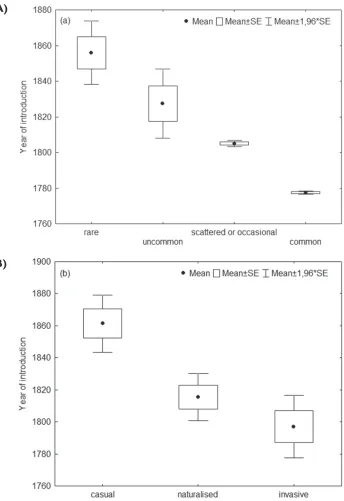
Among the already escaped alien species, the abundance (H = 12.3, DF = 3, N = 83, p = 0.007; Figure 4a) and invasive status of species (H =10.4, DF = 2, N = 86, p = 0.006;Figure 4b) tends to increase with residence time. Invasiveness in the whole region (see Table 1) is also significantly correlated to the year of introduction into Estonia (R = -0.33, p < 0.05), to the species status in Estonia (R = 0.52, p < 0.05) and to the abundance in the wild (R = -0.47, p < 0.05). The supply and demand factors, i.e. today’s availability (R = 0.02, p > 0.05) and price range of alien species in Estonian alien flora (R = 0.08, p > 0.05), is not correlated with introduction time.
Figure 2. The relationship between species price and status in 17 nurseries in Estonia. Non- escaping al-iens were more expensive than natives (z’ = 2.7, p < 0.05) and species in certain status (casual, naturalised, invasive) in alien flora (z’ = 2.8, p = 0.02).
Figure 4. The relationship between alien species characteristics and residence time in 17 nurseries in Estonia: (A) species abundance in the wild and residence time (general test was statistically significant (see text), but no significant differences between groups were detected because of small sample sizes), (B) alien species status and residence time. The residence time of casuals were shorter than of naturalised species (z’
= 3.72, p = 0.0006). Sample of invasive species was too small to drive statistically significant conclusions.
A)
List of species needing attention
As a practical application, a qualitative list of the nationally problematic species among the herbaceous perennials in horticultural catalogues was compiled (Table 3). In Es-tonia, The Nature Conservation Act forbids the release of alien species into the wild. This Act has resulted in the definition of The List of Invasive Alien Species. For all these species, the import of live specimens and all transactions with live plants are prohib-ited. As a result, three species are on both the compiled list and the legally defined list.
Discussion
It is generally accepted that only a limited fraction of introduced species in a given area become naturalised and an even smaller number eventually cause problems (William-son and Fitter 1996, see also Jeschke et al. 2012). However, initially it is not usually possible to speculate about the potential magnitude of these introductions. The results of the present study demonstrate that the total introduced number of 789 alien herba-table 3.Estonian commercial nurseries offering herbaceous perennial species, which need national at-tention as invasive or potentially invasive aliens. Category I: invasive or naturalised species in Estonia and invasive or potentially invasive in at least three neighbouring countries. Category II: naturalised in Estonia and invasive or potentially invasive in two neighbouring countries. Category III: naturalised in Estonia.
Species in category I Species in category II Species in category III
Lupinus polyphyllus Lindl. Aster novi-belgii L. Aquilegia vulgaris L.
Solidago canadensis L.† Euphorbia cyparissias L. Astrantia major L.
Saponaria officinalis L. Inula helenium L. Cymbalaria muralis P. Gaertn. et al.
Fallopia japonica (Houtt.)
Ronse Dec.† Sedum spurium M.Bieb. Delphinium elatum L.
Fallopia sachalinensis (F.Schmidt)
Ronse Decr.† Aconitum napellus L. Dipsacus fullonum L.
Echinops sphaerocephalus L. Aruncus dioicus (Walter) Fernald Doronicum pardalianches L.
Telekia speciosa (Schreb.) Baumg. Bellis perennis L. Echinops ritro L.
Vinca minor L. Dianthus barbatus L. Iris germanica L.
Fragaria x ananassa Duchesne Mentha spicata L.
Lychnis chalcedonica L. Nepeta cataria L.
Malva alcea L. Ornithogalum umbellatum L.
Rudbekia laciniata L. Physalis alkekengi L.
Salvia verticillata L. Primula elatior (L.) Hill
Viola odorata L. Primula vulgaris Huds.
Sanguisorba minor Scop.
ceous perennial species available in Estonian commercial nurseries compares with the 787 alien species in the entire Estonian Alien Flora (Ööpik et al. 2008). Species chosen for their ornamental attraction do not necessarily have more invasive potential than other comparable plants, but the proportionally large number of all introduced species increases the likelihood that a fraction will become naturalised and even invasive (see also Mack 2003). The situation should be therefore monitored carefully.
Invasions have a highly dynamic nature, and many of the most problematic alien species are not recent arrivals, but they reflect historical human activities, a phenom-enon termed an invasion debt (Essl et al. 2011). One part of this reflection is species residence time in the given area: the longer the species is present in the area, the more propagules are spread and the probability of naturalisation increases (Rejmánek et al. 2005). Unfortunately, in real-life situations the actual introduction time is usually unknown or not determined and for this study were available only years of introduc-tion for alien species in alien flora (Ööpik et al. 2008). Nevertheless, the data in the present paper support the generalisation that the residence time affects the range and frequency, as well as the invasive status, of alien species, at least in cases where the species have already reached a status in spontaneous flora. Also, quite often the most effective predictors of invasiveness were “invasive elsewhere” (Herron et al. 2007). Our data show that the invasive status in Estonia, abundance in the wild and of course, the year of introduction into Estonia correlates with current invasiveness of the species in the whole region. Thus, the regional cooperation in this field should be favoured.
Recently, it has been shown that residence time is a pivotal factor in the spatial pat-terns of alien species and human pressure has a greater influence on species that have been introduced more recently (Dainese and Poldini 2012). For the future studies we hypothesise here that exponential growth of trade and travel and various pressures from current consumption could decrease the importance of residence time; further, naturalisations and even invasions will take place quicker and be more dependent on other human-mediations than at present.
The objective of breeding plants to encourage specific traits differs between agricul-ture and ornamental horticulagricul-ture. Obviously, bred ornamental cultivars are genetically distinct from the wild genotype of the species, but usually the change in genetic com-position is minor and has little to do with the traits that lead species to become natu-ralised and invasive (Reichard 2011). Nevertheless, for a few species, recent molecular evidence suggests that continuing propagule pressure aids the spreading of an inva-sion by introducing genetic variation adaptive for new areas and habitats (Simberloff 2009). In this paper, selection strategies to reduce the invasive potential in introduced plants (Anderson et al. 2006) are not considered. Instead, it is suggested that the num-ber of cultivars per species is likely to be strongly correlated with the numnum-ber of nurser-ies where that specnurser-ies is available and will provide an additional opportunity to escape from cultivation. In this case there is another dimension of generated human-mediated propagule pressure. When more cultivars come on the market, then inevitably there will be more specimens in more sites to act as potential dispersers, which is the classical explanation of propagule pressure (Simberloff 2009).
Why should the horticultural industry care about alien species? This question arises because the problems caused by alien species do not have a substantial impact on the in-dustry. For this reason, it is probable that further regulation will be difficult. An economi-cal study by Knowler and Barbier (2005) has suggested the possibility of employing mar-ket-based instruments consistent with the concept of ‘introducers-pay’, to regulate the nursery industry. Yokomizo et al. (2012) proposed a cost-benefit analysis for determining plant introduction that incorporates probability to escape, expected economic cost after escape, expected commercial benefits, and the efficiency and cost of containment. Details of the structural changes required, are given by Dehnen-Schmutz et al. (2010), who also emphasise the complexity of the situation. Drew et al. (2010) and Peters et al. (2006) have both suggested that the involvement of consumers and also professionals, as well as education, may yield better results by addressing the moral problem of the risks caused by alien species and understanding the characteristics of the industry. Different volun-tary initiatives and regulations are often quite effective and should be increased to limit horticultural introductions of invasive plants (Burt et al. 2007, Niemiera and Von Holle 2009). Some results suggested that merely labelling the plants as invasive or native could be a viable strategy for changes in customer behaviour (Yue et al. 2011). Control meas-ures should at least be part of any overall framework, if there is agreement to implement regulations. However, in nature as in economics, there are always cost-benefit trade-offs.
Conclusions
1) The availability of plants from the horticultural trade is a major source of alien species, including locally and regionally naturalised and invasive plants.
2) Supply and demand factors create new and reflect previous propagule pressure and are an important component of the reasons behind the invasiveness of or-namental species. In general, native and expanding wild alien species have a very similar profile on the market - both are inexpensive and widely available, and more cultivars per species are also available.
3) There are urgent requirements for regional and national authorities to regulate and control the ornamental plant trade in order to diminish the risk of new invasions. 4) It would be helpful to involve the public in finding alternatives and encouraging
best practices for both horticultural professionals and amateurs.
Acknowledgements
References
Anderson NO, Galatowitsch SM, Gomez N (2006) Selection strategies to reduce invasive po-tential in introduced plants. Euphytica 148: 203–216. doi: 10.1007/s10681-006-5951-7 Barbier EB, Gwatipedza J, Knowler D, Reichard S (2011) The North American horticul-tural industry and the risk of plant invasion. Agriculhorticul-tural Economics 42: 113–129. doi: 10.1111/j.1574-0862.2011.00556.x
Beans CM, Kilkenny FF, Galloway LF (2012) Climate suitability and human influences com-bined explain the range expansion of an invasive horticultural plant. Biological Invasions: 14: 2067–2078. doi: 10.1007/s10530-012-0214-0
Bucharova A, van Kleunen M (2009) Introduction history and species characteristics partly explain naturalization success of North American woody species in Europe. Journal of Ecology 97: 230–238. doi: 10.1111/j.1365-2745.2008.01469.x
Burt JW, Muir AA, Piovia-Scott J, Veblen KE, Chang AL, Grossman JD, Weiskel HW (2007) Preventing horticultural introductions of invasive plants: potential efficacy of voluntary initiatives. Biological Invasions 9: 909–923. doi: 10.1007/s10530-007-9090-4
Chrobock T, Kempel A, Fischer M, van Kleunen M (2011) Introduction bias: Ciltivated alien plant species germinate faster and more abundantly than native species in Switzerland. Basic and Applied Ecology 12: 244–250. doi: 10.1016/j.baae.2011.03.001
Dainese M, Poldini L (2012) Does residence time affect responses of alien species richness to environmental and spatial processes? NeoBiota 14: 47–66. doi: 10.3897/neobiota.14.3273 Dehnen-Schmutz K (2011) Determining non-invasiveness in ornamental plants to
build green lists. Journal of Applied Ecology 48: 1374–1380. doi: 10.1111/j.1365-2664.2011.02061.x
Dehnen-Schmutz K, Holdenrieder O, Jeger MJ, Pautasso M (2010) Structural change in the international horticultural industry: Some implications for plant health. Scientia Horticul-turae 125: 1–15. doi: 10.1016/j.scienta.2010.02.017
Dehnen-Schmutz K, Touza J, Perrings C, Williamson M (2007a) The horticultural trade and ornamental plant invasions in Britain. Conservation Biology 21: 224–231. doi: 10.1111/j.1523-1739.2006.00538.x
Dehnen-Schmutz K, Touza J, Perrings C, Williamson M (2007b) A century of the ornamental plant trade and its impacts on invasion success. Diversity and Distribution 13: 527–534. doi: 10.1111/j.1472-4642.2007.00359.x
Drew J, Anderson N, Andow D (2010) Conundrums of a complex vector for invasive spe-cies control: a detailed examination of the horticultural industry. Biological Invasions 12: 2837–2851. doi: 10.1007/s10530-010-9689-8
Environmental Information (2012) www.keskkonnainfo.ee
Essl F, Dullinger S, Rabitsch W, Hulme PE, Hülber K, Jarošik V, Kleinbauer I, Krausmann F, Kühn I, Nentwig W, Vilà M, Genovesi P, Gherardi F, Desprez-Loustau M-L, Roques A, Pyšek P (2011) Socioeconomic Legacy yields an invasion debt. PNAS 108 (1): 203–207. doi: 10.1073/pnas.1011728108
European Commission (2011) A comparative assessment of existing policies on invasive species in the EU Member States and in selected OECD countries. Bio Intelligence Service: 86–98.
Hanspach J, Kühn I, Pyšek P, Boos E, Klotz S (2008) Correlates of naturalization and occu-pancy of introduced ornamentals in Germany. Perspectives in Plant Ecology, Evolution and Systematics 10: 241–250. doi: 10.1016/j.ppees.2008.05.001
Herron PM, Martine CT, Latimer AM, Leicht-Young SA (2007) Invasive plants and their ecological strategies: prediction and explanation of woody plant invasion in New England. Diversity and Distributions 13: 633–644. doi: 10.1111/j.1472-4642.2007.00381.x Heywood V, Brunel S (2011) Code of Conduct on Horticulture and Invasive Alien Plants.
Nature and environment 162. Council of Europe Publishing, Strasbourg.
Hulme PE (2009) Trade, transport and trouble: managing invasive species pathways in an era of globalization. Journal of Applied Ecology 46: 10–18. doi: 10.1111/j.1365-2664.2008.01600.x
Hulme PE, Bacher S, Kenis M, Klotz S, Kühn I, Minchin D, Nentwig W, Olenin S, Panov V, Pergl J, Pyšek P, Poques A, Sol D, Solarz W, Vilà M (2008) Grasping at the routes of biological invasions: a framework for integrating pathways into policy. Journal of Applied Ecology 45: 403–414. doi: 10.1111/j.1365-2664.2007.01442.x
Jeschke JM, Gómez Aparicio L, Haider S, Heger T, Lortie CJ, Pyšek P, Strayer DL (2012) Sup-port for major hypotheses in invasion biology is uneven and declining. NeoBiota 14: 1–20. doi: 10.3897/neobiota.14.3435
Niemiera AX, Von Holle B (2009) Invasive Plant Species and the Ornamental Horticulture Industry. In: Inderjit (Ed) Management of Invasive Weeds.
Knowler D, Barbier E (2005) Importing exotic plants and the risk of invasion: are mar-ket-based instruments adequate? Ecological Economics 52: 341–354. doi: 10.1016/j. ecolecon.2004.06.019
Kowarik I (2003) Human agency in biological invasions: secondary releases foster naturalisa-tion and populanaturalisa-tion expansion of alien plant species. Biological Invasions 5: 293–312. doi: 10.1023/B:BINV.0000005574.15074.66
Kukk T (1999) Vascular plant flora of Estonia. Teaduste Akadeemia Kirjastus, Tartu-Tallinn. [In Estonian with English summary]
Küster EC, Kühn I, Bruelheide H, Klotz S (2008) Trait interactions help explain plant inva-sion success in the German flora. Journal of Ecology 96: 860–868. doi: 10.1111/j.1365-2745.2008.01406.x
Lockwood JL, Cassey P, Blackburn TM (2009) The more you introduce the more you get: the role of colonization pressure and propagule pressure in invasion ecology. Diversity and Distribution 15: 904–910. doi: 10.1111/j.1472-4642.2009.00594.x
Mack RN (2000) Cultivation fosters plant naturalization by reducing environmental stochas-ticity. Biological Invasions 2: 111–122. doi: 10.1023/A:1010088422771
Mack RN, Erneberg M (2002) The United States Naturalized Flora: Largely the Product of Deliberate Introductions. Annals of the Missouri Botanical Garden 89(2): 176–189. URL: http://www.jstor.org/stable/3298562
Mack RN, Lonsdale WM (2001) Humans as global plant dispersers: getting more than we bargained for. BioScience 51: 95–102. doi: 10.1641/0006-3568(2001)051[0095:HAGP-DG]2.0.CO;2
Marco A, Lavergne S, Dutoit T, Bertaudiere-Montes V (2010) From the backyard to the back-country: how ecological and biological traits explain the escape of garden plants into Medi-terranean old fields. Biological Invasions 12: 761–779. doi: 10.1007/s10530-009-9479-3 Milbau A, Stout JC (2008) Factors Associated with Alien Plants Transitioning from Casual,
to Naturalized, to Invasive. Conservation Biology 22: 308–317. doi: 10.1111/j.1523-1739.2007.00877.x
NOBANIS, European Network of Invasive Alien Species. www.nobanis.org
Ööpik M, Kukk T, Kull K, Kull T (2008) The importance of human mediation in species es-tablishment: analysis of alien flora of Estonia. Boreal Environment Research 13(A): 53–67. Pemberton RW, Liu H (2009) Marketing time predicts naturalization of horticultural plants.
Ecology 90: 69–80. doi: 10.1890/07-1516.1
Peters WL, Hockenberry Mayer M, Andreson NO (2006) Minnesota horticultural industry survey on invasive plants. Euphytica 148: 75–86. doi: 10.1007/s10681-006-5942-8 Pimentel D, Zuniga R, Morrison D (2005) Update on the environmental and economic costs
associated with alien species in the United States. Ecological Economics 52: 273–288. doi: 10.1016/j.ecolecon.2004.10.002
Pyšek P, Jarošík V, Hulme PE, Kühn I, Wild J, Arianoutsou M, Bacher S, Chiron F, Didžiulis V, Essl F, Genovesi P, Gherardi F, Hejda M, Kark S, Lambdon PW, Desprez-Loustau M-L, Nentwig W, Pergl J, Poboljšaj K, Rabitsch W, Roques A, Roy DB, Shirley S, So-larz W, Vilà M, Winter M (2010) Disentangling the role of environmental and human pressures on biological invasions across Europe. PNAS 107: 12157–12162. doi: 10.1073/ pnas.1002314107
Pyšek P, Jarošík V, Pergl J (2011) Alien Plants Introduced by Different Pathways Differ in Invasion Success: Unintentional Introductions as a Threat to Natural Areas. PLoS ONE 6(9): e24890. doi: 10.1371/journal.pone.0024890
Pyšek P, Richardson DM (2007) Traits associated with invasiveness in alien plants: where do we stand? In: Nentwig W (Ed) Biological Invasion. Springer, Berlin, 97–125. doi: 10.1007/978-3-540-36920-2_7
Pyšek P, Richardson DM, Rejmánek M, Webster GL, Williamson M, Kirschner J (2004) Alien plants in checklists and floras: towards better communication between taxonomists and ecologists. Taxon 53(1): 131–143. doi: 10.2307/4135498
Reichard SH, White P (2001) Horticulture as a pathway of invasive plant introductions in the United States. BioScience 51: 103–113. doi: 10.1641/0006-3568(2001)051[0103:HAA POI]2.0.CO;2
Rejmánek M, Richardson DM, Pyšek P (2005) Plant invasions and invasibility of plant communities. In: van der Maarel E (Ed.) Vegetation ecology. Blackwell Publishing, Cornwall, UK, pp.
Richardson DM, Pyšek P (2012) Naturalization of introduced plants: ecological driv-ers of biogeographical patterns. New Phytologist 196: 383–396. doi: 10.1111/j.1469-8137.2012.04292.x
Richardson DM, Pyšek P, Rejmánek M, Barbour MG, Panetta FD, West CJ (2000) Naturali-zation and invasion of alien plants: concepts and definitions. Diversity and Distributions 6: 93–107. doi: 10.1046/j.1472-4642.2000.00083.x
Siegel S, Castellan NJ (1988) Nonparametric statistics for the behavioral sciences (2nd ed.) New York: McGraw-Hill.
Simberloff D (2009) The role of propagule pressure in biological invasions. Annual Re-view of Ecology, Evolution, and Systematics: 40: 142–149. doi: 10.1146/annurev.ecol-sys.110308.120304
Smith RM, Thompson K, Hodgson JG, Warren PH, Gaston KJ (2006) Urban domestic gar-dens (IX): Composition and richness of the vascular plant flora, and implications for native biodiversity. Biological Conservation 129: 312–322. doi: 10.1016/j.biocon.2005.10.045 Starfinger U, Kowarik I, Rode M, Schepker H (2003) From desirable ornamental plant to
pest to accepted addition to the flora? – the perception of an alien tree species through the centuries. Biological Invasions 5: 323–335. doi: 10.1023/B:BINV.0000005573.14800.07 Statistics Estonia (2012) http://www.stat.ee/
StatSoft, Inc (2012) STATISTICA (data analysis software system), version 11. www.statsoft.com The List of Invasive Alien Species, Annex of The State Gazette 2004, 134, 2076. https://www.
riigiteataja.ee/akt/12828512 [In Estonian]
The Nature Conservation Act, The State Gazette I, 2004, 38, 258. https://www.riigiteataja.ee/ akt/12808270 [In Estonian]
Thuiller W, Richardson DM, Rouget M, Proches S, Wilson J (2006) Interaction between en-vironment, species traits, and human uses describe patterns of plant invasions. Ecology 87: 1755–1769. doi: 10.1890/0012-9658(2006)87[1755:IBESTA]2.0.CO;2
Trueman M, Atkinson R, Guézou A, Wurm P (2010) Residence time and human-mediated propagule pressure at work in the alien flora of Galapagos. Biological Invasions 12: 3949– 3960. doi: 10.1007/s10530-010-9822-8
Weber E (2003) Invasive plant species of the world: a reference guide to environmental weeds. CABI Publishing.
Williamson M, Fitter A (1996) The varying success of invaders. Ecology 77: 1661–1666. http://www.jstor.org/stable/2265769
Yokomizo H, Possingham HP, Hulme PE, Grice AC, Buckley YM (2012) Cost-benefit analysis for intentional plant introductions under uncertainty. Biological Invasions 14: 839–849. doi: 10.1007/s10530-011-0120-x