Two European
Cornus
L. feeding leafmining moths,
Antispila petryi
Martini, 1899, sp. rev. and
A. treitschkiella
(Fischer von Röslerstamm,
1843) (Lepidoptera, Heliozelidae): an unjustified synonymy and
overlooked range expansion
Erik J. van Nieukerken
1, David C. Lees
2, Camiel Doorenweerd
1,3,
Sjaak (J.C.) Koster
1, Rudolf Bryner
4, Arnold Schreurs
5,
Martijn J.T.N. Timmermans
6,2, Klaus Sattler
21 Naturalis Biodiversity Center, PO Box 9557, NL-2300 RA Leiden, The Netherlands; [email protected]
2 Department of Life Sciences, Natural History Museum, Cromwell Road, London, SW7 5BD, UK; [email protected], [email protected]
3 University of Hawai’i at Mānoa; College of Tropical Agriculture and Human Resources;
4 Bergluftweg 19, CH-2505 Biel, Switzerland; [email protected]
5 Conventuelenstraat 3, NL-6467 AT Kerkrade, The Netherlands; [email protected] 6 Middlesex University, The Burroughs, Hendon, London NW4 4BT, UK, [email protected]
http://zoobank.org/232CA3AF-2DEC-4FA8-9C0C-D3E9054EAE3B
Received 14 November 2017; accepted 8 January 2018; published: 26 January 2018 Subject Editor: Maria Heikkilä.
Abstract. Antispila treitschkiella (Fischer von Röslerstamm, 1843)and A. petryi Martini, 1899, sp. rev. were regarded as synonymous since 1978, but are shown to be two clearly separated species with different host-plants, life histories, DNA barcodes and morphology. Antispila treitschkiella feeds on Cornus mas L., is bivol-tine, and has, by following its ornamentally planted host, greatly expanded its range in north-western Europe. In contrast A. petryi feeds on the widespread native C. sanguinea L., is univoltine, and is one of only two
Antispila species previously resident in the British Isles, the Netherlands and northern Europe. Consequently, the increase in abundance of A. treitschkiella in the Netherlands since the early 1990s and in Great Britain in recent years must be regarded as part of a recent expansion into north-western Europe, whereas the native
A. petryi is hardly expanding and less abundant. In Britain, detailed surveys of parks and living collections confirmed the monophagy of these two species. A search of British herbarium samples provided no evidence for an earlier date of establishment. Information on recognition of all stages, including DNA barcodes, and distribution is provided, and these two species are compared with the third European Cornus L. leafminer, A. metallella (Denis & Schiffermüller, 1775).
Introduction
morphologically rather disparate groups (van Nieukerken et al. 2012b; Milla et al. 2017). In the monophyletic genus Antispila s. str. (sensu van Nieukerken et al. 2012b), we recognise 24 named and a few unnamed species from North America, Europe, South Africa and Asia. Most species feed either on Cornaceae or Vitaceae, with the current global total of Cornus-feeding species being ten, including three species in North America (Lafontaine 1973), three in Japan (Kuroko 1961) and one in China (Liu and Wang 2017).
In Europe, Heliozelidae are poorly represented, with only ten species recorded, including two recent invasives from North America: Antispila oinophylla van Nieukerken & Wagner, 2012 and
Coptodisca lucifluella (Clemens, 1860) (van Nieukerken 2012; van Nieukerken et al. 2012b; Ber
-nardo et al. 2015). Amongst the eight indigenous heliozelids, two Antispila species feeding on Cornus L. (Cornaceae) are commonly recognised: the larger A. metallella (Denis & Schiffermüller, 1775) and the smaller A. treitschkiella (Fischer von Röslerstamm, 1843). However, during most of the 20th century, three Antispila species feeding on Cornus were known. In addition to A.
treitschki-ella, feeding on Cornus mas L., A. petryi Martini, 1899 had been recognised as a second, slightly smaller species feeding on C. sanguinea L. Martini (1899) described morphological differences between A. treitschkiella and A. petryi in the larva, forewing colour pattern and wing venation. In his description, Martini was advised by the foremost German Microlepidoptera morphologist at that time, O. Hofmann (of Regensburg), who examined wing venation and the male genitalia, and considered slight differences observed in the latter noteworthy (“beachtenswerth”). Hofmann retained original Martini specimens (syntypes) in his collection, which is now in NHMUK, Lon
-don. Martini’s findings were later partly confirmed and extended by Dziurzyński (1952), who also noted intraspecific variation in some of these characters, although he downplayed the diagnostic importance of wing venation. Rather surprisingly, because Fischer von Röslerstamm had already described A. treitschkiella from what he called “Cornus mascula”, the European Cornel, the same author described yet another species, A. stachjanella Dziurzyński, 1948 from C. mas (Dziurzyński 1948). In Hering’s standard keys for the European leafmines (Hering 1957), all four species were recognised. He found the characters to separate A. petryi from the other species reliable, but had doubts regarding the separation of A. stachjanella from treitschkiella. In the UK, the influential lepidopterist Emmet (1976), probably following Hering, correctly identified the smaller dogwood miner as A. petryi, and not A. treitschkiella. However, these three species (A. treitschkiella, A. stachjanella and A. petryi) were subsequently regarded as one variable taxon on the basis of un
-published research by Janus Wojtusiak (cited in Razowski 1978). This view was not challenged since and has been followed in almost all major European faunas and checklists (Karsholt and Razowski 1996; Leraut 1997; Gaedike and Heinicke 1999; Bengtsson et al. 2008; Swisslepteam 2010; Karsholt and van Nieukerken 2012; Agassiz et al. 2013; Huemer 2013; Aarvik et al. 2017; Gaedike et al. 2017; Kimber 2017; Lepiforum E.V. 2017). The recent use of the name A. petryi for Portuguese specimens (Corley 2015) was based on information from EvN to Martin Corley. Only Emmet (1988) had maintained the use of A. petryi, and openly disagreed with the synonymy (Emmet 1981), but more recent British lists nonetheless followed the synonymy. In a local check
-list of Lepidoptera, Laštůvka et al. (1993) still used the name “petryi”, but referred to Razowski’s synonymy in a note, and dismissed the name in later checklists (Laštůvka and Liška 2011).
Antispila treitschkiella was reported to expand suddenly in distribution and abundance on plant
were invariably bivoltine, whereas the rare populations on the native C. sanguinea had previously been reported as univoltine, like populations in Poland and Great Britain (Dziurzyński 1948, 1952; Emmet 1976; Huisman et al. 2005). A satisfactory explanation for the biological differences within A. treitschkiella could not be given prior to our studies. Incidentally, when checking DNA barcodes of a number of Heliozelidae, we noticed that barcodes from European Antispila larvae that had been collected on Cornus fell into three groups rather than two. After sequencing an adult A. metal-lella from the Netherlands, it was also clear that the sequences published as A. metallella from Ital
-ian larvae on C. sanguinea (used as such in van Nieukerken et al. 2012b), had been misidentified. While a predecessor of the present manuscript was in preparation, a slightly worn small female moth with a six mm wingspan and a golden median fascia with two other golden forewing spots was caught, on 23.viii.2016, in an MV Robinson moth trap in the Wildlife Garden of the Natural History Museum in South Kensington (UK, London). DCL identified this moth provisionally as an Antispila species, a genus not previously reported from the South Kensington area. This deter
-mination was confirmed by EvN from a photograph, a finding that struck DCL as peculiar since the Antispila species known in Britain generally fly in May–June (A. metallella) or June–July (A. treitschkiella sensu auctorum). The specimen was too small to correspond to A. metallella, nor had it the typical size and markings, thus ruling out this species. Surprisingly, no mines could be found on C. sanguinea in the NHM Wildlife Garden, nor on adjacent beds containing C. alba L. A few vacated mines were subsequently found on old plants of C. sanguinea in nearby Kensington Gar
-dens. This find led later to the discovery of many C. mas feeding Antispila in London.
Here we analyse material from throughout Europe and show that A. treitschkiella as currently used is a composite species: A. petryi should be re-instated as a valid, well separated species. In order to recognise the three European Cornus feeding species, they are briefly redescribed and diagnostic differences are presented.
Material and methods
Material. Much of the material for this paper was collected or observed by the authors; additional
specimens from the following collections are considered.
Abbreviations for depositories
NHMUK Natural History Museum, London, UK (previously known as BMNH).
RMNH Naturalis Biodiversity Center, former Leiden Zoology collections, Leiden, Netherlands.
UPI University of Padova, Dept. of Environmental Agronomy and Crop Science, Italy
ZMA Naturalis Biodiversity Center, former Zoological Museum of Amsterdam collections, Leiden, Netherlands.
ZMUO Zoological Museum University of Oulu, Finland.
Details of specimens examined are provided in the Suppl. material 1, in the text we merely list countries and numbers of examined specimens.
Rearing. Collected leaves were kept in polystyrene jars or bags, with some moss and/or paper
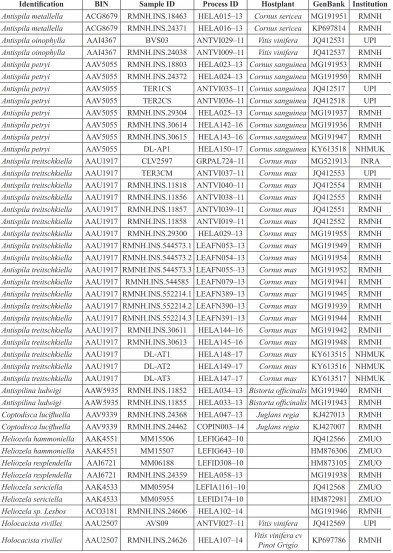
Table 1. Material of Heliozelidae used for DNA barcodes, all in dataset DS-ANTITR, doi: 10.5883/DS-ANTITR.
Identification BIN Sample ID Process ID Hostplant GenBank Institution
Antispila metallella ACG8679 RMNH.INS.18463 HELA015–13 Cornus sericea MG191951 RMNH
Antispila metallella ACG8679 RMNH.INS.24371 HELA016–13 Cornus sericea KP697814 RMNH
Antispila oinophylla AAI4367 BVS03 ANTVI029–11 Vitis vinifera JQ412531 UPI
Antispila oinophylla AAI4367 RMNH.INS.24038 ANTVI009–11 Vitis vinifera JQ412537 RMNH
Antispila petryi AAV5055 RMNH.INS.18803 HELA023–13 Cornus sanguinea MG191953 RMNH
Antispila petryi AAV5055 RMNH.INS.24372 HELA024–13 Cornus sanguinea MG191950 RMNH
Antispila petryi AAV5055 TER1CS ANTVI035–11 Cornus sanguinea JQ412517 UPI
Antispila petryi AAV5055 TER2CS ANTVI036–11 Cornus sanguinea JQ412518 UPI
Antispila petryi AAV5055 RMNH.INS.29304 HELA025–13 Cornus sanguinea MG191937 RMNH
Antispila petryi AAV5055 RMNH.INS.30614 HELA142–16 Cornus sanguinea MG191936 RMNH
Antispila petryi AAV5055 RMNH.INS.30615 HELA143–16 Cornus sanguinea MG191947 RMNH
Antispila petryi AAV5055 DL-AP1 HELA150–17 Cornus sanguinea KY613518 NHMUK
Antispila treitschkiella AAU1917 CLV2597 GRPAL724–11 Cornus mas MG521913 INRA
Antispila treitschkiella AAU1917 TER3CM ANTVI037–11 Cornus mas JQ412553 UPI
Antispila treitschkiella AAU1917 RMNH.INS.11818 ANTVI040–11 Cornus mas JQ412554 RMNH
Antispila treitschkiella AAU1917 RMNH.INS.11856 ANTVI038–11 Cornus mas JQ412555 RMNH
Antispila treitschkiella AAU1917 RMNH.INS.11857 ANTVI039–11 Cornus mas JQ412551 RMNH
Antispila treitschkiella AAU1917 RMNH.INS.11858 ANTVI019–11 Cornus mas JQ412552 RMNH
Antispila treitschkiella AAU1917 RMNH.INS.29300 HELA029–13 Cornus mas MG191955 RMNH
Antispila treitschkiella AAU1917 RMNH.INS.544573.1 LEAFN053–13 Cornus mas MG191949 RMNH
Antispila treitschkiella AAU1917 RMNH.INS.544573.2 LEAFN054–13 Cornus mas MG191954 RMNH
Antispila treitschkiella AAU1917 RMNH.INS.544573.3 LEAFN055–13 Cornus mas MG191952 RMNH
Antispila treitschkiella AAU1917 RMNH.INS.544585 LEAFN079–13 Cornus mas MG191941 RMNH
Antispila treitschkiella AAU1917 RMNH.INS.552214.1 LEAFN389–13 Cornus mas MG191945 RMNH
Antispila treitschkiella AAU1917 RMNH.INS.552214.2 LEAFN390–13 Cornus mas MG191939 RMNH
Antispila treitschkiella AAU1917 RMNH.INS.552214.3 LEAFN391–13 Cornus mas MG191944 RMNH
Antispila treitschkiella AAU1917 RMNH.INS.30611 HELA144–16 Cornus mas MG191942 RMNH
Antispila treitschkiella AAU1917 RMNH.INS.30613 HELA145–16 Cornus mas MG191948 RMNH
Antispila treitschkiella AAU1917 DL-AT1 HELA148–17 Cornus mas KY613515 NHMUK
Antispila treitschkiella AAU1917 DL-AT2 HELA149–17 Cornus mas KY613516 NHMUK
Antispila treitschkiella AAU1917 DL-AT3 HELA147–17 Cornus mas KY613517 NHMUK
Antispilina ludwigi AAW5935 RMNH.INS.11852 HELA034–13 Bistorta officinalis MG191940 RMNH
Antispilina ludwigi AAW5935 RMNH.INS.11855 HELA033–13 Bistorta officinalis MG191943 RMNH
Coptodisca lucifluella AAV9339 RMNH.INS.24368 HELA047–13 Juglans regia KJ427013 RMNH
Coptodisca lucifluella AAV9339 RMNH.INS.24462 COPIN003–14 Juglans regia KJ427007 RMNH
Heliozela hammoniella AAK4551 MM15506 LEFIG642–10 JQ412566 ZMUO
Heliozela hammoniella AAK4551 MM15507 LEFIG643–10 HM876306 ZMUO
Heliozela resplendella AAI6721 MM06188 LEFID308–10 HM873105 ZMUO
Heliozela resplendella AAI6721 RMNH.INS.24359 HELA058–13 MG191938 RMNH
Heliozela sericiella AAK4533 MM05954 LEFIA1161–10 JQ412568 ZMUO
Heliozela sericiella AAK4533 MM05955 LEFID174–10 HM872981 ZMUO
Heliozela sp. Lesbos ACO3181 RMNH.INS.24606 HELA102–14 MG191946 RMNH
Holocacista rivillei AAU2507 AVS09 ANTVI027–11 Vitis vinifera JQ412569 UPI
Morphology.Methods for preparation of the genitalia follow van Nieukerken et al. (2012b). We usually embedded the total genitalia in dorso-ventral position, or removed the phallus. In some cas
-es we unrolled the genitalia, but refrained from spreading the valvae, as this distorts the genitalia too much. For staining male genitalia, we used phenosafranin. Wings were cleaned and descaled in ethanol 70%, stained with phenosafranin and mounted in euparal. Larval pelts remaining after DNA extraction were also stained with phenosafranin and embedded in euparal. Photographs of moths, leafmines, genitalia slides and larval slides in Leiden were taken with a Zeiss AxioCam digital camera attached, respectively, to a Zeiss Stemi SV11 stereo-microscope, a motorized Zeiss SteREO Discovery.V12 or a Zeiss Axioskop H, using Carl Zeiss AxioVision software. Photos by RB were taken with a Canon EOS 5D, Mark II with a Canon MP-E 65mm lens. Photos of complete leaves and leafmines were taken with a Canon EOS 60D on a stand with back lighting, using a light box. Drawings of the genitalia were prepared by JCK with a compound microscope using the camera lucida method (Koster and van Nieukerken 2017). Morphological terminology for adults, including interpretation of wing veins, follows recent Heliozelidae treatments (van Nieukerken and Geertsema 2015).
Measurements of genitalia and forewing details (Table 2) were taken from photographs, using the measurement tools in AxioVision ® software. Measurements of wingspan and forewing length in descriptions were taken with a Zeiss Stemi SV11 stereo microscope, using an eyepiece graticule scale. Measurements in descriptions are given as range with mean ± standard deviation in brackets, followed by sample size (e.g.: 2.7 ± 0.2, 12) when the sample size is 5 or larger.
DNA extraction and sequencing. DNA was extracted using the Qiagen Blood and Tissue kit,
either destructively from larvae or adult specimens preserved in 96% or 100% ethanol or non-de
-structively from the abdomen of voucher specimens, which were then used to prepare genitalic dissections (partly according to protocol in Knölke et al. 2005), or non-destructively from larvae. A 665 bp or a 658 bp fragment of the mitochondrial COI gene was amplified using the Lep prim
-ers (Hebert et al. 2004) or the Folmer prim-ers (Folmer et al. 1994), or a combination thereof and sequenced bidirectionally (van Nieukerken et al. 2012a; Doorenweerd et al. 2016).
Data selection and phylogenetic analysis. Since many molecular data on Heliozelidae have re
-cently been published or will soon be published (van Nieukerken et al. 2012b; van Nieukerken and Geertsema 2015; Milla et al. 2017), we restrict molecular data here to European species. Neighbor Joining (NJ) trees based on DNA barcode sequences of all available specimens were prepared with tools provided by the Barcode of Life Data Systems (Ratnasingham and Hebert 2007). Genetic dis
-tance calculations were performed both using the Kimura two-parameter (K2P) model and uncor
-rected P distance, the former being more commonly used but the latter being more biologically ap
-propriate (Srivathsan and Meier 2012). Maximum Likelihood analyses of the aligned COI barcode regions were performed using RAxML v8 (Stamatakis 2014), searching for the best scoring tree and a multiparametric bootstrap analysis with automated halting following the extended majority rule criterion. The bootstrap support values were subsequently plotted onto the best scoring tree.
The sequence data generated and used in this study have been deposited in the public BOLD dataset ( “Antispila treitschkiella and petryi in Europe ” [DS-ANTITR], doi: 10.5883/DS-ANTITR and GenBank (Table 1).
Hostplant nomenclature and recognition. For the nomenclature we follow in principle
In Europe, there are three widespread native species of Cornus, two shrubs C. mas and C.
sanguinea, and a herb, C. suecica L. In addition C. alba L. occurs natively in Russia, North and
East of Moscow, through Siberia to Korea and NE China (Sokolov et al. 1986), but is also planted elsewhere and locally naturalised. The North American C. sericea L. (some authors use the name C. stolonifera Mitch.) is widely planted and becoming an invasive shrub locally in Europe (Bačič et al. 2015; van Valkenburg et al. 2017). Most European floras (e.g. Ball 1968; Jonsell 2010) treat these four species, but some do not separate the closely related C. sericea and C. alba, which ap
-parently also form hybrids and are sometimes considered subspecies, resulting in the name C. alba subsp. stolonifera (Michx.) Wang for the North American subspecies (Schulz 2012). However, recent North American treatments do not follow this (Murrell and Poindexter 2016).
For C. sanguinea in Europe there usually are two subspecies recognised: C. sanguinea subsp.
australis (C.A.Mey.) Jáv. from SE Europe (but often planted elsewhere!), and the nominal subspecies sanguinea. They can be separated by the type of hairs on leaf-underside: normal hairs in sanguinea, so-called compass hairs or medifixed hairs (also the common type of hairs in other Cornus spp.) in subsp. australis (see Suppl. material 2: Fig. S1). Some authors also recognise a C. sanguinea subsp. hungarica (Karpati) Soo, but according to Verloove (2017) that is a hybrid of the other two subspecies.
In our experience, many records of hostplants of Antispila are either incomplete by just men
-tioning the genus Cornus, and quite a few are incorrect or questionable. We encourage collectors and observers to try to identify the host accurately to species level, in order to get a better impres
-sion of the host distribution of the Antispila species. Identification is usually not difficult when fruits are present, which may be found on the ground later in the season. Identification of single plucked leaves may be difficult, but often not impossible, and it is best to make notes and photo
-graphs and take a voucher (herbarium sample) of the plant where possible for future reference. As a host identification aid, we list some of the vegetative characters of the four species, and add the Japanese Cornelian Cherry, C. officinalis Torr. ex Dur., since A. treitschkiella mines can be found on botanic living collections in Europe seemingly misidentified as that species, or of hybrid origin:
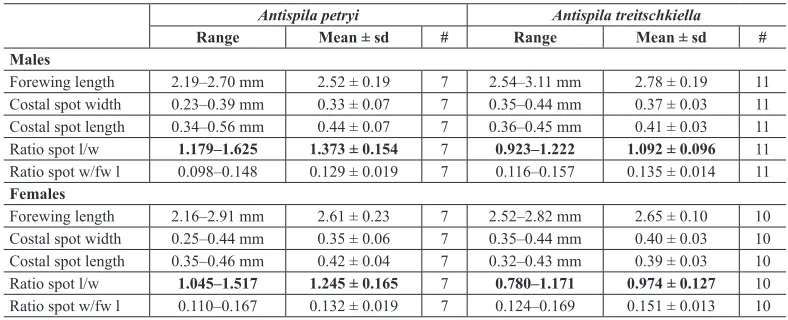
Table 2. Comparison of measurements of forewing and costal spot in Antispila petryi and A. treitschkiella
males and females. Measured on photos, specimens from RMNH collection. Forewing length here does not include fringe, and thus differs from measurements in descriptions. The ratio length–width of the costal spot differs significantly between the species (marked in bold), but still shows an overlap.
Antispila petryi Antispila treitschkiella
Range Mean ± sd # Range Mean ± sd # Males
Forewing length 2.19–2.70 mm 2.52 ± 0.19 7 2.54–3.11 mm 2.78 ± 0.19 11
Costal spot width 0.23–0.39 mm 0.33 ± 0.07 7 0.35–0.44 mm 0.37 ± 0.03 11
Costal spot length 0.34–0.56 mm 0.44 ± 0.07 7 0.36–0.45 mm 0.41 ± 0.03 11
Ratio spot l/w 1.179–1.625 1.373 ± 0.154 7 0.923–1.222 1.092 ± 0.096 11
Ratio spot w/fw l 0.098–0.148 0.129 ± 0.019 7 0.116–0.157 0.135 ± 0.014 11
Females
Forewing length 2.16–2.91 mm 2.61 ± 0.23 7 2.52–2.82 mm 2.65 ± 0.10 10
Costal spot width 0.25–0.44 mm 0.35 ± 0.06 7 0.35–0.44 mm 0.40 ± 0.03 10
Costal spot length 0.35–0.46 mm 0.42 ± 0.04 7 0.32–0.43 mm 0.39 ± 0.03 10
Ratio spot l/w 1.045–1.517 1.245 ± 0.165 7 0.780–1.171 0.974 ± 0.127 10
Cornus mas. Stems green, rarely reddish. Leaves 4–10 cm long, greatest width below middle. Veins 3–5 pairs, often with tufts of white hairs in vein axils, most hairs medifixed, straight (Suppl. material 2: Fig. S1c).
Cornus officinalis. Stems green or red. Leaves ovate to elliptic, 4–12 cm long. Veins 4–7 pairs, with dense tufts of rusty red to brown (not white) hairs in vein axils. Otherwise closely resembles C. mas. (Suppl. material 2: Fig. S1e)
Cornus sanguinea subsp. sanguinea. Stems at least partly red. Leaves 3–10 cm long, largest width in middle. Veins 3–4 pairs, no tufts of hairs, but hairs spread on green underside (becoming red in autumn), only few medifixed hairs (Suppl. material 2: Fig. S1a).
Cornus sanguinea subsp. australis. As nominal subspecies, but most hairs are medifixed (Suppl.
material 2: Fig. S1b).
Cornus sericea. Stems red at sun side, forming roots when touching ground (stoloniferous). Leaves 6–13 cm long. Veins 5–7 pairs, underside often hairy, pale coloured (glaucous), both sides with medifixed hairs (Suppl. material 2: Fig. S1d).
Cornus alba. Stems always red to purple, rather straight, not forming roots when touching ground. Leaves 4–10 cm. Veins 5–7 pairs, underside often hairy, pale coloured (glaucous), both sides with medifixed hairs.
Living collections study. A few parks and living botanic collections in the UK were studied in de
-tail in 2016–2017 in order to address the reliability of findings regarding monophagy of A. treitsch-kiella and A. petryi in particular. Because A. treitschkiella was found to be commonly established in the London area as well as in Cambridge, reaching outbreak levels on some trees of C. mas, and Cornus species were often planted in clusters, this seems a reasonable assay of hostplant repertoire at this time. This survey was conducted in the UK in October and November 2016 within the distri
-bution range so far known for A. treitschkiella, guided mostly by garden maps printed by botanical garden staff. The survey was mainly conducted at Royal Botanic Gardens, Kew on 28.ix.2016 and at Royal Horticultural Society, Wisley on 5.x, with a visit to Cambridge Botanical Gardens on 17.ix. Depending on different plantings at these gardens, examination was conducted of C. mas and C.
san-guinea (including several cultivars of both species), and in addition for specimens of C. sericea, C.
rugosa Lam., C. alba, C. amomum Mill., C. brachypoda C.A. May, C. schindleri Wangerin, C.
drum-mondi C.A. Mey, C. darvasica (Pojark.) Pilip., C. kousa F. Buerger ex Hance (incl. “Eddie’s White Wonder”, C. walteri Wangerin (=C. coreana Wangerin), C. controversa Hemsl., C. bret schneideri L. Henry, C. capitata Wall., C. x arnoldiana Rehder (= C. racemosa Lam. x C. obliqua Raf.), C. quinquinervis Franch. (= C. paucinervis Hance) and C. officinalis. A single specimen of C. mas was also examined at Chelsea Physic Garden in x.2016 and Oxford University Parks on 30.vii.2017, as well as a single specimen in Oxford Botanical Garden (C. mas var. variegata). Additional negative records on C. mas from other observers elsewhere in the UK are reported under results.
Herbarium study. In the UK in 2016, herbaria in Kew and Wisley and at NHMUK (the AMC
herbarium of native and naturalised species) were examined and Cornus was surveyed, including all available C. mas, with the hope of determining origins of invasion of A. treitschkiella in the UK and within Europe. It was hoped that this approach would prove informative as it was for Camerar-ia ohridella Deschka & Dimič (Lees et al. 2011). Wisley was potentially useful because of its focus on cultivated specimens. Specimens of C. mas in flower but not in leaf were ignored.
Parasitoids. We have tried to trace all literature records of parasitoids of these species. As basis
2012) and subsequently traced original references to check for the identity of the host species. We assumed that hosts identified as “Antispila treitschkiella” were A. petryi when reared from C.
san-guinea, and A. treitschkiella when reared from C. mas. Hosts identified as Antispila sp. could only
be identified to species when the host was given as C. mas, because Antispila on C. sanguinea can refer to both A. petryi and A. metallella. In addition a few records of specimens reared by DCL are added (Table 3), which were identified by N. Dale-Skey, J. Noyes and C. Hansson.
Results
Recognition of the species
Adult morphology. Martini (1899) wrote that the species have only small external differences (“Diese
neue der Treitschkiella äußerst ähnliche Art zeigt in Färbung und Zeichnung nur geringe Unterschie -de”), but he found differences in the distal costal spot: longer than wide and almost triangular in A. petryi and almost square and shorter in A. treitschkiella. Dziurzyński (1952) confirmed this character, but by his many measurements he also showed that the character is not fully reliable. We agree that in many cases this character works as a first indication, particularly in females, as the ratio length/width is significantly different in our measurements (see Table 2), but there is some overlap.
Dziurzyński (1952) also mentioned that the fascia is straighter in A. treitschkiella, never inter
-rupted, while it is often interrupted in A. petryi and more curved, with the concave margin at the base. Checking the photographs of many specimens we cannot support this character, both species seem to be variable in this respect.
Venation. Martini (1899) was convinced about the difference in the venation, particularly the position of the M stem in the discoidal cell. However, Dziurzyński (1952) showed the variability of this character. We only prepared one pair of wings of each species (Figs 9–10) and these wings in
-deed support Martini´s difference, but we cannot attest to its reliability. The usefulness of venational characters at species level has been challenged in other moths such as Elachistidae (Albrecht and Kaila 1997), whereas at generic level of Heliozelidae, the larger differences in venation appear to be phylogenetically informative (van Nieukerken et al. 2012b; van Nieukerken and Geertsema 2015).
Genitalia. Martini (1899) mentioned that genitalia were studied, in a time when almost nobody did so with microlepidoptera, but he did not provide details or differences. In two weighty papers, Dziurzyński (1948, 1952) described the genitalia of the species in great detail, with many illustra
-tions. These provided sufficient characters for separation of the species, including the characteristic “horseshoe-shaped” anellus in A. petryi (Fig. 14) that is not developed in A. treitschkiella (Fig. 19). Other differences are found in the uncus, the shape and number of spines on the phallotheca and the shape and length of the sublateral process of the transtilla. These differences were considered to fall within the intraspecific variation as considered by Wojtusiak (In: Razowski 1978), but we refute that here: the characters are constant and identify at least the males easily.
In the female genitalia, Dziurzyński (1952) could not find differences, but we see a small differ
-ence in the length of the apophyses, it is possible that the tip of the oviscapt shows a tiny differ-ence, being more indented in A. treitschkiella (Figs 22, 25, 31, 32), and it seems that the tip of segment 8 is more bilobed in A. petryi (Figs 23, 26), but the shown differences may be partly due to the preparation process. We only examined very few slides of female genitalia.
Table 3. Parasitoids recorded from Cornus feeding Antispila species. Where possible, primary sources were checked, indicated by the catalogue databases (Noyes 2003;
Yu et al. 201
1a;
Yu 2012 )
. Taxa Locality Host-plant Original identification Refer ence
Antispila petryi Eulophidae Pnigalio
pectinicornis (Linnaeus, 1758) UK C. sanguinea A. tr eitschkiella
Askew and Shaw 1974
Pnigalio cf. soemius (W alker , 1839) UK, Surrey
, Priest Hill,
C.
sanguinea
A. petryi
DCL
reared
Antispila treitschkiella Braconidae Colastes
flavitarsis
(Thomson, 1892)
HU: Pécs, 17.xi.1971, 27.x.1974
C. mas
A. tr
eitschkiella
Papp 1975; Papp 2008
Eulophidae Chrysocharis budensis
(Erdős, 1954)
HU: Budapest, Budakeszi, leg.
Szőcs
[interpreted as
C. mas
, since Szőcs
recognised both
Antispila
spp.]
A. tr
eitschkeella
Erdős 1954; 1956; Szőcs 1959
Chrysocharis budensis (Erdős, 1954) PL: W oj. Poznan Not given A. stachjanella Hansson 1985 Cirr ospilus diallus W alker , 1838
CZ: Koda near Beroun, 3.1954
C. mas A. sp Bouček 1959 Cirr ospilus viticola (Rondani, 1877) [as subviolaceus Thomson]
CZ: Koda near Beroun, 3.1954
C. mas
“a leafminer” [interpreted as
treitschkiella ] Bouček 1959 Cirr ospilus vittatus W alker , 1838 CZ C. mas A. sp Bouček 1959 Der ostenus gemmeus (W estwood, 1833)
HU: Normafa, 14.vii.1954
[interpreted as
C mas
, since Szőcs
recognised both Antispila spp.] A. tr eitschkeella Erdős 1956 Minotetrastichus fr ontalis (Nees, 1834)
UK, SE London, Kelsey Park,
x.2016 C. mas A. tr eitschkiella DCL reared Minotetrastichus fr ontalis (Nees, 1834) UK: London, Victoria Embankment, 30.vi.2017 C. mas A. tr eitschkiella DCL reared
Antispila metallella Eulophidae Chrysocharis budensis
(Erdős, 1954)
NL: Simpelveld [as Simpelweld]
Not given A. pfeiffer ella Hansson 1985 Chrysocharis budensis (Erdős, 1954) PL: Torún C. sanguinea A. pfeiffer ella
Vidal and Buszko 1990
Host unidentifiable Antispila Colastes braconius Haliday , 1833 UK Swida sanguinea A. sp. Shaw 1983 Colastes braconius Haliday , 1833 Not given A. tr eitschkiella
Hedwig 1955; Belokobylskij
and
Tobias 1986
Colastes
flavitarsis
(Thomson, 1892)
HU: Pécs, Üszög,1.x.1973
C. mas A. pfeiffer ella [unlikely] Papp 2008 1 Chrysocharis budensis (Erdős, 1954) DE: München Not given A. tr eitschkiella Hansson 1985 Pnigalio cristatus Ratzebur g, 1848
[primary source not seen]
Not given
Noyes 2003
Zagrammosoma
variegatum
Masi, 1907
[primary source not seen]
Not given
and abdomen: nine in A. petryi and eight in A. treitschkiella, missing the spot on the mesothorax. However, Dziurzyński (1952) refuted this character as the number of these dots and their presence on the mesothorax are variable. We found this differential character to be correct; it can be used in many cases (Figs 39, 41). However, the amount of melanisation indeed varies, leading to a lower number of observed dots in some cases even though they are present. In microscopic preparations these differences are always apparent and these spots stain when phenosafranin is used (Figs 33–37).
Dziurzyński (1952) described another larval character on the dorsal side of the 8th segment: a belt of dark “warts”, termed by him the “cingulum macropapillare”. The difference between the species is that A. petryi has 4–10 warts in a single row or two rows, whereas A. treitschkiella (as stachjanella) has many more small wartlets in (at least) three rows. We here confirm the usefulness of this character (Figs 35, 38, 40, 42). This structure has been described in more detail from the related North American A. nysaefoliella Clemens, 1860 as “bumps”, that were shown to generate essentially substrate-born vibrations that can even be heard by the human ear (Low 2008, 2012). This alleged stridulatory behaviour whose function was hypothesised by Low to deter parasitoids has not been studied in European species, but seems very likely also to occur here.
Mines. The shape of the mines is variable, and both earlier authors were unable to point out clear differences, other than the hostplant species. The size of the cut-out is on average slightly smaller in A. petryi than treitschkiella, but without diagnostic value (Figs 43–48, 55, 56).
Updated checklist of European Heliozelidae Heliozela Herrich-Schäffer, 1853
1. hammoniella Sorhagen, 1885 2. resplendella (Stainton, 1851) 3. lithargyrellum (Zeller, 1850)
4. sericiella (Haworth, 1828) [type species]
Antispila Hübner, 1825
5. metallella (Denis & Schiffermüller, 1775) [type species] 6. treitschkiella (Fischer von Röslerstamm, 1843)
7. petryi Martini, 1899
Provisionally in Antispila, but not belonging there 8. oinophylla van Nieukerken & Wagner, 2012*
ampelopsifoliella auctt. [misidentification]
Antispilina Hering, 1941
9. ludwigi Hering, 1941 [type species]
Holocacista Walsingham & Durrant, 1909 10. rivillei (Stainton, 1855) [type species]
Coptodisca Walsingham, 1895 11. lucifluella (Clemens, 1860)*
Key to adults of European Heliozelidae
1 Forewing shiny grey to brown, with only one or two spots along dorsum... ...Heliozela [not further treated here] – Forewing with pale spots at both costal and dorsal margin, often a fascia present as well ...2 2 Forewing basally silvery white, distally dorsal area black and costal area yellow, with
two conspicuous triangular silvery spots. Very small, wingspan 3.5–4.7 mm, introduced on Juglandaceae: walnut species (Juglans L.) and pecan (Carya illinoinensis (Wangenh.) K.Koch) in Italy (Bernardo et al. 2015) ...Coptodisca lucifluella
– Forewing more or less uniform brown or fuscous, with a pale fascia, sometimes broken, at 1/3 and two opposite spots at 2/3 ...3 3 Forewing with an additional white silvery spot in apex, not touching the wing margins.
Head silvery white. Wingspan 5.5–6.2 mm. Introduced on Vitaceae: grapevine (Vitis vi-nifera L.) and Virginia creeper (Parthenocissus quinquefolia (L.) Planch.) in Italy (van Nieukerken et al. 2012b) ...Antispila oinophylla
– Forewing without an additional apical spot, head not white, various tinges of grey, brown or leaden. Native species ...4 4 Small species, wingspan 4.0–4.7 mm. Venation reduced, no cell in forewing. Antenna
with 15–20 segments. Leafminers on Vitis or Bistorta Scop. ...5
– Larger species, wingspan at least 5.0 mm, usually more. Venation complete with discoidal cell (Figs 9, 10). Antenna with 19 segments or more. Leafminers on Cornus ...6 5 Forewing fascia usually divided into two spots, spots relatively large, antenna with 15
segments. Male foretibia with small epiphysis. Mediterranean species, mines on Vitis (van Nieukerken and Geertsema 2015)...Holocacista rivillei
– Forewing fascia not divided in two spots, spots small, antenna with 20 segments. Male foretibia without epiphysis. Rare Central European species, mines on Bistorta officinalis Delarbre (Polygonaceae) (Hering 1941) ...Antispilina ludwigi
6 Smaller species, wingspan 4.8–7.0 mm; forewing and thorax dark fuscous to black, head greyish; male forewing underside with bunch of yellow androconial scales (Figs 7, 8). Antenna with ca 19–22 segments ...7 – Larger species, wingspan 6.8–8.5 mm, usually larger than 7.0 mm; wings and thorax cop
-pery, head golden; male forewing underside without androconial scales. Antenna with ca 25 segments. ...Antispila metallella
7 Forewing costal spot usually triangular, ratio length/width: 1.18–1.63 in males, 1.05–1.52 in females; slightly smaller, wingspan 4.8–6.1 mm. Best distinguished by male genitalia, larva and hostplant: C. sanguinea ...A. petryi
– Forewing costal spot usually trapezoid to almost square, ratio length/width: 0.93–1.22 in males, 0.78–1.17 in females; slightly larger, wingspan 5.7–7.0 mm. Best distinguished by male genitalia, larva and hostplant: C. mas ...A. treitschkiella
Key to male genitalia of European Antispila feeding on Cornus
1 Uncus medially blunt, central lobe reduced or absent. Valva at inner margin with spine
-like process (Figs 57, 59) ...A. metallella
2 Horseshoe-shaped anellus present between the valvae (Fig. 11). Uncus laterally of medi
-al lobe hardly indented (Figs 14, 27). Later-al process of transtilla dist-ally clearly widened (Fig. 14) ...A. petryi
– No anellus between valvae visible (Fig. 16). Uncus laterally of medial lobe distinct
-ly indented (Figs 19, 28). Lateral process of transtilla distal-ly not or hard-ly widened (Fig. 16) ...A. treitschkiella
Key to the leafmines and larvae of European Antispila
1 Near start of mine 2–7 small brown scars made by ovipositing female (“test punctures”) (Figs 62, 63, 65). Larva without dark sclerotised plates (Fig. 64). Vacated mine with large cut-out of ca. 5.5–7 mm length. Mines on C. sanguinea, C. alba or C. sericea ...A. metallella
– No scars near start of mine. Larva with row of dorsal black sclerotised plates (note: larvae usually feed with ventral side upwards) (Figs 39, 41). Vacated mine with small cut-out of ca. 4–5 mm length. Mines on C. sanguinea or C. mas ...2 2 Mine on C. mas. Full grown active larva whitish, with maximum of 8 black dorsal plates
(Fig. 41), often less, no plate on mesothorax. Abdominal segment 8 dorsally at anal end with 2–3 rows of more than 20 black warts of different sizes (Fig. 42) ...A. treitschkiella
– Mine on C. sanguinea. Full grown active larva greyish, with maximum of 9 black dorsal plates, often less visible (plates not always melanised), plate on mesothorax present (Fig. 39). Abdominal segment 8 dorsally at anal end with one row of ca 5 large black warts (Fig. 40) ...A. petryi
Taxonomic descriptions
Antispila petryi Martini sp. rev.
Figs 1, 2, 7, 10–15, 21–23, 27, 29, 31, 33–35, 39, 40, 43–45, 49–52, 55
Antispila petryi Martini, 1899: 398. Syntypes: Germany: 12–14 adults, Thüringen, Sachsenburg, caterpillars 18.viii.–8.
ix.1895, Cornus sanguinea, emerged 6–24.vi.1896, 1898, Martini; ditto, caterpillars mid ix.–3.x.1897, no emergence
date given (at least seven syntypes in NHMUK via Hofmann collection, examined by DCL).
Antispila petryi; Spuler and Meess 1910: 471; Martini 1917: 158 (records Thüringen); Hering 1932: 18 (key); Toll 1947: 31 (Poland); Dziurzyński 1952: 1 (monograph , Poland); Bentinck 1951: 331 (corrected id Dutch record); Hering 1957: 325 (leafmine); Gozmány 1965: 47 (footnote, key, Hungary); Hering 1968: 120 (letter to Klimesch of 1952); Szőcs 1973: 452 (Hungary); Maček 1974a: 56 (Slovenia); Maček 1974b: 94 (Slovenia); Emmet 1976: 306 (description, Eng-land); Lempke 1976: 14 (Netherlands, checklist); Szőcs 1977: 121 (leafmine key); Kuznetsov 1978: 73 (keys); Szőcs 1979: 46 (Hungary: Börzsöny); Szőcs 1981: 210 (Hungary: Budapest); Szabóky 1982: 8 (Hungary: Bakony); Emmet 1988: 38 (biology); Laštůvka et al. 1993: 36 (Czech Republic: Moravia); Corley et al. 2015: 60 (Portugal, checklist); Corley et al. 2016: 619 (Portugal).
Elachista treitschkeella [Misidentification, Unjustified emendation]; Stainton 1851: 9 (England).
Elachista treitschkiella [Misidentification]; Stainton 1854: 250 (England); Fologne 1860: 109 (Belgium, probably
petryi).
Antispila treitschkiella [Misidentification]; Healy 1864: 126 (life history); Stainton et al. 1870: 318 (England); Wocke 1874: 88 (Schlesien, now Poland); Heinemann and Wocke [1876]: 515 (description, Germany); Glitz 1877: 40 (Germany: Hannover); Sand 1879: 192 (France); Frey 1880: 405 (Switzerland); Rössler 1881:323 (Germany: Hessen); Meyrick 1895: 684 (England); Buhr 1935: 158 (Germany: Mecklenburg); Doets 1949: 416 (the Netherlands); Lhomme 1963:
1157 (France, partim); Wojtusiak 1976: 12 (partim, key); Razowski 1978: 96 (Poland, partim, petryi synonymised);
Material examined. Total 23♂, 27♀: France (leafmines), Germany (2♂, 1♀, leafmines), Greece (1♂, larvae, leafmines), The Netherlands (14♂, 12♀, larvae, leafmines), Switzerland (5♂, 14♀, larvae, leafmines), United Kingdom (1♂, larvae). Details in Suppl. material 1.
Differential diagnosis. Antispila petryi and A. treitschkiella differ from A. metallella by their
smaller size (wingspan 4.8–7.0 mm against 6.8–8.5 mm) and in male by presence of a tuft of yel
-low androconial scales on forewing underside. A. petryi differs from A. treitschkiella by the usually smaller and more triangular costal spot at 2/3, and A. petryi is on average smaller than A. treitsch-kiella, but there is some overlap (wingspan 4.8–6.1 against 5.7–7.0 mm). In the male genitalia, the indentations in the uncus are shallower in A. petryi than in A. treitschkiella, the lateral process of the transtilla is straight and widened and the shorter phallus bears two types of spines externally. The horseshoe-shaped sclerotized anellus is characteristic for A. petryi, an anellus is undeveloped in A. treitschkiella. Separation by female genitalia not reliable.
Larva easily separated from A. metallella by presence of a row of dorsal black dots, in contrast to A. treitschkiella, a total of nine dots, including the mesothorax, but some of these may be poorly mela
-nised, making this character not always useable; abdominal segment 8 with a single row of five black warts. Leafmines in principle not separable without larva or when hostplant species is not known.
Description. Male (Figs 1, 49, 50). Head, face and vertex covered with appressed lead-grey
scales. Antenna fuscous, clearly ringed, particularly near tip. Thorax dark fuscous, concolorous with forewings. Legs grey, tarsi ringed white at tip, spurs and undersides paler. Forewing dark fuscous to almost black with silver-golden patterning; an outwardly oblique fascia at ca 1/3, nar
-rowing in middle, sometimes broken, dorsal edge slightly wider than costal; dorsal spot slightly beyond middle of posterior margin, triangular, reaching hardly to middle of wing, a similar triangu
-lar costal spot at 2/3, slightly longer than wide; fringe line distinct. Terminal fringe paler. Hindwing rather dark grey. Underside of wings fuscous, close to base a yellow to orange tuft of androconial scales. Abdomen lead-coloured, including vestiture on external genitalia.
Female (Fig. 2). Similar to male, androconial scales absent. Abdomen with slightly protruding ovipositor.
Measurements, male: forewing length 2.3–2.9 mm (2.7 ± 0.2, 12), wingspan 4.8–6.1 mm, 19–20 antennal segments (n=8); female: forewing length 2.3–3.0 mm (2.7 ± 0.2, 7), wingspan 4.8–6.1 mm, 19–20 antennal segments (n=3). For costal spot see Table 2.
Male genitalia (Figs 11–15, 27, 29). Uncus with two shallow setose lateral lobes and a more prominent central lobe, however, not reaching beyond a line between the lateral lobes; shallowly indented between lobes. Vinculum 335–350 μm long, anteriorly almost truncate. Valva length 230– 255 μm, basally broad, more or less triangular, narrowing towards digitate tip; pecten on pedicel, with 15–16 comb teeth (Fig. 15); anellus a strongly sclerotised horseshoe-shaped band between valvae (this structure was termed juxta by Kuroko 1961 in Cornus feeding species); transtilla plate-like, deeply indented anteriorly, sublateral processes distinct and widened at tips. Juxta anteriorly spade-shaped, about half as long as phallus. Phallus 375–385 μm long, phallotheca with groups of many scaly spines an less larger pointed spines; clearly two types of spines.
Figures 1–6. Antispila, adult habitus, all from Switzerland. 1 A. petryi, male, Mont Vully, Sugiez, e.l. 08.v.2016 2 A. petryi, female, Mont Vully, Sugiez, e.l. 30.iv.2016 3 A. treitschkiella, male, Gampelen, e.l. 17.iv.2016 4 A. treitschkiella, female, Le Landeron, e.l. 17.iv.2016 5 A. metallella, male, Muntelier, 30.iv.1990 6 A. metal-lella, female, Cudrefin, e.l. 18.iii.2015. All to same scale, scale line 10 mm. Photos: Rudolf Bryner.
Larva (33–35, 39, 40). Pale grey translucent, head capsule brown, prothorax with large black tergum and sternum. In instar IV, the final feeding instar, mesothorax, metathorax and abdom
Figures 7–8. Antispila, male forewing underside with tuft of yellow androconial scales, Switzerland. 7 A. petryi, Mont Vully, Sugiez, e.l. 14.v.2016 8 A. treitschkiella, Le Landeron, e.l. 22.iii.2007. Photos Rudolf Bryner.
Biology. Hostplants.Cornus sanguinea, both subsp. australis and sanguinea, and incidentally
on cultivated C. alba (Wocke cited in Martini 1899 and see under Living collections). Martini (1899) reported also C. mas as a rare host, but did that on venational characters of moths alone, which are unreliable; we thus consider these records for now as unlikely to be correct.
Leafmines(Figs 43–45, 55). The egg is inserted on the leaf underside, often on leaf margin
(65% of 54 mines), or less frequent away from the margin; the oviposition site is recognisable as a reddish dot (the vesicula incubatoria of Dziurzyński). The mine starts with a narrow gallery, al
-most straight along the leaf margin when the egg was laid there, or much contorted in other cases; it is usually filled with frass, but the width of the frass line is variable. Later mine expanding into a large full depth blotch, in some cases completely absorbing the earlier gallery; frass often in a clump near the origin of the mine and also scattered around. The larva prepares an oval cut-out of ca 4–5 mm length, usually at the other edge of the mine, lined with silk, and drops to the ground in this case. The larvae feed with ventral side up, but they start turning around in the blotch when preparing the cut-out. The gallery part of the mine is prepared during the first two instars, the blotch during instar 3 and 4.
Life history.Univoltine. Larvae usually from late August until October, in Greece still active
in early November, few records from early August. Adults emerge in captivity from April to June, the few specimens collected as adults being found from June to early August. We assume they are mostly active during the day, rarely collected at light, but found in malaise traps.
Distribution. Widespread in Europe, local in southern England, in the Netherlands and Bel
-gium local in hilly limestone areas in the South and East. Throughout central and southern Europe, but not known in detail, due to confusion with A. treitschkiella, but correct records (on the basis of examined adults, larvae or hostplant data) exist from Germany, Poland, Hungary, Czech Republic (Z. Laštůvka, pers. comm.), Austria (as A. treitschkiella: Klimesch 1990), Switzerland, France, Portugal (Corley 2015), Italy, Slovenia and Greece. Recently recorded (as A. treitschkiella) from the island Öland in Sweden since 2006 (Svensson 2007) and the island Saaremaa in Estonia since 2010 (Jürivete 2012).
in southern Europe including northern parts of the Iberian peninsula, all of Italy, Corsica, Sardinia, and all of the Balkans except the Greek islands; local in northern Turkey, and widespread in the Caucasus region, reaching Iran (Popescu et al. 2016).
Remarks. This species was described from an unspecified number of specimens reared by Mar
-tini from mines on C. sanguinea, collected as caterpillars in 1895 and 1897 in Sachsenburg (not far from Sömmerda) and with adults reared in 1896 and 1898. Martini also mentioned the species from Regensburg, Bavaria, and Breslau (now Wrocław, Poland), but he probably did not study these himself, and relied on information received from respectively Hofmann and Wocke. Issue no 10–12 (Heft IV), pages 333–429 of volume 59 of the Stettiner Entomologische Zeitschrift was published in June 1899 (see page 429: http://biodiversitylibrary.org/page/8946769). This would have allowed Martini to include the reared adults from 1898, although he did not give emergence dates for these.
Martini’s study is very thorough, comparing A. petryi with A. treitschkiella and A. metallella (“pfeifferella”), including the biology and mines. Martini’s collection of Palaearctic Microlepido-ptera was presented to the primary school (“Volksschule”) in Sömmerda, his place of residence in the German federal state of Thüringen, and is no longer traceable (Horn et al. 1990: 253). There is a series of seven potential syntypes of A. petryi in the Hofmann collection in London, cited in Suppl. material 1, from which a lectotype could be selected, if found necessary. For now we consider the identity of A. petryi sufficiently settled and refrain from lectotypification.
Wojtusiak (1976), in his keys to Polish species, lumped the C. mas and C. sanguinea feeders under A. treitschkiella, but he did not propose a formal synonymy, nor did he mention the names A. petryi or A. stachjanella at all. The synonymy of A. petryi with A. treitschkiella was formalized by Razowski (1978). The translation of his argumentation in Polish [the paragraph on page 97 starting with: “Uwagi. Gatunek ten …..”] for this synonymy reads roughly (edited from Google translation, kindly checked by Lukasz Przybyłowicz):
Note. This species was known under the three names listed under the synonymy [viz. treitsch-kiella, petryi and stachjanella]. Dziurzyński (1948, 1952) gave some differences between A. treitsch kiella (F. R.) and A. petryi Mart. and described in addition a new species. The extensive material examined by Dr. J. Wojtusiak allowed to conclude that these differences are unstable and fall within the limits of intraspecific variation.
The male genitalia figured by Wojtusiak and reproduced by Razowski resemble more A. petryi than A. treitschkiella, but some important characters are not illustrated (transtilla, anellus). Also in the drawings in Bengtsson et al. (2008) the anellus is not figured.
Antispila treitschkiella (Fischer von Röslerstamm) Herrich-Schäffer
Figs 3, 4, 8, 9, 16–20, 24–26, 28, 30, 32, 36–38, 41, 42, 46–48, 53, 54, 56
Elachista treitschkiella Fischer von Röslerstamm, 1843 [March]: 297, pl. 100: 4. Syntypes, number and sex unspecified:
Austria: Wien [Vienna], v–vi, leg. Mann, flying around Cornus mascula. One potential syntype in NHMUK without date or hostplant information [examined by DCL; not dissected].
Oecophora treitschkiella Duponchel, [1843, 4 May]: 319, pl. 77:1. Syntypes, [Austria: Vienna, leg. Mann], received from Pareyss (independent new description) (Paris).
Antispila stachjanella; Dziurzyński 1948: 3. Syntypes: unspecified number, both sexes: Poland, Kraków, 1944–1946,
1948, ex mines in Cornus mas; NHMUK [syntypes examined by DCL and by L. Przybyłowicz] Synonymised by Ra
Antispila treitschkiella; Herrich-Schäffer 1855: 315 (recombination, Vienna); Rebel 1911: 420 (Romania); Toll 1938: 211 (Podolia, now Ukraine); Jäckh 1942: 239 (Germany, Loreley); Hering 1957: 325 (leafmine keys); Klimesch 1961: 725 (Alps); Lhomme 1963: 1157 (France, partim); Hering 1968: 120 (letter to Klimesch of 1952); Kuznetsov 1978: 73 (keys); Razowski 1978: 96 (Poland, partim); Klimesch 1990: 77 (Austria, partim); Buszko and Beshkov 2004: 726 (Bulgaria); Patočka and Kulfan 2009: 43, Fig. 52 (Slovakia, ecology); Péré et al. 2010: 1014 (abundance, Bulgaria).
Antispila treitschkeella [unjustified emendation]; [Stainton 1851: 9 (misidentification for petryi)]; Spuler and Meess 1910: 471; Hering 1932: 18 (key); Wörz 1958: 271 (Germany, Württemberg); Gozmány 1965: 47 (Hungary, key); Szőcs 1973: 452 (Hungary); Szőcs 1977: 121 (leafmine key); Szőcs 1981: 210 (Hungary: Budapest); Szabó 1982: 159 (ecology); Szabóky 1982: 8 (Hungary); Tóth et al. 1992: 343 (sex attractants); De Prins 2007: 4 (Belgium).
Antispila treitschkella [misspelling]; Borkowski 2003: 114 (Polish Sudeten).
Antispila stachjanella; Hering 1957: 325 (leafmine); Gozmány 1965: 47 (key); Berestynska-Wilczek 1966a: 433 (larval habits); Berestynska-Wilczek 1966b: 455 (nervous system); Maček 1974a: 56 (Slovenia); Maček 1974b: 94 (Slovenia).
Material examined. Total 34♂, 33♀, 4 sex unknown: Albania (1 ♀), Austria (2♂, 2♀, 2 sex unknown), Bulgaria (larvae, mines), Czech Republic (6♂, 3♀, leafmines), France (leafmines), Germany (1♂, 1♀, leafmines), The Netherlands (16♂, 16♀, 2 sex unknown, larvae, leafmines), Poland (4♂, 2♀), Switzerland (5♂, 7♀, larvae, leafmines), United Kingdom (1♀, larvae, leafmines). Details in Suppl. material 1.
Differential diagnosis. See A. petryi. Larva see A. petryi, characteristic absence of black dot on
mesothorax (second visible segment), making a maximum of eight dots, abdominal segment 8 with 2–3 rows comprising many black warts of different sizes.
Description. Male (Fig. 3). Head face and vertex covered with appressed shiny grey scales.
Antenna fuscous, ringed, particularly near tip, and better visible on underside. Thorax dark fuscous, concolorous with forewings. Legs grey, tarsi ringed white at tip, spurs and undersides paler. Fore
-wing dark fuscous with a slight purple shine, with silver-golden patterning; an outwardly oblique fascia at ca 1/3, hardly or not narrowing in middle, dorsal edge slightly wider than costal; dorsal spot slightly beyond middle of posterior margin, triangular, reaching hardly to middle of wing, a more trapezoid or rectangular costal spot at 2/3, slightly longer than wide; fringe line distinct. Terminal fringe paler. Hindwing rather dark grey. Underside of wings fuscous, close to base a yellow to or
-ange tuft of androconial scales. Abdomen lead-coloured, including vestiture on external genitalia. Female (Fig. 4). Similar to male, androconial scales absent. Abdomen with slightly protruding ovipositor.
Measurements, male: forewing length 2.7–3.3 mm (2.9 ± 0.2, 13), wingspan 5.7–7.0 mm, 19–20 antennal segments (n=8); female: forewing length 2.3–3.0 mm (2.7 ± 0.2, 7), wingspan 5.7–7.0 mm, 19–20 antennal segments (n=3). For costal spot see Table 2.
Male genitalia (Figs 16–20, 28, 30). Uncus with two distinct setose lateral lobes and a more prominent central lobe that reaches beyond a line between the lateral lobes; distinctly indented between lobes. Vinculum 335–355 μm long, anteriorly almost truncate. Valva length 235–270 μm, basally broad, more or less triangular, narrowing towards digitate tip; pecten on pedicel, with 9–14 comb teeth (Fig. 20); anellus absent; transtilla platelike, in the middle emarginated anteriorly, sublateral processes long, thin and curved, hardly or not widened at tips. Juxta anteriorly spade-shaped, about half as long as phallus. Phallus 400–415 μm long, at phallotrema with group of larger pointed spines; most spines belonging to one type.
Larva (Figs 36–38, 41, 42). Whitish translucent, head capsule brown, prothorax with large black shining tergum and sternum. In instar IV, the final feeding instar, mesothorax white, without spot; metathorax and abdominal segments 1 to 7 each with a central black spot, outline more distinct than in A. petryi, more or less trapezoid to almost square, spots becoming smaller from segment 5 to 7, sometimes spots lacking on segments 6 and 7 and very small on metathorax (e.g. Ellis 2017). Abdominal segment 8 dorsally with a swollen hump, at the anal end lined with 2–3 rows of more than 20 black warts of different sizes. Anal segment black. More details on earlier instars are given by Dziurzyński (1948). The fifth instar is a non-feeding prepupal instar, that is reached after one moult inside the case.
Biology. Hostplants. Cornus mas. Records on C. sanguinea probably all refer to A. petryi. Szabó
(1982) remarked on a large population in a Hungarian oak forest:
The larvae are monophagous and do not occur on the shrubs of Cornus sanguinea L. which
species is also very frequent in the forest examined.
There are some records on the planted species C. sericea or C. alba, but the accuracy of these is questionable. May be occasionally also on C. officinalis (see below under Living collections).
Leafmines(Figs 46–48, 56). The egg is inserted on the leaf underside, frequently on leaf margin
(82% of 135 mines), less often away from the margin; in pest densities, however, more mines appear away from the margin. The oviposition site is recognisable as a reddish dot (the “vesicula incubatoria” of Dziurzyński). The mine starts with a narrow gallery, almost straight along the leaf margin when the egg was laid there, or rather contorted in other cases; the frass line is usually rather narrow. Later mine expanding into a large full depth blotch, in many cases absorbing the earlier gallery completely (in half of the marginal mines); frass often in a clump near the origin of the mine and also scattered around. The larva prepares an oval cut-out of ca 4.5–5.5 mm length, usually at the other edge of the mine, lined with silk, and drops to the ground in this case. The larvae feed with ventral side up, but they start turning around in the blotch when preparing the cut-out. The gallery part of the mine is prepared during the first two instars, the blotch during instar 3 and 4.
Life history. Bivoltine. Larvae of the first generation are found from June to July, a second
generation from August until early November; it is possible that generations may overlap. Adults emerge in captivity from April to June (the few earlier records are almost certainly forced breed
-ings), and again from July to late August; the few records of field caught adults agree with this pattern. The adults may swarm around the host during the day, as already was mentioned by Fi-scher von Röslerstamm (1843). A recent observation of ca. 100 swarming adults on C. mas in the Netherlands can be seen here: https://waarneming.nl/waarneming/view/139225815.
Distribution. Widespread in central and southern Europe, in the natural range of C. mas, and north and west of it occurring on the frequently planted trees. Positively recorded on basis of adult or larval characters, or hostplant: England, the Netherlands, Belgium, France, Germany, Poland, Czech republic, Slovakia, Hungary, Switzerland, Austria, Italy, Slovenia, Bulgaria, and Ukraine. We record it here from Albania, one specimen on BOLD, GRPAL724–11, agreeing in DNA bar
-code (Table 1), and from Serbia and Greece on the basis of mines in herbarium specimens (see below). For Greece, there was only a previous record of A. treitschkiella by Staudinger for which the identity cannot be confirmed (Gozmány 2012). Antispila treitschkiella has recently been ex
-panding northwards and westwards with the widely planted trees in parks and gardens (see below). Not yet recorded from the Iberian Peninsula. Many records require verification because of confu
Figures 27–32. Antispila petryi (27, 29, 31) and A. treitschkiella (28, 30, 32), comparative details of male and female genitalia. 27, 28 Uncus, slides JCK8056, JCK7888 29, 30 Phallus, phallotheca and juxta, slides JCK8056, JCK8059 31, 32 Tip of oviscapt, slides D1258, D1257 (D=Doets). Drawings Sjaak Koster.
The natural distribution of C. mas is much more restricted than that of C. sanguinea, its NW border being from SE Belgium to NW France, away from the coast, covering large parts of France, whereas it is scarce in isolated regions in Germany, West and South Switzerland, Austria north and east of the Alps, large parts of Italy and the whole of Southeast Europe south of southern and west
Figures 33–38. Antispila species, details of larvae in microscopic slides, stained with phenosafranin, Swit-zerland. 33–35 A. petryi, Le Landeron, RMNH.INS.30614 and Mont Vully, RMNH.INS.30615 (34) 36–38
A. treitschkiella, Le Landeron, RMNH.INS.30611 and Gampelen, RMNH.INS.30613 (38). Scales 1 mm (lar-vae), 200 μm (heads), 100 μm (abdominal tips). Photos Erik van Nieukerken.
region and Black Sea coast of Russia and Crimea, just reaching Azerbaijan and North Iran. Cornus mas is absent from the Mediterranean islands and the Iberian Peninsula, except for a very small area in the Catalonian Pyrenees (Da Ronch et al. 2016).
Remarks. The original description by Fischer von Röslerstamm (1843) of Elachista
treitsch-kiella is based on an unspecified number of specimens, collected by the renowned Austrian collector J. Mann in the vicinity of Vienna, where the adults were observed flying in the afternoon and par
Figures 39–42. Antispila species, details of live larvae, Switzerland, all on 8.x.2015. 39–40 A. petryi, Le Landeron 41–42 A. treitschkiella, Le Landeron and Vully resp. Photos Rudolf Bryner.
Figures 43–48. Antispila species, leafmines and larvae. 43–45 A. petryi, Switzerland, Vully, 8.x.2015 46–48
A. treitschkiella, Switzerland, Gampelen, 8.x.2015 (46) and Netherlands, Leiden, 26.ix.2017. Scales 5 mm. Photos Rudolf Bryner and Erik van Nieukerken (47, 48).
Fischer von Röslerstamm’s Microlepidoptera were acquired in 1843 by Herrich-Schäffer (Horn et al. 1990: 120, 168), whose collection was split up in various ways (e.g. via Staudinger, Hof
-mann) so that it is now extremely difficult if not impossible to trace his original specimens. In Vien
Figures 49–54. Antispila species, live adults and pupae, Switzerland. 49–52 A. petryi, Vully, male on 21.iv.2016, pupa on 21.ii.2016 53–54 A. treitschkiella, Le Landeron, female, 22.iii.2007, pupa 17.iv.2016. Photos Rudolf Bryner.
no collection date. Its correspondence with the C. mas feeding Antispila needs to be established prior to potential lectotypification.
other NHMUK010305235, is labelled 1949). The original description of A. stachjanella is a short di
-agnosis in Latin amidst a long Polish text and a rather long English summary of six pages. The Latin text does not give information on types, but there is a drawing embedded on page 5, showing a male and a wing of a female collected in Kraków Botanical Garden which emerged 26.vi.1948 ex larva (Dziurzyński 1948: 5). In Krakow there are 11 corresponding specimens which are undissected, two males and nine females (L. Przybyłowicz, pers. comm.), one of which would potentially be suitable for lectotype designation. The whereabouts of specimens giving rise to illustrations of genitalia are unknown. Both in the collections in Leiden and London there are four specimens each of A. treitsch-kiella from Kraków, collected by S. Błeszyński between 1946 and 1948. In Kraków there are no specimens currently labelled A. petryi and 36 specimens under A. treitschkiella 14 of which collected by S. Błeszyński up until 1948. Błeszyński is acknowledged by Dziurzyński (1948: 8, footnote) for his assistance. These 14 specimens could also be syntypes of A. stachjanella.
It is somewhat mysterious why Dziurzyński needed to introduce A. stachjanella in such a de
-tailed study, while he only briefly addressed the separation from A. treitschkiella. A single speci
-men identified by Hering and collected by Toll in Podolia was his only comparative material, and he based the different identities on the fact that the antennae of his species were ringed, whereas the specimen of A. treitschkiella he studied did not have rings. He also cited Rebel (1891), who briefly referred to this character, but also mentioned that other authors did not cite this (Dziurzyński 1948: 6). In fact the ringing is only apparent on the upper side and may be obsolete in some specimens.
Antispila treitschkiella has been – under the name A. stachjanella – the subject, of two very de
-tailed studies respectively on larval behaviour and the central nervous system (Berestynska-Wilczek 1966a, 1966b).
Antispila metallella (Denis & Schiffermüller) Koçak
Figs 5, 6, 57–65
Tinea metallella [Denis & Schiffermüller], 1775: 144 (Dunkelgoldener Schabe mit 6. Silberzeichen). Syntypes, unspeci -fied: Austria: Wien [Vienna] [not examined, collection lost by fire]
Tinea pfeifferella Hübner, [1813]: pl. Tineae IV, Nobiles, 59: fig 398. Syntypes, unspecified, Europe [not examined]. (Lost).
A primary homonym of Tinea pfeifferella Hübner, [1813]: pl. 63: fig. 422 (see Nielsen 1985). Synonymised by Werne
-burg 1864: 584.
Antispila stadtmuellerella Hübner, [1825]: 419. Syntypes, unspecified, Europe (Hübner) (Lost). [Replacement name for the
pre-occupied Tinea pfeifferella, type species of the genus Antispila Hübner, 1825]
Tinea quadriguttella Haworth, 1828: 574. Synonymised by Stephens 1834: 270.
Elachista pfeifferella; Stainton 1854: 250 (England).
Antispila pfeifferella; Herrich-Schäffer 1855: 315 (recombination); Frey 1856: 283 (Switzerland); Stainton et al. 1870: 308; Wocke 1874: 88 (Schlesien, now Poland and Czech Republic); Heinemann and Wocke 1876: 515 (Germany); Sand 1879:192 (France); Meyrick 1895: 684 (England); Spuler and Meess 1910: 471; Grandi 1933: 178 (description larva); Toll 1938: 211 (Podolia, now Ukraine); Doets 1950: 166 (the Netherlands); Hering 1957: 325 (leafmine); Klimesch 1961: 725 (Alps); Lhomme 1963: 1157 (France); Hering 1968: 120 (letter to Klimesch of 1952); Szőcs 1977: 121 (leafmine key); Kuznetsov 1978: 73 (keys); Razowski 1978: 95 (Poland, keys).
Antispila metallella; Koçak 1984: 153 (recombination, nomenclature); Nielsen 1985: 24 (nomenclature); Emmet 1988: 38 (biology); Klimesch 1990: 77 (Austria); Bengtsson et al. 2008: 287 (keys, description, Sweden); Laštůvka and Laštůvka 2015: 635 (Spain).
Figures 62–65. Antispila metallella, leafmines and larvae. 62 Leafmine with larva, Netherlands, Oegstgeest, on Cornus sericea, larva RMNH.INS.18464. 63 Vacated leafmine on C. sanguinea, Netherlands, Valkenburg, ZMA.INS.MIG.02122. 64 Larva and halves of shield, larva RMNH.INS.18464. 65 Vacated leafmine on C.
Figures 66–70. Antispila treitschkiella, invasion in the UK and herbarium specimens. 66 Leafmines of on Cornus mas at London, Hyde Park Corner, 22.ix.2016. 67 Leafmines on C. mas at London, Temple, Victoria Embank-ment, 28.ix.2016. 68 Herbarium specimen, RBG Kew, Verdcourt 4160, 22.viii.1964, from Mt. Pelion, Greece:
C. mas with mines of A. treitschkiella69 Detail of 68 70 Herbarium specimen, RBG Kew, Schneider 1681, 28.viii.1907, from Rila Mt., near Samakov, Bulgaria, C. mas with mines of A. treitschkiella. Photos David Lees.
Differential diagnosis. Adults (Figs 5, 6) of A. metallella are easily recognised by their larger