Open Access
Methodology
A method for statistically comparing spatial distribution maps
Rebecca S Levine
1, Krista L Yorita
2, Matthew C Walsh
1and
Mary G Reynolds*
3Address: 1CDC/ORISE Poxvirus Program Research Fellow, Centers for Disease Control and Prevention, 1600 Clifton Road MS G-06, Atlanta, GA 30333, USA, 2CDC/ORISE Office of the Director Research Fellow, Centers for Disease Control and Prevention, 1600 Clifton Road MS A-30, Atlanta, GA 30333, USA and 3CDC/CCID/DVRD/Poxvirus Program Epidemiologist, Centers for Disease Control and Prevention, 1600 Clifton Road MS G-06, Atlanta, GA 30333, USA
Email: Rebecca S Levine - [email protected]; Krista L Yorita - [email protected]; Matthew C Walsh - [email protected]; Mary G Reynolds* - [email protected]
* Corresponding author
Abstract
Background: Ecological niche modeling is a method for estimation of species distributions based on certain ecological parameters. Thus far, empirical determination of significant differences between independently generated distribution maps for a single species (maps which are created through equivalent processes, but with different ecological input parameters), has been challenging.
Results: We describe a method for comparing model outcomes, which allows a statistical evaluation of whether the strength of prediction and breadth of predicted areas is measurably different between projected distributions. To create ecological niche models for statistical comparison, we utilized GARP (Genetic Algorithm for Rule-Set Production) software to generate ecological niche models of human monkeypox in Africa. We created several models, keeping constant the case location input records for each model but varying the ecological input data. In order to assess the relative importance of each ecological parameter included in the development of the individual predicted distributions, we performed pixel-to-pixel comparisons between model outcomes and calculated the mean difference in pixel scores. We used a two sample Student's t-test, (assuming as null hypothesis that both maps were identical to each other regardless of which input parameters were used) to examine whether the mean difference in corresponding pixel scores from one map to another was greater than would be expected by chance alone. We also utilized weighted kappa statistics, frequency distributions, and percent difference to look at the disparities in pixel scores. Multiple independent statistical tests indicated precipitation as the single most important independent ecological parameter in the niche model for human monkeypox disease.
Conclusion: In addition to improving our understanding of the natural factors influencing the distribution of human monkeypox disease, such pixel-to-pixel comparison tests afford users the ability to empirically distinguish the significance of each of the diverse environmental parameters included in the modeling process. This method will be particularly useful in situations where the outcomes (maps) appear similar upon visual inspection (as are generated with other modeling programs such as MAXENT), as it allows an investigator the capacity to explore subtle differences among ecological parameters and to demonstrate the individual importance of these factors within an overall model.
Published: 30 January 2009
International Journal of Health Geographics 2009, 8:7 doi:10.1186/1476-072X-8-7
Received: 1 August 2008 Accepted: 30 January 2009
This article is available from: http://www.ij-healthgeographics.com/content/8/1/7
© 2009 Levine et al; licensee BioMed Central Ltd.
Background
Ecological niche modeling is an emerging spatial map-ping technology designed to characterize and map the ecological niche distributions occupied by species [1]. A challenge in the field of such modeling has been deter-mining whether independent distribution maps for a sin-gle species – maps generated through similar processes, but with distinct sets of ecological inputs – are signifi-cantly different from one another. Here, we describe a rig-orous method for comparison of model outcomes, which allows evaluation of whether the range and intensity of prediction is significantly different between projected dis-tributions.
We performed an ecological niche modeling study to describe the distribution of monkeypox disease in humans throughout Africa, its only endemic region [2]. Monkeypox disease is caused by a virus of the same name that produces a serious, smallpox-like illness in humans. Little specific ecological information is known about monkeypox virus; neither the complete geographic distri-bution, natural reservoir and/or intermediate zoonotic host(s), nor the principal route of transmission between animals and humans and between humans is fully under-stood [3]. Our goal in creating a spatial model of human disease occurrence was to describe which ecological con-ditions might be most significant in determining disease distribution [4].
For our purposes, we utilized the software GARP (Genetic Algorithm for Rule-set Production), which models ecolog-ical niches of species and predicts their distributions in geographic space [5]. GARP is available through the world-wide web free of charge at http://nhm.ku.edu/desk topgarp/index.html. Species distributions are obtained with GARP using a unique genetic algorithm that creates a series of rules relating specific ecological characteristics to known species occurrences. The user input is twofold: a set of ecological parameters and a set of species occurrence points. The outcome is a predictive spatial distribution map of the species' overall ecological niche based on the input factors which most closely associate environmental characteristics and a species' presence or absence in a geo-graphic region [1,5].
The GARP modeling algorithm itself incorporates strin-gent internal accuracy tests for evaluating the validity of predicted distribution models. Internal model validation occurs through both iterative solving for solution optimi-zation as well as division of input data into multiple train-ing and testtrain-ing sets for independent confirmation. Distribution output at the conclusion of a modeling ses-sion is accompanied by a table of statistics assessing sig-nificance, including a chi-square test and resulting p-value for each generated map [5]. Several studies have also
suc-cessfully validated the accuracy of individual spatial distri-bution models produced via rigorous external test methods, such as using independent data sets or addi-tional field sampling of selected species [6-9].
Although internal tests for model accuracy are available within the framework of the GARP algorithm, a limitation of this and many other spatial modeling technologies is a failure to address the endpoint requirement of being able to compare, in a statistically rigorous fashion, the degree to which individually-generated model results agree with one another. For this example, we wished to determine whether a predicted distribution for human monkeypox disease produced from ecological layers a, b, and c was sta-tistically different from a predicted distribution for human monkeypox disease produced from ecological lay-ers a and b alone. The following presents a method for performing a statistically based comparison of such spa-tial maps of the same size and scale. We embarked on this project for a specific purpose, namely we needed to deter-mine which ecological parameters were the most signifi-cant in determining the available niche for human monkeypox disease. While the method presented herein stemmed from our need to compare variously derived ecological niche models to one another, the procedure is not specific to that purpose alone and constitutes a poten-tially valuable contribution to the field of spatial mapping as it can be used to compare any two (or more) distribu-tion maps of equivalent dimensions, such as those gener-ated through the use of other modeling applications, e.g., MAXENT [10].
Results
In order to assess the relative importance of each ecologi-cal parameter in the development of the model, it was necessary to statistically compare each of the individual jackknife maps to the comprehensive map. This analysis goes one step beyond the scope of previously existing technology. All maps were created initially as ArcInfo grids; however, we used a free downloadable Avenue script to export the ArcInfo grids as ascii raster grids, or numerical representations of images where each pixel is represented by a unique cell with a specific score for each parameter http://www.esri.com/. Possible scores for each pixel ranged from 0–10, with 0 indicating that the dis-ease's ecological niche was absent from that pixel and 10 indicating the maximum positive prediction for presence. Of key importance is that the maps were of identical dimensions and classified using an equivalent continuous scale, meaning that each raster grid had the same number of cells and possible scores.
ESRI's http://www.esri.com/Arc View GIS version 3.3 for
windows, plus the Spatial Analyst extension Geographic
Information Systems (GIS) software was utilized for crea-tion and manipulacrea-tion of spatial maps. Statistical analyses
were performed using the SAS System for Windows, Version
9 http://www.sas.com/index.html.
Step 1 – data formatting
Upon transforming each GARP-generated dataset as a ras-terized ascii file with rows and columns corresponding to the map's coordinates, each map was exported as a grid of identical size containing 886 rows and 739 columns. Next, we created a one-dimensional array with the number of positions equal to the number of x-coordinates in the map, thereby transforming the file from its original grid format to a single column of data. The resulting data-set contained one observation per cell and preserved both the unique score and position of each pixel. This subse-quent ascii transformation array created using SAS corre-sponded to a dataset containing 654,754 unique observations (rows) that equaled the number of pixels in the original coverage area. This process was repeated for
Table 1: Summary of statistical analysis of 'jackknife procedure' used to determine environmental importance of ecological parameters (re-printed with permission from [2]).
N-1 Excluded Parameter Difference from Comprehensive Map
Mean Std Dev t Value Pr > |t| % Kappa
Aspect 0.227 1.1201 75.25 < .0001 14.90913 0.8471
Diurnal Temp Range -0.162 1.462 -41.09 < .0001 16.00786 0.8074
Elevation -0.266 1.265 -78.19 < .0001 14.59951 0.8366
Flow Accumulation -0.014 0.9739 -5.36 < .0001 12.44882 0.8683
Flow Direction -0.362* 1.0288 -130.6* < .0001 11.30027 0.818
Frost Days -0.005 1.0807 -1.62 0.1063§ 13.99543 0.8562
Land Cover 0.3947* 1.1047 132.67* < .0001 15.73201 0.8418
Precipitation -1.484* 2.1541* -255.8* < .0001 26.04734* 0.6299±
Minimum Temp 0.2259 1.0138 82.75 < .0001 13.24499 0.8606
Mean Temp -0.204 1.1033 -68.74 < .0001 13.09959 0.8392
Maximum Temp -0.298 1.4251 -77.65 < .0001 13.2078 0.8063
Topographic Index -0.026 0.957 -9.94 < .0001 12.70847 0.8627
Wet Days -0.134 1.2503 -39.82 < .0001 14.66416 0.833
each spatial distribution map we wished to compare (12 jackknife maps plus 1 comprehensive map).
The individual array datasets from each map were merged together to form a single dataset with one column per jackknife map, and one row per unique pixel position. The variables for each observation consisted of the pixel identifier (its row) and the pixel score (0–10) from each column. To increase computational efficiency, we deleted all observations (i.e. rows) which had pixel scores of zero for all maps before beginning statistical analysis. These 100% niche-absence pixels represent areas that would never include predicted niche for this "species," such as oceans or desert regions. This data culling limited the data only to those pixels having at least one non-zero score thereby providing meaningful comparisons and facilitat-ing statistical calculations. After deletfacilitat-ing all observations for which the score was zero for all jackknife maps, 137,857 pixels remained which had at least one non-zero score.
Step 2 – variable creation
To complete the dataset to be used in analysis for pixel-by-pixel comparison between each individual jackknife map and the comprehensive map, we created new variables to represent the difference in pixel scores between each pair
of maps. Consider a particular pixel y whose score in jack-knife layer a was 7 and score in the comprehensive map b
was 5. The pixel difference (dn) for pixel y was represented by the difference in scores, in other words dy = 2. A mean difference in pixel score of zero would satisfy the null hypothesis (if dn = 0 pixel scores are the same) i.e., that such a jackknife map was identical to the comprehensive map, thus demonstrating that the missing layer had little to no influence on the predicted niche distributions.
Step 3 – statistical testing
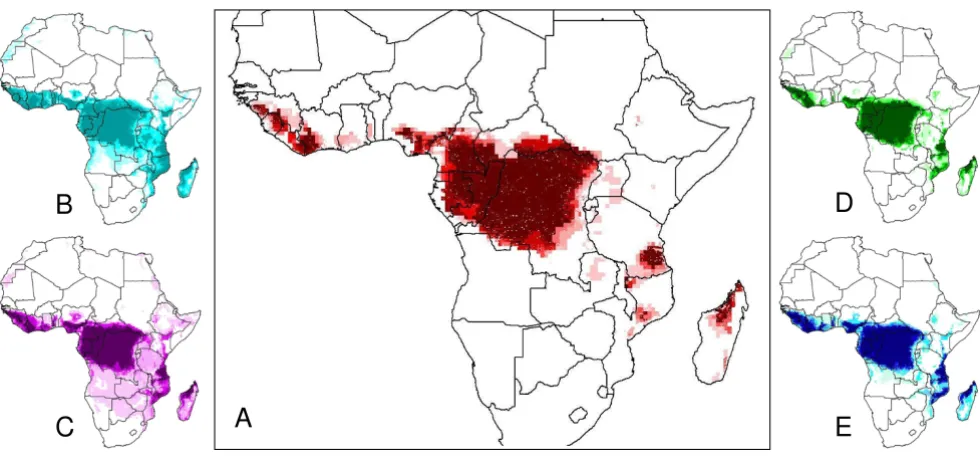
As the sample population of map pixels was quite large (137,857 pixels), mean pixel difference scores were assumed to have a normal distribution. Therefore, a two sample Student's t-test was used to evaluate the null hypothesis and generate statistics including: mean differ-ence, standard deviation, t-value, and p-value for the t-test. Results showing the mean difference, standard deviation, t-value, and p-value for the t-test of each ecological param-eter are shown in table 1[2]. Based on this preliminary analysis, we determined that when removed from the model, precipitation, flow direction (water), and land cover most profoundly altered the predicted distribution of human monkeypox disease, suggesting their impor-tance in determining the range for this model. Removal of precipitation and flow direction caused pronounced
com-Spatial results from 'jackknife procedure' to determine relative significance of various ecological parameters
Figure 1
Spatial results from 'jackknife procedure' to determine relative significance of various ecological parameters. Figure 1A shows the comprehensive map made with all parameters – each jackknife map was compared for similarity via statis-tical analysis with this comprehensive map. Figures 1B-E show jackknife maps created each with the exclusion of one parame-ter. Excluded parameters shown are: (B) Precipitation, (C) Flow Direction, (D) Land Cover, and (E) Frost Days. These four maps were selected for visualization based on statistical results of the jackknife test shown in table 1 [2].
A
C
B
D
mission of the range while removal of land cover caused a relative omission (shown by highest differences from mean pixel scores and disproportionately extreme t-val-ues). Furthermore, when removed, precipitation caused the mean standard deviation of the model to increase nearly two-fold, to 2.15 as compared to the average 1.15. All parameters were found statistically significant for model inclusion (p < 0.0001) with the exception of frost days (p = 0.11), indicating that frost days did not signifi-cantly contribute to this distribution model of human monkeypox disease.
The use of t-tests and other independent two-group tests evaluated only whether the mean pixel score was the same in both groups, whereas we were also concerned with the distribution of scores. In order to compare the relative dif-ference of each map, we first utilized weighted kappa sta-tistics using the FREQ procedure in SAS. Kappa stasta-tistics are most often used to evaluate inter-rater reliability when judging a common stimulus. In the case of map compari-son, the 'raters' were the maps being compared, while the stimulus was the data provided by the variables (each map being compared) and the agreement objective was the pixel score generated by each map. These statistics were weighted based on the Cicchetti-Allison method so as to consider deviations further from the mean as more diver-gent than deviations closer to the mean. A kappa value of 1 indicates perfect agreement between raters and a value of 0 indicates no more agreement than that expected by chance. Weighted kappa values between 0.8 and 1 are gen-erally accepted as having excellent agreement between the raters; values falling below 0.8 may be considered less sta-tistically significant [12]. We found that precipitation, when excluded from the overall ecological niche model of human monkeypox disease, was the sole layer causing the kappa coefficient to drop below significance (0.63), as shown in table 1[2].
The second method for comparing the relative difference of each map was the creation of histograms showing the frequency distribution of pixel score differences for each ecological parameter's jackknife map as compared to the scores generated by the comprehensive map. We gener-ated a 'score' variable by multiplying the number of pixels with a certain difference score by that value (i.e., if dn = 5 for 50 pixels in a jackknife map as compared to the com-plete map, the score would be 50*5 = 250). For negative differences (indicating over-prediction of distribution), we multiplied by negative one to get a positive score. If the summed score results for each jackknife map had many pixels with scores either the same or very close to the same as the complete distribution map, the mean difference score was closer to zero, becoming larger with a greater dissimilarity. Exclusion of precipitation and flow direc-tion again yielded the highest divergence from the
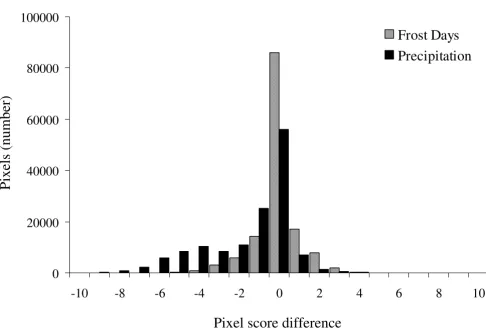
com-prehensive map. The distributions of pixel difference scores for 2 exemplar jackknife maps as compared to the comprehensive map are shown in Figure 2.
Finally, we examined the frequency distribution of pixel score differences. Using absolute difference scores, we cal-culated the percent of pixel difference scores falling out-side of one standard deviation of the mean difference in pixel score. Though the exclusion of the flow direction parameter failed to stand out, the exclusion of the precip-itation parameter caused the percent difference between the jackknifed map and the comprehensive map to increase nearly two-fold (26% difference as compared with an average 14% difference). This result is shown in table 1 as percent difference [2].
The observation that multiple independent statistical tests demonstrated a significant loss of internal consistency for the overall model when precipitation was left out, strongly supported the idea that precipitation was the sin-gle most important independent ecological parameter in the niche model for human monkeypox disease.
Discussion
It is broadly accepted that the determination of range lim-its for species often have at their core the effect of various ecological parameters [13,14]. Ecological niche modeling is itself a technique designed to account for multi-dimen-sional aspects of a species' particular habitat in ecological space and considered superior to many other first-order modeling systems precisely because it addresses many fac-tors simultaneously in both spaces. However, we found that after a final model was created to give a description of
where human monkeypox disease might be found; miss-ing from the current GARP modelmiss-ing system was the power to explain why. In other words, we lacked a method to assist in distinguishing the empirical significance of each of the diverse ecological parameters considered, thereby hindering our ability to explain why the disease was where it was and wasn't where it wasn't.
impor-tance. In this study, the differences between the jackknifed models are not subtle, but are nevertheless in line with our expectations. We anticipate that this method will prove most useful for making meaningful comparisons when distribution maps appear similar upon visual inspection.
Conclusion
The method described herein presents a procedure for evaluating the statistical significance of ecological param-eters involved in niche modeling. Here we have applied the procedure to output created using the GARP system, but this method is broadly applicable to other spatial modeling technologies as well, such as MAXENT, which others have found to be superior to GARP [10]. While our method elucidated precipitation as a highly significant determinant in the distribution of human monkeypox
disease in Africa, it is still a clear beginning step and not without limitations. Areas of improvement include an ability to employ more powerful statistical tests beyond a Student's t-test or the relatively weak kappa test, and to compare maps that are not necessarily of the same size or scale. Nevertheless, this method fills a gap in the practical application in both the fields of spatial mapping and sta-tistics and will serve as a stepping stone for future compar-ative studies.
Competing interests
The authors declare that they have no competing interests.
Authors' contributions
RL and MG conceived of the study, participated in its coordination and execution, and drafted the manuscript. KY created the variables and performed the statistical
test-Histogram showing the distribution of pixel score differences between the comprehensive map and two jackknife maps
Figure 2
Histogram showing the distribution of pixel score differences between the comprehensive map and two jack-knife maps. Exemplar jackknife maps produced by exclusion of 'mean annual precipitation' and 'frost days' layers from the model were chosen to illustrate distributions resulting in significant versus non-significant findings, respectively. The sign of the mean difference (positive or negative integer value) indicates whether each jackknife layer map over-predicted (negative) or under-predicted (positive) the distribution as compared to the comprehensive map. A jackknife parameter having many pixels with values of or close to zero (difference = 0) presents a distribution most similar to the comprehensive map, indicating that its exclusion does not seriously affect the distribution of disease.
0
20000
40000
60000
80000
100000
-10
-8
-6
-4
-2
0
2
4
6
8
10
Frost Days
Precipitation
Pixel score difference
Publish with BioMed Central and every scientist can read your work free of charge "BioMed Central will be the most significant development for disseminating the results of biomedical researc h in our lifetime."
Sir Paul Nurse, Cancer Research UK
Your research papers will be:
available free of charge to the entire biomedical community
peer reviewed and published immediately upon acceptance
cited in PubMed and archived on PubMed Central
yours — you keep the copyright
Submit your manuscript here:
http://www.biomedcentral.com/info/publishing_adv.asp
BioMedcentral
ing. MW formatted the data. All authors read and approved the final manuscript.
Acknowledgements
Thank you to the following individuals for their expertise: I.K. Damon, CDC; M.Q. Benedict, CDC; R.C. Holman, CDC; and A.T. Peterson, Uni-versity of Kansas.
This study was supported by the Centers for Disease Control and Preven-tion.
The findings and conclusions in this report are those of the authors and do not necessarily represent the views of the funding agency.
References
1. Peterson AT: Predicting species' geographic distributions based on ecological niche modeling. The Condor 2001, 103:599-605.
2. Levine RS, Peterson AT, Yorita KL, Carroll D, Damon IK, Reynolds MG: Ecological niche and geographic distribution of human monkeypox in Africa. PLoS ONE 2007, 2:e176.
3. Breman JG: Monkeypox: an Emerging Infection for Humans? In Emerging Infections 4 Edited by: Scheld WM, Craig WA, Hughes JM. Washington D.C.: ASM Press; 2000:45-67.
4. Peterson AT, Bauer JT, Mills JN: Ecologic and geographic distri-bution of filovirus disease. Emerg Infect Dis 2004, 10:40-47. 5. Stockwell DRB, Peters D: The GARP modeling system:
prob-lems and solutions to automated spatial prediction. Interna-tional Journal of Geographical Information Science 1999, 13:143-158. 6. Levine RS, Peterson AT, Benedict MQ: Distribution of members
of Anopheles quadrimaculatus say s.l. (Diptera: Culicidae) and implications for their roles in malaria transmission in the United States. J Med Entomol 2004, 41:607-613.
7. Levine RS, Peterson AT, Benedict MQ: Geographic and ecologic distributions of the Anopheles gambiae complex predicted using a genetic algorithm. Am J Trop Med Hyg 2004, 70:105-109. 8. Peterson AT, Sanchez-Cordero V, Beard CB, Ramsey JM: Ecologic niche modeling and potential reservoirs for Chagas disease, Mexico. Emerg Infect Dis 2002, 8:662-667.
9. Peterson AT, Shaw J: Lutzomyia vectors for cutaneous leishma-niasis in Southern Brazil: ecological niche models, predicted geographic distributions, and climate change effects. Int J Par-asitol 2003, 33:919-931.
10. Elith J, Graham CH, Anderson RP, Dudik M, Ferrier S, Guisan A, et al.: Novel methods improve prediction of species' distributions from occurrence data. Ecography 2006, 29:129-151.
11. Peterson AT, Cohoon KC: Sensitivity of distribution prediction algorithms to geographic data completeness. Ecological Mode-ling 1999, 117:159-164.
12. Landis J, Koch G: An application of hierarchical kappa-type sta-tistics in the assessment of majority agreement among mul-tiple observers. Biometrics 1977, 33:159-174.
13. MacArthur R: Geographical Ecology Princeton, NJ: Princeton University Press; 1972.
![Table 1: Summary of statistical analysis of 'jackknife procedure' used to determine environmental importance of ecological parameters (re-printed with permission from [2]).](https://thumb-us.123doks.com/thumbv2/123dok_us/800613.2075746/3.612.57.555.108.444/statistical-jackknife-procedure-environmental-importance-ecological-parameters-permission.webp)