Germination of the invasive legume
Lupinus polyphyllus
depends on cutting date and seed morphology
Yves P. Klinger1, Rolf Lutz Eckstein2, David Horlemann1,
Annette Otte1, Kristin Ludewig1
1 Division of Landscape Ecology and Landscape Planning, Research Centre for Biosystems, Land Use and Nutrition (iFZ), Justus Liebig University Giessen, Heinrich-Buff-Ring 26–32, D-35392 Giessen, Germany 2 Department of Environmental and Life Sciences, Biology, Karlstad University, SE- 651 88 Karlstad, Sweden
Corresponding author: Yves Klinger ([email protected])
Academic editor: Bruce Osborne | Received 3 July 2020 | Accepted 30 July 2020 | Published 25 August 2020
Citation: Klinger YP, Eckstein RL, Horlemann D, Otte A, Ludewig K (2020) Germination of the invasive legume
Lupinus polyphyllus depends on cutting date and seed morphology. NeoBiota 60: 79–95. https://doi.org/10.3897/
neobiota.60.56117
Abstract
In semi-natural grasslands, mowing leads to the dispersal of species that have viable seeds at the right time. For invasive plant species in grasslands, dispersal by mowing should be avoided, and information on the effect of cutting date on the germination of invasive species is needed. We investigated the germination of seeds of the invasive legume Lupinus polyphyllus Lindl. depending on the cutting date. We measured seed traits associated with successful germination that can be assessed by managers for an improved timing of control measures. To this end, we sampled seeds of L. polyphyllus on six cutting dates and analyzed the germi-nation of these seeds in climate chambers and under ambient weather conditions. We collected information on seed morphology (color/size/hardseededness) for each cutting date to identify seed traits associated with successful germination. Observed germination patterns were highly asynchronous and differed between seeds cut at different dates. Seeds cut early, being green and soft, tended to germinate in autumn. Seeds cut late, being dark and hard, were more prone to germinate the following spring, after winter stratification. This allows the species to utilize germination niches throughout the year, thus indicating a bet-hedging strat-egy. Seed color and the percentage of hard seeds were good predictors of germination percentage, but not of mean germination time and synchrony. Managers should prevent the species producing black and hard seeds, while cutting plants carrying green and soft seeds is less problematic. Furthermore, germination pat-terns differed between climate chambers and the common garden, mainly because germination of dormant seeds was lower in climate chambers. More germination experiments under ambient weather conditions should be carried out, as they can give information on the germination dynamics of invasive species.
Keywords
dormancy, grassland management, lupine, phenology, seed traits
Copyright Yves P. Klinger et al. This is an open access article distributed under the terms of the Creative Commons Attribution License (CC BY 4.0), which permits unrestricted use, distribution, and reproduction in any medium, provided the original author and source are credited.
introduction
The timing of germination determines which environmental conditions the seedling will experience and thereby influences a variety of plant characteristics (Casas et al. 2012). Consequently, the germination ecology of a species largely decides in which habitats and under which climates it may establish. The introduction of species to new ranges often leads to new germination conditions (Kudoh et al. 2007), and the ability to germinate successfully under a variety of environmental conditions is a characteris-tic of many successful and widespread invasive species (Baker 1974; Wainwright and Cleland 2013). Whether seeds are viable depends largely on their development stage, which is influenced by the timing of seed set and seed ripening.
In semi-natural grasslands, the mowing date is the environmental factor that most strongly determines the timing of seed release. Furthermore, mowing is a way of seed dispersal for species that have viable seeds at the right time. In most cases, the dispersal of mature seeds after mowing is a desirable process, as it is responsible for sustaining a high plant diversity in semi-natural grasslands (Auffret 2011; Humbert et al. 2012). In other cases, such as weeds or non-native invasive species, dispersal of ripe seeds by mowing is not wanted (Wilson et al. 2009) and shifts in grassland management and the time of cutting may create opportunities for invasives to establish in these eco-systems. Consequently, understanding the germination ecology of invasive plants is essential for their management and control and for limiting their spread to new sites.
Established invasive species are often more challenging to manage than newly arrived species (Simberloff 2003). Ideally, control measures would take place before seed formation, but time windows for adequate management can be short in areas where
different conservation goals have to be matched. In the case of speciesinvading mountain
grasslands, e.g., mowing of areas critical for the protection of ground-nesting birds has to be postponed until nesting is finished, which means that invasive species may have produced viable seeds by the time of mowing. Consequently, managers are looking for information on the relationships between cutting dates, seed morphology, and seed germinability.
Lupinus polyphyllus Lindl. is a widespread perennial legume originating from North-America. It is widely found as an ornamental plant (Fremstad 2010) and commonly used for soil stabilization and soil melioration (Rehfuess et al. 1991). Due to its many uses, the species is naturalized in different regions all over the world, e.g. in Europe (Fremstad 2010; Hejda 2013), New Zealand (Holdaway and Sparrow 2006) and Chile (Meier et al. 2013). Invaded habitats include road verges (Valtonen et al. 2006), riparian terraces (Meier et al. 2013), and mountain grasslands (Klinger et al. 2019). Due to its ability to fix nitrogen, it is considered an ecosystem engineer and may cause unwanted ecosystem effects
(Hiltbrunner et al. 2014). In invaded habitats, L. polyphyllus is capable of overgrowing and
shading the underlying vegetation and may cause a considerable decline in the richness of small species (Thiele et al. 2010; Hiltbrunner et al. 2014), while promoting the spread of tall-growing, nitrogen-demanding vegetation (Otte and Maul 2005). Meadows invaded by this species provide hay of low fodder quality, because of its high water-content and the
Despite the importance of seed ecology for the spread and establishment of species, there is often insufficient knowledge concerning germination and ripening character-istics of invasive species (Gallinat et al. 2018). The capability of seeds to after-ripe and germinate, which depends on the interaction between phenology and cutting date, may have important implications for the management of invasive species in grasslands.
Therefore, we investigated the germination of the invasive legume L. polyphyllus in
relation to the cutting date. Over the course of the vegetation period, i.e., weekly from the beginning to the end of fruiting, we sampled seeds from five locations invaded by
L. polyphyllus. We combined two experiments to investigate the germination of L. poly-phyllus: A common garden experiment to analyze the germination patterns under am-bient weather conditions and a climate chamber experiment under standardized con-ditions. We aim to provide management recommendations based on seed traits such as seed color and hardseededness that may help to decide when fruiting lupine stands should be cut and when plant material has to be removed from the sites after mowing.
Specifically, our research hypotheses were:
1) The germination ability of L. polyphyllus seeds increases with later cutting date.
Consequently, we expect a higher germination percentage, a shorter mean germi-nation time, and a higher synchrony of germigermi-nation with later cutting date. 2) Seed traits such as seed size, seed color, and the percentage of hard seeds provide
reliable information about the germination ability of seeds sampled at different dates. We expect larger seeds, seeds with darker color and harder seeds to show higher germination percentage, shorter mean germination time and higher syn-chrony compared to small, green, and soft seeds.
Methods
Seed sampling, seed handling, and experimental design
Seeds were collected in the Rhön UNESCO Biosphere Reserve, in central Germany. The study area (from 50°26'N to 50°32'N and from 09°54'E to 10°05'E), a part of the Biosphere Reserve, is situated between 600 m and 950 m a.s.l. It is characterized by large and coherent semi-natural grasslands of high conservational value that are non-intensively used as meadows and pastures (e.g., Habitats Directive 92/43/EEC, habitat
types 6520: mountain hay meadows, and 6230: species-rich Nardus grasslands). These
grasslands have a centuries-long land-use history of mowing and pasturing with low nitrogen-inputs. In the 1990s, the traditional mowing date in early July was postponed to August and September, in order to safeguard the populations of protected ground-nesting birds and because the meadows decreased in importance for local farmers. This
allowed L. polyphyllus, already present along roadsides in the area, to produce seeds
before mowing and to spread extensively into the meadows. During the past 20 years,
dou-bling in some localities (Klinger et al. 2019). This invasion is considered a major threat to the biodiversity of the mountain grasslands in the study region. Depending on site
conditions, L. polyphyllus can reach a height of 60 to 150 cm. In June and July
inflores-cences are formed, each consisting of 50 to 80 single flowers (Fremstad 2010;
Bunde-samt für Naturschutz 2017). L. polyphyllus develops seed pods with four to twelve seeds,
which burst at seed maturity and spread the seeds ballistically up to several meters (Otte et al. 2002; Volz 2003). Per plant, up to 2500 seeds can be produced (Aniszewski 2001).
Seeds of L. polyphyllus were manually collected from five meadows (sampling locations)
over six weeks (July–August 2015; cutting dates). The distance between sampling locations
ranged between 1500 and 5000 meters. For each cutting date and location, we sampled one inflorescence each from ten plants for the germination experiments. From each inflo-rescence, we randomly took one pod and determined seed size, seed color, and the propor-tion of hard seeds. For seed color, we distinguished between four colors: green, dark green, brown and black. Seeds with different pigmentations and puncturing (see Aniszewski 2001) were integrated to the different classes according to the predominant color, seeds were assigned the color “black” when they were considerably darker than brown seeds. Usually, seeds of several colors were found on the same location or even within the same seed pod. To determine the average color for each replicate, we gave ranks from one (green) to four (black) to each color and calculated the median. For seed hardness, we classified the seeds into five classes, from undeveloped and very soft to very hard. Based on these data, we calculated mean seed size, average seed color and the proportion of hard seeds for each
replicate. For the germination experiments, we pooled the seeds within each sampling
loca-tion. Seeds were manually cleaned, air-dried and stored in darkness at room temperature
(app. 20 °C) until the start of the germination experiments on September 28th, 2015.
Laboratory experiments are a standardized tool to investigate germination in a controlled environment and can provide information on germination cues, dormancy, and other factors (Baskin and Baskin 2014). Nonetheless, germination in the laborato-ry often differs from germination under (semi-)natural conditions (Grime et al. 1981; Hölzel and Otte 2004) and thus gives only a limited representation of germination patterns that can be observed in the field. We combined a climate chamber experiment
and a common garden experiment to study the germination of L. polyphyllus both
un-der standardized and ambient weather conditions. A factorial experimental design was
used to analyze the effects of cutting date (6 dates), sampling location (5 locations), and
temperature (day/night: 20/10 °C and 15/5 °C; only in the climate chamber experi-ment) on seedling emergence. Germination was defined as protrusion of the radicle.
In the climate chamber experiment (from September 28th, 2015 to July 28th,
2016), seeds were placed into petri dishes with distilled water (25 seeds per replicate) in climate chambers (Rumed type 3401, Rubarth Apparate GmbH). Each treatment
combination (cutting date × sampling location × temperature) was replicated five times,
content of the Petri dish was controlled during the experiment. For seeds in the climate chambers, germination was checked once a week and seedlings were removed.
In the common garden experiment, germination was observed under ambient
weather conditions from September 17th, 2015 to July 14th, 2016. The seeds were placed
on a 1:1 mixture of sand and commercial potting soil (Fruhstorfer Erde, Type P, Indus-trie-Erdenwerke Archut GmbH, Lauterbach/Germany) in trays (18 × 28 cm) in a com-mon garden at the research station Linden-Leihgestern of the Justus-Liebig University
(50°32'N, 8°41'E). Per tray, 25 seeds were used (n = 5 for each cutting date × sampling
lo-cation combination, resulting in 150 trays). Seeds were protected from predation using wire cages. For seeds in the common garden, germination was checked once every seven to fourteen days. After three months of incubation, germination decreased in both ex-periments and thus was checked every other week. After ten months of incubation, the experiments ended since no further germination was observed. By the end of the experi-ments, the remaining seeds were covered by mold and collapsed when pinched by hand. Thus, the remaining seeds were considered dead (following Baskin and Baskin 2014).
Germination variables and statistical analyses
As response variables, we calculated the germination percentage (%), mean germination time (days) and synchrony of germination (unitless) per replicate (according to Ranal and Santana 2006; Ranal et al. 2009). The germination percentage is the proportion of germinated seeds of the total number of seeds. Mean germination time and synchrony of germination were calculated based on seedling counts over time (Ranal et al. 2009). Mean germination time is a measurement of the weighted average time required for germina-tion (Ranal and Santana 2006). The synchrony index is a measure for the overlapping of germination that ranges from 0 (when no two seeds germinated at the same time) to 1 (when all germinating seeds germinated at the same time; for details see Ranal et al. 2009).
Seeds from the climate chamber experiment and from the common garden
experi-ment were analyzed separately. The effects of the experiexperi-mental variables cutting date,
sampling location and temperature on the response variables germination percentage and germination time were analyzed using linear mixed-effect models (LMM) and synchrony of germination using generalized linear mixed-effect models (GLMM) for
binomial distributions. The factors cutting date and temperature were included as fixed
factors in the first models. As there was no effect of the temperature, the final models
only included cutting date or seed color fixed factors. We added an error term for
re-peated measures to the models to account for variation within each sampling location.
Furthermore, we added a general linear hypothesis and multiple comparisons (glht) to determine significant differences between groups.
To identify seed traits associated with germination success, we checked for
cor-relation of seed traits with the factor cutting date using Pearson’s R². This was the case
for seed size, seed color, and proportion of hard seeds. We then fitted models with these
location as random factor. To choose the best seed traits or trait combination to explain
germination success of L. polyphyllus, we compared these models via AIC and pairwise
model ANOVA. To assess model quality, we calculated Nagakawa and Schielzeth’s R² for linear mixed-effect models (Nakagawa and Schielzeth 2013). We visually checked for normality of residuals and homogeneity of variances using diagnostic plots (Zuur et al. 2010). Mixed-effect models were carried out using the ‘lme4’ (Bates et al. 2015) and ‘lmerTest’ (Kuznetsova et al. 2017) packages, post-hoc-tests were calculated using the ‘multcomp’ package (Hothorn et al. 2008), graphs were created using the ‘ggplot2’ package (Wickham 2016) in R (R Core Team 2016).
Results
During the sampling period, seed color became darker (changing from green via dark green and brown, to black) and the proportion of hard seeds increased gradually. Mean
seed size ranged from 3.9 mm (date six, August 11th) to 6.4 mm (date three, July 21st).
It increased during the first three weeks of cutting and then decreased thereafter as seeds became drier. Seed color and the proportion of hard seeds were correlated, as hard seeds usually were darker than soft seeds. There were no differences in the total
germination percentages between different sampling locations, although the
germina-tion peaks shifted by up to two weeks between different locagermina-tions.
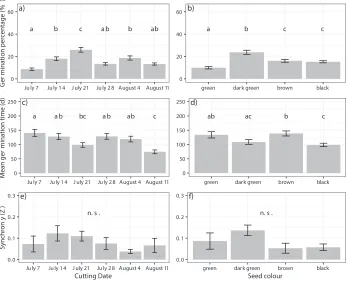
In climate chambers, 16.3% of all collected lupine seeds germinated (Fig. 1a, b).
Germination percentage was lowest after the first cutting date (July 7th, 8.6%) and
in-creased until the third date (July 21st) where it peaked at 26% (Fig. 1a). Afterwards, we
observed a significant decrease from week three (July 21st) to four (July 28th; to 13.4%;
Table 1). Mean germination time was 114 days and varied from 3 days to 303 days in cli-mate chambers (Fig. 1c, d), with seeds collected on the first date having the longest mean germination time (141 d; Fig. 2d). Mean germination time decreased until week three (98 d), then increased again and had its overall minimum in week six (74 d). Synchrony of germination was quite low with an average of 0.08 over all cutting dates (Fig. 1e, f).
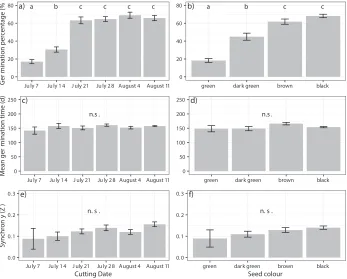
In the common garden, 51.7% of seeds germinated and mean germination time was 153.6 days (Fig. 2). Thus, seeds in the common garden germinated to a higher degree compared to seeds in climate chambers, but slower. Germination percentages in the common garden were lowest in seeds sampled during the first two weeks (17.0%
on July 7th and 30.6% on 14th), reached the highest level in week three (63.2% on
July 21st) and stayed high afterwards (Fig. 2a, Table 1). In the common garden, mean
germination time was similar for all cutting dates and averaged 153.6 days. Synchrony of germination in the common garden was quite low with an average of 0.12 over all treatments and on all cutting dates (Fig. 2e, f).
table 1. Differences in germination percentages of L. polyphyllus seeds between six cutting dates assessed in two germination experiments (climate chamber and common garden). Differences were assessed using mixed effect models for each experiment separately with sampling location as random factor (formula: Germination percentage ~ Cutting Date + (1|Sampling location).
Climate chamber n = 300 R2
marginal= 0.20 R2conditional= 0.25
Estimate Std. Error Df t Value p Value
Date 1 (July 7; Intercept) 8.64 1.86 22.56 4.65 < 0.001
Date 2 (July 14) 9.36 2.11 295 4.45 < 0.001
Date 3 (July 21) 17.36 2.11 295 8.25 < 0.001
Date 4 (July 28) 4.8 2.11 295 2.28 0.023
Date 5 (August 4) 10 2.11 295 4.75 < 0.001
Date 6 (August 11) 4.64 2.11 295 2.20 0.028
Common garden n = 150 R2
marginal= 0.63 R2conditional= 0.71
Estimate Std. Error Df t Value p Value
Date 1 (July 7; Intercept) 16.96 3.88 14.21 4.37 < 0.001
Date 2 (July 14) 13.6 3.86 145 3.52 < 0.001
Date 3 (July 21) 46.24 3.86 145 11.99 < 0.001
Date 4 (July 28) 47.68 3.86 145 12.37 < 0.001
Date 5 (August 4) 52 3.86 145 13.49 < 0.001
Date 6 (August 11) 48.8 3.86 145 12.66 < 0.001
Figure 1. The effect of the factors cutting date (weekly from July 7th to August 11th) and seed color on
germi-nation percentage (a, b), mean germination time (c, d), and synchrony of germination (e, f) in seeds stored in climate chambers averaged over the two temperature regimes. Bars show mean values ± standard errors.
a)
a b c a b b ab
0 20 40 60
Ju ly 7 Ju ly 1 4 J uly 21 Ju ly 2 8 August 4 August 11
Ger
mination percentage (%
)
b)
a b c c
0 20 40 60
green dark green brown black
c)
a a b bc a b ab c
0 50 100 150 200 250
Ju ly 7 Ju ly 1 4 J uly 21 Ju ly 2 8 August 4 August 11
Mean ger
mination time (d)
d)
ab ac b c
0 50 100 150 200 250
green dark green brown black
e)
n. s .
0.0 0.1 0.2 0.3
Ju ly 7 Ju ly 1 4 J uly 21 Ju ly 2 8 August 4 August 11 Cutting Date
Synchron
y (Z
)
f)
n. s .
0.0 0.1 0.2 0.3
green dark green brown black
a) a b c c c c 0 20 40 60 80
Ju ly 7 Ju ly 1 4 J uly 21 Ju ly 2 8 August 4 August 11
Ger
mination percentage (%
)
b) a b c c
0 20 40 60 80
green dark green brown black
c) n.s . 0 50 100 150 200 250
Ju ly 7 Ju ly 1 4 J uly 21 Ju ly 2 8 August 4 August 11
Mean ger
mination time (d)
d) n.s . 0 50 100 150 200 250
green dark green brown black
e)
n. s .
0.0 0.1 0.2 0.3
Ju ly 7 Ju ly 1 4 J uly 21 Ju ly 2 8 August 4 August 11 Cutting Date
Synchron
y (Z
)
f)
n. s .
0.0 0.1 0.2 0.3
green dark green brown black
Seed colour
Figure 2. The effect of the factors cutting date (weekly from July 7th to August 11th) and seed color on
germination percentage (a, b), mean germination time (c, d), and synchrony of germination (e, f) in seeds stored under ambient weather conditions. Bars show mean values ± standard errors.
table 2. Differences in germination percentages of L. polyphyllus seeds between four seed colors (median seed color per sample with four levels: green, dark green, brown, and black) assessed in two germination experiments (climate chamber and common garden). Differences were assessed using mixed effect models for each experiment separately with sampling location as random factor (formula: Germination percent-age ~ Seed color + (1|Sampling location).
Climate chamber n = 300 R2
marginal= 0.15 R2conditional= 0.22
Estimate Std. Error Df t Value p Value
Green (Intercept) 9.45 1.88 16.2 5.03 < 0.001
Dark green 14.34 1.94 298.48 7.4 < 0.001
Brown 7.71 2.12 299.21 3.64 < 0.001
Black 5.64 1.74 297.85 3.25 < 0.01
Common garden n = 150 R2
marginal= 0.58 R2conditional= 0.65
Estimate Std. Error Df t Value p Value
Green (Intercept) 17.29 4.11 12.24 4.21 < 0.01
Dark green 27.78 3.82 146.4 7.27 < 0.001
Brown 47.13 4.18 146.84 11.27 < 0.001
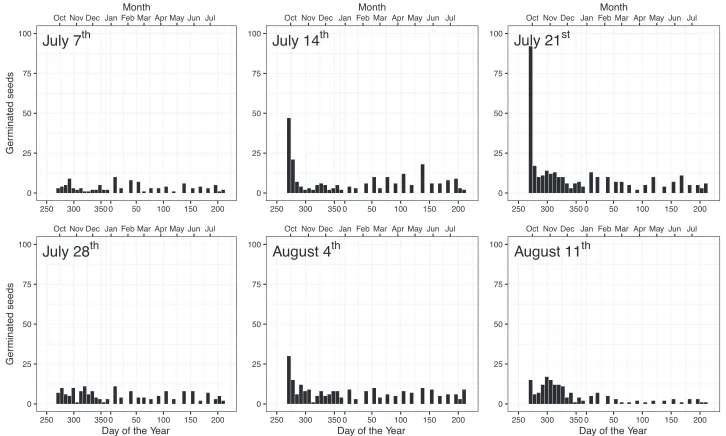
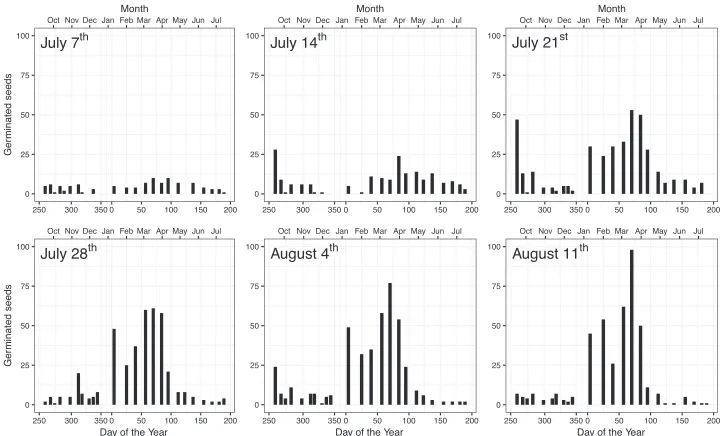
or higher while in the common garden, germination percentage increased continuously with the amount of hard seeds. In both experiments, seeds of different color had relatively similar germination times with black (99 d) and dark green (109 d) seeds germinating most rapidly in climate chambers (Fig. 1d). In the common garden, there were no sig-nificant differences in mean germination time between seeds of different colors (Fig. 2d). While in climate chambers, germination peaked early and decreased afterwards (Fig. 3), two peaks (in autumn and spring) characterized germination in the common garden (Fig. 4). There were no significant differences between colors in climate cham-ber, while synchrony in the common garden increased slightly with the increase in the percentage of hard seeds.
Germination percentage (in both experiments) and mean germination time (only in
climate chambers) responded significantly to cutting date, while there was no effect of the
different temperature regimes. For germination percentage and mean germination time,
the best explanatory models (see Suppl. material 1: Model Tables) each contained solely one fixed factor, mainly due to high correlations between explaining factors. Germination percentage in climate chambers was best explained by seed color and showed highly sig-nificant differences between colors (R² = 0.15). Germination percentage in the common garden was well explained by both seed color (R² = 0.58) and proportion of hard seeds. For mean germination time, the best explaining factors were either color or proportion of hard seeds, while both models performed poorly overall. Synchrony was not affected significantly by any factor and there was no model of significant explanatory value.
Figure 3.Germination patterns of L. polyphyllus in climate chambers conditions (15/5 °C and 20/10 °C di-urnally fluctuating temperatures) sampled weekly on six cutting dates (July 7th to August 11th) after seed set.
July 7th
Oct Nov Dec Jan Feb Mar Apr May Jun Jul
0 25 50 75 100
250 300 3500 50 100 150 200 Month
Ge
rm
inated seeds
July 14th
Oct Nov Dec Jan Feb Mar Apr May Jun Jul
0 25 50 75 100
250 300 350 0 50 100 150 200 Month
July 21st
Oct Nov Dec Jan Feb Mar Apr May Jun Jul
0 25 50 75 100
250 300 350 0 50 100 150 200 Month
July 28th
Oct Nov Dec Jan Feb Mar Apr May Jun Jul
0 25 50 75 100
250 300 3500 50 100 150 200 Day of the Year
Ge
rm
inated seed
s
August 4th
Oct Nov Dec Jan Feb Mar Apr May Jun Jul
0 25 50 75 100
250 300 350 0 50 100 150 200 Day of the Year
August 11th
Oct Nov Dec Jan Feb Mar Apr May Jun Jul
0 25 50 75 100
Figure 4.Germination patterns of L. polyphyllus under ambient weather conditions sampled weekly on six cutting dates (July 7th to August 11th) after seed set.
July 7th
Oct Nov Dec Jan Feb Mar Apr May Jun Jul
0 25 50 75 100
250 300 350 0 50 100 150 200 Month
Ge
rm
inated seeds
July 14th
Oct Nov Dec Jan Feb Mar Apr May Jun Jul
0 25 50 75 100
250 300 350 0 50 100 150 200 Month
July 21st
Oct Nov Dec Jan Feb Mar Apr May Jun Jul
0 25 50 75 100
250 300 350 0 50 100 150 200 Month
July 28th
Oct Nov Dec Jan Feb Mar Apr May Jun Jul
0 25 50 75 100
250 300 350 0 50 100 150 200 Day of the Year
Ge
rm
inated seed
s
August 4th
Oct Nov Dec Jan Feb Mar Apr May Jun Jul
0 25 50 75 100
250 300 350 0 50 100 150 200 Day of the Year
August 11th
Oct Nov Dec Jan Feb Mar Apr May Jun Jul
0 25 50 75 100
250 300 350 0 50 100 150 200 Day of the Year
Discussion
The germination patterns of the invasive legume L. polyphyllus differed between
dif-ferent cutting dates, partially confirming our first hypothesis. Seeds collected early, while being green and soft, germinated to a lower degree and more slowly compared
to seeds collected later. While seeds of early-cut L. polyphyllus plants germinated in
autumn, seeds of late-cut plants were more prone to germinate in spring. This relation-ship may be associated with their progression through different phases of seed develop-ment. During morphogenesis the embryo develops, then during maturation, storage compounds are synthesized in the growing endosperm and thereafter, seeds may go through a phase of desiccation, in which they dry and eventually enter dormancy (Angelovici et al. 2010). Consequently, the different cutting dates of our experiment
covered the phases of maturation and desiccation. Until late July, L. polyphyllus seeds
were in the phase of maturation. Afterwards (end-July to mid-August), seeds were in
the desiccation phase. Although dormancy per sewas not tested in our study, the
ob-served germination patterns and differences between climate chambers and the
com-mon garden strongly indicate that seeds from late cut L. polyphyllus plants expressed
same population (D’hondt et al. 2010), which may consequently lead to asynchronous germination patterns.
Despite pronounced peaks of germination in autumn and spring, germination of
L. polyphyllus seeds was highly asynchronous. In both experiments and under all cut-ting dates, some seeds germinated over the whole duration of the experiments, over 300 days. The timing of germination determines which environmental conditions the seedling will experience and may influence plant characteristics, such as growth and reproduction (Donohue 2002; Casas et al. 2012). The timing of germination itself may be influenced by plant life-history traits, e.g. the phenology of flowering, seed maturation, and seed dispersal (Galloway 2001; Donohue 2002). Variations in germi-nation depending on the time of seed collection have been observed by other authors (e.g., Greipsson and El-Mayas 2003; Samarah 2005; El-Keblawy and Al-Rawai 2006; Brobäck 2015), but there is little information on the long-term germination patterns of species and seasonal effects that are associated with this factor. In invasive species, asynchronous germination can lead to the exploitation of open germination niches throughout the year, which might contribute to their invasion success (Wolkovich
and Cleland 2011; Gioria et al. 2016). In the case of L. polyphyllus, this effect may be
amplified by its high seed production (Volz 2003), its long-lasting flowering, by its ability to resprout and produce seeds after early cutting (Brobäck 2015), and by the observation that the ballistic seed dispersal of the species takes place over many weeks if stands are left untouched (Klinger et al., unpublished data). The observed germination
patterns of L. polyphyllus thus suggest a bet-hedging strategy (Cohen 1966), which may
partly explain its invasion success and its capability to colonize many different habitats. Our second hypothesis can be verified, as seed color and the percentage of hard seeds were good predictors of germination percentage and give information on the germination patterns that can be expected. Soft and green seeds germinated to the lowest degree and in autumn. However, germination percentages of these seed batches were relatively high, giv-en their early developmgiv-ental phase. High germination rates in immature seeds have begiv-en
found in some legumes, e.g., in Lotus and Scorpiurus (Cristaudo et al. 2008), and Vicia
(Samarah 2005), but germination failed in others, such as in green seeds of Lupinus
noot-katensis (Greipsson and El-Mayas 2003). Black and hard seeds germinated to a high degree and in spring. In temperate climates, seedlings germinating in autumn face harsh environ-mental conditions during winter combined with low competition, while spring germina-tion is associated with more favorable environmental condigermina-tions, but higher competigermina-tion (Masuda and Washitani 1992). Since soft and green seeds mostly germinated in autumn,
the winter survival of the emerging seedlings may be low, as L. polyphyllus seedlings seem to
be sensitive to freezing and showed high mortality when exposed to –10 °C (Arfin‐Khan
et al. 2018). Furthermore, unripe seeds of roadside L. polyphyllus stands in Sweden were
prone to mold infection that led to very low germination rates (Brobäck 2015). The last cutting date represents the state in which seeds are shed by the plant. Both ballistic seed dispersal as well as the expression of physical dormancy go along with the drying of the
pods and the seed coat. Black and hardseeds are more prone to germinate in spring and
may thus have higher survival rates compared to green seeds. Furthermore, as L. polyphyllus
in spring, especially in habitats with weak competitors, such as semi-natural grasslands. Additionally, water impermeable/hard seeds are more prone to being carried over into the seed bank (Russi et al. 1992b) or dispersed via endozoochory (Otte et al. 2002; D’hondt
and Hoffmann 2011). Although L. polyphyllus may not have invaded the seed bank of
meadows in our study region yet (Ludewig et al., unpublished data), a carry-over of seeds should be avoided, as it makes invasive species management lengthier and more expensive. Consequently, managers should target plants that still have green and soft seeds, which can be considered less problematic despite germination percentages being relatively high.
Germination patterns differed between climate chambers and the common garden, particularly after seeds darkened and became harder. Overall, germination percentages in the climate chamber experiment (ca. 16%) were similar to the emergence rates found by Sõber and Ramula (2013) (21.5%), but relatively low compared to other studies on
L. polyphyllus (Elliott et al. 2011; Arfin-Khan et al. 2018; over 60%). We suggest that this is at least partly due to the fact that seeds were not scarified and that dormancy was prob-ably not broken by imbibition in the climate chamber experiment. This is also supported by the results of the common garden experiment, in which germination percentages were considerably higher than under laboratory conditions, mainly due to a second
germina-tion peak in spring after winter-stratificagermina-tion in situ. However, germination of L.
polyphyl-lus only slightly increased when seeds were pre-treated by cold in another study (Elliott
et al. 2011). Our results show that, while laboratory experiments give valuable informa-tion on the environmental factors influencing germinainforma-tion, the germinainforma-tion patterns ob-served under artificial conditions may diverge from germination dynamics under ambient weather conditions (Hölzel and Otte 2004). A better understanding of invasive species germination under natural conditions is necessary, as it can potentially reveal windows of opportunity for invasive species management. We thus recommend to complement germination experiments in climate chambers with common garden or field experiments.
Conclusions
Seeds of L. polyphyllus are capable of after-ripening and germinating even if plants are
cut while most seeds are still green and soft. Germination capability increased strongly during the first weeks after seed set with a maximum when most seeds were brown to
black and not fully hardened. Therefore, L. polyphyllus stands should be cut before seed
set, if possible. If this is not feasible due to different limitations, we recommend cutting while plants carry green and soft seeds. When stands with black and hard seeds are cut, the plant material should be removed immediately to reduce propagule pressure on site.
Acknowledgments
Bavar-ia), Michael Geier and Tobias Gerlach (Bavarian Administration of the Biosphere Re-serve Rhön), as well as Torsten Raab (Hessian Administration of the Biosphere ReRe-serve Rhön). We greatly thank Josef Scholz vom Hofe for assistance with propagule and data collection both in the field and in the lab, Sabrina Rothen for data preparation, Sarah Harvolk-Schöning for statistical support, and Melanie Schindler for valuable comments on the final version of the manuscript. We are grateful to two anonymous referees for their insightful comments on an earlier version of the manuscript.
References
Angelovici R, Galili G, Fernie AR, Fait A (2010) Seed desiccation: A bridge between matura-tion and germinamatura-tion. Trends in Plant Science 15(4): 211–218. https://doi.org/10.1016/j. tplants.2010.01.003
Aniszewski T (2001) Seed number, seed size and seed diversity in washington lupin (Lupinus
poly-phyllus Lindl.). Annals of Botany 87(1): 77–82. https://doi.org/10.1006/anbo.2000.1300
Arfin‐Khan MAS, Vetter VMS, Reshi ZA, Dar PA, Jentsch A (2018) Factors influencing seed-ling emergence of three global invaders in greenhouses representing major eco-regions of the world. Plant Biology 20(3): 610–618. https://doi.org/10.1111/plb.12710
Auffret AG (2011) Can seed dispersal by human activity play a useful role for the conser-vation of European grasslands? Applied Vegetation Science 14(3): 291–303. https://doi. org/10.1111/j.1654-109X.2011.01124.x
Baker HG (1974) The evolution of weeds. Annual Review of Ecology and Systematics 5(1): 1–24. https://doi.org/10.1146/annurev.es.05.110174.000245
Baskin CC, Baskin JM (2014) Chapter 2 – Ecologically meaningful germination studies. In: Baskin CC, Baskin JM (Eds) Seeds (Second Edition). Academic Press: 5–35. https://doi. org/10.1016/B978-0-12-416677-6.00002-0
Bates D, Mächler M, Bolker B, Walker S (2015) Fitting linear mixed-effects models using lme4. Journal of Statistical Software 67(1): 1–48. https://doi.org/10.18637/jss.v067.i01
Bolingue W, Ly Vu B, Leprince O, Buitink J (2010) Characterization of dormancy behaviour in seeds of the model legume Medicago truncatula. Seed Science Research 20(2): 97–107.
https://doi.org/10.1017/S0960258510000061
Brobäck D (2015) Preventing the spread of the invasive plant L. polyphyllus. Master Thesis. Uppsala Universitet (Uppsala).
Bundesamt für Naturschutz (2017) FloraWeb: Daten und Informationen zu Wildpflanzen und zur Vegetation Deutschlands. http://www.floraweb.de/pflanzenarten/biologie.xsql?suchnr=3524&
Cohen D (1966) Optimizing reproduction in a randomly varying environment. Journal of Theoretical Biology 12(1): 119–129. https://doi.org/10.1016/0022-5193(66)90188-3
Cristaudo A, Gresta F, Avola G, Miano V (2008) Germination capability of immature seeds of Lotus
ornithopodioides L. and Scorpiurus subvillosus L. Proceedings of the 12th Meeting of the
FAO-CIHEAM Sub-Network on Mediterranean Pastures And Fodder Crops, Elvas, Portugal, 9–12. de Casas RR, Kovach K, Dittmar E, Barua D, Barco B, Donohue K (2012) Seed after-ripening
D’hondt B, Brys R, Hoffmann M (2010) The incidence, field performance and heritability of non-dormant seeds in white clover (Trifolium repens L.). Seed Science Research 20(3): 169–177. https://doi.org/10.1017/S0960258510000152
D’hondt B, Hoffmann M (2011) A reassessment of the role of simple seed traits in mortality following herbivore ingestion. Plant Biology 13(s1): 118–124. https://doi.org/10.1111/ j.1438-8677.2010.00335.x
Donohue K (2002) Germination timing influences natural selection on life-history charac-ters in Arabidopsis thaliana. Ecology 83: 1006–1016. https://doi.org/10.1890/0012-9658(2002)083[1006:GTINSO]2.0.CO;2
El-Keblawy A, Al-Rawai A (2006) Effects of seed maturation time and dry storage on light and temperature requirements during germination in invasive Prosopis juliflora. Flora 201(2): 135–143. https://doi.org/10.1016/j.flora.2005.04.009
Elliott CW, Fischer DG, LeRoy CJ (2011) Germination of three native Lupinus spe-cies in response to temperature. Northwest Science 85(2): 403–410. https://doi. org/10.3955/046.085.0223
Fremstad E (2010) NOBANIS – Invasive Alien Species Fact Sheet – Lupinus polyphyllus. Online Database of the European Network on Invasive Alien Species – NOBANIS. www.nobanis.org
Gallinat AS, Russo L, Melaas EK, Willis CG, Primack RB (2018) Herbarium specimens show patterns of fruiting phenology in native and invasive plant species across New England. American Journal of Botany 105(1): 31–41. https://doi.org/10.1002/ajb2.1005
Galloway LF (2001) Parental environment effects on life history in the herbaceous plant
Cam-panula americana. Ecology 82(10): 2781–2789. https://doi.org/10.2307/2679960
Gioria M, Pyšek P, Osborne BA (2016) Timing is everything: Does early and late germination favor invasions by herbaceous alien plants? Journal of Plant Ecology 11(1): 4–16. https:// doi.org/10.1093/jpe/rtw105
Greipsson S, El-Mayas H (2003) Seed set, germination and seedling establishment in Lupinus
nootkatensis. Journal of New Seeds 5(4): 1–15. https://doi.org/10.1300/J153v05n04_01
Grime JP, Hodgson JG, Hunt R (1988) Comparative Plant Ecology: A functional approach to common British species. Springer Netherlands. https://doi.org/10.1007/978-94-017-1094-7
Grime JP, Mason G, Curtis AV, Rodman J, Band SR (1981) A comparative study of germina-tion characteristics in a local flora. The Journal of Ecology 69(3): 1–1017. https://doi. org/10.2307/2259651
Hejda M (2013) Do species differ in their ability to coexist with the dominant alien Lupinus
polyphyllus? A comparison between two distinct invaded ranges and a native range.
Neo-Biota 17: 39–55. https://doi.org/10.3897/neobiota.17.4317
Hensgen F, Wachendorf M (2016) The effect of the invasive plant species Lupinus polyphyl-lus Lindl. on energy recovery parameters of semi-natural grassland biomass. Sustainability 8(10): 1–998. https://doi.org/10.3390/su8100998
Hiltbrunner E, Aerts R, Bühlmann T, Huss-Danell K, Magnusson B, Myrold DD, Reed SC, Sig-urdsson BD, Körner C (2014) Ecological consequences of the expansion of N2-fixing plants in cold biomes. Oecologia 176(1): 11–24. https://doi.org/10.1007/s00442-014-2991-x
Hölzel N, Otte A (2004) Ecological significance of seed germination characteristics in flood-meadow species. Flora 199(1): 12–24. https://doi.org/10.1078/0367-2530-00132
Hothorn T, Bretz F, Westfall P (2008) Simultaneous inference in general parametric models. Biometrical Journal 50(3): 346–363. https://doi.org/10.1002/bimj.200810425
Humbert J-Y, Pellet J, Buri P, Arlettaz R (2012) Does delaying the first mowing date ben-efit biodiversity in meadowland? Environmental Evidence 1(1): 1–9. https://doi. org/10.1186/2047-2382-1-9
Klinger YP, Harvolk-Schöning S, Eckstein RL, Hansen W, Otte A, Ludewig K (2019) Applying landscape structure analysis to assess the spatio-temporal distribution of an invasive legume in the Rhön UNESCO Biosphere Reserve. Biological Invasions 21: 2735–2749. https:// doi.org/10.1007/s10530-019-02012-x
Kudoh H, Nakayama M, Lihová J, Marhold K (2007) Does invasion involve alternation of germination requirements? A comparative study between native and introduced strains of an annual Brassicaceae, Cardamine hirsuta. Ecological Research 22(6): 869–875. https:// doi.org/10.1007/s11284-007-0417-5
Kuznetsova A, Brockhoff PB, Christensen RHB (2017) lmerTest Package: Tests in linear mixed effects models. Journal of Statistical Software 82(1): 1–26. https://doi.org/10.18637/jss. v082.i13
Masaka K, Yamada K (2009) Variation in germination character of Robinia pseudoacacia L. (Leguminosae) seeds at individual tree level. Journal of Forest Research 14(3): 167–177.
https://doi.org/10.1007/s10310-009-0117-9
Masuda M, Washitani I (1992) Differentiation of spring emerging and autumn emerging ecotypes in Galium spurium L. var. Echinospermon. Oecologia 89(1): 42–46. https://doi. org/10.1007/BF00319013
Meier CI, Reid BL, Sandoval O (2013) Effects of the invasive plant Lupinus polyphyllus on ver-tical accretion of fine sediment and nutrient availability in bars of the gravel-bed Paloma river. Limnologica – Ecology and Management of Inland Waters 43(5): 381–387. https:// doi.org/10.1016/j.limno.2013.05.004
Nakagawa S, Schielzeth H (2013) A general and simple method for obtaining R2 from
gen-eralized linear mixed-effects models. Methods in Ecology and Evolution 4(2): 133–142.
https://doi.org/10.1111/j.2041-210x.2012.00261.x
Otte A, Maul P (2005) Verbreitungsschwerpunkte und strukturelle Einnischung der Stauden-Lupine (Lupinus polyphyllus Lindl.) in Bergwiesen der Rhön. Tuexenia 25: 151–182. Otte A, Obert S, Volz H, Weigand E (2002) Effekte von Beweidung auf Lupinus polyphyllus
Lindl. in Bergwiesen des Biosphärenreservates Rhön. In: Kowarik I, Starfinger U(Eds) Bi-ologische Invasionen. Herausforderungen zum Handeln? Neobiota 1: 101–133.
Rehfuess KE, Makeschin F, Rodenkirchen H (1991) Results and experience from amelioration trials in Scots pine (Pinus sylvestris L.) forests of Northeastern Bavaria. Fertilizer Research 27(1): 95–105. https://doi.org/10.1007/BF01048612
Russi L, Cocks PS, Roberts EH (1992a) Coat thickness and hard-seededness in some Medicago
and Trifolium species. Seed Science Research 2(4): 243–249. https://doi.org/10.1017/
S0960258500001434
Samarah NH (2005) Effect of drying methods on germination and dormancy of common vetch (Vicia sativa L.) seed harvested at different maturity stages. Seed Science and Tech-nology 33(3): 733–740. https://doi.org/10.15258/sst.2005.33.3.21
Simberloff D (2003) How much information on population biology is needed to manage in-troduced species? Conservation Biology 17(1): 83–92. https://doi.org/10.1046/j.1523-1739.2003.02028.x
Sõber V, Ramula S (2013) Seed number and environmental conditions do not explain seed size variability for the invasive herb Lupinus polyphyllus. Plant Ecology 214(6): 883–892.
https://doi.org/10.1007/s11258-013-0216-8
Thiele J, Isermann M, Otte A, Kollmann J (2010) Competitive displacement or biotic resist-ance? Disentangling relationships between community diversity and invasion success of tall herbs and shrubs. Journal of Vegetation Science 21(2): 213–220. https://doi.org/10.1111/ j.1654-1103.2009.01139.x
Valtonen A, Jantunen J, Saarinen K (2006) Flora and lepidoptera fauna adversely affected by invasive Lupinus polyphyllus along road verges. Biological Conservation 133(3): 389–396.
https://doi.org/10.1016/j.biocon.2006.06.015
Volz H (2003) Ursachen und Auswirkungen der Ausbreitung von Lupinus polyphyllus Lindl. im Bergwiesenökosystem der Rhön und Maßnahmen zu seiner Regulierung. PHD Thesis. Justus Liebig University (Giessen).
Wainwright CE, Cleland EE (2013) Exotic species display greater germination plasticity and higher germination rates than native species across multiple cues. Biological Invasions 15(10): 2253–2264. https://doi.org/10.1007/s10530-013-0449-4
Wickham H (2016) ggplot2: Elegant graphics for data analysis (Second edition). Springer.
https://doi.org/10.1007/978-3-319-24277-4_9
Wilson JRU, Dormontt EE, Prentis PJ, Lowe AJ, Richardson DM (2009) Something in the way you move: Dispersal pathways affect invasion success. Trends in Ecology & Evolution 24(3): 136–144. https://doi.org/10.1016/j.tree.2008.10.007
Wolkovich EM, Cleland EE (2011) The phenology of plant invasions: A community ecol-ogy perspective. Frontiers in Ecolecol-ogy and the Environment 9(5): 287–294. https://doi. org/10.1890/100033
supplementary material 1
Model Tables
Authors: Yves P. Klinger, Rolf Lutz Eckstein, David Horlemann, Annette Otte, Kristin Ludewig
Data type: table xlsx-file
Explanation note: Model summary tables.
Copyright notice: This dataset is made available under the Open Database License (http://opendatacommons.org/licenses/odbl/1.0/). The Open Database License (ODbL) is a license agreement intended to allow users to freely share, modify, and use this Dataset while maintaining this same freedom for others, provided that the original source and author(s) are credited.