Reviewable v1
Research Article
Estimating the Permeability of Carbonate Rocks
from the Fractal Properties of Moldic Pores using
the Kozeny-Carman Equation
Adewale Amosu, Hamdi Mahmood, Paul Ofoche
‡ Texas A&M University, College Station, United States of America
Corresponding author: Adewale Amosu ([email protected]) Received: 13 Feb 2018 | Published: 21 Feb 2018
Citation: Amosu A, Mahmood H, Ofoche P (2018) Estimating the Permeability of Carbonate Rocks from the Fractal Properties of Moldic Pores using the Kozeny-Carman Equation. Research Ideas and Outcomes 4: e24430. https://doi.org/10.3897/rio.4.e24430
Abstract
Reservoir modeling of carbonate rocks requires a proper understanding of the pore space distribution and its relationship to permeability. Using a pigeonhole fractal model we characterize the fractal geometry of moldic pore spaces and extract the fractal dimension. We apply the Kozeny-Carman equation and equations relating the tortuosity and the porosity to the fractal dimension to derive an empirical relationship between permeability and porosity.
Keywords
Porosity; Permeability; Tortuosity; Carbonate Rocks; Kozeny-Carman Equation; Pigeon Hole Fractal Model; Fractal Geometry
‡ ‡ ‡
Introduction
Scale invariance of intrinsic patterns is an important concept in geology that can be observed in numerous geological objects and phenomena. These geological objects and phenomena are described as containing statistically self-similar patterns often modeled with fractal geometry. Examples include the perimeter of coastlines (Mandelbrot 1983) and oil and gas field distributions (Hein 1999). Fractal geometry has also been used extensively to characterize pore space and fracture distribution of both carbonate and clastic rocks as well as the transport properties of porous media and fluid flow in reservoirs (Pape et al. 1987, Pape et al. 1999). In this short paper we apply the modified Kozeny-Carman equation to estimate permeability from fractal properties of moldic pore spaces. The Kozeny-Carman equation describes the relationship between permeability and porosity assuming laminar flow in tubular cylinders. The tubular cylinders constitute the pigeon hole fractal model and are a particularly useful approximation of moldic pores in three dimensions. We apply the equation to data from the Happy Spraberry Field, in Garza County, Texas.
Study Area and Methodology
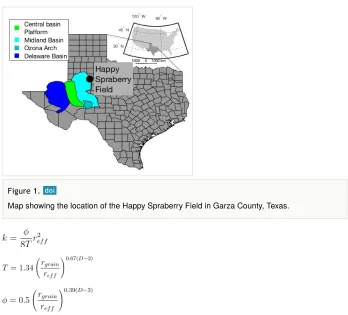
The Happy Spraberry Field Texas is located in Garza County on the northern part of the Midland Basin (Fig. 1). It produces oil from heterogeneous shallow-shelf carbonates of the Permian-aged Lower Clear Fork Formation. Core samples obtained from the field indicate the reservoir facies contain oolitic skeletal grainstones/packstones and skeletal rudstones. The reservoir facies have cemented and dissolution-enhanced pore types caused by facies selective diagenesis. Moldic pores are the most abundant across the field and dominate the oolitic skeletal grainstone packstone facies.
In the above equations, T is tortuosity, r is average grain size, r is the effective pore radius, D is the fractal dimension, k is permeability and ø is porosity.
Application
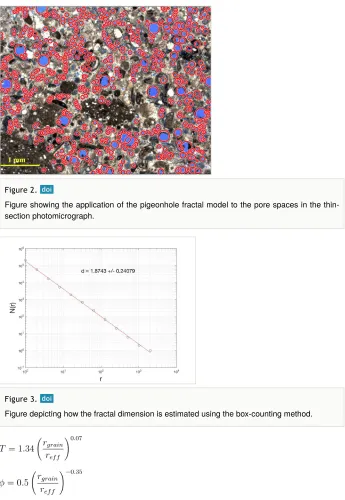
Fig. 2 shows the pigeonhole model used to approximate the moldic pores. Fig. 3 depicts how the fractal dimension is estimated. Plausible values of the fractal dimension range from 1.63 to 2.11, hence equation (2) is applicable for values greater than 2. We choose the representative value of 2.11 and substitute it in the second and third equations to obtain:
grain eff
Figure 1.
Combining these two two equations with the first equation, we obtain:
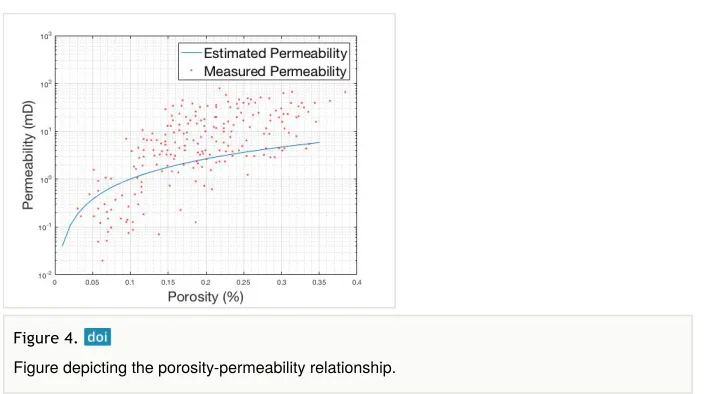
Using an average value of grain size radius = 250000 nm and porosity ranging from 0 to 35%, we compare the estimated permeabilities to laboratory-measured core permeabilities
Figure 2.
Figure showing the application of the pigeonhole fractal model to the pore spaces in the thin-section photomicrograph.
Figure 3.
from the field. Fig. 4 shows the estimated permeability-porosity relationship has a good match with laboratory-measured permeability-porosity relationship especially for porosity values less than 20%.
Conclusions
The pigeonhole fractal is used to successfully characterize the moldic pores in the reservoir facies of carbonate rocks and extract the fractal dimension. We then apply the Kozeny-Carman equation and equations relating the tortuosity and the porosity to the fractal dimension to establish an empirical relationship between permeability and porosity.
References
• Amosu A, Sun Y (2017a) WheelerLab: An interactive program for sequence
stratigraphic analysis of seismic sections, outcrops and well sections and the generation of chronostratigraphic sections and dynamic chronostratigraphic sections. SoftwareX 6: 19‑24. https://doi.org/10.1016/j.softx.2016.12.003
• Amosu A, Sun Y (2017b) FischerLab: An interactive program for generating dynamic Fischer plots from wireline logs and stratigraphic data. AAPG Annual Convention and Exhibition. AAPG
• Amosu A, Sun Y (2018) MinInversion: A Program for Petrophysical Composition Analysis of Geophysical Well Log Data. Geosciences 8 (2): 65. https://doi.org/10.3390/ geosciences8020065
• Hein FJ (1999) Mixed (‘‘multi’’) fractal analysis of granite wash fields/pools and
structural lineaments, Peace River Arch area, northwestern Alberta, Canada; a potential approach for use in hydrocarbon exploration. Bulletin of Canadian Petroleum Geology 47: 556‑572.
Figure 4.
• Mandelbrot BB (1983) The Fractal Geometry of Nature—Revised and Enlarged Edition. W.H. Freeman and Co, New York, 495 pp.
• Pape H, Riepe L, Schopper J (1987) Theory of self‐similar network structures in sedimentary and igneous rocks and their investigation with microscopical and physical methods. Journal of Microscopy 148 (2): 121‑147. https://doi.org/10.1111/
j.1365-2818.1987.tb02861.x