L E T T E R T O T H E E D I T O R
Open Access
Regulation of soluble CD127 protein
release and corresponding transcripts
expression in T lymphocytes from septic
shock patients
Julie Mouillaux
1,2†, Camille Allam
1,3†, Thomas Rimmelé
1,4, Thomas Uberti
4, Benjamin Delwarde
4, Julien Textoris
1,2,4,
Guillaume Monneret
1,2,3, Estelle Peronnet
1,2*†and Fabienne Venet
1,2,3†* Correspondence:
[email protected] †Julie Mouillaux, Camille Allam,
Estelle Peronnet and Fabienne Venet contributed equally to this work.
1EA 7426 « Pathophysiology of
injury-induced immunosuppression (PI3) » Lyon 1 University / Hospices Civils de Lyon / bioMérieux, 5 place d’Arsonval, 69437 Lyon Cedex 03, France
2Joint Research Unit
HCL-bioMérieux-Lyon 1 University, Hôpital Edouard Herriot, 5 place d’Arsonval, 69003 Lyon, France Full list of author information is available at the end of the article
To the Editor,
Sepsis is the leading cause of death for critically ill patients. Septic patients develop
T lymphocyte dysfunctions associated with increased mortality and nosocomial
infec-tions [
1
]. Therefore, IL-7 has been recently evaluated in a clinical trial to reverse these
alterations [
2
]. IL-7 receptor (IL-7R) is composed of an IL-7-specific chain (CD127)
and a common receptor
γ
-chain [
3
]. IL-7R exists in a soluble form (sCD127) [
4
],
resulting from shedding from the cell surface or transcriptional regulation [
5
,
6
].
Several transcripts missing the exon 6, coding for the transmembrane domain have
been identified, such as IL7R3 [
4
,
6
] and IL7R7 (Ensembl). We recently showed that
plasmatic sCD127 concentration and whole blood IL7R3 transcript expression were
decreased in septic shock [
7
,
8
]. However, sCD127 protein and transcripts regulations
in survivor and non-survivor patients differed, with higher sCD127 concentration and
lower IL7R3 expression in non-survivors. Therefore, the regulation of soluble IL-7R in
sepsis remains not fully understood.
In this study, we evaluated sCD127 release and corresponding transcripts IL7R3 and
IL7R7 expressions in purified T cells from septic shock patients. After approval by local
ethics committee, T cells were isolated from 32 septic shock patients (Table
1
) and 31
healthy volunteers (HV) (Additional file
1
).
Interestingly, the sCD127 release tended to be higher in patients
’
T cells supernatant
compared to HV (Fig.
1
). This contrasts with the decreased plasmatic sCD127
concen-tration in septic shock patients [
7
], possibly impacted by lymphopenia. Both IL7R3 and
IL7R7 transcripts expressions were decreased in septic shock patients
’
T cells (Fig.
2
),
as we previously observed in whole blood [
8
]. While whole blood IL7R3 and IL7R7
ex-pressions may be impacted by sepsis-induced lymphopenia, these transcripts are also
intrinsically regulated in T cells.
To delineate soluble IL-7R regulation in sepsis, we aimed to reproduce ex vivo its
ex-pression pattern observed in patients, by stimulating T cells from HV with IL-7 or
TCR activation, known to regulate CD127 expression [
9
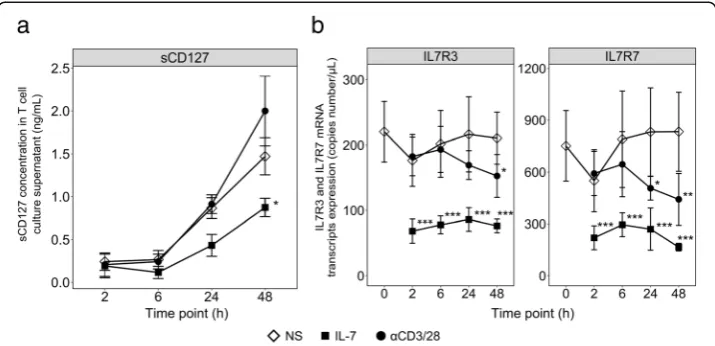
]. sCD127 was spontaneously
released from non-stimulated T cells (Fig.
3
a). During IL-7 stimulation, sCD127 protein
release and transcripts expression decreased. In contrast, TCR activation induced an
opposite regulation of sCD127 and corresponding transcripts (Fig.
3
b): sCD127
concen-tration increased, as previously described [
10
], while IL7R7 and IL7R3 transcripts
ex-pressions decreased. This suggests that these transcripts are not the main source of
sCD127 in this context, and that other mechanisms, such as shedding of membrane
CD127, might occur. Overall, ex vivo TCR activation partly reproduced soluble IL-7R
expression pattern observed in septic shock, suggesting that the initial T cell activation
shown to occur in sepsis [
11
,
12
] could participate to soluble IL-7R regulation, both at
the transcriptional and protein levels.
Table 1
Clinical characteristics of septic shock patients
Parameters Septic shock patients (n= 32)
Sex, male 26 (68%)
Age, years 70 [62–76]
SAPS II score 61 [51–82]
SOFA score (n= 31) 9 [8–12]
Charlson co-morbidity score (n= 30)
0 3 (10%)
1 14 (47%)
> 1 13 (43%)
Mac Cabe score (n= 31)
Non-fatal diseases 21 (68%)
Ultimately fatal diseases 9 (29%)
Rapidly fatal diseases 1 (3%)
Initial infection
Abdominal infection 16 (50%)
Pneumopathy 4 (12.5%)
Urinary infection 4 (12.5%)
Other 8 (25%)
Type of admission
Medical 13 (41%)
Emergency surgery 18 (56%)
Elective surgery 1 (3%)
Microbiological documentation
Gram negative 10 (31%)
Gram positive 7 (22%)
Other 1 (3%)
Non-documented 14 (44%)
Mortality at D28 9 (28%)
Lactate at D1 (mmol/L) 2.8 [1.7–5.6]
Lymphocytes at D3 (109/L) 1.05 [0.6–1.35]
mHLA-DR at D3 (AB/C) 8199 [3076–12,171]
Fig. 1sCD127 protein release from purified T cells from septic shock patients. sCD127 release was quantified in supernatants of purified T cells of septic shock patients (D1,n= 9) in comparison with healthy volunteers (HV,n= 13) after 48 h of culture without any stimulation. Data are presented as Tukey boxplots. Mann-Whitney tests were used to compare values between septic shock patients and HV. **p< 0.01, ***p< 0.001. See Additional file1for details
Altogether, we report here an intrinsic downregulation of IL-7R soluble transcripts in
septic shock patients
’
T cells, independently of lymphopenia, in parallel with an
in-creased sCD127 protein release. Ex vivo experiments in cells from HV suggest that
ini-tial T cell activation after sepsis might participate in this regulation, although this
remains to be formally demonstrated.
Additional file
Additional file 1:Methods. (PDF 352 kb)
Abbreviations
HV:Healthy volunteer; IL-7R: IL-7 receptor; sCD127: Soluble CD127;αCD3/28: Anti-CD3/CD28 antibodies coated beads
Acknowledgements
The authors would like to thank Elisabeth Cerrato and Anne Portier for their help in experimental procedures, Olivier Tabone for his advices on statistical analysis and data representation, and Valérie Cerro and Justine Dubreuil for valuable help with the patient inclusion process in the Immunosepsis study.
Funding
This work was supported by bioMérieux (JM, EP, JT), Hospices Civils de Lyon (CA, TR, TU, BD, FV, GM), and Association Nationale de la Recherche et de la Technologie (JM, Convention Industrielle de Formation par la Recherche convention 2015/060). The Association Nationale de la Recherche et de la Technologie had no role in study design, in the collection, analysis, and interpretation of data and in writing the manuscript.
Availability of data and materials
The datasets used and/or analyzed during the current study are available from the corresponding author on reasonable request.
Authors’contributions
JM, CA, FV, and EP designed the experiments. JM and CA performed the experiments and the statistical analyses. All authors discussed the data, drafted or revised critically the manuscript for important intellectual content, and read and approved the final manuscript.
Ethics approval and consent to participate
Septic shock patients: this project was approved by our Institutional Review Board for ethics (“Comité de Protection des Personnes Sud-Est II”), which waived the need for informed consent, because this study was observational and
Fig. 3sCD127 release and transcripts expression upon ex vivo stimulation of healthy volunteers’purified T cells.a
sCD127 protein release andbIL7R3 and IL7R7 mRNA transcripts expressions were measured in purified T cells from healthy volunteers (HV) stimulated ex vivo after the indicated time of incubation with IL-7 (n= 5, 10 ng/mL), anti-CD3/CD28 antibodies coated beads (n= 5,αCD3/28, 1:2 bead to cells ratio), or not stimulated (n= 10, NS). For each HV and each condition of stimulation, samples were proceeded in biological triplicates (culture wells) and technical duplicates (for ELISA only), summarized by the mean of the values for each individual. Data are presented as means and standard error of the mean. Mann-Whitney tests were used to compare values between non-stimulated and stimulated purified T cells from HV. *p< 0.05, **p< 0.01, ***p< 0.001. See Additional file1
performed on residual blood after completion of routine follow-up (#IRB 11236). This study is registered at the French Ministry of Research and Teaching (#DC-2008-509), at the Commission Nationale de l’Informatique et des Libertés and on clinicaltrials.gov (NCT02803346). Non-opposition to inclusion in the study was registered for each patient. Healthy volunteers: peripheral blood from healthy volunteers was provided by the“Etablissement Français du Sang” from Lyon. According to the standardized procedure for blood donation, written informed consent was obtained from healthy volunteers and personal data were anonymized at time of blood donation and before blood transfer to our research lab.
Consent for publication
Not applicable.
Competing interests
JM, JT, and EP are employees of bioMérieux. BD, FV, GM, EP, and JT are co-inventors on three patent families covering IL-7 receptor biomarkers. This work was supported by Association Nationale de la Recherche et de la Technologie (JM, Convention Industrielle de Formation par la Recherche convention 2015/060).
Publisher
’
s Note
Springer Nature remains neutral with regard to jurisdictional claims in published maps and institutional affiliations.
Author details
1
EA 7426 « Pathophysiology of injury-induced immunosuppression (PI3) » Lyon 1 University / Hospices Civils de Lyon / bioMérieux, 5 place d’Arsonval, 69437 Lyon Cedex 03, France.2Joint Research Unit HCL-bioMérieux-Lyon 1 University, Hôpital Edouard Herriot, 5 place d’Arsonval, 69003 Lyon, France.3Immunology Laboratory, Hospices Civils de Lyon, Hôpital Edouard Herriot, 5 place d’Arsonval, 69003 Lyon, France.4Anesthesiology and Intensive care medicine department, Hospices Civils de Lyon, Hôpital Edouard Herriot, 5 place d’Arsonval, 69003 Lyon, France.
Received: 7 August 2018 Accepted: 26 December 2018
References
1. Hotchkiss RS, Coopersmith CM, McDunn JE, Ferguson TA (2009) Tilting toward immunosuppression. Nat Med 15:496– 497.https://doi.org/10.1038/nm0509-496
2. Francois B, Jeannet R, Daix T et al (2018) Interleukin-7 restores lymphocytes in septic shock: the IRIS-7 randomized clinical trial. JCI Insight 3.https://doi.org/10.1172/jci.insight.98960
3. Lundström W, Fewkes NM, Mackall CL (2012) IL-7 in human health and disease. Semin Immunol 24:218–224.https://doi. org/10.1016/j.smim.2012.02.005
4. Goodwin RG, Friend D, Ziegler SF et al (1990) Cloning of the human and murine interleukin-7 receptors: demonstration of a soluble form and homology to a new receptor superfamily. Cell 60:941–951. https://doi.org/10.1016/0092-8674(90)90342-C
5. Vranjkovic A, Crawley AM, Gee K et al (2007) IL-7 decreases IL-7 receptorα(CD127) expression and induces the shedding of CD127 by human CD8+ T cells. Int Immunol 19:1329–1339.https://doi.org/10.1093/intimm/dxm102
6. Rose T, Lambotte O, Pallier C et al (2009) Identification and biochemical characterization of human plasma soluble IL-7R: lower concentrations in HIV-1-infected patients. J Immunol 182:7389–7397.https://doi.org/10.4049/jimmunol.0900190
7. Peronnet E, Mouillaux J, Monneret G et al (2016) Elevated soluble IL-7 receptor concentration in non-survivor ICU patients. Intensive Care Med 42:1639–1640.https://doi.org/10.1007/s00134-016-4445-x
8. Delwarde B, Peronnet E, Venet F et al (2018) Low interleukin-7 receptor messenger RNA expression is independently associated with day 28 mortality in septic shock patients. Crit Care Med 46:1739–1746.https://doi.org/10.1097/CCM. 0000000000003281
9. Alves NL, van Leeuwen EMM, Derks IAM, van Lier RAW (2008) Differential regulation of human IL-7 receptorα expression by IL-7 and TCR signaling. J Immunol 180:5201–5210.https://doi.org/10.4049/jimmunol.180.8.5201
10. Monti P, Brigatti C, Krasmann M et al (2013) Concentration and activity of the soluble form of the interleukin-7 receptor αin type 1 diabetes identifies an interplay between hyperglycemia and immune function. Diabetes 62:2500–2508.
https://doi.org/10.2337/db12-1726
11. Schwulst SJ, Muenzer JT, Chang KC et al (2008) Lymphocyte phenotyping to distinguish septic from nonseptic critical illness. J Am Coll Surg 206:335–342.https://doi.org/10.1016/j.jamcollsurg.2007.07.038