Volume 2, Issue 11, November 2013
Page 350
ABSTRACT
Increased vehicle emission is one of the most important issues that have drawn the attention of policy makers and environment alerts these days. The increasing no’s of automobiles playing on roads to day in our country is positioning a serious threat to the ecology, through its harmful pollutants also the fuel economy least maintained and low cost of the fuel have provoked the people to go for diesel vehicle several research has been made in the field of pollution control from automobiles and the research is still going on ,the research has been done an various sectors like in cylinder modification suitable doping of fuel and the exhaust after treatment through all these methods are aimed at one target yet the exhaust after treatment program has scored over the ot her methods. In my present investigation an attempt has been made to study the performance of various metal oxide catalyst a combustion of carbon monoxide and tri metal oxide catalyst in reducing the pollutant from four stroke C.I engine it has been found that a stable catalyst have been found through experimental that can act as a promising technology in future.
Key words: diesel, catalyst, combustion, pollution
1. INTRODUCTION
There are millions of cars on the road in the United States, and each one is potentially a source of air pollution. Especially in large cities, the amount of pollution that all the cars produce together can create big problems. To solve those problems, cities, states and the federal government create clean-air laws, and many laws have been enacted that restrict the amount of pollution that cars can produce. To keep up with these laws, automakers made many refinements to car engines and fuel systems. To help reduce the emissions further, they developed an interesting device called a catalytic converter, which treats the exhaust before it leaves the car and removes a lot of the pollution. In this article, you will learn which pollutants are produced by an engine and why and how a catalytic converter deals with each of these pollutants. Catalytic converters are amazingly simple devices, so it is incredible to see how big an impact they have. In order to reduce emissions, modern car engines carefully control the amount of fuel they burn. They try to keep the air-to-fuel ratio very close to the stoichiometric point, which is the calculated ideal ratio of air to fuel. Theoretically, at this ratio, all of the fuel will be burned using all of the oxygen in the air. For gasoline, the stoichiometric ratio is about 14.7:1, meaning that for each pound of gasoline, 14.7 pounds of air will be burned. The fuel mixture actually varies from the ideal ratio quite a bit during driving. Sometimes the mixture can be lean (an air-to-fuel ratio higher than 14.7), and other times the mixture can be rich (an air-to-fuel ratio lower than 14.7).
2. THE MAIN
EMISSIONS OF A CAR ENGINE
1.Nitrogen gas (N2) - Air is 78-percent nitrogen gas, and most of this passes right through the car engine.
2.Carbon dioxide (CO2) - This is one product of combustion. The carbon in the fuel bonds with the oxygen in the air. 3.Water vapor (H2O) - This is another product of combustion. The hydrogen in the fuel bonds with the oxygen in the air. These emissions are mostly beginning (although carbon dioxide emissions are believed to contribute to global warming). But because the combustion process is never perfect, some smaller amounts of more harmful emissions are also produced in car engines:
1.Carbon monoxide (CO) - a poisonous gas that is colorless and odorless
2.Hydrocarbons or volatile organic compounds (VOCs) - produced mostly from unburned fuel that evaporates
Sunlight breaks these down to form oxidants, which react with oxides of nitrogen to cause ground level ozone (O3), a
major component of smog. Nitrogen oxides (NO and NO2, together called NOx) - contributes to smog and acid rain, and also causes irritation to human mucus membranes ,These are the three main regulated emissions, and also the ones that catalytic converters are designed to reduce.
3.
CATALYTIC
CONVERTERS
Most modern cars are equipped with three-way catalytic converters. "Three-way" refers to the three regulated emissions it helps to reduce -- carbon monoxide, VOCs and NOx molecules. The converter uses two different types of catalysts, a reduction catalyst and an oxidation catalyst. Both types consist of a ceramic structure coated with a metal catalyst, usually
Fabrication and Testing of a Catalytic
Convertor
V.Veeraragavan
Assistant Professor
Volume 2, Issue 11, November 2013
Page 351
platinum, rhodium and/or palladium. The idea is to create a structure that exposes the maximum surface area of catalyst to the exhaust stream, while also minimizing the amount of catalyst required (they are very expensive) There are two main types of structures used in catalytic converters -- honeycomb and ceramic beads. Most cars today use a honeycomb structure.4. CATALYST
4.1 The Reduction Catalyst
The reduction catalyst is the first stage of the catalytic converter. Platinum and rhodium used, help to reduce the NOx emissions. When an NO or NO2 molecule contacts the catalyst, the catalyst rips the nitrogen atom out of the molecule and holds on to it, freeing the oxygen in the form of O2. The nitrogen atoms bond with other nitrogen atoms that are also stuck to the catalyst, forming N2. For example:
2NO => N2 + O2 or 2NO2 => N2 + 2O2
4.2 The Oxidization Catalyst:
The oxidation catalyst is the second stage of the catalytic converter. It reduces the unburned hydrocarbons and carbon monoxide by burning (oxidizing) them over a platinum and palladium catalyst. This catalyst aids the reaction of CO and hydrocarbons with the remaining oxygen in the exhaust gas. For example:
2CO + O2 => 2CO2
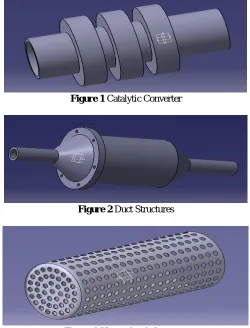
Figure 1 Catalytic Converter
Figure 2 Duct Structures
Figure 3 Honey Comb Structure
5. FABRICATION
5.1 Fabrication of canister
Volume 2, Issue 11, November 2013
Page 352
inserted between mating flanges and was done on the act against flanges. A stopper was provided inside the casing to prevent form casing from blow away.5.2FABRICATION OF FOAM CASING
A mild steel sheet was folded to the shape of a duct with dimension just above that of the ceramic foam filter. Two flanges of 100mm outer diameter with a rectangular slot of 75mm*50mm welded to the ends of the duct.
5.3FABRICATION OF ALUMINA BALL CASING
A wire mesh was made into the shape of a cylinder with a diameter matching with that inner diameter of a canister. A provision was made on one end of the casing for loading the alumina ball.
5.4 Fabrication of duct
A Duct is fabricated which has three circular slots of diameter 80 mm, this duct is fitted before catalytic converter, this duct reduces the temperature and velocity at certain amount, so the reaction of the catalyst in honeycomb will be higher with the harmful gases which comes out from the engine exhaust, so this results more reduction of the harmful gases into harmless gases.
6.
PREPARATION
OF
CATALYST
6.1 Catalyst Used
1.Iron 2.Cobalt 3.Copper 4.Manganese and
5.Bimetal or tri-metal combination of catalyst.
6.2 Properties of catalyst
Materials used L.I.T M.P˚C B.P˚C T.C W/mk
Copper 284 1083 2310 384
Cobalt - 1499 2900 39.1
Ferrous 131 - - -
Manganese 130 - - -
L.I.T-Lowering of ignition temperature, M.P-Melting point, B.P-Boiling, T.C-Thermal conductivity
7. COATING PROCEDURE
In this coating process, about 5g of salt was dissolved in 250ml of distilled water. To this solution few drops of ammonium hydroxide solution is added to form the corresponding metal hydroxide precipitate. The ceramic foam filter and alumina balls were immersed in to the precipitate and heated for some time on a hot plate, then the alumina balls were removed and allowed to dry in atmosphere while the foam filter was removed and baked in an oven.
8. EXPERIMENTAL DETAILS
8.1 Engine Specification
Engine type : Single cylinder engine Brake power : 3.7 kW
Speed : 1500 rpm Bore : 80 mm Stroke : 110 mm
Type of loading: Brake drum dynamometer
8.2 Procedure
1.The metal coated foam filter and alumina balls are placed inside the canister on the either side and sealed on both ends. 2. The thermocouples are inserted into the
foam and alumina balls to measure the respective bed temperature.
3.Also the manometer is connected to tapings provided at the intact and out up of the canister.
Volume 2, Issue 11, November 2013
Page 353
5.The smoke is measured with the help of bosh smoke Meta device. This is done by expressing the filter paper to the exhaust from the catalytic converter for about 10 seconds.6.The same procedure was repeated in the same engine using bio – diesel as fuel.
9. RESULTS AND DISCUSSION
9.1 Testing of emissions
9.1.1 Diesel as fuel with and without ducts
9.1.2 Bio-diesel as fuel with and without ducts
9.1.3. Diesel and Bio-diesel as fuel with ducts
9.1.4. Diesel and Bio-diesel without ducts
CONCLUSION
1.Graph 1 shows that emissions of gases are more in the case of without ducts than in with ducts for diesel fuel. 2.Graph 2 shows that emissions of gases are more in the case of without ducts than in with ducts for bio-diesel fuel. 3.Graph 3 shows that during emission testing with ducts bio-diesel emits comparatively less percentage of CO2, NO and
CO than that of diesel fuel. But hydrocarbon emission is more in the case of bio-diesel.
4.Graph 4 shows that during emission testing without ducts bio-diesel emits comparatively less percentage of NO and HC than diesel fuel whereas CO2 and CO emissions remains same. For both the fuel.
The redesigned catalytic converter is more advantageous for engines that uses Bio-diesel as fuel for its following changes from the existing catalytic converter:
Volume 2, Issue 11, November 2013
Page 354
above results, the emissions of CO2, NOx and CO are less during the emission .So these ducts plays an important role to reducing the emissions of engine.References
[1] Magdi khair Jacques lernaire (2000)” Achieving heavy duty diesel nox /PM level below their EPA 2002 Stoots and Integral solution” sae transpaper 2000 – 01 –0187 PP, 7 to 12.
[2] Zn Mogaka V.W wong (1892)” Performance and regeneration characterizes for cellular ceramic diesel particulate trap” Sae transpaper 8202272 PP, 1078 – 1100
[3] W.R Wade, J E white and J.J Florek (1981)” Diesel particulatetrap regeneration technique” SAE Transpaper 810018, PP 502 – 522
[4] J. Paul day and louis S Scha (1988) “Impact of catalyst support design parameters on automobile emission “SAE Tran paper 881590, PP 3.592 – 3.602
[5] Masa Kazer Iwamoto” novel catalytic control of nox in automobile and stationery source emission” Kazhukiko nagaese and kohji fantasu(1990)” A study of Nox concentration mechanism in diesel exhaust “Sae Tran paper 901615, PP 1952 to 1960
[6] Carno J. Pereira and Michal D. Amiridus Nox” Control from Stationery sources over view of regulation technology and research formation”