1
Durkin, M., Beaumont, E. Hollins Martin, C.J., Carson, J. (2016). A pilot study exploring the relationship between self-compassion, self-judgement, self-kindness, compassion, professional quality of life and wellbeing among UK community nurses. Nurse Education Today.
Abstract
Background: Compassion fatigue and burnout can impact on performance of nurses. This paper explores the relationship between compassion, self-judgement, self-kindness, compassion, professional quality of life, and wellbeing among community nurses.
Aim: To measure associations between self-compassion, compassion fatigue, wellbeing, and burnout in community nurses.
Method: Quantitative data were collected using standardised psychometric
questionnaires: (1) Professional Quality of Life Scale; (2) Self-Compassion Scale; (3) short Warwick Edinburgh Mental Wellbeing Scale; (4) Compassion For Others Scale, used to measure relationships between self-compassion, compassion fatigue,
wellbeing, and burnout.
Participants: A cross sectional sample of registered community nurses (n=37) studying for a postgraduate diploma at a University in the North of England took part in this study.
Results: Results show that community nurses who score high on measures of self-compassion and wellbeing, also report less burnout. Greater self-compassion satisfaction was also positively associated with compassion for others, and wellbeing, whilst also being negatively correlated with burnout.
Conclusion: High levels of self-compassion were linked with lower levels of burnout. Furthermore when community nurses have greater compassion satisfaction they also report more compassion for others, increased wellbeing, and less burnout. The implications of this are discussed alongside suggestions for the promotion of greater compassion.
2
A pilot study exploring the relationship between compassion, self-judgement, self-kindness, compassion, professional quality of life and wellbeing among UK community nurses.
Background
A recent report on the UK National Health Service (NHS) by Lord Francis QC, revealed that certain hospital failings were in part due to staff not acting with
compassion, which led to his recommendation to develop more compassionate care among healthcare staff, with a specific focus on nurse training (Francis, 2013). Compassion is an integral part of any healthcare profession, and forms the basis of the Royal College of Nursing’s (2010) and Nursing and Midwifery Council’s (2008) guidelines for good practice in the UK, and also the American and Canadian
professional nursing bodies (American Nurses Association, 2010; Canadian Nurses Association, 2008). Providing compassionate care is also highlighted as a necessary skill for district nurses (Queens Nursing Institute, 2014).
Compassion in Nursing
3
exhibit compassion, whilst burnout can lead to feelings of depersonalization (Straughair, 2012, a & b). Hence, an absence of compassion in some parts of the NHS in the UK may be related to deficits in nurse education, particularly in relation to stress related subjects.
Compassion Fatigue and Burnout
Joinson (1992) first coined the term compassion fatigue, when she noted that an increasing number of nurses were reporting feelings of exhaustion as a direct consequence of working with patients. Building on this, Figley (1995) introduced his own notion of ‘compassion fatigue’ when talking about these effects with healthcare workers, further suggesting that ‘compassion fatigue’ occurs as a result of hearing about a traumatizing event that a person has experienced. ‘Compassion fatigue’ is a secondary form of traumatic stress, which Figley terms the ‘cost of caring’ (Figley, 2002a). Durkin et al (2013), reported high levels of ‘compassion fatigue’ and lower levels of ‘burnout’ in student nurses, compared with assistant practitioners. Causal
factors were considered to include heavy workloads, lack of support, and long working hours. A study by Rout (2000), discovered that out of a sample of (n=79) NHS employed district nurses, the greatest predictors of stress included lack of communication between colleagues, extra work demands, feeling dissatisfied and problematic patients. Similarly, Beaumont et al, (2015a) discovered that more than half of a sample of student midwives (n=103) reported average levels of burnout. Burnout is commonly reported by nurses, with many describing experiences of feeling stressed as a direct consequence of stressors within their demanding role. Hegney et al, (2014) identified in a sample of 132 nurses, that compassion fatigue and burnout are strongly related to anxiety and depression. Burnout can affect a person’s ability to display compassion, and has been related to feelings of emotional strain, reduced job satisfaction, and lack of support provision from managers and the organization (Farquharson et al, 2013; Young-Hee & Jong Kyung, 2012). Michalec et al (2013), highlights the risks of burnout amongst undergraduate students
transitioning into full time employment.
In addition, the UK National Health Service (NHS), with its constant
4
compassionate mind, in many circumstances the threat system of a student nurse could be in a constant state of activation, which hinders their ability to feel
compassion (Gilbert, 2009). However, having a compassionate presence has been shown to negate stress and improve wellbeing among nurses (Sabo, 2011).
Compassion satisfaction and Wellbeing
Compassion satisfaction is the positive feeling associated with knowing that the professional has in some way helped another. According to Stamm (2009), when compassion satisfaction is high, and both burnout and compassion fatigue are low, the professional’s quality of life is improved. Professional quality of life is the balance between compassion satisfaction, burnout, and compassion fatigue. When there is equilibrium in a person’s professional quality of life, they will experience more flourishing in practice (Stamm, 2009). Todaro-Franceschi (2013), reported that although nurses are taught to understand what constitutes ‘quality of life’, they can
lose their own self-care in their daily working life. Nurses are required to work long hours and are expected to tend simultaneously to multiple patients, whilst
consistently providing continuous compassion (Gershon, 2013). In stressful situations, such as a hospital environment, nurses often neglect their personal
emotional and psychological needs. To compound these claims, nurses connect with their patients and families through the concept of empathy (Senyuva et al, 2014), which can be impeded by compassion fatigue and burnout.
Work related stress can also affect the wellbeing of nurses. In a recent NHS staff survey (NHS, 2014), out of 67,261 registered general nursing and midwifery staff, 41% reported having experienced stress related issues that significantly impacted upon their personal wellbeing. Wellbeing has shown to be a significant predictor of high nursing staff turnover (Brunetto et al, 2013). This leads one to question what can be implemented to improve nurses’ ability to provide and sustain high levels of compassion across time to their patients.
There is an increasing amount of evidence that promotes the idea that developing compassion for one’s own suffering can alleviate stress, burnout, and increase resilience (Neff 2003; Gilbert, 2009; Neff & Germer, 2013).
self-5
management techniques that prepare them for the emotional demands of clinical practice. Zeller and Levin (2013), recommend that ‘mindfulness’ should be taught to
alleviate stress levels, with interventions for compassion fatigue delivered in education programs (Aycock & Boyle, 2009). In essence, higher education institutions must teach the concept of ‘compassion’ and practical applications to develop it into nursing programs.
Self-Compassion
There has been an expansion of the amount of research that has explored the role self-compassion plays (Beaumont & Hollins-Martin, 2015; Gilbert, 2009; Hucherson, Seppala & Gross 2008), especially in relation to the education of health care
professionals (Cornwell et al, 2014). For example, Beaumont et al (2015, b), found a significant association between high levels of ‘self-compassion’ and fewer symptoms of ‘burnout’ in trainee psychotherapists.
Several studies have explored relationships between compassion and nursing. For example, Gustin and Wagner (2012), discovered that cultivating self-compassion in clinical nurse teachers improved self-compassion for others. Jafari et al (2012) found that a positive attitude towards the nursing role, job satisfaction, and feelings of hope, were related to lower levels of stress among a sample of Iranian nurses. Senyuva et al (2013), found that compassion can help nurses understand patient suffering through recognition of a shared unity of pain. Heffernan et al (2010), reported a positive correlation between self-compassion and emotional intelligence in a sample of 135 nurses. Heffernan et al (2010), further suggest that without self-compassion nurses would be unable to deliver authentic self-compassion for others. Neff and Pommier (2013), propose that self-compassion can improve interpersonal functioning and is linked to qualities such as empathy and altruism. These studies support the idea that examining self-compassion among student nurses is important, and that this may be a way forward for developing compassion and stress reduction techniques.
6 Methodology
This study was a cross sectional questionnaire survey. Quantitative data were
collected from a total of (n=37) registered community nurses studying at a University in the North of England. All participants had clinical experience and were full-time students studying for a 1 year post-graduate diploma in community specialist
practice. The sample included 34 females and 3 males, aged 23-56 (mean age 36). Other demographic data were excluded to retain focus on relationships between the measures themselves.
Procedure
At the start of their lecture a group of community nursing students were invited to participate in the survey, resulting in a small convenience sample of 37 community nursing students. Informed consent was provided by all students present.
Ethical Considerations
Approval was granted by the University Ethics Committee in line with the British Psychological Society guidelines on ethical practice (BPS, 2014). Participants were informed that data would be stored securely and anonymously for a year before being destroyed.
Data collection and selection of research instruments
7
(1) Compassion for Others (CFO) Scale (Pommier, 2011)
The CFO Scale measures how people typically act towards others and includes statements such as “when people cry in front of me I usually don’t feel anything at all”. Each item connects to six subscales; kindness, indifference, common humanity,
separation, mindfulness, and disengagement. Participants indicate how they behave in relation to the individual items using a scoring scale from 1-5 where 1 equals ‘almost never’ and 5 ‘almost always’. Indifference, separation, and disengagement items are reverse scored. Total score for compassion is calculated using the mean for each subscale, before computing the overall mean from the scores. When examining subscales separately, reverse-coding is not used. Cronbach’s alphas for this measure are high, with overall compassion (.90), kindness (.77), indifference (.68), common humanity (.70), separation (.64), mindfulness (.67), and
disengagement (.57). The scale’s validity was established from data collected with student populations in the USA, and may not be directly comparable to British community nurses.
(2) The Professional Quality of Life (ProQOL) Scale (Stamm, 2009)
This 30-item scale measures positive and negative aspects of working with trauma. There are 10 statements for each of the 3 subscales; compassion satisfaction, compassion fatigue/secondary traumatic stress, and burnout. Each item is scored using a Likert scale ranging from 1 (never) to 5 (very often) relative to the last 30 days. A sample item is “I feel connected to others”. Internal reliability is good with Cronbach’s alphas for compassion satisfaction (.88), burnout (.75), and compassion fatigue/secondary traumatic stress (.81). Scale validity was calculated from data from over 200,000 participants across the globe (Stamm, 2009).
(3) The Self-Compassion Scale (SCS)-Long Version (Neff, 2003)
This instrument measures how people typically act towards themselves during times of great difficulty. It includes 6 subscales: self-kindness, self-judgement, mindfulness, common humanity, isolation, and over identification. Statements such as “I try to be
loving towards myself when I feel emotional pain” are scored on a scale of 1 (almost never) to 5 (almost always). This scale has a high internal reliability, with Cronbach’s
8
humanity (.80), isolation (.85), mindfulness (.85), and over-identification subscale (.88). The SCS has been validated in both the UK and internationally.
(4) The Short Warwick Edinburgh Mental Well-being Scale (sWEMWBS)
The sWEMWBS consists of 7 positively worded items that relate to respondents feelings over the prior fortnight. For example, “I’ve been feeling optimistic about the
future”. Responses range from 1 (none of the time) to 5 (all of the time). Internal reliability is high, with a Cronbach’s alpha of (.83) (Tennant et al, 2009). Scale validity has been established with data collected in the UK and globally.
Statistical analyses
Data were analyzed using SPSS version 20. Descriptive statistics were calculated before inferential analyses using a Spearman’s Rho correlation and Mann Whitney Independent U- Test from divided scores of ‘high’ versus ‘low’ on all measures which
relate to self-compassion. The rationale behind test use was to investigate the relationship between each variable, and to explore differences in ‘high’ versus ‘low’ levels of self-compassion among community nurses. Data were not normally distributed, therefore non-parametric tests were conducted.
Results
To view mean and standard deviation scores for the 4 questionnaires (see Table 1) TABLE 1
9
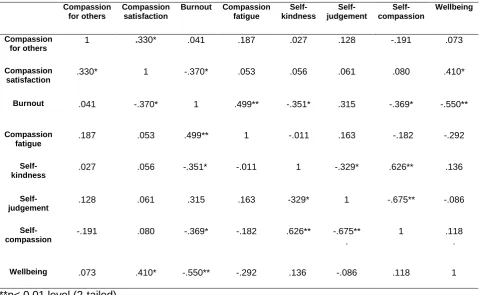
The significance level for examining differences between groups was set at α = 0.05. To view the calculated relationships between variables using a Spearman’s rho
correlation (see Table 2). TABLE 2
A statistically significant negative relationship between self-compassion and burnout was found (r = - .369). Self-kindness was also significant and again inversely related to burnout (r = -.351). Compassion satisfaction was found to be positively associated with compassion (r =.330), wellbeing (r =.410), and negatively with burnout (r = -.370). Although non-significant, self-judgement was found to be positively associated with both compassion fatigue and burnout.
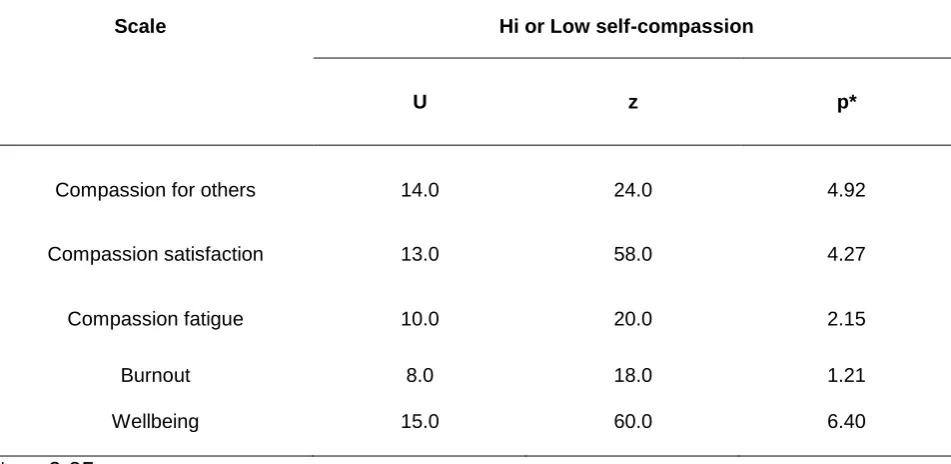
Mean scores for ‘high’ and ‘low’ levels of self-compassion, burnout,
compassion fatigue, compassion satisfaction, and wellbeing were examined. Results found there to be no significant difference between groups (see table 3)
TABLE 3
Discussion
Results suggest that community nurses who are more self-compassionate are less likely to suffer from symptoms of burnout. In addition, community nurses who feel a greater sense of satisfaction from their work show greater compassion, more positive wellbeing, and are less prone to burnout. The high scores for compassion
satisfaction are supported by the work of Maben et al (2010), who found that nurses at the beginning of their careers want to provide high quality evidence-based care. However, two years on these nurses reported feelings of frustration and burnout. Michalec et al (2013), call this the “quiet before the storm”, with self-judgement increasing a tendency towards burnout. Such evidence supports the idea that teaching community nurses the skills of self-compassion could potentially reduce negative thoughts and emotions. Such self-care techniques could potentially help prevent compassion fatigue and burnout.
10
compassion were higher than Pommier’s (2010), original sample of undergraduate
students. However, two restrictions of our study are that we do not have access to the Pommier (2010) data, and our sample of community nurses is relatively small. Nonetheless, our findings are indicative of a possible larger problem and potentially explain recent criticisms of nursing staff highlighted in the Francis Report (Francis, 2013).
Our data have shown that when compassion satisfaction and self-compassion are high, the community nurses in our study showed greater compassion,
experienced a better quality of life, increased wellbeing, and greater resilience towards occupational stress. Those who were self-critical tend to experience greater stress. In essence, whilst engaged in stressful situations it can be easy for nurses to neglect their own emotional and psychological needs, which makes them prone to compassion fatigue and burnout. Hence, more of a sense of enjoyment from providing care to patients could be developed through teaching self-compassion skills. This would create what Sabo (2011), calls ‘a compassionate presence’.
Contribution to the literature
There are several contributions that can be taken from this study.
(1) We are the first research team to examine relationships between compassion, self-compassion, compassion fatigue, quality of life, burnout, and wellbeing in registered community nurses. However, it should be noted that we used a small convenience sample of community nurses.
(2)Teaching techniques for self-care might reduce levels of compassion fatigue and burnout in community nurses. Building students’ resilience and self-compassion through teaching techniques might have benefits in terms of reducing compassion fatigue and burnout. This is a matter for further research.
(3) Developing community nurses’ compassion satisfaction could increase compassion for others, and improve their personal wellbeing. When a nurse’s
11
(4) Those who were dissatisfied with their role tended to score lower on measures of compassion. Findings show that self-compassion did not correlate positively with compassion for others, instead they were related to reduced burnout scores.
Implications for community nurses
Findings suggest that developing self-compassion may prove beneficial for registered community nurses. Our study has shown that even moderate levels of self-compassion may be linked to reduced levels of burnout. This finding in itself merits further investigation. Our paper adds to the growing body of literature that considers self-compassion to be a healthy attribute for nurses to have (Cornwell et al, 2014). If community nurses can be taught to recognise how they interact with patients, they will be able to develop greater compassion satisfaction. This in turn can lead to an increase in compassion for others.
Limitations
Questionnaires were collected from participants at the beginning of their post
graduate diploma in community nursing. If questionnaires were given at the start and end of training, this would have provided pre-training and post-training data. It is difficult to generalize the findings of this study to other community nurses, both within and outside of the university.
Participant numbers were quite small. An additional investigation involving a larger sample, and including allied nursing specialisms would provide more information. In addition, only quantitative data was collected. A qualitative approach may have offered richer and more detailed data regarding the subjective experiences of the participating community nurses. Further factors may have influenced the scores from this survey. For example, participants from different backgrounds may have strong trait resilience that could have altered results. In addition to the data collected, we could have measured resilience, coping strategies, cultural, and ethnic differences.
Further research
12
played by organisations for community nurses could also be illuminating. For
example, organisational stress can inhibit compassion, especially when people feel under financial threat or threats of job loss (Crawford et al, 2014). Similarly, staff shortages can impact on staff, especially if staff members do not feel supported by managers.
Further research could also investigate interventions that may promote self-care in community nurses. Compassionate Mind Training (CMT) is perhaps one intervention that could help community nurses to develop compassion for their own suffering and the suffering of others. CMT draws on evidence from neuropsychology, attachment theory, evolutionary psychology, and social psychology, and its aim is to cultivate a compassionate mind. Within a therapeutic context, compassionate mind training is endorsed as a technique that helps increase feelings of care and
compassion, through reducing self-criticism, guilt, and shame (see Beaumont & Hollins-Martin 2015 and Leaviss & Uttley 2014, for a review). Furthermore, developing self-compassion has been found to increase compassion for others (Heffernan et al, 2010) and impact positively on wellbeing (Yarnell & Neff, 2013).
Summary and Conclusions
13 References
American Nurses Association (Ed.). 2010. Nursing's Social Policy Statement: The Essence of the Profession. Nurses books. org.
Aycock, N. & Boyle, D. 2009. Interventions to manage compassion fatigue in oncology nursing. Clinical Journal of Oncology Nursing, 13(2), 183-191.
Beaumont, E., & Hollins Martin, C. J. 2015. A narrative review exploring the
effectiveness of Compassion-Focused Therapy. Counselling Psychology Review, 30 (1), 21-32.
Beaumont, E., Durkin, M., Hollins-Martin, C. J., & Carson, J. 2015,a. Compassion for others, self-compassion, quality of life and mental well-being measures and their association with compassion fatigue and burnout in students midwives: A
quantitative survey. Midwifery. http://dx.doi.org.10.1016/j.midw.2015.11.002
Beaumont, E., Durkin, M., Hollins Martin, C. J., & Carson, J., 2015,b. Measuring relationships between self-compassion, compassion fatigue, burnout and well-being in trainee counsellors and trainee cognitive behavioural psychotherapists: a
quantitative survey. Journal of Counselling and Psychotherapy Research. 16:15–23.
doi: 10.1002/capr.12054
The British Psychological Society. 2014. Code of Human Research Ethics. The British Psychological Society: Leicester.
Bjerknes, M.S., & Bjork, I.T. 2012. Entry into nursing: an ethnographic study of newly qualified nurses taking on the nursing role in a hospital setting. Nursing Research and Practice, 1-7.
Bray, L., O’Brian, M.R., Kirton, J., Zuairu, K., & Christiansen, A. 2014. The role of professional education in developing compassionate practitioners: A mixed methods study exploring the perceptions of health professionals and pre-registration students.
14
Brunetto, Y., Xerri, M., Shriberg, A., Farr‐Wharton, R., Shacklock, K., Newman, S., & Dienger, J. 2013. The impact of workplace relationships on engagement, well‐being, commitment and turnover for nurses in Australia and the USA. Journal of Advanced Nursing, 69(12), 2786-2799.
Canadian Nurses Association. 2008. Advanced Nursing Practice: A National Framework. Canadian Nurses Association: Toronto.
Cornwell, J., Donaldson, J., & Smith, P. 2014. Nurse Education Today: Special issue on compassionate care. Nurse Education Today, 9(34), 1188-1189.
Crawford, P., Brown, B., Kvangarsnes, M., & Gilbert, P. 2014. The design of compassionate care. Journal of Clinical Nursing, doi: 10.1111/jocn.12632
Curtis, K. 2014. Learning the requirements for compassionate practice: Student vulnerability and courage. Nursing Ethics, 21(2), 210-223.
Durkin, M., Smith, J., Powell, M., Howarth, J., Carson, J. 2013. Compassion fatigue, burnout and wellbeing in AP’s. British Journal of Healthcare Assistants, 7(9),
456-459.
Evans, J., Macrory, I. Randall, C. 2015. Measuring well-being: Life in the UK 2015. Office for National Statistics. www.ons.gov.uk/well-being (last accessed 21 July 2015).
Farquharson, B., Bell, C., Johnston, D., Jones, M., Schofield, P., Allan, J., & Johnston, M. 2013. Nursing stress and patient care: real‐time investigation of the effect of nursing tasks and demands on psychological stress, physiological stress, and job performance: study protocol. Journal of Advanced Nursing, 69(10), 2327-2335.
15
Figley, C.R. 2002 (a). Treating Compassion Fatigue. Brunner/Mazel: New York.
Figley, C.R. 2002 (b). Compassion fatigue: Psychotherapists’ chronic lack of self-care. Psychotherapy in Practice, 58(11), 1433-1441.
Francis, R. 2013. Report of the Mid Staffordshire NHS Foundation Trust: Public Inquiry. The Stationery Office London. www.midstaffspublicinquiry.com/report (accessed on 3 February 2015).
Gershon, J. C. 2013. Healing the Healer One Step at a Time. Journal of Holistic Nursing,doi: 10.1177/0898010113495976
Gilbert. P. 2009. The Compassionate Mind. Constable: London.
Gustin, L., & Wagner, L. 2013. The butterfly effect of caring–clinical nursing teachers’
understanding of self‐compassion as a source to compassionate care. Scandinavian Journal of Caring Sciences, 27(1), 175-183.
Heffernan, M., Quinn, M.T., McNulty, R. and Fitzpatrick, J.J. 2010 Self compassion and emotional intelligence in nurses, International Journal of Nursing Practice, 16, 4, 366–73.
Hegney, D. G., Craigie, M., Hemsworth, D., Osseiran‐Moisson, R., Aoun, S., Francis, K., & Drury, V. 2014. Compassion satisfaction, compassion fatigue, anxiety,
depression and stress in registered nurses in Australia: study 1 results. Journal of Nursing Management, 22(4), 506-518.
Hutcherson, C. A., Seppala, E. M., & Gross, J. J. 2008. Loving-kindness meditation increases social connectedness. Emotion, 8(5), 720.
Iles, V. 2011. Why reforming the NHS doesn’t work: the importance of understanding
16
Jafari, S., Sadegi, R., Betebi, A., Hossein, M., Ebrahimpoor, M., Shojael, F., Vaez, M. 2012. The effects of occupational stress on quality of life and associated factors among hospital nurses in Iran. Journal of Social and Developmental Sciences, 3(6), 194-202.
Joinson, C. 1992. Coping with compassion fatigue. Nursing, 22(4), 116-118.
Leaviss. J., & L. Uttley. 2014. Psychotherapeutic benefits of compassion-focused therapy: an early systematic review. Psychological Medicine, p1-19. Cambridge University Press. doi:10.1017/S0033291714002141.
Maben, J., Cornwell, J. and Sweeney, K. 2010. In praise of compassion, Journal of Research in Nursing, 15, 1, 9–13.
Michalec, B., Diefenbeck, C., & Mahoney, M. 2013. The calm before the storm? Burnout and compassion fatigue among undergraduate students. Nurse Education Today, 33, 314-320.
Murphy, F., Jones, S., Edwards, M., James, J., & Mayer, A. 2009. The impact of nurse education on the caring behaviours of nursing students. Nurse Education Today, 29, 254-264.
National Health Service Staff Survey. 2013. Briefing note: issues highlighted by the NHS Staff Survey in England. NHS England: London.
Neff, K. D. 2003.The development and validation of a scale to measure self-compassion. Self and Identity, 2, 223-250.
Neff, K. D., & Germer, C. K. 2013. A pilot study and randomized controlled trial of the mindful self‐compassion program. Journal of Clinical Psychology,69(1), 28-44.
17
practicing meditators. Self and Identity, 12, 160–176. doi: 10.1080/
15298868.2011.649546.
Nursing and Midwifery Council 2008. The Code: Standards of Conduct Performance and Ethics for Nurses and Midwives. NMC: London.
Öhman, M., & Söderberg, S. 2004. District nursing–sharing an understanding by being present. Experiences of encounters with people with serious chronic illness and their close relatives in their homes. Journal of Clinical Nursing, 13(7), 858-866.
Pommier, E. A. 2011. The compassion scale. Dissertation Abstracts International Section A: Humanities and Social Sciences, 72, 1174.
The Queen’s Nursing Institute 2014 2020 Vision - 5 years on: Reassessing the future of district nursing. The Queen’s Nursing Institute: London.
Rout, U. R. 2000. Stress amongst district nurses: a preliminary investigation. Journal of Clinical Nursing, 9(2), 303-309.
Royal College of Nursing. 2010. Principles of nursing practice: principles and measures consultation summary. RCN. London.
Sabo, B. M. 2011. Compassionate presence: the meaning of hematopoietic stem cell transplant nursing. European Journal of Oncology Nursing, 15, 103-111.
Şenyuva, E., Kaya, H., Işik, B., & Bodur, G. 2014. Relationship between self‐
compassion and emotional intelligence in nursing students. International Journal of Nursing Practice, 20(6), 588-596.
Stamm, B.H. 2009. Professional Quality of Life: Compassion Satisfaction and Fatigue Version 5 (ProQOL). /www.isu.edu/~bhstamm or www.proqol.org.
18
Straughair, C. 2012(b). Exploring compassion: implications for contemporary nursing. Part 2. British Journal of Nursing, 21(4), 239-244.
Tennant, R., Hiller, L., Fishwick, R., Platt, S., Joseph, S., Weich, S., Parkinson, J., Secker, J., & S, Stewart-Brown. 2009. The Warwick and Edinburgh Mental Well-Being Scale (WEMWBS): development and UK validation. Health and Quality of Life Outcomes, 5(63), 1-13.
Todaro-Franceschi, V. 2013. Compassion fatigue and burnout in nursing: enhancing professional quality of life. Springer: New York.
Yarnell, L. M., & Neff, K. D. 2013. Self-compassion, interpersonal conflict resolutions, and well-being. Self and Identity, 12(2), 146-159.
Young Hee, Y., Jong Kyung, K. 2012. A literature review of compassion fatigue in Nursing. Korean Journal of Adult Nursing, 24(1), 38-51.
19
Table 1. Mean, Standard deviation and range on scores for each measure. Nurses
Questionnaire N Mean S.D Range
CFOS 37 4.1 .59 3-5
SCS 36 2.8 .53 2-4
CS 37 39.3 6.3 19-48
CF/STS 37 21 5.1 10-30
BO 37 22 5.0 16-36
sWEMWBS 36 25.2 3.1 18-32
CFOS=Compassion for others scale. SCS=Self-Compassion Scale. CS= compassion satisfaction, CF/STS= compassion fatigue/secondary traumatic stress, BO- burnout, sWEMWBS=The Short Warwick and Edinburgh Mental Well-being Scale.
Table 2: Spearman’s rho correlations for compassion, judgement and self-kindness in relation to burnout, compassion fatigue, compassion satisfaction, wellbeing and compassion for others.
Compassion for others
Compassion satisfaction
Burnout Compassion fatigue Self-kindness Self-judgement Self-compassion Wellbeing Compassion for others
1 .330* .041 .187 .027 .128 -.191 .073
Compassion satisfaction
.330* 1 -.370* .053 .056 .061 .080 .410*
Burnout .041 -.370* 1 .499** -.351* .315 -.369* -.550**
Compassion fatigue
.187 .053 .499** 1 -.011 .163 -.182 -.292
Self-kindness
.027 .056 -.351* -.011 1 -.329* .626** .136
Self-judgement
.128 .061 .315 .163 -329* 1 -.675** -.086
Self-compassion
-.191 .080 -.369* -.182 .626** -.675**
.
1 .118
.
Wellbeing .073 .410* -.550** -.292 .136 -.086 .118 1
20
Table 3: Mann Whitney Independent U test results for all variables in relation to nursing students classified as having high or low self-compassion.
Scale Hi or Low self-compassion
U z p*
Compassion for others 14.0 24.0 4.92
Compassion satisfaction 13.0 58.0 4.27
Compassion fatigue 10.0 20.0 2.15
Burnout 8.0 18.0 1.21
Wellbeing 15.0 60.0 6.40
*p < 0.05
Research Highlights
Self-compassion was significantly associated with less burnout in community nurses.
Compassion satisfaction correlated positively and significantly with wellbeing,
compassion for others, and less burnout.
Community nurses scored high (M=4.1) on measures of compassion for others in relation to psychology students in the USA.