285
Copyright © 2017. Vandana Publications. All Rights Reserved.
Volume-7, Issue-5, September-October 2017
International Journal of Engineering and Management Research
Page Number: 285-292
Study on Public Participation Mode in the Admittance Stage of Public -
Private Partnerships (PPP) Project
Kejian SHANG1*, Dongmei FENG2, Chong JIA3
1,2,3School of Business Administration, Liaoning Technical University, Huludao 125105, CHINA
*Corresponding Author
ABSTRACT
It is necessary for the ultimate user of the public project to participate in the admittance decision-making of PPP project to guarantee successful operation of PPP (public-private- partnerships, PPP in short hereafter) project. The paper analyzes in detail process of PPP project admittance and possible risks in each process. Through the use of cluster analysis and Thomas effective decision model, the participation nodes and participation patterns of the public at each stage are determined to help the public better participate in PPP project admittance decision-making.
Keywords-- PPP project; public participation; admittance decision-making; cluster analysis; model research
Fund Project: Liaoning Provincial Philosophy and Social Science Planning Fund Project (L16CGL012), 2017 Fuxin City Social Science Research Project (2017Fsllx008).
I.
INTRODUCTION
In recent years, the Chinese government has been vigorously promoting the PPP model in the field of public projects. Most of the PPP models succeeded, but there are some failure examples. X Zhang, MA Soomro [1] analyzed these failed cases, concluding that one important factor is that end users of PPP project - the public did not participate in PPP project admittance. Luo Meiying et al. [2] found the problem of vacant public participation in the reality. Brammer, JR. et al. [3] studied public participation regulation, finding that public participation regulation should adapt to the local environment. Sun L et al. [4] studied how to manage the relationship between the local government and the residents when it deteriorates, finding that public participation can help reduce conflicts between residents and local governments. Kaya IA, Erol NK [5] studied the role of public participation in redundant land-use conflicts, Langer K et al. [6] studied public participation in German wind energy projects. Wang Li [7] studied public
participation in the environmental impact assessment of construction projects in China and put forward corresponding suggestions. Xiao Qiang [8] commented on the current legal system for public participation in environmental impact assessment. Xie LL et al. [9] studied game of public participation in public projects in Guangzhou, and Ren Hong et al. [10] studied public participation game in PPP projects, Ma Longjun [11] studied public participation in BOT franchise agreement. Studies have found that public participation can effectively reduce conflict, but not suitable for all projects, and public participation is not appropriate throughout the entire process of PPP projects. This paper only analyzes the necessary public participation nodes and participation patterns in the admittance stage of PPP project.
II.
ANALYSIS OF BASIC PROCESS IN
PPP PROJECT ADMITTANCE STAGE
The admittance stage of PPP project generally includes the links of project identification, project preparation and project procurement. To determine the public participation nodes in the admittance stage, a prior detailed understanding of all the steps in the admittance stage is needed.
2.1 Project identification
In chronological order, the first step in PPP project is project identification. Project identification includes four sub-links of project initiation, project screening, value for money evaluation and financial affordability argument [12].
286
Copyright © 2017. Vandana Publications. All Rights Reserved.
After initiated, the project will be screened by thePPP center. The basic principles for screening are: (1) large investment amount; (2) long and stable public demand; (3) flexible charging price adjustment mechanism; (4) high degree of marketization. Then, PPP center develops medium-and- long-term plan according to the screening results.
Value for money evaluation: industry authorities and PPP center makes value for money evaluation from quantitative and qualitative aspects. Qualitative analysis dominates the current evaluation, while cities determine quantitative evaluation according to the actual situations. Qualitative evaluation mainly concerns the following points:①whether supply increase is possible;②whether risk allocation can be optimized;③whether operational efficiency can be improved;④whether innovation ability can be increased;⑤whether competition can be fair.
Financial affordability argument: In order to ensure sustainability of financial support, financial affordability assessment is a must for projects paid or subsidized by the government, and annual subsidies and payment for the project should be controlled within a certain range in proportion of government revenue.
2.2 Project preparation
In project preparation, there are four steps: management structure construction → due diligence → implementation plan preparation → implementation plan review.
2.3 Project procurement
In project procurement, there are a total of four sub-steps, respectively, prequalification, procurement document preparation, response document review, negotiation and contract signing [12]. In prequalification, the PPP project implementing agency first needs to prepare the prequalification documents and publish the project tender notice on the designated media. For the project procurement document preparation, PPP project procurement methods include public bidding, tender invitation, competitive negotiations and single source procurement [13]. In response document review, the main work is to determine the final procurement requirements and prepare a comprehensive review report. In the negotiation and contract signing, a negotiation group should be set up for the project implementation. According to the ranking of candidate social capital, negotiations should be conducted on specific content of the contract, and who reaches the consensus first is the successful bidder.
III. RISK FACTOR ANALYSIS IN PPP
ADMITTANCE STAGE
Chan et al. [14] argued that failure of public-private partnerships project is largely because of unsuccessful risk management. All of the risks in the PPP project life cycle can be broadly divided into three categories: state-level risk, market-level risk and project-level risk [15]:
The state-level risks include the following: government corruption, government intervention, expropriation or publicization, government credit, political or public opposition, tax adjustment, project approval delays, climate or geological conditions, force majeure, land acquisition risk, environmental risk, legal change, imperfect legal and regulatory system, government decision-making error or lengthy process; market-level risks mainly include: interest risk, foreign exchange risk, inflation, financing risk, unique risk, market demand change risk, third-party delay / default risk; project-level risks mainly include: completion risk, supply risk, technical risk, operating costs overruns, charges change risk, payment risk, risk of residual value, risk of organization coordination, risk of change of project or operation, risk of change of social capital investor, lack of tender competition, insufficient financial supervision, subjective project calculation, lack of capacity of franchisees, conflicted or incomplete supporting infrastructure risk contract documents.
IV.
RESEARCH ON PUBLIC
PARTICIPATION POINT SELECTION IN
ADMITTANCE STAGE FROM RISK
PERSPECTIVE
288
Copyright © 2017. Vandana Publications. All Rights Reserved.
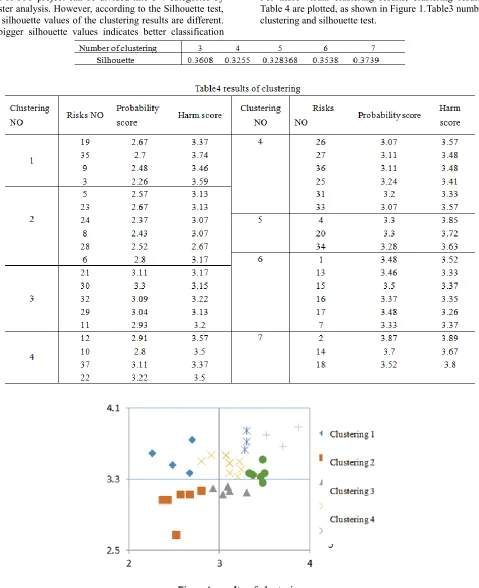
The above risks are clustered by probability andseverity, with the results shown in Table 4. In Table 3, the risk of PPP project can be divided into 3-7 categories by cluster analysis. However, according to the Silhouette test, the silhouette values of the clustering results are different. A bigger silhouette values indicates better classification
289
Copyright © 2017. Vandana Publications. All Rights Reserved.
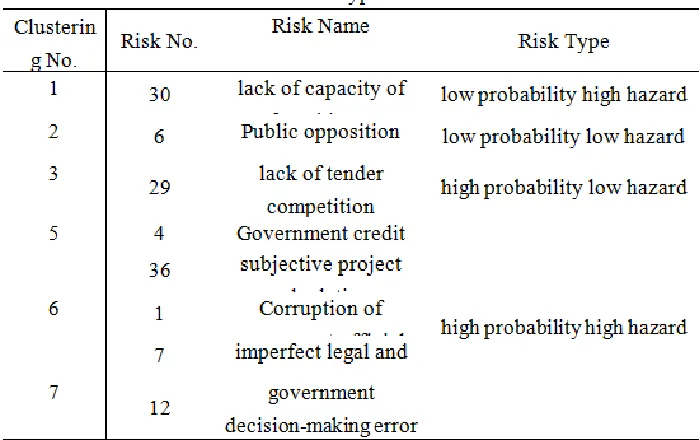
It can be seen from Figure 1-1 that clustering 2corresponds to low probability low hazard, cluster 1 corresponds to low probability high hazard, cluster 3 corresponds to high probability low hazard, cluster 4, cluster 5, cluster 6 and cluster 7 correspond to high probability high hazard. Also, it can be seen from the figure that, the most important concern is the risk in cluster 7.
From the point of view of PPP project risk management, there are four risk management methods: risk aversion, risk reduction, risk transfer and risk utilization [16]. The most commonly used method is risk transfer. Risk transfer in PPP project is known as risk allocation, which means to allocate the risk to the person best at dealing with the risk.
In PPP project, there are many ways to reduce risk, such as standardizing approval procedures, implementing strict PPP project access evaluation and
social capital selection. But the problem is that if the PPP project participants only include government and social capital, then the two sides may reach a certain interest consensus and form a community of interests, thereby increasing the probability of risk. Take risk of government decision-making error for example. Assuming that social capital proposes to build a dam for a dry river to the government, if the government and social capital has formed a community of interests, then the government is very likely to agree to this PPP project proposal and start the construction, resulting in public capital waste.
Therefore, there is need to introduce a third party to monitor and balance government and social capital, and public participation is the most commonly used method. That is, introduce the public into the PPP project risk management, and PPP project risk management appropriate for public participation is shown in Table5.
In PPP project decision-making stage, the main approach to reduce risk in lack of capacity of franchisees is to make public evaluation of the previous project or project under construction and make the evaluation results as a social capital access condition. The reason for adoption of public participation is that the public is the main user of PPP project, and the public perception is the clearest and most definite reflection of PPP project quality.
Public opposition is because the interests of the relevant public in the PPP project are not protected or suffer from loss, thereby raising the risk of public opposition. The way to reduce this risk is to allow the public to participate in PPP project design, design of construction and operation program, thereby increasing the public acceptance to the design, construction and operation
program. Insufficient tender competition is due to wrong, unfair procedures in the tender process, non-transparent and unreal information, lack of sufficient number of bidders, or bid-rigging that violates the market. Fairness of the tender competition should be protected by publicizing the bidding process and results to the public. Government credit refers to direct or indirect damage to the project due to the inability of the government to perform the relevant responsibilities and obligations in the PPP contract.
290
Copyright © 2017. Vandana Publications. All Rights Reserved.
when setting the price, and invite some of the public toassess the price, thereby reducing the probability of such risks.
Corruption of government officials increases the cost of communication between PPP project companies and increases the government's default costs. The way to reduce this risk is to publicize all the important activities in the life cycle of the PPP project to the public to reduce the corruption of government officials caused by black case work.
Imperfect legal and regulatory system refers to the low level and efficiency of PPP related laws, and contradiction or ineffective cohesion between different laws, which leads to poor operability and project loss. In the case of imperfect regulatory system, the public can be mobilized to temporarily regulate various issues in PPP
project, and the most effective public participation method or mechanism can be fixed in legal form.
Government decision-making error / lengthy process means PPP decision-making process is not standardized, officials lack understanding of PPP project due to official bureaucracy, lack preparation or information for the PPP project to be undertaken. The way to reduce this risk is to involve the public in all the early stages of the PPP project. The first is to reflect the real public opinion to the government to ensure accuracy of decision-making information. The second is to supervise the illegal conduct in the decision-making process to ensure rationality of the decision-making process. For the above reasons, the public participation points in the admittance stage of PPP project are summed up in Table 6.
In the PPP project admittance stage, after selection of participation nodes, what needs to be done is to determine the pattern of public participation. According to Thomas effective decision model, each public participant node has different requirement for decision quality and acceptability. Thus, according to Thomas effective decision model, public participation
291
Copyright © 2017. Vandana Publications. All Rights Reserved.
According to the survey results, publicparticipation mode of the public participation nodes in the PPP project admittance stage can be obtained, as shown in Table8. The corresponding method to determine PPP project public group can be decided after determining the
scope of public participation as follows:
292
Copyright © 2017. Vandana Publications. All Rights Reserved.
PPP project decisions and programs, those who canprovide important information or knowledge for decision-making of PPP projects, those who have the power to influence PPP project decision making, implementation and operation.
The second step is to determine the public community. According to content of public participation decision-making and nature of decision-making, for instance, whether it is decision-making quality based or public acceptance based, the relatively broad public boundaries in the previous step is defined in detail to narrow the scope of the public, avoid waste of decision making costs and time due to excessive scope of public. The third step is to discover potential public groups. In order to avoid the impact of unorganized public on decision-making of PPP projects, potential public groups should be identified through bottom-up approach.
V.
CONCLUSIONS
In this paper, the steps of PPP admittance stage are described, and the risk of PPP project life cycle is analyzed to reduce the risk of PPP project admittance stage and select participation nodes. Based on the probability and severity of PPP project risk, government initiation, social capital initiation, evaluation screening, projects paid or subsidized by the government, external investor survey, announcement of prequalification result and determination of the final procurement requirement plan are determined as the public participation nodes by cluster analysis. Then, through Thomas effective decision-making model and questionnaire, participation patterns corresponding to different participation nodes are determined. This study provides an important reference for public participation in PPP project admittance decision-making.
REFERENCES
[1] X Zhang X, MA Soomro. Failure Path Analysis with Respect to Private Sector Partners in Transportation Public-Private Partnerships[J]. Journal Of Management In Engineering.2016, 32(1): 040150312016.
[2] Luo Meiying, Zhao Gaoxu. Re-evaluation of the role of public participation in administrative decision generation [J]. Administrative law review.2016(01):34-45.
[3] Brammer JR, Brunet ND, Burton AC, Cuerrier A, Danielsen F, Dewan K. The role of digital data entry in participatory environmental monitoring[J]. Conservation Biology. 2016,30(6):1277-87.
[4] Sun L, Yung EHK, Chan EHW, Zhu D. Issues of NIMBY conflict management from the perspective of stakeholders: A case study in Shanghai[J]. Habitat
International. 2016,53:133-141.
[5] Kaya IA, Erol NK. Conflicts over Locally Unwanted Land Uses (LULUs): Reasons and solutions for case studies in Izmir (Turkey)[J]. Land Use Policy. 2016. 1(58):83-94.
[6] Langer K,Decker T,Menrad K.Public participation in wind energy projects located in Germany: Which form of participation is the key to acceptance?[J] Renewable Energy.2017,7(112):63-73
[7] Wang Li. Research and Discussion on Public Participation in Environmental Impact Assessment of Construction Projects in China [J] .Environmental and Sustainable Development,2015,40(02):74-77.
[8] Xiao Qiang, Wang Hailong. Evaluation of Current Law System Design for Public Participation in Environmental
Impact Assessment [J]. Law Science
Magazine,2015,36(12):60-70.
[9] Xie LL,Xia B,Hu Y,Shan M,Le Y, Chan APC,Public participation performance in public construction projects of South China: A case study of the Guangzhou Games venues construction[J].International Journal Of Project Management.2017,7(35):1391-1401。
[10] Ren Hong, Xiang Ruifeng. Game Analysis of Public Participation in PPP Project [J]. China Real Estate,2017,(18):30-36.
[11] Ma Longjun, Zhang Song. Study on public participation in BOT franchise agreement [J] . Administrative Law Review,2017,(02):122-131.
[12] Fu Dongmei, Zhu Jing. Key Problems in Five Stages of PPP Project Operation Process [J]. China Lawyer,
2016,(08):78-80.
[13] Liu Jingshi, Wang Shouqing. Study on the Choice of PPP Project Franchisees – A Comparison Based on the Applicability of Tendering and Bidding Law and Government Procurement Law [J]. Construction Economics,,2015,36(07):9-12
[14] Chan APC, Lam PTI, Wen Y, Ameyaw EE, Wang S, Ke Y. Cross-Sectional Analysis of Critical Risk Factors for PPP Water Projects in China[J]. Journal Of Infrastructure Systems. 2015;21(1).