A Literature Review of Expert Problem
Solving using Analogy
Carolyn Mair Southampton University [email protected]
Miriam Martincova
Southampton Solent University [email protected]
Martin Shepperd Brunel University
We consider the problem of predicting software project cost using analogy can lead to variable results. To achieve this, we provide an overview of human problem solving approaches and their relationship with individual differences from the cognitive psychology literature. This is supplemented by a systematic literature review of empirical studies of expert problem solving of non-trivial problems. We identified six studies, but none from the domain of software engineering. These studies suggest that analogical reasoning plays an important role in problem solving. For example, the ability to induce structure and therefore find deeper analogies is widely seen as the hallmark of an expert. However, analogy-based prediction tools fail to provide support for this type of reasoning for prediction. We conclude this mismatch between experts’ cognitive processes and software tools contributes to the erratic performance of analogy-based prediction.
Keywords: expert, problem solving, ill-defined, well-defined, analogy, case based reasoning, CBR, personality
1. INTRODUCTION
In this paper we consider software project management behaviour from a new perspective, that of problem solving. In cognitive psychology, problem solving has a rich and well developed tradition with an extensive empirical basis. This contrasts with much software engineering research that has tended to emphasize algorithmic aspects and treat humans as something of a “black box”. In particular, we consider the specific problem solving situation of software experts making project predictions using analogical techniques. In its automated, algorithmic form this is case-based reasoning (CBR) yet such tools are used by project managers and other experts when attempting to solve ill-defined problems. Thus it seems there is a potential mismatch between the nature of the CBR tool and the task and cognitive approaches associated with experts working on ill-defined problems.
This paper contains a description of the fundamentals of problem solving from a cognitive psychology perspective and reviews a range of approaches including analogical techniques. We also consider the interplay between problem solving performance and personality. Then we narrow our focus to identify what is empirically known about analogical reasoning by professionals for ill-defined problems. To do this we use a systematic literature review (SLR), an increasingly used research instrument in software engineering. For background information on reviews see Petticrew (2001) and for a review of recent SLRs in software engineering see Kitchenham, Brereton, Budgen, Turner, Bailey & Linkman (2009). Finally we pull the strands together by discussing how this different insight may enrich our understanding of cognitive processes involved in problem solving and their interplay with individual differences in software engineers, and how this might impact a future research agenda.
2. BACKGROUND ON PROBLEM SOLVING PROCESSES AND PERSONALITY
A problem is a situation in which obstacles need to be overcome in order to reach a goal. Problem solving involves higher cognitive processes: memory, attention and perception in order to search a for solution for a given problem, or reach a goal. The processes differ according to the individual’s knowledge, experience, skills, and strategies in problem solving (Wang & Chiew, 2008). The problem solver identifies the problem (the initial state), then represents the problem (actions to reach the goal state), and chooses a course of actions to reach a solution (the goal state). The variations in these stages are in part a function of individual differences.
(Reiter-
Palmon & Illies, 2004). In some situations, the initial state, the allowable operations or the goal state are not clearly specified, or a unique solution cannot be shown to exist. Such problems are known as ill-defined (non-trivial) problems (Olsen, 2002; Jonassen, 1997; Gettys, Pliske, Manning, & Casey, 1987). Project cost estimators in software engineering would typically need to solve ill-defined problems. Our focus is on expert problem solvers, and unsurprisingly, experts and novices vary in the strategies they use. Experts encode (Chase & Simon, 1973) and organise (e.g. Chi, Feltovich & Glaser, 1981) knowledge structures differently, have superior memory and show a greater degree of interconnectedness and flexibility in their knowledge organization (Brailey, Vasterling & Franks, 2001). Furthermore, experts are faster at performing the skills of their domain, they represent a problem at a deeper level (Day & Lord, 1992), and spend more time analyzing a problem qualitatively (Spence & Brucks, 1997). In addition, experts tend to use a range of strategies to solve problems including algorithms, heuristics such as hill climbing and means-end analysis (Newell & Simon, 1972), and analogy.
Analogical problem solving or reasoning is a process of comparison using prior knowledge applying it to the current situation. Gick and Holyoak (1980) propose that analogical problem solving depends on three steps: noticing that an analogical connection exists between the source and the target problem, mapping corresponding parts of the problems onto each other, and finally applying the mapping to generate a parallel solution to the target problem. Smith and Kosslyn’s (2007) model of analogical reasoning comprises five stages and introduces the role of memory. Accordingly, the first stage is retrieval (holding a target in working memory (WM) while simultaneously accessing an analogous example (source) from long-term memory (LTM)), followed by mapping (aligning the source and target and mapping the features of the source to the target), evaluation (is the analogy useful?), abstraction (isolating the shared feature(s)), and finally, prediction (hypothesising about the target based on the characteristics of the source).
In such a scenario, if a similar case is retrieved, the solution can be used or adapted as appropriate to generate a solution the current problem (Kolodner, 1992; Schank, 1990, 1999). The adapted case is then committed to memory as the case-based reasoning (CBR) cycle in which a new problem prompts the retrieval of similar cases from memory. If the retrieved case is not useful, revisions take place until a satisfactory solution is found. This case is retained for later use. Thus solutions are derived from applying the lessons learned from previous problem solving experiences to the solution of the problem at hand (Aamodt & Plaza, 1996).
The phenomenon of analogical reasoning has been used as the basis for the design of knowledge management tools, including those which use analogical or CBR. Using the concept that history repeats itself, but not exactly, CBR has been used to address many software engineering problems including cost or effort prediction. However, the variability of results when using case based reasoning (CBR) is difficult to interpret. Recent research interest in CBR, as a knowledge management tool, has emphasised algorithmic approaches. However these are typically used for solving well-defined problems, and are not typical of problems encountered by project managers. Solving ill-defined problems demands the application of complex higher-order cognitive strategies, such as creativity, that differ from the application of algorithms.
Much research on analogical reasoning has focused on student samples, and findings have been inconsistent. For example, Gentner (1989) found that students did not use analogical reasoning spontaneously; whereas more recently, Blanchette and Dunbar (2002) found that students made analogies automatically and without awareness. Despite this discrepancy, established findings suggest that experts are more likely to use analogical reasoning than are novices. Reasons for this are given as ‘the ability to recognise familiar patterns’ (Chase & Simon, 1973); larger search space (Bonnardel & Marmeche, 2004); and a more extensive repertoire of cases (Reiter-Palmon & Illies, 2004). Independent evidence for spontaneous and intuitive analogical problem solving leading to better solutions has been found in a range of domains including design (Dahl & More, 2002), investment banking (Olsen, 2002), medicine (Weber, Bockenholt, Hilton & Wallace, 1993), human computer interaction (Wijekumar & Jonassen,2007) and software engineering (Jorgensen & Gruschke, 2008).
of processing at the encoding stage (e.g. Craik & Lockhart, 1972; Tulving, 1974). Hence, despite the common notion that we can store unlimited memories permanently in LTM, interference and inefficient remembering strategies lead to decay and ‘forgetting’ (Underwood, 1957).
In order to understand the role of analogy in solving ill-defined problems, it is necessary to give a brief overview of memory. Human memory has been conceptualised by cognitive psychologists (e.g. Atkinson & Shiffrin, 1968; Baddeley & Hitch, 1974) as comprising independent processes: i) encoding (acquisition and consolidation of the memory trace); ii) storage (maintenance of the memory trace); and iii) retrieval (reactivating the trace), and three separate stores: a limited capacity sensory store, a limited capacity short-term or working memory (Baddeley & Hitch, 1974) store which is subject to decay and retains memory while it is being rehearsed (Peterson & Peterson, 1959), and an unlimited capacity long-term store which stores memories permanently. Such models predict that information from short-term memory (STM) is stored in (LTM) by means of rehearsal. Such models provide simplistic descriptions and largely ignore the biological substrates of memory. However with advances in neuroscience (e.g. using computational models such as those devised by Rolls & Treves (1998), we now can appreciate that memory is a complex system of independent, yet interactive systems that operates in a massively parallel and widely distributed fashion.
Each memory system can be divided into classifications such that in LTM memories can be declarative or procedural. Declarative memory can be subdivided into episodic (memory of events and experiences in serial form) or semantic (a structured record of acquired facts, concepts and skills, or procedural (Tulving, 1972, cited in Tulving & Donaldson, 1972). Information in semantic memory is derived from episodic memory. Hence we can learn from our experiences by means of reconstructing memory structures (Bartlett, 1932). These structures are termed scripts and schemas. Scripts are knowledge about common things or activities; schemas contain knowledge about an event or object abstracted from prior experience (Schank & Abelson, 1977). Procedural memory is the memory for skills and is considered to be implicit (Schacter, 1987).
Previously, we described that successful retrieval depends on several factors used at the encoding stage including context (Tulving & Wiseman, 1976) and consolidation (Wixted, 2004) and categorisation. According to Runco and Pritzker (1999) ‘encoding amounts to categorisation’. Creative individuals (divergent thinkers) have the ability to categorise in both conventional and unconventional ways. This in turn facilitates efficient retrieval by means of analogies and unpredictable associations (Necka, 1999, cited in Runco & Pritzker, 1999). Associative processes have been found to enhance creative thinking and problem solving (e.g. Mednick, 1962). Furthermore, analogies have been found to have a positive effect on generating new ideas (Bonnardel, 2000; Bonnardel & Marmeche, 2004). Dahl and Moreau (2002) found that analogical transfer facilitated creative problem solving. In their study, participants who were exposed to an analogy were then able to solve a problem more creatively (and in a way similar to the analogy) than those exposed to other information. Creative problem solving typically occurs in ill-defined domains where the nature and existence of a problem is poorly specified (Mumford & Connelly, 1991). Such a domain is estimating project cost. Creative thinkers are able to efficiently select relevant information to free up cognitive capacity to attend to the novel aspects of the problem at hand (Sweller, 1988), produce original associations and simplify complex problems to achieve insightful solutions (Necka, 1999, cited in Runco & Pritzker, 1999). It is this ability to selectively encode information which distinguishes expert from novice problem solvers. Clearly, reaching a successful solution involves complex cognitive strategies and is facilitated by expertise.
There exists a large literature on measuring expertise in a variety of domains (e.g. Chase & Simon, 1973; Chi, Feltovich & Glaser, 1981). In cognitive psychology, according to the IP paradigm, in addition to experts having more experience, their knowledge structures differ from those of novices. That is their knowledge is procedural rather than declarative, structured into meaningful chunks, and is flexible (Glaser, 1989). However, the developmentalist paradigm (Bajaj, 1998), the emergence of knowledge and increasing commitment to the problem is emphasised (see e.g. Dreyfus & Dreyfus, 1986).
(Myers & Briggs, 1980) which demands the individual adopt the personality type he or she would use in a specific situation (e.g. at work). According to type theories, people are either introvert or extraverts. On the other hand, trait theories determine personality as part of a continuum. We are interested in underlying personality traits, rather than type, and hence are investigating individual differences using the Eysenck Personality Questionnaire (Eysenck &
Eysenck, 1975).
3. SYSTEMATIC LITERATURE REVIEW
Having considered the background to problem solving research we now turn to a more focused question of what is known empirically about the analogical problem solving behaviour of experts when confronted with non-trivial or ill-defined problems such as are encountered in project management. Unfortunately we are not aware of any work that looks specifically at software project management so we pose the question more generically with the underlying assumption that lessons from more general studies may be relevant to our specific problem domain.
So our goal is to conduct a systematic literature review (SLR) of the empirical literature on expert problem solving using analogies for ill-defined problems. The aim is to identify all relevant studies and synthesize the results into coherent picture that is unbiased and repeatable.
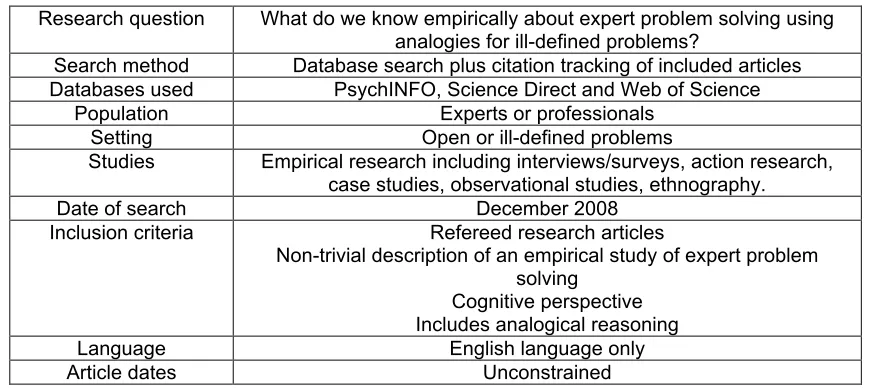
Research question What do we know empirically about expert problem solving using analogies for ill-defined problems?
Search method Database search plus citation tracking of included articles Databases used PsychINFO, Science Direct and Web of Science
Population Experts or professionals
Setting Open or ill-defined problems
Studies Empirical research including interviews/surveys, action research, case studies, observational studies, ethnography.
Date of search December 2008
Inclusion criteria Refereed research articles
Non-trivial description of an empirical study of expert problem solving
Cognitive perspective Includes analogical reasoning
Language English language only
Article dates Unconstrained
TABLE 1: Systematic Literature Review Summary
Prior to the review, a protocol was defined which contained an unambiguous description of the inclusion criteria that a study had to satisfy in order to be entered into the review. The main objective for our search was to discover which studies examined expert problem solving using analogy. Details are contained in Table 1. Note that we did not use an explicit quality instrument since the empirical methods employed by the different articles were extremely diverse. Instead we merely required articles to be demonstrably refereed. Articles contained a mixture of qualitative and quantitative data.
Since different databases have varying syntactic niceties we present the logical search: (cognitive) AND
(‘problem solving’, OR ‘decision making’, OR ‘cognitive processes’, OR reasoning) AND (analogy OR ‘case-based reasoning’) AND
(‘ill-structured’, OR ‘ill-defined’) AND (experts OR professionals)
second researcher. In all cases reasons for rejecting these articles were recorded. Citations to relevant articles were then analysed using Google Scholar to attempt to find other relevant articles as the study progressed.
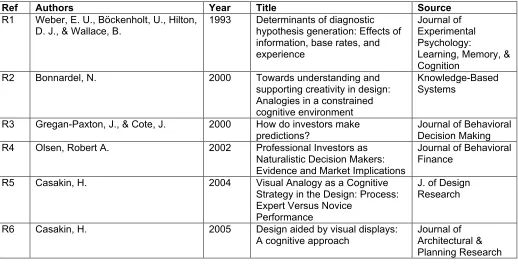
Six articles (see Table 2) were found to be investigating analogical problem solving empirically. All other articles were rejected because they:
were not relevant to problem solving/analogical problem solving
dealt only with well-defined rather than ill-defined problems
were focused on a child or student population i.e. not expert or professionals
were reviews
described tools, systems or models rather than original empirical research
Note that as we suspected we were unable to locate any work in the problem domain of software project management or indeed within software engineering as a whole.
Ref Authors Year Title Source
R1 Weber, E. U., Böckenholt, U., Hilton,
D. J., & Wallace, B. 1993 Determinants of diagnostic hypothesis generation: Effects of information, base rates, and experience
Journal of Experimental Psychology:
Learning, Memory, & Cognition
R2 Bonnardel, N. 2000 Towards understanding and
supporting creativity in design: Analogies in a constrained cognitive environment
Knowledge-Based Systems
R3 Gregan-Paxton, J., & Cote, J. 2000 How do investors make
predictions? Journal of Behavioral Decision Making R4 Olsen, Robert A. 2002 Professional Investors as
Naturalistic Decision Makers: Evidence and Market Implications
Journal of Behavioral Finance
R5 Casakin, H. 2004 Visual Analogy as a Cognitive
Strategy in the Design: Process: Expert Versus Novice
Performance
J. of Design Research
R6 Casakin, H. 2005 Design aided by visual displays: A cognitive approach
Journal of Architectural & Planning Research
TABLE 2: Included Articles
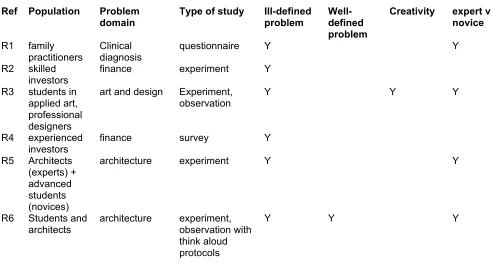
We now turn to the findings of each article in more detail (see Table 3). The review process of accepted article(s) involved inducing sub-questions relevant to the overall research question from the information found in the article. The following questions have guided the analysis:
What type(s) of participant were involved?
What was the problem domain under investigation?
Were ill and well-defined problems compared?
How did the performance of experts compare with novices?
What role did creativity play in problem solving?
What cognitive aspects of problem solving were studied?
How were analogies used? How effective were they?
Is there a relationship between personality and problem solving performance?
How does personality influence experts’ problem solving behaviour?
contrasted problem solving for ill and well-defined problems. Another common theme was to contrast expert with novice behaviour. Here the general expectation was to find that experts are more effective at identifying and utilising analogies, particularly across domains, although study R5 actually contradicted this expectation.
Ref Population Problem
domain Type of study Ill-defined problem Well-defined problem
Creativity expert v novice
R1 family
practitioners Clinical diagnosis questionnaire Y Y
R2 skilled
investors finance experiment Y R3 students in
applied art, professional designers
art and design Experiment,
observation Y Y Y
R4 experienced
investors finance survey Y
R5 Architects (experts) + advanced students (novices)
architecture experiment Y Y
R6 Students and architects
architecture experiment, observation with think aloud protocols
Y Y Y
Table 3: Included Study Findings
An example of a typical study is R3 by Gregan-Paxton and Cote (2000). Here results show that financial investors rely on analogical reasoning to generate input to the decision-making. Investors engaged in two distinct forms of analogical reasoning, one that is driven primarily by structural correspondence (the base and target overlap in terms of the relations linking the individual elements of a representation together) and one that is driven by surface correspondence (the base and target overlap in terms of the individual features making up their representations). Many investors induced an abstract representation of the structural correspondence of the base companies and used it to predict the outcome in the target company situation (i.e. they engaged in relational reasoning). Thus, findings from this study suggest that investors engage in relational reasoning, a process driven by the structural correspondence of a company to an existing schema. However, the results also indicate that investors engage in literal similarity reasoning, a process driven by surface correspondence on one company to another. This finding implies that literal similarity and relational reasoning may serve as complementary strategies in many decision-making contexts. Despite our expectations, informed from the more theoretical literature no study we were able to locate considered the role of personality and its interplay with problem solving behaviour.
The other general observation is that all six studies adopted a far broader view of analogical reasoning than that encapsulated by CBR. Most notably this features in the view that analogies may be construed as deep (structural) or surface level, that is, feature similarity. This would imply that CBR and in particular for project effort prediction is solely operating with surface level analogies. Another difference is the far richer view of how an analogy might be represented, for example, R5 and R6 considered the use of visual analogies and how these might help novices to expand their explorations in the ‘problem space’ (Casakin, 2004).
So to summarise the findings of our systematic review we see:
• We found a number (6) of studies that empirically examined analogical problem solving of experts from a cognitive perspective. However, none of the studies that we were able to locate considered software engineering as a problem domain.
• The types of analogy (within and cross-domain, textural and visual, detailed and imprecise) varied considerably and likewise the ways that they contributed to problem solving. This seemed to depend upon a number of factors including setting, nature of problem and experience of the problem-solver).
• The majority of studies differentiated between surface analogies (where the target and the solution analogies share similar values for their characterising features) and structural analogies (where deeper analogies are to be found in terms of induced structure rather than feature values). The ability to induce structure is frequently seen as the hallmark of an expert.
• Schema representation is an important determinant of problem solving particularly in terms of locating and using structural analogies.
• Analogies were seen to enhance creative thinking.
• We found no study that investigated personality and analogical problem solving in a natural setting. Thus, there seems to be a gap in the research literature.
Finally, we are aware that the SLR is in many senses preliminary and it is very possible that there are other relevant studies that we have not yet located. This is because of the lack of defined terminology for many of the concepts we are interested in and the lack of a single well-defined ‘host” research community.
4. SUMMARY
This research was motivated by the question as to why software project managers (using CBR tools such as ANGEL) to predict project costs led to rather erratic results (sometimes good other times not). By adopting a broader perspective on problem solving rather than conceiving it as principally algorithmic in nature has meant that we have identified a rich vein of relevant and complementary research.
By means of a review of the discipline and a systematic literature review of empirical studies of analogical problem solving by experts for ill-defined problems, we conclude that the CBR approach adopts a restricted view of analogical problem solving. Essentially CBR seeks to exploit surface-level rather than structural similarity. Certainly this is so for prediction tools such as ANGEL that explicitly aim to minimise standardised Euclidean distance between feature sets. The assumption behind such a world-view must be either proportionality or at least some regularity between the problem domain and the solution domain. This is termed proportional or predictive analogies.
We might explore moving into the world of transference analogies or deep analogies. This will require the problem solver (project manager in our case) to induce structure from surface features. Presently such cognitive processes are unsupported by tools such as ANGEL and moreover, potentially hindered due to the representation of features as vectors. Many studies not only claim a difference between experts and novices is experts can find and use structural or deep analogies unlike novices, but that structural analogies are more likely to lead to successful results.
To summarise, tools based solely on algorithmic approaches to problem solving are in many aspects deficient. This could go some way towards explaining the variability of results reported when utilizing these tools for project prediction. A deeper understanding of the processes of and approaches to human problem solving will help us design better prediction tools for the future.
REFERENCES
Aamodt, A. and Plaza, E. (1996) Case-based reasoning: Foundational issues, methodological variations, and system approaches. Artificial Intelligence Communications, 7, 39-59.
Atkinson, R.C. and Shiffrin, R.M. (1968) Human memory: A proposed system and its control processes. In
Spence, K.W. and Spence, J.T. (eds), The Psychology of Learning and Motivation: Advances in Research and Theory. Academic Press, London.
Bajaj, A. (1998) A Comparison of expert and novice judgments in selecting computing architectures for
organizational use. Proceedings of the Association of Information Systems (AIS), Baltimore, MD, August. Available from: http://nfp.cba.utulsa.edu/bajaja/MyInfo/index.html [Accessed 08 January 2009].
Bartlett, F.C. (1932) Remembering: A Study in Experimental and Social Psychology. Cambridge University Press, Cambridge.
Blanchette, I. and Dunbar, K. (2002) Representational change and analogy: How analogical inferences alter target representations. Journal of Experimental Psychology: Learning, Memory, and Cognition, 28, 132-141.
Bonnardel, N. (2000) Towards understanding and supporting creativity in design: Analogies in a constrained cognitive environment. Knowledge-Based Systems, 13, 505-513.
Bonnardel, N. and Marmèche, E. (2004) Evocation processes by novice and expert designers: Towards
stimulating analogical thinking. Creativity and Innovation Management. Special Issue: Creativity in the Workplace, 13, 176-186.
Brailey, K., Vasterling, J.J. and Franks, J.J. (2001) Memory of psychodiagnostic information: Biases and effects of expertise. American Journal of Psychology, 114, 55-92.
Chase, W.G. and Simon, H.A. (1973) Perception in chess. Cognitive Psychology, 4, 55-81.
Chi, M.T., Feltovich, P.J. and Glaser, R. (1981) Categorization and representation of physics problems by experts and novices. Cognitive Science, 5, 121-152.
Craik, F.I.M and Lockhart, R.S. (1972) Levels of processing: A framework for memory research. Journal of Verbal Learning and Verbal Behavior, 11,671-684.
Dahl, D.W. and Moreau, C.P. (2002) The influence and value of analogical thinking during new product ideation. Journal of Marketing Research, February, 47-60.
Day, D.V. and Lord, R.G. (1992) Expertise and problem categorization - the role of expert processing in organizational sense-making. Journal of Management Studies, 29, 35-47.
Dreyfus, H.L. and Dreyfus, S.E. (1986) Mind over Machine: The Power of Human Intuition and Expertise in the Era of the Computer, Basil Blackwell, Oxford.
Eysenck,H.J. andEysenck, S.B.G. (1975) Manual of the Eysenck Personality Questionnaire. Hodder & Stoughton, London.
Furnham, A., Jackson, C.J. and Miller, T. (1999) Personality, learning style and work performance. Personality and Individual Differences, 27, 1113-1122.
Gentner, G. (1989) The mechanisms of analogical learning. In Vosniadou, S. and Ortny A. (eds), Similarity and Analogical Reasoning (pp. 199-241). Cambridge University Press, New York.
Gettys, C.F., Pliske, R.M., Manning, C. and Casey, J.T. (1987) An evaluation of human act generation performance. Organizational Behavior and Human Decision Processes, 39, 23-51.
Gick, M.L., and Holyoak, K.J. (1980) Analogical problem solving, Cognitive Psychology, 12, 306-355.
discovered knowledge structures? In Klahr, D. and Kotovsky, K. (eds), Complex Information Processing: The Impact of Herbert A Simon. Lawrence Erlbaum Associates, Hillsdale, NJ.
Huitt, W. (1992) Problem solving and decision making: Consideration of individual differences using the Myers-Briggs Type Indicator. Journal of Psychological Type, 24, 33-44.
Jonassen, D.H. (1997) Instructional design for well-structured and ill-structured problems. Educational Technology Research and Development, 45, 656-694.
Jorgensen, M. and Gruschke, T.M. (2008) The impact of lessons-learned sessions on effort estimation and
uncertainty assessments. Accepted for publication in IEEE Transactions of Software Engineering. Available from: http://simula.no/research/engineering/publications/Simula.SE.223 [Accessed 17 November 2008].
Kitchenham, B., Brereton, O.P., Budgen, D., Turner, M., Bailey, J. and Linkman, S. (2009). Systematic
literature reviews in software engineering – A systematic literature review. Information and Software Technology, 51, 7-15.
Kolodner, J. (1992) An introduction to case-based reasoning. Artificial Intelligence Review, 6, 3-34.
Maiden, N. A. (1991) Analogy as a paradigm for specific reuse. Software Engineering Journal, 6, 3-15.
Mednick, S.A. (1962) The associative basis of the creative process. Psychological Review, 69, 220-232.
Messick, S. (1976) Personality consistencies in cognition and creativity. In Messick, S. and Associates (eds),
Individuality in Learning (pp. 4-22). Jossey Bass, San Francisco,CA.
Mumford, M.D. and Connelly, M.S. (1991) Leaders as creators: Leader performance and problem solving in ill- defined domains. Leadership Quarterly. Special Issue: Individual Differences and Leadership: 2, 289-315.
Myers, I.B. and Briggs, K.C. (1980) Gifts Differing: Understanding Personality Type. Davies-Black Publishing Mountain View, CA.
Myrtveit, I. and Stensrud, E. (1999) A controlled experiment to assess the benefits of estimating with analogy and regression models. IEEE Transactions on Software Engineering, 25, 510-525.
Newell, A. and Simon, H.A. (1972) Human Problem Solving. Prentice-Hall, Englewood Cliffs, NJ.
Olsen, R.A. (2002) Professional investors as naturalistic decision makers: Evidence and market implications. Journal of Psychology & Financial Markets, 3, 161-167.
Peterson, L.R. and Peterson, M.J. (1959) Short-term retention of individual verbal items. Journal of Experimental Psychology, 58, 193-198.
Petticrew, M. (2001) Systematic reviews from astronomy to zoology: Myths and misconceptions. British Medical Journal, 322, 98-101.
Reiter-Palmon, R. and Illies, J.J. (2004) Leadership and creativity: Understanding leadership from a creative problem solving perspective. The Leadership Quarterly, 15, 55-77.
Rolls, E.T. and Treves, A. (1998) Neural Networks and Brain Function. Oxford University Press, Oxford.
Runco, M.A. and Pritzker, S. (eds) (1999) Encyclopedia of Creativity. Academic Press, San Diego, CA.
Schacter, D.L. (1987) Implicit memory: History and current status. Journal of Experimental Psychology: Learning, Memory, and Cognition, 13, 501-518.
Schank, R.C. (1990) Tell me a story: Narrative and intelligence. Northwestern University Press, Evanston, IL.
Schank, R.C. (1999) Dynamic Memory Revisited. Cambridge University Press, Cambridge.
Schank, R.C. and Abelson, R. (1977) Scripts, Plans, Goals, and Understanding: An Inquiry into Human Knowledge Structures. Lawrence Earlbaum Associates, Hillsdale, NJ.
Shepperd, M.J., Schofield, C. and Kitchenham, B.A. (1996) Effort estimation using analogy. Proceedings of
the 18th International Conference on Software Engineering, Berlin, Germany, 25-29 March, pp.~170-179. IEEE Computer Society Washington, DC, USA.
Smith, E.E. and Kosslyn, S.M. (2007) Cognitive Psychology: Mind and Brain. Pearson/Prentice Hall, Upper Saddle River, NJ.
Smith, M.U. (1991) A view from biology. In Smith, M.U. (ed.), Toward a Unified Theory of Problem Solving (pp. 1-20). Lawrence Erlbaum Associates, Hillsdale, NJ.
Spence, M.T. and Brucks, M. (1997) The moderating effects of problem characteristics on experts' and novices' judgments. Journal of Marketing Research, 34, 233-247.
Stice, J. (ed.) (1987). Developing Critical Thinking and Problem solving Abilities. Jossey-Brass, San Francisco.
Sweller, J. (1988) Cognitive load during problem solving: Effects of learning. Cognitive Psychology, 12, 257- 285.
Treffinger, D.J., Selby, E.C. and Isaksen, S.G. (2008) Understanding individual problem solving style: A key to learning and applying creative problem solving. Learning and Individual Differences, 18, 390-401.
Tulving, E. (1974). Cue-dependent forgetting, American Scientist, 62, 74-82.
Tulving, E. and Donaldson, W. (eds.) (1972) Organization of Memory. Academic Press, New York.
Tulving, E. and Wiseman, S. (1976), Relation between recognition and recognition failure of recallable words.
Bulletin of the Psychonomic Society, 6, 79-82.