The Thirty-Third AAAI Conference on Artificial Intelligence (AAAI-19)
End-to-End Knowledge-Routed
Relational Dialogue System for Automatic Diagnosis
Lin Xu,
1†Qixian Zhou,
1†Ke Gong,
1Xiaodan Liang,
1∗Jianheng Tang,
3Liang Lin
1,21Sun Yat-Sen University,2Dark Matter AI Inc. ,3Soochow University
[email protected], [email protected], [email protected] [email protected], [email protected], [email protected]
Abstract
Beyond current conversational chatbots or task-oriented di-alogue systems that have attracted increasing attention, we move forward to develop a dialogue system for automatic medical diagnosis that converses with patients to collect ad-ditional symptoms beyond their self-reports and automati-cally makes a diagnosis. Besides the challenges for conver-sational dialogue systems (e.g. topic transition coherency and question understanding), automatic medical diagnosis further poses more critical requirements for the dialogue rationality in the context of medical knowledge and symptom-disease relations. Existing dialogue systems (Madotto, Wu, and Fung 2018; Wei et al. 2018; Li et al. 2017) mostly rely on data-driven learning and cannot be able to encode extra expert knowledge graph. In this work, we propose an End-to-End Knowledge-routed Relational Dialogue System (KR-DS) that seamlessly incorporates rich medical knowledge graph into the topic transition in dialogue management, and makes it cooperative with natural language understanding and natu-ral language generation. A novel Knowledge-routed Deep Q-network (KR-DQN) is introduced to manage topic tran-sitions, which integrates a relational refinement branch for encoding relations among different symptoms and symptom-disease pairs, and a knowledge-routed graph branch for topic decision-making. Extensive experiments on a public medical dialogue dataset show our KR-DS significantly beats state-of-the-art methods (by more than 8% in diagnosis accuracy). We further show the superiority of our KR-DS on a newly col-lected medical dialogue system dataset, which is more chal-lenging retaining original self-reports and conversational data between patients and doctors.
Introduction
Task-oriented dialogue aims to achieve specific task through interactions between the system and users in natural lan-guage, which is gaining research interest in the different application domain, including movie booking (Lipton et al. 2017), restaurant booking (Wen et al. ), online shop-ping (Yan et al. 2017), and technical support (Lowe et al. 2015). In the medical domain, A dialogue system for med-ical diagnosis converses with patients to obtain additional
∗
Lin Xu and Qixian Zhou contribute equally to this work and share first-authorship. Corresponding author is Xiaodan Liang. Copyright c2019, Association for the Advancement of Artificial Intelligence (www.aaai.org). All rights reserved.
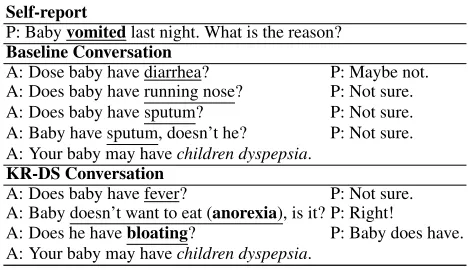
Self-report
P: Babyvomitedlast night. What is the reason? Baseline Conversation
A: Dose baby have diarrhea? P: Maybe not. A: Does baby have running nose? P: Not sure. A: Does baby have sputum? P: Not sure. A: Baby have sputum, doesn’t he? P: Not sure. A: Your baby may havechildren dyspepsia.
KR-DS Conversation
A: Does baby have fever? P: Not sure. A: Baby doesn’t want to eat (anorexia), is it? P: Right!
A: Does he havebloating? P: Baby does have. A: Your baby may havechildren dyspepsia.
Table 1: A conversation example between the patient (P) and the agent (A). We underline all symptoms and highlight the symptoms related to the diagnosed disease (italic). Superior to the baseline method (Wei et al. 2018) that asks irrelevant and repeated symptoms, our KR-DS generates more reason-able results thanks to the relational refinement and guidance of knowledge-routed graph, as presented in Fig. 2.
symptoms and make a diagnosis automatically, which has significant potential to simplify the diagnostic procedure and reduce the cost of collecting information from patients (Tang et al. 2016). Besides, patient condition reports and prelimi-nary diagnosis reports generated by the dialogue system may assist doctors to make a diagnosis more efficiently.
learn-ing. Nevertheless, this work only exploits Deep Q-network (DQN) via data-driven learning to manage topic transitions (deciding which symptoms should be asked), whose results are intricate and repeated, as shown in Table 1. Moreover, this work only targets dialogue management for dialogue state tracking and policy learning, utilizing extra template-based models for natural language processing, which fails to match the real-world automatic diagnosis scenarios well.
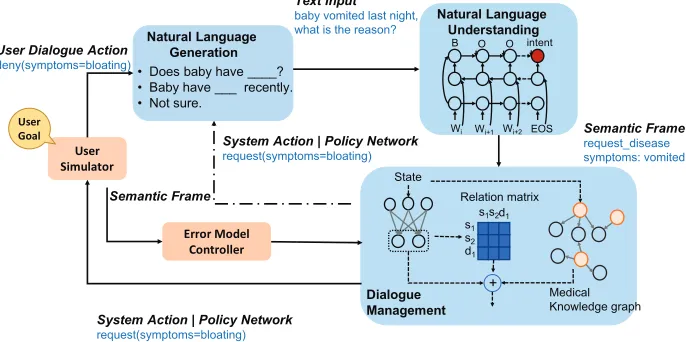
To address the above challenges, we propose a complete end-to-end Knowledge-routed Relational Dialogue System (KR-DS) for automatic diagnosis, that seamlessly incorpo-rates rich medical knowledge graph and symptom-disease relations into the topic transition in Dialogue Management (DM), and makes it cooperative with Natural Language Understanding (NLU) and Natural Language Generation (NLG), as shown in Fig. 1.
In general, doctors determine a diagnosis based on med-ical knowledge and diagnosis experience. Inspired by that, we designed a novel Knowledge-routed Relational Deep Q-network (KR-DQN) for dialogue management, which inte-grates a knowledge-routed graph branch and a relational re-finement branch, taking full advantage of the medical knowl-edge and historical diagnostic cases (doctor experience). The relational refinement branch automatic learns relations among different symptoms and symptom-disease pairs from historical diagnostic data to refine rough results generated from a basic DQN. The knowledge-routed graph branch helps policy decision via a well-designed medical knowl-edge graph routing prior information based on conditional probabilities. Therefore, these two branches can contribute to generating more reasonable decision results from knowl-edge guiding and relation encoding, as shown in Table 1.
Moreover, existed dataset (Wei et al. 2018) fails to support our end-to-end dialogue system training as it only contains user goals (extracted and normalized symptoms and disease) instead of complete conversation data. Therefore, we build a new dataset collected from an online medical forum by extracting symptoms and diseases from patients’ self-reports and conversations between patients and doctors. Our dataset reserves the original self-reports and interaction utterances between doctors and patients to train the NLU component with real dialogue data, which matches the realistic clinic scenarios much better.
Our contributions are summarized in the following as-pects. 1) we propose an End-to-End Knowledge-routed Re-lational Dialogue System (KR-DS) that seamlessly incorpo-rates medical knowledge graph into the topic transition in dialogue management, and makes it cooperative with nat-ural language understanding and natnat-ural language genera-tion. 2) A novel Knowledge-routed Deep Q-network (KR-DQN) is introduced to manage topic transitions, which inte-grates a relational refinement branch for encoding relations among different symptoms and symptom-disease pairs, and a knowledge-routed graph branch for topic decision-making. 3) We construct a new challenging end-to-end medical dia-logue system dataset, which retains the original self-reports and the conversational data between patients and doctors. 4) Extensive experiments on two medical dialogue system datasets show the superiority of our KR-DS, which
signif-icantly beats state-of-the-art methods by more than 8% in diagnostic accuracy.
Related Work
The successes of RNNs architecture (Wen et al. ; Ser-ban et al. 2016; Zhao et al. 2017) motivated investigation in dialogue systems due to its ability to create a latent representation, avoiding the need for artificial state labels. Sequence-to-sequence models have also been used in task-oriented dialogue systems (Sutskever, Vinyals, and Le 2014; Vinyals and Le 2015; Eric and Manning 2017; Madotto, Wu, and Fung 2018). (Zhao et al. 2017) proposed frame-work enabling encoder-decoder models to accomplish slot-value independent decision-making and interact with ex-ternal databases. (Chen et al. 2018) proposed a hierarchi-cal memory network by adding the hierarchihierarchi-cal structure and the variational memory network into a neural encoder-decoder network. Although these architectures have better language modeling ability, they do not work well in knowl-edge retrieval or knowlknowl-edge reasoning, where the model in-herently tends to generate short and general responses in spite of different inputs.
Another research line comes from the utilizing of knowl-edge bases. (Young et al. 2017) investigated the impact of providing commonsense knowledge about the concepts cov-ered in the dialogue. (Liu et al. 2018) proposed a neural knowledge diffusion model to introduce knowledge into di-alogue generation. (Eric et al. 2017) noticed that neural task-oriented dialogue systems often struggle to smoothly inter-face with a knowledge base and they addressed the problem by augmenting the end-to-end structure with a key-value re-trieval mechanism.
In addition, there are two works much related to our con-cerns where deep reinforcement learning is applied for au-tomatic diagnosis (Tang et al. 2016; Wei et al. 2018). How-ever, they only targeted on dialogue management for dia-logue state tracking and policy learning. Moreover, their data used is simulated or simplified that cannot reflect the situa-tion of the real diagnosis. In our work, we perform not only relation modeling to attend correlated symptoms and dis-eases but also graph reasoning to guide policy learning by prior medical knowledge. We further introduce an end-to-end task-oriented dialogue system for automatic diagnosis and a new medical dialogue system dataset, which pushes the research boundary of automatic diagnosis to match real-world scenarios much better.
Proposed Method
''
&& & &
'"! '%+
!'!'
%$(&'&& &, #'" & )" ' ,)" '&'!'
*'&'%&"!
!,&, #'" &"'!
%$(&'&, #'" &"'!
!"*%#
- "&,) - ,)%!', - "'&(%
%$(&'&, #'" &"'!
Figure 1: Framework of our end-to-end Knowledge-routed Relational Dialogue System (KR-DS), A Bi-LSTM based Natural Language Understanding is employed to parse input utterances and generate semantic frames which are further fed into DM module to generate system actions. Dialogue Management manages the system actions containing a basic DQN branch, a relational refinement branch, and a medical knowledge-routed graph branch. A User Simulator with a user goal (consisting of symptoms of patients) to interact with agent and give rewards. A template-based NLG is used to generate natural language for user simulator and dialogue manager based on actions.
by a template-base NLG. Additionally, to train the whole system in an end-to-end way via reinforcement learning, a user simulator is added to execute the conversation exchange conditioned on the generated user goal.
Natural Language Understanding
In our task, NLU is mainly used to classify intent and fill slots for the Chinese language as our dataset was collected from a Chinese website. We use a public Chinese segmen-tation tool and add medical terms into the custom dictio-nary to improve accuracy. Given a word sequence, NLU classifies intent and fill in a set of slots to form a semantic frame. As illustrated in Fig. 1, semantic frames are struc-tured data that contain the user’s intent and slots. In partic-ular, six types of intents are considered in our automatically diagnosis dialogue system. For a user, there are four types of intents, including request+disease, confirm+symptom,
deny+symptomandnot-sure+symptom. We apply the pop-ular BIO format (Hakkani-T¨ur et al. 2016) to label each word tag in the sentence.
Following (Hakkani-T¨ur et al. 2016), given a word se-quence, we apply a Bi-LSTM to recognize BIO tags of each word and simultaneously classify intent of this sentence. With tag labeling done we fill slots based on dialogue con-textual information and medical term normalization. Symp-toms and diseases are normalized to medical terms defined by the annotators. With regard to context understanding, we maintain a rule-based dialogue state tracker, which stores the status of symptoms. We represent slots of the current seman-tic frame as a fixed-length symptom vector (each bit -1, 1, -2, 0) and plus it to last symptom vector to get a new symptom vector. If a symptom is requested by an agent and happens not to appear in user’s answer, this method could also fill slot by referring to the recorded request slot.
As symptoms and intents are labeled in our dataset, we use supervised learning to train Bi-directional LSTM model. Moreover, after pre-training, NLU can be jointly trained with other parts in our KR-DS through reinforcement learn-ing.
Policy Learning with KR-DQN
Overview. We design DM in a reinforcement learning framework. Dialogue Manager is an agent and interacts with the environment (user simulator) via the dialogue pol-icy. The optimized dialogue policy selects the best action that maximizes the future reward, which suitably solves the problem of our diagnosis dialogue system for its large se-lection spaces, sequential decision and success/failure end. As shown below, we first describe the basic elements of reinforcement learn- ing in our task. Suppose we have M diseases, N symptoms. Four types of agent action in-cludeinform+disease, request+symptom, thanks and clos-ing. Therefore agent action space size D is denoted asD= num greeting+M+N. User actions arerequest+disease,
confirm/deny/not-sure+symptomandclosing. There are also four types of symptom states, positive, negative, not-sure
andnot mentioned, represented by 1, - 1, -2, 0 in symptom vectors respectively. At each turn, dialogue statestcontains
the previous action of both user and agent, known symptoms representation and current turn information.
experimental results in ablation parts. Finally, dialogue pol-icyπdescribes the behaviors of an agent. It takes state st as input and outputs the probability distribution over all possi-ble actionsπ(at|st).
DQN is a common policy network in many problems, in-cluding playing game (Mnih et al. 2015), video captioning (Wang et al. 2018). Beyond the DQN with simple Multi-Layer Perceptron(MLP), we propose a novel Knowledge-routed Relational DQN (KR-DQN) by considering prior medical knowledge and modeling relations between actions to generate reasonable actions, illustrated in Fig. 2.
Basic DQN Branch.We first utilize a basic DQN branch to generate a rough action result, as formulated in Eq. (1) The MLP takes statestas input and outputs a rough action
resultar
t ∈ RD. The structure of MLP is a simple neural
network with a hidden layer. The activation function of the hidden layer is rectified linear unit.
art=M LP(st). (1)
Relational Refinement Branch.A relation module can affect an individual element (e.g. a symptom or a disease) by aggregating information from a set of other elements (e.g. other symptoms and diseases). As the relation weights are automatically learned driven by the task goal, the relation module can model dependency between the elements. So we design a relational refinement module by introducing a relation matrix R ∈ RD×D which represents dependency
among all actions. The initially predicted actionar t
subse-quently multiplies this learnable relation matrixRto get re-fined action resultaft ∈ RD, which is written as Eq. (2).
The relation matrix is asymmetric, representing a directed weighted graph. Each column of the relation matrix sums to one and each elements of refined action vector aft is a weighted sum of the initially predicted action art, where
weights denote the dependency between the elements.
aft =art·R. (2)
The relation matrixR is initialized with conditional prob-abilities from dataset statistics. Each entryRij denotes the
probability of the unit xj conditional on the unit xi. The
relation matrix learns to capture the dependency among ac-tions through back-propagation. Our experiments show that this initialization method is better than random initialization as the prior knowledge can guide relation matrix learning.
Knowledge-routed Graph Branch.When receiving pa-tients’ self-reports, doctors first grasp a general understand-ing of the patients with several possible candidate diseases. Subsequently, by asking for significant symptoms of these candidate diseases, doctors exclude other candidate diseases until confirms a diagnosis. Inspired by this, we design a knowledge-routed graph module to simulate the thinking process of a doctor.
We first calculate the conditional probabilities between diseases and symptoms as directed medical knowledge-routed graph weights, in which there are two types of nodes (diseases and symptoms) as shown in Fig. 2. Edges only ex-ist between a disease and a symptom. Each edge has two weights, which are conditional probabilities from diseases
% % )'!% $% %%$% "#!
%%
%! %#(
$$
$
$
$#
%#$% !&
%
$$ ! )"%! ! )"%!%!$$$ $$%!$)"%!$
# #) %!
%! %! %!
&
Figure 2: Illustration of Knowledge-routed Deep Q-network (KR-DQN) for DM. The basic DQN branch generates rough action results. The relational branch encodes relations among actions to refine the results. The knowledge-routed graph branch induces medical knowledge for graph reason-ing and conducts a rule-based decision to enhance the action results. The three branches can be jointly trained through re-inforcement learning.
to symptoms, noted asP(dis|sym) ∈ RM×N, and
condi-tional probabilities from symptoms to diseases, written as
P(sym|dis)∈RN×M.
During communication with patients, doctors may have several candidate diseases. We represent candidate dis-eases probability as disease probabilities correspond-ing to observed symptoms. Symptom prior probabilities
Pprior(sym) ∈ RN are calculated through the following
rules. For the mentioned symptoms, positive symptoms is set to 1 while negative symptoms is set to -1 to discourage its related diseases. Other symptom(not sure or not mention) probabilities are set to its prior probabilities which are cal-culated from the dataset. Then these symptom probabilities
Pprior(sym)multiply conditional probabilitiesP(dis|sym)
to get disease probabilityP(dis), which is formulated as:
P(dis) =P(dis|sym)·Pprior(sym). (3)
Considering candidate diseases, doctors often inquire some notable symptoms to confirm diagnosis according to their medical knowledge. Likewise, with disease probabilities
P(dis), symptom probabilitiesP(sym)is obtained by ma-trix multiplication between diseases probabilities P(dis)
and conditional probabilities matrixP(sym|dis):
P(sym) =P(sym|dis)·P(dis). (4)
We concatenate disease probabilities P(dis) ∈ RM and
symptom probabilities P(sym) ∈ RN padded with zeros for greeting actions to get knowledge-routed action proba-bilitiesakt ∈D.
With three action vectors art, a f
t and akt, we first
ap-plysigmoidactivation function to action vectorar t anda
f t
{
“disease_tag”: “Pediatric hand, foot and mouth disease”, “request_slots”: {
“diseases”: “UNK” },
“self-report”: “ Hello doctor, my baby keeps cryat sleep since the 2ndthis month,
and he’s been feeling uncomfortable at eat next day, we checked that not so much rashes on hands and feet. On third day, he’s got a little feverand tonight I found so many rasheson his leg and feet. What is wrong with my baby? ” “implicit_symptoms”: {
“Apathetic”: True, “Anorexia”: True }
}
Figure 3: An example of a user goal.
three results as predicted action distributionsatof KR-DQN
under the current statest.
at=sigmoid(art) +sigmoid(a f t) +a
k
t (5)
In order to prevent repeated request, we add symptoms fil-ter to KR-DQN outputs. All components are trained with a well-designed reward (described at the beginning of this sec-tion) to encourage KR-DQN learn how to request effective symptoms and make a right diagnosis.
User Simulator
In order to train our end-to-end dialogue system, we apply a user simulator to sample user goals from the experimen-tal dataset for automatically and naturally interacting with the dialogue system. Following (Schatzmann and Young 2009), our user simulator maintains a user goal G. As shown in Fig. 3, a user goal generally consists of four parts: dis-ease tagfor the disease that the user suffers,self-reportfor the original self-reports from patients,implicit symptomsfor symptoms talked about between the patient and the doctor, andrequest slotsfor the disease slot that the user would re-quest. When the agent requests a symptom during the course of the dialogue, the user will take one of the three actions includingTruefor the positive symptom,Falsefor the neg-ative symptom, and Not sure for the symptom that is not mentioned in the user goal. The dialogue session will be ter-minated as successful if the agent informs a correct disease. On the contrary, the dialogue process will fail if the agent makes the wrong diagnosis or the dialogue turn reaches the maximum turnT.
Natural Language Generation
Given actions produced from Dialogue Management and User Simulator, a template-based natural language genera-tion (template-NLG) is applied in our system to generate human-like sentences. As mentioned in NLU part, request and inform pairs are relatively simple. Previous dialogue systems (Li et al. 2017; Lei et al. 2018) have many possible request/inform patterns but each one of them has only one template. Varying from them, we design 4 to 5 templates for each action to diversify dialogues. As for medical terms used in the dialogues, analogous to NLU, we choose daily expres-sions corresponding to specific symptoms and diseases from our collected medical term list.
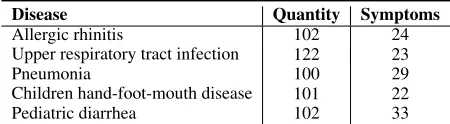
Disease Quantity Symptoms
Allergic rhinitis 102 24
Upper respiratory tract infection 122 23
Pneumonia 100 29
Children hand-foot-mouth disease 101 22
Pediatric diarrhea 102 33
Table 2: Statistics of dialogues and symptoms for diseases.
End-to-End Training With Deep Q-Learning
Following (Mnih et al. 2015), we employ Deep Q-Learning to train DM with fine-tuned NLU and template-base NLG. Two important DQN tricks (Van Hasselt, Guez, and Silver 2016), target network usage and experience replay are ap-plied in our system. We use Q(st, at|θ)to denote the the
expected discounted sum of rewards, after taking a action
atunder statest. Then according Bellman equation, the
Q-value can be written into:
Q(st, at|θ) =rt+γmaxat+1Q
∗(s
t+1, at+1|θ0) (6) θ0is the parameters of target network obtained from previous episode.γis the discount rate. We use-greedy exploration at training phase for effective action space exploration, se-lecting a random action in probability. We store the agent’s experiences at each time-step in experience replay buffer, denoted aset(st, at, rt, st+1). The buffer is flushed if
cur-rent network performs better than all previous models.
Experiments
DX Medical Dialogue Dataset
We build a newly DX dataset for medical dialogue system, reserving the original self-reports and interaction utterances between doctors and patients. We collected data from a Chi-nese online health-care community (dxy.com) where users asking doctors for medical diagnosis or professional medi-cal advice. We annotate five types of diseases, including al-lergic rhinitis,upper respiratory infection,pneumonia, chil-dren hand-foot-mouth disease, andpediatric diarrhea. We extract the symptoms that appear in self-reports and conver-sation and normalize them into 41 symptoms. Four annota-tors with medical background are invited to label the symp-toms in both self-reports and raw conversations.Sympsymp-toms appearing in self-reports are regarded as explicit symptoms while the others are implicit symptoms. The diseases of each medical diagnosis conversation are labeled automatically by the website. There are 527 conversational data in total. 423 conversational data are selected as the training set 104 for testing. More detailed dataset statistics are shown in Table .
Experimental Setup
using the provided train/test sets. The slot error rate and in-tent error rate are both set at 5%. We further evaluate our end-to-end framework on our DX dataset that reserves origi-nal conversation data. We selected 423 dialogues for training and conducted inference on another 104 dialogues.
Evaluation Metrics. Same as (Wei et al. 2018), we use the rate of making the right diagnosis as dialogue accuracy. We also employ a newly metric, namely matching rate, to evalu-ate the effectiveness of symptoms dialogue system requests. A successful matching means systems ask a symptom that exists in user implicit symptoms, otherwise, it is a failure matching.
Implementation DetailsWe implement the system on Py-torch. To train the DQN composed of a two-layer neural net-work, theof-greedy strategy is set to 0.1 for effective ac-tion space exploraac-tion and theγin Bellman equation is 0.9. The initial buffer size D is 10000 and the batch size is 32. The learning rate is 0.01. We choose SGD as the optimizer and 100 simulation dialogues will add to experience replay pool at each epoch training. Generally, we train the mod-els for about 300 epochs. The source code will be released together with our DX dataset.
Experimental Results
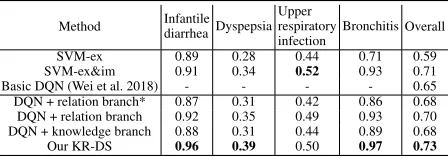
MZ dataset. We only train Dialogue Management for the limitation of MZ dataset and compare our method with sev-eral baselines, as shown in Table 3.“SVM-em” means the SVM model trained with just explicit symptoms and “SVM-em&im” is the SVM model using both explicit and im-plicit symptoms. Basic DQN is the proposed framework of (Wei et al. 2018). The results of the above three baselines are provided by (Wei et al. 2018). “DQN+relation branch” means our proposed model without knowledge-routed graph branch and “DQN+knowledge branch” is the model without relation refinement branch. Observed from Table 3, the per-formance of SVM-em&im is higher than SVM-em, which indicates that the implicit symptoms would make a signif-icant improvement. However, basic DQN (Wei et al. 2018) gets 6% loss of accuracy compared to SVM-ex&im because it fails to inquiry effective implicit symptoms. Notably, our KR-DS not only significantly beats basic DQN (8%) but also outperforms SVM-ex&im (2%), which shows that our method can inquiry implicit symptoms effectively and make a precise diagnosis, thanks to knowledge-routed graph rea-soning and relational refinement.
DX dataset. We further evaluate the proposed end-to-end KR-DS through Deep Q-learning on our DX dataset. For comparison, we re-implement a baseline, which shares the identical NLU and NLG with KR-DS but employ a single Deep Q-network (Wei et al. 2018) as policy network. In ad-dition, we apply a state-of-the-art end-to-end task-oriented dialogue system framework (Lei et al. 2018) to our task (Se-quicity), which uses belief spans to store constraints and re-quests (which are symptoms and diseases in this task) for state tracking. As shown in Table 4, our method outper-forms basic DQN (Wei et al. 2018) and state-of-art seq-to-seq (Lei et al. 2018) method in both task complete ac-curacy and symptom matching rate. Focusing on obtaining the largest positive reward, basic DQN often guesses the
Method Infantilediarrhea Dyspepsia Upper respiratory infection
Bronchitis Overall
SVM-ex 0.89 0.28 0.44 0.71 0.59 SVM-ex&im 0.91 0.34 0.52 0.93 0.71 Basic DQN (Wei et al. 2018) - - - - 0.65 DQN + relation branch* 0.87 0.31 0.42 0.86 0.68 DQN + relation branch 0.92 0.35 0.49 0.93 0.70 DQN + knowledge branch 0.88 0.31 0.44 0.89 0.68 Our KR-DS 0.96 0.39 0.50 0.97 0.73
Table 3: Performance comparison on the MZ dataset.
Method Accuracy Match rate Ave turns Basic DQN (Wei et al. 2018) 0.731 0.110 3.92
Sequicity (Lei et al. 2018) 0.285 0.246 3.40
Our KR-DS 0.740 0.267 3.36
Table 4: Performance comparisons with the state-of-the-art methods on DX dataset.
right disease results but inquiries some unreasonable and re-peated symptoms during the dialogue due to no constraints for symptom and disease relation (prior knowledge). Our framework shows superiority not only in a higher accuracy but also higher matching rate, which indicates the symptoms acquired by KR-DS agent is more reasonable and as a con-sequence, it can make the more right diagnosis. Seq-to-seq frameworks (Sequicity) performs worse on this medical di-agnosis task as they focus on the in-dialogue sentence tran-sition while ignoring medical symptom connections to diag-nosis.
Ablation Studies
Component analysis. To verify the effects of the main components of our KR-DS, we further conducted a series of ablation studies on MZ dataset, as shown in Table 3. Here we mainly target at the following components in our framework: knowledge-routed graph branch and relation re-finement branch. As is shown in Table 3, all these factors contribute to better performance of our method. Addition-ally, initializing relation matrix with conditional probabil-ity in the relational branch is better than random initializa-tion (“DQN+relainitializa-tion*”), as the prior medical knowledge can guide the relation matrix learning.
Reward evaluation.Our reward is designed based on the maximum turn value L=22, 2*L for success and -L for fail-ure and -1 for the penalty. -1 penalty will cause shorter di-alogue turns by accumulating through the process of dia-logue. We evaluate several reward functions considering the magnitude of reward by doing experiments as follows: we chose four group of rewards R1: +22, -11, -1; R2: +11, -6, -1; R1*: +22, -11, -0.5; R2*: +11, -6, -0.25 for success, fail-ure and penalty in experiments, and got accuracy shown in
Reward R1 R2 R1* R2*
Accuracy 0.697 0.725 0.718 0.739
0.475Hand foot mouth disease Upper respiratory
tract infection
Herpes Fever
Rash
Pneumonia Anorexia
Mental malaise
Cough
0.48
0.83 0.55 0.89
0.25 0.86
0.79
0.64 Rhinallergosis
Upper respiratory tract infection
Cough
Pharynx discomfort
Fever
Nasal congestion
0.549 0.088
0.549 0.893
0.131
0.246 0.475
T0, User: 9 month-old baby, coughsince the time catching cold one month ago. We have been to a pediatric, and got diagnosis of tonsillitis. We have taken cephalosporin and oseltamivir, but the effect is not obvious.
T1, Agent: Does your baby have a stuffy nose? T2, User: Yes, the baby did recently have a stuffy nose. T3, Agent: OK, maybe your baby have caught allergic rhinitis.
T1, Agent: OK, maybe your baby have caught allergic rhinitis.
T0, User: My baby 16 months, began to have a feversince early morning on 28th. The highest fever is to 40.5. We fed her ibuprofen three times, plug suppository once, but this fever is not very sensitive to antipyretics, which can not go down. The child’s in poor appetite and poor spirit now.
T1, Agent: Does your baby get rashes? T2, User: No, not found.
T3, Agent: OK, have your baby got cough? T4, User: I have no idea.
T5, Agent: Does your baby have herpeson body? T6, User: Yes, she has.
T7, Agent: According to above symptoms, I think your baby may catch hand foot mouth disease.
T1, Agent: Does your baby have a stuffy nose? T2, User: I have no idea.
T3, Agent: Does your baby stools smell bad? T4, User: I don’t know.
T5, Agent: Does your baby have dyspnea? T6, User: I have no idea.
T7, Agent: Does your baby have dyspnea? ……
T19,agent: Your baby may catchUpper respiratory tract infection.
Nasal congestion
Sour Stool
Dyspnea
0.24
0.34 0.26
0.03 0.13
Figure 4: Visualized conversation results on DX dataset. In each table, the first line is a self-report of patient. The results generated by our KR-DS are presented on the left column and the ones produced by the pure DQN method (Wei et al. 2018) on the right. We also present the knowledge graph related to the diagnosis process to the left of each table. To highlight the symptoms and diseases, red boxes used for symptoms from self-report, green forTruesymptom, gray forFalseandnot sure
symptoms in the user goal, blue for the diagnosed disease.
3.7
2.84
4.13
2.6
3.29
3.94 3.84
3.47
4.25
0 0.5 1 1.5 2 2.5 3 3.5 4 4.5
Diagnosis validity Symptom rationality Dialogue fluency Basic DQN Sequicity KR-DS
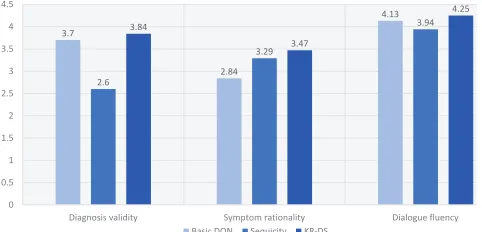
Figure 5: Human evaluation of three methods.
Fig. 5. We found using smaller reward value achieves similar results with ours, but leading to a stable training process.
Human Evaluation
As automated metrics is insufficient for evaluating a dia-log system (Liu et al. 2016), we invited three users with medical background to perform human evaluation based on three aspects: 1) diagnosis validity, 2) correctness of final diagnosis, symptom rationality and relevance, rationality of requested symptoms based on current dialogue status and medical knowledge, 3) dialogue fluency, dialogue fluency of communication. 104 dialogues in testing set are evaluated by three users. Users are given user goal (Fig. 3) and converse with three dialogue systems, including Basic DQN (Wei et al. 2018), Sequicity (Lei et al. 2018) and our KR-DS. For each dialogue session, users are asked to giving a rating on a scale from 1 (worst) to 5 (best) on above three aspects.
As shown in Fig. 5, for diagnosis validity, our KR-DS has the higher average rating than other two methods. For symp-tom rationality and relevance, our method also outperforms other methods. Basic DQN obtains the lowest rating for re-questing unrelated symptoms frequently. For dialogue flu-ency, our method also performs the best.
Qualitative Analysis
For the more intuitive demonstration of our generated di-alogues, two user goal results are displayed in Fig. 4. For the first example, self-report indicates two possible diseases, Rhinallergosis, and Upper respiratory tract infection accord-ing to the mentioned symptoms. The baseline gives the re-sult directly, which may cause misdiagnosis. Contrarily, be-sides guidance by prior knowledge, our agent also considers the relations between symptoms and diseases, which tries to acquire a discriminatory symptom nasal congestion that is more relevant to Rhinallergosis and finally makes valid di-agnosis. For the second result, the baseline method keeps asking symptoms which are not related to the correct dis-eases, like Sour Stool (no connection) and Nasal Congestion (with probability less than 0.3). Obviously, beneficial from the prior disease knowledge and symptom relations, our KR-DS asks Rash, Herpes, and Cough and diagnoses the correct Hand foot mouth disease.
Conclusions
References
Bordes, A.; Boureau, Y.-L.; and Weston, J. 2016. Learning end-to-end goal-oriented dialog. arXiv preprint arXiv:1605.07683.
Chen, H.; Ren, Z.; Tang, J.; Zhao, Y. E.; and Yin, D. 2018. Hierarchical variational memory network for dialogue gen-eration. InProceedings of the 2018 World Wide Web Confer-ence on World Wide Web, 1653–1662. International World Wide Web Conferences Steering Committee.
Eric, M., and Manning, C. 2017. A copy-augmented sequence-to-sequence architecture gives good performance on task-oriented dialogue. InProceedings of the 15th Con-ference of the European Chapter of the Association for Com-putational Linguistics: Volume 2, Short Papers, 468–473. Eric, M.; Krishnan, L.; Charette, F.; and Manning, C. D. 2017. Key-value retrieval networks for task-oriented dia-logue. InProceedings of the 18th Annual SIGdial Meeting on Discourse and Dialogue, 37–49.
Hakkani-T¨ur, D.; T¨ur, G.; Celikyilmaz, A.; Chen, Y.-N.; Gao, J.; Deng, L.; and Wang, Y.-Y. 2016. Multi-domain joint semantic frame parsing using bi-directional rnn-lstm. InInterspeech, 715–719.
Lei, W.; Jin, X.; Kan, M.-Y.; Ren, Z.; He, X.; and Yin, D. 2018. Sequicity: Simplifying task-oriented dialogue systems with single sequence-to-sequence architectures. In Proceed-ings of the 56th Annual Meeting of the Association for Com-putational Linguistics, volume 1, 1437–1447.
Li, X.; Chen, Y.-N.; Li, L.; Gao, J.; and Celikyilmaz, A. 2017. End-to-end task-completion neural dialogue systems. InProceedings of the Eighth International Joint Conference on Natural Language Processing, volume 1, 733–743. Lipton, Z.; Li, X.; Gao, J.; Li, L.; Ahmed, F.; and Deng, L. 2017. Bbq-networks: Efficient exploration in deep reinforce-ment learning for task-oriented dialogue systems. arXiv preprint arXiv:1711.05715.
Liu, C.-W.; Lowe, R.; Serban, I. V.; Noseworthy, M.; Char-lin, L.; and Pineau, J. 2016. How not to evaluate your di-alogue system: An empirical study of unsupervised evalua-tion metrics for dialogue response generaevalua-tion.arXiv preprint arXiv:1603.08023.
Liu, S.; Chen, H.; Ren, Z.; Feng, Y.; Liu, Q.; and Yin, D. 2018. Knowledge diffusion for neural dialogue generation. InProceedings of the 56th Annual Meeting of the Associa-tion for ComputaAssocia-tional Linguistics, volume 1, 1489–1498. Lowe, R.; Pow, N.; Serban, I. V.; and Pineau, J. 2015. The ubuntu dialogue corpus: A large dataset for research in unstructured multi-turn dialogue systems. In 16th Annual Meeting of the Special Interest Group on Discourse and Di-alogue, 285.
Lukin, S. M.; Gervits, F.; Hayes, C.; Moolchandani, P.; Leuski, A.; Rogers, J.; Amaro, C. S.; Marge, M.; Voss, C.; and Traum, D. 2018. Scoutbot: A dialogue system for col-laborative navigation. Proceedings of ACL 2018, System Demonstrations93–98.
Madotto, A.; Wu, C.-S.; and Fung, P. 2018. Mem2seq: Effectively incorporating knowledge bases into end-to-end
task-oriented dialog systems. In Proceedings of the 56th Annual Meeting of the Association for Computational Lin-guistics, 1468–1478.
Mnih, V.; Kavukcuoglu, K.; Silver, D.; Rusu, A. A.; Ve-ness, J.; Bellemare, M. G.; Graves, A.; Riedmiller, M.; Fidjeland, A. K.; Ostrovski, G.; et al. 2015. Human-level control through deep reinforcement learning. Nature
518(7540):529.
Mrkˇsi´c, N.; S´eaghdha, D. O.; Wen, T.-H.; Thomson, B.; and Young, S. 2016. Neural belief tracker: Data-driven dialogue state tracking.arXiv preprint arXiv:1606.03777.
Schatzmann, J., and Young, S. 2009. The hidden agenda user simulation model.IEEE transactions on audio, speech, and language processing17(4):733–747.
Serban, I. V.; Sordoni, A.; Bengio, Y.; Courville, A. C.; and Pineau, J. 2016. Building end-to-end dialogue systems us-ing generative hierarchical neural network models. InAAAI, volume 16, 3776–3784.
Sutskever, I.; Vinyals, O.; and Le, Q. V. 2014. Sequence to sequence learning with neural networks. InAdvances in neural information processing systems, 3104–3112. Tang, K.-F.; Kao, H.-C.; Chou, C.-N.; and Chang, E. Y. 2016. Inquire and diagnose: Neural symptom checking en-semble using deep reinforcement learning. InProceedings of NIPS Workshop on Deep Reinforcement Learning. Van Hasselt, H.; Guez, A.; and Silver, D. 2016. Deep re-inforcement learning with double q-learning. InAAAI, vol-ume 2, 5. Phoenix, AZ.
Vinyals, O., and Le, Q. 2015. A neural conversational model. arXiv preprint arXiv:1506.05869.
Wang, X.; Chen, W.; Wu, J.; Wang, Y.-F.; and Wang, W. Y. 2018. Video captioning via hierarchical reinforcement learn-ing. InProceedings of the IEEE Conference on Computer Vision and Pattern Recognition, 4213–4222.
Wei, Z.; Liu, Q.; Peng, B.; Tou, H.; Chen, T.; Huang, X.; Wong, K.-F.; and Dai, X. 2018. Task-oriented dialogue system for automatic diagnosis. InProceedings of the 56th Annual Meeting of the Association for Computational Lin-guistics (Volume 2: Short Papers), volume 2, 201–207. Wen, T.; Vandyke, D.; Mrkˇs´ıc, N.; Gaˇs´ıc, M.; Rojas-Barahona, L.; Su, P.; Ultes, S.; and Young, S. A network-based end-to-end trainable task-oriented dialogue system. In
15th Conference of the European Chapter of the Association for Computational Linguistics.
Yan, Z.; Duan, N.; Chen, P.; Zhou, M.; Zhou, J.; and Li, Z. 2017. Building task-oriented dialogue systems for on-line shopping. InThirty-First AAAI Conference on Artificial Intelligence.
Young, T.; Cambria, E.; Chaturvedi, I.; Huang, M.; Zhou, H.; and Biswas, S. 2017. Augmenting end-to-end dia-log systems with commonsense knowledge. arXiv preprint arXiv:1709.05453.