Improving irrigation Efficiencies'
MARVIN E. JENSEN
Agricultural Research Service, USDA Kimberly, Miro
LAWRENCE R. SWARNER
Bureau of Reclamation, US Department of the Interior Boise, Idaho
JOHN T. PHELAN
Soil Conservation Service, USDA Washington, D.C.
1. EVALUATING IRRIGATION EFFICIENCY 2
The term "irrigation efficiency" has been used extensively during the past 30 years to express the performance of a complete irrigation system or components of a system. Though specifically defined by its users, on occasion, irrigation effi-ciency is not rigidly defined and has many interpretations. The term is frequently modified to assure specific interpretation such as "water application efficiency," but consistency in the use of modified terms is also lacking. Before considering techniques for improving irrigation efficiencies, terminology involved and the. factors affecting irrigation efficiency will be discussed.
A. Terminology
Irrigation was defined by Israelsen (1950) as the artificial application of water to soil for the purpose of supplying water essential to plant growth. He also stated that irrigation is essentially a practice of supplementing natural precipitation for the production of crops. This definition generally has been accepted with minor modifications. However, a quantitative definition of essential water for plant growth is lacking. Irrigation, with the exception of subirrigation, is usually not a continuous process, but the application of water to soil after the soil water has been depleted to some level. Numerous studies have shown that soil water can be depleted to specific energy levels, depending on the crop and root zone depth,
before the yield or quality of the crop or both are materially affected. The allow-able energy level is an additive function of mechanical energy (soil water suction) and chemical energy (osmotic pressure). Deliberately permitting depletion of
joint contribution from the Soil and Water Conserv. Res. Div., ARS; the Eng. Div., SCS, USDA; and the Div. Irrig., Bur. of Reclamation, USDI.
' Part I of this chapter was written by Marvin E. Jensen.
soil water to prescribed energy levels is practiced to stimulate or retard vegetative plant growth to obtain the most desired marketable product from a crop.
The effect of salts in the soil solution on plant growth is an important factor
in and areas. Thorne and Peterson (1954) indicated that any attempt to control soil water without recognizing osmotic pressure of the soil solution might fail entirely. The soil water energy level is the major controlling factor in the availa-bility of soil water to plants and is a function of both soil water suction and osmotic pressure. Therefore, if irrigation is for the purpose of supplying water essential for plant growth, it must maintain not only favorable soil water levels, but also a favorable salt concentration in the soil solution.
The term "efficiency" is used in many ways, e.g., (i) as an index of performing a task with a minimum of waste effort, and (ii) as a ratio of the results actually obtained from an operation compared to results that theoretically could be ob-tained. The latter definition is used extensively in engineering such as the ratio of energy output from a machine to energy input: This definition provides a numerical value that has direct and useable applications in engineering design and will be used in defining the following terms.
Irrigation efficiency (E' ) is the ratio, usually expressed as per cent, of the volume of the irrigation water transpired by plants, plus that evaporated from the soil, plus that necessary to regulate the salt concentration in thi soil solution, and that used by the plant in building plant tissue to the total volume of water diverted, stored, or pumped for irrigation.
Today, water returned to the atmosphere by transpiration from plants, evapo-ration from the soil, and water used in building plant tissue is accepted as the basic water requirement (consumptive use or essentially evapotranspiration). Irrigation water requirement generally used in computing irrigation efficiency is evapotranspiration minus effective rainfall. It should, however, also include the leaching requirement. The current concept of effective rainfall for most field crops includes all light showers. However, a light rain shower may increase evapo-transpiration from a crop having a partial canopy of vegetation, or a crop showing signs of water stress, for 1 to 2 days because of increased evaporation. Under these conditions, light showers may not reduce the irrigation requirement. Effec-tive rainfall is total rainfall minus deep percolation that may occur during heavy rains or when rain follows a thorough irrigation. In practice, rainfall runoff is often overlooked. When evaporation from the soil can be economically prevented, evaporation may some day be eliminated as part of the basic water requirement used in computing irrigation efficiency.
The definition of irrigation efficiency given above is affected by all losses of water that occur after the water in a natural stream or aquifer is controlled or removed specifically for irrigation purposes. As with all efficiency terms, the theoretical maximum efficiency is 100%. Sustained operation of an irrigation project in an arid area maintaining high crop yields with an irrigation efficiency of 100% would not be theoretically possible unless water necessary to control salts in the soil solution is included in the numerator of the efficiency term. Water necessary to control salts cannot logically be considered waste when computing irrigation efficiencies because this water is beneficially used. Israelsen (1950) stated that irrigation must provide water for growth of crops and at the same time allow enough water to pass through the soil to leach out excess salts.
1122 WATER CONSERVATION
Israelsen (1932, 1950), Myers (1955), US Dep. Agr. (1954), and Thorne and Peterson (1954), by including in the numerator the water necessary to maintain a favorable salt concentration in the soil solution, and including in the denomi-nator the water losses that occur when water is stored in a reservoir for irrigation. Dividing the volume of irrigation water used in evapotranspiration and building of tissue plus that amount necessary for salt control per unit area of land by the irrigation efficiency, expressed as a decimal, gives the volume of water per unit area that must be available for storage or for direct diversion for irrigation. This definition is applicable to any size project for any specified period of time, and would theoretically sustain permanent irrigation agriculture, if continuous operation at 100% efficiency were possible.
Major irrigation projects generally store water for later distribution to tracts of irrigated land. However, many smaller projects may divert directly from a natural stream, or pump from- an aquifer directly onto the land. Separation of the various components of irrigation efficiency is necessary to evaluate the effi-ciency of segments of the entire irrigation system. Effieffi-ciency terms for segments of the system are defined below beginning with the reservoir.
Reservoir storage efficiency (E,) is the ratio, usually expressed as per cent, of the volume of water delivered from the reservoir for irrigation to the volume of water delivered to the storage reservoir, surface or underground, for irrigation.
Water conveyance efficiency (E n ) is the ratio, usually expressed as per cent, of the volume of water delivered by an open or closed conveyance system to the volume of water delivered to the conveyance system at the supply source or sources.
Water application efficiency (E.) is the ratio, usually expressed as per cent, of the volume of irrigation water used in evapotranspiration in a specified irrigated area, plus that necessary to maintain a favorable salt content in the soil solution, to the volume of water delivered to this area.
Reservoir storage efficiency and water conveyance efficiency terms have been in general use for many years (Israelsen, 1932). Water application efficiency, pertaining only to the water actually stored in the soil, was defined earlier by Israelsen (1932, 1939, 1950) and has been used extensively, although occasionally interchangeably with irrigation efficiency. The major reason for including the leaching requirement in E. is because, as defined by Israelsen, water application efficiency of 100% could not be theoretically obtained, if salt control by leaching were necessary for permanent agriculture. Other authors have expressed a need to define E. as given. Reeve (1957) indicated the desirability to redefine the term so as to represent operational procedures that are essential in providing a soil environment favorable to a crop in respect to both water and salinity. Hall (1960) also defined water application efficiency to include the volume applied for intentional leaching.
IRRIGATION EFFICIENCY I 1 2 3
efficiency terms to specific components of an inigation project Hall (1960) also ..= presented several parameters that may be used for evaluating irrigation system performance.
Uniformity in definition and measurement of efficiencies
still
makes rigid com-parisons of the capabilities or potential efficiencies of similar systems difficult, becauseof the
human element involved in the operation of the system. Variation in operational procedures can cause marked differences in irrigation efficiencies of identical systems. Reliable evaluation of basic differences in system perform-ances, such as between surface and sprinkler systems, can be made only when systems are operated to give the same adequacy of irrigation over the same per-centage of the field, and when operated as designed.B. Facteri Affecting irrigation Efficiencies
I. COMPONENTS OF EFFICIENCY TERMS•
The efficiency of individual components of an irrigation system should be so defined and computed so that the product of the component efficiency terms, expressed as ratios, gives the over-all irrigation efficiency for the area considered. Terms describing uniformity and adequacy of an irrigation should not be labeled as efficiency terms,
if
the product of all such terms does not give over-all irrigation efficiency. Irrigation efficiency should be the product ofE„ E„
andEa
whenexpressed as ratios. The relationships of component efficiency terms, expressed as per cent, are described below:
E
170-0 TO-6 1TO- x ID° =a
s., + – Re
W X 100 [61-1]where
.E
4 =
irrigation efficiency, per cent,W„
t
+Ft.=
the volume of irrigation water per unit area of land tran-spired by plants and evaporated from thesoil
under favor-able soil water levels, plus that necessary to regulate the salt content of the soil solution minus effective rainfall (Irriga-tion Water Requirement), andW
i
= the volume of water per unit area of land that is stored in a reservoir or diverted for irrigation.E. = (
W8/W
10) X 100 [61-2]where
E.=
reservoir storage efficiency, per cent,We =z volume of water delivered from the reservoir for irrigation, and volume of water delivered to the reservoir to be stored for irrigation.
E
c
=(WajWc.)
X 100 [61-3]where
Ee
=
water conveyance efficiency, per cent,Wc =
volume ofwater
delivered by the conveyance system, andCONSERVATION.:
[61-4) where
E, water application efficiency, per cent,
Wet volume of irrigatiOn water in a specified area transpired by plants and evaporated from the soil under desirable soil water leirels,
WI = volume of water necessary for 'leaching (salt control) in the given area, volunie of effective rainfall in the given area, and
W,= volume of water applied to the given area (where a main conveyan .systern is used, W.= WO:
Differences in opinion arise as to whether computed water application effi-ciency for an irrigation should be less if only a portion of the total root zone water storage capacity were filled during the irrigation. For example, assuming no leaching requirement, if a gall could hold a 15-cm irrigation but only 5 an of water were applied and all of it stored, should the computed water application
efficiency be 100% or 33%? Obviously if only 5 cm were necessary to mature a crop, and heavy rainfall was anticipated before the next season, the 5-cm application would be adequate and the water application efficiency should be 100%, if the water was uniformly applied. One attempt to circumvent this dif-ference in opinion was presented by Myers and Haise (1960). Water applica-tion efficiency was defined as (W. W.,) 100/W,2 or the product of the ratios: water needed to water applied, and water stored in the soil for evapotranspira-tion to water applied. Water needed may, or may not, be the amount required to fill the root zone storage capacity. Hansen (1960) proposed a term called water storage efficiency, referring to storage in the soil. It was defined as the ratio of water stored in the root zone during an irrigation to water needed to fill the root zone prior to the irrigation; it is useful in evaluating the operation of an irriga-tion system. However, it is possible to irrigate more frequently and produce an excellent crop, but never filling the potential root zone more than one-half its capacity each time. Therefore, this term should not be labeled efficiency because a calculated average water storage efficiency, in this example of 50% • would not necessarily mean that twice as much irrigation water as necessary is being de-livered. Likewise, a light irrigation may be given to cover a field in a short time with more water applied during the next irrigation to bring the soil to its full capacity. This would not necessarily increase the gross water requirement, though this would be implied if the soil water storage efficiency term were used. The degree of actual storage obtained is an indication of the adequacy of an irrigation and does not necessarily affect the efficiency of the system.
Similarly, terms have been devised to describe the uniformity of irrigation. A term similar to the uniformity coef ficient proposed by Christiansen (1942) has been used: C„ 100 [1.0 - (lx/nM)), where x is the deviation of individual ob-servations (absolute values) from the mean M, and n is the number of observations.
AMOUNT NEEDED TO ADEQUATELY IRRIGATE 90% OF THE AREA
LOSS BY DEEP ,N\
_ . PERCOLATION
.711EACHING IMMECINENT7
DISTRIBUTION PATTERN
DISTRIBUTION COEFFICIENT FOR 90% OF AREA
i40-IRRIGATION, EFFICIENCY
and the other 20% increments received 90, 100, 110 the uniformity coefficient would be:
(1.0) 5
(0.20 + 0.10 + 0 -I- 0.10 + 0.20
100 1.0 .
Dividing the amount of irrigation water to be applied by this:coefficient, ex-pressed as a fraction, would mean that 18% more water would be applied, but if the same distribution pattern persisted, 20% of the area would receive :.980 of the original mean depth intended to be applied, and 80% would receive 108 to 138% of the original mean depth. Tn an example presented by Hansen (1960) all areas received adequate irrigation but some areas received excessive irriga-tion. The distribution efficiency of 80% could not be used as proposed, since ade-quate water was already being applied to all areas.
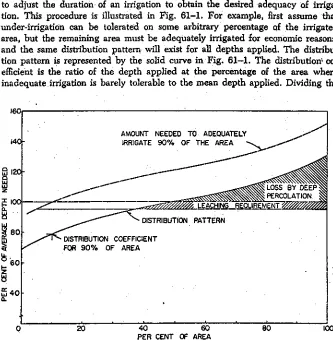
When the distribution pattern of an irrigation system is known with either a sprinkler system or a surface system, the distribution pattern can be used to evalu-ate the adequacy of an irrigation or provide a numerical value that can be used to adjust the duration of an irrigation to obtain the desired adequacy of irriga-tion. This procedure is illustrated in Fig. 61-1. For example, first assume that under-irrigation can be tolerated on some arbitrary percentage of the irrigated area, but the remaining area must be adequately irrigated for economic reasons, and the same distribution pattern will exist for all depths applied. The distribu-tion pattern is represented by the solid curve in Fig. 81-1. The distribudistribu-tions
co-efficient is the ratio of the depth applied at the percentage of the area where inadequate irrigation is barely tolerable to the mean depth applied. Dividing the
20 40 60 80 100
PER CENT OF AREA
WATER CONSERVATION
4:141t4to be applied at this point by'the OistabutIon coefficient gives the.' mean depth actitally needed to assure that all but the percentage of -area, safe Would be. idequatelk irrigated. , The percentage of the area on which ..under-irri gation is tblerable would depend on the economic value and sensitivity of the --crop grown ta both under-irrigation and over-irrigation: An eConomic:evaluation of the net returns obtained in'term's of crop responie with the distribution pattern of the system should' be the deciding factor in selecting the percentage of the area on which tinder4rigation can be tolerate& In areaS where leaching is impor-.
tant, maintenance- of prodtictivity must also be considered.
Distribution patterns. for sprinkler systems tend to ...follow a normal distribu-, -lion (Hart, 1961): Thus distribution patterns for sprinkler systems can be re-produced knowing only 'the mean application rate and the standard deviation or variance.
The distribution coefficient would also be applicable, even if all areas were' being over-irrigated and the amount being applied needed to be reduced: For example, if the dePth of water being applied during an irrigation is indicated by'
the dashed line in Fig. 61-1 and inadequate irrigation on 20% of the area would give the greatest net 'returns, then the adjusted amount or duration of irrigation
needed would be 1/1.07 or 93.5% of the original amount. The distribution pat-tern can be assumed to remain the same for a sprinkler system, but may change with depth applied with a surface system.
2. WATER LOSSES AFFECTING IRRIGATION EFFICIENCIES
Irrigation efficiency is affected by evaporation from water surfaces in reservoirs and conveyance channels, transpiration by unbeneficial riparian vegetation along reservoirs and channels, seepage losses in reservoirs and conveyance channels, deep percolation losses in fields, and unavoidable operational waste. The magni-tude of these losses varies widely among irrigation projects because of the
dif-ferent physiographic features, water control and conveyance structures, and man-agement practices.
3. MEASUREMENT AND CALCULATION PROCEDURES
a. Water Application Efficiency and Farm Delivery Requirement. When evalu-ating water application efficiencies on existing projects, one of two methods is generally used. For individual irrigations, the soil water content is measured at representative points throughout the field prior to, and 2 or more days after, an irrigation. If the leaching requirement Is zero, the water application efficiency of the irrigation is calculated from the volume of water stored per unit area, or
the mean depth stored adjusted for normal evapotranspiration between sampling dates, and the mean depth applied:
E ( W2 – + nE1) a] X 100 [61-5]
where
W2 and W1 = mean depths of water in the soil after and before irrigating, n= number of days between sampling dates,
Eg =-- consumptive use or evapotranspiration rate between sampling
dates expressed as depth of water used per day, and
The evapotranspiration rate should be either an estimate for the period be-tween sampling dates or the average of the rate measured before and after irri-gating.
Water application efficiencies computed in this manner only approximate wa-ter application efficiency because deep percolation losses do not cease in 2 to 3 days after an adequate irrigation. Consequently, water application efficiencies will vary, depending on the time of sampling after the irrigation. For example, on a bare, sandy loam soil at Prosser, Washington, USA, the mean total depth of water in the soil profile 5, 10, and 20 days after an irrigation with evaporation pre-vented was 31.5, 30.2, and 28.2 cm, respectively (D. E. Miller. Moisture reten-tion in synthetic soil profiles. SWC, ARS, USDA, Irrigareten-tion Exp. Sta., Prosser, Washington. Personal correspondence). If there were 21.3 cm of water in the profile before irrigating and 12.7 cm of water was applied, the computed water application efficiency would have been 80%, 70%, and 54%, respectively, de-pending on when the after-irrigation samples were taken. The decrease in soil water with time was caused by unsaturated flow from the profile due to gravity. When evapotranspiration is occurring, the rate of unsaturated flow from the soil profile decreases more rapidly because of more rapid withdrawal of water from the upper layers.
Suitable techniques are not available to easily evaluate the actual amount of water that drains through the soil profile, as compared with the amount required for leaching purposes. This is one reason why leaching requirement generally has not been considered in water application efficiency studies. Reported water application efficiencies with present measurement procedures, therefore, are only approximations because of the difficulty in evaluating water needed and ,used for leaching, and because slow drainage from the profile is difficult to evaluate. More comparable water application efficiencies could be determined for individual irri-gations, if uniformity in time of sampling after irrigation was used, such as when gravity drainage decreased to Iess than a fixed rate of 0.5 or 1 mm/day or 0.1 of the mean evapotranspiration rate. The most accurate comparisons of water application efficiencies for various systems can be made only when total deep percolation losses between irrigations are known. Thus, water used in evapotran-spiration, instead of water stored in the soil as presented in equation [61-3], is essential for accurate water application efficiencies.
Measurement of water application efficiencies for individual irrigations is time consuming and expensive. The second method of evaluating water application efficiencies involves estimating field or farm irrigation efficiency which includes conveyance and application losses on the farm or field. Estimated farm irrigation efficiency is the ratio, expressed as per cent, of estimated evapotranspiration and leaching requirement on the farm minus effective rainfall to irrigation water delivered to the farm:
Estimated farm or field (Et + Wg – R„) 100
irrigation efficiency Wd
where
E
t
= estimated volume- of evapotranspiration, WI
= volume of water required for leaching,R.= volume of effective rainfall, and
Wil =
volume of irrigation water delivered.ese estimates . are reasons . an. -useable:When good waterrnanagernent .is practice& 1-16wevei, poor irrigittiod practices are involVed; such•as 'ilia
• ". - ' .
quate irrigations on part. rof-Oirefarm Or'field, the estimated eVapotranspiration may be tOO'high, resulting in apparent farm or field frrigation efficiencies also are todhigh. Fann or field irrigation ` efficiency shouldbe based on measured' evapotranspiration wheneVer'pc*Sible,. or the estimated consuniptive use should' be adjusted for actual toil water levels maintained, actnaI duration of growing' seasons, and adeqqack of the'irrigations
Most studies evaluating irrigation efficiencies by estimating evapotranspiration have not:included the leaching requirement in the numerator of equation [61-6]', If leaching requirement.: wereinclUded; farm irrigatien efficiency values reported' would be hi'ghetin many areas. ..:
EfficienCy studies of this type should be interpreted cautiously. For example,
if an annual water allotment is involved, the farmers tend to take their full allot-merit, thus predetermining estimated farm irrigation efficiency.
b. Water Conveyance Efficiency and Diversion Requirement Water convey-ance efficiency is easily determined, if water delivered to farms, known opera-. tional waste, and the water diverted from a stream or released from, a reservoir -to the channel is measured. Reliabie measurements are more difficult with short reaches of conveyance channels because of the difficulties encountered in accu-rately measuring a small difference in large Bows between two points. Diversion requirement is the farm delivery requirement plus necessary operational waste divided by the conveyance efficiency expressed as a fraction.
e. Irrigation Efficiency and Storage Requirement. The over-all irrigation effi-ciency is the product of reservoir storage effieffi-ciency, water conveyance effieffi-ciency, and farm irrigation efficiency. Evapotranspiration plus leaching requirement, minus effective rainfall on the irrigated area of the project, plus operational waste, divided by the over-all project irrigation efficiency gives the total storage requirement. Over-all irrigation efficiency is often quite low. For example, assum-ing no leachassum-ing requirement, farm irrigation efficiency with gravity systems often averages 45 to 55% and conveyance efficiency 70 to 75%, depending on the type of channels. Reservoir storage efficiency can be quite high, if underground storage or deep, tight surface reservoirs are involved. Assuming a 90 to 95% range in reservoir storage ef ficiency, the over-all project irrigation efficiency would range from 28 to 39%. Often canal seepage and runoff from farms can be col-lected and brought back to the conveyance system, thereby increasing the over-all
irrigation efficiency of a project.
-4. RIVER BASIN CONSIDERATIONS
IRRIGATION EFFICIENCY 1 1 2 9 increases construction costs. Also, only a portion of the runoff, deep percolation, and canal and reservoir seepage can be collected and reused in a river basin because of evapotranspiration losses on waste or non-cropland and transpiration from vegetation bordering channels.
The quality of the water collected for reuse is often impaired. The evapotran-spiration process on both crop and wasteland sends salt-free water into the atmosphere. Dissolved solids in irrigation water become more concentrated in the seepage collected and reused in projects further downstream.
II. IMPROVING PROJECT IRRIGATION EFFICIENCIES 3
Project irrigation efficiency encompasses water storage efficiency (when storage is involved), water conveyance efficiency, and farm irrigation efficiency. Although project irrigation efficiency may vary considerably during the irrigation season it is commonly considered as a seasonal value.
The water supply source affects project irrigation efficiency. The water supply for many irrigation projects is stored in a reservoir during periods of excess flows for later release and distribution to the irrigable lands of the projects. Other projects secure their water from natural flow by direct diversion from a stream or by pumping from an underground aquifer. Storage and conveyance losses may not be involved in the Latter project efficiencies.
A. Current Project Irrigation Efficiencies
Project irrigation efficiencies vary widely from area to area. A recent study, using information secured on 21 selected Bureau of Reclamation projects in the 17 Western States, USA, indicated that the average project water conveyance efficiency for the years 1949 to /960, was 63.1%, but ranged from 47.5 to 82.7%, US Dep. Interior (1962). Reservoir storage efficiencies for these projects were not available. Average farm irrigation efficiencies for these projects for the same years ranged from 32.3 to 78.2%, with an average of 59.3%.
There is almost universally a correlation between abundance and/or cost of water and project irrigation efficiency. Where water is scarce or high in cost, the efficiencies are higher. Conversely, where water is abundant and/or low in cost, the efficiencies are lower. Thus, in a sense, economics play a major role in existing project irrigation efficiencies. Project management, as well as farm management, involves balancing the immediate cost of water against the higher labor and investment costs required to use it more ef ficiently. In many cases, the true costs of using excess water are not recognized immediately but may be reflected in reduced yields due to leaching of plant nutrients, reduced yields caused by accu-mulation of soluble salts or exchangeable sodium, or in extra drainage installa-tions which will be required later to control rising water table levels.
1 1 3 0 WATER CONSERVATION
. Factors Affecting Project Efficiencies
I. NATURE OF LOSSES
The Tosses and wastes in storage reservoirs and in the , conveyance and distri-bution system to the individual farm occur as seepage, evaporation, consumptive use, and operational losses and wastes. These losses and wastes vary with the type and design of the irrigation project. Many irrigation projects store water in a mountainous area during the winter. During the irrigation season, water is released at the reservoir, either directly into a distribution system or into the natural stream channel from which it may be diverted into a distribution system downstream. Some projects merely divert or pump natural flows from a stream into a dis-tribution system. On these projects the disdis-tribution channels may be excavated through natural material and left unlined, or they may be earth, concrete, asphalt, or plastic lined. Other systems deliver water in concrete, metal, or transite pipe for gravity irrigation, or adequate pressure may be provided for sprinkler irriga-tion. Because opportunity for seepage, evaporation, and operational wastes and losses are different in each distribution system, project irrigation efficiencies vary widely.
Some reservoirs or dams serve multipurpose functions and, in addition to irri-gation, regulation for flood control, power generation, recreation, and fish and wildlife requirements, must be considered and met, insofar as possible. All water required)for multipurpose operations should not be charged to irrigation. For this reason, care must be exercised in delineating and explaining project irrigation efficiencies, where multipurpose reservoirs are involved.
2. RESERVOIR STORAGE LOSSES AND WASTES
Seepage from reservoirs reduces reservoir storage efficiencies. In the selection of a reservoir site, the permeability of the soil, or earthen mantle, covering the reservoir area is evaluated. In some instances where high permeabilities are found, either compacting the earth or applying a compacted earthen blanket may effec-tively decrease the seepage losses. Polyethylene or vinyl film has been used to line smaller reservoirs, but is currently considered to be too expensive for large reservoirs.
When a reservoir is filled, some of the water is absorbed by the bank of the reservoir. When the reservoir water level is lowered, water drains from the bank into the reservoir. This water is referred to as bank storage and may amount to a sizeable volume in a large reservoir. For example, inflow-outflow measurements for Lake Mead on the Colorado River, USA, (capacity 3.85 x 10" m 9 (3.125 x 10⁷ acre-ft)) show the bank storage to be about 4.1 X 10 9 ms (3.3 x 100 acre-ft) when the lake is filled to capacity (Langbein, 1960). If a portion of the bank storage does not return to the reservoir because of use by unbeneficial riparian vegetation, reservoir storage efficiency will be reduced.
3. LOSSES IN PROJECT SYSTEMS
One of the greatest causes of water losses from a reservoir area, or a canal distribution system, is the phreatophytes which in general are unbeneficial water-using plants that transpire large volumes of water annually. Salt cedar (Tamarix gallica) is the number one offender in the Southwest, USA. It is not uncommon for its water consumption to reach 1.5 X 10 4 ma/ha. (5 acre-ft/acre). Under ideal conditions of growth and density it may exceed 2.7 X 10 4 m8/ha (9 acre-ft/ acre). In the 17 Western States, USA, it is estimated that 6.1 X 10⁸ ha (1.5 X 10⁷ acres) are infested with phreatophytes, consuming 3.1 X 10 10 m8 (2.5 X 10⁷ acre-ft) annually.
Studies made in the Rio Grande Basin, USA, indicated that, prior to channeli-ration, there were approximately 3,000 ha (75,000 acres) of salt cedar, cotton-woods (Populus sp.), willows (Salix sp.), Russian-olive trees. (Etoeagnus augusti-folia L.), and other water-consuming vegetation in, and adjacent to, the river channel and flood plain. About 3.7 X 10⁸ ms (3.0 X 10⁸ acre-ft) of water, or about one-third of the normal annual flow of the river at the head of the irrigated lands, was used unbeneficially by phreatophytes (Hill, 1983). The eradication of the phreatophytes is an obvious remedy, although a difficult one to apply. Improved chemical sprays, as well as improved mechanical devices, have aided in the eradication, especially when used in conjunction with the improved chan-nelization of water courses. Deliberate lowering of the groundwater table beyond the reach of the phreatophyte roots has been used successfully in Utah for shallow-rooted phreatophytes.
The US Geological Survey estimates the average annual evaporation from freshwater bodies in the 17 Western States, USA, at over 2.8 X 10 10 ma (2.3 X 10⁷ acre-ft). To meet the growing demand for fresh water, all known losses are being reevaluated to increase the effectiveness of water resource management. One of the most promising developments in the reduction of evaporation losses from reservoir or lake surfaces, which does not interfere with multipurpose usage of a body of water, is the use of hexadecanol and octadeconal formulations. These chemicals form a monomolecular Rim over the water surface which . provides an invisible, but effective, barrier to evaporation from the water surface, if heavy weed or algae growth does not exist. The application and distribution problems have been difficult on large bodies of water, or where the water surface is com-monly subjected to violent wave action. Work is continuing on the application and distribution methods (US Dep. Interior, 1983). It appears possible to cut evaporation losses one-third or more by this method of evaporation control.
Seepage losses from canal and distribution systems, and resulting damage from waterlogging and sodium or salt accumulation, may be reduced by canal lining. In the USA, the extensiveness of any canal lining program depends on economic feasibility after considering many factors, including value of land protected from seepage, value of water, increased capacity available in lined canals, and lower maintenance costs. Considerable work is being done on the development of low-cost canal linings and is fully discussed in chapter 60.
1132 WATER CONSERVATION
water throughout a project area will necessitate some unavoidable operational wastes. Operational-wastes of 5% are considered reasonable.
As a general nile, low project irrigation efficiencies are considered to be unde-sirable; however, there are instances where the losses and wastes, which occur. in one system, are not harmful and are recovered and utilized as return flows providing irrigation water on another project. In such cases, it would be false economy on a basin basis to expend funds to reduce these harmless wastes. How-ever, if operational costs for the upper project can be materially reduced and the two projects are operated independently, then reduction of wastes in the upper project may be economically feasible.
4. METHODS OF WATER DELIVERY
The method of water delivery has a pronounced effect on project irrigation efficiency. Application of irrigation water must be closely adjusted, both to the requirements of the crop and to the available water-holding capacity of the soil root zone, if satisfactory production is to be obtained, losses of both soil and water on the farm are to be held to a minimum, and the needs of the farmer are to be served. Attainment of these conditions calls for flexibility, rather than rigidity, of water deliveries through the project distribution system. Flexibility is especially important for satisfactory operation of an irrigation system in areas such as Nebraska and Kansas, USA, where intense precipitation storms occur. The occurrence of these storms requires sudden and frequent changes in water deliveries. The system must be constructed to permit flexible operation because alternate operational procedures must frequently be used.
Three distinct methods of delivery of irrigation water are commonly recognized in the USA: demand, rotation, and continuous flow. Seldom, if ever, is all of the irrigation water delivered on a project strictly according to any one of these methods. Rather, modifications or combinations of two or all three are used at various times or in various locations as needed.
a. The Demand System. The demand system involves the delivery of water to the farms at times, and in quantities, as requested by the water user. It is ideal from the water, user's point-of-view, as it enables him to irrigate each crop when irrigation is needed and to use a stream size that he finds to be most economical and efficient. This system of delivery offers many opportunities for a project to encourage wise use of water and generally results in higher project irrigation efficiencies. Demand deliveries require an alert, ingenious and flexible operational organization capable of matching daily supply with demands. Because it is not economically feasible to design unlimited capacity in the canal and laterals, the water user's demand may exceed project capacity during the peak of the irrigation season. If so, a change to one or both of the other systems of water delivery may be necessary.
water diStribution: Under the rotation methOd, water is delivered to ,,each user in sufficient: 'quantity for a fixed period of time under a prearranged' schedule.
Under careful management good project irrigation ef ficiencies can be secured..;. under the rotation method, hut the fixed schedule makes it impossible for a water user to delay his irrigation even a few days. This would be poSsibIe, if he received his water under the demand system. To forego an irrigation when his rotation period is due would subject his crop to severe water stress before the next rotation period was due.
c. The Continuous Flow System: Under this method each water user receives his share of water as a continuous flow. It reportedly had its start in the USA under the early miner's inch appropriations where users demanded their legal allotment constantly, whether needed or not. Generally speaking, on small tracts or on sandy soils, and when the irrigation stream is small, this method wastes water and time and contributes to waterlogging of the soil. Because of the resulting low farm irrigation efficiencies it should not be used except when extreme con-ditions render rotation or demand systems impractical.
5. WATER CHARGE SCHEDULE
A project water charge schedule affects project irrigation efficiencies. There are two schedules in general use in the USA: The flat rate charge and the gradu-ated or excess water charge.
a. Flat Rate Charge. Under the fiat rate charge schedule each water user pays the same rate either on a hectare (or acre) basis or on a cubic meter (acre-ft) basis. Where the rate is based on the irrigable land owned or operated by the water user, each operator pays the same amount per hectare (or acre) irrespec-tive of how much water he uses per hectare (or acre) during the irrigation season. In many areas water storage supplies may limit the amount of water per hectare (or acre). However, where supplies are adequate and the seasonal water charge is based on irrigable land, it is possible for one water user to secure more water per hectare (or acre) than needed at no extra cost. Under this condition there is no financial incentive for the water user to conserve or make efficient use of his water.
k. Graduated or Excess Water Charge. Under this system an allotment is estab-lished for each hectare (or acre) of irrigable land. Unless limited by storage capacity an allotment is the amount of water normally required to produce crops under reasonably efficient irrigation practices. Each water user is required to pay a minimum amount for the water allotment. On some projects.the allotment varies, depending on the characteristics of the soils. Coarser textured soils, because of the associated problems of distributing water efficiently, receive more water than finer textured soils. In a few cases all water users are required to pay for a "base amount" which is usually 1,500 m8/ha (0.5 acre-ft/acre). less than the allotment.
This provides a monetary incentive to apply water efficiently. The additional 1,500 m8/ha (0.5 acre-ft/acre) which makes up the allotment, may be pur-chased, if needed, at the same rate as the base amount.
1 3 4 WATER CONSERVATION '
costs 120% of the allotment rate, the second increment costs 140%, and the third increment or more masts 160% of the allotment rate. The excess water charge has been found to be very effective in encouraging good farm irrigation practices. In addition to creating an awareness among water users that using water carelessly costs more money, there is the additional incentive in the pride a water user takes "in staying within Ms allotment."
e. Methods of Improving Project Irrigation Efficiencies. Since water for irriga-tion is a natural resource available to those making applicairriga-tion for it and benefi-cially utilizing it in the USA, charges greater than those incurred in the construc-tion of facilities to bring the water to the land and to operate and maintain these facilities cannot be levied without the consent of the water users. For this reason in an area of abundant and readily available water, the charges will be low and will provide little incentive to use water efficiently. In such cases it is difficult to increase existing project irrigation efficiencies. Project water requirements are generally based on the consumptive irrigation requirement for an anticipated cropping pattern for the area and a reasonable water application efficiency. How-ever, there are some older projects in existence where present water use is un-reasonably high. In some of these areas, particularly in Utah, USA, new water• allotments have been imposed and upheld by the courts. These were based on estimated consumptive irrigation requirement and a reasonable, but firm, water application efficiency. This action has forced water users to improve their water application efficiencies (Bagley, 1965). There are a number of practices that can be used within the project, or imposed by the district, to improve present efficien-cies. These practices are briefly described below.
1. Water Measurement. Experience has shown that where water measurement is not practiced throughout a project, irrigation efficiencies are generally very low. On one irrigation project in eastern Oregon, USA where water is measured only at the diversion to the main canal, it is estimated that project irrigation efficiencies range from 20 to 30% (Stammers, 1963). Measuring devices are being installed at individual farm turnouts to provide better water control and management throughout the irrigation system and to insure each water user of his equitable supply. Preliminary observations indicate that the project irrigation efficiency will be increased substantially as a result of these installations. Although there may be a few projects where the abundance of water makes it unnecessary to measure water, more efficient project and farm operations would result from measurement of water. In the future, as water supplies are more fully utilized, water measurement will become more important to farmers and irrigation districts alike. Water measurement will permit equitable water distribution to the farmers of a project area and will allow the project management to properly regulate and control the water throughout the irrigation system.
2. Modification of Delivery Schedule. On many projects it is possible to modify present delivery schedules, especially where the continuous flow method is found to be inefficient. In some cases modification of the system will be necessary, but the greatest obstacle to overcome is the long established local custom of water delivery and use. Often it is possible to change Loin a rotation system of delivery to a demand system, except during peak delivery period, with considerable savings in water and substantial increases in project irrigation efficiency.
low vvithont reductions in crop yields. Records also disclose that when excess water charges have been removed, or the allotment has been raised, there has been a definite increase in water use without a noticeable increase in crop pro-duction. For example, on one large division of a project in southwest Idaho, USA where the allotment was 9,150 m a/ha (3.00 acre-ft/acre) with excess charges being made for additional water, the water use averaged 13,600 m a/ha (4.47 acre-ft/acre} for the period 1951 to 1955, inclusive. At the start of the 1956 season the allotment was changed to 15,200 m a/ha (5.00 acre-ft/acre). An immediate increase in water use occurred with the average water use being 19,000 ma/ha (5.21 acre-ft/acre) for the period 1956 to 1963, inclusive. On another project in eastern Oregon where the allotment was increased in 1945 from 10,700 m a/ha (3.50 acre-ft/acre) to 12,200 (4.00), the average water use was 13,200 m's/ha (4.33 acre-ft/acre) for the years 1941 to 1945, inclusive. For the years 1946 to 1963, inclusive, the average water use was 14,300 (4.83). In many areas efficiencies could be increased by the irrigation districts levying an excess water charge, thus making the fanner cognizant of the need for good irrigation practices.
4. Improvement in Operational Practices. On some projects, particularly small ones, the operational practices, insofar as water deliveries are concerned, are not conducive to either high farm or project irrigation efficiencies. If a farmer is to make efficient use of his irrigation water, he must have reasonable assurance that he can obtain water when he needs it or is entitled to receive it. Operational procedures that control and regulate the water throughout the project distribution system will increase irrigation efficiencies on many projects. In some instances operational wastes and losses are considerably higher than necessary. These losses and wastes may be held to a minimum with improved operational practices.
S. Consolidation of Irrigation Districts. Although it is difficult to accomplish,
the consolidation of several irrigation districts into one operational unit will allow the employment of a better qualified manager than could be employed by a small district. The better management would generally be reflected in lower operating costs per unit area and more efficient regulation and control of the water supply, thus increasing project irrigation efficiencies. The combination of small irrigation districts often allows exchanges or regulation of water between districts which improve the project efficiency. In many cases overlapping portions of distribution systems or duplicate operational structures and equipment may be eliminated.
6. Modernization of Project Facilities. Many of the control and regulating structures on projects constructed in the USA during the early 1900's are obsolete or nearly worn out. This is particularly true of checks, turnouts, and some canal linings. A planned program of replacement and modernization of the delivery system to keep the system abreast of the changes being made in other farming
practices will increase the operational efficiency of the project both from a water
use and economic standpoint. The use of automatic control structures will reduce the waste and losses necessary to operate the system;
1 1 3 6 WATER CONSERVATION
limits of project irrigation efficiencies are unknown, but it is reasonable to expect considerable increases as the demand for water becomes greater.
III. IMPROVING FARM WATER CONVEYANCE AND
APPLICATION EFFICIENCIE5 4
A., Irrigation Water Losses on the Farm
Only a portion of the irrigation water delivered to a farm fulfills its intended purpose, that of providing essential water for the crops grown. Some of the water will be lost by evaporation or seepage from farm ditches, more will be lost from runoff or percolation below the root zone in the field.
Conveyance losses from the headgate or farm water source to the individual furrow, border, or sprinkler head 'may vary from almost zero when the water is conveyed through a watertight pipe to as much as one-half of the initial supply in sandy ditches. In open ditches, some of the loss is attributed to evaporation, but in most instances this portion is relatively small. Weeds and aquatic plants along or in ditches can use significant amounts of water, but generally the most important loss occurs as seepage through the ditch sides and bottom. The magni-tude of the seepage loss is dependent primarily upon the permeability of the soil material in which the ditch is built. It may also be affected by such factors as nearness to a water table, silt transported by the irrigation system, and chemi-cal composition of the water.
On the Leld itself waste will occur by runoff from the surface of the land and uneven distribution of the water, or excessive duration of irrigations, may cause excessive amounts to percolate below the rooting depth of the crop. The relative magnitudes of these two types of losses are greatly affected by the intake charac-teristics of the soil, the slope of the land, the method of irrigation, coupled with the size of the irrigation stream and the field, and the management ability of the irrigator. On slowly permeable soils, runoff is usually greater than deep percola-tion, whereas on sandy, open soils, runoff may be practically nil and deep perco-lation losses may be great. Likewise, the use of large irrigation streams tends to increase runoff and decrease deep percolation losses. The ability of the irrigator to adjust the size of his irrigation stream to the soil and the field conditions is probably the most important element in reducing losses from these causes.
There are also some losses by evaporation in distributing the water over the field. These losses are largely a function of climatic conditions, the method of irrigation used, the type and quantity of ground cover, and the duration of the irrigation set. With surface irrigation and an actively growing, dense crop, evapo-ration may be no greater than normal evapotranspiration.
The US Dep. Agr. (1060) has estimated that on the average abotit 47% of the irrigation water available on the farm enters the soil and is held in the root zone where it is available to crops. It also points out that it is not unusual for farmers to attain irrigation efficiencies of 70 to 75% by proper selection, design, and operation of their syStem.
IRRIGATION EFFICIENCY 1137
B. Factors Affecting Farm Irrigation Efficiency
1. AVAILABILITY OF WATER
For most efficient use, the irrigation water must be delivered at a rate to: (1) Satisfy the water needs of the crop during the peak use period and (ii) permit uniform distribution of water over the land. The volume available over the season must be sufficient to maintain the desired water level throughout the growing season and to provide leaching water that may be required.
These requirements ._=or stream size and volume cannot always be met. As a result of competition for water, there has developed a governmental, social, and economic structure which greatly affects the flexibility of the irrigator in
manag-ing his water. •
In the USA, individual states have developed water codes that fix limits as to the stream size and volume diverted. These, together with regulations on priority of use of the available supply, often have resulted in attitudes conducive to overuse of water when it is available. Seldom, if ever, is the natural supply of water in phase with the crop demands and there are periods of surplus and deficiencies. Under such conditions, it is human nature to use water lavishly when it is available, knowing that drouth periods will probably follow.
2. ECONOMIC FACTORS
The manager of an irrigated farm must balance all the production costs to derive the greatest profit from his operation. Efficient use of water will require a greater capital investment in physical facilities or will require greater amounts of labor. When water is cheap, there is little incentive to invest more capital or to make the effort to use water judiciously. On the other hand, when the cost of water is great, there is great concern and much justification for care in its application.
Efficient use of water is also affected by the intensity of the farm enterprise and the value of the crop produced. In many instances, even when water is cheap, the operator will economically benefit from proper application of his water
through increased production per unit area and improved quality of his product. •
3. INDIVIDUAL AND COMMUNITY HABITS
1 1 3 8 WATER CONSERVATION
C. Improving Farm Distribution and Conveyance Efficiency
I. FUNCTIONAL REQUIREMENTS
The farm distribution system conveys water from the headgate, or source, to the individual furrow, border, basin, or sprinkler head. It must do this without excessive conveyance losses and must deliver the water in the quantity needed at the point of application with a minimum labor requirement.
2. MINIMIZING DISTRIBUTION LOSSES
Much can be done to assure that the water will be distributed uniformly. Of primary importance is the arrangement of the irrigated fields so they conform to topographic and farm boundaries, yet keep the required length of ditches or pipelines to a minimum.
Weeds, brush, and trees growing in and along ditch banks can use considerable quantities of water. They are also undesirable because they reduce ditch capacity, increase maintenance costs, and may provide a source of weed seed that irrigation water carries onto the fields. They may be controlled by chemicals, by burning, or by mowing or pasturing.
Canal linings on the farm are very effective in reducing seepage losses and minimizing undesirable plant growth. They sometimes permit the use of smaller ditches, stabilize erosive grades, and prevent breaks and washouts.
Pipelines have these same advantages and in addition reduce evaporation losses to a minimum. They are also capable of conveying water under pressure. Pipelines are essential with sprinkler irrigation and are very useful when water is to be conveyed across a swale or pumped to a higher point. Permanent pipe-lines are usually buried so as not to obstruct farm operations. Portable pipepipe-lines are used to carry the water to the individual furrow, border, basin, or sprinkler head.
3. MINIMIZING OPERATION LOSSES
Efficient use of irrigation water requires adequate controls to measure, check, divide, or divert the irrigation stream. Inadequate controls in the farm distribu-tion system result in increased labor for irrigating and in water losses because of inaccurate methods of apportioning the stream to the individual outlet.
In many instances, the volume of water delivered to a farm over a 24-hour period may be adequate to satisfy crop requirements, but the stream size may be so small that it does not permit efficient irrigation. In these instances, overnight storage reservoirs may be helpful. The small flow for the 24-hour period may be stored and a large stream withdrawn from the reservoir for irrigation. Over-night reservoirs are helpful only if seepage and evaporation losses in the reservoir can be held to a practical minimum. This may require treating the storage area chemically or mechanically by lining the sides and bottom of the pond.
4. ON-FARM REUSE OF SURFACE RUNOFF
1 1 3 9
irrigation requires that the principal attention be given to minimizing the deep percolation losses by allowing considerable surface runoff which is then collected and reused. On-farm reuse of surface.runoff is particularly well adapted to fields that have fine textured soils or considerable slope.
Tail water recovery systems consist of pickup ditches, which convey the water to a sump or storage reservoir, and often a pump and pipeline to deliver this
water to a point where it can be used again. When the volume of the reservoir is small in relation to the rate of flow in the pickup ditches, automatic controls may be needed on the pump.
Tail water recovery systems should not be considered as a substitute for good irrigation water management. The stream sizes used for irrigation must be non-erosive and proportioned to suit the needs of the crop and the soil. The systems often permit a saving in the labor for irrigating by eliminating "cutbacle streams
used with furrow irrigation and by compensating for small errors in stream adjustment with other surface methods. Design, operation, and general practices being used are described by Davis (1964) and Kasmire et al. (1955).
O. Improving Form Irrigation Efficiencies
Proper use of irrigation water is only partially accomplished when it has been efficiently delivered to the field. Frequently insufficient attention has been given to the design and management of the facilities for distributing the water over the field. Improvements in water distribution probably offer the greatest oppor-tunity to conserve irrigation water.
1. IMPROVEMENT OF PHYSICAL FACILITIES
The land surface often needs modification to make it better adapted to the method of irrigation used. Land leveling is a popular improvement on fields that are irrigated by surface or subsurface methods. In some instances this intensive practice has been adopted, not to save water but to provide greater ease in irri-gating. Land leveling can only make management of irrigation water easier; in itself, it does not improve efficiency. It provides good surface drainage and per-mits more precise cultural and harvesting operations. When land leveling reduces
slope, as is common with bench leveling, it greatly reduces runoff of natural
precipitation, reduces soil erosion, and permits efficient water application with lower management skills.
Land smoothing or grading for surface drainage is often helpful, even when the irrigation water is applied by sprinklers. Fine-textured, nearly level soils often benefit from smoothing when sprinkler irrigated because it eliminates small over-irrigated spots caused by ponding.
I 1 4 0 WATER CONSERVATION
result if the farm irrigation system is designed with sufficient flexibility to permit the irrigator to respond to changed physical and economic conditions.
The irrigator needs good controls and measuring devices. It is just as important for the manager to know bow much water has been applied as to know the quantities of seed or fertilizer used. The system should allow him to put the water where he wants it in the quantity that will permit efficient use.
Facilities for the disposal or reuse of surface waste are essential with many methods of irrigation, yet their importance frequently is not recognized. The design and layout of the water disposal or reuse system should be coordinated with the design and layout of the water distribution system.
2. MANAGEMENT IMPROVEMENT
While an adequate water supply and facilities for its distribution are essential, efficient use of irrigation water requires good management. Irrigation water man-agement is defined by the US Soil Conservation Service (US Dep. Agr., 1965) as "the use and management of irrigation water, where the quantity of water used for each irrigation is determined by the water-holding capacity of the soil, and the need of the crop, where the water is applied at a rate and in such a manner that the crop can use it efficiently and significant erosion does not occur."
Conditions on an irrigated field never remain static. As the crop roots develop, the amount of available soil water that can be stored increases. The soil intake characteristics and susceptibility to erosion change with tillage practices, climatic conditions, and crop influences. Thus, the irrigator is faced with an ever-changing set of conditions requiring adjustments in his irrigation techniques. To keep abreast of these needs, he must continually evaluate his irrigation operation to insure himself that he is making best use of his water.
The irrigator can detect erosive streams by simple observation, but he must rely on moisture meters, soil examinations, or time estimates to evaluate the amount of water remaining in his field. 'He must be able to measure the amount of water applied and compare this volume with the volume needed to fill the root zone. He needs to estimate how uniformly the water is being applied over the field and how , much is being lost as surface waste and by deep percolation. Techniques for estimating surface waste and deep percolation vary with dif-ferent methods of. irrigation. With sprinklers, for example, it is quite simple for the 'irrigator to know how much water has been applied for the system delivers
a predetermined amount each hour. With subirrigation systems, the water
condi-tion can be observed by the depth to the water table as measured in a shallow well. With surface methods, an experienced irrigator can judge the uniformity of his application by noting the times of advance and recession of the irrigation water
over the border, furrow, or field.
41
The irrigator can best judge the uniformity of application in furrows or corru-gations by observing the time water is running in the upper and lower ends of the furrow. Irrigation should be continued until adequate water is applied at the lower end. If the furrow length and stream size are in proper proportion, the upper end will not have received an excessive application.
The irrigator can compensate somewhat for distortion of the sprinkler pattern by wind. In severe instances, irrigations may be scheduled during the part of day when the normal wind velocity is lowest.
With all systems, the irrigator must schedule his operations so irrigation water will be applied to all parts of the field as it is needed. He must be equally aware of the magnitude of the deep percolation losses as he is of the water lost as surface runoff. Only by keeping the two in balance can he attain the highest over-all farm irrigation efficiency.
3. REQUIREMENTS TO REALIZE POTENTIAL EFFICIENCIES
Knowledge obtained through research and development of new equipment and materials is constantly improving the prospects of attaining truly high irrigation efficiencies. Almost any device or procedure available at a reasonable cost that simplifies the management problem will prove valuable.
The precision of irrigation attained through management cannot exceed the precision of knowledge of the physical conditions in the field. One of the most fertile areas for improvement of irrigation efficiency through management is in the development of better instruments to measure the amount of available soil water in a field. Simple devices to measure volumetrically the amount of water applied to small areas or the amount that runs off an area are needed. Instruments which will reflect a buildup of saline or alkali conditions would be helpful in maintaining adequate control without waste of leaching water or soil amendments. As noted, the irrigator often must balance the cost of water against the cost of labor to apply it more efficiently. Automation of irrigation potentially can reduce labor costs. The future is almost sure to bring more and better sensing devices to control the starting and stopping of water application, automatically controlled gates, valves, and other devices to change the point of application within a field. Attainment of the highest possible irrigation efficiencies requires that all varia-bles that affect the application of water be controlled. At the present time, one of the factors most variable in nature is the intake characteristic of the soil. Intake rates on most soils vary from very low to very high because of changes density or structure. If the intake characteristics could be controlled by mechanical or chemical means, the most desirable conditions for the irrigation method used could Be achieved and maintained.
1 1 4 2 WATER CONSERVATION
LITERATURE CITED
Bagley, J. M. 1965. Effects of competition on efficiency of water use. Amer. Soc. Civil Eng., Proc., J. Irrig. Drainage Div. 91 (IR 1):69-77.
Christiansen, J. E. 1942. Irrigation by sprinkling. California Agr. Exp. Sta. Bull. 670. 124 p.
Davis, J. R. 1964. Design of irrigation tailwater systems. Amer. Soc. Agr. Eng., Trans. 7:336-338.
Hall, Warren A. 1960. Performance parameters of irrigation systems. Amer. Soc. Agr. Eng., Trans. 3:75-76, 81.
Hansen, Vaughn E. 1960. New concepts in irrigation efficiency. Amer. Soc. Agr. Eng., Trans. 3:55-57, 61, 64.
Hart, W. E. 1961. Overhead irrigation c.rn parameters. Agr. Eng. 42:354-355. Hi11, Leon W. 1963. improving irrigation e.'aciencies in a river basin. Int. Comm. Irrig.
Drainage, Trans. 5th Congr. (Tokyo) Rep. 13, Quest. 18, p. 16.197-16.223.
Israelsen, 0. W. 1932. Irrigation principles and practices. 1st ed. John Wiley, New York. 422 p.
Israelsen, 0. W. 1939. Water-applicagion efficiencies in irrigation and soil conservation. Agr. Eng. 20:423-425.
Israelsen, 0. W. 1950. Irrigation principles and practices. 2nd ed. John Wiley, New York. 405 p.
Kan:lire, N. L., N. L. McFarlane, and 0. A. Harvey. 1955. Beneficial use of waste water in the Coachella Valley. California Agr. Ext. Serv. Riverside. 8 p.
Langbein, W. B. 1960. Water budget. Comprehensive survey of sedimentation in Lake Mead, 1948-49, US Dep. Interior. Geol. Surv. Prof. Pap. 295. p. 95-102.
Myers, L. E., Jr. 1955. Glossary of terms used in irrigation practice. California Mosquito Contr. Ass., Proc., 23rd Annual C.ortf, and Amer. Mosquito Contr. Ass., 11th Meeting, Los Angeles, California. p. 64-70.
Myers, L. E Jr., and H. R. Heise. 1960. Concerning water application efficiency of surface and sprinkler methods of irrigating. Int. Comm. Irrig. Drainage, 4th Congr.
(Madrid, Spain) Rep. 1, Quest. 12, p. 12.1-12.14.
Reeve, R. C. 1957. The relation of salinity to irrigation and drainage requirements. Int. Comm. Irrig. Drainage, 3rd Congr. Rep. 10, Quest. 10, p. 10.175-10.187.
Stan)rners, W. N. 1963. Investigations on the improvement of irrigation practices in the Umatilla Irrigation Project. Oregon State Univ. Agr. Exp. Sta. Spec. Rep. 166. 33 p. Thorne, D. W., and H. B. Peterson. 1954. Irrigated soils. 2nd ed. The Blakiston Co.,
Inc., New York. p. 1-15.
US Department of Agriculture. 1954. Diagnosis and improvement of saline and alkali soils. US Dep. Agr. Handbook SO. 160 p.
US Department of Agriculture. 1960. Estimated water requirements for agricultural purposes and their effects on water supplies. In Water resource activities in the United States. US Senate Select Comm. Nat. Water Resources, 86th Congr. Comm. Print 13. 24 p.
US Department of Agriculture. June 1965. National catalogue of practices used in soil and water conservation. Soil Consent. Serv. US Dep. Agr. 20 p.
US Department of Interior. 1962. Use of irrigation water, a report on ;elected federal reclamation projects, 1949-1960. Bur. of Reclamation. 116 p.
US Department of Interior. 1963. Research-engineering methods and materials. Bur.
of Reclamation. Res. Rep. 1. 137 p. •