Methodological Aspects of System and Process
Management at Chemistry Industry
Bibutova Shahlo Sadullaevna
Independent Researcher, Tashkent State University of Economics, Republic of Uzbekistan
I. Introduction
Focusing on the ongoing changes in the socio-economic policy of the state, the dynamics of consumer demand and market conditions, business entities of various organizational and legal forms of ownership strive to create an adequate management
system that can take into account the influence of the multiplicity
of factors of the external environment, the variability of the internal environment and develop an effective response corresponding to these conditions.
However, there is a predominance of disparate, highly specialized management decisions that do not have the necessary strategic potential. A logical consequence of this phenomenon was the
formation of inefficient forms of management and management,
based on heterogeneous elements described by informal, often mutually exclusive rules and procedures that have an excess or
deficit of functional relationships.
These circumstances suggest that at the current stage of economic development, one of the main tasks is to further improve the principles and organizational and methodological aspects of the functioning of management systems in the basic sectors of the economy, including chemical enterprises, which largely determine the nature and results of branches of reform, the transition to a civilized economy.
Of particular importance are theoretical and applied research aimed at developing and improving conceptual approaches, mechanisms for the functioning of systems and methods of
adaptive management of the country’s socio-economic, scientific,
technological and legal conditions.
The imperfection of the methodological recommendations on the functioning of the management system determines the need to review the current approaches to the formation of effective management systems in the market economy.
Literature Review
Methods to improve the effectiveness of the organization of
management of scientific and technological development of
chemical industry enterprises have been studied by scientists as In the works of L.I. Abalkina [1], S.Yu. Glazyev[2], B.J. Inozemtseva, D.S. Lviv determines the important role of the
state in the technological renewal of Russian industry, identifies
shortcomings and ways to improve public policy in this area.
Specialists in the field of science of science, such as Voronin
Yu.M [3], A.I. Rakitov, B.C. Stepin is considering the potential of science, which ultimately may allow the formation of a new economy, called the “knowledge economy.”
The theoretical aspects of the impact of scientific and technological
progress on economic development have been studied by many foreign scientists: B. Santo, R. Solow, Hamburg D.Yu. [4], R.
Harrod, J. Schumpeter, C. Arrow. A significant contribution to
the study of this problem was made by domestic scientists A.I.
Anchishkin, S.Yu. Glazyev, A.E. Warsaw, V.L. Klimenko, N.D. Kondratiev, A.G. Kruglikov, K.F. Puzynia, I.A. Sadchikov, P.P. Taburchak. A significant contribution to the study of the problems
of integration of science, production and education was made by the works of many domestic and foreign scientists. Among
them, the works of Garabajiu A.A. [5], A.N. Avdulova, Glinsky B.A., Baksansky O.E. [6], V.A. Balukova, C.B. Valdaytseva, G.A. Krayukhina, V.E. Somova, N.P. Fedorenko, S.Yu. Yagudina, A.A.
Yakovleva et al. The research conducted by the applicant is also based on the works revealing the importance of human capital in the processes of modernization of the economy and industry in particular. These are the works of such scientists as Dubenetsky
Y.N.[7], W. Petit, P. Romer, A. Smith, T. Schulz, S.N. Bobylev, A.G. Glinchikova, N. Ivanov.
It should be noted that during the reform period a number of works
appeared (A.N. Andrukhovich, K.A. Bagrinovsky, Zhukov D.Yu., Goncharova S.V., Menshutina N.V.[8]), Zalevsky A.A. [9] devoted
to various aspects management of technological development of economic systems. These studies, of course, are of certain interest for Russian chemical companies, but for objective reasons they
require their adaptation, taking into account industry specifics
of the functioning of enterprises in this sector of the economy, which predetermined the relevance of the topic of the dissertation research, its goals and objectives.
Among the most famous domestic works devoted to the justification
of theoretical and methodological foundations, involving the construction of effective management systems, improvement of
corporate governance methods include the scientific works of Ivanov V.I. [10], Ivanov S.P., Storozhenko V.N., Shulaev N.S. [11], V.A. Shwandara [12], M.B. Khamidulin, Butikov I. L.,
Yausheva R.
Analysis and Results
In many countries, the chemical industry is the engine of the economy, as it determines, along with other basic industries, the country’s economic and export potential, including in Uzbekistan. Its special position is determined by a rather high share in gross
output (about 1.2%), in industrial products (over 4.6%) and the
close interconnection of development with other sectors, primarily with the agricultural sector of the economy.
In accordance with economic reforms, the republic provides for
a significant reduction in the state’s share in the management of
Abstract
This article describes the methodological aspects of system and process management at chemistry industry. Based on studying foreign experience author proposed developed system and process management at chemistry industry. By the author were studied the organizational structure of the management of the joint-stock company Uzkimyosanoat.
Keywords
the industry and its further development, primarily due to the attraction of direct investments by strategic investors, as well as
the diversification of production.
Under the current conditions, the issue of developing an industry management strategy taking into account foreign experience in conjunction with related industries, the interests of investors and the state in a market economy becomes particularly relevant. In the face of increasing global competition, new directions in technical development, the management of the chemical industry in the world coordinate system is quite complex and remains controversial.
Their solution necessitates the development of scientific, methodological and practical recommendations for improving the mechanism for transforming chemical industry enterprises
(taking into account their place and role in the country’s economy)
with the attraction of foreign investment.
At the same time, there are a lot of gaps in the formation of an effective management mechanism based on the use of system and process approaches; methods for taking into account the impact
of risks and classification of objects of the internal and external
environment, approaches to setting goals and forming rational management decisions based on formalized economic models have not been developed enough. activities of market entities. It is advisable to use the organizational management model and the matrix structure of economic activity when developing a medium-term strategy for the development of basic industries, regulating the parameters of the main business processes, including in the chemical industry.
The chemical industry of the Republic of Uzbekistan has a long
history of development. The first chemical plants were created
at the beginning
30s of the twentieth century. Considering the country’s wide
agricultural demand for mineral fertilizers and pesticides, a number of large chemical enterprises were created in Uzbekistan, which subsequently became a solid foundation in creating one of the most powerful chemical complexes in Central Asia.
Today, the chemical industry of the republic has significant production, raw materials and scientific and technical potential. The number of employees in the industry is more than 30 thousand
people.
The basis of the modern structure of the industry is mainly determined by the developed production of mineral fertilizers, primarily nitrogen and phosphorus fertilizers, which account for more than half of the gross output of the industry.
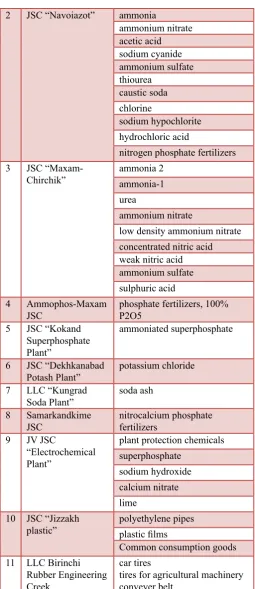
Chemical industry Table 1
№ Name of enterprises Production
1 Ferghanaazot JSC urea
ammonium nitrate
nitrogen phosphate fertilizers
Nitric acid
ammonia acetate threads
HMD 100%
sodium chlorate
2 JSC “Navoiazot” ammonia
ammonium nitrate acetic acid sodium cyanide ammonium sulfate thiourea
caustic soda chlorine
sodium hypochlorite hydrochloric acid
nitrogen phosphate fertilizers 3 JSC
“Maxam-Chirchik” ammonia 2ammonia-1 urea
ammonium nitrate
low density ammonium nitrate concentrated nitric acid weak nitric acid ammonium sulfate sulphuric acid 4 Ammophos-Maxam
JSC phosphate fertilizers, 100% P2O5
5 JSC “Kokand
Superphosphate
Plant”
ammoniated superphosphate
6 JSC “Dekhkanabad
Potash Plant” potassium chloride 7 LLC “Kungrad
Soda Plant” soda ash 8 Samarkandkime
JSC nitrocalcium phosphate fertilizers
9 JV JSC
“Electrochemical
Plant”
plant protection chemicals superphosphate
sodium hydroxide calcium nitrate lime
10 JSC “Jizzakh
plastic” polyethylene pipesplastic films
Common consumption goods 11 LLC Birinchi
Rubber Engineering Creek
car tires
tires for agricultural machinery conveyer belt
The production capacities of chemical industry enterprises fully ensure the domestic demand of Uzbekistan for mineral fertilizers, as well as export it on an ongoing basis.
Chemical products, such as nitrogen, potassium and phosphoric fertilizers, acetic acid, sodium chlorate, methanol, ammonia, nitric acid and others, cover the domestic market demand and are partially supplied to the markets of neighboring countries of the Central Asian region.
Currently, the chemical industry is a diversified sector of the
economy, the basis of which is made up of the following sub-sectors:
mineral fertilizer production complex,
a complex of production of inorganic substances and
•
chemical reagents for the energy, gold mining, and chemical industries;
production of plant protection chemicals;
•
soda ash production;
•
production of consumer goods.
•
At present, more than 180 types of chemical products are produced
at the enterprises of Uzkimyosanoat JSC.
At the present stage, the main task of the industry is to significantly
reduce the volume of imports of raw materials through the development of new types of products and, thus, achieve raw material independence for its especially important types. Achieving this goal involves expanding the nomenclature and increasing the competitiveness of exported products, the export potential of the industry through the use of local resources, technical re-equipment and reconstruction of existing industries, localization, creation of joint ventures with foreign partners and attraction of foreign investment.
The effectiveness of the republic’s chemical growth depends not only on the export potential of enterprises, but also on the state of the world market of chemical and petrochemical products, which determines the trends that are forming in the fourth industrial structure, aimed at the sustainable development of the global chemical industry and the introduction of the ecosystem. In general, it can be noted that there are broad prospects for the development of the chemical industry, which is one of the key components of the industry of Uzbekistan. At the same time, attracting leading world manufacturers to implement investment projects aimed at creating modern high-tech industries, as well as developing new markets for products, remains an important area.
At the same time, the practical implementation of projects aimed
at accelerating the development and diversification of the chemical
industry requires the adoption of effective measures to increase the
investment attractiveness of the industry, first of all, by reducing
the state’s share in enterprises by selling state-owned assets to private property, and introducing modern corporate governance
methods , international financial reporting standards and improving
the management structure of enterprises.
The organizational structure of the management of the chemical industry of the republic is a three-level management system represented by the joint-stock company Uzkimyosanoat.
Level 1: structure of the executive office of Uzkimyosanoat
JSC.
According to the legal form, Uzkimyosanoat is a joint stock company, the sole shareholder is the State Assets Management Agency of the Republic of Uzbekistan.
Level 2: subsidiaries and affiliates of Uzkimyosanoat JSC -
industrial enterprises and service organizations.
Level 3: subsidiaries and affiliates of organizations that are part
of Uzkimyosanoat JSC.
The main components of the chemical industry management system require a radical review of the industry management strategy and improving the level of business process management in the industry.
Modern integration management processes in the context of globalization make it possible to organize and optimize the business of transnational chemical and petrochemical corporations, as well as integrated logistics chains, or supply chains of chemical and petrochemical products. It is expected that the global chemical and petrochemical industry will become even more consolidated
in the future: intense competition forces small and medium-sized companies to merge. Chemical and petrochemical companies are
also increasing their activity in the field of integration business
processes, striving through mega-associations to increase
productivity, profit and competitiveness.
The successful implementation of large-scale reforms at the present stage of the country's development requires the organization of well-coordinated management bodies, the introduction of modern management methods, taking into account foreign experience of leading companies.
At this stage, special attention is paid to the development of the
scientific and personnel potential of the industry, the development
of R&D, the introduction of new management methods. For
the first time, it is in the program for the development of the
chemical industry of the republic that special attention is paid to the introduction of modern methods of motivating workers with
the use of efficiency indicators.
In this connection, it is proposed to consider the main elements of
the management system and proposals to improve the efficiency
of their functioning.
Key elements of a control system
To manage means to bring the control object to the target state.
Based on this definition, we can distinguish the main elements of
the organization’s management system. An organization manages a range of management objects. The target state of the management objects is set by a system of goals and indicators, the activities to bring the management objects into the required state are described using the business process model, the performers of this activity are determined by the organizational structure.
It must be remembered that when designing a management system, the primacy of activity over the organizational structure must be proclaimed. In other words, during the design process, the answer is not to the questions «what does one or another unit do,» but «what should be done to achieve a particular goal and by whom.»
Based on the composition of the elements of the control system and their logical relationship, the sequence of designing the control system from scratch is as follows:
Formulation of the highest goal of the organization
•
Develop a strategy for achieving it
•
Formation of the top level of the system of goals and
•
indicators
Defining Management Objects •
Development of a model of business processes, the formation
•
of a lower level system of goals and indicators Organizational Design
•
Formation of regulatory and methodological
•
documentation
Automation control system (if necessary) •
When improving the existing control system, we can talk not about redesigning from scratch, but about sequentially adjusting the elements of the control system in accordance with the indicated sequence of steps.
As an example, consider a set of typical management objects of an organization and an approach to highlighting top-level business processes.
Any organization should manage the following main objects: 1. Owner
2. Consumer
3. Product
services)
5. Supplier
6. Production and technological equipment (VET) 7. Engineering infrastructure facilities (OITI) 8. Labor force (personnel)
9. Capital
The objective of the control system is to transfer control objects
from the initial natural state to the final one, which is necessary
to obtain the desired results of activity and achieve the goals of the organization.
Taking into account the main elements of the management system of any organization, in order to achieve high indicators, approved annually by the management bodies on the basis of
forecast indicators for the executive management body (KPI), it is proposed to lower and develop KPIs for each employee based
on functional tasks based on proven international methods in conjunction with an increase in wages and the introduction of other types of motivation for the results achieved.
This system forms a unified corporate culture in achieving strategic
goals and contributes to the development of employee potential, focuses the implementation of individual tasks on the part of employees in order to achieve the forecast strategic indicators of the organization, which are subject to periodic analysis and evaluation.
The results of the effectiveness and potential of employees will be evaluated by an objective method, according to a well-developed matrix, on the basis of which objective and balanced decisions will be made regarding monetary motivation and / or considering the transfer of an employee to other positions.
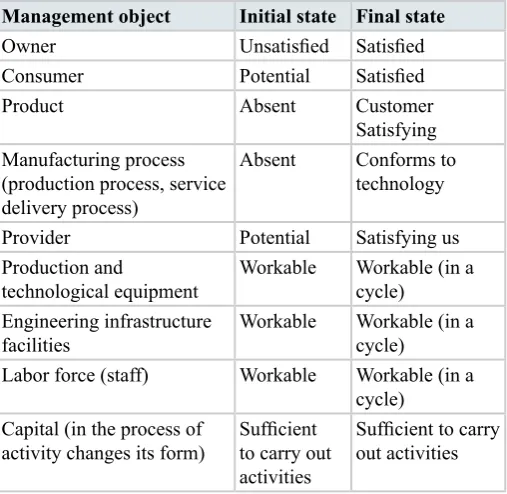
Table 1 : Beginning and ending status of managing objects Management object Initial state Final state Owner Unsatisfied Satisfied
Consumer Potential Satisfied Product Absent Customer
Satisfying Manufacturing process
(production process, service
delivery process)
Absent Conforms to technology
Provider Potential Satisfying us
Production and
technological equipment Workable Workable (in a cycle)
Engineering infrastructure
facilities Workable Workable (in a cycle) Labor force (staff) Workable Workable (in a
cycle)
Capital (in the process of
activity changes its form) Sufficient to carry out activities
Sufficient to carry
out activities
The techniques make it possible to make the most critical and important work human independent - if the employee is changed or the manager is absent, the work will be performed the same way. Human resources management at this stage of development is one of the most important elements in the corporate governance system for the industry. The further development of business in the industry depends on the methods of motivation and correctly set goals. The control system, in turn, is also the object of control, but at a higher level. The organization should set goals, design
business processes and organizational structure on a regular basis,
transferring the management system from the “inefficient” state
to the “effective” state. A process approach is used as a tool for describing management activities.
Applied in management techniques and methods, such as a quality management system, budgeting, CRM and others, are ways of organizing business processes. Therefore, it is recommended to immediately incorporate the necessary techniques and techniques into the business process model.
In order to increase the investment attractiveness of the industry and the competitiveness of products manufactured by chemical enterprises, one of the main goals of managing the industry should be the correct construction of the organizational structure of management along the entire vertical of its management. Strengthening the role of innovation, technological change in socio-economic development reduces the impact of traditional management models - a centralized management system The process approach is an approach to the analysis and synthesis of the organization’s activities, based on the allocation of business processes that make up the activities. In accordance with the selected management objects, top-level business processes are
allocated (table 2).
Table 2 : Management objects and business processes of top level
№ Management object Buisness process 1. Organization
Management System Development of agreed business conditions 2. Owner Attraction and
maintenance of authorized capital 3. Consumer Promotion and sales
4. Product Development of new and improvement of existing
products (services)
5. Manufacturing process (production process,
service delivery process)
Production
6. Provider Reproduction of resources
7. Production and
technological equipment Reproduction of VET
8. Engineering
infrastructure facilities Reproduction of OITI
9. Labor force (staff) Reworking
10. Capital Financing
Within the framework of a centralized enterprise management system, decisions are made quickly, but spontaneously and without serious elaboration and coordination (which can have serious
negative consequences).
However, today, in the face of increased competition, increased demand for innovations, consolidation of business, the introduction of Western management standards, the centralized management model is gradually losing its position, due mainly to the limitations that it imposes on business development opportunities.
authoritarian leader, at a certain stage in business development was forced to decentralize management at his enterprise and abandon one-man management in favor of what is today called corporate culture.
For enterprises operating in a highly competitive environment, management failures, even temporary ones, can mean death. Therefore, the departure from the affairs of an entrepreneur using a centralized management model is likely to mean the end of his business (recall that we are talking about a relatively large or
technologically complex business).
As the studies of Geert Hofstede, a recognized expert in the field of the influence of cultures on economic development, show,
cultures of Western countries are more characterized by a small distance of power, that is, decentralized decision-making models are more common in business than in countries with a lower level of development. Of course, there are exceptions, but in such cases the high centralization of management is usually supplemented by a clear system of rules and a strict pyramid of power with a rigid distribution of functions and powers between levels of government.
The predisposition of the domestic managerial culture to a high degree of centralization of decisions means that along with attracting foreign direct investment from countries with a predominance of decentralized management models, it is planned to introduce corporate governance methods based on delegation of authority, coordination of decisions, etc., typical for corporate business in developed countries .
In order to avoid the risks of decentralization, it is very important to create a system of effective incentives that encourage good behavior, responsibility, independence, initiative, and innovation.
If possible, material compensation should be tied to the final
result, taking into account the degree of independence and responsibility of the employee, his contribution to the development of the business. Moral encouragement, employee knowledge of their career prospects and improvement of material well-being, depending on their contribution to the common cause, are very important.
Analyzing the experience of foreign experience of leading chemical manufacturers, it is important to note that the development of many companies was associated with the correctness of the chosen methods of systemic and process approaches to the management of the industry and, in general, from the corporate management strategy.
Normative acts and the Corporate Governance Code provide for
the annual approval of a long-term and medium-term development strategy of a company. In reality, not all enterprises have precise
definitions for future development results, goals, development
of mechanisms and ways to achieve them for the next 5 years. Therefore, when developing plans and preparing management decisions, tasks constantly arise related to assessing development prospects.
Basically, at the enterprises of the industry, in the process of creating forecasts, intuitive offers and non-alternative technical and economic calculations prevail, at best for a limited number of indicators. At the same time, the data obtained at the enterprises are unsystematic, spontaneous and voluntaristic in nature. The
main reason for the insufficient use of multivariate scientifically
based calculations at enterprises is the poor development of a number of theoretical and methodological issues of applying system management methods at the level of each enterprise in conjunction with the industry development strategy.
At the present stage of development, one of the main tasks is to further improve the principles and organizational and methodological aspects of the functioning of management systems at chemical enterprises, which largely determine the nature and results of reforms in the industry, especially those related to the introduction of market forms of management. Of particular importance are theoretical and applied research aimed at developing and improving conceptual approaches and mechanisms for the functioning of systems and methods of adaptive management that are adequately developed in the country of socio-economic,
scientific, technological and legal conditions.
In symbiosis, it is proposed to develop in the industry a methodology for the effective management of the supply goals of the consumed chemical products based on the concept of “shared savings” or “shared savings” for all business entities in the supply chain. It is proposed to determine the main tasks of supply chain management of chemical products:
1. The choice of the “best” type of chemical products. 2. Organization of procurement of chemical products. 3. Cargo processing and storage of chemical products. 4. Use of products for their intended purpose in the production
of the final finished product.
5. Ensuring the safety of the use of products.
6. Development of marketing research with the study of demand for products for at least the next 5 years within the country and beyond, the conditions of supply and demand, the development of new types of products oriented to the consumer in combination with services for consumers.
Conclusions
The essence of the proposed corporate strategy for managing the supply chain of manufactured chemical products based on “shared savings” is as follows: suppliers of products are provided
with direct share financial participation in profits from improving the efficiency of use of products at the enterprise-consumer
products.
The corporate strategy proposes a radical review of organizational management structures, moving away from typical production-oriented ones, replacing them with management structures production-oriented to attracting additional income in connection with the creation of structural units oriented to consumer demand, i.e. It is proposed to create such structural divisions as “new lines of business”, “logistics and trading”, “strategy and business development”, as well as expand the marketing and sales division and make it one of the main divisions in the structure.
Such a corporate strategy not only provides key benefits when
managing a consumer enterprise, but also reduces operating costs and increases productivity.
The state of the chemical industry reflects the level of scientific
and technological progress, and its development will serve as a locomotive for the creation of new industrialization. Each new
job in the chemical industry creates five additional jobs in related
industries.
The achievements of chemistry determine the competitiveness of industries such as engineering, automotive, aircraft, energy, agriculture, light industry and others.
References
[1]. Abalkin L.I. Campaign or strategy? // IVF. 2004. No. 6. Glazyev S.Yu. The theory of long-term technical and [2].
Voronin Yu.M. The state and conditions of effective [3].
reproduction of the country’s scientific potential // Problems
of forecasting. 2003. No. 4.
Hamburg D.Yu. Ammonia synthesis: history and modernity [4].
// Chemical industry. 1992. No. 4-7, 9-10.
Garabajiu A.A. Mathematical modeling of processes of [5].
grinding and classification of bulk materials in a rotary
centrifugal mill // Chemical Industry. 2003. No. 6.
Glinsky B.A., Baksansky O.E. Methodology of science: [6].
cognitive analysis. M .: “Altex”, 2001. - 188s.
[7]. Dubenetsky Y.N. Active industrial policy: urgent need //
Problems of forecasting. 2003. No. 1.52. Eurochem. 2004.
No4.
[8]. Zhukov D.Yu., Goncharova S.V., Menshutina N.V. Corporate database for workers in the chemical industry // Chemical Industry Today. 2004. No. 11.
[9]. Zalevsky A.A. Economics of the chemical industry: Textbook. Manual for universities. M .: Chemistry, 1986. - 192s.
[10]. Ivanov V.I. Status and development prospects of the Russian chemical and petrochemical industry ”// Bulletin of the Russian Chemical Society named after DI. Mendeleev. 2005. - No. 6.
[11]. Ivanov S.P., Storozhenko V.N., Shulaev N.S. Mesh shell made
of polymeric materials and some aspects of its practical application // Chemical Industry. 2003. No. 6.
Innovation Management: Textbook / Ed. prof. V.A. [12].
Shwandara, prof. V.Ya. Gorfinkel. M .: High school textbook,