Volume 2, Issue 8, August 2013
Page 208
ABSTRACT
In direct injection (DI) diesel engines fuel spray injection orientation plays very important role in fuel air mixing and it is highly an influence on engine performance as well as exhaust gas emissions. A single cylinder four stroke DI diesel engine with having multi-hole nozzle injector is considered for the analysis and a computational fluid dynamics (CFD) code, STAR-CD is used for the simulation. In the present study, various injection orientations are considered for the analysis. In-cylinder fuel spray is discussed through the 3D temperature contour plots at orientations of 950, 1000, 1050 and 1100 are considered for the analysis. It is concluded that the peak mass average temperatures are higher as well as that attained well in time in case of 1000 orientation it indicates effective combustion in this case.
Key words: Diesel engine, spray, injection orientations, temperature, STAR-CD.
1. INTRODUCTION
In DI diesel engines the fuel is injected into the cylinder against the high pressure and temperature compressed air. In this process of combustion is heterogeneous, unsteady, and 3-Dimensional. Combustion is a chemical reaction where certain elements of hydrogen and carbon molecules are combining with oxygen and liberates heat energy.
Liquid fuel is injected through the nozzle by the fuel injection system into the cylinder through the end of compression stroke. The liquid jet leaving the nozzle becomes turbulent and spreads out as it entrains and mixes with the in-cylinder air. The outer surface of the fuel jet breaks up into droplets [1]. The initial mass of fuel evaporates first thereby generating a fuel vapour-air mixture sheet around the liquid containing core. Larger droplets provide a higher penetration but smaller droplets are requisite for quicker mixing and evaporation of the fuel. The sprayed fuel stream encounters the resistance from the dense in-cylinder fluids and breaks into a spray. This distance is called the Breakup Distance. Further they vaporize and mix with compressed high temperature and high pressure in-cylinder fluids. At this stage the in-cylinder fluids have above the self-ignition temperature of the fuel. It causes the fuel to ignite spontaneously and initiate the combustion at various locations, where desired condition is prevailed [3].
The spray impinging on the wall of the cylinder becomes an unavoidable. Because of compact high speed DI diesel engines. In fact due to the short distance between injector nozzle and the cylinder walls and also high injector pressures, fuel spray may impinge on the cylinder walls before vaporization takes place. Accordingly spray wall interaction becomes an important phenomenon in high speed DI diesel engines [4]. The spray impingement has a great influence on the distribution of fuel jet, evaporation and subsequent combustion processes. Accordingly injector orientation angle is highly influencing on the spray impingement and subsequent phenomena [5].
2. Combustion
Chen et al. was applied a commercial computational fluid dynamic package STAR-CD to real engine gas flow. The Volkswagen (VW) two-valve transparent 1.91 DI diesel engine was used to simulate flow field in the inlet port and combustion chamber under engine speeds of 1000 rpm and 2000 rpm. The CFD predictions were verified by Laser-Doppler anemometer measurements under motored condition during three periods that are valve opening, valve closure and the maximum valve lift. The transient flow for the induction stroke in the VW engine has been simulated
EFFECT OF INJECTION ORIENTATION
ON MASS-AVERAGED TEMPERATURE IN
A DI DIESEL ENGINE: THROUGH CFD
SIMULATION
Dr.P.MANOJ KUMAR1 Prof .V.PANDURANGADU 2 Dr.S.L.V.PRASAD 3
Dr.M.SRINIVASA REDDY 4
1Department of Mechanical Engineering, Professor & HOD Gurunank institutions technical campus school of Engineering & Technology, Ibrahimpatnam, hyderabad , A.P India
2Department of Mechanical Engineering, Professor, JNT University, Anantapur, A.P., India
3Department of Mechanical Engineering, Professor, Shridi Sai institute of science & engineering, Anantapur, A.P., India
Volume 2, Issue 8, August 2013
Page 209
successfully using STAR-CD version 2.21. Comparisons between predicted and measured results have shown reasonable agreement for mean flow features. At the valve exit, differences in velocity magnitude at the locations close to the cylinder head may be attributed to drawbacks of the k-ε model and measurement uncertainties. The fluctuating velocities
were under predicted, especially at the recirculation regions. This study is the first step of the VW engine simulation. The results show that the large scale flow structure is dominant, and is highly dependent on the port geometry, bowl-in-piston geometry and their locations relative to the cylinder. The turbulent kinetic energy was created principally at the edges of the inlet jet and the cylinder wall jet flow during the early induction stroke. During second phase of the induction stroke, the flow varies linearly with engine speed. This observation justifies the assumption made for validating the CFD results at 2000 rpm for which directly measured experimental data were not available. The successful simulations of the intake flow encourage further numerical analysis of the processes of compression, spray and combustion. It provides considerable potential for detailed information required by designers to evaluate strategies for optimizing engine performance [6]. Trigui et al. had conducted three-dimensional numerical studies during compression process. For this purpose they have used STAR-CD, a commercial CFD code. First, they have calculated both intake and compression process from IVO to TDC. As a second step, they have used three-dimensional Particle Tracking Velocimetry (PTV) data at IVC as initial conditions and performed 3-D computations during compression up to TDC. Then they compared the velocity field computed from both the cases. Their study indicated that this approach is feasible, and that with adequate vector field yield from 3-D PTV, the overall error could be commensurate with any technique (such as LDV or CFD alone) that could be used for the same purpose, but at much lower cost and time [7]. The investigations were performed in a 6-cylinder SI-engine running at wide open throttle by Holger Peters, Ralph Worret and Ulrich Spicher The numerical calculations were performed using the finite volume CFD code STAR-CD. The mesh generation process, including the description of the piston and the valve motion, was automated using Expert System Internal Combustion Engine (ES-ICE). Combustion in the present study was treated with the one-equation Weller flamelet model. This model was implemented in STAR-CD. For the verification of the combustion model, calculated cylinder pressure data and mass fractions burned are compared to experimental results. The results of the combustion process are discussed for different engine speeds and equivalence ratios are shown, encouraging results for the above combustion model. The comparison of the calculated and measured in-cylinder pressure indicates good agreement for equivalence ratios between 0.87 and 1.25 and engine speeds up to 3000 rev/min. The shape of the predicted flame appears to be reasonable [8]. Chen et al. had studied on engine flow using commercial CFD package STAR-CD. The Volkswagen (VW) two-valve transparent DI diesel engine was used to simulate flow field in the inlet port and combustion chamber under engine speeds of 1000 rpm and 2000 rpm. The CFD predictions were verified by Laser-Doppler Anemometer measurements under motored condition during three periods: valve opening, valve closure and the maximum valve lift. In presentation they discussed the predicted flow structure and its main features under different engine speeds, and examined the validity and accuracy of the CFD predictions in comparison with measured data [9]. Bianchi et al. had investigated influence of different initial condition definition procedures on combustion and emissions predictions in small-bore high-speed DI diesel engines. Using the STAR-CD code for the intake stroke and KIVA-2 for the compression stroke, combustion simulation is performed as analysis. The study considered a detailed assignment of the initial conditions at when Inlet valve is closed (IVC). In the second case the results of a time-resolved calculation of the intake stroke performed using the STAR-CD code. An algorithm was developed in order to properly map the data from STAR-CD into KIVA-2[10]. Marc Zellat et al. were described the recent development of the general multi-purpose code STAR-CD in the field of Internal Combustion Modeling with a special emphasis on DI diesel and Gasoline Direct Engine (GDI) engines operating with very high level of Exhaust Gases Recirculation (EGR) (Higher than 30%). A new combustion model is enhanced in STAR-CD. The Extended Coherent Flame Model-3Z (ECFM-3Z) is described first. This model enable to compute combustion for operating conditions with large Exhaust Gases Recirculation (EGR) amount in the GDI and DI diesel engines has been completed. Predictions are compared with extensive data from a DI diesel engine in production over a wide range of operating conditions. The results show that the combustion model used in combination with a two steps auto-ignition model gives realistic heat release history as well as emission prediction [11]. k-ε model is one of the popular in the turbulence models used in IC engines. The k-ε model assumes a Newtonian relationship between the turbulent stress and mean strain rates. Here ‘k’ is the turbulent kinetic energy and ε is the
dissipation rate. Morel and Monsour [12] in their model accounted for changes in ε, which is produced by dilation for a
flow with compression and expansion. Tahryl computed the turbulent viscosity appearing in the relationship between
Volume 2, Issue 8, August 2013
Page 210
dependent on local in-cylinder conditions and, therefore, on the numerical methodology adopted to determine the initial conditions [14].
3. Results and Discussion
3.1 Engine Geometry and Specifications
In this section the three dimensional plots of spray distribution in a DI diesel engine cylinder for three injector orientation angles at selected Crank angles are presented[15]. The fuel injection parameters are listed in table -2 are considered for the analysis. It is assumed to begin the fuel injection at 10˚ before TDC and end at 3˚ after TDC in the duration of fuel
injection is 7˚ CA and the mass flow rate of fuel is considered as 0.0177 kg/sec [16]. A fuel injector with eight nozzles
spaced uniformly is considered for the analysis.
In the present work, 450sector is taken for the analysis due to the symmetry of eight-hole injector. The computational
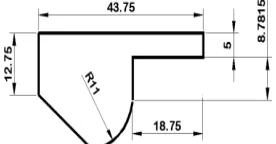
mesh when the piston is at Top Dead Center (TDC) is shown in fig: 1. the computational domain comprises of the combustion chamber with piston crown. The number of cells in the computational domain at TDC is 10608. Piston bowl dimensions are given in fig: 2. Engine details are given in table 1 and fuel and injection details are given in table 2.
Figure: 1 Computational Sector mesh used in the engine simulation at TDC
Fig: 2 Geometric dimensions of Piston Bowl
Table 1: Engine Specifications
Volume 2, Issue 8, August 2013
Page 211
3.2 Initial and Boundary ConditionsIt is important to study the in-cylinder fluid dynamics during the later part of combustion and initial part of expansion strokes in DI diesel engines. Analysis is carried out from 400 before TDC (bTDC) to 800 after TDC (aTDC), as fuel
injection combustion and pollutant formations are taken place during this period.
The initial swirl is taken as 2m/s and the constant absolute pressure and temperatures as 9.87 bar, 583 K respectively. The turbulent model has the Intensity length scale as 0.1 and 0.001 respectively and it is assumed that there is no traces of fuel and exhaust gases. The initial surface temperatures of combustion dome region and piston crown regions are taken as 450 K and the cylinder wall region has temperature of 400 K.
3.3 Effect of Injection Orientation on Mass-Averaged Temperatures Variation with Crank Angle
The effect of injection orientation angle on mass average temperature prevailing in the combustion chamber with respect to crank angle is shown in figure 4. The figures are drawn with the data generated from the computational fluid dynamics (CFD) simulation of combustion process. Figure 4, shows the variation of in-cylinder temperature at different crank angles for four injection orientation angles varies from 950-1100. It is observed that the mass-averaged
temperatures are gradually rise from 580 K to 846 K till start of injection and follows the same path in all the three cases from 400 before TDC to 100 before TDC. This is attributed to cylinder fluid temperature rise due to compression of
in-cylinder fluids during compression stroke. There is a slight drop in mass-average temperatures, noticed from 100 before
TDC, during a short span, this is due to endothermic reaction taking place during evaporation of fuel, as the fuel injection starts from 100 before TDC to 30 before TDC. A sharp rise in mass-average temperature profiles was noticed,
this indicates combustion has taken place.
In case of 1000 injection orientation angle the peak mass average temperatures are attained little earlier than the other two
cases. The average mass temperature of 1890 K was noticed at 90 after TDC. In case of 950 injection orientation angle it
is observed that a little delay to attain the peak mass average temperature of 1928 K at 140 after TDC. In case of 1050 and
1100 injection orientation angle mass average temperature of 1759 1758 K was observed at 80 after TDC. It is very clear
from the figure 4, that the mass average peak temperatures are attained well in time for the case of 1000 orientation i.e.,
30 crank angle earlier than that of other two cases and its peak mass average temperatures are also higher than that of
other two. From the figure it was inferred that at 1000 injection orientation angle good combustion taken place at right
time.
Figure: 3: Comparison of injection orientation of Mass-Averaged Temperature vs. Crank Angle Profiles for the four spray orientation
From the above analysis it can be concluded that in case of 1000 injection orientation angle there is an early start of
combustion and early reach of peak mass average temperatures and sustain a good mass average temperatures throughout the combustion process.
From the graph it is noticed that in case of 950 injection orientation angle there is a higher temperature in the exhaust
stages. It indicates that there is delay in combustion phase. Due to more wetting area, the fuel that is impinged on the walls will be adhere on it during initial part of combustion, the same is participated in the late combustion stage. This contributes to higher temperatures in the late combustion phase. In case of 1000 injection orientation angle the late
combustion is observed to be optimum. At 800 after TDC higher mass- average temperatures of 1900 K, 1905 K 1750and
1750 K are noticed for the cases of 950, 1000 1050 and 1100 injection orientations respectively. From the graph it was
observed that 800 after TDC there is no drastic change in mass average temperatures of exhaust gases in all the three
cases.
3.4 Effect of Injection Orientation on In-Cylinder Temperature distributions
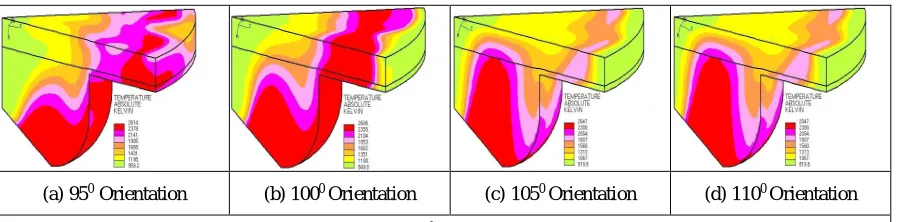
The effect of injection orientation angle on in-cylinder temperature distribution for the four different fuel injection orientation angles viz 950, 1000 1050 and 1100 are shown in figure
Volume 2, Issue 8, August 2013
Page 212
(a) 950 Orientation (b) 1000 Orientation (c) 1050 Orientation (d)1100Orientation
Fig: 4 Temperature Contour Plots at 20 after TDC at Various Injection Orientation
From the figure 4, it is observed that at 20 after TDC initiation of combustion taking place at selected pockets, where the
fuel air mixture is near to stoichiometric or slightly higher. The first ignition is due to the temperature rise associated with the strong pressure wave which emanates from each ignition site due to local rapid chemical energy release. At this stage near lip of the bowl as well as at the bottom sides of the bowl regions initiation of combustion starts in all the three cases; however the high temperature zones are small in the combustion chamber. The minimum temperatures are noticed in the squish region in all the three cases. This is due to higher surface heat transfer in this region.
At 40 after TDC from the figure 5(a-d), it is observed that the spreading of high temperature flame takes place in all the
three cases, this indicates, that the combustion of fuel has been taken place at multiple locations. This is due to spontaneous ignition at regions, which are very close to the region where the first ignition occurs. In case of 950 injection
orientation figure 5(a) along the side walls of the bowl as well as squish region there is a strip of narrow band of high temperature flame propagation. In case of 1000 injection orientation as shown figure 5(b), it is observed that the flame
propagates vertically along with side walls of the bowl and horizontally along the piston head toward the axis of the bowl. In case of 1050 and 1100 injection orientation as shown in figure 5(c-d), it is observed that there is a
delay in flame spreading.
This is attributed to that the spray orientation. As the spray orientation angle is more the fuel spray travelled distance is more. In case of 950 and 1000 injection orientation the spray direction towards the strong vortex which is situated at the
lip of the bowl, whereas in the case of 1050 and 1100 injection orientation the spray is directed away from the strong
turbulent zone, hence the delay in combustion occurs. At 60 after TDC shown in figure 6(a-d), combustion related high
temperature zones of temperatures 2757 K, 2798 K, 2711 K and 2711 K, are noticed for the four fuel injection orientation angles viz 950,1000 1050 and 1100 cases. This is attributed that the high heat release rates due to rapid combustion during
this period. At this stage peak mass average temperature are noticed and are represented in figure 6. At this stage flame front which is at the cylinder head appears to propagating towards the squish region i.e. positive x-direction, another wave flame front moving negative x-direction at the bottom of the bowl is noticed.
(a) 950 Orientation (b) 1000 Orientation (c) 1050 Orientation (d) 1100 Orienation
Fig: 5 Temperature Contour Plots at 40 after TDC at Various Injection Orientation
(a) 950 Orientation (b) 1000 Orientation (c) 1050 Orientation (d) 1100 Orientation
Volume 2, Issue 8, August 2013
Page 213
At 200 after TDC shown in figure 7(a-d), in case of 950 injection orientation shown in figure 7(a), the flame front fully
occupies the squish region, in case of 1000 and 1100 injection orientation it is noticed that the flame propagation
progresses in squish region. Another flame front which is situated at the bottom side of the bowl is noticed which is rolling upwards and moving towards the squish region. This is attributed to the expansion stroke, a space is created due to the piston moving away from the cylinder head. This resemble to its corresponding velocity vector plots which contain higher velocities. In the velocity vector plots and its corresponding temperature contour plots contains higher temperatures in the same region and propagation. At this stage cylinder occupying the higher temperatures of the order of 2757 K, 2798 K, 2711 and 2711 K respectively.
4. Conclusion
It is observed that the mass-averaged temperatures are gradually rise from 580 K to 846 K till start of injection and follows the same path in all the three cases from 400 before TDC to 100 before TDC. In case of 950 injection orientation
angle there is a delay to attain the peak mass average temperature, the attained temperature at 140 after TDC is 1928 K.
It is observed that the mass average peak temperatures are attained well in time in case of 1000 orientation i.e., 30 crank
angles earlier than that of other two cases and its peak mass average temperatures are also higher than that of other two cases. It indicates that in case of 1000 injection orientation there is good combustion taken place at right time. In case of
1050 and 1100 orientation, it attained maximum temperature of 1758 K at 80 after TDC. It is noticed that in case of 950
orientation there is a higher temperature in the exhaust stages. It indicates late combustion.
REFERENCES
[1] Reitz, R.D. and Bracco, F.V.: “On the dependence of Spray Angle and Other Spray Parameters on Nozzle Design and Operating Conditions”, SAE paper 790494, 1979.
[2] Naber, J.D., Reitz, R.D.: Modeling Engine Spray/Wall- Impingement; SAE Paper 880107, 1988
[3] T. Bo, D. Clerides, A. D. Gosman and P. Theodossopoulos “Prediction of the Flow and Spray Processes in an Automobile DI Diesel Engine” S.A.E. paper 970882.
[4] G.M. Bianchi and P. Pelloni “Modeling the Diesel Fuel Spray Breakup by Using a Hybrid Model” S.A.E. paper 1999-01-0226.
[5] A.D. Gosmen “State of the art of multi-dimensional modeling of engine reacting flows” oil and gas science technology, Vol.54 (1999).
[6] Trigui, N., Affects, H. and Kent, J. C., “Use of Experimentally Measured In-Cylinder Flow Field Data at IVC as Initial Conditions to CFD Simulations of Compression Stroke in C. I. Engines – A Feasible Study” S.A.E Technical Paper. 940280,1994.
[7] Trigui, N., Affects, H. and Kent, J. C., “Use of Experimentally Measured In-Cylinder Flow Field Data at IVC as Initial Conditions to CFD Simulations of Compression Stroke in C. I. Engines – A Feasible Study” S.A.E Technical Paper. 940280, 1994.
[8] Holger Peters, Ralph Worret, Ulrich Spicher “Numerical Analyses of the Combustion Process in a Spark-Ignition Engine.” The Fifth International Symposium on Diagnostics and Modeling of Combustion in Internal Combustion Engines (COMODIA 2001), July 1-4, 2001, Nagoya.
[9] Chen A., Wallace S. and Veshagh A., “Intake Flow Predictions of a Transparent DI Diesel Engine” S.A.E. Technical Paper 981020.
[10]Bianchi G.M., Richards K. and Reitz R.D., “Effects of Initial Conditions in Multidimensional Combustion Simulations of HSDI Diesel Engines” S.A.E. Technical Paper 1999-01-1180.
(a) 950 Orientation (b) 1000 Orientation (c) 1050 Orientation (d) 1100 Orientation
Volume 2, Issue 8, August 2013
Page 214
[11]Marc Zellat, Driss Abouri, Thierry Conte and Bharat RAghunathan, “Advanced modeling of GDI and DI DieselEngines: Investigations on Combustion and High EGR level” 15th International Multidimensional Engine User’s Meeting at the S.A.E Congress 2005, April, 10, 2005 Detroit, MI.
[12]Morel, T. and Mansour, N., “Modelling of Turbulence in Internal Combustion Engine” S.A.E Technical Paper 820040 1982.
[13]El Tahry, S. H., “k-ε Equation for Compressible Reciprocating Engine Flows”, JL Energy. Vol 7, No. 4, pp. 345 -352, 1983.
[14]Bianchi G. M., K. Richards and R.D. Reitz, “Effects of Initial Conditions in Multidimensional Combustion Simulations of HSDI Diesel Engines”, 1999-01-1180.
[15]Paul Rodatz, German Weisser, and Franz X. Tanner “Assessment of CFD Methods for Large Diesel Engines Equipped with Common Rail Injection System” S.A.E. paper 2000-01-0948.
[16]Kuleshov A.S., “Model for Predicting Air-Fuel Mixing, Combustion and Emissions in DI Diesel Engines over whole Operating Rang” S.A.E. paper 2005-01-2119.
AUTHOR
Dr.P.Manoj Kumar has 13 of teaching experience. Previously worked in St John’s College of engineering college for 7 years as Associate Professor and HOD, Stananley Stephen college engineering & Technology as a Professor and HOD of mechanical engineering department for 5 years. Presently working in Guru Nanak Institutions Technical campus, Ibrahimpatnam (R.R.Dist) as a Professor and HOD in the department of Mechanical Engineering. He has completed research in the area of IC engines under JNT University, Anatapur, Andhra Pradesh, India. He has published 1 national, 7 international papers.