ANALYSIS OF EXCHANGE RATE OF
THE BALANCE OF PAYMENT
APPROACH USING AUTOREGRESSIVE
METHOD
Tony Seno Aji1, Hendry Cahyono1, Ach. Yasin1
1 Department of Economics, Faculty of Economic, Universitas Negeri Surabaya
Abstract
Fluctuations in currency exchange rates will affect the economy, including international trade activities, inflation, capital flows, and interest rates. Seeing the magnitude of the impact of fluctuations in the exchange rate of the economy, it is very important to examine the factors that affect the exchange rate. The factors that influence the exchange rate according to the balance of payment approach include inflation, interest rates and output. The data analysis technique used is the autoregressive method. The results of this study are: (1) inflation affects the rupiah exchange rate against the dollar. The higher the inflation, the higher the rupiah exchange rate, which means that the rupiah exchange rate weakens. The effect of Inflation on the exchange rate in this study is in accordance with the theory of Purchasing Power Parity; (2) the policy interest rate does not affect the rupiah exchange rate against the dollar during the observation period. The movement of the exchange rate is very dynamic and is influenced by various factors. In addition to the big players and financial institutions, the influence of fundamental factors and external factors also plays a role in moving the market; (3) output growth does not affect the rupiah exchange rate against the dollar. The insignificance of the effect of output growth on the exchange rate may be another variable that is very dominant affecting the exchange rate or it can also be because there is a lag between output growth and the rupiah exchange rate. The dominant variable affecting the exchange rate is the inflation rate and the historical data exchange rate (t-1). Historical data from exchange rates can form expectations of society and ultimately in real terms affect the exchange rate.
Key words: Autoregressive, Balance of Payment Approach, Exchange Rate, Inflation.
INTRODUCTION
challenge for each country to increase its competitiveness so that it is not crushed by other countries. The flow of goods and capital flows can directly or indirectly have an impact on changes in currency exchange rates.
After the 1997 monetary crisis, Indonesia adopted a floating exchange rate system, which caused the exchange rate to move more flexible. The exchange rate will adjust to market mechanisms that cause exchange rates to fluctuate. This change in the exchange rate system occurs because the monetary authority considers that the dynamics of external developments run so fast along with the openness of the national economy to foreign market penetration so that the movement of the rupiah exchange rate becomes difficult to control permanently.
Lately, we have seen the rupiah exchange rate against the US dollar is very volatile with a declining value trend. At the end of 2012, the exchange rate of the rupiah against the US dollar was still below 10,000 per dollar, but in October 2013 it was above 11,000 per dollar and in December 2014 the rupiah reached 12,700. On March 9, 2015, the exchange rate of the rupiah reached 13,047. Even in the second quarter of 2018, the exchange rate of the rupiah reached Rp 13,800.
The decline in the exchange rate of the rupiah reflects the decline in public demand for the rupiah because of the declining role of the national economy or because of the increasing demand for foreign currency as an international means of payment. In general, the cause of the decline in the exchange rate can be caused by the internal side and or from the external side. The ups and downs of currency exchange rates on the market (appreciation or depreciation) show the amount of volatility that occurs in a country's currency. If volatility is getting bigger, then it shows an increasingly large exchange rate movement and vice versa. If the exchange rate experiences extreme movements, the economy will experience instability.
Seeing the magnitude of the impact of fluctuations in the exchange rate on the economy, it is very important to examine the factors that affect the exchange rate. The factors that influence the exchange rate according to the balance of payment approach include interest rates, inflation and output. The relationship of these variables can be explained by the theory of purchasing power parity and interest power parity. Based on the background above, the problems in this study are:
1) Is there an influence between inflation and exchange rate?
The balance of payments approach states that the value of currency exchange is determined by the flow of supply and demand in the foreign exchange market. Foreign exchange requests come from individuals or institutions that make payments to foreign parties in foreign currencies. Transactions can be in the form of imports of goods and services or the purchase of foreign securities.
While the dollar offer comes from foreign exchange receipts derived from the export of goods and services and securities to foreign parties. The USD supply curve has a positive scope, the meaning is that the higher USD exchange rate makes our exports relatively cheaper for foreign buyers because each unit of domestic currency costs becomes lower in USD. As a result, the higher USD exchange rate drives demand for export volume, and ultimately increases the supply of USD (Kuncoro, 2016).
Changes in domestic prices, income, tastes, others caused a shift in the USD demand curve. For example, domestic real income growth will increase import demand, thus shifting the demand curve to the right. The rupiah depreciates, creating a new exchange rate balance.
Changes in prices, real income, and tastes in other countries can result in a shift in the USD supply curve. For example, the increase in prices of goods in the US will increase the purchase of goods from outside the US, so that our exports increase and the supply of the USD increases. This will shift the supply curve to the right, and the rupiah appreciates.
Factors that cause the exchange rate to fluctuate can be seen from the BOP which is the sum of the current account (Ca) and capital account balance (K):
BOP = C(Pt/StP*t, Yt/ Y*t, Zt) + K(rt-r*t)
The current-account balance is influenced by relative prices (Pt/StP*t), relative real income
(Yt / Y*t), and other variable variables that can shift curves (Zt) such as import duties and
export subsidies. The balance of the capital account is determined by the difference in interest rates (rt-r*t).
This approach also predicts Ø is positive. The growth of real output will tend to increase imports, thus causing a depreciation of the domestic currency. The coefficient λ is negative, meaning that the increase in domestic interest rates, without being followed by changes in foreign interest rates, will attract the entry of foreign funds which causes an appreciation of the domestic currency.
Many empirical studies examine factors that influence currency exchange rates. Among them, Aji, et al., (2016) found that the M2, output growth, interest rate, capital flow, and dollar inventory affect the exchange rate.
Triyono (2008) analyzes an exchange rate using an error correction model (ECM) with an independent variable of inflation, the money supply, the SBI interest rate, and imports. The results of the analysis with the t-test are known that the short-term regression variable inflation, SBI, and import are not significant to the exchange rate, while the JUB variable affects the exchange rate. In the long-term regression variable inflation, JUB, SBI, and imports have an effect on the exchange rate at α = 5%.
Wibowo and Amir (2005) analyzed the rupiah exchange rate. It was found that the difference in income, interest rate inflation and exchange rate lag 1 influenced the amount of the rupiah exchange rate against the dollar. Atmadja (2002) found that only the variable money supply had an influence on the movement of the rupiah exchange. The independent variables in the research are inflation rates, interest rates, money supply, national income and balance of payments positions.
Meisuri, P.E.A. (2013) examined the factors that influence the exchange rate of the rupiah. The results of the t-test indicate that inflation has no significant effect on changes in the exchange rate of the rupiah, real interest rates have a significant influence on changes in the exchange rate of the rupiah, and the price of the world crude oil has a significant influence on changes in the exchange rate of the rupiah. The results of the F-test show that inflation, real interest rates, and world crude oil prices have a significant influence on changes in the exchange rate of the rupiah simultaneously in the period 2005-2011.
price ratio between Vietnam and America is an important variable that determines the exchange rate. Agustin, G (2009) found that the variables of the price level ratio, the difference in interest rates, the money supply, foreign exchange reserves, exports and imports together have an influence on changes in the exchange rate. Whereas partially (t-test), the variable total value of exports does not have effect on the exchange rate.
RESEARCH METHODS
The approach in this study is a positivist approach that uses secondary data. This study tries to test the theory with the implementation of empirical data so that it can be classified as applied research. The data analysis used to see the Determinants of the Exchange Rate is the autoregressive model. The procedures performed are as follows:
1) Test the normality of data;
2) Test for linearity; and
3) Classic Assumption Test;
4) Autoregressive.
The variables in this study are three independent variables which will be tested for their effect on the exchange rate, namely inflation, interest rates, and output, each of these data uses quarterly data. The operational definitions of these variables are:
1. The exchange rate used is the US $ exchange rate against the Rupiah. US $ was chosen because US $ is the most stable hard currency and most recognized as the currency for international transactions by all countries.
2. Inflation in this study uses inflation differences between Indonesia and the United States
3. The interest rate is the difference in the BI rate, 7 days Repo, and the Fed Rate.
4. The output in this study is proxied using the difference in economic growth per quarter between Indonesia and the United States.
RESULTS
The normality test in this study uses the Jerque-Bera Test with α = 0.05, if probability <α, then the data is not normally distributed. If probability> α, then the data is normally distributed (Widarjono, 2016). The Jerque-Bera test results obtained a probability value of 0.287 because 0.05 <0.287 then the data is normally distributed.
Indicators of the model formed fulfilling linearity assumptions can be seen through the value of the Prob. F and compare it with a significance value (α). Prob Value F count 0.8466 greater than 0.05 so it can be concluded that the model has met the linearity assumption.
To detect the presence of autocorrelation in this study using the Breusch Godfrey Serial Correlation LM Test. The value of Prob Chi-Square (2) which is the value of the Breusch Godfrey value, which is equal to 0.39 were > 0.05 so that it accepts H0or which means there are no problems with serial autocorrelation.
Multicollinearity tests assess whether there is a correlation or intercorrelation between independent variables in the regression equation. Value of Centered VIF (Variance Inflation Factors) for all variables less than 10, it can be stated that there is no multicollinearity problem in this research model.
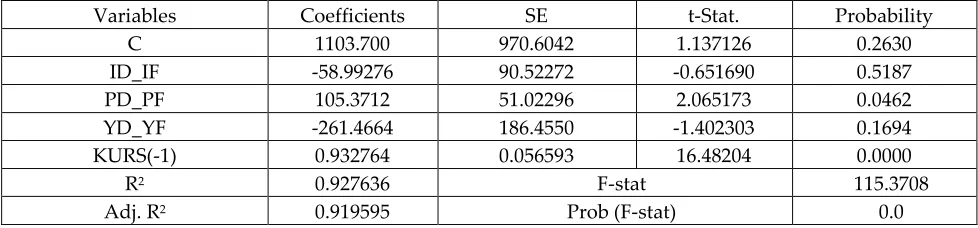
Probability value from F count and Chi-Square count from Breusch-Pagan-Godfrey test are greater than alpha level 0.05 so it can be concluded that there is no heteroscedasticity in the model. The results of this study are presented in Table 1.
TABLE 1. AUTOREGRESSIVE
Variables Coefficients SE t-Stat. Probability
C 1103.700 970.6042 1.137126 0.2630
ID_IF -58.99276 90.52272 -0.651690 0.5187
PD_PF 105.3712 51.02296 2.065173 0.0462
YD_YF -261.4664 186.4550 -1.402303 0.1694
KURS(-1) 0.932764 0.056593 16.48204 0.0000
R2 0.927636 F-stat 115.3708
Adj. R2 0.919595 Prob (F-stat) 0.0
From Table 1 it can be seen that the interest rate (ID_IF) is not significant, it is known from the probability value of 0.5187 (greater than 5 percent). The probability of inflation (PD_PF) is 0.46, meaning that it is significant, or inflation affects the rupiah exchange rate. The probability of output/economic growth (YD_YF) is 0.16, greater than 0.05, meaning not significant. While lag 1 (t-1) of the exchange rates (KURS (-1)) affects the rupiah exchange rate t.
DISCUSSION
The Effect of Inflation on Exchange Rates
that the rupiah exchange rate against the dollar weakens. The general increase in the price of goods can have an impact on international trade activities.
The effect of Inflation on the exchange rate in this study is in accordance with the theory of Purchasing Power Parity (PPP). A commodity should have the same price both in Indonesia and the United States when expressed in the same currency so that the purchasing power of both currencies (rupiah and US dollar) is at parity. If there is a price difference, arbitration will occur in which will adjust prices in both countries so that the price is finally the same. When the price of domestic goods increases (assuming the price of foreign goods remains), the demand for domestic goods falls, then the domestic currency tends to weaken. Conversely, if the price of foreign goods increases in such a way that the relative price of domestic goods falls, the demand for domestic goods increases then the domestic currency strengthen. In the long run the increase in the relative price of a country causes the domestic currency to depreciate, and conversely, the decline in the relative price causes its currency to appreciate (Mishkin, 2017).
The results of this study are supported by the findings of Aji, et al., (2016) who found a positive influence between inflation and currency exchange rates. Canales and Habermeier (2004) found that Consumer Price Inflation (CPI) has impact on the positive direction of currency exchange rates in various countries (cross section data). Hsing (2009) also states the positive influence between inflation and currency exchange rates in New Zealand. Parven et al., (2012) found that there was significant influence between inflation and currency exchange rates in Pakistan. Mirchandani (2013) found a moderate relationship with a positive direction between inflation and currency exchange rates. Bashir and Luqman (2014) conducted research with the results that the real exchange rate will depreciate with the increase in the price level.
The Effect of Interest Rate on Exchange Rate
The interest rate is the cost that must be paid by the borrower for the loan obtained or is a reward for the lender for the loaned funds. Based on the estimation results, it is found that the interest rate has no effect on the exchange rate. In theory, interest rates determine the added value of a country's currency. The higher the interest rate of a currency, the higher the demand for that currency. Under normal conditions, every investor expects a high return from the investment instrument chosen including the currency. The interest rate, in this case, can affect the exchange rate of a currency against other currencies.
interest rates, international trade and also expectations from economic actors. Policy factors and external conditions can also play a major role in exchange rate movements, including the Fed's policies and various trade policies of US and China.
The results of this research are in harmony with the research of Bato et al., (2017) who found that the interest rate has no effect on the exchange rate. Eslamlouyen et al., (2015) also found that the relationship the interest rate and the exchange rate was not significant.
The Effect of Output on Exchange Rate
Variable output in this study is proxied using output growth (economic growth). Economic growth is defined as an increase in the ability of an economy to produce goods and services. Economic growth refers to changes that are quantitative in nature, and the costs are measured using the gross domestic product (GDP). GDP is the total market value of the final goods and services produced in an economy over a period of time. The statistical estimation results show that the output variable does not affect the rupiah exchange rate. The movement of currency exchange rates is a consequence of the interactions that occur between economic actors in various countries in conducting transactions in their economic activities. This interaction will increase along with the increasing economic activities in various countries. The increased flow of goods, services and capital between countries can ultimately affect the movement of currency exchange rates.
The insignificance of the effect of output growth on the exchange rate may be another variable that is very dominant affecting the exchange rate or it can also be because there is a lag between output growth and the exchange rate. Viewed from the R square, the model formed is very high (91 percent), the dominant variable affecting the exchange rate is the inflation rate and historical data exchange rate (t-1). Historical data from exchange rates can form expectations of society and ultimately in real terms affect the exchange rate.
CONCLUSIONS
The conclusions of this research are:
1. Inflation affects the exchange rate. The higher the inflation, the higher the rupiah exchange rate, which means that the rupiah exchange rate weakens. The effect of Inflation on the exchange rate in this study is in accordance with the theory of PPP.
big players and financial institutions, the influence of fundamental factors and external factors also plays a role in moving the market. External factors greatly affect the exchange rate, especially global economic conditions, trade wars between America and China and policies from superpower countries. Indonesia as a developing country has not had much influence in coloring the global economy
3. The growth of output does not affect the exchange rate. The insignificance of the effect of output growth on the exchange rate may be another variable that is very dominant affecting the exchange rate or it can also be because there is a lag between output growth and the rupiah exchange rate. The dominant variable affecting the exchange rate is the inflation rate and historical data exchange rate (t-1). Historical data from exchange rates can form expectations of society and ultimately in real terms affect the exchange rate.
Suggestions from the results of this research are:
1. The government and Bank Indonesia must always be in synergy in maintaining inflation stability. Because inflation includes the dominant variable in influencing the rupiah exchange rate against the dollar
2. Historical data from the exchange rate also affects the exchange rate, meaning that the public's expectations of the exchange rate are formed by historical data. Bank Indonesia will issue a sound moral policy to control expectations from the public so that the rupiah exchange rate against the dollar can be stable.
REFERENCES
Agustin, G. (2009). Analisis Paritas Daya Beli Pada Kurs Rupiah terhadap Dolar Amerika Serikat Periode September 1997 – Desember 2007 dengan Menggunakan Metode Error Correction Model, Jurnal Ekonomi dan Studi Pembangunan, 1(1).
Aji, T. S., Ismail, M., Maski, G. & Santoso, D. B. (2016). Determinant of Exchange Rate with Hybrid Model: Empirical Evidence from Indonesia, Journal of Applied Economic Sciences, 6(44).
Atmadja, A. S. (2002). Analisis Pergerakan Nilai Tukar Rupiah Terhadap Dolar Amerika Setelah Diterapkannya Kebijakan Sistem Nilai Tukar Mengambang Bebas di Indonesia. Jurnal Akuntansi dan Keuangan, 4(1).
Bashir, F. & Adeel Luqman. (2014). Long run Determinants of Real Exchange Rate: An Econometric Analysis from Pakistan. Pakistan Journal of Commerce and Social Sciences, 8(2).
Canales-Kriljenko, J. & Karl Habermeier. (2004). Structural Factors Affecting Exchange Rate Volatility: A Cross-Section Study. IMF Working Paper, WP/04/147, August.
Eslamloueyan, K. & Amir Kia. (2015). Determinants of the Real Exchange Rate in Oil-Producing Countries of the Middle East and North Africa: A Panel Data Investigation Emerging Markets. Finance & Trade, 51.
Hsing, Y. (2009). Analysis of the Behavior of the New Zealand Dollar Exchange Rate:
Comparison of Four Major Models. Review of Applied Economics, 5(1-2),
Kuncoro, M. (2016). Manajemen Keuangan Internasional: Pengantar Ekonomi dan Bisnis Global, BPFE UGM, Yogyakarta.
Le, Thai-Ha. (2014). Exchange Rate determination in Vietnam. Economics Bulletin, 35(1).
Meisuri, PEA. (2013). Analisa Faktor-Faktor yang Mempengaruhi Nilai Tukar Mata Uang Rupiah Terhadap Dollar. Jurnal Manajemen dan Bisnis, 1(1).
Mirchandani, A. (2013). Analysis of Macroeconomic Determinants of Exchange Rate Volatility in India. International Journal of Economics and Financial Issues, 3(1).
Miskhin FS. 2017. Ekonomi, Uang, Perbankan, dan Pasar Keuangan, Pearson Education-Salemba Empat, Jakarta.
Parven, S., Abdul Qayyum Khan & Muhammad Ismail. (2012). Analysis of the Factors Affecting Exchange Rate Variability in Pakistan. Academic Research International, 2(3).
Pratiwi, T. E., dan Santosa HPB. (2012). Analisis Perilaku Kurs Rupiah (IDR) Terhadap Dollar Amerika (USD) Pada Sistem Kurs Mengambang Bebas di Indonesia Periode 1997.3 – 2011.4 (Aplikasi Pendekatan Keynesian Sticky Price Model), Diponegoro. Journal of Economics, I(1).
Triyono, (2008). Analisis Perubahan Kurs Rupiah terhadap Dolar Amerika. Jurnal Ekonomi Pembangunan, 9(2).
Wibowo, T., dan Amir, H. (2005). Faktor-faktor yang Mempengaruhi Nilai Tukar Rupiah. Jurnal Kajian Ekonomi dan Keuangan, 9(4).