The Thirty-Third AAAI Conference on Artificial Intelligence (AAAI-19)
Attention-Aware Sampling via Deep
Reinforcement Learning for Action Recognition
Wenkai Dong,
1,3Zhaoxiang Zhang,
1,2,3∗Tieniu Tan
1,2,3 1Center for Research on Intelligent Perception and Computing (CRIPAC),National Laboratory of Pattern Recognition (NLPR)
2Center for Excellence in Brain Science and Intelligence Technology (CEBSIT),
Institute of Automation, Chinese Academy of Sciences (CASIA)
3University of Chinese Academy of Sciences
[email protected], [email protected], [email protected]
Abstract
Deep learning based methods have achieved remarkable progress in action recognition. Existing works mainly focus on designing novel deep architectures to achieve video repre-sentations learning for action recognition. Most methods treat sampled frames equally and average all the frame-level pre-dictions at the testing stage. However, within a video, dis-criminative actions may occur sparsely in a few frames and most other frames are irrelevant to the ground truth and may even lead to a wrong prediction. As a result, we think that the strategy of selecting relevant frames would be a further important key to enhance the existing deep learning based action recognition. In this paper, we propose an attention-aware sampling method for action recognition, which aims to discard the irrelevant and misleading frames and preserve the most discriminative frames. We formulate the process of mining key frames from videos as a Markov decision pro-cess and train the attention agent through deep reinforcement learning without extra labels. The agent takes features and predictions from the baseline model as input and generates importance scores for all frames. Moreover, our approach is extensible, which can be applied to different existing deep learning based action recognition models. We achieve very competitive action recognition performance on two widely used action recognition datasets.
Introduction
Action recognition has drawn a large amount of atten-tion due to its potential in practical applicaatten-tions like video surveillance and behavior analysis. Since deep learning has achieved great success in the task of object recog-nition with competitive performance achieved on Ima-geNet (Krizhevsky, Sutskever, and Hinton 2012), recent works have focused on learning deep representations from a large number of labeled video data. These works can be mainly divided into the following categories: two-stream based methods (Simonyan and Zisserman 2014; Wang et al. 2016; Diba, Sharma, and Van Gool 2017; Feichtenhofer, Pinz, and Wildes 2017; Du et al. 2018), Recurrent Neural
∗
Corresponding Author ([email protected]).
Copyright c2019, Association for the Advancement of Artificial Intelligence (www.aaai.org). All rights reserved.
Agent
Conv + pooling
Features
FC-layer Frame-level predictions
Video-level prediction RGB or
Flow
1
2
T
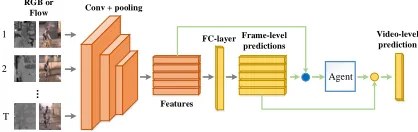
Figure 1: Flow-chart of our proposed method for action recognition. Each stream takes a sequence of frames or op-tical flow stacks as input. Then, a agent trained by deep reinforcement learning generates importance scores for all frames, which finds the attentions of the video for recogni-tion.
Networks based methods (Donahue et al. 2015), 3D Con-vNets based methods (Tran et al. 2015) and their combi-nations (Yue-Hei Ng et al. 2015; Carreira and Zisserman 2017). Among these works, two-stream based methods play the most important role because they can exploit informa-tion from video data efficiently. To test a video efficiently, these methods first sample frames sparsely and uniformly from the whole video. Then they perform recognition for each frame and average all the frame-level predictions to ob-tain the video-level prediction.
at-tention agent.
Our method owns the following advantages. The first ad-vantage is that it needs no extra labels. The agent is trained with a supervision reward guided by the classifier of the baseline action recognition model, which means only video-level labels are needed. Secondly, since our agent takes in-formation from a trained baseline model as input, the agent is independent from the training procedure of the baseline model, which means our method is compatible to most exist-ing two-stream based methods. Thirdly, our method is sim-ple and can boost the performance of the baseline model ef-fectively. The main contributions of this paper are summa-rized as follows:
• We discover a novel problem for action recognition, which is that irrelevant frames should be differentiated and discarded during the testing stage.
• To address this issue, we propose an attention-aware sam-pling method to select discriminative frames in videos, where the agent is trained by DRL.
• We conduct experiments on two widely used benchmark datasets to demonstrate the effectiveness of our method and achieve competitive results.
Related Work
Deep learning based Action Recognition. Since it achieved great success on ImageNet (Krizhevsky, Sutskever, and Hinton 2012), deep learning has been widely used in ac-tion recogniac-tion. These works can be mainly divided into the following categories: two-stream-based (Simonyan and Zis-serman 2014; Wang et al. 2016), LSTM-based (Donahue et al. 2015), 3D ConvNets-based (Tran et al. 2015), and their combination (Yue-Hei Ng et al. 2015; Carreira and Zisser-man 2017). Karparthy et al. (Karpathy et al. 2014) first eval-uated ConvNets on a large dataset, called Sports-1M. How-ever, the deep model achieved lower performance than hand-craft features (Wang and Schmid 2013) because it failed to capture the complicated temporal information, although they tried different fusion methods including early fusion, late fusion and slow fusion. To overcome this problem, Si-monyan et al. (SiSi-monyan and Zisserman 2014) designed the two-stream ConvNets composed of spatial and tempo-ral ConvNets. The spatial and tempotempo-ral networks take RGB frames and stacked optical flow as input, respectively. The fi-nal predictions are obtained by averaging the outputs of two streams. Due to the great success of two-Stream ConNets, many improved methods based on it have been proposed and achieved state-of-the-art performances. Feichtenhofer et al. (Feichtenhofer, Pinz, and Zisserman 2016) improved it by changing the position and method of fusion. Zhang et al. (Zhang et al. 2016) replaced optical flow with motion vector due to the high computational cost of optical flow. Feichtenhofer et al. (Feichtenhofer, Pinz, and Wildes 2016; 2017) applied Residual Networks in two-stream model and injected residual connections between two streams, aiming to achieve spatio-temporal interaction between two streams. Zhu et al. (Zhu et al. 2016) proposed a key volume mining deep framework to identify key volumes and conduct classi-fication simultaneously. Wang et al. (Wang et al. 2016)
mod-eled long-term temporal structure by proposing a temporal segment network using multiple clips sparsely sampled from the whole video. In (Diba, Sharma, and Van Gool 2017), Diba et al. proposed a temporal linear encoding layer to ag-gregated frame-level information into video-level represen-tation. Du et al. (Du et al. 2018) proposed an interaction-aware spatio-temporal pyramid attention layer inspired by PCA.
Most existing works focus on designing novel deep ar-chitectures to model long-term temporal structure and learn discriminative spatio-temporal features. However, they ig-nore the different importance of frames and treat every frame equally during the testing stage, which can hurt the final per-formance. Therefore, we propose an attention-aware sam-pling method to discard the irrelevant frames and preserve the key frames.
Deep reinforcement learning. Reinforcement learning has been originated from the understanding of humans’ decision making process, which aims to enable the agent to decide the behavior from its experiences. Unlike conventional su-pervised machine learning method, reinforcement learning is supervised through the reward signals of actions. Deep re-inforcement learning is a combination of deep learning and reinforcement learning, which has been applied in various tasks in recent years. For example, Mnih et al. (Mnih et al. 2013) combined reinforcement learning with CNN and achieved the human-level performance in the Atari game. Rao et al. (Rao, Lu, and Zhou 2017) applied DRL to face recognition and Zhou et al. (Zhou and Qiao 2017) to video summarization. More recently, it has been applied to track-ing (Dong et al. 2018), segmentation (Han et al. 2018) and person search (Chang et al. 2018).
However, little progress has been made in reinforcement learning for action recognition. The process of selecting key frames is a kind of hard attention mechanism in our method. Considering that there are no labels for the key frames and our hard attention model is non-differentiable, we formu-late the process of mining key frames as a Markov descision process and apply deep reinforcement learning to train the attention model.
Method
The pipeline of our framework is shown in Figure 1. Our attention-aware sampling framework is composed of two parts: a baseline action recognition model and an attention agent. The baseline model takes a sequence of frames as in-put and generates features and frame-level predictions for each frame, which are the inputs of the agent. The output of the agent is a sequence of probabilities. At inference stage, the probabilities are viewed as importance scores for each frame and are used to pick the most discriminative frames. We first introduce the baseline model as follows.
Baseline model
1
{ }
Tt t
V
v
Video
1
{ }
f T t ts
{ } 1r T t t
s
Baseline
1
{ }
T t ts
Agent
{ t| t {0,1}, 1,..., }
actions a a t T 0
p
1
p Feature
extractor Cla
ss
if
ie
r
{r| 1, 1,..., }
t t
s a t T
LSTM
LSTM
LSTM LSTM
LSTM
LSTM
1 a t
p
a t
p
1 a t
p
LSTM
1 0
sgn(
c c)
R
p
p
Reward
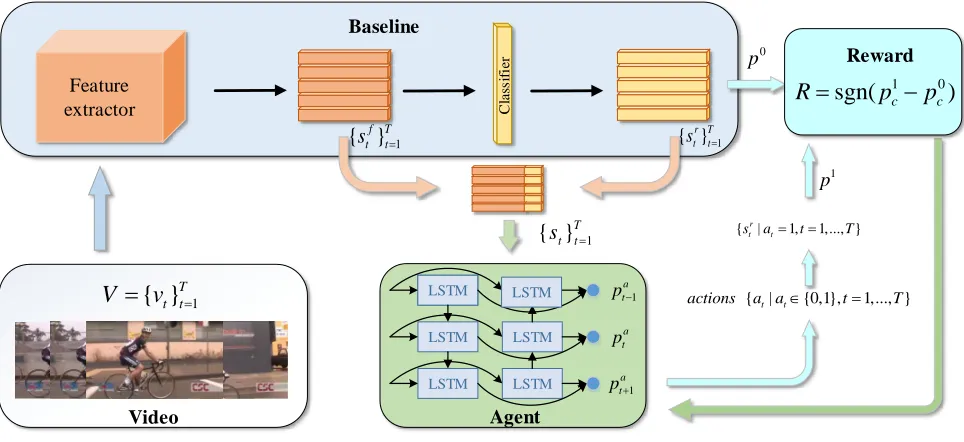
Figure 2: Process of training attention-aware sampling (AS) agent via deep reinforcement learning (spatial stream). The AS agent receives state{st}Tt=1and takesaction{at}Tt=1 to select part of the video. The feedback reward is computed based on
the difference between the original video-level predictionp0and the new predicitonp1.
information; the temporal stream takes stacks of optical flow images as input to exploit motion information. The final pre-diction is obtained by averaging the outputs of two streams. For convenience, we take one stream for an example to il-lustrate our method.
The classical action recognition framework is composed of a feature extractor F(·) and a classifier CL(·). Given a video V, first we sampleT frames{v1, v2, ..., vT} with equal temporal spacing between them. Then we obtain a se-quence of features{sft}T
t=1 and predictions{srt}Tt=1
calcu-lated byF(vt)andCL(sft), respectively. We train the base-line model with the standard categorical cross-entropy loss and the parameters of the baseline model are fixed when training the attention agent.
Attention-aware sampling
Discriminative actions may occur sparsely in a few frames. Hence, not all frames in a video are helpful to recognition. It is necessary to discard irrelevant frames to avoid the adverse effect from them.
Attention models have been widely used in various com-puter vision tasks. In our approach, we consider the process of seeking the most discriminative frames as the process of finding temporal attentions, which is formulated as a one-step Markov decision process (MDP). Figure 2 provides a sketch map of this process. The agent, interacting with an environment which provides rewards and updates its state, learns by maximizing the total expected reward to select the frames, finally resulting inm most discriminative frames.
The state, agent, action and reward of the MDP are elabo-rated below.
State.The statestcontains two components:(s f t, srt).s
f t is the feature of framevt extracted byF(vt)andsrt is the prediction calculated by the classifier CL(sft). These two components are essential and complementary because sft provides visual content for the agent whilesrt indicates how accurate the frame is.
Agent.The agent is a bidirectional long-short term mem-ory network (BiLSTM) topped with a fully connected (FC) layer. For a video with lengthT, the BiLSTM takes as input the state{st}Tt=1and produces corresponding hidden states
{ht}Tt=1. Eachhtis the concatenation of the forward hidden statehft and the backward hidden statehbt, which encapsu-late the future information and the past information with a strong emphasis on the parts surrounding thetthframe. The FC layer that ends with the sigmoid function predicts for each frame an action selection probabilitypa
t =σ(W ht).
Action. The action is the selection of each sampled frame. We define 2 types ofactionas ‘discarding’ and ‘re-maining’. As shown in Figure 2, the agent emits a vector pa∈RT×1for each video, wherepa
t ∈[0,1]represents the probability of choosingaction‘remaining’ for thetthframe. More specifically, the FC layer of the agent outputs a prob-abilitypa
t for each framevt, where a frame-selection action atis sampled:
at∼Bernoulli(pat), (1)
whereat∈ {0,1}indicates whether thetthframe is selected or not. The selected frames is defined as {sr
1,2, ..., T}.
Reward.The reward reflects how good theactiontaken by the agent is with regard to the states. We generate the reward with the pre-trained classifierCL(·). We first define ther0reward as follows:
r0=sgn(p1c−p
0
c), (2)
wherec is the ground truth label of the video andpc rep-resents the probability of predicting the video as classc.p0
represents the video-level prediction of all frames andp1is
decided by the hard attention model:
p0= PT
t=1s
r t
T , p
1=
PT t=1ats
r t PT
t=1at
. (3)
The reward r0 takes value in {−1,1}, reflecting the
dicted possibility variation of the ground truth if the pre-dicted action does not change after one iteration. Moreover, if it changes, a strong stimulation ofr= Ωis enforced when it turns from incorrect to correct, and a strong punishment of r=−Ωif the turning goes otherwise. We setΩas10in the paper. Thus, the final form of the rewardR can be written as:
R=
( Ω ,if stimulation
−Ω ,if punishment r0 ,otherwise
(4)
Training with Policy Gradient
The goal of our attention-aware sampling agent is to learn a policy functionπθ with parametersθby maximizing the expected reward
J(θ) =Epθ(a1:T)[R], (5)
where pθ(a1:T) denotes the probability distributions over possible action sequences, and R is computed by Eq. 4. As defined above, our actionsets consists of the different choices of selecting the frames. There are 2actionsfor each frame and the exponential size2T is computationally infea-sible for deep Q-learning. Thus, we employ the policy gra-dient method.
Following the REINFORCE algorithm proposed by Williams (Williams 1992), we can compute the derivative of the expected rewardJ(θ)w.r.t. the parametersθas
5θJ(θ) =Epθ(a1:T)[R
T X
t=1
5θlog πθ(at|ht)], (6)
whereat is theactiontaken by the agent for the framevt andhtis the hidden state from the BiLSTM.
Since Eq.6 involves the expectation over high-dimensional action sequences, which is hard to compute directly, we approximate the gradient by running the agent for N episodes on the same video and then taking the average gradient
5θJ(θ)≈
1 N
N X
n=1
T X
t=1
Rn5θlog πθ(at|ht), (7)
whereRnis the reward computed at thenthepisode.
Algorithm 1Attention-aware sampling agent training
Input: Frames{vt}from training set{V}
Output: Parametersθof the hard attention model
1: Initializeθwith random values
2: fori←1,2, ..., M do
3: Sample a sequence ofTframes{vt}Tt=1from
training set{V}
4: Compute features{sft}T
t=1and predictions{srt}Tt=1 5: Get a video-level predictionp0
6: Compute probabilities{pa t}Tt=1 7: forepisode←1,2, ..., Ndo 8: Sample{at}Tt=1from policyπθ
9: Get the new video-level predictionp1 10: Compute rewardRn
11: end for
12: Updateθwith gradient5θJ(θ)and5θLsampling
13: Update the moving average of rewardsbfor the cor-responding video
14: end for 15: returnθ
Although the gradient in Eq.7 gives the direction of up-datingθ, it may contain high variance which will make the network hard to converge. Therefore, we normalize the re-ward through subtracting the rere-ward by a constant baseline b, so the gradient becomes
5θJ(θ)≈
1 N
N X
n=1
T X
t=1
(Rn−b)5θlog πθ(at|ht), (8)
whereb is simply computed as the moving average of re-wards experenced so far for each video.
Besides theJ(θ)term to maximize the expected reward, we minimize the following term during training to help the agent selectmframes from the wholeT frames when test-ing,
Lsampling=β· ||
1 T
T X
t=1
pat−m
T||, (9)
whereβ is the hyperparameter that balances the weighting and the best choice of mwill be discussed in the Experi-ments section.
The details of training the proposed attention-aware sam-pling agent are summarized inAlgorithm1.
Inference
Given a sequence of T frames{vt}Tt=1 of a test video V,
we first employ F(·)andCL(·)to compute their features {sft}Tt=1 and recognition predictions{srt}Tt=1, and then we
apply a trained hard attention modelπto predict the frame-selection probabilities as importance scores. Finally, we se-lectmframes according to the importance scores, which are the temporal attentions of the testing video. The inference of attention-aware sampling is summarized inAlgorithm2.
Discussion about the non-selected frames
dis-Algorithm 2Attention-aware sampling agent testing
Input: Frames{vt}of testing video{V}
Output: Video-level predictionp1
1: Initializeθfrom the trained attention model
2: Get features{sft}Tt=1and predictions{srt}Tt=1 3: Compute probabilities{pa
t}Tt=1through policyπθ
4: Sort the frames in descending order by probabilities
5: Select the firstmframes
6: Get the video-level predictionp1 7: returnp1
cards the irrelevant frames. To further demonstrate the ef-fectiveness of our method, we preserve some information of the irrelevant frames:
at∈ {α,1}, (10)
whereα ∈ (0,1)is a hyperparameter. Instead of discard-ing the irrelevant frames, we set a small weight for them. However, in our experiments, the performance is worse than the pure hard attention model. We think that there are two main reasons leading to this phenomenon. Firstly, the agent in our attention model can discriminate key frames from ir-relevant ones. Secondly, the irir-relevant frames are not help-ful to recognition, which should be discarded at the testing stage.
Experiments
We conducted experiments on two widely used datasets to evaluate our proposed attention-aware sampling method, and compared it with state-of-the-art action recognition ap-proaches. The following describes the details of the experi-ments and results.
Datasets and Experiment Settings
Datasets. We evaluate our approach on two challeng-ing action recognition datasets: UCF101 (Soomro, Zamir, and Shah 2012) and HMDB51 (Kuehne et al. 2011). The UCF101 dataset consists of 101 action classes with 13,320 video clips and provides videos with a fixed resolution of 320×240. We follow the provided evaluation protocol and report the average accuracy over three splits. The HMDB51 dataset is a large collection of realistic videos from various sources, such as movies and web videos. The dataset is com-posed of 6,766 video clips from 51 action categories. We also evaluate our approach using three training/testing splits and report average accuracy over these splits.
Implementation Details.We first train the two streams separately. We use the mini-batch stochastic gradient de-scent algorithm to learn the baseline model parameters, where the batch size is set to 128, weight decay set to 5×10⁻⁴and momentum set to 0.9. We initialize network
weights with pre-trained models from ImageNet and Kinet-ics. For the models pre-trained on ImageNet, our temporal stream uses optical flow stack with L = 5frames and is trained with dropout 0.7. The learning rate is initialize as 0.001and decreases to its101 after190and300epochs. The
maximum epoch is set as 340. For the extraction of opti-cal flow, we choose the TVL1 (Zach, Pock, and Bischof 2007) optical flow algorithm implemented in OpenCV with CUDA. For spatial network, the learning rate is initialized as0.001and decreases to its101 after30and60epochs. The whole training procedure stops at 80 epochs. During train-ing, we use the same augmentations as (Wang et al. 2016). The input RGB frames or optical flow frames are of size 256×340, and the width and height of cropped region are randomly sampled from{256,224,192,168}, which will be resized to224×224for training. To train the models pre-trained on Kinetics, the learning rate is initialize as 0.001 and decreases to its 101 after10and20epochs. The maxi-mum epoch is set as30for both streams. We use Pytorch to train our deep neural network, and specifically, 4 GTX 1080Ti GPUs are used for the parallel computing.
For the attention-aware sampling network, we use Adam (Kingma and Ba 2014) as the optimization algorithm. The learning rate is initialize as10−5and decreases to its101 after20and40epochs. The whole training procedure stops at45epochs. The weight decay and hyperparameterβ are set to10−5and0.1, respectively.
Finally, we present our testing scheme for our method. Following the testing scheme of the original two-stream ConvNets (Simonyan and Zisserman 2014), we first sam-ple25RGB frames or optical flow stacks from the videos. Meanwhile, we crop 4 corners and 1 center, and their hor-izontal flippings. Then our attention agent takes each 25 -volume as inputs to selectmframes or optical flow stacks and averagely aggregates predictions of10×mregions to get the video-level prediction for single stream. For the fusion of spatial and temporal stream networks, we take a average of them. The value ofmis seleted from{4,8,12,16,20}and m= 12leads to the best performance according to our ex-periments.
Ablation Study
We first compare our method with several baselines that dif-fer in feature extraction. Then we analyze our method with different experiment settings, including the input state st, the weightαand the number of the frames we select from T = 25frames.
method to select key frames and discard irrelevant frames. For a fair comparison, we sample the same250volumes as the input to our framework and our attention model selects m×10volumes according to the state{st}Tt=1.
As shown in Table 1, the performance of pre-training on Kinetics is much better than that of pre-training on ImageNet (69.9%vs.75.8%), because a large amount of training data on Kinetics can reduce the risk of over-fitting and help both streams learn more robust features. Then it is shown that our AS method can boost the recognition performance of models pre-trained on ImageNet and Kinetics to71.2%and77.3%, respectively. We also evaluate the performance of randomly selecting frames and this brings worse recognition accuracy (75.4%vs.75.8%) because this will discard key frames and destroy the completeness of the action. The results demon-strate the effectiveness of our AS method. The learned agent is able to discriminate key frames from irrelevant frames and seek different attentions of videos for the recognition.
TSN Kinetics Random AS Acc.
66.7
X 68.5*
X 69.9
X X 75.8
X X X 75.4
X 68.6
X X 71.2
X X X 77.3
Table 1: Two-stream accuracy(%) with different baseline models on HMDB51 dataset (3 splits) whenm = 12. The line withoutX denotes the result of the two-Stream Con-vNets (Simonyan and Zisserman 2014) with BN-inception backbone. 68.5* is the result reported in (Wang et al. 2016) and AS denotes our attention-aware sampling method.
Performance evaluation of our approach with differ-ent state settings.In this subsection, we focus on the study of the state which the agent take as input.sft is the output of the feature extractorF(vt), which contains the visual con-tent of framevt.srt is the recognition output of the classifier CL(sft), which indicates how accurate the recognition out-put is and how important the framevtis to the recognition of the video. Results on comparing the performance of dif-ferent states are reported in Table 2. It is shown thatsr
t can help the agent learn a better policy (71.3%vs.72.2%).
Performance evaluation of our approach with dif-ferent numbers of frames selected by the agent. The attention-aware sampling method mines the key frames in videos. Experimental results in Table 1 demonstrate that AS method improves the performance. We tried differentmin our experiments, which is the number of frames the agent selects given T sampled frames. A smallm will increase the risk of discarding key information while a largemwill increase the risk of introducing irrelevant noise. Therefore, we need to find a balance between keeping important in-formation and discarding irrelevant noise, which is decided by m. Results in Table 3 show the influence of different
Method State HMDB51
Original —– 67.1
TSN —– 70.9
Original + AS sft 68.0 Original + AS sft, sr
t 69.1
TSN + AS sft 71.3
TSN + AS sft, srt 72.2
Table 2: The two-stream accuracy (%) with different state settings on HMDB51 dataset(split1).
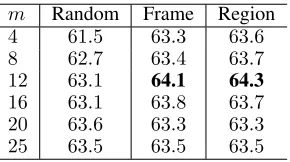
m. It is noted that m = 25 stands for the baseline and means the agent selects all sampled frames. We observe that m = 12 yields the best performance under 2 different se-lection schemes. Besides, whenm ≤ 16, the performance of AS method is better than that of randomly sampling, which also demonstrates that our agent can learn a good pol-icy. However, AS method gets a worse performance when m = 20. We believe that this is because the agent mix up the key information and noise due to the lossLsampling.
Then we will introduce and analyze the difference be-tween the frame-based selectionandregion-based selec-tiontesting schemes in details. Given250(1 center, 4 cor-ners and their flippings at 25 temporal locations) volumes sampled from a testing video, we put each25volumes into our framework and the agent outputs25importance scores. Hence, we can get250importance scores from a video. Then there are 2 selection schemes: frame-based selection and region-based selection. The first one is that we average the 10importance scores of the same frame and obtain25(equal to 25temporal locations) importance scores. Then we se-lectmframes and aggregate the predictions of themframes (10mvolumes) to get a video-level prediction. The second one is that we selectmvolumes from each25volumes of the same region. Then we aggregate the predictions of the10m volumes. The difference between them is that region-based selection may contain more temporal locations than frame-based selection. Moreover, region-frame-based selection performs spatial attention slightly. Therefore, the best performance of region-based selection is better than that of frame-based se-lection (64.3%vs.64.1%).
m Random Frame Region
4 61.5 63.3 63.6
8 62.7 63.4 63.7
12 63.1 64.1 64.3
16 63.1 63.8 63.7
20 63.6 63.3 63.3
25 63.5 63.5 63.5
Table 3: Accuracy (%) of the spatial stream of TSN (pre-trained on Kinetics) with differentmand selection schemes on HMDB51 (split1). Frame means the frame-based selec-tion and region means the region-based selecselec-tion.
effectiveness of our method, we preserve some information of the irrelevant frames and the results are summarized in Table 4. We can see that the pure hard attention achieves the best performance. We think that there are two main reasons leading to this phenomenon. Firstly, the agent in our atten-tion model can discriminate key frames from irrelevant ones. Secondly, the irrelevant frames are not helpful to recogni-tion, which should be discarded at the testing stage.
α 0 0.1 0.2 0.3
Acc. 71.24 71.00 71.15 70.94
Table 4: TSN (pre-trained on ImageNet) accuracy(%) with differentα.
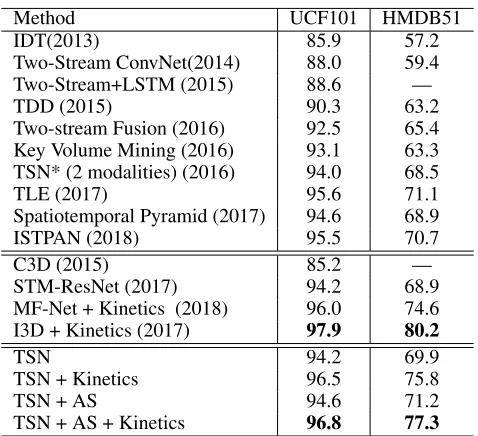
Comparison with state-of-the-art results.After explor-ing the experiment settexplor-ings and analyzexplor-ing the effect of attention-aware sampling method, we compare our method with state-of-the-art methods action recognition methods, which are presented in Table 5. We see that among the two-stream based methods without 3D convolutional kernels, such as TLE (Diba, Sharma, and Van Gool 2017) (71.1%), Spatiotemporal Pyramid (Wang et al. 2017) (68.9%) and ISTPAN (Du et al. 2018) (70.7%), our method achieves the best performance on the HMDB51 (71.2%) and out-performs some methods with 3D convolutional kernels: ST-ResNet (Feichtenhofer, Pinz, and Wildes 2016) and STM-ResNet (Feichtenhofer, Pinz, and Wildes 2017). The reason why the performance of I3D (Carreira and Zisserman 2017) (80.2%) is better is that their method uses two 3D ConvNets and takes64frames as the input when training, which leads to a high temporal resolution and can capture fine-grained temporal structure of actions. However, 3D ConvNets tend to overfitting without a large amount of training data (Kinet-ics) and the performance of our method is much better than that of I3D with the models pre-trained on ImageNet (72.2% vs. 66.4% on HMDB51 split1).
We also observe that the improvement of AS method on UCF101 is lower than that on HMDB51 (0.4% vs. 1.3%). We believe that videos in UCF101 are of higher quality than those in HMDB51. Therefore, videos in UCF101 contain less noise and it is harder for the agent to select the key frames.
Conclusion
In this paper, we discover a novel problem for action recog-nition, which is that irrelevant frames should be differenti-ated and discarded during the testing stage. To address this issue, we proposed a novel attention-aware sampling method for action recognition to discard misleading frames and se-lect discriminative frames simultaneously. We formulate the process of mining the key frames of videos as a Markov de-cision process and train the attention model through deep reinforcement learning without extra labels. Moreover, our approach is extensible, which can be applied to different ex-isting deep learning based action recognition models. Our method achieves very competitive performance of action recogntion on widely used UCF101 and HMDB51 datasets.
Method UCF101 HMDB51
IDT(2013) 85.9 57.2
Two-Stream ConvNet(2014) 88.0 59.4
Two-Stream+LSTM (2015) 88.6 —
TDD (2015) 90.3 63.2
Two-stream Fusion (2016) 92.5 65.4
Key Volume Mining (2016) 93.1 63.3
TSN* (2 modalities) (2016) 94.0 68.5
TLE (2017) 95.6 71.1
Spatiotemporal Pyramid (2017) 94.6 68.9
ISTPAN (2018) 95.5 70.7
C3D (2015) 85.2 —
STM-ResNet (2017) 94.2 68.9
MF-Net + Kinetics (2018) 96.0 74.6
I3D + Kinetics (2017) 97.9 80.2
TSN 94.2 69.9
TSN + Kinetics 96.5 75.8
TSN + AS 94.6 71.2
TSN + AS + Kinetics 96.8 77.3
Table 5: Performance comparison with the state-of-the-art. The first part contains methods without using 3D convolu-tional kernels and methods of the second part benefit a lot from 3D convolutional kernels.
Acknowledgments
This work was supported in part by the National Key R&D Program of China (No. 2018YFB1004600), the National Natural Science Foundation of China (No. 61761146004, No. 61773375), and the Beijing Municipal Natural Science Foundation (No. Z181100008918010).
References
Carreira, J., and Zisserman, A. 2017. Quo vadis, action recognition? a new model and the kinetics dataset. In Com-puter Vision and Pattern Recognition (CVPR), 2017 IEEE Conference on, 4724–4733. IEEE.
Chang, X.; Huang, P.-Y.; Shen, Y.-D.; Liang, X.; Yang, Y.; and Hauptmann, A. G. 2018. Rcaa: Relational context-aware agents for person search. In The European Confer-ence on Computer Vision (ECCV).
Chen, Y.; Kalantidis, Y.; Li, J.; Yan, S.; and Feng, J. 2018. Multi-fiber networks for video recognition. InThe European Conference on Computer Vision (ECCV).
Diba, A.; Sharma, V.; and Van Gool, L. 2017. Deep tem-poral linear encoding networks. InProceedings of the IEEE Conference on Computer Vision and Pattern Recognition, volume 1.
Donahue, J.; Anne Hendricks, L.; Guadarrama, S.; Rohrbach, M.; Venugopalan, S.; Saenko, K.; and Darrell, T. 2015. Long-term recurrent convolutional networks for visual recognition and description. In Proceedings of the IEEE conference on computer vision and pattern recogni-tion, 2625–2634.
continuous deep q-learning. In The IEEE Conference on Computer Vision and Pattern Recognition (CVPR).
Du, Y.; Yuan, C.; Li, B.; Zhao, L.; Li, Y.; and Hu, W. 2018. Interaction-aware spatio-temporal pyramid attention networks for action classification. InThe European Confer-ence on Computer Vision (ECCV).
Feichtenhofer, C.; Pinz, A.; and Wildes, R. 2016. Spatiotem-poral residual networks for video action recognition. In
Advances in neural information processing systems, 3468– 3476.
Feichtenhofer, C.; Pinz, A.; and Wildes, R. P. 2017. Spa-tiotemporal multiplier networks for video action recogni-tion. In 2017 IEEE Conference on Computer Vision and Pattern Recognition (CVPR), 7445–7454. IEEE.
Feichtenhofer, C.; Pinz, A.; and Zisserman, A. 2016. Convo-lutional two-stream network fusion for video action recog-nition. InProceedings of the IEEE Conference on Computer Vision and Pattern Recognition, 1933–1941.
Han, J.; Yang, L.; Zhang, D.; Chang, X.; and Liang, X. 2018. Reinforcement cutting-agent learning for video object seg-mentation. In The IEEE Conference on Computer Vision and Pattern Recognition (CVPR).
Karpathy, A.; Toderici, G.; Shetty, S.; Leung, T.; Sukthankar, R.; and Fei-Fei, L. 2014. Large-scale video classification with convolutional neural networks. InProceedings of the IEEE conference on Computer Vision and Pattern Recogni-tion, 1725–1732.
Kingma, D. P., and Ba, J. 2014. Adam: A method for stochastic optimization.arXiv preprint arXiv:1412.6980. Krizhevsky, A.; Sutskever, I.; and Hinton, G. E. 2012. Imagenet classification with deep convolutional neural net-works. InAdvances in neural information processing sys-tems, 1097–1105.
Kuehne, H.; Jhuang, H.; Garrote, E.; Poggio, T.; and Serre, T. 2011. Hmdb: a large video database for human motion recognition. InComputer Vision (ICCV), 2011 IEEE Inter-national Conference on, 2556–2563. IEEE.
Mnih, V.; Kavukcuoglu, K.; Silver, D.; Graves, A.; Antonoglou, I.; Wierstra, D.; and Riedmiller, M. 2013. Play-ing atari with deep reinforcement learnPlay-ing. arXiv preprint arXiv:1312.5602.
Rao, Y.; Lu, J.; and Zhou, J. 2017. Attention-aware deep reinforcement learning for video face recognition. In Pro-ceedings of the IEEE Conference on Computer Vision and Pattern Recognition, 3931–3940.
Simonyan, K., and Zisserman, A. 2014. Two-stream con-volutional networks for action recognition in videos. In Ad-vances in neural information processing systems, 568–576. Soomro, K.; Zamir, A. R.; and Shah, M. 2012. Ucf101: A dataset of 101 human actions classes from videos in the wild. arXiv preprint arXiv:1212.0402.
Tran, D.; Bourdev, L.; Fergus, R.; Torresani, L.; and Paluri, M. 2015. Learning spatiotemporal features with 3d convo-lutional networks. InProceedings of the IEEE international conference on computer vision, 4489–4497.
Wang, H., and Schmid, C. 2013. Action recognition with improved trajectories. InProceedings of the IEEE interna-tional conference on computer vision, 3551–3558.
Wang, L.; Xiong, Y.; Wang, Z.; Qiao, Y.; Lin, D.; Tang, X.; and Van Gool, L. 2016. Temporal segment networks: To-wards good practices for deep action recognition. In Euro-pean Conference on Computer Vision, 20–36. Springer. Wang, Y.; Long, M.; Wang, J.; and Philip, S. Y. 2017. Spa-tiotemporal pyramid network for video action recognition. InCVPR, volume 6, 7.
Wang, L.; Qiao, Y.; and Tang, X. 2015. Action recogni-tion with trajectory-pooled deep-convolurecogni-tional descriptors. InProceedings of the IEEE conference on computer vision and pattern recognition, 4305–4314.
Williams, R. J. 1992. Simple statistical gradient-following algorithms for connectionist reinforcement learning. Ma-chine learning8(3-4):229–256.
Yue-Hei Ng, J.; Hausknecht, M.; Vijayanarasimhan, S.; Vinyals, O.; Monga, R.; and Toderici, G. 2015. Beyond short snippets: Deep networks for video classification. In
Proceedings of the IEEE conference on computer vision and pattern recognition, 4694–4702.
Zach, C.; Pock, T.; and Bischof, H. 2007. A duality based approach for realtime tv-l 1 optical flow. In Joint Pattern Recognition Symposium, 214–223. Springer.
Zhang, B.; Wang, L.; Wang, Z.; Qiao, Y.; and Wang, H. 2016. Real-time action recognition with enhanced motion vector cnns. In Proceedings of the IEEE Conference on Computer Vision and Pattern Recognition, 2718–2726. Zhou, K., and Qiao, Y. 2017. Deep reinforce-ment learning for unsupervised video summarization with diversity-representativeness reward. arXiv preprint arXiv:1801.00054.