COMMUN. IN SOIL SCIENCE AND PLANT ANALYSIS, 11(9), 889-894 (1980)
NITROGEN MANAGEMENT FOR MALTING BARLEY
KEY WORDS: Nitrogen fertilization, available nitrogen, malting barley, brewing quality.
B. J. Ruffing, D. T. Westermann USDA-SEA-AR
Snake River Cons. Res. Cntr, Kimberly, ID 83341
and M. E. Jensen USDA-SEA-AR Rm 237, Bldg 005
BARC-West Beltsville, MD 20705 ABSTRACT
Malting barley is a specialized agricultural crop in which high yields and quality are production objectives. We evaluated the effects of different N rates on barley yields and selected malting quality parameters grown on irrigated silt loam soils
(Xerollic calciorthids). Maximum barley yields having acceptable malting quality parameters were obtained when the preplant soil NO
3-N plus fertilizer N was between 100 to 120 kg N/ha. About 33 kg N/ha was taken up by the plants from the mineralization of soil organic N. 'Higher available N levels decreased malting quality parameters below acceptable levels. Germination percentage was not changed by the different N rates.
r
Copyright ID 1980 by Marcel Dekker, Inc.
890 RIOTING, WESTERMANN, AND JENSEN
INTRODUCTION
Halting barley is an important cash crop in the western United
States in which the management variables of water supply and N
availability largely control yields and malting quality. Nitrogen
influences yields, as well as grain kernel size, protein content, and percent germination, which affect malting quality 3 ' 4 ' 7 . Irri-gation practices also influence the available N levels, yields
and quality 1
'
8 .The effect of
different nitrogen and irrigation cultural practices on the yield and quality of this crop wasstudied. This paper reports the effects of different amounts of
available N on yields and malting quality.
METHODS AND MATERIALS
In 1971 and 1972 the cultivar Moravian VIII and in 1973 and
1974 Moravian III (Hordeum vulgare L.) were planted at a rate of
112 kg/ha in irrigated field
experiments.
The soil in each exper-iment was a typical Portneufseries (Xerollic
calciorthid). These soils have a calcic layer at the 40- to 45-cm soil depth restrict-ing root penetration but not water movement.A randomized block, split plot design with three replications was used for each experiment, with the soil moisture treatments as the main plots and the N rates as the subplots. Selected amounts
of ammonium nitrate (34-0-0) were broadcast on the surface of the
subplots and disked 10- to 15-cm into the soil before planting.
The N fertilization rate depended upon the experiment and ranged
from 0 to 224 kg N/ha. Before N fertilization, the residual soil
NO
3-N content was determined by a specific-ion electrode method on soil samples taken to a 61 cm depth. The available N is defined
as the residual soil NO
3-N plus the applied N fertilizer.
Two soil moisture treatments
were
studied, one similar to the conditions reported to be optimum for spring wheat5 and the otherwas also similar except that the first irrigation was delayed about one week during the plant's jointing growth stage.
This
treat-ment saved about 6 cm irrigation water and reduced straw lengthsNITROGEN MANAGEKENT 891
did not significantly change the grain protein, plumpness or yields
within a given N rate nor was there any significant irrigation by
N interactions.
Fifteen to twenty plant tops were taken from each treatment
plot at the soft-dough growth stage, dried at 60 C, weighed,
ground to pass a 40-mesh seive, and analyzed for total N2. Degree
of lodging was visually estimated at the firm-dough growth stage, where 0% and 100% indicate no lodging and all plants lying flat,
respectively. Grain yields were measured by harvesting a portion
of each plot with a conventional grain combine. Kernel plumpness
is the percentage by weight of kernels remaining on a 0.238-cm
sieve. Grain protein percentages were determined by the Udy dye
method (Udy Analyzer Co., P.O. Box 148, Boulder, CO)11.
RESULTS AND DISCUSSION
Barley grain yields ranged from 2600 to 6600 kg/ha during
the four years of this study. The relative grain yields increased as the available N increased from 19 to 120 kg/ha (Fig. 1).
Max-imum grain yields occurred between 100 and 120 kg N/ha while
maintaining acceptable levels for protein (<12%) and plump kernels
(>80%). The protein content exceeded 112 and the kernel plumpness dropped below 80% when the available N exceeded 120 kg/ha. Grain
from all treatments exceeded 98% germination. There was a tendency
for grain yields to decrease at the higher available N levels,
possibly because not all the grain was harvested where severe
lodging occurred. Lodging severity (>50%) generally increased as
the available N increased above 130 kg N/ha.
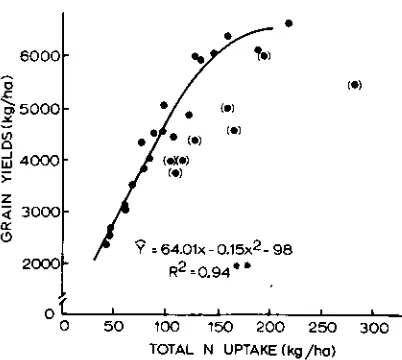
The grain yields were curvilinearly related to the total N
• uptake in those treatments having acceptable malting quality
para-meters (Fig. 2). The total N uptake was also linearly related to
the available N, where total N uptake + 32 + 0.52(available N), r2 = 0.98 (except for 1973 when the constant and coefficient were
66 and 0.94, respectively, r2 = 0.98). All the data points above
5400 kg/ha in Fig. 2 are from the 1973 experiment. Separation of
residual soil NO
892
RUFFING, WESTERMANN AND JENSEN
5
•
20-a
• 1-41.-
(
►
)
• •NO
1 N 0 ..
...
2, 0.81•.
0 ...,,_...-(s)
.kir m
...°
..,,,.
..eN,
\•' r2. 0.67* '
.n
e
eF
`..r
,,,tv \ ... f:f‘.00), FF---r2. 0,584
'''. 'Ilt4Al
417....,
T
100,
g
80-
7-z
60-w
•
40-13
100
12
go T
4
80
-70
a
-60
0-9
0
•
t
o4-0
0
100
200
AVAILABLE NO9/110
FIG. 1. Relationships of relative grain yield, protein
concen-tration, and percentage plump kernels to available N.
(Parentheses show points where
barley did not have
accept-able malting quality parameters.)
6000
▪
5000
I ▪ 4000
7-z
3000
a
0
2000
(•)? .
54.01x-0.15x2 -98
R
2
(:).94.
o I I I
0
50 100 150 200 250 300
TOTAL N UPTAKE (kg/ha)
NITROGEN MANAGEMENT 893
1974 gave total N uptake = 34 + 0.47(residual NO 3-N) + 0.52
(fer-tilizer N), .R2 d. 0.99.
These data indicate that the recovery of the fertilizer N and
residual NO
3-N was between 47% and 52% and that about 33 kg N/ha came from the mineralization of soil organic N sources.
Approxi-mately 66 kg N/ha would have been mineralized if similar N recov-eries are assumed. About 60 kg N/ha was mineralized from the soil organic N from mid-April to mid-June on similar soils under fallow
(unpublished data, D. T. Westermann). Similar fertilizer N recov-eries, amounts of N from soil organic sources, and available N requirements have been reported for barley4,9,10. Apparent higher
recoveries of residual NO
3 -N and fertilizer N in 1973 may have resulted from not measuring all the residual NO 3-N and more N being released by the mineralization processes.
CONCLUSIONS
Maximum yields of high quality malting barley were obtained when the residual soil NO
3-N in the 0- to 61-cm soil layer plus the fertilizer N was between 100 and 120 kg N/ha and where the mineralization of soil organic N contributed about 33 kg/ha to
plant N uptake. Higher available N levels decreased quality parameters and increased susceptibility to lodging.
ACKNOWLEDGEMENTS
The seed for this study and the brewing quality analyses were provided by Adolph Coors Co. of Golden, CO. Part of the funds
required for the study were provided by the Malting Barley
Improve-ment Association, Milwaukee, WI.
REFERENCES
1. Banasik. O. J. and J. F. Power. Brewers Digest 48:58-62 (1973).
2. Bremner, J. M. In: Agronomy (C. A. Black, ed.), 9:1149-1178. Am. Soc. Agron., Madison, WI., (1965).
3. Day, A. D. Agron. J. 49:536-539 (1957).
894 RUFFING, WESTERMANN, AND JENSEN
5. McMasters, G. M. and D. C. Larsen. Univ. of Idaho Current Info. Series No. 22, p. 4, (1966).
6. Milham, P. J., A. S. Awad, R. E. Paull and J. H. Bull. Ana-lyst 95:751-757, (1970).
7. Pomeranz, Y., N. N. Standridge, E. A. Hackett, D. M. Wesenberg and G. D. Booth. Cereal Chem. 53:574-585, (1976).
8. Sepasdhah, A. R. Agron. J. 70:731-734, (1978).
9. Soper, R. J., G. J. Racz and P. I. Fehr. Can. J. Soil Sci. 51:45-49, (1971).
10. Walker, D. R. Can. J. Plant Sci. 55:873-879, (1975).