The Thirty-Third AAAI Conference on Artificial Intelligence (AAAI-19)
Free VQA Models from Knowledge
Inertia by Pairwise Inconformity Learning
Yiyi Zhou,
1Rongrong Ji,
1,3Jinsong Su,
2Xiangming Li,
1Xiaoshuai Sun
1∗1Fujian Key Laboratory of Sensing and Computing for Smart City, Department of Cognitive Science,
School of Information Science and Engineering, Xiamen University, China
2School of Software Engineering, Xiamen University, China 3Peng Cheng Laboratory, China
Abstract
In this paper, we uncover the issue ofknowledge inertiain visual question answering (VQA), which commonly exists in most VQA models and forces the models to mainly rely on the question content to “guess” answer, without regard to the visual information. Such an issue not only impairs the perfor-mance of VQA models, but also greatly reduces the credibil-ity of the answer prediction. To this end, simply highlighting the visual features in the model is undoable, since the predic-tion is built upon the joint modeling of two modalities and largely influenced by the data distribution. In this paper, we propose a Pairwise Inconformity Learning (PIL) to tackle the issue of knowledge inertia. In particular, PIL takes full ad-vantage of the similar image pairs with diverse answers to an identical question provided in VQA2.0 dataset. It builds a multi-modal embedding space to project pos./neg. feature pairs, upon which word vectors of answers are modeled as an-chors. By doing so, PIL strengthens the importance of visual features in prediction with a novel dynamic-margin based
triplet lossthat efficiently increases the semantic
discrepan-cies between pos./neg. image pairs. To verify the proposed PIL, we plug it on a baseline VQA model as well as a set of recent VQA models, and conduct extensive experiments on two benchmark datasets,i.e., VQA1.0 and VQA2.0. Exper-imental results show that PIL can boost the accuracy of the existing VQA models (1.56%-2.93% gain) with a negligible increase in parameters (0.85%-5.4% parameters). Qualitative results also reveal the elimination of knowledge inertia in the existing VQA models after implementing our PIL.
Introduction
Visual question answering (VQA) is a task of answering the human question based on a given image. The challenge lies in how to jointly understand comprehensive visual and tex-tual information. The existing VQA models (Lu et al. 2016; Fukui et al. 2016; Yu et al. 2017; Anderson et al. 2018) have demonstrated the ability to answer human questions in vari-ous tasks, such as text understanding, object or scene recog-nition, counting and visual reasoningetc.
Despite the exciting progress, the strong language pri-ors has long plagued the development of VQA (Antol et
∗
Corresponding Author. E-mail: [email protected] Copyright c2019, Association for the Advancement of Artificial Intelligence (www.aaai.org). All rights reserved.
VQA model
Q: How many
clocks are showing? Predict: 2
(1)
Q: What color are the
leaves on the trees? Predict: Green
(2)
Attention
Attention
CNN
LSTM Attention
Fusion Predict CNN
LSTM Attention
Fusion Predict
CNN
LSTM Attention
Fusion
Predict CNN
LSTM Attention
Fusion
Predict
VQA model
(a) Two typical cases of knowledge inertia.
Question: Is Big Ben in the photo?
Answer: Yes Answer: No
Question: What color are the bater's sneakers?
Answer: Black Answer: Red
(1)
(2)
(b) Examples of the image pair setting.
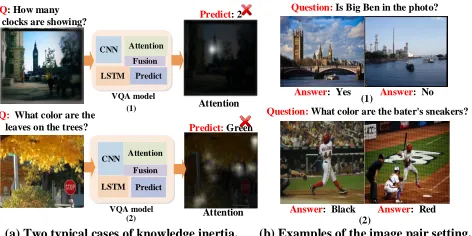
Figure 1: Illustrations of the knowledge inertia (a) and the image pair setting (b). In (a), the model focuses on the cor-rect answer entities in images, but still predicts the wrong answer due to the negative impact of knowledge inertia. In (b), the pair of similar images has the same question, simi-lar content but different answers. This setting is used in this paper to enhance the role of visual information in prediction.
al. 2015; Goyal et al. 2017). In particular, as revealed lat-ter in Sec.3, the existing VQA models tend to rely solely on the content of a given question to predict the answer, with-out regard to the given image,i.e., a phenomenon termed as
knowledge inertia(Liao 2002)1in this paper. Fig.1.(a)
illus-trates two typical cases of knowledge inertia.
To eliminate the negative effect of knowledge inertia, a natural solution is to force the VQA model to make predic-tions more based on the visual content, i.e., by emphasiz-ing the weightemphasiz-ings of visual features, as argued in Goyal et al. (2017). However, doing so is intractable in the existing VQA models. First, the objective function of existing VQA models is to maximize the answer probability conditioned on the given question and image. The prediction is built upon the joint modeling of the textual and visual features, where the weightings of two modalities are automatically learned by the training examples and can not be manually adjusted. Second, as a classification task, VQA also faces the problem of extremely uneven data distributions, which subsequently exacerbates the issue of knowledge inertia.
1
LSTM
CNN/FRCNN
Attention Fusion FC Layer Predict
VQA Channel Project
LSTM
CNN/FRCNN
Attention Fusion FC Layer Predict
VQA Channel
Weight Sharing
Project
Multimodal Embedding
Space
Question: What number is on the man in white shirt?
Positive Example
Negative Example The Image Pair Setting
Answer: 25
Answer: 9
Attention Image
Attention Image
Anchor
Positive Negative
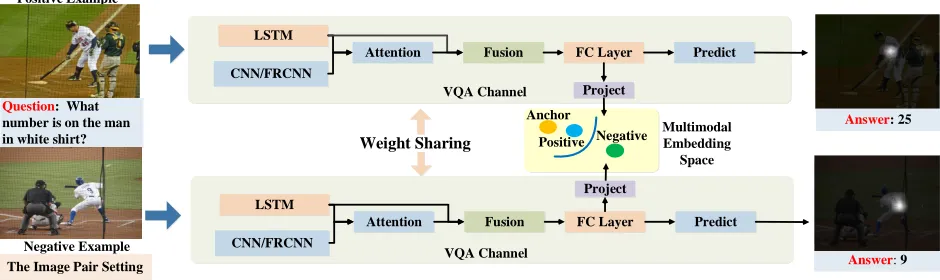
Figure 2: Framework of Pairwise Inconformity Learning (PIL). The input is a pair of similar images with the identical question but different answers. The model processes this pair of examples simultaneously, and projects their joint features onto a multi-modal embedding space. The blue and green dots refer to the embedded joint features of the positive and negative examples, while the orange dot denotes the anchor which is the pre-trained word vector of the positive example’s answer.
In this paper, we propose a novel Pairwise Inconformity Learning, denoted as PIL2, which takes full advantage of the
image pair setting proposed in VQA2.0 dataset (Goyal et al. 2017), an example of which is shown in Fig.1.(b). In prin-ciple, under the same textual input, we target at maximizing the semantic distances between joint features of positive and negative examples, which subsequently eliminates the im-pact of knowledge inertia in prediction. In particular, PIL first creates a multi-modal embedding space in addition to the typical VQA model settings. In this space, a novel dy-namic margin based triplet loss is further proposed to in-crease the semantic distance between pos./neg. examples, where the well pre-trained word embedding of the answer is used as anchor. Then, hard example mining is performed based on the pairwise distances, which further improves the VQA performance.
The proposed PIL is flexible, which can be well plugged into a range of standard and cutting-edge VQA models, such as SAN (Yang et al. 2016) and BUA (Teney et al. 2018). We have quantified its accuracy boost by evaluating it on VQA1.0 (Antol et al. 2015) and VQA2.0 (Goyal et al. 2017) datasets, which reports 1.6%-2.9% gains over two datasets. Moreover, the increase of model complexity is limited, say an increase of 0.85%-5.4% in parameters, which retains highly efficient in real-world applications.
Overall, the contribution of this paper is three-fold: • We uncover a key issue in VQA, namelyKnowledge
In-ertia, which restricts the performance and the credibility of the existing VQA models.
• We propose a Pairwise Inconformity Learning (PIL) scheme to address this issue, which includes a dynamic margin based triplet loss and an online hard example min-ing strategy to boost the VQA performance.
• PIL is generalized and can boost the accuracy of the ex-isting VQA models (1.2%-3.5% gain) with a negligible increase in parameters (0.85%-3.7% parameters).
2
https://github.com/xiangmingLi/PIL
Related Work
At present, visual question answering (VQA) is often con-sidered as a classification task with fixed categories (Antol et al. 2015; Yang et al. 2016; Fukui et al. 2016; Anderson et al. 2018). Earlier, VQA methods tend to predict the an-swer by directly learning a joint representation of the im-age and text features extracted by convolutional neural net-work (CNN) and recurrent neural netnet-works (RNNs) (An-tol et al. 2015)(Ma, Lu, and Li 2015). To capture the most relevant visual signal, the work in (Yang et al. 2016) first introduces the attention mechanism to VQA, which is fur-ther extended to a multi-step attention to improve visual reasoning. There are also some recent works focusing on the modifications of attention mechanism (Lu et al. 2016; Zhu et al. 2017; Fukui et al. 2016). For example, the work in (Lu et al. 2016) proposes two co-attention algorithms to generate attended features from both visual and tex-tual features. Some recent developments (Fukui et al. 2016; Kim et al. 2017; Yu et al. 2017) focus on investigating dif-ferent fusion approaches for more efficient interactions be-tween two modalities. For example, the work in (Fukui et al. 2016) uses a compact bilinear pooling for feature fusions, which brings a significant improvement to the model per-formance. After that, other bilinear pooling based methods are further proposed, such as the work in (Kim et al. 2017; Yang et al. 2016). There are also some works introducing the external knowledge or existing techniques to VQA, such as the use of Wiki knowledge (Wu et al. 2016) and knowledge graph (Wang et al. 2016), or replacing the convolutional fea-ture map with the regional feafea-tures from Faster-RCNN as the visual input (Anderson et al. 2018).
$OO <HV1R 1XP 2WKHU
1RQH.,
.,
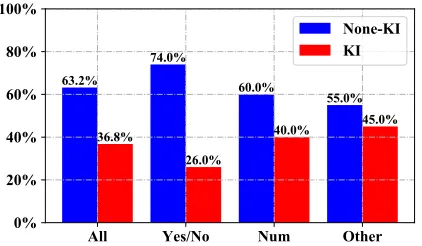
Figure 3: The failure case distribution of 1,000 examples from the VQA2.0val set. “Yes/No”, “Num.” and “Other” denotes the three main question types in VQA, while “All” represent the overall result. “KI” refers to the failure pre-dictions directly or indirectly caused by Knowledge Inertia, which are the cases that the model finds out the correct an-swer entities in images but still make false predictions.
dataset based on VQA1.0 and VQA2.0, and propose a model that use visual and textual concepts for answer prediction to avoid the effect of language priors.
Knowledge Inertia
Knowledge inertia is a terminology from social science, which refers to a problem solving strategy uses old, redun-dant, stagnant knowledge and past experience without re-course to new knowledge and experience (Liao 2002). Here, we use it to represent the behaviors happened in existing VQA models as below.
Ideally, after training, the VQA model should be able to find the most relevant visual signals for prediction based on the question. However, due to the existence of strong lan-guage priors in the datasets (Goyal et al. 2017), the model has a strong dependency on the textual features uncon-sciously. It leads to a result that the model relies sorely on the question to predict answer without regard to visual infor-mation. This is termed as knowledge inertia in this paper.
To study the influence of knowledge inertia, we quanti-tatively analyzed failure cases of the model predictions, the result of which is shown in Fig.3. Here, we define the fail-ure case of knowledge inertia as the model finds the obvious answer in images and still makes wrong predictions, such as the examples in Fig.1.a. It can be seen that at least about 30% of the false predictions are caused directly or indirectly by knowledge inertia, which thereby indicates the emergency to solve this problem.
The key solution to knowledge inertia is to improve the role of visual feature in predictions, so that the questions can be answered based not only on what the model already “know” but also on what the model are currently “seeing”. However, directly improving the visual weighting is un-doable, as analyzed earlier in Sec.1.
Pairwise Inconformity Learning
To address the issue of knowledge inertia, we propose a Pair-wise Inconformity Learning, termed as PIL. In addition to the typical VQA setting, PIL creates a multi-modal embed-ding space with a dynamic-margin based triplet loss to in-crease semantic distances between positive/negative exam-ples. The framework is shown in Fig.2.
Problem Setup In VQA, The training example is a triplet denoted ase= (I, Q, a), whereIis the image,Qis the ques-tion andais the answer. The answer prediction is regarded as a classification task with fixed categories, the objective function of which is formulated as:
max
G logP(a|fj),
where fj=G(I, Q).
(1)
Here, G(·)is the main part of a VQA model without the prediction layer, andfjrefers to the joint feature.
To improve the role of visual information in predic-tion, we make use of the image pair setting proposed in VQA2.0 (Goyal et al. 2017), where positive and negative images have the same question, similar visual content, but different answers, as shown in Fig.1.b. Particularly, given a pair of examples, denoted as(ep, en), we aim at increasing the semantic distance between their joint features:
max
G d f
p j, f
n j
, (2)
where d(·) is any distance measurement. The intuition is that with the same textual input, the larger semantic distance between pos./neg. examples will result in more discrimina-tive visual representations, forcing the model to rely more on visual information during the prediction .
Multi-modal Embedding. Following this principle, the first step of PIL is to learn a multi-modal embedding space, where the well pre-trained word vectors of the correspond-ing answers can be used as anchors. Concretely, given a pair of example(ep, en)and a VQA modelG(·), we first extract their multi-modal joint representations, denoted as
fjp, fn
j ∈ Rm. Then, we project them into this space and obtain the embedded features,fp
e andfen∈Rn, by:
fep=σ Wembfjp
, fen=σ Wembfjn
, (3)
whereWemb∈Rn×mis the projection matrix, andσ(·)is an activation function.
The first objective of PIL is to minimize the distances be-tween the embedding vector and anchors:
Lemb=kfep−fapk22+kfen−fank22, (4) wherefp
a andfan ∈Rnare anchors of pos./neg. examples. The intuition behind this embedding space is three-fold: • First, we quantitatively found that directly implementing
a strong distance regularization (e.g., Eq.2) onfjwill hin-der the overall model performance.
an indispensable step, which is however computationally expensive in VQA due to the large number of categories,
e.g., typically over 3,000 in most benchmarks, each with thousands of examples.
• Third, in this embedding space, well pre-trained word vectors of answers can be used as anchors, e.g., Glove Embeddings (Pennington, Socher, and Manning 2014), which already have strong semantics.
Dynamic-margin based Triplet Loss. To increase the feature distances between embedded joint representations of pos./neg. examples, we propose a dynamic-margin based triplet lossLtriplet, which is denoted as:
Ltriplet= max0, m+kfep−fapk22− kfen−fapk22
+ max0, m+kfen−fank22− kfep−fank22,
where m=kfap−fank22.
(5) Eq.5 differs from the traditional triplet loss func-tion (Schroff, Kalenichenko, and Philbin 2015) in that the margin valuemis dynamically set by the distance between two answer word vectors. Such design can not only avoid the complex tunning ofm, but also represent the semantic margins between different answers more accurately.
The Baseline Model. We further propose a baseline model to deploy the proposed PIL, which is depicted in Fig.2. The input image is processed by CNN or Faster R-CNN to obtain a regional feature matrixF ∈ Rv×k, while the question featurefq ∈Rhis extracted by an LSTM net-work. Here,kis the number of image regions, andvandh
are dimensions of visual and textual features. We then imple-ment an attention process onFto obtain a weighted visual featurefv∈Rv, formulated as:
fv= k X
i=1 αifi,
where αi=Sof tmax(ei),
ei=Conv
ReLu Conv Fusion(fi, fq)
,
(6)
Conv(·)is a convolution operation andFusion(·)is a multi-modal fusion function,e.g., anMFB pooling(Yu et al. 2017) used in this paper. After that, we fusefqandfvto obtain the joint featurefj.
In some widely-used datasets,e.g.VQA1.0 (Antol et al. 2015) and VQA2.0 (Goyal et al. 2017), a question is often associated with a set of answers. We thereby follow the set-ting in (Anderson et al. 2018) to formulate the answer pre-diction as a multi-label classification, and use theSigmoid cross entropyas the loss function, denoted as:
Lentropy=
N X
i
yilog (si)−(1−yi) log (si), (7)
wheres=Sigmoid(Wfj),yi= 1indicates thei-category is in the answer set, andNis the number of categories.
The Overall Loss. The overall objective function of PIL:
min
G,Wemb
Lentropy+αLtriplet+βLemb, (8)
whereαandβare hyper parameters tuned by experiments.
Hard Example Mining. Our scheme further enables hard example mining by exploring the semantic distance between positive and negative examples. Following the principle of (Schroff, Kalenichenko, and Philbin 2015), we divide the training examples into three categories which areeasy, semi-hard andhard. According to this hardness, we further assign a difficulty scoredsas:
ds=
(0.25 if d(fp e, f
n e)> m,
0.5 if d(fp
e, fap)< d(fep, fen)< m,
1.0 if d(fep, fen)< d(fep, fap),
(9)
whered(·)is thel2−distance,fp
e andfenare embedded joint features of pos./neg. examples, respectively.fais the anchor andmis the dynamic margin. The score will be multiplied by the overall loss during training. By doing so, the model will receive more gradients from hard examples.
Experiments
To validate the proposed learning scheme, we conduct ex-tensive experiments on two widely-used dataset, namely VQA1.0 (Antol et al. 2015) and VQA2.0 (Goyal et al. 2017), and compare out model with a set of stat-of-the-arts.
Experiment Setup
Datasets. VQA1.0 dataset contains 200,000 natural im-ages from MS-COCO (Chen et al. 2015) with 614,153 hu-man annotated questions in total. Each question has 10 free-response answers. The whole dataset is divided into three splits, in which there are 248,349 examples for training, 121,512 for validation, and 244,302 for testing. VQA2.0 is developed based on VQA1.0, and has about 1,105,904 image-question pairs, of which 443,757 examples are for training, 214,254 for validation, and 447,793 for testing. As a different setting, VQA2.0 provides annotations of similar image pairs as we mentioned above. We also collects image pairs in VQA1.0. For each example, we select its negative example that has the same question but different answers from both VQA1.0 and VQA2.0 datasets3. Then, we have about 197 thousand pairs for training. Since each question in these two datasets is associated with a list of answers, we use the most frequent answer as the anchor.
Model Configuration. In terms of the baseline model, we use the Glove Embedding (Pennington, Socher, and Man-ning 2014) as the word input with a dimension of 300. The dimension of the LSTM module is 2048, while thekando
in MFB fusion (Yu et al. 2017) are set to 5 and 1000, respec-tively. The dimensions of the last forward layer and the pro-jections are set to 2048 and 300. The two hyper-parameters,
αandβ, are set to 0.25 and 0.01 after tuning. The initial 3
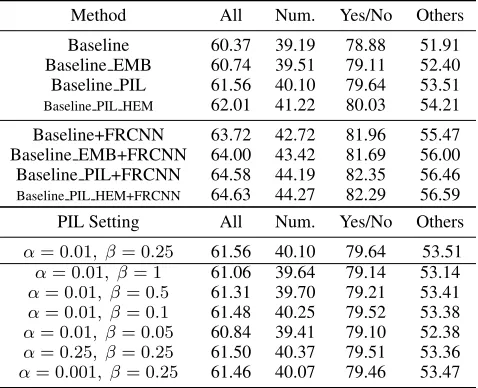
Table 1: Ablation Studies. Trained on VQA2.0 train split and tested on the val split. “FRCNN” denotes the use of Faster R-CNN features.
Method All Num. Yes/No Others
Baseline 60.37 39.19 78.88 51.91
Baseline EMB 60.74 39.51 79.11 52.40
Baseline PIL 61.56 40.10 79.64 53.51
Baseline PIL HEM 62.01 41.22 80.03 54.21
Baseline+FRCNN 63.72 42.72 81.96 55.47
Baseline EMB+FRCNN 64.00 43.42 81.69 56.00
Baseline PIL+FRCNN 64.58 44.19 82.35 56.46
Baseline PIL HEM+FRCNN 64.63 44.27 82.29 56.59
PIL Setting All Num. Yes/No Others
α= 0.01, β= 0.25 61.56 40.10 79.64 53.51
α= 0.01, β= 1 61.06 39.64 79.14 53.14
α= 0.01, β= 0.5 61.31 39.70 79.21 53.41
α= 0.01, β= 0.1 61.48 40.25 79.52 53.38
α= 0.01, β= 0.05 60.84 39.41 79.10 52.38
α= 0.25, β= 0.25 61.50 40.37 79.51 53.36
α= 0.001, β= 0.25 61.46 40.07 79.46 53.47
learning rate is 7e-4, which is halved after every 25,000 steps. The batch size is 64 and the maximum training step is set to 150,000. The optimizer we used isAdam(Kingma and Ba 2014). For the implemented the state-of-the-arts, we fol-low their default settings. During experiments, we use two types of visual inputs,i.e., the last feature map of ResNet-152 (He et al. 2016) with a size of14×14×2048and the regional features released by (Anderson et al. 2018) with a size of36×2048. For simplicity, we denote them asCNN
andFRCNN, respectively.
Experiment Analysis
Ablation Studies. We first examine different designs pro-posed in this paper, the results of which are shown in Tab.1. Here,EMBmeans that only the answer embedding loss is used as the regularization.PILdenotes the complete use of Pairwise Inconformity Learning, andHEM is the hard ex-ample mining. From Tab.1 we can see that, all designs are beneficial for the model performance, and considering that it requires very few extra parameters, these improvements are valuable. Meanwhile, with the number of training exam-ple increases, the improvement by PIL will be more obvi-ous, as shown in Tab.5. Tab.1 also shows the tuning results of the two hyper-parametersαandβfor the answer embed-ding loss and the triplet loss, as defined in Eq.8. The values in the first column are the setting we used for other exper-iments. With this setting, the embedding loss will give to more gradients to the model than that of the triplet loss. Our understanding is that the embedding loss not only carries the functionality of maintaining the multi-modal space, but also affects the projections of joint features. So, the value of its hyper parameter should be larger. Another observa-tion is that if the values of hyper parameters are too large, it will impair the overall performance. One possible reason is that the question in VQA1.0 and VQA2.0 often has multiple
Table 2: Comparisons with other negative-learning scheme. Trained on VQA2.0 train set and tested on the validation set.
Method All Num. Yes/No Others
Baseline 60.37 39.19 78.88 51.91
Baseline+l2 Reg.(α=1e-3) 59.47 37.64 77.93 51.22
Baseline+Contra. Loss(α=1e-3) 59.58 38.98 77.58 51.42
Baseline+kl-D Reg.(α=5e-3) 59.18 38.20 77.29 50.94
Baseline+fv-l2 Reg.*(α=1e-4) 59.41 37.74 77.75 51.21
Baseline+fv-PIL* 61.32 39.82 79.62 53.11
Baseline PIL 61.56 40.10 79.64 53.51
*The regularization is implemented on the attention featurefv.
Table 3: Applications on the State-of-the-Arts. Trained on VQA2.0train+valsplit, and tested ontest-devsplit.
Method All Num. Yes/No Others
CNN+LSTM 54.22 - -
-CNN+LSTM-PIL 56.62 36.18 78.46 49.83
SAN 58.93 37.52 78.34 50.12
SAN-PIL 61.42 39.67 77.62 52.55
SAN FRCNN 62.14 41.75 78.91 52.45
SAN FRCNN+PIL 65.07 43.20 81.15 56.34
BUA FRCNN 65.32 44.21 81.82 56.05
BUA FRCNN+PIL 66.23 45.20 82.63 57.23
answers, and a too strong regularization might reduce the di-versity of the model prediction, making it hard to reach the optimal performance.
Comparisons with Other NL Schemes. We further com-pare the proposed PIL with other negative learning schemes in Tab.2. Here, “l2 Reg.” means that anl2-distance regular-ization is directly used to increase the semantic distances between the joint featuresfj of pos./neg. examples, while “fv-l2 Reg.” denotes that the regularization is implemented on the attention visual featurefv. “kl-D Reg.” refers to the
KL-divergence, which is used to increase the distribution di-vergence between predictions of positive and negative exam-ples. “Contra. Loss” denotes the contrastive loss proposed in (Hadsell, Chopra, and LeCun 2006), which is also deployed on the joint features. “fv-PIL” denotes the implementation of the proposed PIL on the attention features, and its setting is the same with that of PIL. From Tab.2, we find that, by di-rectly regularizing the joint features, these negative learning schemes can have a counterproductive effect on the model performance, which confirms the hypothesis we made in the method section. The result of “fv-PIL”also suggests that simply increasing the distances among visual features is in-sufficient for improving the role of visual features.
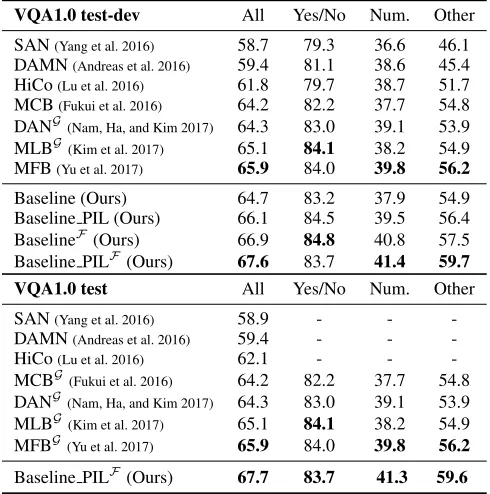
Table 4: Comparisons with the state-of-the-arts on VQA1.0. “F” denotes the use of Faster R-CNN features, and “G” means that the model usesVisual Genome (Krishna et al. 2016) as the additional training data.
VQA1.0 test-dev All Yes/No Num. Other
SAN(Yang et al. 2016) 58.7 79.3 36.6 46.1 DAMN(Andreas et al. 2016) 59.4 81.1 38.6 45.4 HiCo(Lu et al. 2016) 61.8 79.7 38.7 51.7 MCB(Fukui et al. 2016) 64.2 82.2 37.7 54.8 DANG(Nam, Ha, and Kim 2017) 64.3 83.0 39.1 53.9 MLBG(Kim et al. 2017) 65.1 84.1 38.2 54.9 MFB(Yu et al. 2017) 65.9 84.0 39.8 56.2
Baseline (Ours) 64.7 83.2 37.9 54.9
Baseline PIL (Ours) 66.1 84.5 39.5 56.4
BaselineF(Ours) 66.9 84.8 40.8 57.5
Baseline PILF(Ours) 67.6 83.7 41.4 59.7
VQA1.0 test All Yes/No Num. Other
SAN(Yang et al. 2016) 58.9 - - -DAMN(Andreas et al. 2016) 59.4 - - -HiCo(Lu et al. 2016) 62.1 - - -MCBG(Fukui et al. 2016) 64.2 82.2 37.7 54.8 DANG(Nam, Ha, and Kim 2017) 64.3 83.0 39.1 53.9 MLBG(Kim et al. 2017) 65.1 84.1 38.2 54.9 MFBG(Yu et al. 2017) 65.9 84.0 39.8 56.2
Baseline PILF(Ours) 67.7 83.7 41.3 59.6
even higher than that of our baseline model. Such a result not only indicates the performance improvements brought by PIL, but also suggests that PIL can help models obtain more discriminative visual information. So its benefits will be more apparent when applied to less-than-good models. Notably, the additional parameters increased by PIL are only 5.4%, 2.4% and 1.8% for three models.
Comparing Baseline+PIL to State-of-the-arts. We fur-ther evaluate the baseline model with the proposed PIL on VQA1.0 and VQA2.0 datasets. The results are given in Tab.5. The first observation is that the proposed baseline is a simple yet powerful model. Without the use of additional datasets like Visual Genome, it has already reached the most advanced performance in VQA. Considering that any mi-nor improvement is valuable on these two highly competi-tive datasets, PIL really takes effect. After deploying PIL, the baseline model outperformsBUA, the best state-of-the-art, by 2.23%, which is indeed significant in VQA. Notably, PIL only requires about 1.2% of parameters in addition.
Is the Impact of Knowledge Inertia Reduced?
We further examine whether the proposed PIL can strengthen the role of visual information in prediction, thereby reducing the impact of knowledge inertia. We first draw the prediction distributions on the 10 most common swers in Fig4. Here, “Ground Truth” denotes the default an-swer distribution of VQA2.0 val set. “Baseline” and “Base-line PIL” are the prediction distributions by the model with and without PIL, respectively. Compared to the defaultdis-Table 5: Comparisons with the state-of-the-arts on VQA2.0.
VQA2.0 test-dev All Yes/No Num. Other
MFB(Yu et al. 2017) 64.16 80.95 40.73 54.62
MF-SIGG(Zhu et al. 2017) 64.73 81.29 42.99 55.55
BUAG(Teney et al. 2018) 62.07 79.20 39.46 52.62 BUAF,G(Teney et al. 2018) 65.32 81.82 44.21 56.05
Baseline (Ours) 63.53 80.40 41.16 54.23
Baseline PIL (Ours) 65.07 81.15 43.20 56.34
BaselineF(Ours) 66.21 82.38 45.03 57.24
Baseline PILF(Ours) 67.53 83.96 46.50 58.29
VQA2.0 test All Yes/No Num. Other
LSTM-Q(Goyal et al. 2017) 54.22 73.46 35.18 41.83
MCB(Fukui et al. 2016) 62.27 78.82 38.28 53.36
MF-SIGG(Zhu et al. 2017) 65.84 81.85 43.64 57.07
BUAG(Teney et al. 2018) 62.27 79.32 39.77 52.59 BUAF,G(Teney et al. 2018) 65.67 82.20 43.90 56.26
Baseline PIL (Ours) 65.10 81.38 43.33 56.24
Baseline PILF(Ours) 67.65 83.91 46.01 58.46
\HV QR
ZKLWH EOXH UHG EODFN
N
N
N
N
N
N
N
N
*URXQG7UXWK
%DVHOLQH
%DVHOLQHB3,/
Figure 4: Distributions of the top-10 answers on the VQA2.0
valset.Thekl-divergences between the ground truth and the baseline prediction on 3,000 answer categories is 0.06, and becomes smaller by adopting PIL (0.04).
tribution, these 10 answer categories receive more predic-tions from the model with a common VQA setting, which means that the model tends to choose the most frequent an-swers as their predictions. With PIL, the distribution of these ten answers is closer to the default distribution, which means that in more cases the model answers the question based more on the visual content and less effected by the language prior. So, we deduce that the influence of knowledge is alle-viated.
Next, we visualize the joint features of baseline models with and without PIL byt-SNE(Maaten and Hinton 2008) in Fig.5. From Fig.5, it can be observed that PIL helps the model produce more discriminative joint features. Under the same category, the content of questions is relatively similar. So the larger differences among joint features indicate that the visual features are more discriminative for each answer category. We can therefore confirm that the role of visual information is enhanced in prediction.
15 10 5 0 5 10 15 15 10 5 0 5 10
15 EODFN %DVHOLQH EOXH UHG ZKLWH JUHHQ
15 10 5 0 5 10 15
15 10 5 0 5 10
15 EODFN%DVHOLQH3,/ EOXH
UHG ZKLWH JUHHQ
(a) Answers of Colors
40 30 20 10 0 10 20 30 40
40 30 20 10 0 10 20 30 40 %DVHOLQH FDW GRJ JLUDIIH KRUVH HOHSKDQW
40 30 20 10 0 10 20 30 40
40 30 20 10 0 10 20 30 40 %DVHOLQH3,/ FDW GRJ JLUDIIH KRUVH HOHSKDQW
(b) Answers of Animals
30 20 10 0 10 20 30
30 20 10 0 10 20 30 %DVHOLQH WHQQLV EDVHEDOO IULVEHH VRFFHU VNLLQJ
30 20 10 0 10 20 30
30 20 10 0 10 20 30 %DVHOLQH3,/ WHQQLV EDVHEDOO IULVEHH VRFFHU VNLLQJ
(c) Answers of Sports
Figure 5: Visualizations of Joint Features without and with the proposed Pairwise Inconformity Learning by t-SNE.
4. Question: Who wears a red suit?
Image Without PIL With PIL
Answer: skier Predict: man Predict: skier 4. Question: Who wears a red suit?
Image Without PIL With PIL
Answer: skier Predict: man Predict: skier
2. Question: Are these cows well-fed?
Image Without PIL With PIL
Answer: yes Predict: yes Predict: yes 2. Question: Are these cows well-fed?
Image Without PIL With PIL
Answer: yes Predict: yes Predict: yes
6. Question: How many planes are there?
Image Without PIL With PIL
Answer: 1 Predict: 4 Predict: 1 6. Question: How many planes are there?
Image Without PIL With PIL
Answer: 1 Predict: 4 Predict: 1 5. Question: How many slices of pizza does this child have?
Image Without PIL With PIL
Answer: 0 Predict: 6 Predict: 0 5. Question: How many slices of pizza does this child have?
Image Without PIL With PIL
Answer: 0 Predict: 6 Predict: 0 1. Question: What is the girl wearing on her feet?
Image Without PIL With PIL
Answer: sandals Predict: sandals Predict: sandals 1. Question: What is the girl wearing on her feet?
Image Without PIL With PIL
Answer: sandals Predict: sandals Predict: sandals
3. Question: Is she wearing a helmet?
Image Without PIL With PIL
Answer: no Predict: no Predict: no 3. Question: Is she wearing a helmet?
Image Without PIL With PIL
Answer: no Predict: no Predict: no
7. Question: Are these horses galloping?
Image Without PIL With PIL
Answer: yes Predict: no Predict: yes 7. Question: Are these horses galloping?
Image Without PIL With PIL
Answer: yes Predict: no Predict: yes
8. Question: What color is the license plate?
Image Without PIL With PIL
Answer: yellow Predict: white Predict: yellow 8. Question: What color is the license plate?
Image Without PIL With PIL
Answer: yellow Predict: white Predict: yellow
9. Question: What is on the wall behind the toilet?
Image Without PIL With PIL
Answer: picture Predict: tile Predict: picture 9. Question: What is on the wall behind the toilet?
Image Without PIL With PIL
Answer: picture Predict: tile Predict: picture 10. Question: Is the dog sitting on a sofa?
Positive Without PIL With PIL
Negative
Predict: Yes
Predict: Yes
Predict: Yes
Predict: No
Image
11. Question: Is Big Ben in the photo? Positive Without PIL With PIL
Negative
Predict: Yes
Predict: Yes
Predict: Yes
Predict: No
Image
12. Question: What color are the bater's sneakers
Positive Without PIL With PIL
Negative
Predict: Red
Predict: Red
Predict: Red
Predict: Black
Image
Figure 6: Visualizations of attentions with and without the proposed Pairwise Inconformity Learning (PIL). The red color in predictions refers to the correct answer while the green color denotes the incorrect ones.
Fig.6. Clearly, there are two typical cases of knowledge in-ertia in these examples. The first case is that, the model does not focus on the correct visual entities but can still predict the answers based on their “past experience”,e.g. exp.(1)-(3). Although such a problem does not lead to a decline in the model performance, it still impairs the credibility of the model prediction. The second case is that, even if the model finds out the correct answer entity in the image, it will still make a wrong prediction.e.g.exp.(6)-(9). We also observe that under the example-pair setting,e.g.exp.(10)-(12), the baseline model often makes the same prediction for similar images. With PIL, such a case has been alleviated to a large extend, and the model can predict the answer more based on what they are currently “seeing”. As shown in the rest examples, PIL also helps model produce attentions more
ac-curately. In sum, PIL does strengthen the role of visual in-formation and reduces the influence of knowledge inertia.
Conclusion
signif-icant performance improvement. More importantly, statistic results and qualitative analyses prove that our scheme can reduce the impact of knowledge inertia.
Acknowledgments
This work is supported by the National Key R&D Program (No.2017YFC0113000, and No.2016YFB1001503), Nature Science Foundation of China (No.U1705262, No.61772443, and No.61572410), Post Doctoral Innovative Talent Support Program under Grant BX201600094, China Post-Doctoral Science Foundation under Grant 2017M612134, Scien-tific Research Project of National Language Committee of China (Grant No. YB135-49), and Nature Science Founda-tion of Fujian Province, China (No. 2017J01125 and No. 2018J01106).
References
Agrawal, A.; Batra, D.; Parikh, D.; and Kembhavi, A. 2018. Don’t just assume; look and answer: Overcoming priors for visual question answering. computer vision and pattern recognition.
Anderson, P.; He, X.; Buehler, C.; Teney, D.; Johnson, M.; Gould, S.; and Zhang, L. 2018. Bottom-up and top-down at-tention for image captioning and visual question answering. InCVPR, volume 3, 6.
Andreas, J.; Rohrbach, M.; Darrell, T.; and Klein, D. 2016. Learning to compose neural networks for question answer-ing.arXiv preprint arXiv:1601.01705.
Antol, S.; Agrawal, A.; Lu, J.; Mitchell, M.; Batra, D.; Lawrence Zitnick, C.; and Parikh, D. 2015. Vqa: Visual question answering. InProceedings of the IEEE Interna-tional Conference on Computer Vision, 2425–2433. Chen, X.; Fang, H.; Lin, T.-Y.; Vedantam, R.; Gupta, S.; Doll´ar, P.; and Zitnick, C. L. 2015. Microsoft coco cap-tions: Data collection and evaluation server. arXiv preprint arXiv:1504.00325.
Fukui, A.; Park, D. H.; Yang, D.; Rohrbach, A.; Darrell, T.; and Rohrbach, M. 2016. Multimodal compact bilinear pooling for visual question answering and visual grounding.
arXiv preprint arXiv:1606.01847.
Goyal, Y.; Khot, T.; Summersstay, D.; Batra, D.; and Parikh, D. 2017. Making the v in vqa matter: Elevating the role of image understanding in visual question answering. InIEEE Conference on Computer Vision and Pattern Recognition, 6325–6334.
Hadsell, R.; Chopra, S.; and LeCun, Y. 2006. Dimension-ality reduction by learning an invariant mapping. In null, 1735–1742. IEEE.
He, K.; Zhang, X.; Ren, S.; and Sun, J. 2016. Deep residual learning for image recognition. InProceedings of the IEEE Conference on Computer Vision and Pattern Recognition, 770–778.
Hermans, A.; Beyer, L.; and Leibe, B. 2017. In defense of the triplet loss for person re-identification. arXiv preprint arXiv:1703.07737.
Kim, J.; On, K. W.; Lim, W.; Kim, J.; Ha, J.; and Zhang, B. 2017. Hadamard product for low-rank bilinear pooling.
international conference on learning representations. Kingma, D., and Ba, J. 2014. Adam: A method for stochastic optimization. arXiv preprint arXiv:1412.6980.
Krishna, R.; Zhu, Y.; Groth, O.; Johnson, J.; Hata, K.; Kravitz, J.; Chen, S.; Kalantidis, Y.; Li, L.-J.; Shamma, D. A.; et al. 2016. Visual genome: Connecting language and vision using crowdsourced dense image annotations. arXiv preprint arXiv:1602.07332.
Liao, S. 2002. Problem solving and knowledge inertia. Ex-pert Systems With Applications22(1):21–31.
Lu, J.; Yang, J.; Batra, D.; and Parikh, D. 2016. Hierarchi-cal question-image co-attention for visual question answer-ing. InAdvances In Neural Information Processing Systems, 289–297.
Ma, L.; Lu, Z.; and Li, H. 2015. Learning to answer ques-tions from image using convolutional neural network.arXiv preprint arXiv:1506.00333.
Maaten, L. v. d., and Hinton, G. 2008. Visualizing data using t-sne. Journal of machine learning research9(Nov):2579– 2605.
Nam, H.; Ha, J. W.; and Kim, J. 2017. Dual attention net-works for multimodal reasoning and matching.
Pennington, J.; Socher, R.; and Manning, C. 2014. Glove: Global vectors for word representation. InProceedings of the 2014 conference on empirical methods in natural lan-guage processing (EMNLP), 1532–1543.
Schroff, F.; Kalenichenko, D.; and Philbin, J. 2015. Facenet: A unified embedding for face recognition and clustering. In
Proceedings of the IEEE conference on computer vision and pattern recognition, 815–823.
Teney, D.; Anderson, P.; He, X.; and Den Hengel, A. V. 2018. Tips and tricks for visual question answering: Learn-ings from the 2017 challenge. computer vision and pattern recognition.
Wang, P.; Wu, Q.; Shen, C.; and Hengel, A. v. d. 2016. The vqa-machine: Learning how to use existing vision algorithms to answer new questions. arXiv preprint arXiv:1612.05386.
Wu, Q.; Wang, P.; Shen, C.; Dick, A.; and van den Hengel, A. 2016. Ask me anything: Free-form visual question an-swering based on knowledge from external sources. In Pro-ceedings of the IEEE Conference on Computer Vision and Pattern Recognition, 4622–4630.
Yang, Z.; He, X.; Gao, J.; Deng, L.; and Smola, A. 2016. Stacked attention networks for image question answering. InProceedings of the IEEE Conference on Computer Vision and Pattern Recognition, 21–29.
Yu, Z.; Yu, J.; Fan, J.; and Tao, D. 2017. Multi-modal fac-torized bilinear pooling with co-attention learning for visual question answering. In Proc. IEEE Int. Conf. Comp. Vis, volume 3.