ISSN: 2231-5373
http://www.ijmttjournal.org
Page 311
Application of Advanced Cryptographic
System
Meena Bairola
#1, Dr. A.S. Uniyal
*2#
Department of Mathematics
M.B. (Govt.) P.G. College, Haldwani (UK), India
Abstract
In this paper we have defined some new definition of primes like Sam prime, Adherent prime, Extreme prime
and Reverse prime and use them in cryptographic system for secure communication.
Keywords:
Sam prime, Adherent prime, Extreme prime, Reverse prime, Cryptography, Encryption,
Decryption.
INTRODUCTION
Cryptography was concerned with the conversion (encryption) of message from an understandable form into
meaningless one and reverse again at the other end, rendering it unreadable by an unauthorized person without
the information of secret key (decryption key). Cryptography is becoming a more essential topic in computer
science. As there is a requirement for more secure cryptographic schemes, the application of number theory is
going to increase for the developing secure encryption methods. S. Agarwal and A.S. Uniyal
[1]have proposed
a scheme for secure communication using prime weighted graph. Here in this paper we have designed an
encryption algorithm using SAM prime and adherent primes.
NEW DEFINITONS
SAM PRIME:
A prime number which is also a Mersenne, Fibonacci, Fermat as well as Lucas prime is called
SAM prime. 3 is the only prime which is a SAM prime because it can be written as,
M2 = 2
2– 1= 3
(Mersenne prime)
u4 = 1+ 2 = 3
(Fibonacci prime)
0
F0 = 2
2+ 1= 3
(Fermat prime)
L2 =L0 + L1 = 2+1= 3
(Lucas prime)
ADHERENT PRIMES
:
Two or more primes are called adherent primes, if the sums of their digits are equal
and also a prime.
Example:
(i) 43 and 61 are adherent primes.
43 = 4+3 = 7
61= 6+ 1= 7
(ii) 137, 173, 191 are adherent primes.
137= 1+3+7= 11
173= 1+7+3 = 11
191= 1+9+1 = 11
(iii) 999727 and 999961 are adherent primes.
999727= 9+9+9+7+2+7= 43
999961= 9+9+9+9+6+1= 43
EXTREME PRIME:
p = d0d1d2d3d4….dn be a prime having more than three digits. By omitting all
intermediate digits of prime p, we get a number d0 dn, if this number d0 dn is a prime number then p is called
an extreme prime. In other words, if the extreme digits of prime p also make a prime, then p is known as
extreme prime.
ISSN: 2231-5373
http://www.ijmttjournal.org
Page 312
REVERSE PRIMES:
p and q be the two different primes having m and n digits respectively. If the two
numbers pm,n =pq and pn,m = qp are primes such that pm,n ≠ pn,m then pm,n and pn,m are called reverse primes.
Example:
(i) p2,1 = 113 and p1,2 = 311 are reverse primes as 3 and 11 are two different primes such that 113≠
311.
(ii) p2,2 = 1319 and p2,2 = 1913 are reverse primes as 13 and 19 are two different primes such that 1319 ≠
1913.
CRYPTOGRAPHY
Cryptography
[2]is the art and science of secure data communications over insecure channels. It is the study of
technique of transferring messages in disguised form so that only the intended recipients can eliminate the
disguise and interpret the message. Today, however, cryptography is everywhere! Security mechanisms that rely
on cryptography are an integral part of almost any computer system.
CRYPTOGRAPHIC SYSTEM
A cryptographic system
[3]is any computer system that involves cryptography. Such systems include for
instance, a system for secure electronic mail which might include methods for digital signatures, cryptographic
hash functions, key management techniques, and so on. Cryptographic systems are made up of cryptographic
primitives
[4], and are usually rather complex. Because of this, breaking a cryptosystem is not restricted to
breaking the underlying cryptographic algorithms; usually it is far easier to break the system as a whole.
ENCRYPTION ALGORITHM
Password of Gmail: KAUSANI@26
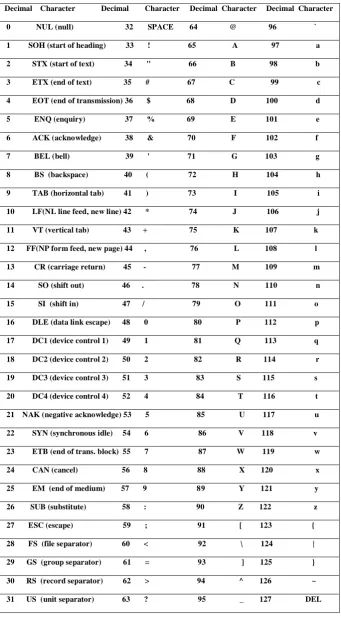
Step I: Assign the ASCII value to each character of the message using Table 1.Table 2 shows the assignment of
ASCII value to the characters.
Step II: Add the length of the string in ASCII value corresponding to each character. Here the length of the
string is 10. The addition of the length of the string in the ASCII value is shown in table 3.
Step III: Assign a prime number for each numerical value getting after addition. If the value is a prime number
then consider the number as it is and if the number is composite number then add/ subtract some value to it to
make it a prime number just coming after/before it so that all the characters are to be assigned a prime number
as shown in table 4.
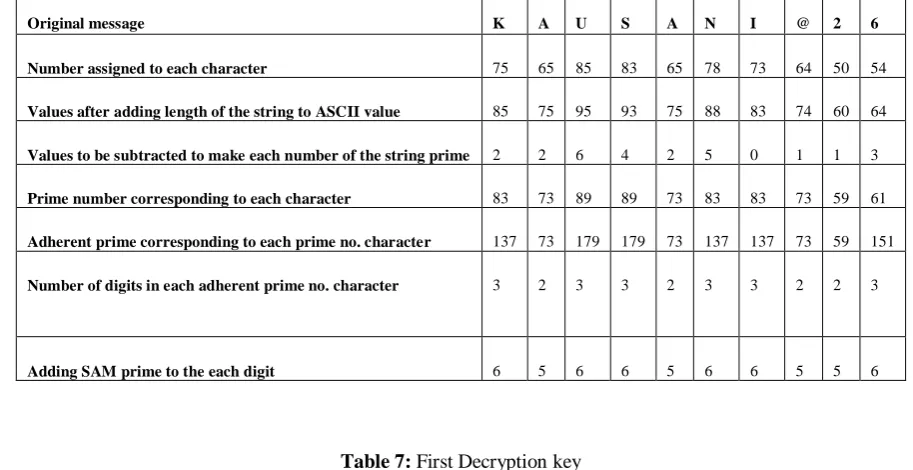
Step IV: Now find adherent prime for each prime number just coming after it. Now make a key by using number
of digits in each adherent prime as shown in table 5.
ISSN: 2231-5373
http://www.ijmttjournal.org
Page 313
Table 1:
ASCII value encryption chart
Decimal Character Decimal Character Decimal Character Decimal Character
0 NUL (null) 32 SPACE 64 @ 96 `
1 SOH (start of heading) 33 ! 65 A 97 a 2 STX (start of text) 34 " 66 B 98 b 3 ETX (end of text) 35 # 67 C 99 c 4 EOT (end of transmission) 36 $ 68 D 100 d 5 ENQ (enquiry) 37 % 69 E 101 e 6 ACK (acknowledge) 38 & 70 F 102 f 7 BEL (bell) 39 ' 71 G 103 g 8 BS (backspace) 40 ( 72 H 104 h 9 TAB (horizontal tab) 41 ) 73 I 105 i
10 LF(NL line feed, new line) 42 * 74 J 106 j 11 VT (vertical tab) 43 + 75 K 107 k 12 FF(NP form feed, new page) 44 , 76 L 108 l 13 CR (carriage return) 45 - 77 M 109 m 14 SO (shift out) 46 . 78 N 110 n 15 SI (shift in) 47 / 79 O 111 o 16 DLE (data link escape) 48 0 80 P 112 p 17 DC1 (device control 1) 49 1 81 Q 113 q 18 DC2 (device control 2) 50 2 82 R 114 r 19 DC3 (device control 3) 51 3 83 S 115 s 20 DC4 (device control 4) 52 4 84 T 116 t 21 NAK (negative acknowledge) 53 5 85 U 117 u 22 SYN (synchronous idle) 54 6 86 V 118 v
23 ETB (end of trans. block) 55 7 87 W 119 w 24 CAN (cancel) 56 8 88 X 120 x
25 EM (end of medium) 57 9 89 Y 121 y 26 SUB (substitute) 58 : 90 Z 122 z 27 ESC (escape) 59 ; 91 [ 123 {
28 FS (file separator) 60 < 92 \ 124 |
29 GS (group separator) 61 = 93 ] 125 }
30 RS (record separator) 62 > 94 ^ 126 ~
ISSN: 2231-5373
http://www.ijmttjournal.org
Page 314
Table 2:
Assignment of ASCII value to the character
Original message K A U S A N I @ 2 6
ASCII value corresponding to each character 75 65 85 83 65 78 73 64 50 54
Table 3:
Addition of the length of the string in the ASCII value
Original message K A U S A N I @ 2 6
No. assigned to each character 75 65 85 83 65 78 73 64 50 54
Values after adding length of the string to ASCII value 85 75 95 93 75 88 83 74 60 64
Table 4:
Assignment of a prime number to each character
Original message K A U S A N I @ 2 6
Number assigned to each character 75 65 85 83 65 78 73 64 50 54
Values after adding length of the string to ASCII value 85 75 95 93 75 88 83 74 60 64
Value to be subtracted to make each no. of the string prime 2 2 6 4 2 5 0 1 1 3
Prime number corresponding to each character 83 73 89 89 73 83 83 73 59 61
Table 5:
Assignment of an Adherent Prime to each prime number character
Original message K A U S A N I @ 2 6
Number assigned to each character 75 65 85 83 65 78 73 64 50 54
Values after adding length of the string to ASCII value 85 75 95 93 75 88 83 74 60 64
Values to be subtracted to make each number of the string prime 2 2 6 4 2 5 0 1 1 3
Prime number corresponding to each character 83 73 89 89 73 83 83 73 59 61
Adherent prime corresponding to each prime no. character 137 73 179 179 73 137 137 73 59 151
Number of digits in each adherent prime no. character 3 2 3 3 2 3 3 2 2 3
ISSN: 2231-5373
http://www.ijmttjournal.org
Page 315
Table 7:
First Decryption key
Table 8:
String of other decryption key
Now this string will give the information that how many digits we should consider to find the string of adherent
primes as shown in table 9.
Table 9:
String of prime number
Find the
Adherent
prime for each prime number exist just before it except which are not adherent prime.
Table 10:
Resultant string of Adherent Prime
Table 11
: Second decryption key
Original message K A U S A N I @ 2 6
Number assigned to each character 75 65 85 83 65 78 73 64 50 54
Values after adding length of the string to ASCII value 85 75 95 93 75 88 83 74 60 64
Values to be subtracted to make each number of the string prime 2 2 6 4 2 5 0 1 1 3
Prime number corresponding to each character 83 73 89 89 73 83 83 73 59 61
Adherent prime corresponding to each prime no. character 137 73 179 179 73 137 137 73 59 151
Number of digits in each adherent prime no. character 3 2 3 3 2 3 3 2 2 3
Adding SAM prime to the each digit 6 5 6 6 5 6 6 5 5 6
SAM prime number string 6 5 6 6 5 6 6 5 5 6
String of decryption key to be subtracted 3 3 3 3 3 3 3 3 3 3
Resultant string of numbers 3 2 3 3 2 3 3 2 2 3
Resultant string of numbers 3 2 3 3 2 3 3 2 2 3
Prime number 137 73 179 179 73 137 137 73 59 151
Resultant string of Adherent primes 83 73 89 89 73 83 83 73 59 61
String of second Decryption key to be added 2 2 6 4 2 5 0 1 1 3
ISSN: 2231-5373
http://www.ijmttjournal.org
Page 316
Table 12:
String of number after adding length of string
Table 13:
Character corresponding to each number (ASCII VALUE) of the string
Hence the original password is:
KAUSANI@26
CONCLUSION
Cryptography is used to ensure that the contents of a message are confidentiality transmitted and would not be
altered. The main aim of this paper was to propose and implement an algorithm so that data can be encrypted at
client side before it is uploaded because it provides an extra layer of security and minimizes data theft in transit;
therefore the proposed algorithm is useful for the security of passwords.
REFERENCES
[1] Shubham Agarwal, Anand Singh Uniyal, Prime Weighted Graph in Cryptographic System for Secure Communication, International Journal of Pure and Applied Mathematics (IJPAM), ISSN-1311-8080, Vol. No.105, No. 3, (2015), page: 325-338.
[2] Song Y. Yan, Computational Number Theory and Modern Cryptography, John Wiley & Sons, USA (2012).
[3] Shubham Agarwal, Anand Singh Uniyal, Elliptic Curves: An Efficient and Secure Encryption Scheme in Modern Cryptography, International Journal of Advance Research in Science and Engineering (IJARSE), ISSN-2319-8354, Vol. No.4, Issue 03, March (2015), page: 134-143.
[4] http://en.wikipedia.org/wiki/Cryptographic primitive.
Resultant string of numbers 85 75 95 93 75 88 83 74 60 64
Length of the string 10 10 10 10 10 10 10 10 10 10
Original string of number after subtraction 75 65 85 83 65 78 73 64 50 54
String of numbers 75 65 85 83 65 78 73 64 50 54